D7 Lead Finder vs Lead411 (2026): Which Lead Tool Wins?
D7 Lead Finder is cheap and fast; Lead411 is deeper and pricier. Here's an honest 2026 breakdown of accuracy, pricing, and which one actually fits your outbound.
Choosing between D7 Lead Finder and Lead411 usually comes down to one honest question: do you want a cheap list-scraper that spits out volume, or a deeper sales-intelligence platform with intent data and a contract to match? They sit at opposite ends of the B2B data market, and picking the wrong one wastes either your budget or your sender reputation.
This is a neutral breakdown — no vendor spin. We'll compare data accuracy, pricing, coverage, and real-world fit, then show where a verification-first workflow beats both.
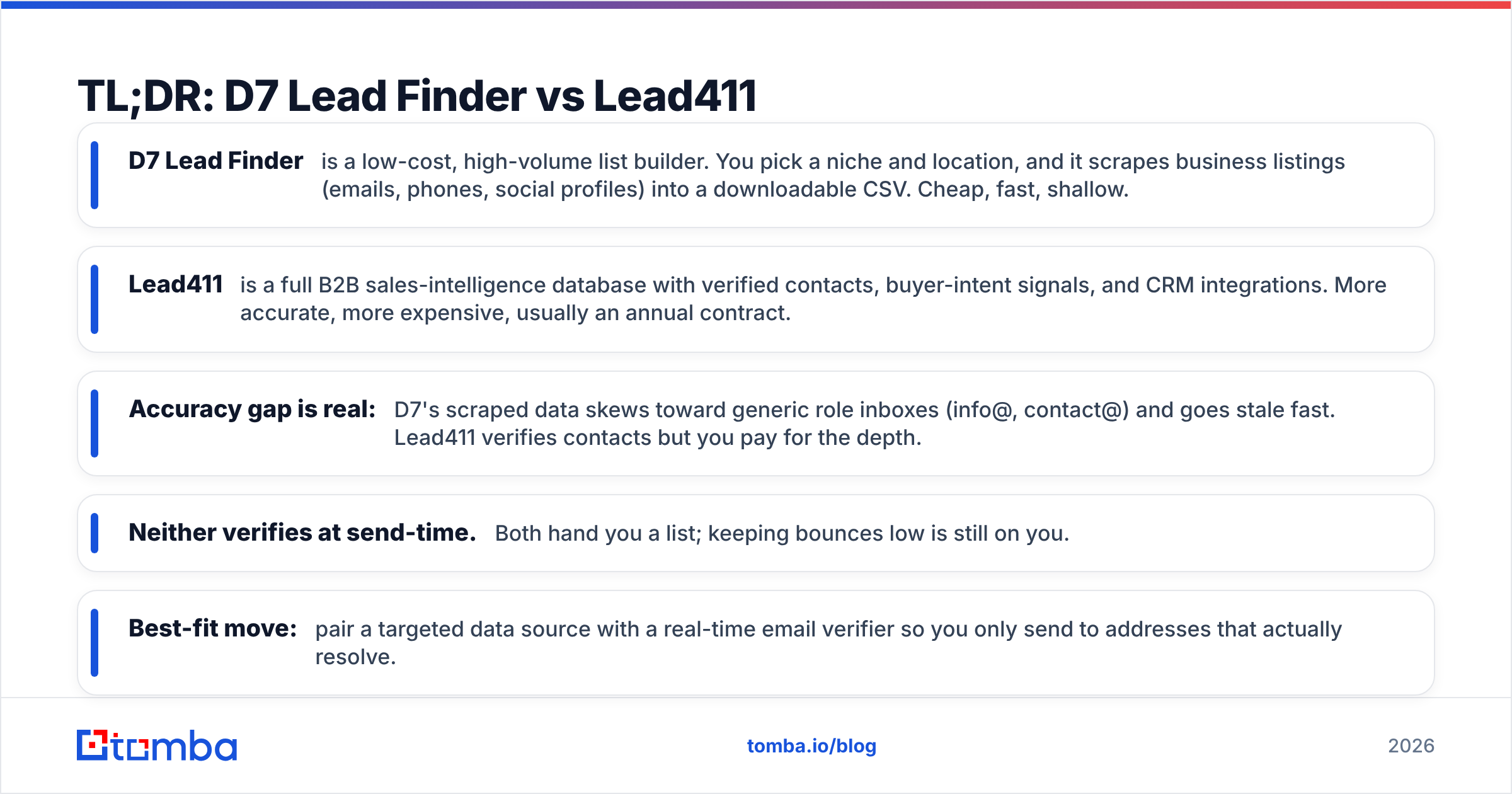
TL;DR: D7 Lead Finder vs Lead411#
- D7 Lead Finder is a low-cost, high-volume list builder. You pick a niche and location, and it scrapes business listings (emails, phones, social profiles) into a downloadable CSV. Cheap, fast, shallow.
- Lead411 is a full B2B sales-intelligence database with verified contacts, buyer-intent signals, and CRM integrations. More accurate, more expensive, usually an annual contract.
- Accuracy gap is real: D7's scraped data skews toward generic role inboxes (info@, contact@) and goes stale fast. Lead411 verifies contacts but you pay for the depth.
- Neither verifies at send-time. Both hand you a list; keeping bounces low is still on you.
- Best-fit move: pair a targeted data source with a real-time email verifier so you only send to addresses that actually resolve.
What is D7 Lead Finder?#
D7 Lead Finder is a lead-scraping tool built for speed and volume. You type a business category ("dentists in Austin," "SaaS startups in London"), and it pulls publicly listed business data — company name, website, phone, email, and social links — then packages it as a spreadsheet you can export.
The appeal is simplicity and price. There's a low monthly entry point, and you can generate thousands of rows in minutes without any sales-database learning curve. It's popular with agencies, local-service marketers, and anyone who needs raw business contacts fast.
The trade-off is depth and freshness. Because D7 leans on scraped directory listings, a large share of the emails are generic company inboxes rather than a named decision-maker. That's fine for spray-and-pray local outreach and terrible for targeted B2B selling where you need to reach a VP of Marketing by name. Scraped data also decays — people change jobs, listings go stale — and there's no ongoing verification layer keeping the rows accurate.

What is Lead411?#
Lead411 is a B2B sales-intelligence platform, not just a scraper. It maintains a database of company and contact records enriched with verified emails, direct-dial phone numbers, org charts, technographics, and — its headline feature — buyer-intent data that flags accounts researching your category right now.
You search by persona, industry, company size, tech stack, or trigger events (new funding, hiring surges), then push contacts into your CRM or sequencer. According to user reviews on G2, Lead411 scores well on data accuracy and support, and its "Bombora-powered" intent signals are a genuine differentiator for teams doing account-based outreach.
The catch is cost and commitment. Lead411 is priced for sales teams, typically on annual plans, and the per-seat model adds up. For a solo founder or a small agency doing occasional list pulls, that's a lot of platform for the job. It's built for repeatable, pipeline-driven outbound — not a one-off CSV grab.
D7 Lead Finder vs Lead411: side-by-side comparison#
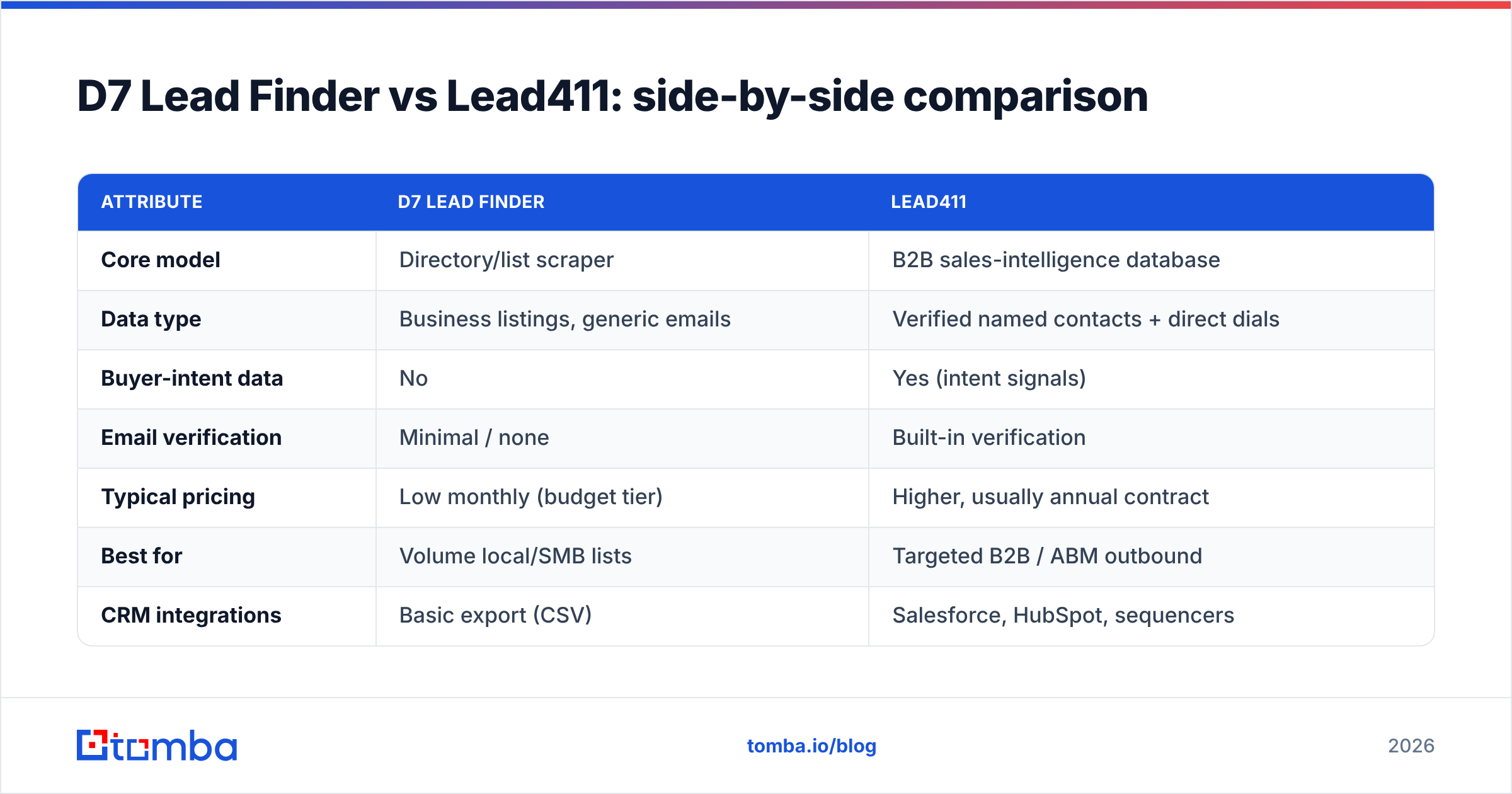
Here's how the two stack up on the attributes that actually change your results.
| Attribute | D7 Lead Finder | Lead411 |
|---|---|---|
| Core model | Directory/list scraper | B2B sales-intelligence database |
| Data type | Business listings, generic emails | Verified named contacts + direct dials |
| Buyer-intent data | No | Yes (intent signals) |
| Email verification | Minimal / none | Built-in verification |
| Typical pricing | Low monthly (budget tier) | Higher, usually annual contract |
| Best for | Volume local/SMB lists | Targeted B2B / ABM outbound |
| CRM integrations | Basic export (CSV) | Salesforce, HubSpot, sequencers |
| Free/trial option | Limited trial | Limited free leads/trial |
| Data freshness | Decays quickly | Refreshed + verified |
| Learning curve | Very low | Moderate |
The pattern is clear: D7 wins on price and simplicity, Lead411 wins on accuracy, targeting, and workflow. Neither is "better" in the abstract — they solve different problems for different buyers.
Is D7 Lead Finder or Lead411 more accurate?#
Lead411 is meaningfully more accurate, but you pay for it — and neither replaces send-time verification.
D7's data is scraped from public listings, so accuracy is inconsistent by design. You'll get a high proportion of role-based emails (info@, sales@, admin@) that either bounce, route to a shared inbox, or get filtered as cold spam. For targeted B2B, that hurts both deliverability and reply rates.
Lead411 applies its own verification and refresh cycles, so a named contact's email is far more likely to resolve. But every database — Lead411 included — carries some staleness between refresh cycles. People switch jobs constantly, and no provider re-checks every record the moment you export it.
That's the gap a verification step closes. Running any exported list through a real-time email verification pass catches the addresses that went dead since the last database refresh, plus the catch-all domains that quietly accept everything and then bounce later. If accurate B2B data is your priority, treat verification as a required step, not an optional one — regardless of which tool you feed it.
Which one is cheaper — and what's the catch?#
D7 Lead Finder is far cheaper up front; Lead411's cost comes with an annual commitment.
D7's budget monthly pricing is its whole pitch — you can start pulling lists for the price of a couple of lunches. The catch is that low cost buys low signal: you spend the savings back in wasted send volume, bounces, and hours spent manually cleaning a spreadsheet full of generic inboxes.
Lead411 charges more and typically locks you into an annual plan with per-seat pricing. The catch there is commitment: if your outbound is seasonal or exploratory, you're paying twelve months for a tool you might use in bursts. Watch for credit caps and export limits inside the plan tiers, too — "unlimited" rarely means unlimited.

Before you commit either way, price out the total cost: subscription + verification + the labor to clean and de-dupe. A cheap list that bounces 30% of the time isn't cheap. That math is why many teams pair a lean, pay-for-what-you-use data source with a verifier rather than buying one heavyweight platform. You can compare that approach against transparent Tomba pricing to see the difference.
Who should pick D7 Lead Finder?#
Pick D7 Lead Finder if:
- You need local or SMB volume. Restaurants, contractors, clinics, retail — broad lists where a generic business email is an acceptable entry point.
- Budget is the hard constraint. You want thousands of rows for very little money and can tolerate lower accuracy.
- You're doing one-off campaigns. No CRM pipeline, no ongoing intent tracking, just a list this month.
- You'll verify separately. You already plan to run every export through a verification and de-dup pass before sending.
D7 is a blunt instrument, and that's fine when the job is blunt. Just don't expect it to power precision ABM.
Who should pick Lead411?#
Pick Lead411 if:
- You sell to specific personas. You need named decision-makers with verified direct dials, not a shared inbox.
- Intent data matters. You want to prioritize accounts already researching your category and time your outreach.
- Outbound is a repeatable machine. Sequencers, CRM sync, and consistent monthly pipeline justify a platform subscription.
- Data quality outranks price. You'd rather pay more and clean less.
Lead411 is the stronger choice for funded sales teams running account-based motions — the depth pays off when every meeting matters.
Is there a better alternative for verified B2B emails?#
Yes — if your real bottleneck is reaching named people with emails that actually land, a finder-plus-verifier stack often beats both tools.
Here's the thing neither D7 nor Lead411 fully solves: you usually already know which companies you want. What you're missing is the right person's real, deliverable email. That's a finder-and-verifier problem, not a "buy a giant database" problem.
A focused workflow looks like this:
- Start from the domain. Use domain search to pull every discoverable email at a target company, mapped to names and roles.
- Find the specific person. When you know the name, an email finder returns their most likely address with a confidence score — no scraping generic inboxes.
- Verify before you send. Every candidate runs through verification, including catch-all handling, so bounces stay low and your sender reputation stays intact.
- Enrich the record. Layer on job title, company, and social data with data enrichment so your sequences personalize instead of guessing.
You pay for the specific data you use instead of an annual platform seat, and you skip the "3,000 rows of info@" problem entirely. For teams whose whole goal is deliverable outreach, that verification-first order of operations tends to outperform buying volume for its own sake.
Compare the pricing philosophies directly. Where D7 sells cheap volume and Lead411 sells an annual platform, a credit-based finder like Tomba starts free (25 searches/month) and scales — Starter at $49/mo, Growth at $99/mo, Pro at $249/mo — so your spend tracks your actual usage. You can also check the underlying data sources to see how the emails are sourced and scored.
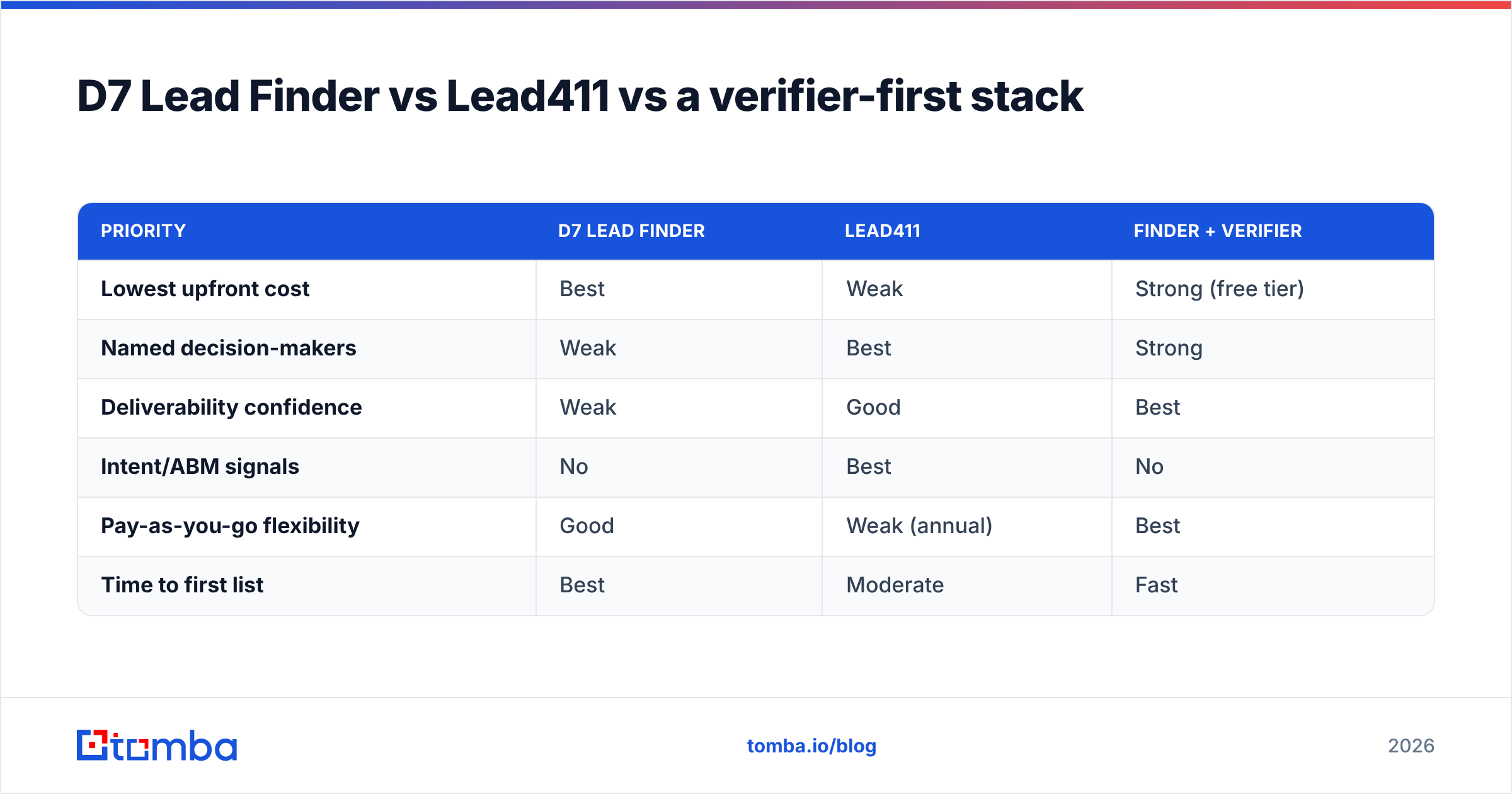
D7 Lead Finder vs Lead411 vs a verifier-first stack#
| Priority | D7 Lead Finder | Lead411 | Finder + Verifier |
|---|---|---|---|
| Lowest upfront cost | Best | Weak | Strong (free tier) |
| Named decision-makers | Weak | Best | Strong |
| Deliverability confidence | Weak | Good | Best |
| Intent/ABM signals | No | Best | No |
| Pay-as-you-go flexibility | Good | Weak (annual) | Best |
| Time to first list | Best | Moderate | Fast |
Read the table by your top priority, not by row count. If intent data drives your motion, Lead411 is worth its price. If deliverable emails to named people at known companies is the whole game, a finder-plus-verifier stack is the leanest path.
The bottom line#
D7 Lead Finder and Lead411 aren't really competitors — they're opposite bets. D7 bets on cheap volume; Lead411 bets on deep, intent-rich accuracy behind an annual contract. Match the bet to your motion: local/SMB spray leans D7, funded ABM leans Lead411.
But if your outbound lives or dies on reaching the right person with an email that actually delivers, don't over-buy a database to solve a finder problem. Start free with the Tomba Email Finder, pull verified, named contacts by domain or by person, and run every address through built-in verification before it hits your sequencer. You'll spend less, bounce less, and reach more of the people who can actually say yes — no annual lock-in required.
Related guides#
Ready to find emails that actually work?
Join 150,000+ professionals who stopped guessing and started sending. Free credits on signup — no credit card required.
Get the Tomba newsletter
Practical outbound tactics and product updates — once every two weeks.
About the author