Data Marketers Group vs ZoomInfo: B2B Data Compared (2026)
Data Marketers Group sells static B2B lists; ZoomInfo sells a live intelligence platform. We compare pricing, accuracy, and coverage so you pick the right B2B data source for your budget.
Data Marketers Group vs ZoomInfo: B2B Data Compared (2026)
Choosing between Data Marketers Group vs ZoomInfo comes down to one question: do you want a one-time list you own outright, or a live intelligence platform you rent every year? They are not really the same product, and picking the wrong one wastes either budget or momentum.
This is a neutral breakdown of what each vendor actually delivers in 2026 — pricing, data freshness, coverage, and the hidden costs nobody puts on the pricing page — plus where a pay-as-you-go verification layer beats both.
TL;DR#
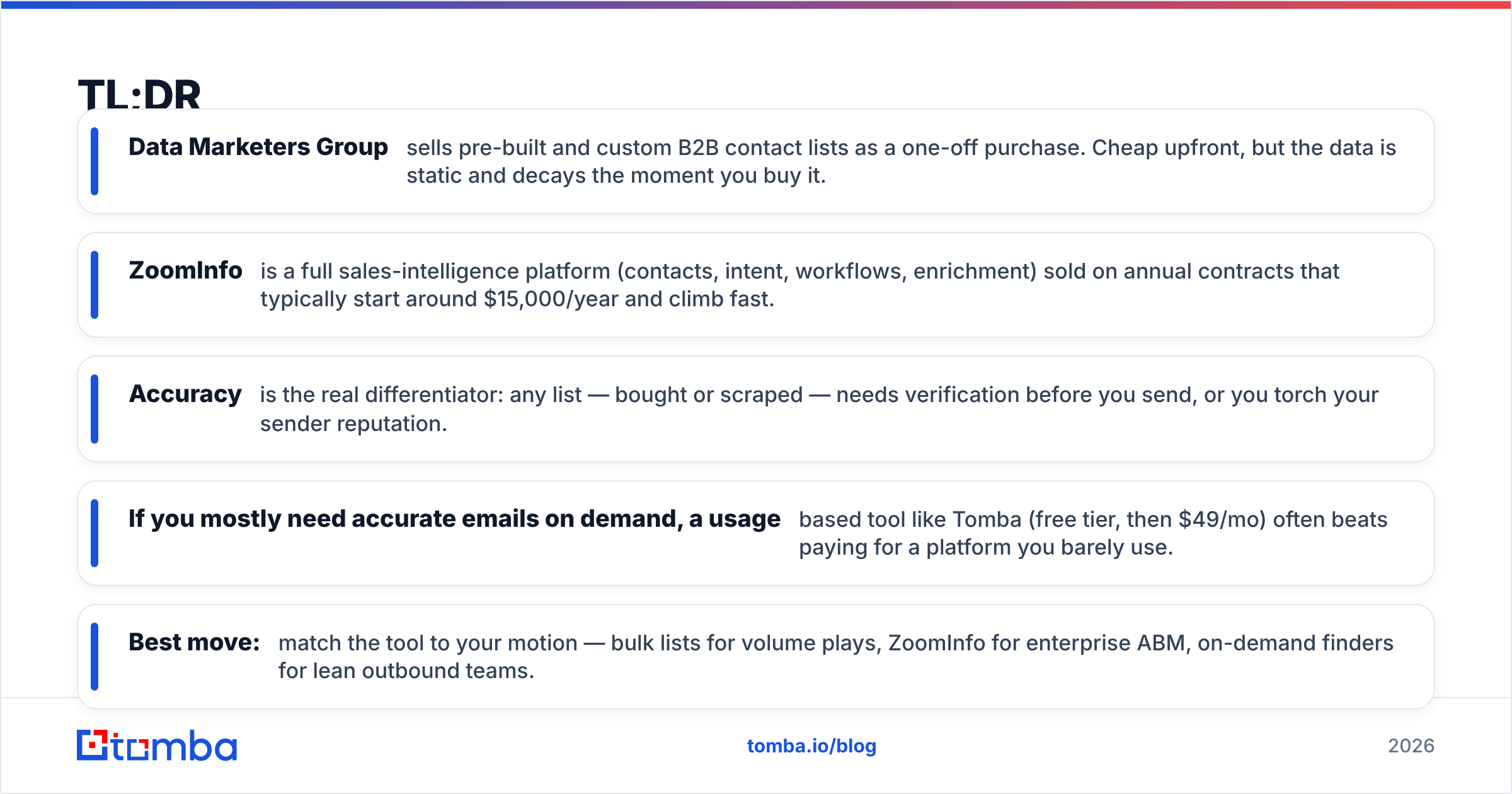
- Data Marketers Group sells pre-built and custom B2B contact lists as a one-off purchase. Cheap upfront, but the data is static and decays the moment you buy it.
- ZoomInfo is a full sales-intelligence platform (contacts, intent, workflows, enrichment) sold on annual contracts that typically start around $15,000/year and climb fast.
- Accuracy is the real differentiator: any list — bought or scraped — needs verification before you send, or you torch your sender reputation.
- If you mostly need accurate emails on demand, a usage-based tool like Tomba (free tier, then $49/mo) often beats paying for a platform you barely use.
- Best move: match the tool to your motion — bulk lists for volume plays, ZoomInfo for enterprise ABM, on-demand finders for lean outbound teams.
What is Data Marketers Group?#
Data Marketers Group is a B2B data vendor that sells targeted email and mailing lists — think "IT decision-makers in North America" or "healthcare CFOs" — either off the shelf or built to your spec. You pay once, download a CSV, and the records are yours to use.
The appeal is obvious: it's cheap relative to a platform subscription, there's no annual lock-in, and you get a large volume of contacts immediately. For a direct-mail campaign or a high-volume, low-touch email blast, that math can work.
The catch is that a list is a snapshot. B2B data decays fast — people change jobs, companies fold, domains migrate. Industry estimates put contact data decay at roughly 22–30% per year, and a static file has no mechanism to fix itself. What looked like 50,000 valid contacts in January is measurably worse by summer. That's why any purchased list should run through an email verifier before it touches your sending domain.

What is ZoomInfo?#
ZoomInfo is the enterprise heavyweight of B2B data. It's not a list — it's a platform: a searchable database of companies and contacts, layered with intent signals, org charts, technographics, workflow automation, and enrichment that syncs into your CRM. According to its own positioning and reviews on G2, it's built for revenue teams running structured, account-based motions at scale.
You're not buying records; you're renting access. Pricing is quote-based, annual, and seat-plus-credit driven. Public reviews and reseller data consistently put entry contracts in the $15,000/year range, with mid-market and enterprise tiers running well into six figures once you add intent data, seats, and enrichment volume.
For a large sales org that lives inside its data platform every day, that cost is justified by the workflow depth. For a three-person outbound team that just needs verified emails, it's a lot of platform to pay for.
Data Marketers Group vs ZoomInfo: side-by-side comparison#
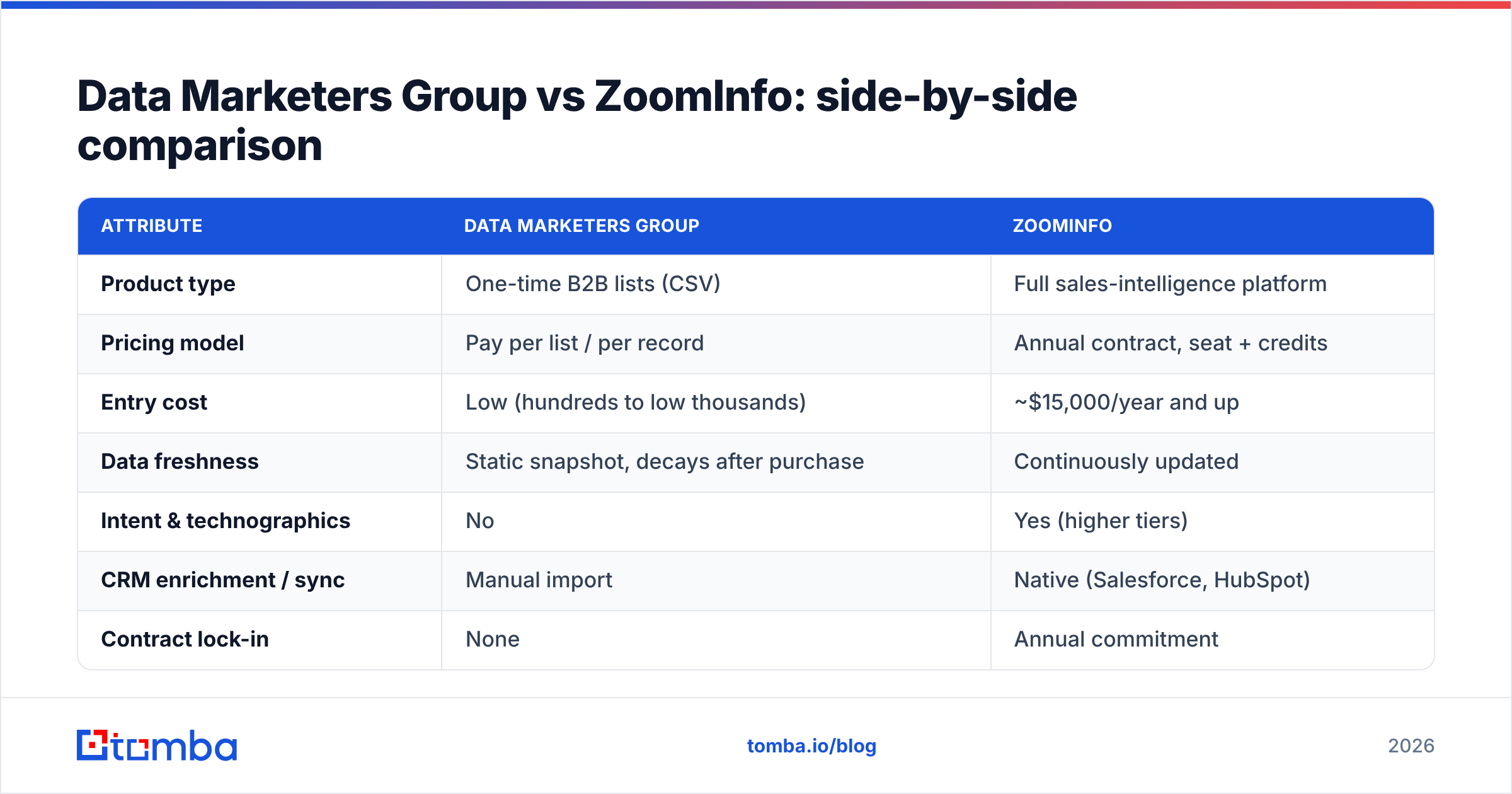
Here's how the two stack up on the attributes that actually affect your pipeline. Remember you're comparing a data product (a list you buy) against a data platform (software you subscribe to).
| Attribute | Data Marketers Group | ZoomInfo |
|---|---|---|
| Product type | One-time B2B lists (CSV) | Full sales-intelligence platform |
| Pricing model | Pay per list / per record | Annual contract, seat + credits |
| Entry cost | Low (hundreds to low thousands) | ~$15,000/year and up |
| Data freshness | Static snapshot, decays after purchase | Continuously updated |
| Intent & technographics | No | Yes (higher tiers) |
| CRM enrichment / sync | Manual import | Native (Salesforce, HubSpot) |
| Contract lock-in | None | Annual commitment |
| Best for | Volume mail/email campaigns | Enterprise ABM & RevOps |
| Verification included | Not guaranteed — verify yourself | Platform-maintained, still verify catch-alls |
The pattern is clear: Data Marketers Group wins on upfront cost and flexibility; ZoomInfo wins on freshness, depth, and workflow integration. Neither removes your obligation to validate data before you send — buying expensive doesn't mean buying clean.
Which one is more accurate?#
Neither wins by default — the workflow around the data decides accuracy. This is the mistake most buyers make: they treat "accuracy" as a spec on the box rather than something they maintain.
A ZoomInfo record is more likely to be current because the platform re-verifies continuously. But ZoomInfo also relies heavily on catch-all domains, where the mail server accepts everything and reveals nothing about whether a specific mailbox exists. Those addresses pass a basic "valid" check and still bounce. You need a real catch-all verifier to separate deliverable from risky.
A Data Marketers Group list is a snapshot that ages the instant you download it. If you buy it in Q1 and send in Q3, you're mailing stale data unless you re-verify. The list itself isn't "inaccurate" — it's out of date, which produces the same bounces.
The professional move, regardless of source: run every address through verification right before the send, and check your own data sources and hygiene rather than trusting a vendor's headline accuracy number.

How does pricing really compare?#
Sticker price and total cost are two different stories.
Data Marketers Group is cheap to start. You can buy a targeted list for a few hundred to a few thousand dollars with no recurring commitment. But the real cost includes what you spend re-verifying stale records, the deals lost to bounced sends, and the reputation damage if you skip cleaning. A "$500 list" with a 25% decay rate is effectively a $500 list with 25% waste baked in.
ZoomInfo is expensive and predictable. You commit annually, and the cost scales with seats, credits, and add-ons. The value is real if you use the platform daily — but shelfware is the enterprise-software tax. Plenty of teams pay $15k+ and pull the same 2,000 contacts they could have sourced far cheaper.
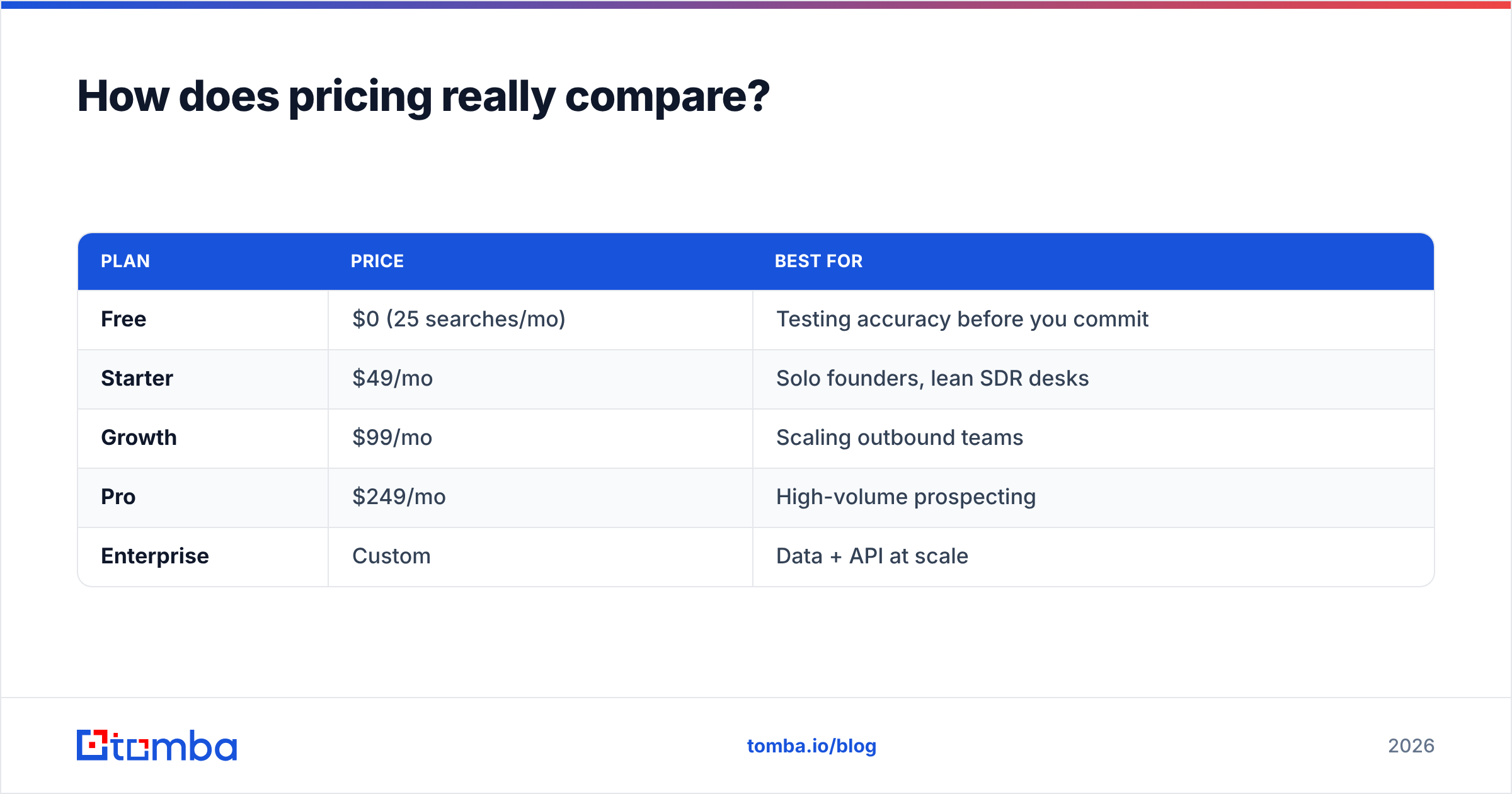
The third option — usage-based finding + verification. If your core need is "accurate email addresses for the specific people I'm targeting," a pay-as-you-go model often wins on cost. Here's how Tomba's structure compares:
| Plan | Price | Best for |
|---|---|---|
| Free | $0 (25 searches/mo) | Testing accuracy before you commit |
| Starter | $49/mo | Solo founders, lean SDR desks |
| Growth | $99/mo | Scaling outbound teams |
| Pro | $249/mo | High-volume prospecting |
| Enterprise | Custom | Data + API at scale |
You can see the full breakdown on the Tomba pricing page. The point isn't that Tomba replaces a full intelligence platform — it's that most teams overpay for data they could source on demand.
When should you choose each option?#
Match the tool to your motion instead of chasing the biggest database.
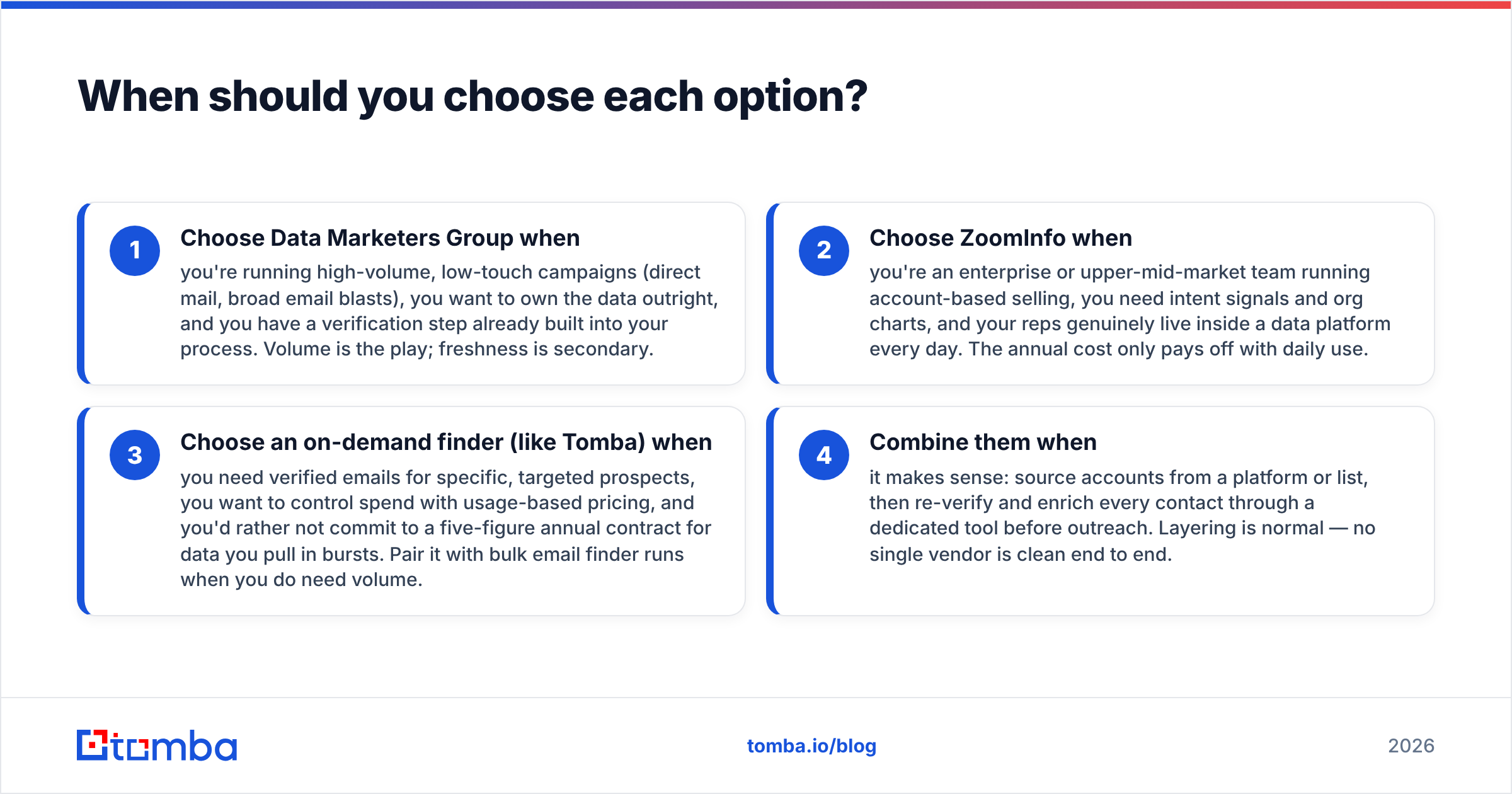
Choose Data Marketers Group when you're running high-volume, low-touch campaigns (direct mail, broad email blasts), you want to own the data outright, and you have a verification step already built into your process. Volume is the play; freshness is secondary.
Choose ZoomInfo when you're an enterprise or upper-mid-market team running account-based selling, you need intent signals and org charts, and your reps genuinely live inside a data platform every day. The annual cost only pays off with daily use.
Choose an on-demand finder (like Tomba) when you need verified emails for specific, targeted prospects, you want to control spend with usage-based pricing, and you'd rather not commit to a five-figure annual contract for data you pull in bursts. Pair it with bulk email finder runs when you do need volume.
Combine them when it makes sense: source accounts from a platform or list, then re-verify and enrich every contact through a dedicated tool before outreach. Layering is normal — no single vendor is clean end to end.
What about data enrichment and CRM sync?#
This is where ZoomInfo pulls ahead of a static list — and where the gap can be closed for less than you'd expect.
ZoomInfo's native enrichment writes fresh firmographics, job changes, and technographics straight into Salesforce or HubSpot. A Data Marketers Group CSV gives you none of that; enrichment is a manual, one-time import.
But enrichment isn't exclusive to six-figure platforms. A dedicated data enrichment layer can append verified emails, company data, and social profiles to whatever list you already own — turning a cheap static file into a workable, current dataset without the ZoomInfo contract. If your only reason for considering ZoomInfo is enrichment, price that path first.
For teams that want their own repeatable source of truth, building against a maintained B2B database or API often beats renting someone else's platform — you keep control of cost and coverage.
The bottom line#
Data Marketers Group vs ZoomInfo isn't really a fair fight — they solve different problems. Data Marketers Group is the budget, own-it-outright list vendor for volume plays. ZoomInfo is the premium, always-on platform for enterprise ABM. The right pick depends entirely on your motion, your team size, and how much data you actually consume.
What doesn't change is the verification requirement. Bought lists decay, platform records hide catch-alls, and every unverified send chips away at your sender reputation. Whatever you buy, clean it before you send it.
If your real need is accurate, on-demand emails without a five-figure commitment, start with the Tomba Email Finder. Find professional addresses by name, domain, or company, verify them in the same workflow, and scale spend with usage instead of a contract. Try the free tier first — 25 searches, no card — and see the accuracy before you commit a dollar. It's the cheapest way to test whether you need a full platform at all.
Related guides#
Ready to find emails that actually work?
Join 150,000+ professionals who stopped guessing and started sending. Free credits on signup — no credit card required.
Get the Tomba newsletter
Practical outbound tactics and product updates — once every two weeks.
About the author