The Best B2B Data Vendors in USA: A 2026 Buyer's Guide
A neutral, no-fluff breakdown of the top B2B data vendors in the USA in 2026—compared on price, accuracy, coverage, and compliance so you buy the right list, not the loudest brand.
Buying B2B data in the USA is easy. Buying data that is accurate, compliant, and fairly priced is where most teams get burned. There are dozens of data vendors in USA. They all promise the same 200-million-contact database. The real difference shows up later—in your bounce rate, your legal exposure, and your renewal invoice, not the sales demo.
This guide compares the vendors that actually matter in 2026, with concrete numbers where they exist and honest caveats where they don't.
TL;DR: What You Need to Know#
- There is no single "best" vendor. ZoomInfo and Cognism win on coverage depth; Apollo and Tomba win on price-to-value; specialty players like BookYourData win on prebuilt, ready-to-download lists.
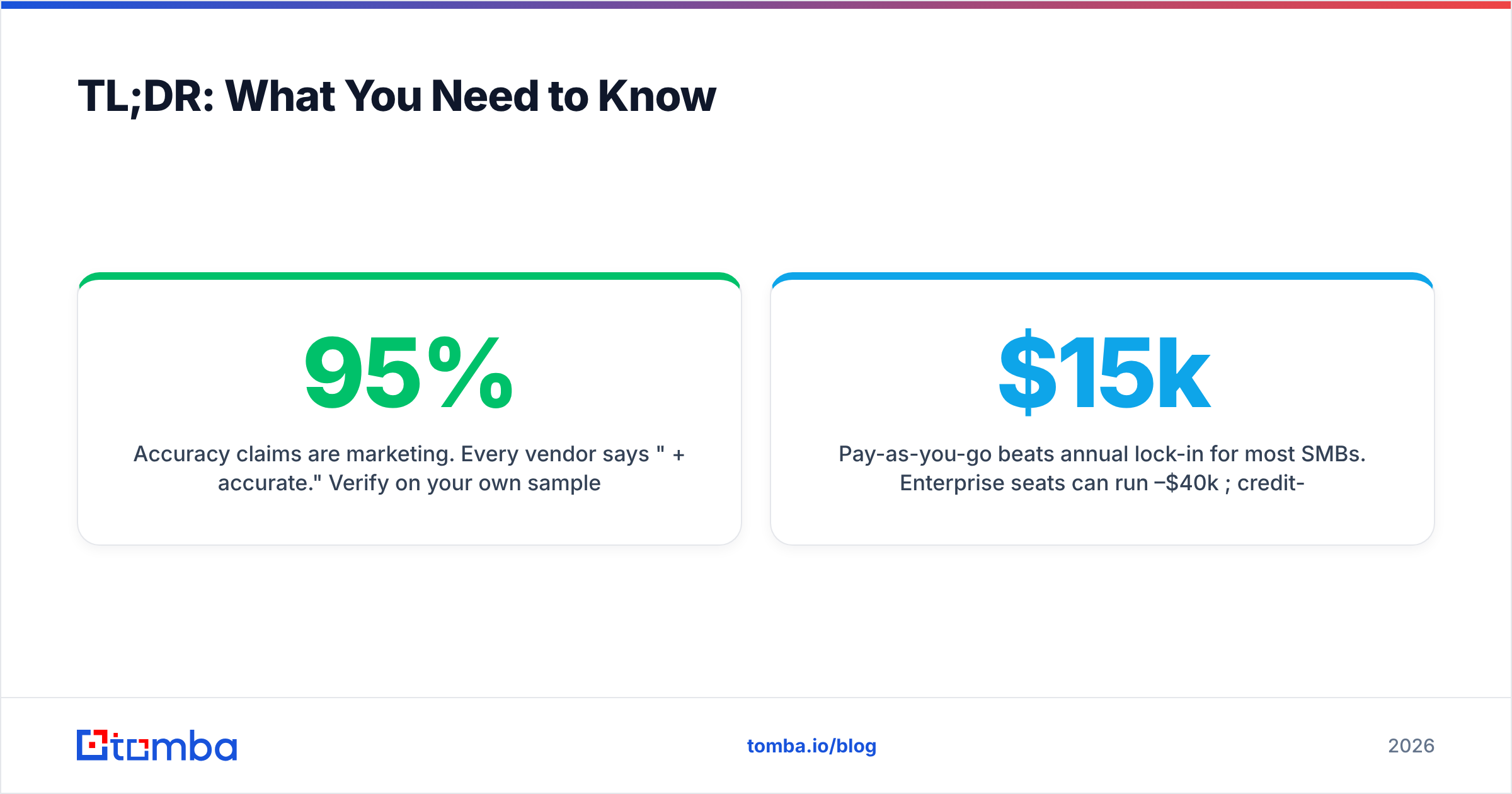
- Accuracy claims are marketing. Every vendor says "95%+ accurate." Verify on your own sample before you sign anything annual.
- US data has real compliance rules. CAN-SPAM, CCPA/CPRA, and state-level privacy laws matter. A cheap list that ignores them is a liability, not a bargain.
- Pay-as-you-go beats annual lock-in for most SMBs. Enterprise seats can run $15k–$40k/year; credit-based tools start under $50/mo.
- Match the vendor to the job: enrichment, net-new prospecting, and ready-made lists are three different purchases.
What Is a B2B Data Vendor, Exactly?#
A B2B data vendor sells you contact and company information you can use for sales and marketing—think of it as a wholesaler for the raw material of outbound. Instead of manually hunting for a CFO's email one profile at a time, you buy access to a database (or an API) that returns names, verified emails, phone numbers, job titles, firmographics, and technographics on demand.
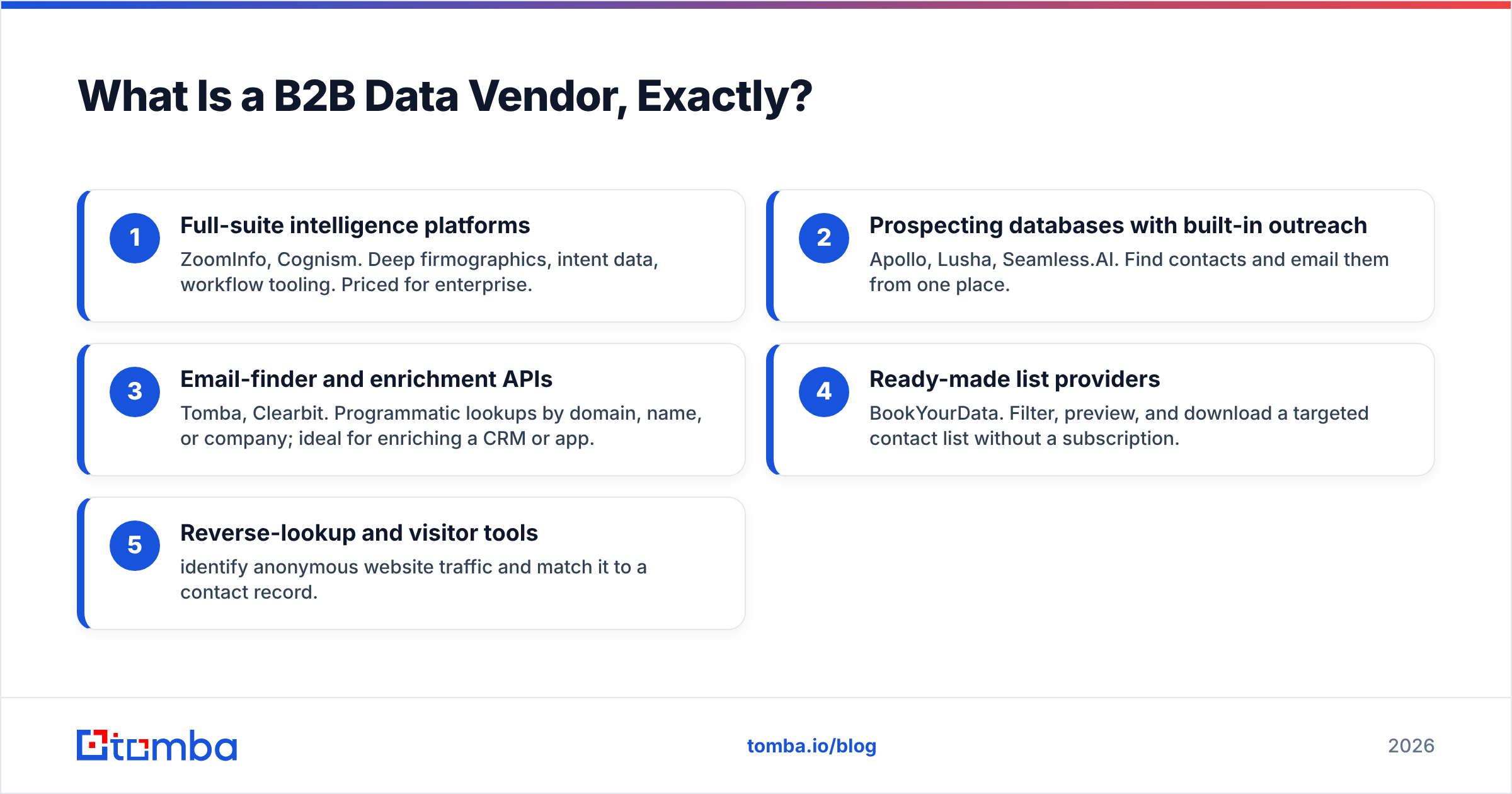
Under the hood, US data vendors fall into a few distinct types. Knowing which type you're buying stops you from overpaying for capabilities you'll never touch.
- Full-suite intelligence platforms — ZoomInfo, Cognism. Deep firmographics, intent data, workflow tooling. Priced for enterprise.
- Prospecting databases with built-in outreach — Apollo, Lusha, Seamless.AI. Find contacts and email them from one place.
- Email-finder and enrichment APIs — Tomba, Clearbit. Programmatic lookups by domain, name, or company; ideal for enriching a CRM or app.
- Ready-made list providers — BookYourData. Filter, preview, and download a targeted contact list without a subscription.
- Reverse-lookup and visitor tools — identify anonymous website traffic and match it to a contact record.
Most teams end up using two: one for net-new discovery and one for data enrichment to keep the CRM clean.
Which Data Vendors in USA Are Worth Comparing in 2026?#
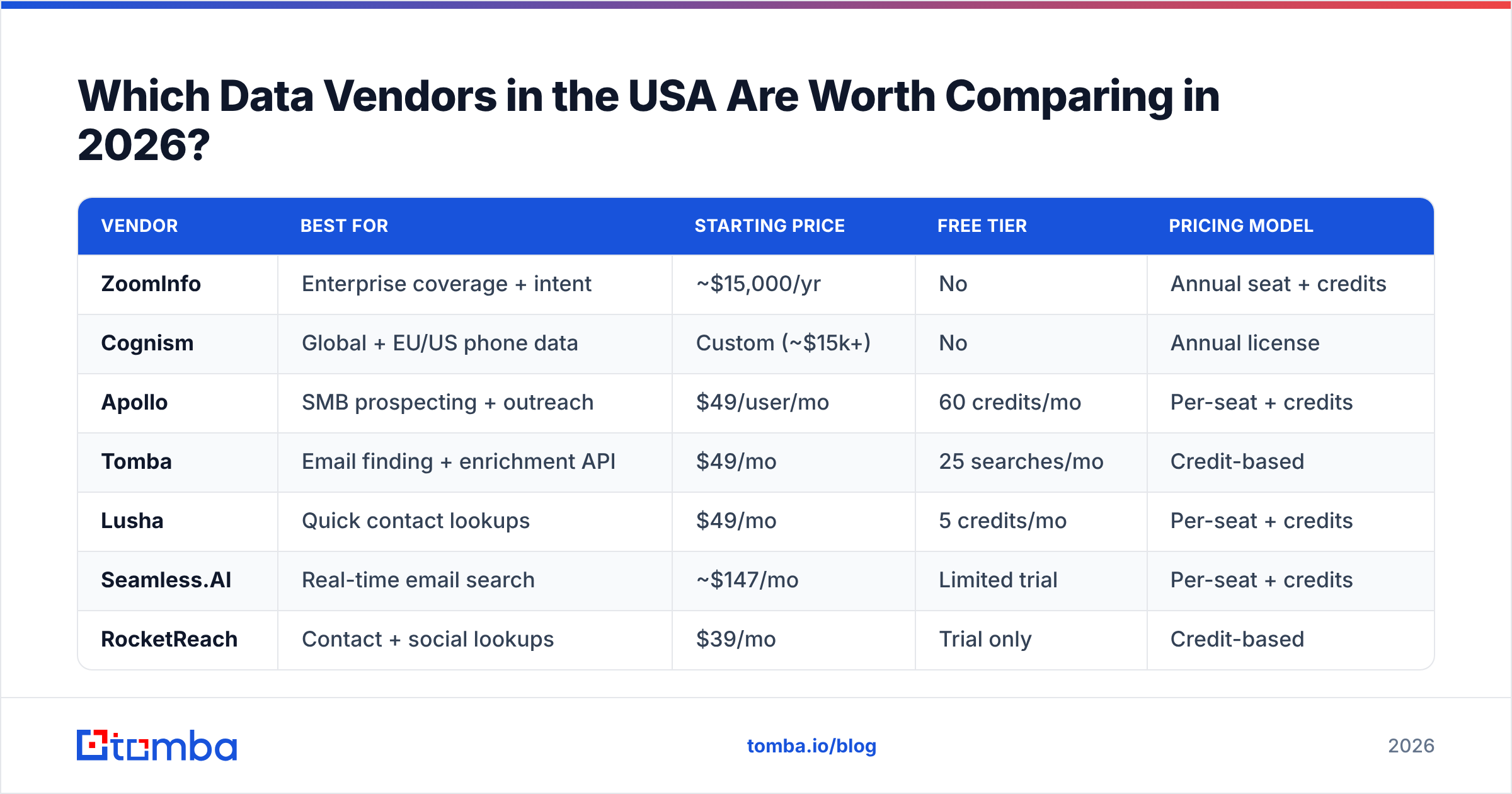
Below is the head-to-head that matters. Prices are entry-level published rates as of 2026; enterprise quotes vary widely and are almost always negotiable.
| Vendor | Best for | Starting price | Free tier | Pricing model |
|---|---|---|---|---|
| ZoomInfo | Enterprise coverage + intent | ~$15,000/yr | No | Annual seat + credits |
| Cognism | Global + EU/US phone data | Custom (~$15k+) | No | Annual license |
| Apollo | SMB prospecting + outreach | $49/user/mo | 60 credits/mo | Per-seat + credits |
| Tomba | Email finding + enrichment API | $49/mo | 25 searches/mo | Credit-based |
| Lusha | Quick contact lookups | $49/mo | 5 credits/mo | Per-seat + credits |
| Seamless.AI | Real-time email search | ~$147/mo | Limited trial | Per-seat + credits |
| RocketReach | Contact + social lookups | $39/mo | Trial only | Credit-based |
| BookYourData | Ready-made downloadable lists | Pay-as-you-go | Sample preview | Per-contact credits |
| Clearbit (HubSpot) | Enrichment inside HubSpot | Bundled/Custom | With HubSpot | Platform bundle |
A few honest reads on this table.
The premium tier:
- ZoomInfo and Cognism sell breadth, intent signals, and enterprise support. A large SDR team with budget will use that depth. A five-person team will use maybe 10% of it.
- Apollo is the default value pick for SMB outbound, since prospecting and sending live in one tool. Outgrown it or hit its data limits? A focused Apollo alternative built on verified emails often lands more messages.
The value and specialty tier:
- Tomba sits in the enrichment/API lane. Tomba pricing starts free (25 searches/mo), then $49, $99, and $249 a month—credit-based, no annual lock-in.
- BookYourData shines when you want one prebuilt list to filter and download today. No seat, no subscription. It's a different buying motion, and a strong fit when you know your exact target.
- Clearbit is now a HubSpot feature (Breeze Intelligence). Great inside HubSpot, weak as a standalone. Teams elsewhere often pick a Clearbit alternative for portable enrichment.
How Accurate Is US B2B Data, Really?#
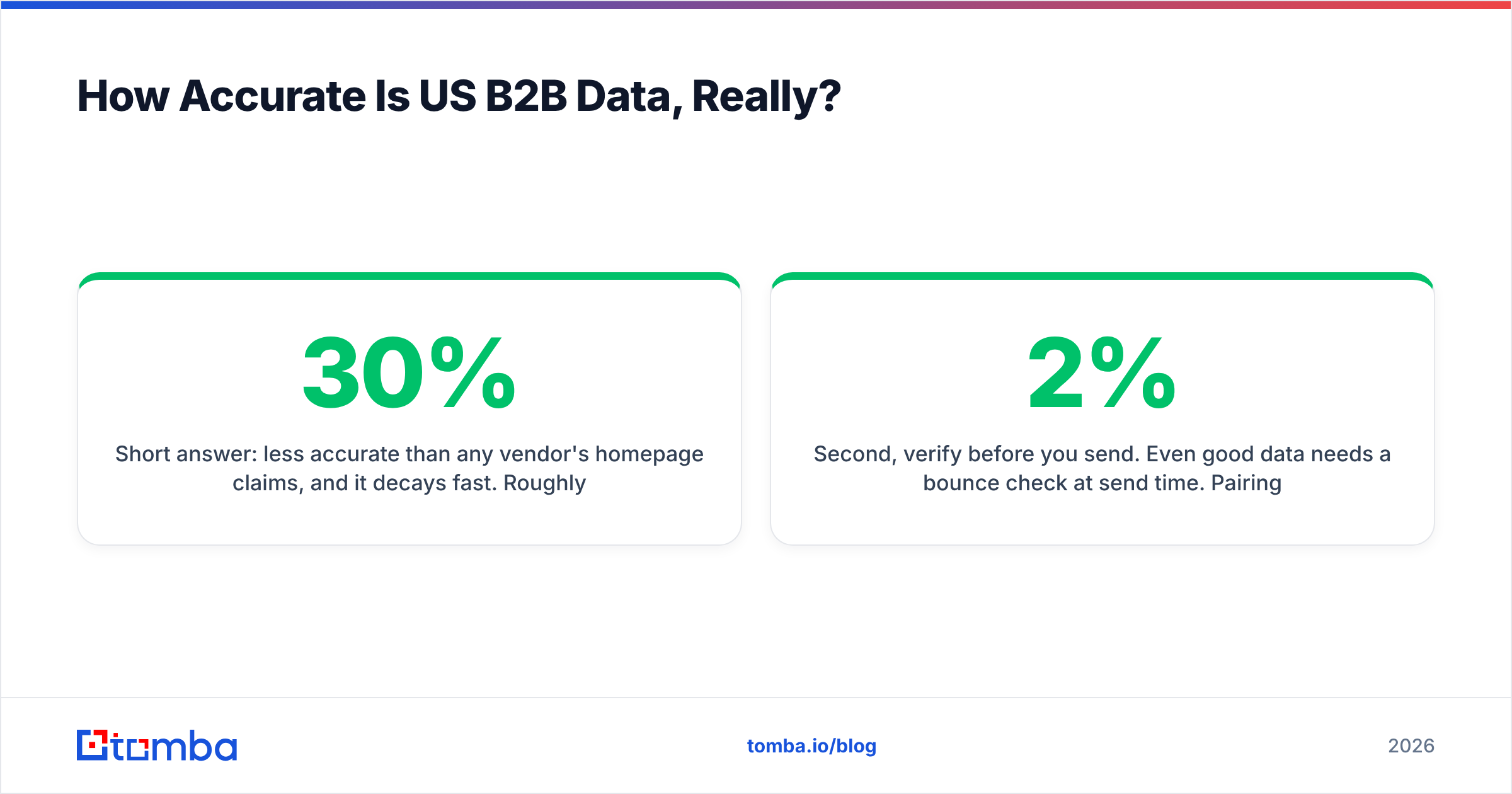
Short answer: less accurate than any homepage claims, and it decays fast. Roughly 25–30% of B2B contact data goes stale every year. People change jobs, companies rebrand, and domains migrate. A "95% accurate" database from last quarter is not 95% accurate on the record you pull today.
Two rules protect you:
First, test on your own sample. Take 100 target accounts you already know and run them through each vendor's free tier. Count real bounces, not vendor-reported "valid" flags. This 30-minute exercise reveals more than any G2 review. You can sanity-check where a provider sources records on Tomba's data sources page as a model for the transparency to demand from any vendor.
Second, verify before you send. Even good data needs a bounce check at send time. Pairing a finder with an email verifier is the single highest-ROI habit in outbound—it's the difference between a 2% bounce rate that protects your domain and a 12% rate that gets you throttled by spam filters.
For deeper background on how buyers evaluate this category, Gartner's Digital Markets and peer reviews on G2 are useful neutral references—just weight recent reviews over lifetime averages.
Is Cheaper Data Worse Data?#
Not necessarily—but cheap data with no verification layer usually is. The price difference between a $15,000/year platform and a $99/month API often reflects bundled features (intent scoring, org charts, workflow automation) rather than raw contact quality. If you only need verified emails and firmographics, you're subsidizing features you'll never open.
Here's the honest framework for matching spend to need:
- You need intent data and org charts across thousands of accounts → premium platform (ZoomInfo, Cognism). The price is justified.
- You need net-new contacts plus a place to email them → mid-tier suite (Apollo, Lusha).
- You need to enrich an existing list or CRM programmatically → a focused API (Tomba, Clearbit). Pay for lookups, not seats.
- You need one targeted list, once → a ready-made provider (BookYourData). Buy the file, skip the subscription.
- You need phone numbers for a calling team → check dial-verified coverage specifically; a phone finder with validation beats a database that lists numbers it never tested.
The mistake isn't buying cheap. It's buying a platform's full price for an API-sized job.
What About Compliance? (CAN-SPAM, CCPA, and Beyond)#
This is the part vendors bury in the FAQ. In the USA, B2B outreach is governed primarily by CAN-SPAM, plus state privacy laws led by California's CCPA/CPRA and a growing list of copycats. B2B data is more permissive than B2C, but "more permissive" is not "no rules."
Non-negotiables when you evaluate any US data vendor:
- Suppression and opt-out honoring — can the vendor process do-not-contact requests, and do they refresh against known opt-outs?
- Data provenance — where do records come from? Public sources, opt-in networks, and licensed data are defensible; scraped-and-sold data is riskier.
- Right-to-delete workflow — under CCPA/CPRA, consumers (including some sole proprietors) can request deletion. Your vendor should support it.
- Region handling — if any contacts sit in the EU/UK, GDPR applies regardless of where you're based.
A useful primer on the underlying law is the FTC's own CAN-SPAM guidance and the general overview on Wikipedia. Treat compliance as a filter, not an afterthought: a vendor that can't answer provenance questions clearly is telling you something.
How Do I Actually Choose a Data Vendor?#
Run this five-step process instead of trusting the shiniest demo:
- Define the job. Enrichment, net-new prospecting, or a one-time list? Each points to a different vendor type. Don't buy a platform for a lookup job.
- Set a real budget ceiling—monthly. Convert every annual quote to a monthly number and compare like-for-like. A "$15k/year" seat is $1,250/month; ask whether the value clears that bar.
- Test accuracy on your accounts. Run 100 known targets through free tiers. Count real bounces. Rank by measured accuracy, not claimed accuracy.
- Check coverage for your ICP. A vendor strong in US tech may be thin in manufacturing or healthcare. Test your specific segment, not "all industries."
- Verify the exit. Month-to-month beats annual for anything you haven't proven. Credit-based tools like Tomba let you scale up or pause without a renewal fight.
If you're building or enriching at scale, an API-first approach usually wins on total cost. A programmatic B2B database with a domain search endpoint lets you enrich records inside your own workflow instead of exporting CSVs between six tools.
Which Vendor Fits Which Team?#
- Enterprise with a large SDR org and intent budget: ZoomInfo or Cognism. You'll use the depth.
- SMB running outbound end-to-end in one tool: Apollo, with a verification layer bolted on.
- Developers and RevOps enriching a CRM or product: Tomba or Clearbit—buy lookups, not seats.
- A marketer who needs one clean, targeted list today: BookYourData's pay-as-you-go download.
- Recruiters and researchers needing wide people search: RocketReach or Lusha for quick lookups.
Notice the pattern: the best outcome is usually a two-vendor stack—a discovery source plus a verification/enrichment layer—not a single all-in-one that's mediocre at both.
The Bottom Line#
The best of the data vendors in USA is the one whose data survives contact with your own inbox and your own compliance checklist. Premium platforms are worth it when you'll actually use intent data and org charts. For everyone else—SMBs, RevOps teams, developers—a credit-based finder plus a verification step delivers cleaner results at a fraction of the annual-seat price.
If your job is finding and verifying professional emails without a five-figure contract, start with the Tomba Email Finder. Search by domain, name, or company, verify before you send, and pay only for the lookups you use—with a free tier to test accuracy on your own accounts before you spend a dollar. Prove the data on your list first; buy the plan second.
Related guides#
// get started
Find, verify and enrich your first contacts today
Start on the free plan with 25 searches a month, then scale when your team is ready.
Free plan · No credit card required · GDPR & CCPA
// about the author