Datagma Pricing in 2026: Plans, Credits, and Hidden Costs
Datagma sells lead enrichment on a credit model that looks cheap until you scale. Here's how Datagma pricing really works in 2026 — the tiers, the credit math, the overage traps, and a flat-rate alternative worth a look.
Datagma is a data-enrichment and lead-generation platform that finds emails, phone numbers, and company data, then pushes it into your CRM or outreach stack. The product is solid. The pricing is where buyers get surprised — because like most enrichment vendors, Datagma sells credits, not outcomes, and credit math is where "€39 a month" quietly turns into a much bigger invoice.
This is a neutral, third-party breakdown of Datagma pricing in 2026: how the credit model works, what each tier really buys you, where the hidden costs hide, and how it stacks up against a flat-rate email finder. No hype, just the numbers you need before you put a card down.
TL;DR: Is Datagma pricing worth it?#
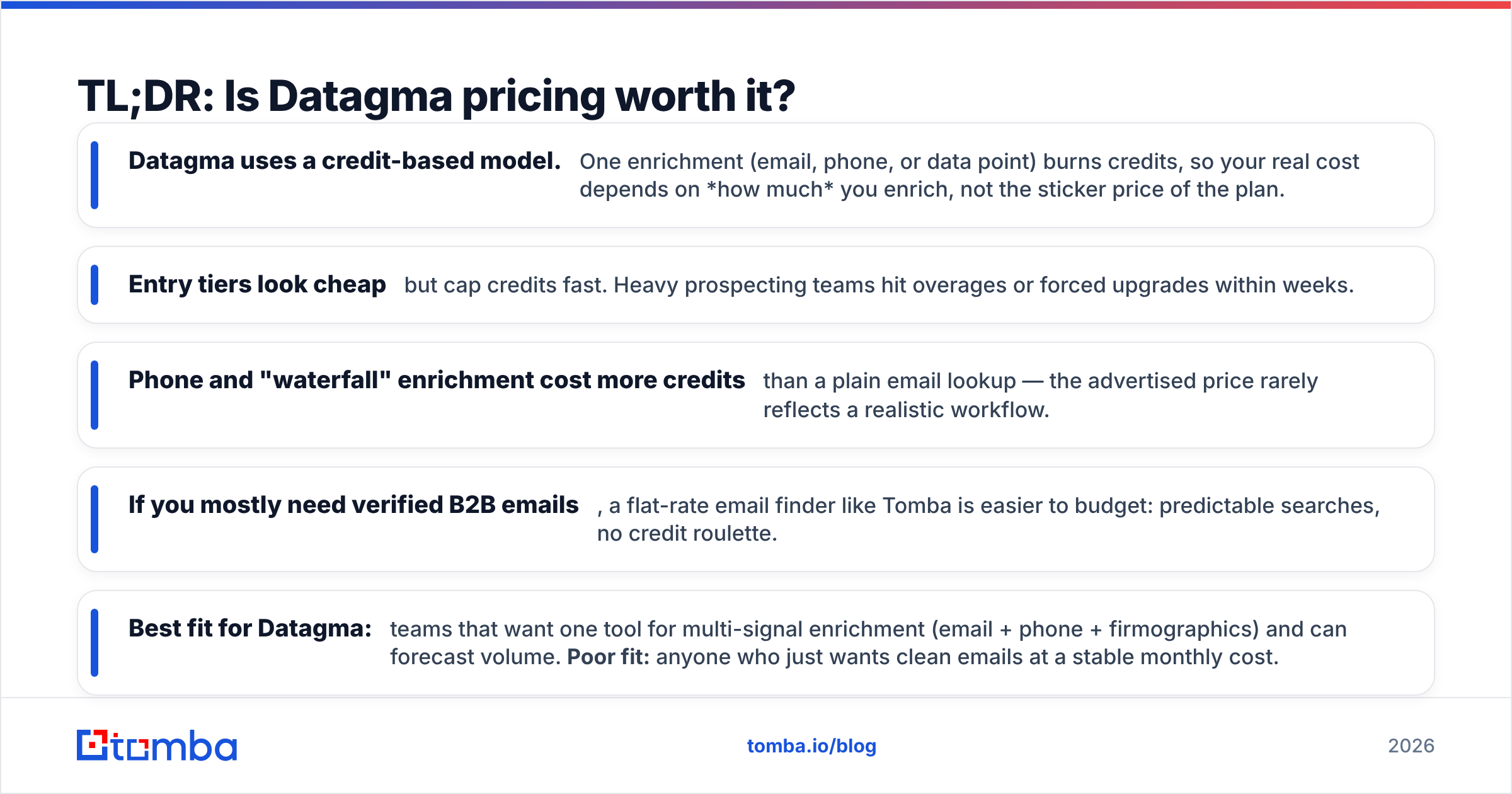
- Datagma uses a credit-based model. One enrichment (email, phone, or data point) burns credits, so your real cost depends on how much you enrich, not the sticker price of the plan.
- Entry tiers look cheap but cap credits fast. Heavy prospecting teams hit overages or forced upgrades within weeks.
- Phone and "waterfall" enrichment cost more credits than a plain email lookup — the advertised price rarely reflects a realistic workflow.
- If you mostly need verified B2B emails, a flat-rate email finder like Tomba is easier to budget: predictable searches, no credit roulette.
- Best fit for Datagma: teams that want one tool for multi-signal enrichment (email + phone + firmographics) and can forecast volume. Poor fit: anyone who just wants clean emails at a stable monthly cost.
How does Datagma pricing actually work?#
Datagma bills on monthly or annual credits. Every action you take — finding an email, revealing a phone number, enriching a LinkedIn profile, or running a company lookup — deducts a set number of credits from your balance. When the balance hits zero, you either buy more or wait for the next cycle.
That model has two consequences buyers underestimate:
- Different actions cost different amounts. A basic email find is cheap. A mobile phone number or a full "waterfall" enrichment (where the system tries multiple data providers until one hits) costs several times more. Your effective price per useful contact is almost always higher than the headline math suggests.
- Unused credits usually don't roll over. If you buy for peak volume and have a slow month, you've paid for capacity you burned nothing on. If you buy lean and have a busy month, you're topping up at overage rates.
Here's the mental model: credit pricing is like a prepaid mobile plan. The per-minute rate looks tiny, but between the fees for "premium" actions and the minutes you never use, the real cost per call you actually cared about is much higher than the brochure.
What are the Datagma plans and tiers?#
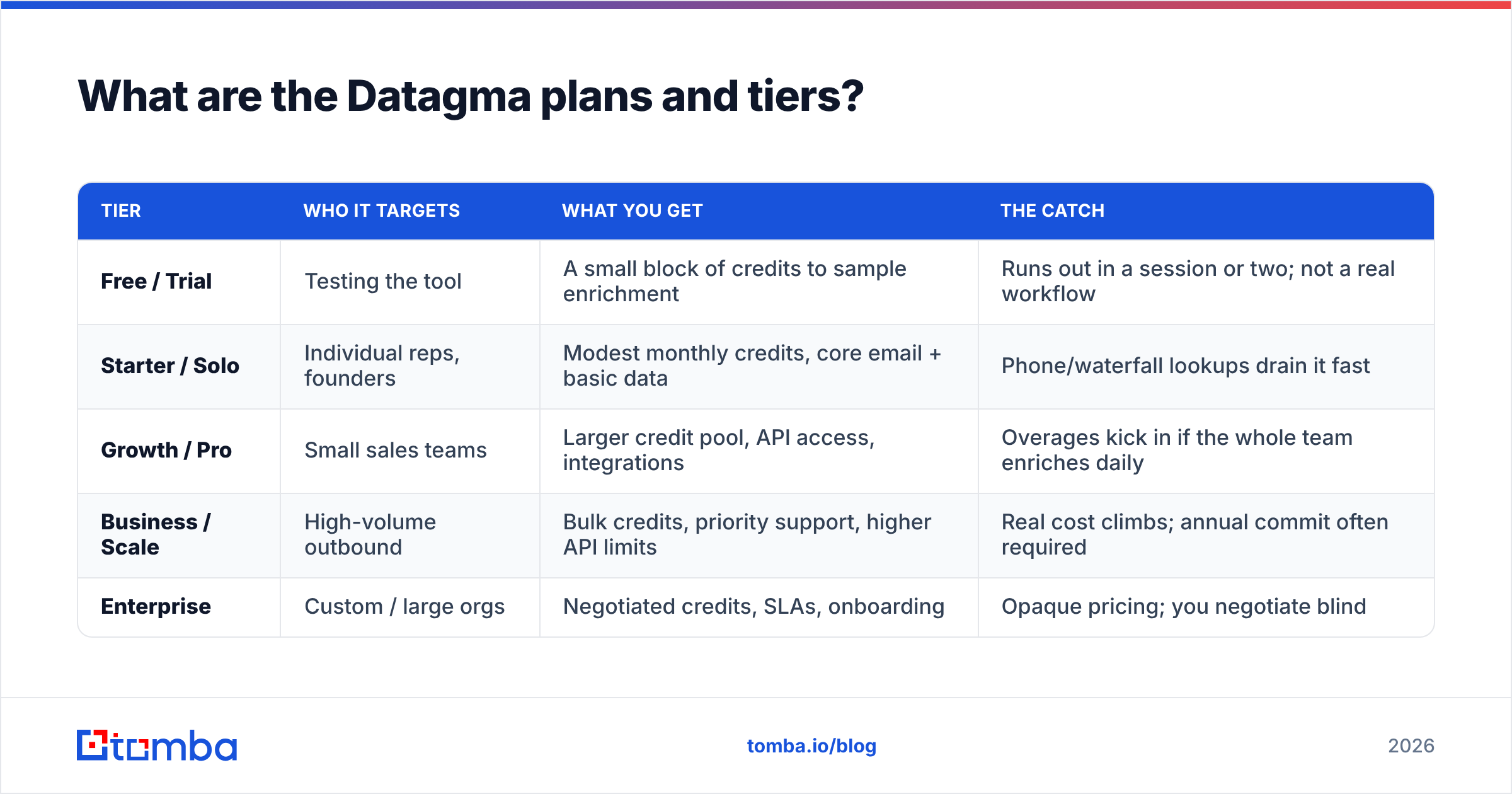
Datagma has historically offered a free trial, then a ladder of paid tiers scaling from solo users up to teams and API-heavy customers. Exact credit allotments and prices shift over time, so always confirm the live numbers on the official Datagma site before buying. The structure, however, is stable and worth understanding:
| Tier | Who it targets | What you get | The catch |
|---|---|---|---|
| Free / Trial | Testing the tool | A small block of credits to sample enrichment | Runs out in a session or two; not a real workflow |
| Starter / Solo | Individual reps, founders | Modest monthly credits, core email + basic data | Phone/waterfall lookups drain it fast |
| Growth / Pro | Small sales teams | Larger credit pool, API access, integrations | Overages kick in if the whole team enriches daily |
| Business / Scale | High-volume outbound | Bulk credits, priority support, higher API limits | Real cost climbs; annual commit often required |
| Enterprise | Custom / large orgs | Negotiated credits, SLAs, onboarding | Opaque pricing; you negotiate blind |
The pattern is familiar across the category: the cheapest plan is a hook, and the plan you actually need after a month of real usage is one or two rungs up. Budget for the tier above the one that looks right in the demo.
Where the hidden costs hide#
- Premium data types. Mobile numbers and multi-source waterfall enrichment cost a multiple of a standard email lookup. A plan that "includes 1,000 credits" may only yield a few hundred usable phone-verified contacts.
- API overage. If you wire Datagma into your own tooling, automated calls burn credits around the clock. It's easy to blow a monthly budget with one misconfigured sync.
- Annual lock-in for the good rate. The attractive per-credit price usually requires a yearly commitment. Month-to-month costs noticeably more.
- Verification gaps. Enrichment that returns an address is not the same as a verified address. If you're not separately running an email verifier, bounced sends cost you sender reputation on top of the credits you already spent.
Is Datagma accurate enough to justify the credits?#
This is the question that decides whether credit pricing is fair or frustrating. You pay per lookup whether the data is right or not, so accuracy directly changes your true cost per usable contact. A tool with 70% deliverable emails effectively costs you ~30% more per good lead than the credit sheet implies, because a chunk of your spend returns dead data.

Datagma's waterfall approach — querying several sources and returning the best hit — generally helps coverage, which is its strongest selling point. But coverage and accuracy aren't the same thing. Independent buyers on review sites like G2 report the usual enrichment-tool trade-off: broad reach, with a meaningful share of catch-all or unverifiable results that still consume credits. If you rely on it, pair it with catch-all verification (Tomba offers a dedicated catch-all verifier) so you're not paying to email addresses that will never land.
The practical takeaway: judge any credit-priced tool by cost per verified, deliverable contact, not cost per lookup. That single reframing changes most pricing comparisons.
Datagma pricing vs Tomba: the flat-rate comparison#
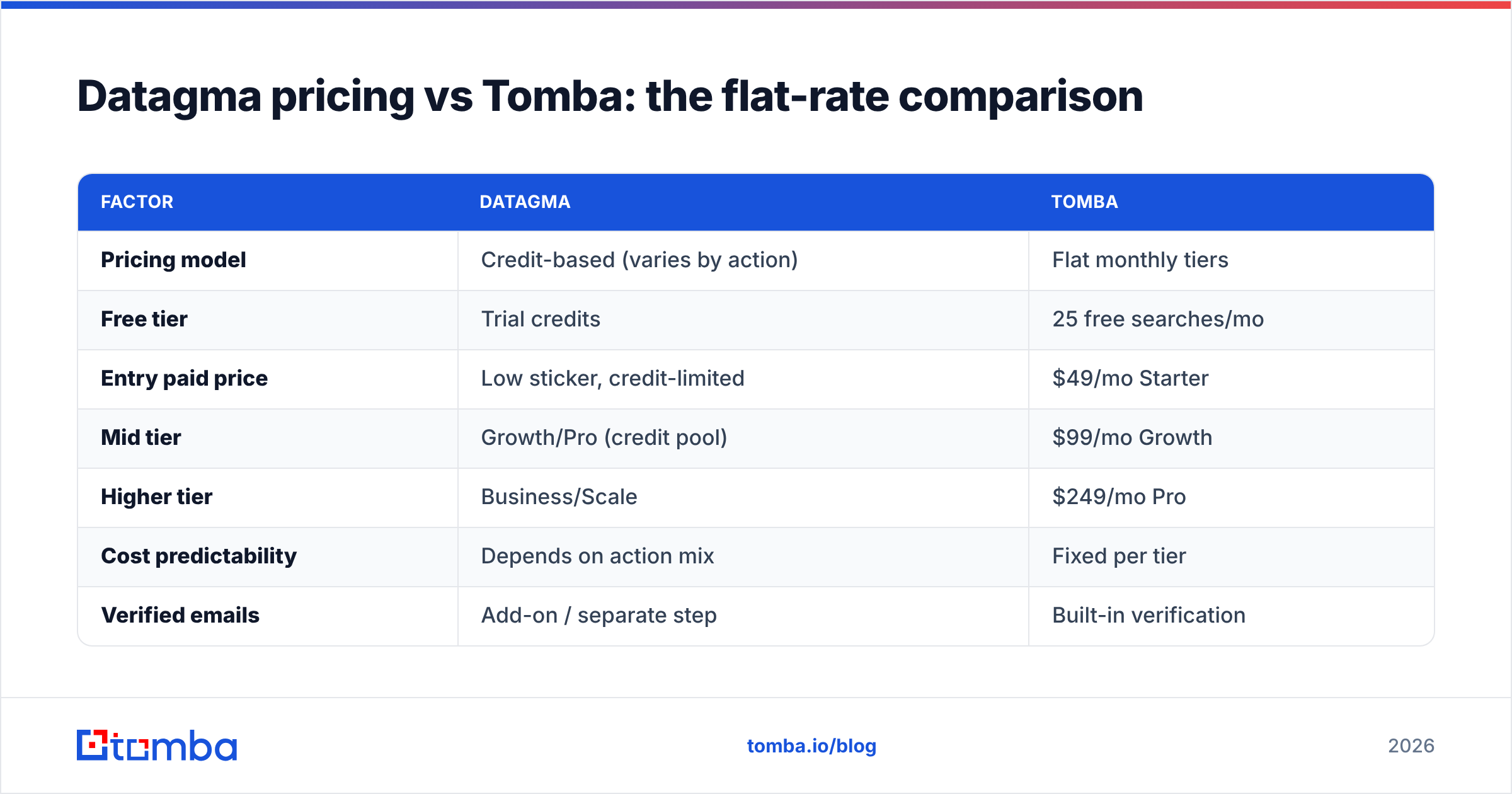
If your core need is verified B2B emails (with phone and enrichment as nice-to-haves), a flat-rate model removes the credit anxiety entirely. Tomba prices by searches and verifications on predictable monthly tiers, so your bill doesn't swing with how aggressively your team prospects.

| Factor | Datagma | Tomba |
|---|---|---|
| Pricing model | Credit-based (varies by action) | Flat monthly tiers |
| Free tier | Trial credits | 25 free searches/mo |
| Entry paid price | Low sticker, credit-limited | $49/mo Starter |
| Mid tier | Growth/Pro (credit pool) | $99/mo Growth |
| Higher tier | Business/Scale | $249/mo Pro |
| Cost predictability | Depends on action mix | Fixed per tier |
| Verified emails | Add-on / separate step | Built-in verification |
| Phone + enrichment | Yes (higher credit cost) | Phone finder + enrichment available |
| Best for | Multi-signal enrichment at forecastable volume | Predictable, verified email at a stable cost |
A few honest points of balance:
- Datagma wins when you genuinely need a single pane for email plus mobile phone plus firmographics and you can predict your monthly volume. The waterfall coverage is real.
- Tomba wins when budgeting matters more than breadth — you know exactly what $49, $99, or $249 buys, and verification is baked in rather than a credit surcharge. See the full Tomba pricing page for the current tier limits.
- Neither is universally "cheaper." Cheaper depends on your action mix. If 90% of your lookups are plain emails, flat-rate almost always wins. If you're pulling verified mobiles at scale, a credit tool's waterfall may be worth the premium.

How do you calculate your real Datagma cost?#
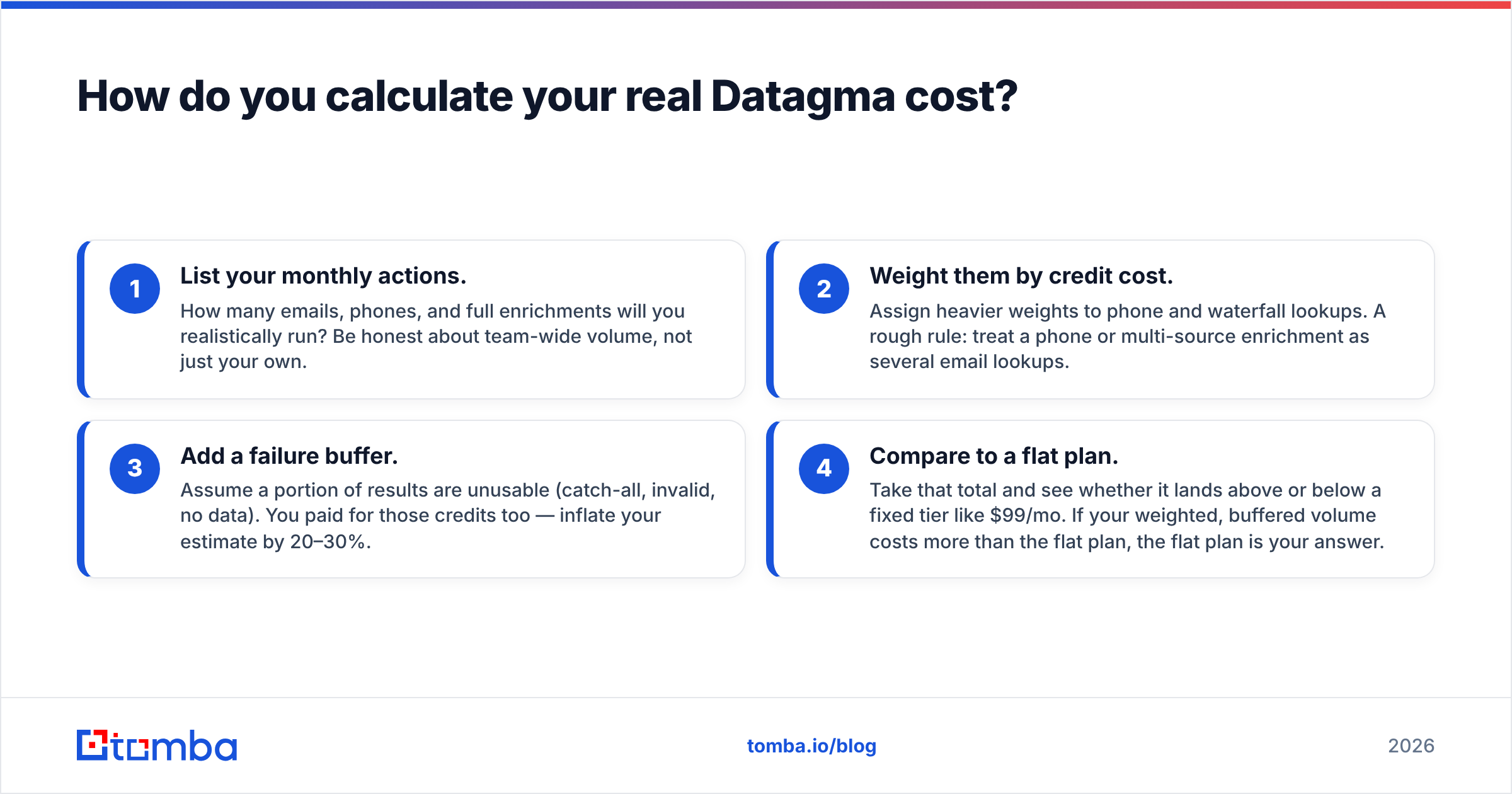
Don't compare sticker prices — model a month of your actual work. Here's a four-step estimate that takes ten minutes:
- List your monthly actions. How many emails, phones, and full enrichments will you realistically run? Be honest about team-wide volume, not just your own.
- Weight them by credit cost. Assign heavier weights to phone and waterfall lookups. A rough rule: treat a phone or multi-source enrichment as several email lookups.
- Add a failure buffer. Assume a portion of results are unusable (catch-all, invalid, no data). You paid for those credits too — inflate your estimate by 20–30%.
- Compare to a flat plan. Take that total and see whether it lands above or below a fixed tier like $99/mo. If your weighted, buffered volume costs more than the flat plan, the flat plan is your answer.
Teams that skip step 3 are the ones who feel blindsided by the second invoice. The credits didn't lie — the effective rate on usable data was just higher than the marketing number.
Who should choose Datagma — and who shouldn't?#
Choose Datagma if:
- You need multi-signal enrichment (email + mobile + company data) from one tool.
- Your monthly volume is stable and forecastable.
- You're comfortable actively managing a credit balance and can commit annually for the best rate.
Look elsewhere if:
- Your main job is finding and verifying B2B emails at a predictable cost.
- Volume is spiky and you hate surprise overages.
- You want verification built in rather than as a separate credit-burning step.
For that second group, a flat-rate stack is simpler to run and easier to defend to finance. You can find emails by name or company with the email finder, enrich records with data enrichment, and verify everything before it ever touches your sequencer — all on a bill that doesn't move with your prospecting mood.
The bottom line on Datagma pricing#
Datagma pricing is fair for what it is — a flexible, credit-based enrichment tool — but "flexible" is a double-edged sword. The credit model rewards forecastable, high-value enrichment and punishes casual or unpredictable use. The sticker price is never the real price; your action mix and failure rate are. Run the four-step estimate above before you commit, and always measure cost per verified contact rather than cost per lookup.
If, after doing that math, you realize you mostly just need clean, deliverable B2B emails without the credit calculus, try Tomba's Email Finder. Start free with 25 searches a month, upgrade to a flat $49/mo Starter when you scale, and keep your outbound budget boringly predictable — verification included, no overage surprises. Find your first emails free with Tomba and see what a stable line item feels like.
Related guides#
Ready to find emails that actually work?
Join 150,000+ professionals who stopped guessing and started sending. Free credits on signup — no credit card required.
Get the Tomba newsletter
Practical outbound tactics and product updates — once every two weeks.
About the author