Datanyze vs Extruct AI (2026): B2B Data Intelligence Compared
Datanyze leans on technographics and a fixed database; Extruct AI runs live agentic company research. Here's how the two stack up in 2026 — and where each one leaves gaps you'll need to fill.
Datanyze vs Extruct AI is a choice between two eras of B2B data tooling. One reads a company's tech stack from a fixed database. The other sends AI agents to research the open web on demand. This guide compares the two on data, accuracy, pricing, and the contact gap both leave behind.
TL;DR
- Datanyze is a technographics-first sales intelligence tool: it tells you what software a company runs and pairs that with a static contact database. Best for territory research and tech-stack targeting.
- Extruct AI is a newer, agentic company-research platform: you describe the accounts you want, and AI agents crawl the web live to build and enrich lists. Best for custom account discovery that a fixed database can't cover.
- They solve different halves of the same problem. Datanyze answers "who uses X software?"; Extruct answers "find me companies matching this fuzzy description." Neither is primarily an email-finding or verification engine.
- Both leave a contact-data gap. You still need accurate, verified email addresses and phone numbers to act on either tool's account lists — that's where a dedicated email finder earns its place in the stack.
- Pick by workflow: static technographic filters and a browser extension → Datanyze; open-ended AI list-building → Extruct AI; reliable contact data to make either usable → Tomba.
What are Datanyze and Extruct AI?#
Datanyze and Extruct AI both help you find and research target accounts, but they come from opposite eras of go-to-market tooling.
Datanyze built its reputation on technographics. It detects the technologies a website runs — CRM, analytics, ecommerce platform, chat widget, and so on — and turns that into a targeting signal. Say you sell a Shopify app and want every mid-market retailer on Shopify Plus. That is exactly the filter Datanyze was built for.
Over the years it added a B2B contact database and a Chrome extension. So reps can pull a company's tech stack and a few contacts while browsing. You can see its current positioning on the Datanyze homepage.
Extruct AI takes a very different approach. Instead of querying a pre-built database, you describe your ideal accounts in plain language — say, "Series A fintech companies in Europe building on open banking APIs." Its agents then research the live web to assemble a list. They enrich each row with the attributes you ask for.
It is part of a 2025–2026 wave of "AI research agent" tools. These treat list-building as a search-and-reason task, not a database lookup. Details are on the Extruct AI site.
The core distinction: Datanyze retrieves from a fixed index; Extruct reasons over the open web on demand. That single difference drives almost every trade-off below.

Datanyze vs Extruct AI: how do they compare at a glance?#
Here's the head-to-head on the attributes that actually change your workflow. Treat vendor pricing as directional — both companies move tiers and gate features behind demos, so confirm current numbers before you buy.
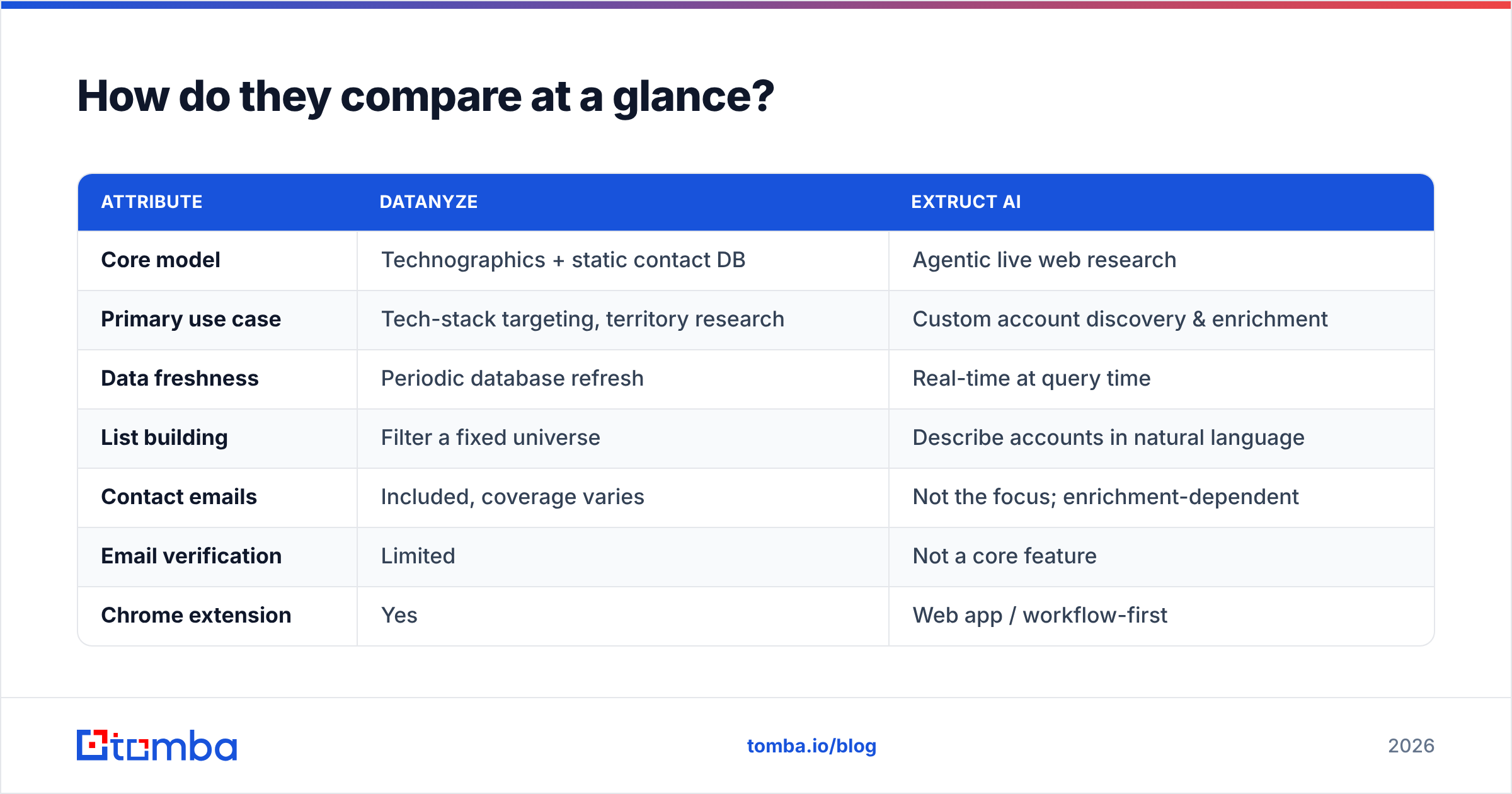
| Attribute | Datanyze | Extruct AI |
|---|---|---|
| Core model | Technographics + static contact DB | Agentic live web research |
| Primary use case | Tech-stack targeting, territory research | Custom account discovery & enrichment |
| Data freshness | Periodic database refresh | Real-time at query time |
| List building | Filter a fixed universe | Describe accounts in natural language |
| Contact emails | Included, coverage varies | Not the focus; enrichment-dependent |
| Email verification | Limited | Not a core feature |
| Chrome extension | Yes | Web app / workflow-first |
| Best for team | SMB/mid-market reps | RevOps, founders, research-heavy GTM |
| Learning curve | Low | Low-to-medium (prompt design matters) |
| Typical pricing shape | Per-seat, credit-limited | Usage/credit-based, custom |
The pattern that emerges: Datanyze is the safer pick when your targeting maps cleanly to a technology filter, and Extruct wins when your ideal customer profile is too nuanced for pre-set filters. But look at the two rows in the middle — contact emails and verification. Both tools treat accurate, deliverable contact data as an afterthought, and that's exactly the row that stalls campaigns.
Is Datanyze better than Extruct AI for account targeting?#
It depends on how your ideal customer profile is shaped.
Choose Datanyze when your targeting is a filter, not a description. Technographic segmentation is Datanyze's home turf. "Companies using HubSpot," "sites running Magento," "SaaS firms with Intercom installed" — these are crisp, filterable attributes, and a static index answers them instantly. Reps who live in the browser also like the extension: pull up a prospect's site, see the stack and a couple of contacts, move on. For SMB and mid-market teams with a repeatable, technology-driven motion, that's a fast, low-friction loop.
Datanyze's weakness is the same as its strength. A fixed database is only as current as its last refresh, and technographic detection can lag when companies swap tools. Contact coverage is uneven outside core markets, and the emails you pull still need checking before you send.
Choose Extruct AI when your ICP resists filters. Some target lists can't be expressed as checkboxes. "Companies that recently announced a sustainability initiative and sell physical products" isn't a database field — it's a research task. Extruct's agents shine here because they read the live web and reason about fuzzy criteria, then enrich each account with the columns you specify. For founders validating a new segment or RevOps teams building a one-off strategic list, that flexibility is hard to replicate in Datanyze.
Extruct's trade-offs are the flip side of agentic freedom. Results quality depends on how you phrase the request, live research is slower than a database query, and — critically — the AI still needs a reliable source for verified contact details. An agent can find the right company and even the right person, but confirming that jane.doe@company.com actually lands in an inbox is a different discipline. For that, a dedicated email verifier does what neither tool is built to do.
What about data accuracy and freshness?#
Accuracy splits into two questions these tools answer differently: is the account information current and is the contact data deliverable.
On account freshness, Extruct has the structural edge because it researches at query time — there's no stale index to fall out of date. Datanyze depends on refresh cadence, which is fine for slow-moving attributes (a company's tech stack rarely changes weekly) but weaker for fast-moving signals like headcount, funding, or new hires.
On contact deliverability, neither tool is designed to be your source of truth, and that's the part most teams underestimate. A company list with 15% bad emails doesn't just waste sends — it drags your sender reputation down and pushes good messages to spam. Independent review sites like G2 consistently show that "data accuracy" complaints across this category cluster on contact-level fields (emails and direct dials), not firmographics. The account is usually right; the person's email is the coin flip.
This is the gap worth naming plainly: both Datanyze and Extruct AI get you to the right door, but neither guarantees the key works. You verify contact data with a purpose-built tool, or you pay for it in bounce rates.

Where do both tools leave a gap — and how do you fill it?#
Every account-intelligence tool produces the same downstream need: turn a list of companies and names into verified, reachable contacts. Here's the four-step reality of using either Datanyze or Extruct in a real pipeline.
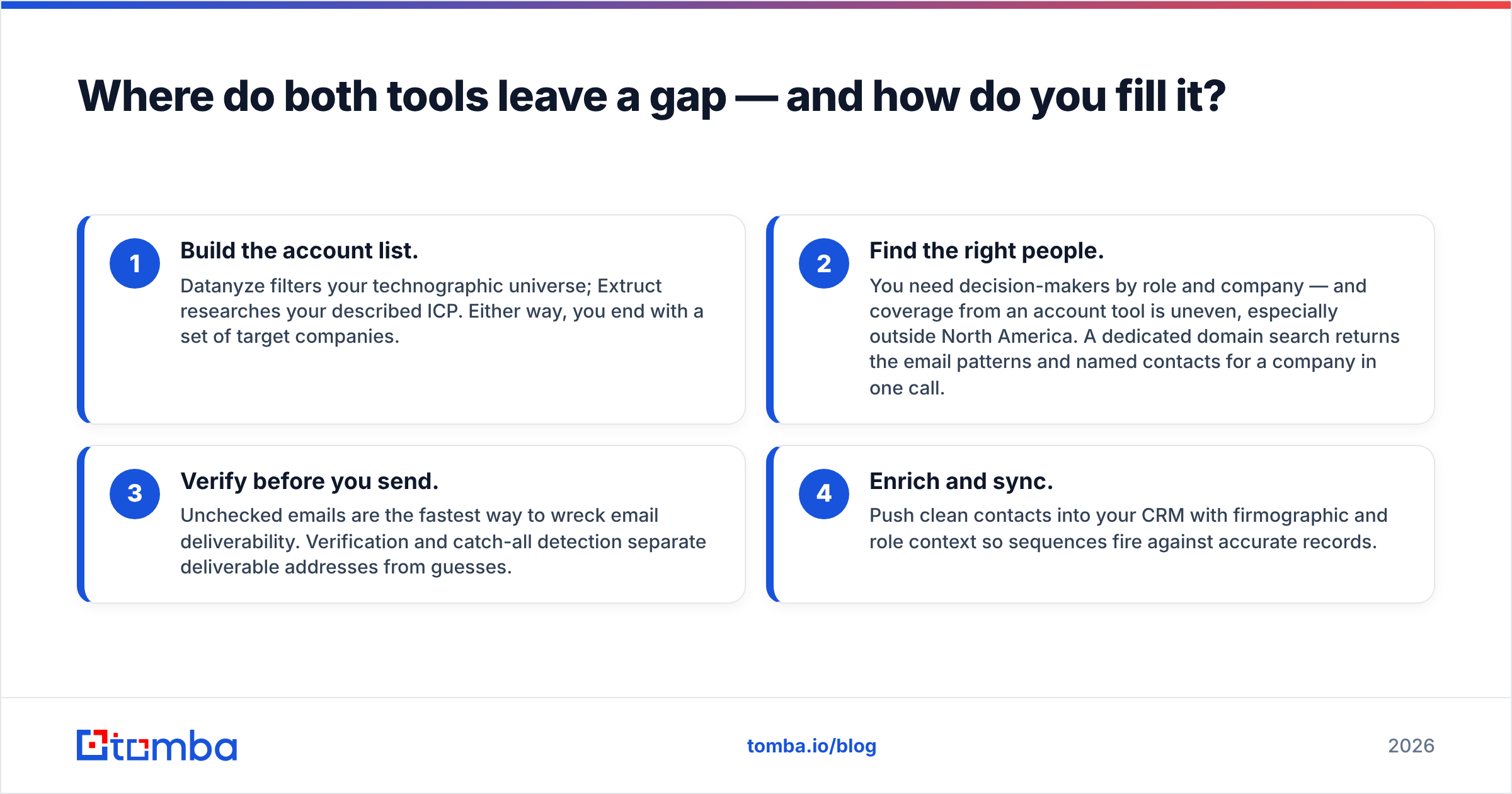
- Build the account list. Datanyze filters your technographic universe; Extruct researches your described ICP. Either way, you end with a set of target companies.
- Find the right people. You need decision-makers by role and company — and coverage from an account tool is uneven, especially outside North America. A dedicated domain search returns the email patterns and named contacts for a company in one call.
- Verify before you send. Unchecked emails are the fastest way to wreck email deliverability. Verification and catch-all detection separate deliverable addresses from guesses.
- Enrich and sync. Push clean contacts into your CRM with firmographic and role context so sequences fire against accurate records.
Steps 2 and 3 are exactly what an email-finding and verification layer is built for, and it's why teams pair an account-intelligence tool with something like Tomba rather than expecting one product to do both jobs. Here's how the responsibilities divide:
- Datanyze / Extruct AI — decide which accounts and why they matter.
- Tomba Email Finder — turn those accounts into verified, contactable people.
- CRM (HubSpot, Salesforce, Pipedrive) — house the enriched records and run the sequence.
You can wire this together without engineering effort. Tomba connects through native integrations and a documented email finder API, so a company that surfaces in Extruct or Datanyze flows into a verified-contact step automatically. If you'd rather work in a spreadsheet first, the bulk email finder processes a whole account list at once.
How much do they cost?#
Pricing in this category is rarely a clean sticker number — both vendors gate features and volume behind tiers and demos — but the shape of the cost is what matters for planning.
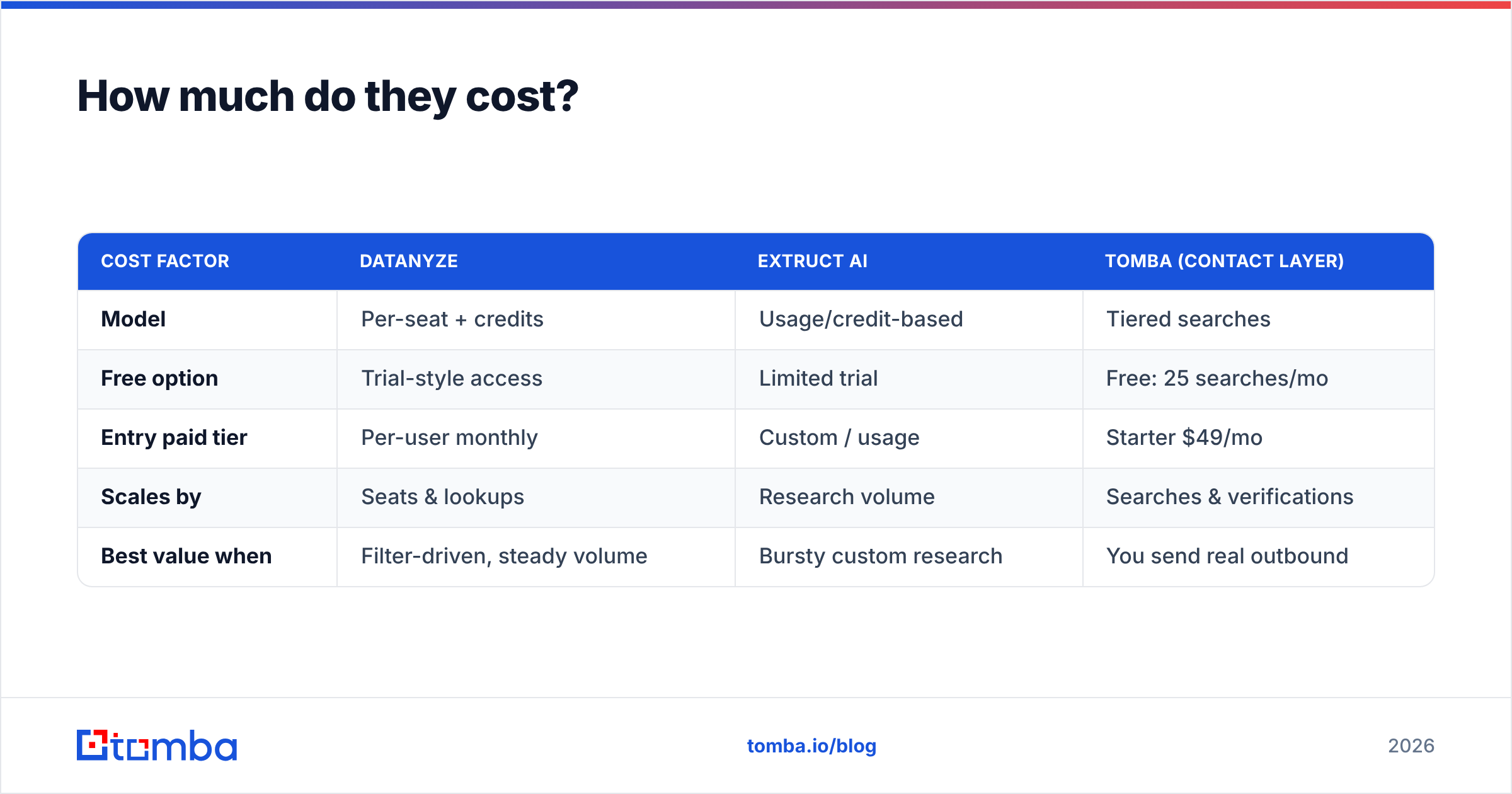
| Cost factor | Datanyze | Extruct AI | Tomba (contact layer) |
|---|---|---|---|
| Model | Per-seat + credits | Usage/credit-based | Tiered searches |
| Free option | Trial-style access | Limited trial | Free: 25 searches/mo |
| Entry paid tier | Per-user monthly | Custom / usage | Starter $49/mo |
| Scales by | Seats & lookups | Research volume | Searches & verifications |
| Best value when | Filter-driven, steady volume | Bursty custom research | You send real outbound |
A few honest notes on budgeting:
- Datanyze rewards steady, repeatable use — if your reps pull contacts daily against a consistent technographic filter, per-seat pricing amortizes well. Occasional users tend to overpay for idle seats.
- Extruct AI rewards bursty, high-value research — a strategic list-building sprint justifies the usage cost, but running it as an always-on data feed gets expensive fast.
- The contact layer is the cheapest insurance in the stack. Tomba's pricing starts free (25 searches/month) and moves to $49/month at the Starter tier, with Growth at $99 and Pro at $249. Compared to the cost of a burned domain from bad sends, verified contact data is the line item you don't cut.
The takeaway: don't evaluate Datanyze or Extruct on price in isolation. Add the cost of the verification step you'll need regardless, and the total-cost picture gets a lot clearer.
Which one should you choose?#
Here's the Datanyze vs Extruct AI decision, compressed:
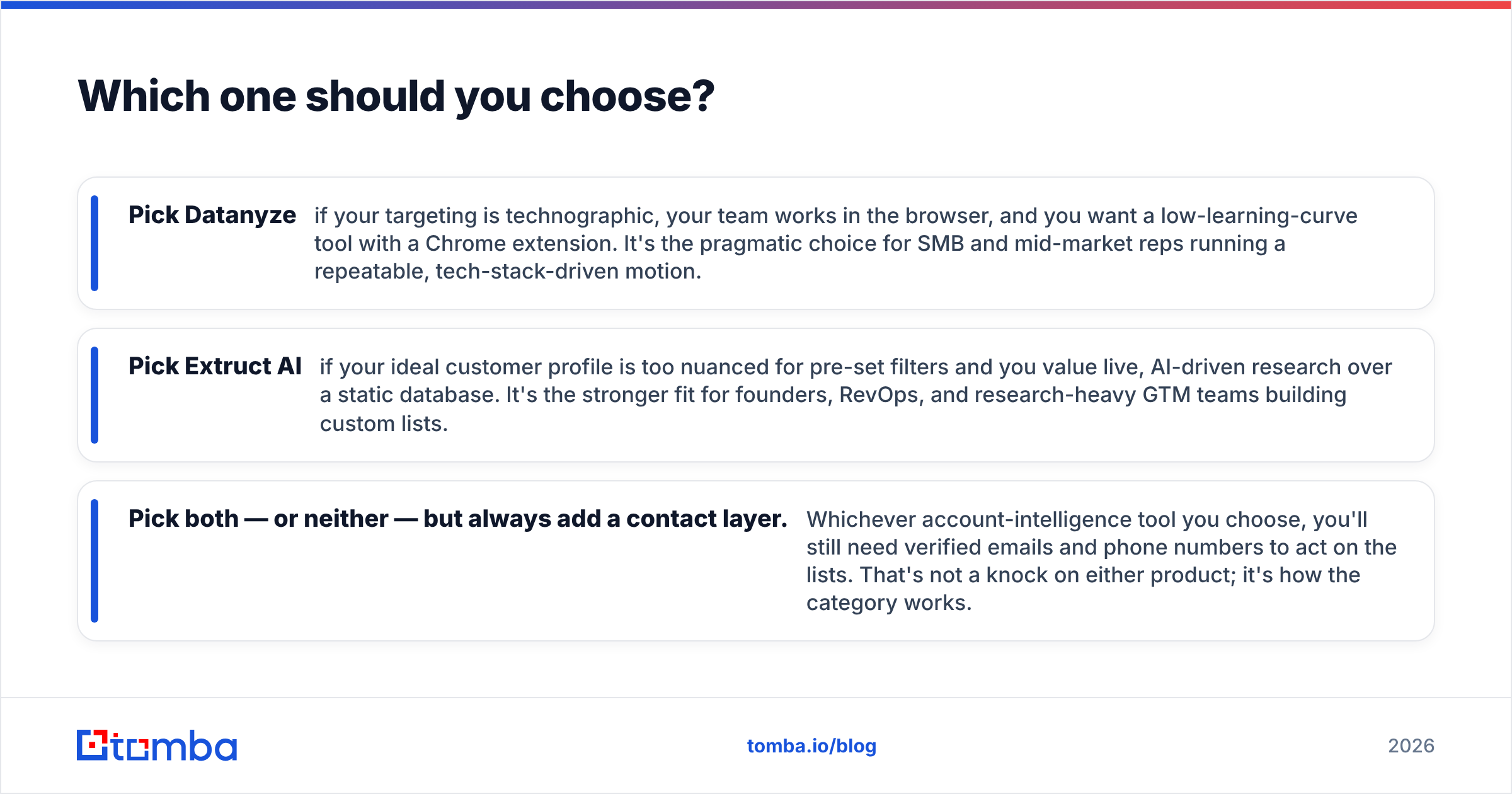
- Pick Datanyze if your targeting is technographic, your team works in the browser, and you want a low-learning-curve tool with a Chrome extension. It's the pragmatic choice for SMB and mid-market reps running a repeatable, tech-stack-driven motion.
- Pick Extruct AI if your ideal customer profile is too nuanced for pre-set filters and you value live, AI-driven research over a static database. It's the stronger fit for founders, RevOps, and research-heavy GTM teams building custom lists.
- Pick both — or neither — but always add a contact layer. Whichever account-intelligence tool you choose, you'll still need verified emails and phone numbers to act on the lists. That's not a knock on either product; it's how the category works.
For most teams, the winning setup isn't "Datanyze or Extruct." It's an account-intelligence tool for targeting plus a dedicated finder-and-verifier for reach. That division of labor keeps your lists smart and your bounce rate low.
The bottom line#
Datanyze vs Extruct AI isn't really a competition. They're two answers to different questions — "who runs this software?" versus "find me companies that look like this." Choose based on how your ICP is shaped: filters favor Datanyze, fuzzy descriptions favor Extruct. But whichever you land on, the account list is only half the job. You still have to reach real people, and that means verified, deliverable contact data neither tool is built to guarantee.
That's where Tomba slots in. Point the Tomba Email Finder at the accounts your intelligence tool surfaces, verify every address before you send, and push clean records into your CRM — no bounced campaigns, no scorched sender reputation. Start free with 25 searches a month, and turn any target list into contacts you can actually reach.
Related guides#
Ready to find emails that actually work?
Join 150,000+ professionals who stopped guessing and started sending. Free credits on signup — no credit card required.
Get the Tomba newsletter
Practical outbound tactics and product updates — once every two weeks.
About the author