Datanyze vs Finderio: Which Email Finder Wins in 2026?
Datanyze and Finderio both promise B2B contact data, but they solve different problems. Here's an honest breakdown of accuracy, pricing, and where each tool falls short.
You are comparing Datanyze and Finderio because you need working B2B email addresses without torching your sender reputation. The two tools get mentioned in the same breath, but they are built for different jobs — and neither one is the obvious winner until you match it to your actual workflow.
This is a neutral breakdown: what each tool does, where the data holds up, what it costs, and where a purpose-built email finder beats both.
TL;DR: Datanyze vs Finderio at a glance#
- Datanyze is a technographics and lead-scoring tool with a Chrome extension that surfaces contact data. It shines when you care who uses what software, not just email discovery.
- Finderio (Finder.io by 500apps) is a straightforward email finder and verifier bundled inside a larger app suite. Its strength is price when you already pay for the suite.
- Accuracy is the deciding factor for cold outreach, and both tools show gaps on catch-all domains and smaller companies.
- If your core need is find a valid email and prove it won't bounce, a dedicated email finder like Tomba usually delivers a higher verified hit rate for less money.
- Read to the end for a side-by-side pricing and accuracy table before you commit a credit card.
What is Datanyze and who is it for?#
Datanyze started as a technographics company — it tells you which technologies a website runs (CRM, analytics, ad tech, ecommerce platform) so you can build lists of companies that fit your product. Over time it added a Chrome extension that pulls contact details, including email and direct-dial numbers, while you browse LinkedIn or a company site.
That heritage matters. Datanyze is strongest when your targeting is technology-based: "show me every company running Shopify Plus and HubSpot." The contact data is a means to an end, layered on top of the firmographic and technographic core. You can read more about how technographics fit into modern prospecting on G2's category page.
Where Datanyze gets weaker is depth of verified email coverage. Because email discovery is not its primary engine, you will hit records with a company email pattern guessed rather than confirmed, and no clear verification status attached.

What is Finderio and who is it for?#
Finderio — marketed as Finder.io by 500apps — is an email finder, email verifier, and domain search tool sold inside the broader 500apps subscription. You give it a name and domain, it returns a likely email; you give it a domain, it returns the addresses it has on file.
The pitch is bundling. If your team already uses the 500apps suite for CRM, help desk, or marketing, Finderio is "free-ish" incremental value rather than a separate line item. As a standalone email finder it is functional but rarely best-in-class: coverage on mid-market and enterprise domains is decent, but verification confidence and catch-all handling lag behind specialist tools.
For teams that just need addresses and already live in 500apps, that trade is reasonable. For teams whose entire outbound motion depends on deliverability, the bundled approach can cost you in bounce rate what it saves you in subscription fees.
Datanyze vs Finderio: how do they compare directly?#
Here is the honest side-by-side. Prices and limits shift, so confirm on each vendor's site before buying — but the shape of the comparison holds.
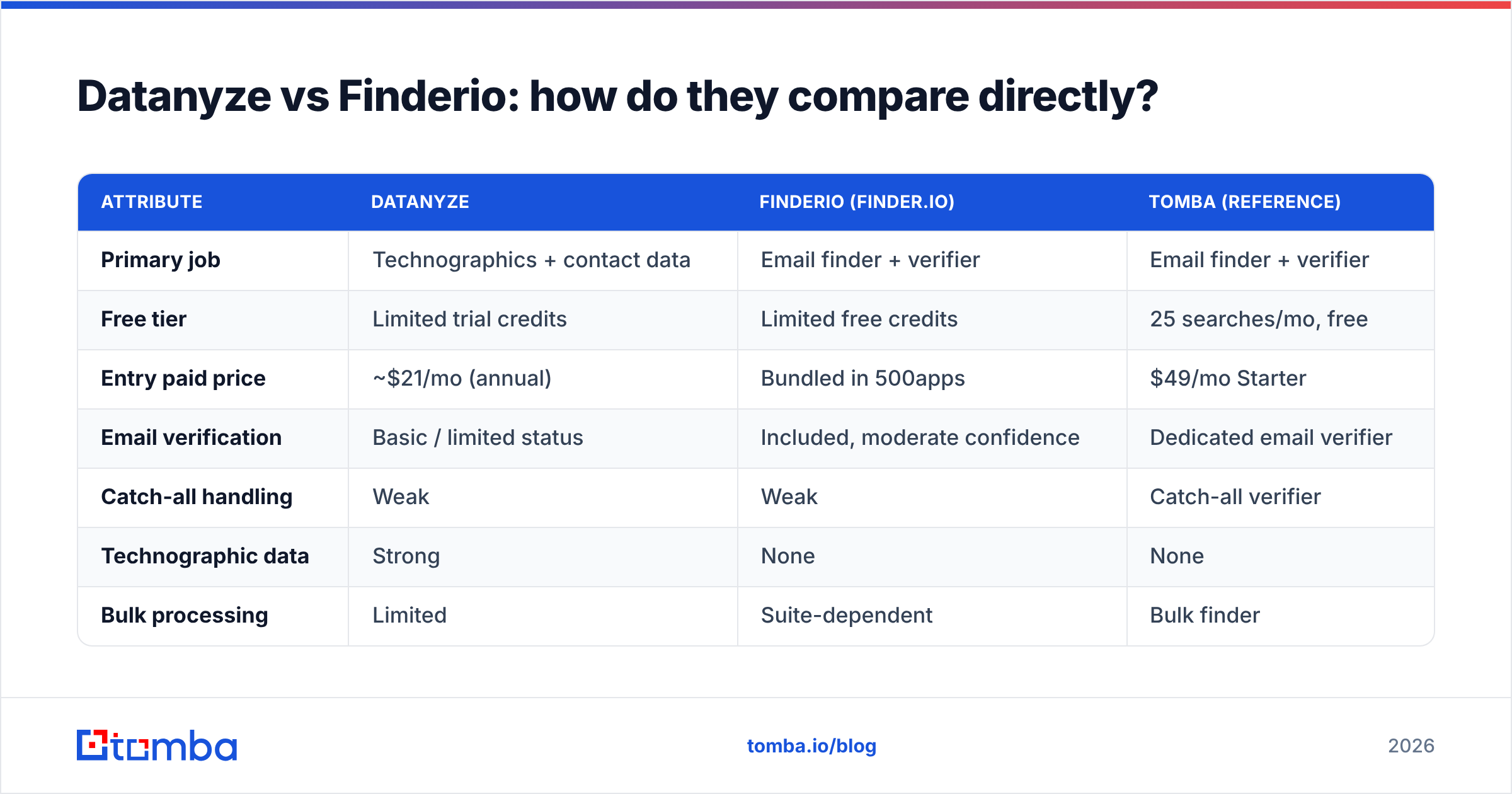
| Attribute | Datanyze | Finderio (Finder.io) | Tomba (reference) |
|---|---|---|---|
| Primary job | Technographics + contact data | Email finder + verifier | Email finder + verifier |
| Free tier | Limited trial credits | Limited free credits | 25 searches/mo, free |
| Entry paid price | ~$21/mo (annual) | Bundled in 500apps | $49/mo Starter |
| Email verification | Basic / limited status | Included, moderate confidence | Dedicated email verifier |
| Catch-all handling | Weak | Weak | Catch-all verifier |
| Technographic data | Strong | None | None |
| Bulk processing | Limited | Suite-dependent | Bulk finder |
| Native integrations | CRM, LinkedIn | 500apps ecosystem | HubSpot, Salesforce, Sheets, API |
| Best fit | Tech-based targeting | Existing 500apps users | Accuracy-first outbound |
The pattern is clear: Datanyze wins on targeting intelligence, Finderio wins on bundle economics, and a specialist email finder wins on verified deliverability. None of them is best at all three.

Which tool has more accurate email data?#
Accuracy is where this decision is won or lost, because a cheap tool that feeds you 15% invalid addresses is not cheap — it is a deliverability liability. Every hard bounce chips away at your sender reputation, and once that drops, even your valid emails start landing in spam.
Both Datanyze and Finderio return emails without always making verification status obvious. That leaves you two bad options: send blind and eat the bounces, or export everything to a separate verifier before you send. The second option adds a step and a cost that erodes the "it's included" advantage.
A few accuracy realities to plan around:
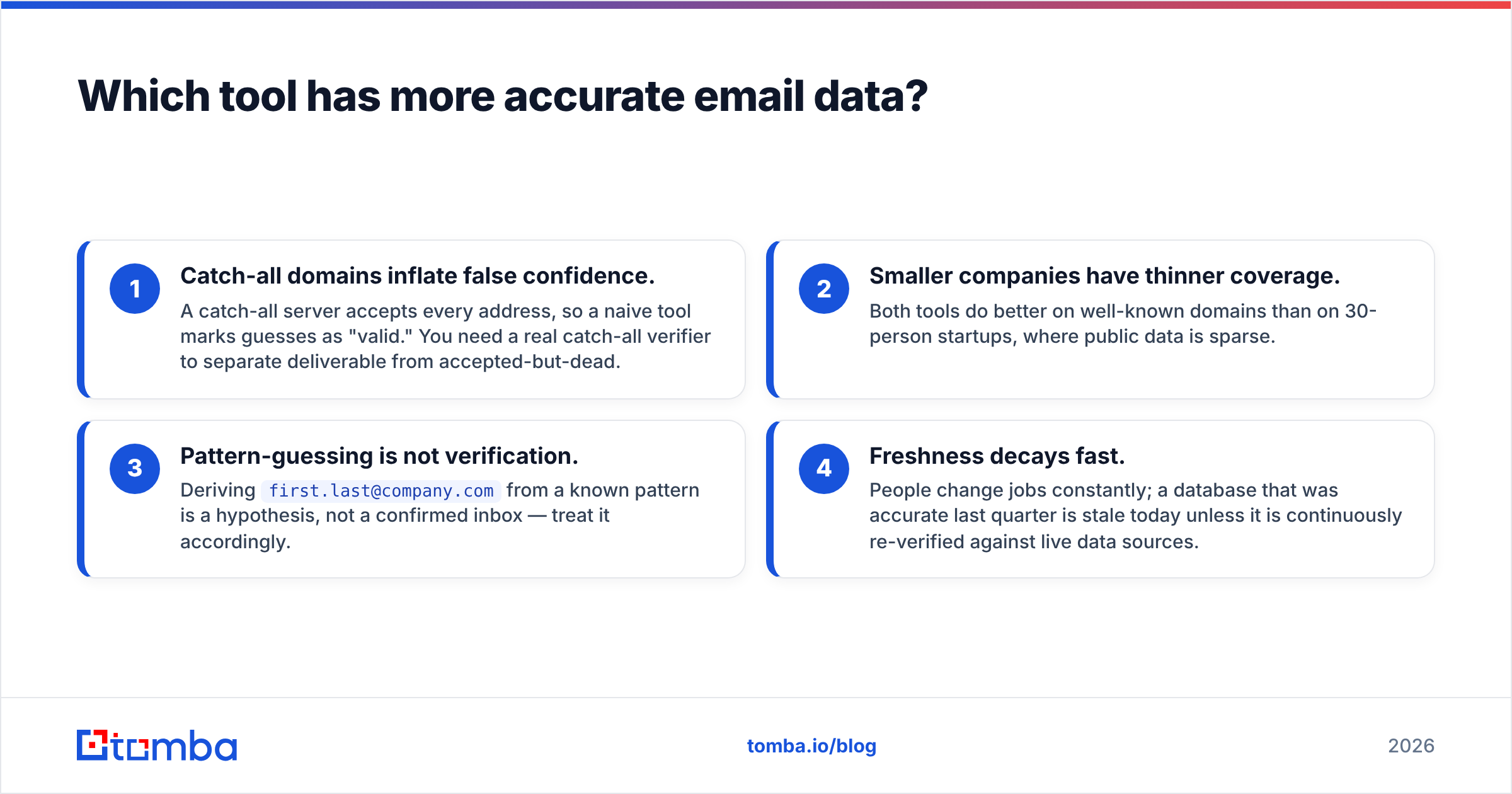
- Catch-all domains inflate false confidence. A catch-all server accepts every address, so a naive tool marks guesses as "valid." You need a real catch-all verifier to separate deliverable from accepted-but-dead.
- Smaller companies have thinner coverage. Both tools do better on well-known domains than on 30-person startups, where public data is sparse.
- Pattern-guessing is not verification. Deriving
first.last@company.comfrom a known pattern is a hypothesis, not a confirmed inbox — treat it accordingly. - Freshness decays fast. People change jobs constantly; a database that was accurate last quarter is stale today unless it is continuously re-verified against live data sources.
If you want to see how a specialist approaches this, Tomba publishes its data sources and runs every result through SMTP-level checks rather than relying on pattern inference alone.

How does pricing really compare?#
On paper Datanyze's entry price looks aggressive and Finderio looks "free" inside the suite. The real cost shows up when you add the verification step both tools push downstream.
- Datanyze charges per credit for contact reveals, and technographic seats are priced for teams that value the firmographic layer. If you are not using that layer, you are paying for capability you ignore.
- Finderio is only economical if you already pay for 500apps. As a standalone purchase, the math changes and you are buying a mid-tier email finder wrapped in a suite you may not need.
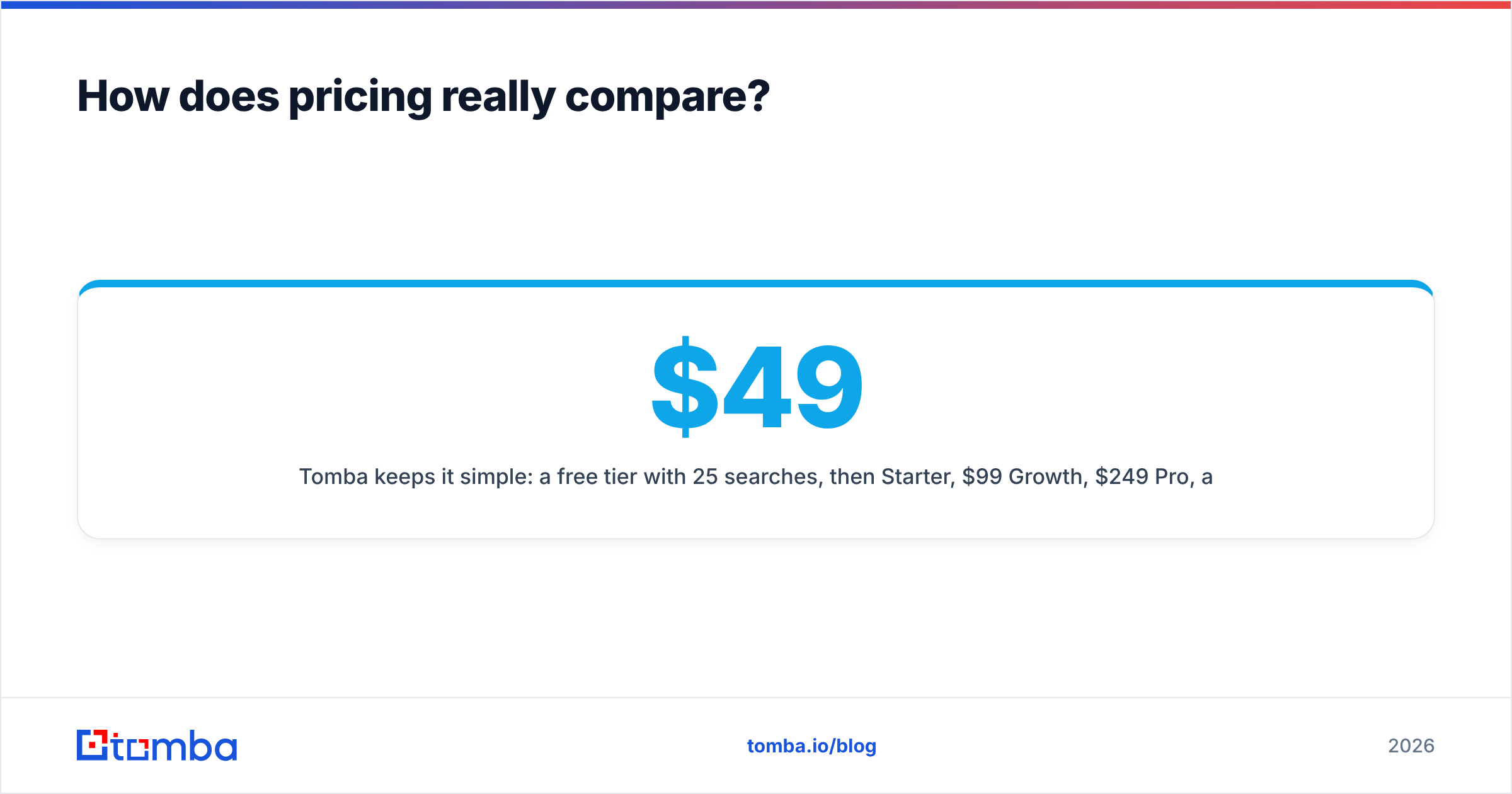
- Tomba keeps it simple: a free tier with 25 searches, then $49/mo Starter, $99/mo Growth, $249/mo Pro, and custom Enterprise. Full Tomba pricing includes finder plus verifier, so you are not stacking a second vendor to check your own data.
The question is not "which sticker price is lowest." It is "what does one verified, deliverable email cost me end to end?" A tool that bundles verification into the same credit usually wins that calculation.
When should you choose Datanyze?#
Pick Datanyze when your targeting is technology-driven and contact discovery is secondary. If your ideal-customer profile is defined by the software a company runs — "companies that just adopted a competing CRM," "sites on a specific ecommerce platform" — Datanyze's technographic core is genuinely useful and hard to replicate with a pure email finder.
You will still want a dedicated verifier in the loop before you send, but for building the account list in the first place, Datanyze earns its place. Pair it with a strong email verifier and you cover the gap.
When should you choose Finderio?#
Pick Finderio when you already run the 500apps suite and your outreach volume is modest. In that scenario the incremental cost is low and the workflow stays inside one login. For a small team doing light prospecting, that convenience is worth more than a few percentage points of accuracy.
If email discovery is your primary daily job, though, the bundle logic inverts. You end up using a mid-tier finder because it came in the box, not because it is the best tool for the outreach your revenue depends on.
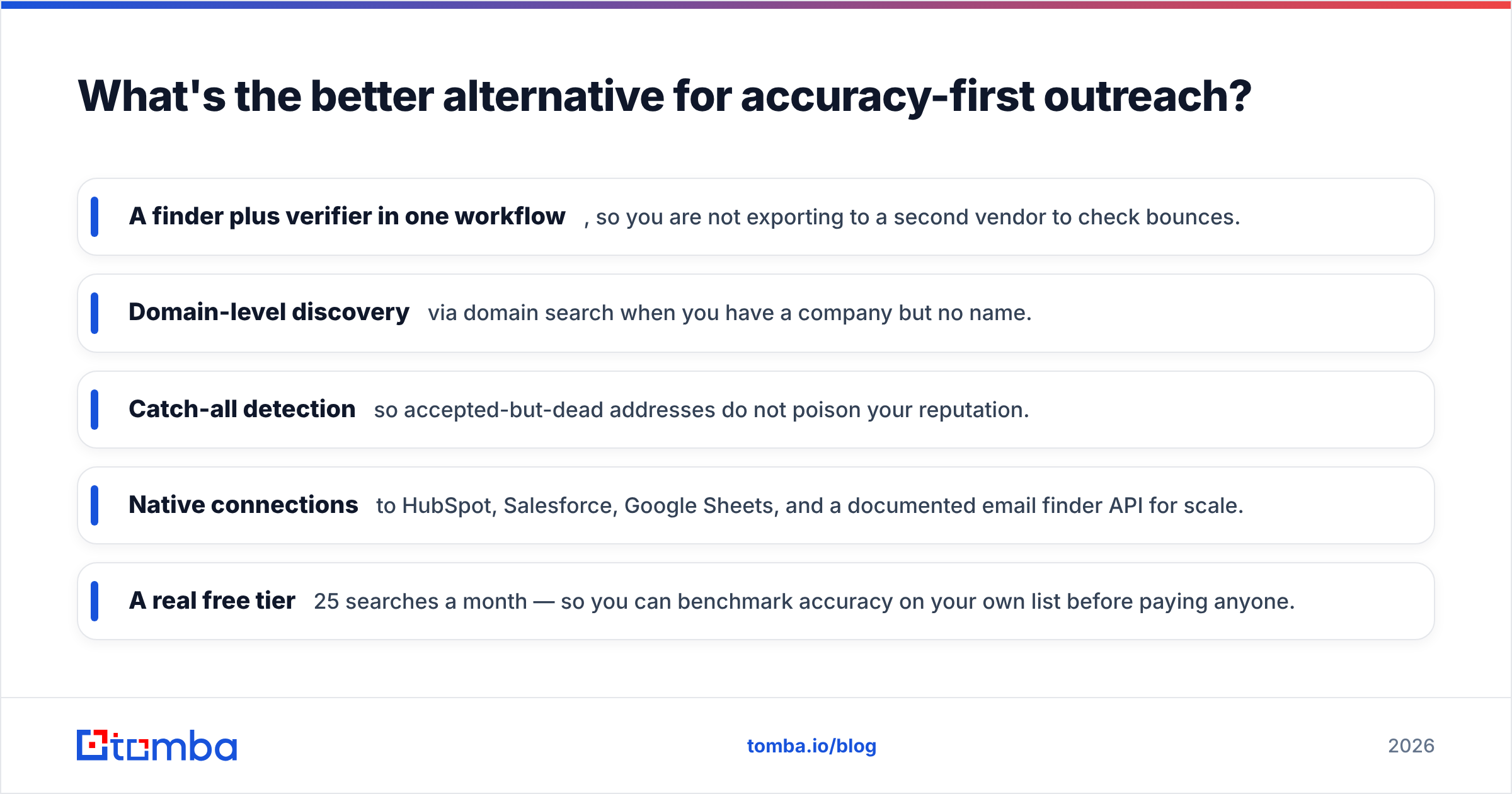
What's the better alternative for accuracy-first outreach?#
If your success metric is reply rate off a clean list, lead with a purpose-built email finder and treat technographics or suites as add-ons. A specialist tool concentrates its engineering on the one thing you actually get judged on: returning a real email and proving it is deliverable before you hit send.
That is the lane Tomba is built for. You get:
- A finder plus verifier in one workflow, so you are not exporting to a second vendor to check bounces.
- Domain-level discovery via domain search when you have a company but no name.
- Catch-all detection so accepted-but-dead addresses do not poison your reputation.
- Native connections to HubSpot, Salesforce, Google Sheets, and a documented email finder API for scale.
- A real free tier — 25 searches a month — so you can benchmark accuracy on your own list before paying anyone.
None of that makes Datanyze or Finderio bad tools. It means they are optimized for different jobs, and if your job is deliverable outbound, you should test against a finder that optimizes for exactly that.

Datanyze vs Finderio: the verdict#
There is no single winner — there is a winner for your workflow:
- Choose Datanyze if technology-based targeting drives your list building and you will add verification separately.
- Choose Finderio if you already pay for 500apps and your outreach volume is light.
- Choose a dedicated finder like Tomba if verified deliverability is the metric your pipeline lives or dies by.
The honest move is to run the same 50-lead sample through all three and measure verified hit rate and bounce rate yourself. Vendor accuracy claims are marketing; your test list is evidence. You can also cross-reference third-party reviews on Capterra before you decide.
Start with a free, verified test#
Before you commit a budget to any of these, prove the accuracy on your own leads. Spin up a free Tomba account, run your toughest 25 prospects through the Tomba Email Finder, and compare the verified hit rate against whatever you get from Datanyze or Finderio. If the deliverable emails come back cleaner and cheaper, you have your answer — backed by your data, not a sales page.
Related guides#
Ready to find emails that actually work?
Join 150,000+ professionals who stopped guessing and started sending. Free credits on signup — no credit card required.
Get the Tomba newsletter
Practical outbound tactics and product updates — once every two weeks.
About the author