Datanyze vs Leadzenai (2026): Which B2B Data Tool Wins?
Datanyze and Leadzen.ai both promise clean B2B contact data — but they solve different problems. Here's an honest, side-by-side breakdown of accuracy, pricing, and fit for 2026 outbound.
The Datanyze vs Leadzenai choice comes down to one question you won't see on either pricing page. Do you need technographics on US-based accounts? Or broad contact discovery in emerging markets? Both tools get lumped together as "B2B data providers." But they were built for almost opposite jobs. Pick wrong, and you pay for coverage you never touch.
This is a neutral, side-by-side look at how they compare in 2026. We cover data accuracy, pricing, coverage, and workflow. We also show where a dedicated email-finding stack beats both.
TL;DR: Datanyze vs Leadzen.ai at a glance#
- Datanyze is a technographics-first tool. It's strongest when you target accounts by the software they run — CRM, ad tech, or e-commerce platform. You then grab a contact's email or phone from a Chrome extension.
- Leadzen.ai is an AI-driven lead-discovery platform. It offers deep India and APAC coverage, real-time search, and enrichment. The focus is high-volume prospecting.
- Accuracy is uneven on both. Technographic signals age, and any database decays 2–3% per month. So verification is non-negotiable, whichever you buy.
- Pricing favors Leadzen.ai for volume prospecting. Datanyze's credit model gets expensive fast for teams pulling thousands of contacts.
- If your core need is finding and verifying professional emails at scale, keep it simple. A focused tool like the Tomba Email Finder plus an email verifier often beats platform prices for features you won't use.
What is Datanyze and who is it for?#
Datanyze (owned by ZoomInfo) is a lightweight sales-intelligence tool. It's built around two ideas: technographics and a browser extension. Technographics means data about the technology a company uses. Does an account run Shopify or Magento? HubSpot or Salesforce? Which ad networks do they buy? If your pitch only lands when the prospect uses a specific stack, that signal is gold.
The day-to-day workflow is the Chrome extension. You land on a company website or LinkedIn profile and click the icon. Datanyze then surfaces contact details plus firmographic and technographic context. It's built for a rep working one account at a time. It's not for a growth team pulling 10,000 rows into a sequence.
Datanyze fits best when:
- You sell to a tech-defined ICP — martech, adtech, e-commerce apps, or integrations where the buyer's existing stack decides fit.
- Your motion is account-by-account, with reps researching in-browser rather than bulk-exporting lists.
- You're mostly targeting North American mid-market and enterprise, where Datanyze's coverage is deepest.
You can read its own positioning on the Datanyze site. Cross-check user sentiment on G2 before committing.

What is Leadzen.ai and who is it for?#
Leadzen.ai is a newer, AI-first lead-generation platform. It focuses on real-time search and enrichment breadth. Datanyze leans on a curated technographic layer. Leadzen.ai pitches dynamic discovery instead. You describe an audience, and it assembles matching contacts with emails, phone numbers, and firmographic context. It often pulls fresh signals rather than a static snapshot.
Its standout is geographic coverage in India and wider APAC. Say you're prospecting into Indian SMBs, startups, or regional enterprises. Leadzen.ai typically returns more usable records than US-centric databases. Those databases thin out fast outside North America and Western Europe. See the official Leadzen.ai homepage for its current feature set.
Leadzen.ai fits best when:
- You run high-volume outbound and need thousands of contacts, not one-at-a-time lookups.
- Your market skews toward India/APAC, where its density beats legacy US providers.
- You want phone-first outreach — its number coverage is a genuine strength for regions where calling still outperforms email.

Datanyze vs Leadzenai: the head-to-head table#
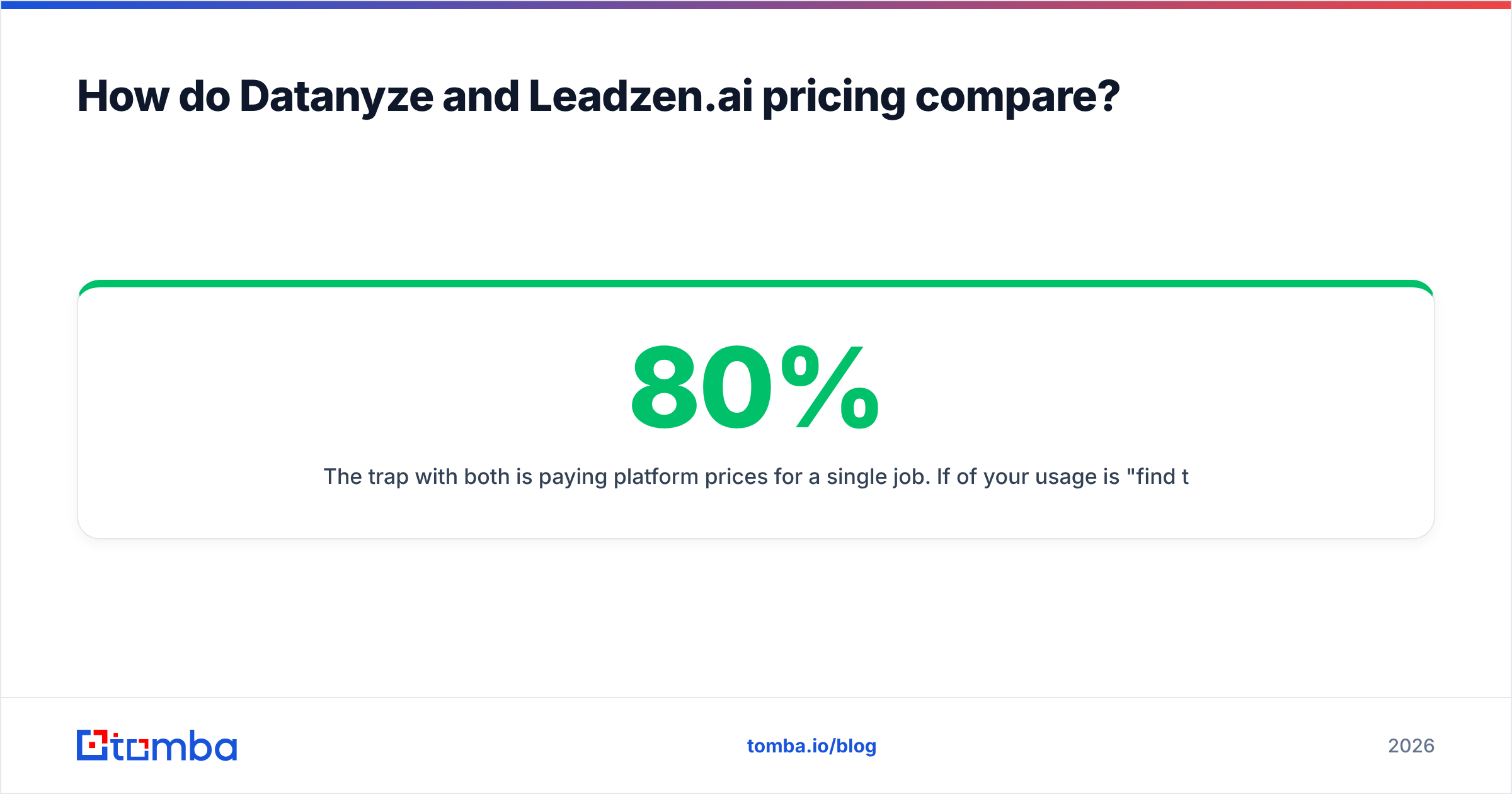
Here's the honest side-by-side. Treat vendor-published accuracy claims skeptically. Independent tests almost always land lower than marketing pages.
| Attribute | Datanyze | Leadzen.ai |
|---|---|---|
| Primary strength | Technographics + browser lookups | AI real-time search + enrichment |
| Best geography | North America | India / APAC |
| Workflow | One account at a time (extension) | Bulk discovery + lists |
| Phone coverage | Moderate | Strong (regional) |
| Technographic data | Yes (core feature) | Limited |
| Typical buyer | AE/SDR researching accounts | Growth teams, agencies |
| Bulk export | Limited on lower tiers | Built for volume |
| Free option | Limited trial | Trial / limited free tier |
| Data freshness model | Periodic snapshot | Real-time leaning |
The pattern is clear. Datanyze wins on why to target an account. Leadzen.ai wins on how many contacts you can pull. Neither is a universal winner. They optimize for different halves of the prospecting job.
Which has better data accuracy in 2026?#
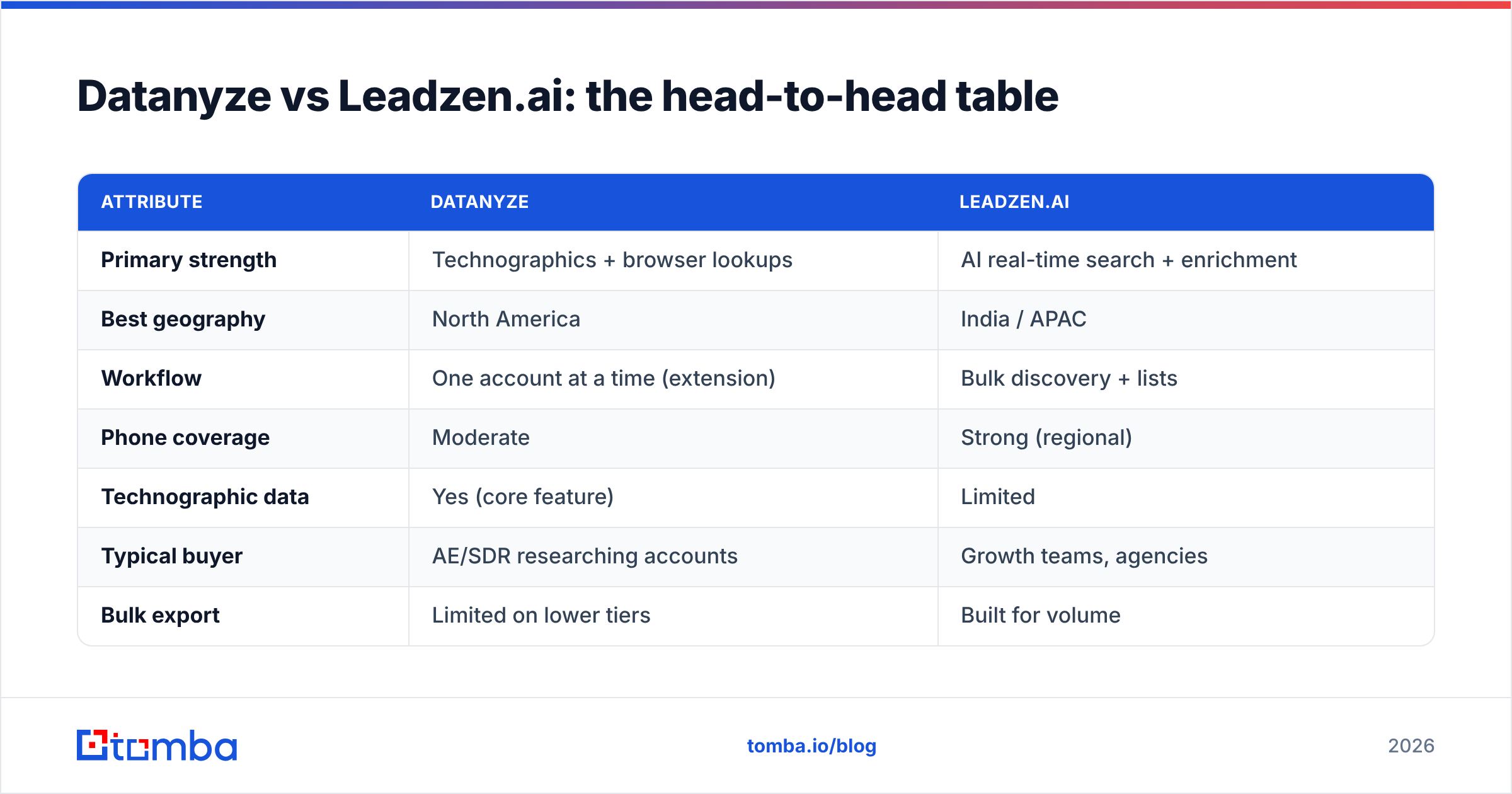
Neither tool escapes one fundamental problem. B2B contact data decays roughly 2–3% every month. People change jobs, companies rebrand, and domains migrate. A database that's 95% accurate at capture is closer to 70% a year later. That's what happens when it isn't re-verified.
Datanyze's technographic signals add a second decay problem. A company that ran a given platform six months ago may have migrated off it. So a "uses Salesforce" tag can be stale even when the contact record is fine. For tech-triggered plays, verify the signal as well as the email.
Leadzen.ai's real-time leaning helps freshness on discovery. But breadth in fast-growing markets has a cost. More catch-all domains and unverifiable addresses slip through. That's where a catch-all verifier earns its keep, before you load anything into a sequence.
The practical takeaway is simple. Whichever you choose, verify every address before sending. Bouncing 15% of a list doesn't just waste sends. It drags down your domain's sender reputation. It also quietly caps deliverability on the good addresses. A dedicated email verification pass is cheap insurance. The problem it prevents is expensive to reverse.

How do Datanyze and Leadzen.ai pricing compare?#
Both vendors keep pricing partly gated behind sales calls. Both use credit or contact-based models. That makes total cost hard to predict. Here's the general shape as of 2026:
- Datanyze sells credit packs tied to contact reveals. Light research use is affordable. But per-contact economics get steep once a team pulls thousands of records a month. You end up paying enterprise-adjacent rates for a lightweight tool.
- Leadzen.ai structures around search and enrichment volume. It tends to be more forgiving for high-throughput prospecting, especially in its home markets.
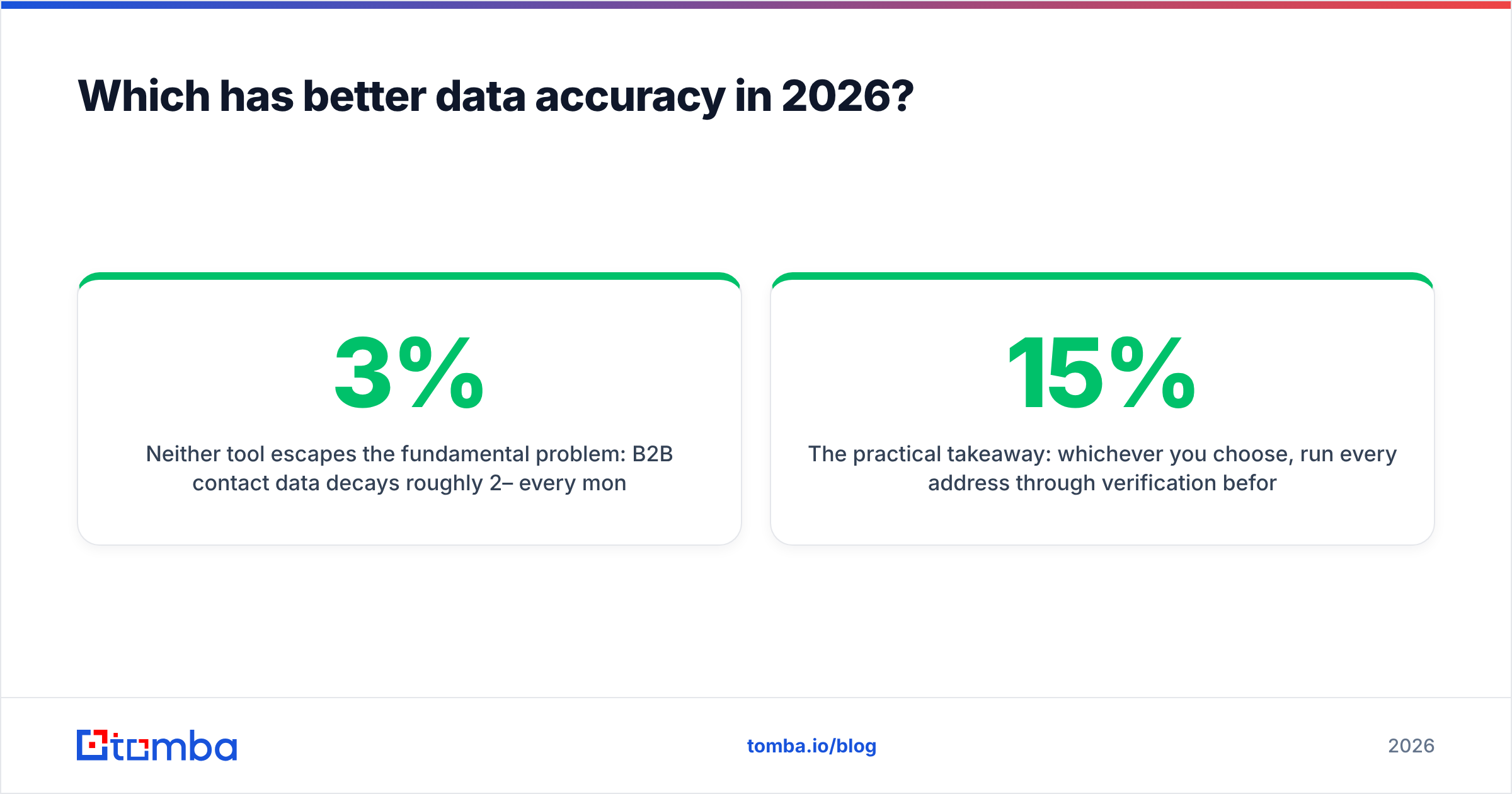
The trap with both is paying platform prices for a single job. Say 80% of your usage is "find this person's verified email." Then you're subsidizing technographic databases or AI-search infrastructure you barely touch. For pure email discovery and verification, compare their per-contact cost against transparent Tomba pricing. It runs Free (25 searches/mo), Starter at $49/mo, Growth at $99/mo, and Pro at $249/mo. You pay for finding and verifying emails, and nothing else.

Datanyze vs Leadzen.ai: pros and cons#
Datanyze — pros
- Best-in-class technographic targeting for tech-defined ICPs
- Fast, low-friction browser workflow for reps
- Backed by ZoomInfo's data infrastructure
Datanyze — cons
- North-America-centric coverage thins out globally
- Credit costs escalate quickly at volume
- Not built for bulk list-building or enrichment ops
Leadzen.ai — pros
- Strong India/APAC coverage most US tools lack
- Built for high-volume, real-time discovery
- Competitive phone-number data for calling motions
Leadzen.ai — cons
- Limited technographic depth
- Broad coverage means more catch-alls to verify
- Smaller ecosystem of native integrations than incumbents
When should you skip both and use a dedicated email finder?#
Skip both when your actual job is narrower than "sales intelligence platform." A lot of teams buy Datanyze or Leadzen.ai. Then they realize they only ever use one feature: getting a verified professional email for a name and company. That's a solved problem. It doesn't require a five-figure platform commitment.
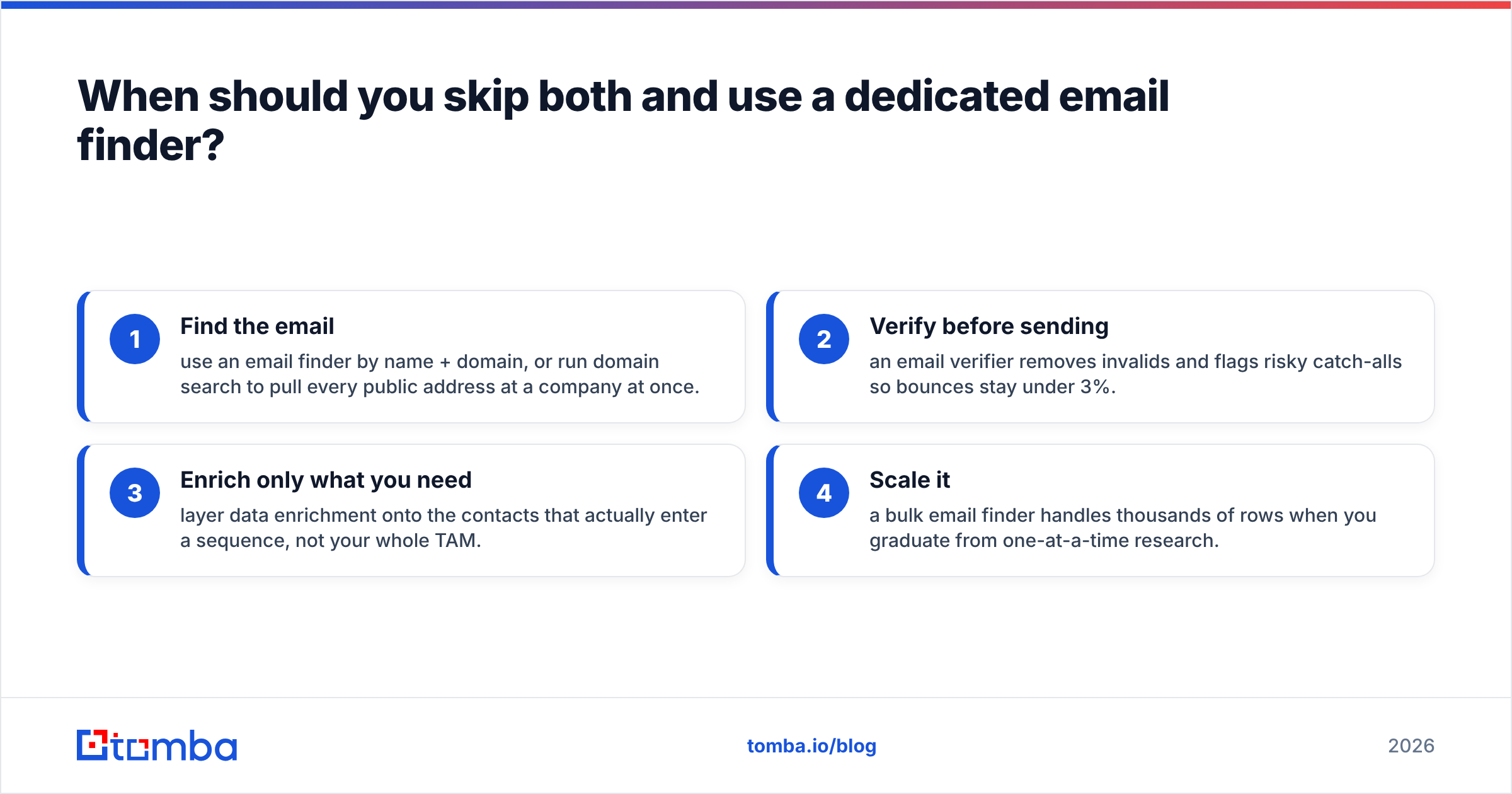
A focused stack looks like this:
- Find the email — use an email finder by name and domain. Or run domain search to pull every public address at a company at once.
- Verify before sending — an email verifier removes invalids and flags risky catch-alls. Bounces stay under 3%.
- Enrich only what you need — layer data enrichment onto the contacts that enter a sequence, not your whole TAM.
- Scale it — a bulk email finder handles thousands of rows when you graduate from one-at-a-time research.
Here the two platforms and a tool like Tomba stop being competitors. They become complementary. Use Datanyze for technographic triggers. Use Leadzen.ai for APAC discovery. Use a dedicated finder-plus-verifier to confirm the emails you send to are real. Many teams find the last layer is the only one they can't skip.
Which should you choose?#
Here's the Datanyze vs Leadzenai decision in two lines. Choose Datanyze if your ICP is defined by its tech stack and you sell into North America. Choose Leadzen.ai if you run volume outbound into India or APAC and want phone-first coverage. If your real need is verified emails at a predictable cost, a dedicated finder wins. It beats platform prices for features you'll never open.
- Tech-triggered, NA, account-by-account → Datanyze
- High-volume, India/APAC, phone + email → Leadzen.ai
- Just verified emails, transparent pricing → dedicated email finder + verifier
Whatever you pick for discovery, don't let unverified data reach your sending domain. Start free with the Tomba Email Finder. Find professional emails by name, company, or domain. Then verify every address before it hits a sequence. It's the one layer that protects deliverability, whichever intelligence platform you choose. Twenty-five searches a month cost nothing. So you can benchmark accuracy against Datanyze or Leadzen.ai on your own list before spending a dollar.
Related guides#
Ready to find emails that actually work?
Join 150,000+ professionals who stopped guessing and started sending. Free credits on signup — no credit card required.
Get the Tomba newsletter
Practical outbound tactics and product updates — once every two weeks.
About the author