Datanyze vs Ninjapear (2026): Which B2B Data Tool Wins?
An honest, side-by-side breakdown of Datanyze vs Ninjapear on data accuracy, pricing, and prospecting features — plus where each one quietly falls short.
Choosing between Datanyze and Ninjapear usually comes down to one question your budget owner will ask later: how many of these emails actually landed? Both tools promise clean B2B contact data and faster prospecting. They get there in very different ways, and the gap shows up in your bounce rate, not the sales demo.
This is a neutral, feature-by-feature comparison — no vendor spin. You'll get the pricing, the accuracy trade-offs, the ideal user for each, and an honest note on where a purpose-built email finder beats both.
TL;DR — Datanyze vs Ninjapear at a glance#
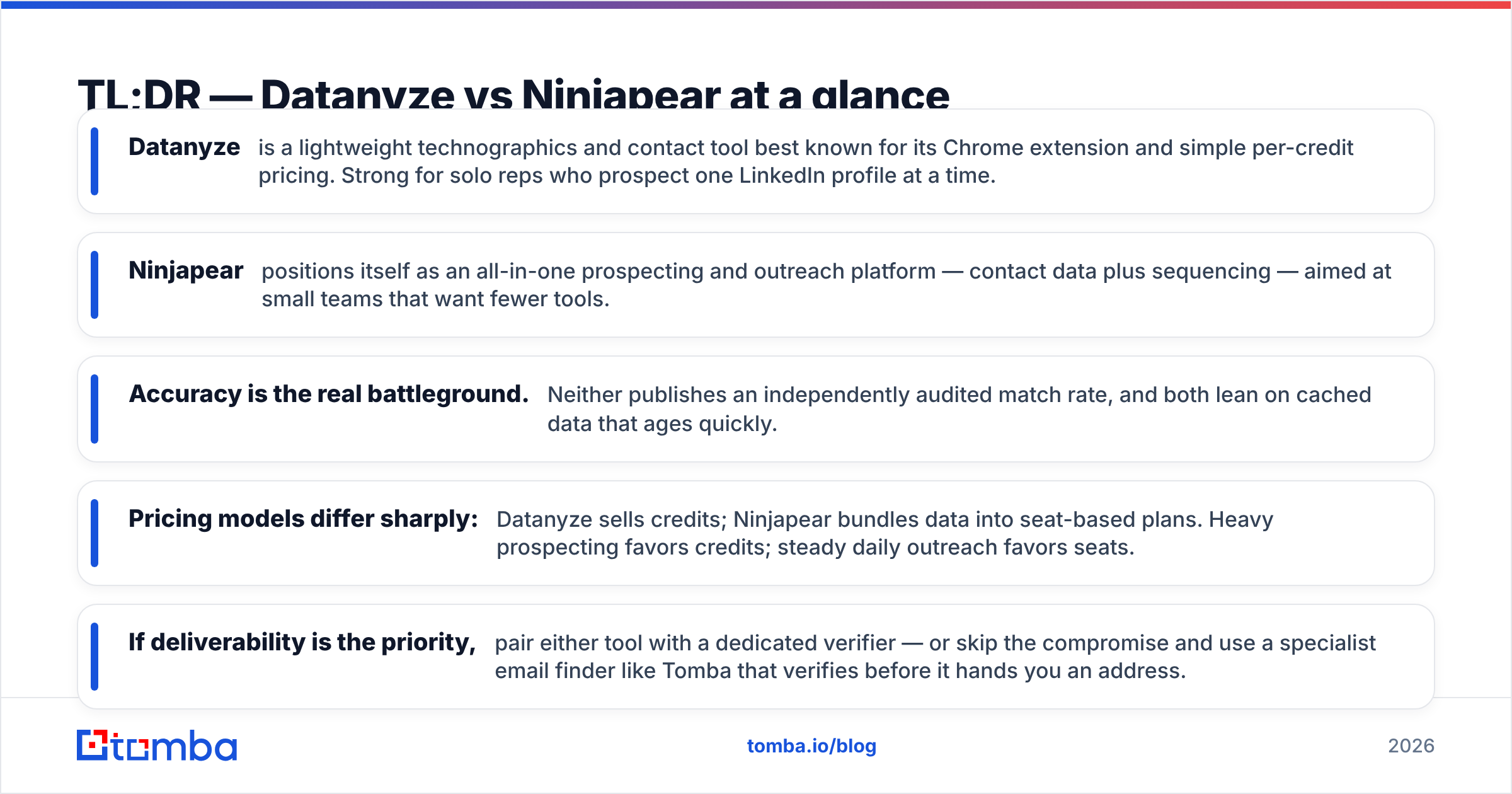
- Datanyze is a lightweight technographics and contact tool best known for its Chrome extension and simple per-credit pricing. Strong for solo reps who prospect one LinkedIn profile at a time.
- Ninjapear positions itself as an all-in-one prospecting and outreach platform — contact data plus sequencing — aimed at small teams that want fewer tools.
- Accuracy is the real battleground. Neither publishes an independently audited match rate, and both lean on cached data that ages quickly.
- Pricing models differ sharply: Datanyze sells credits; Ninjapear bundles data into seat-based plans. Heavy prospecting favors credits; steady daily outreach favors seats.
- If deliverability is the priority, pair either tool with a dedicated verifier — or skip the compromise and use a specialist email finder like Tomba that verifies before it hands you an address.
What is Datanyze?#
Datanyze is a sales-intelligence tool that grew up around technographics — data about the software a company runs. Today most people use it as a Chrome extension that surfaces a prospect's business email and phone number while you browse LinkedIn or a company website.
Its appeal is simplicity. You install the extension, click a profile, and Datanyze returns contact details drawn from its cached database. Credits are consumed per reveal, so the model is easy to reason about: you pay for what you pull.
Where Datanyze shows its age is depth. It was acquired and repositioned more than once, and its database refresh cadence isn't published. For accounts in fast-moving industries, that means a meaningful share of contacts have moved roles since the record was cached. It's a reveal tool, not a verification engine.
What is Ninjapear?#
Ninjapear markets itself as an all-in-one prospecting platform: find contacts, enrich them, and run outreach sequences without leaving the app. The pitch targets small sales teams tired of stitching together a finder, a verifier, and a separate sending tool.
That bundling is the draw and the risk. When one vendor owns finding, enrichment, and sending, a weakness in any layer quietly taxes the others. A slightly stale database plus an average verifier means more bounces feeding directly into sequences you're actively running — and bounces hit your sender reputation before you notice the pattern.
Ninjapear's seat-based pricing suits teams that prospect at a steady daily pace. It's less friendly to spiky, campaign-driven workflows where you might pull 5,000 contacts one week and none the next.
Datanyze vs Ninjapear: the core comparison#
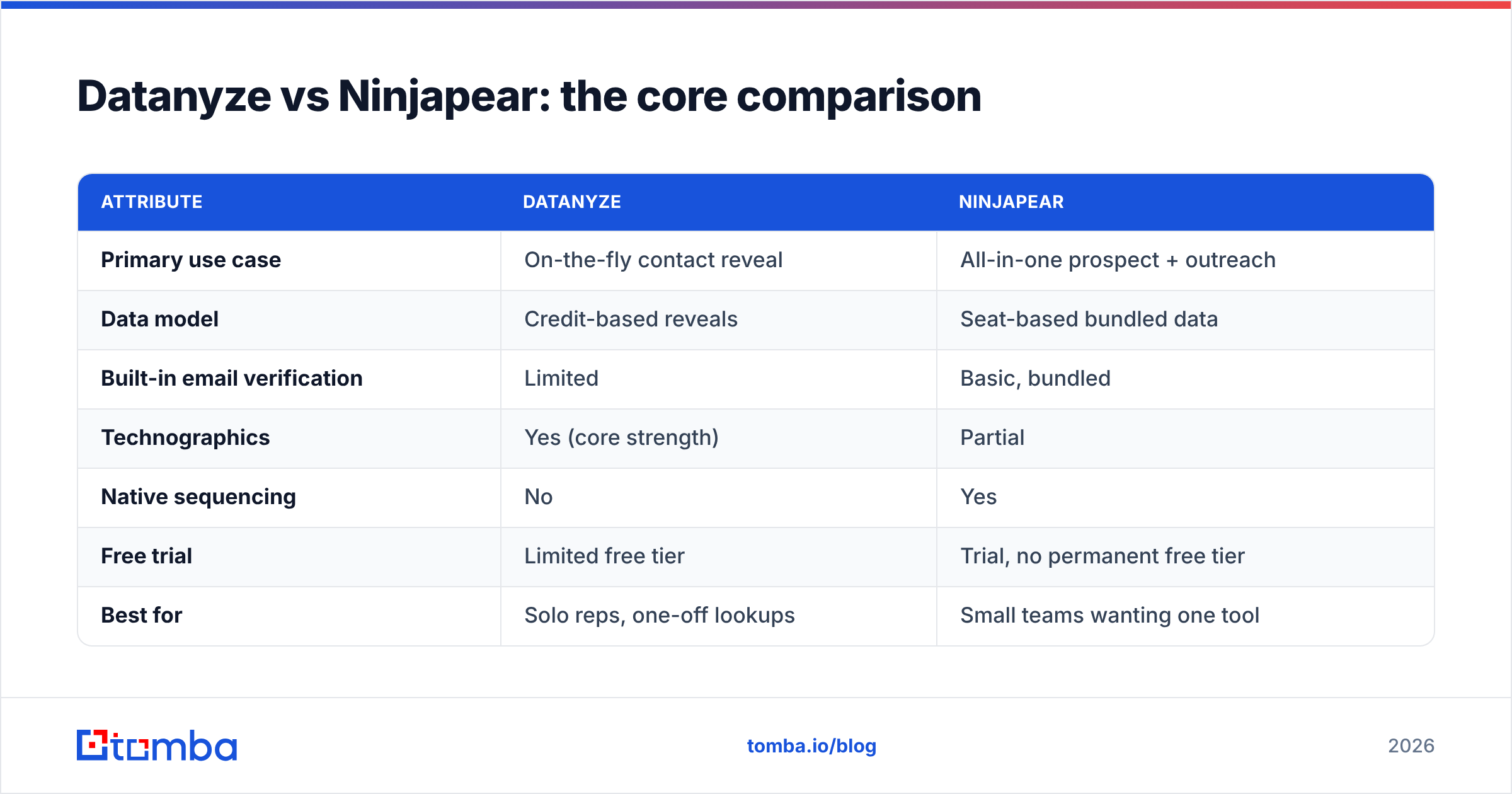
Here's the head-to-head on the attributes that actually change your results. Prices reflect publicly listed tiers at the time of writing; always confirm current rates on each vendor's site.
| Attribute | Datanyze | Ninjapear |
|---|---|---|
| Primary use case | On-the-fly contact reveal | All-in-one prospect + outreach |
| Data model | Credit-based reveals | Seat-based bundled data |
| Built-in email verification | Limited | Basic, bundled |
| Technographics | Yes (core strength) | Partial |
| Native sequencing | No | Yes |
| Free trial | Limited free tier | Trial, no permanent free tier |
| Best for | Solo reps, one-off lookups | Small teams wanting one tool |
| Weak spot | Data freshness | Verification depth |
The pattern is clear: Datanyze is a focused reveal utility, Ninjapear is a broader workflow suite. Neither is built primarily as an accuracy-first email engine, and that's the thread that runs through every column above.
Is Datanyze or Ninjapear more accurate?#
Accuracy is where marketing copy and inbox reality diverge — and neither tool publishes an independently verified match rate. That absence is itself the answer: when a vendor is confident in accuracy, they lead with the number.
Both rely on cached databases. A cached record is a snapshot; the moment a prospect changes jobs, it's wrong, and B2B data decays at roughly 2–3% per month. Without a real-time SMTP check at the moment of export, you inherit that decay directly into your campaigns.
This is exactly where a specialist tool separates from a generalist. A dedicated email verifier performs a live check — MX record, SMTP handshake, catch-all detection — before an address reaches your list. If you're evaluating any B2B data provider, ask the same three questions:
- What's the verified match rate, not the database size?
- How is each email checked at the point of export — cached status or live SMTP?
- How are catch-all domains handled — flagged honestly, or passed off as valid?

A tool that dodges question one is telling you it competes on volume, not deliverability. For cold outreach, deliverability wins every time — a smaller verified list beats a large unverified one, because every bounce chips at your domain reputation.

How does pricing compare?#
The two tools price data on opposite philosophies, and that choice matters more than the headline number.
- Datanyze — credit model. You buy reveals. Costs scale with usage, which rewards light or bursty prospecting but gets expensive at volume. Predictable if your pipeline is steady; punishing during a big campaign push.
- Ninjapear — seat model. You pay per user for bundled data and sending. Great when reps prospect daily at a consistent pace; wasteful for occasional or seasonal use, since idle seats still bill.
- Overage traps. Both models hide cost in the edges — Datanyze when a campaign spikes your reveals, Ninjapear when you add seats for light users who barely touch the tool.
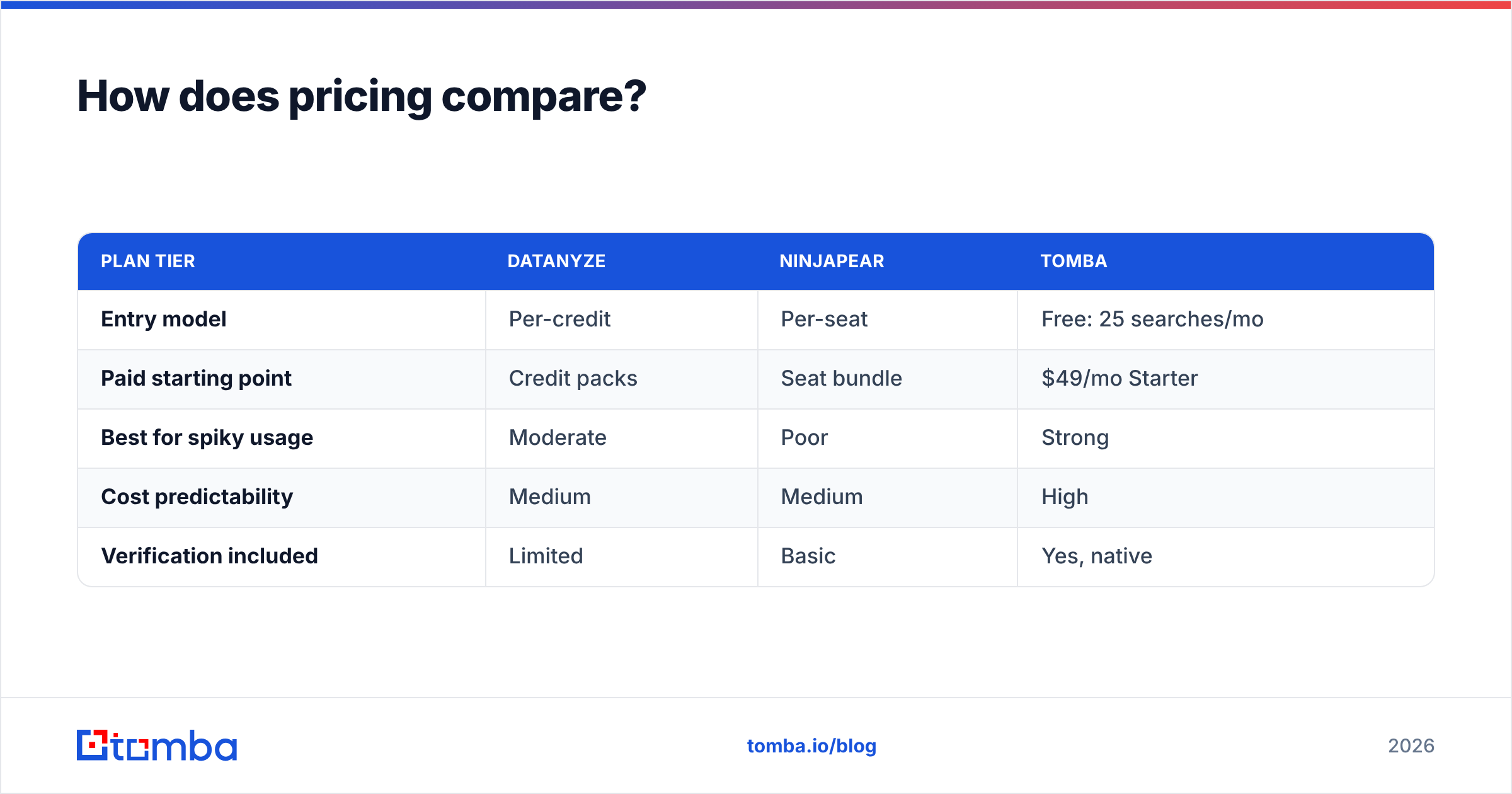
For reference, a purpose-built finder like Tomba uses transparent search-based tiers: a free plan with 25 searches/month, Starter at $49/mo, Growth at $99/mo, and Pro at $249/mo. You can compare the full Tomba pricing breakdown, but the point is structural — search-based pricing is easier to forecast than a hybrid of seats plus credit overages.
| Plan tier | Datanyze | Ninjapear | Tomba |
|---|---|---|---|
| Entry model | Per-credit | Per-seat | Free: 25 searches/mo |
| Paid starting point | Credit packs | Seat bundle | $49/mo Starter |
| Best for spiky usage | Moderate | Poor | Strong |
| Cost predictability | Medium | Medium | High |
| Verification included | Limited | Basic | Yes, native |
Which tool should you choose?#
Match the tool to how you actually work, not to the longest feature list.
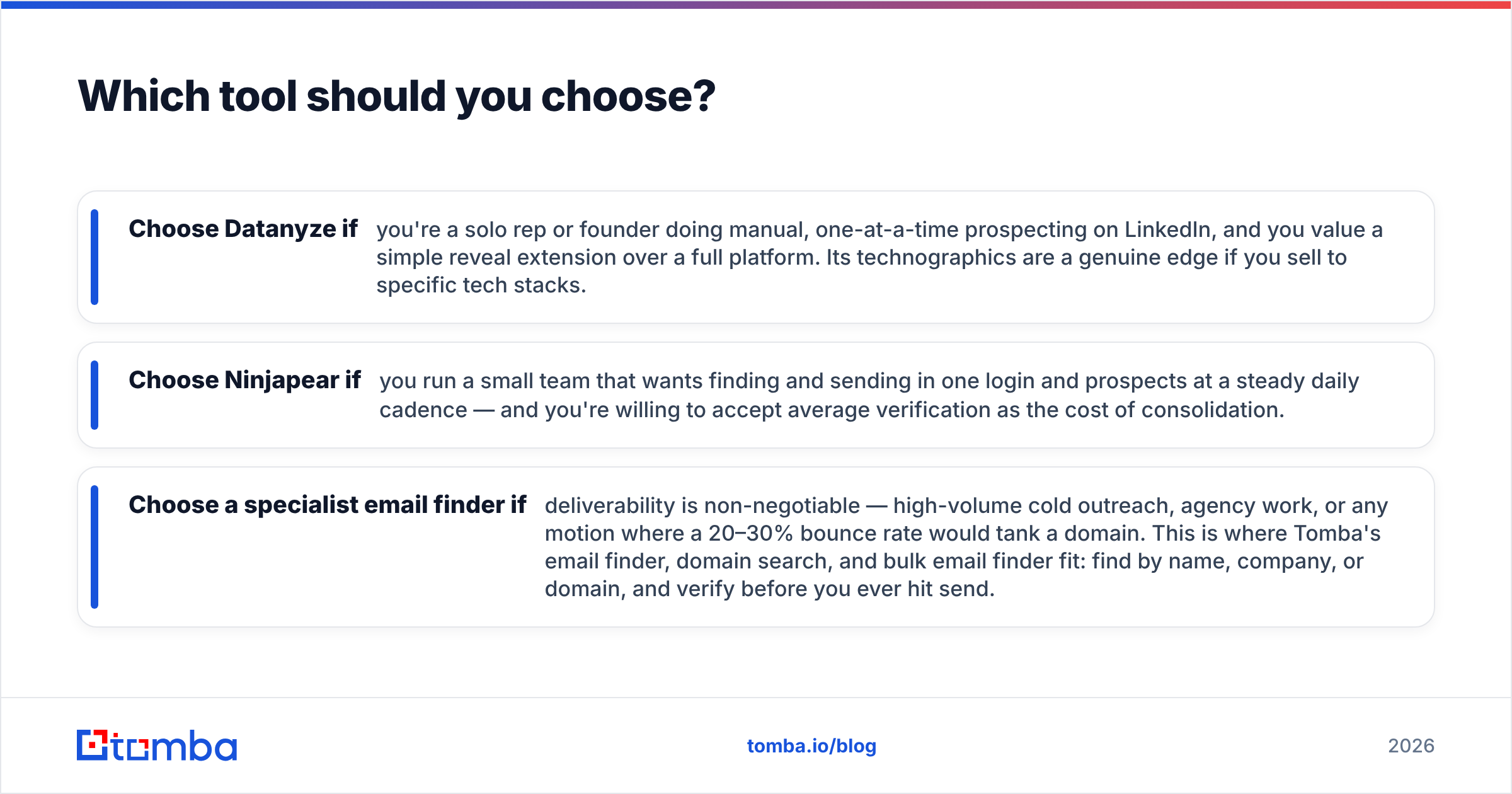
- Choose Datanyze if you're a solo rep or founder doing manual, one-at-a-time prospecting on LinkedIn, and you value a simple reveal extension over a full platform. Its technographics are a genuine edge if you sell to specific tech stacks.
- Choose Ninjapear if you run a small team that wants finding and sending in one login and prospects at a steady daily cadence — and you're willing to accept average verification as the cost of consolidation.
- Choose a specialist email finder if deliverability is non-negotiable — high-volume cold outreach, agency work, or any motion where a 20–30% bounce rate would tank a domain. This is where Tomba's email finder, domain search, and bulk email finder fit: find by name, company, or domain, and verify before you ever hit send.
A common and effective setup is layered — use Datanyze or Ninjapear for discovery inside your existing workflow, then run every list through a dedicated verifier and enrichment pass so only live, deliverable contacts reach your sequences. You can wire that in through Tomba's integrations with HubSpot, Pipedrive, and Zapier without changing your CRM.
Datanyze vs Ninjapear: honest pros and cons#
Datanyze
- Pros: Simple credit pricing, strong technographics, low-friction Chrome extension, good for one-off lookups.
- Cons: Unclear data freshness, limited native verification, weak for high-volume export, no sequencing.
Ninjapear
- Pros: All-in-one finding plus outreach, seat pricing suits steady teams, fewer tools to manage.
- Cons: Bundled verification is basic, seat model wastes budget on light users, consolidation hides a weak accuracy layer.
Neither is a bad tool. They're built for different buyers, and both share the same soft spot: verification is an afterthought, not the foundation. If your revenue depends on emails landing, that soft spot is the whole ballgame.
For a deeper look at how independent tests rank match rates across providers, third-party review sites like G2 and Capterra are worth scanning before you commit — filter reviews by company size closest to yours.
The bottom line#
Datanyze wins on simplicity for solo, in-browser prospecting. Ninjapear wins on consolidation for small teams that want one tool. But both treat verification as a feature to bundle rather than the core promise — and that's precisely what determines whether your campaign reaches inboxes or spam folders.
If accuracy and deliverability are what you're really shopping for, start with a tool built for exactly that. Tomba's email finder verifies every address before it reaches you, backs it with transparent search-based pricing starting free at 25 searches/month, and plugs into the CRM and outreach tools you already run. Try it on your next list, compare the bounce rate against your current provider, and let the numbers pick the winner.
Related guides#
Ready to find emails that actually work?
Join 150,000+ professionals who stopped guessing and started sending. Free credits on signup — no credit card required.
Get the Tomba newsletter
Practical outbound tactics and product updates — once every two weeks.
About the author