Datanyze vs SalesIntel (2026): Which B2B Data Tool Wins?
Datanyze vs SalesIntel compared on data accuracy, coverage, technographics, and price. See which B2B data tool fits your GTM stack in 2026 — and the cheaper way to fill the gaps.
Choosing between Datanyze and SalesIntel usually comes down to one question you can't answer from a pricing page: do you need technographic signals to target accounts, or verified contacts to reach the humans inside them? These two tools sit on opposite ends of that spectrum, and picking the wrong one means paying for data you'll never use.
This comparison breaks down where each tool actually earns its keep in 2026 — accuracy, coverage, technographics, phone data, integrations, and real cost — so you can match the tool to your motion instead of the marketing.
TL;DR: Datanyze vs SalesIntel at a glance#
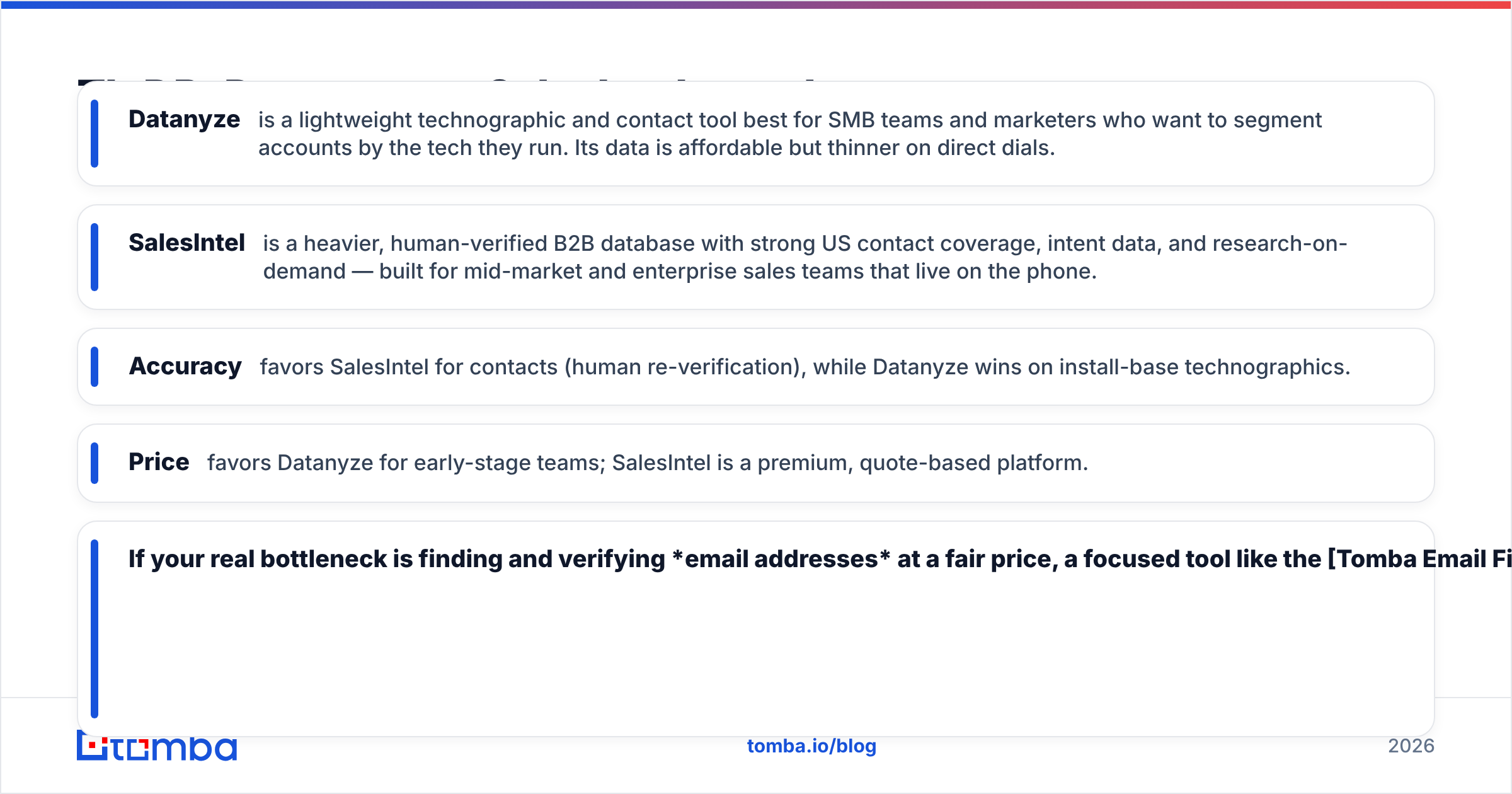
- Datanyze is a lightweight technographic and contact tool best for SMB teams and marketers who want to segment accounts by the tech they run. Its data is affordable but thinner on direct dials.
- SalesIntel is a heavier, human-verified B2B database with strong US contact coverage, intent data, and research-on-demand — built for mid-market and enterprise sales teams that live on the phone.
- Accuracy favors SalesIntel for contacts (human re-verification), while Datanyze wins on install-base technographics.
- Price favors Datanyze for early-stage teams; SalesIntel is a premium, quote-based platform.
- If your real bottleneck is finding and verifying email addresses at a fair price, a focused tool like the Tomba Email Finder often beats bolting on a full data suite you'll only half-use.
What is Datanyze and who is it for?#
Datanyze is a technographics-first prospecting tool. Its original claim to fame was detecting which technologies a website runs — analytics, ecommerce platforms, ad tech, chat widgets — and letting you build target lists around those signals. Over time it added a Chrome extension that surfaces contact emails and direct dials while you browse LinkedIn or company sites.
The core buyer is a marketer or SMB SDR who wants to answer "which companies use Shopify and HubSpot?" and then grab a contact or two without a heavyweight contract. Datanyze leans on a credit-based model and a genuinely usable free trial, which makes it approachable for solo founders and small teams.
Where it gets thin: contact depth. Datanyze can hand you a plausible email pattern and some direct dials, but it doesn't run the same human re-verification cycle that its heavier competitors do. For low-volume outreach that's fine. For a 20-rep team dialing all day, gaps add up fast. You can learn more on the official Datanyze site.
What is SalesIntel and who is it for?#
SalesIntel is a human-verified contact and company database aimed squarely at mid-market and enterprise revenue teams. Its differentiator is a "research-on-demand" model: if a contact you need isn't in the database, SalesIntel's research team will source and verify it for you. Combine that with re-verification every 90 days, buyer intent data (via a Bombora partnership), and firmographic/technographic filters, and you get a platform designed to feed a full outbound machine.
SalesIntel's sweet spot is US-based, phone-heavy sales. Its direct-dial coverage in North America is a frequent reason teams pick it over cheaper alternatives. The tradeoff is cost and commitment: pricing is quote-based, annual, and clearly aimed at funded sales orgs rather than side projects. You can review its positioning on G2, where verified-contact accuracy is the most-praised attribute.
Datanyze vs SalesIntel: full comparison table#
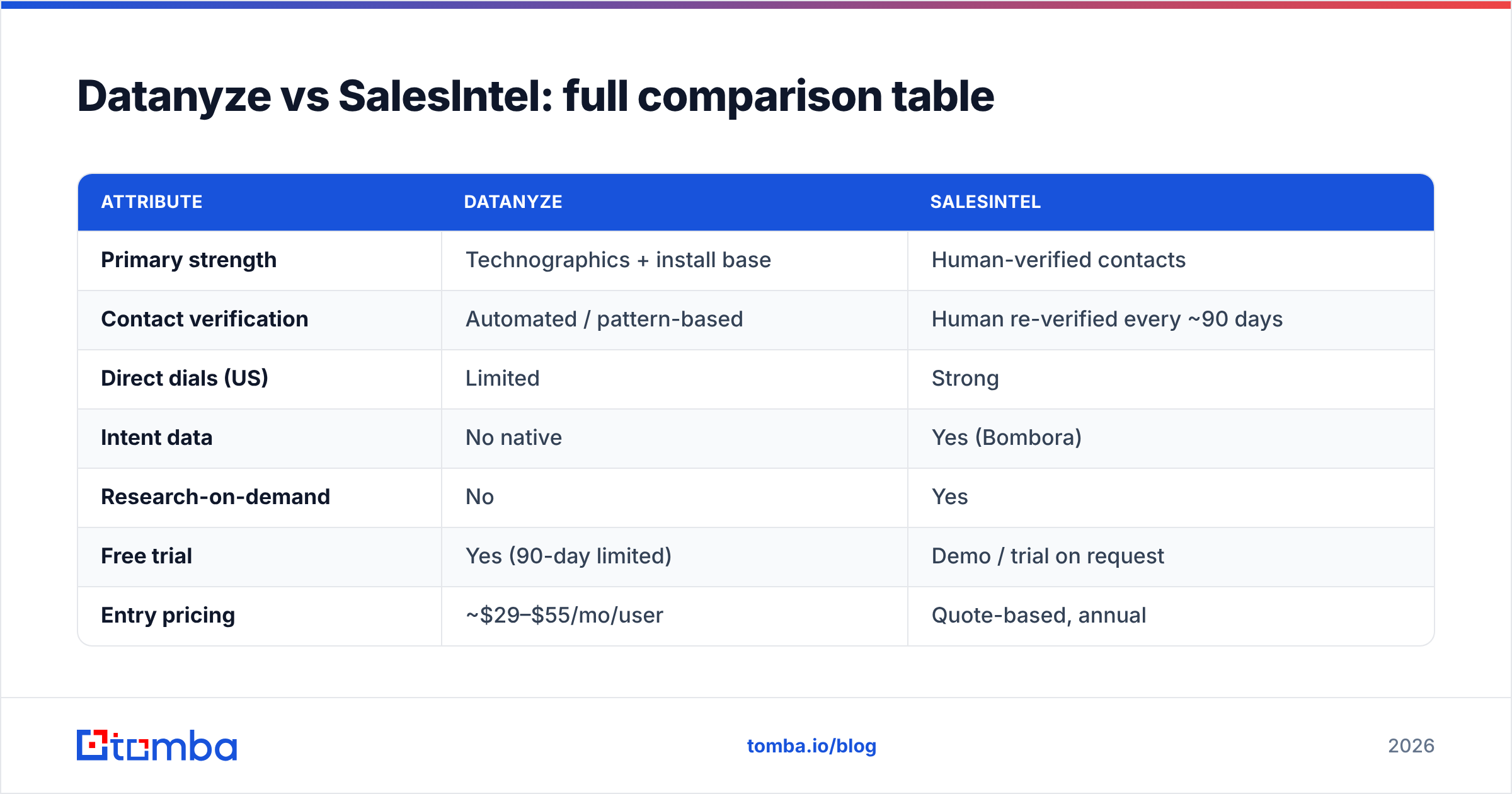
Here's the head-to-head on the attributes that actually change your pipeline. Treat the pricing as directional — SalesIntel is quote-based and both vendors adjust tiers.
| Attribute | Datanyze | SalesIntel |
|---|---|---|
| Primary strength | Technographics + install base | Human-verified contacts |
| Contact verification | Automated / pattern-based | Human re-verified every ~90 days |
| Direct dials (US) | Limited | Strong |
| Intent data | No native | Yes (Bombora) |
| Research-on-demand | No | Yes |
| Free trial | Yes (90-day limited) | Demo / trial on request |
| Entry pricing | ~$29–$55/mo/user | Quote-based, annual |
| Best fit | SMB, marketers, solo SDRs | Mid-market & enterprise sales |
| International coverage | Moderate | US-heavy |
The pattern is clear: Datanyze is a scalpel for account targeting, SalesIntel is a platform for account penetration. Neither is strictly "better" — they solve different problems at different price points.
Which has better data accuracy?#
SalesIntel wins on contact accuracy; Datanyze wins on technographic accuracy. That split matters more than a single headline percentage.
SalesIntel's human-in-the-loop verification is its whole pitch. Because researchers re-check records on a rolling cycle, bounce rates on its direct emails and phone numbers tend to be lower than fully automated databases — which is why phone-first teams tolerate the premium price. Think of it like a library that pays staff to walk the shelves and pull outdated books, versus one that trusts the catalog.
Datanyze's accuracy story is strongest at the company layer. Its technology-detection crawler is mature, so if you filter for "companies running Marketo," the install-base data is dependable. At the contact layer, Datanyze relies more on inference and email patterns, so you'll want a verification step before you send at volume. That's where a dedicated email verifier earns its place in the stack regardless of which platform you choose — clean lists protect your sender reputation and keep you out of spam traps.
One caveat worth stating plainly: every vendor's "95% accurate" claim is measured differently. Test both on your ICP with a small sample before committing to an annual deal. Data quality is regional and vertical-specific.
Which has better coverage and technographics?#
If technographics drive your segmentation, this is the deciding section.
Datanyze was built around technographics, and it shows. Its detection covers a broad set of web technologies and updates frequently, making it the stronger pick for marketers running ABM plays keyed to specific platforms ("target every company that just added a competitor's chat widget").
SalesIntel also offers technographic filters, but they're one feature inside a broader contact platform rather than the main event. Where SalesIntel pulls ahead is contact coverage depth in the US, plus firmographic and intent layers that Datanyze doesn't natively match.
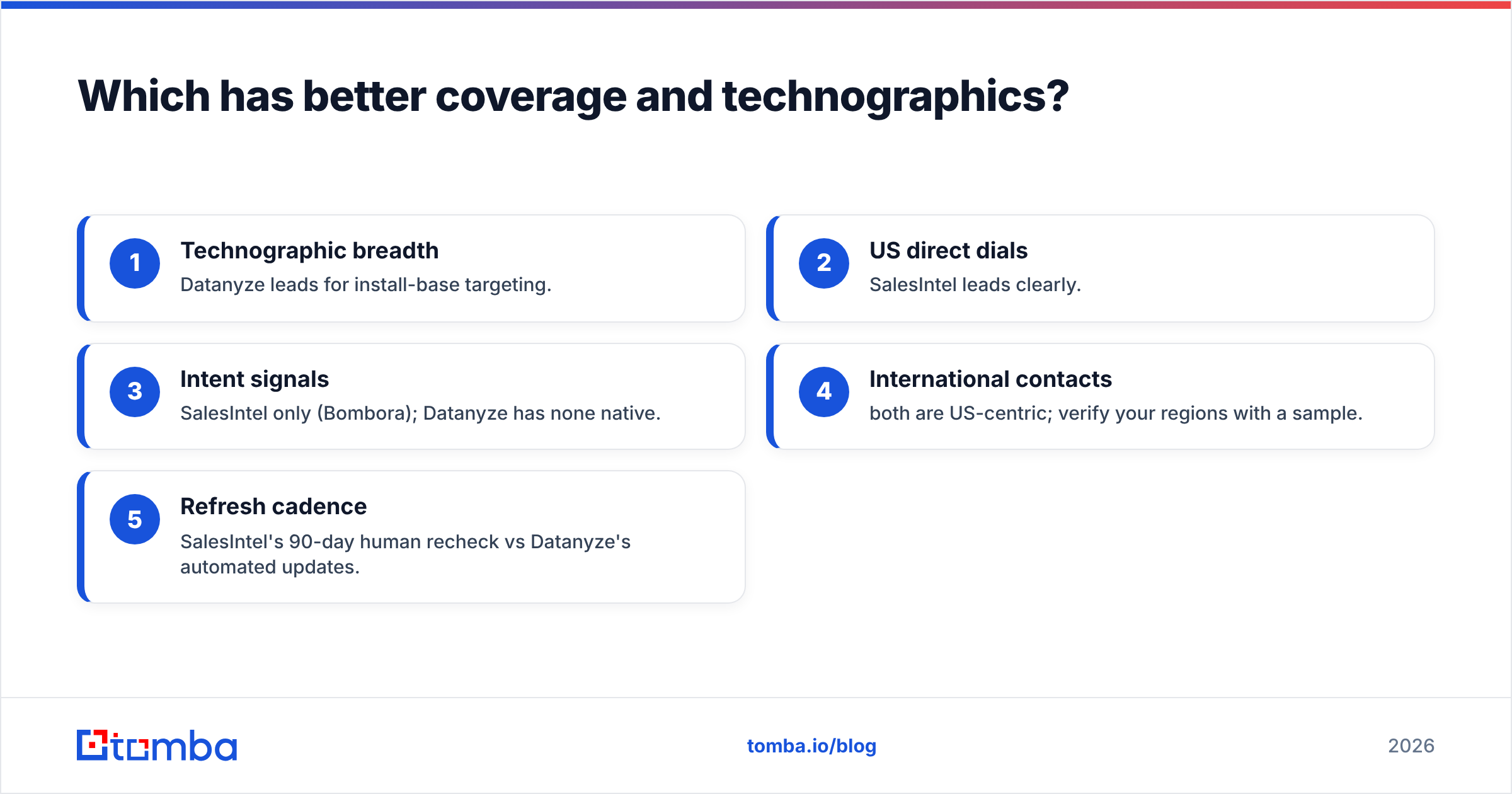
Consider these five coverage dimensions when you evaluate:
- Technographic breadth — Datanyze leads for install-base targeting.
- US direct dials — SalesIntel leads clearly.
- Intent signals — SalesIntel only (Bombora); Datanyze has none native.
- International contacts — both are US-centric; verify your regions with a sample.
- Refresh cadence — SalesIntel's 90-day human recheck vs Datanyze's automated updates.
For teams that need to reach decision-makers by email across many domains, neither tool is purpose-built for high-volume discovery. That's the job of a domain search that returns every public email pattern for a company in one call — a complement to, not a replacement for, an intent platform.
Datanyze vs SalesIntel: pricing and real cost#
Pricing is where the two diverge hardest, and where buyers most often over-purchase.
Datanyze publishes accessible, near-self-serve tiers in the roughly $29–$55 per user per month range, plus a genuine free trial. That transparency is a real advantage for a small team that wants to start today without a sales call.
SalesIntel is quote-based and annual. You won't find a public price because packaging depends on seats, credits, intent, and research-on-demand volume. Expect a mid-four-figure-and-up annual commitment — reasonable if you'll use the verification and phone data heavily, expensive if you won't.
| Cost factor | Datanyze | SalesIntel |
|---|---|---|
| Model | Monthly / credit-based | Annual, quote-based |
| Free entry | 90-day limited trial | Demo on request |
| Commitment | Low | High (annual) |
| Overage risk | Credit top-ups | Negotiated |
| Best for budget | SMB / startups | Funded sales orgs |
The honest framing: if your bottleneck is finding and verifying reachable contacts rather than consuming intent data, paying enterprise prices for a full platform is overkill. A focused finder plus verifier stack — see Tomba pricing, where the Starter plan is $49/mo — often covers 80% of the outbound need at a fraction of a seat-based enterprise contract. And for teams that need dials, a dedicated phone finder can slot in without buying an entire suite.
Integrations and workflow fit#
Both tools plug into the usual suspects — Salesforce and HubSpot CRMs, plus Chrome extensions for on-page prospecting. SalesIntel's integration story is deeper on the enterprise side (RevDriver extension, CRM enrichment, intent routing), matching its buyer. Datanyze keeps it lightweight, which suits a smaller stack.
If your workflow lives in a CRM, confirm the sync is native and bidirectional before you buy; check vendor docs like the HubSpot integrations directory rather than trusting a sales rep's demo. A tool that only exports CSVs will quietly cost you hours every week. Whatever you pick, a clean data enrichment step keeps CRM records from rotting between vendor refresh cycles.
When should you skip both and use a focused finder?#
Skip the full-suite decision entirely when your actual job is narrow: you have a list of target companies and you need verified emails (and maybe phones) to reach specific people. That's not a technographics problem or an intent problem — it's a finding problem, and finders do it cheaper and faster.
Reach for a dedicated email-finder stack when:
- You're volume-bound, not signal-bound — you know who to target; you just need contact details.
- Budget is tight — you can't justify an annual enterprise seat for a two-rep team.
- You need API access — piping contacts into your own tooling via an email finder API beats manual exports.
- Deliverability is the priority — verified emails protect your domain reputation from day one.
Datanyze and SalesIntel are legitimately good at what they specialize in. But plenty of teams buy them to solve a finding problem they could solve for less.
The verdict: Datanyze vs SalesIntel#
Pick Datanyze if you're an SMB or marketing team that segments accounts by technology and wants low-commitment, transparent pricing. Pick SalesIntel if you're a mid-market or enterprise sales org that lives on the phone, needs human-verified US contacts, and will genuinely use intent and research-on-demand.
But if you read this whole comparison and realized your real need is simply accurate, affordable, verified contact data at scale — start with the Tomba Email Finder. Search by domain, name, or company, verify in the same workflow, and export straight into your CRM without an annual enterprise contract. Try it free with 25 searches a month, then scale to the plan that matches your outbound volume — no quote call required.
Related guides#
Ready to find emails that actually work?
Join 150,000+ professionals who stopped guessing and started sending. Free credits on signup — no credit card required.
Get the Tomba newsletter
Practical outbound tactics and product updates — once every two weeks.
About the author