Datanyze vs Tami AI (2026): Which B2B Data Tool Wins?
Datanyze vs Tami AI, compared head-to-head on data accuracy, pricing, coverage, and workflow fit — plus a leaner alternative for teams that just need verified contact data.
Choosing between Datanyze and Tami AI comes down to one question: do you need technographic targeting data or an AI agent that builds prospect lists for you? They look similar on a feature grid, but they solve different problems, and picking wrong wastes budget on data you won't use.
This comparison breaks down both tools on accuracy, pricing, coverage, and workflow fit — then shows where a focused email-finding stack beats either one for pure contact discovery.
TL;DR#
- Datanyze is a technographics and sales-intelligence tool best for finding companies by the technology they run, with a Chrome extension for LinkedIn prospecting.
- Tami AI leans into AI-driven list building and enrichment, aiming to automate the "who should I contact" step rather than just serve raw data.
- Data accuracy is the deciding factor for both — neither is worth much if the emails bounce, so verification matters more than raw volume.
- Pricing favors Datanyze for light users; Tami AI's value depends on how much you trust its AI to replace manual research.
- If your real need is verified emails and phone numbers at scale, a dedicated finder like Tomba Email Finder is cheaper and more accurate than paying for a full intelligence suite.
What are Datanyze and Tami AI?#
Datanyze is a sales intelligence platform known for technographics — data about which software and technologies a company uses. If you sell a Shopify app and want every store running Shopify Plus, Datanyze is built for that. It also offers contact data (emails and direct dials) through a browser extension that surfaces details while you browse LinkedIn or company sites. It has been around long enough to be a recognizable name in the technographics category.
Tami AI is a newer, AI-first entrant. Instead of handing you a database to query, it positions itself as an assistant that interprets your ideal customer profile, assembles matching prospect lists, and enriches them automatically. The pitch is less "search and filter" and more "describe your target and let the model do the sourcing." That's attractive for small teams without a dedicated research analyst, but it also means you're trusting an AI layer between you and the underlying data.
The core difference: Datanyze gives you a structured database and filters; Tami AI gives you an automation layer that tries to skip the filtering. One rewards analysts who know exactly what they want; the other rewards operators who'd rather delegate the sourcing.
How do Datanyze and Tami AI compare on features?#
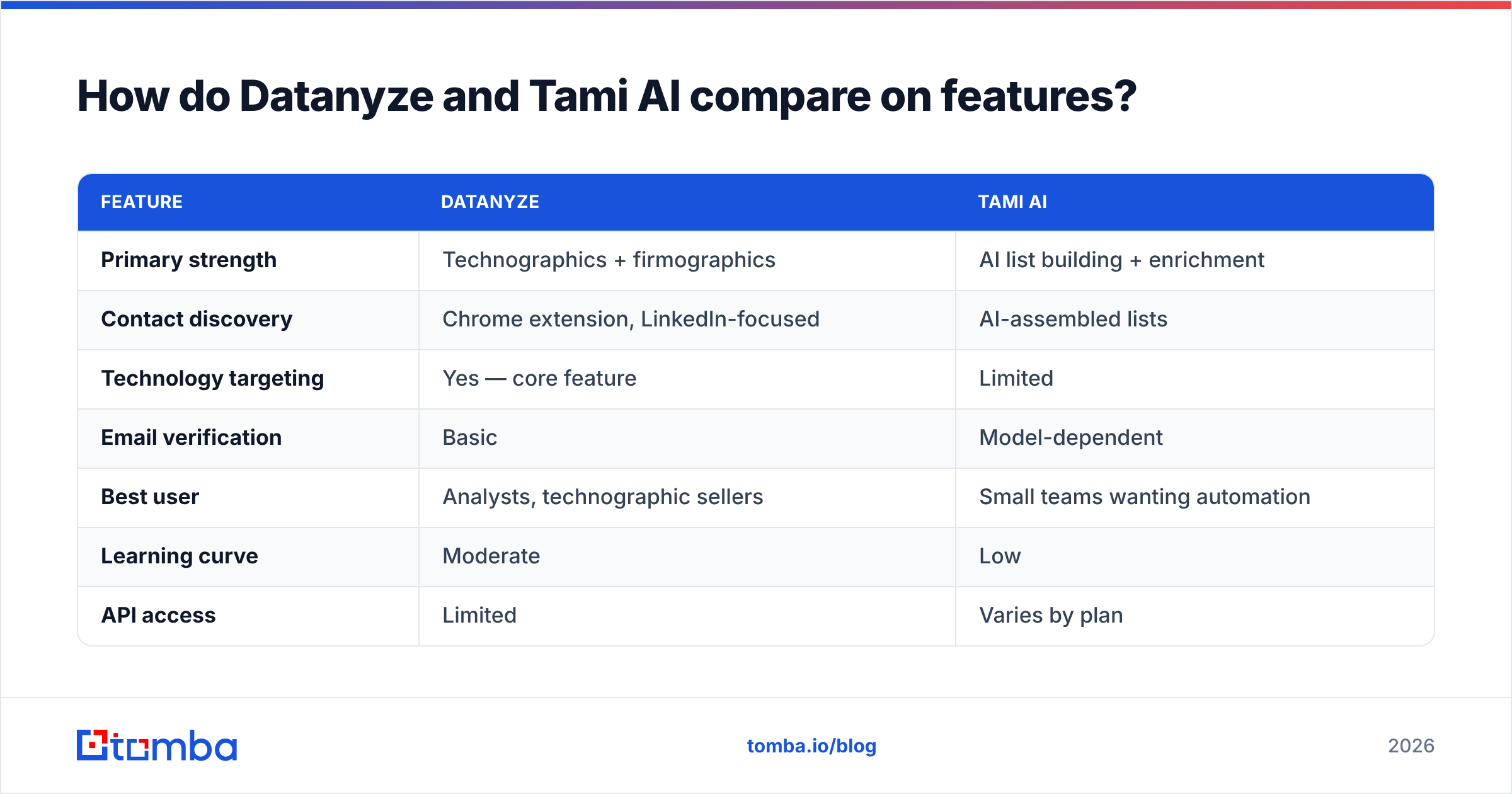
Here's the side-by-side on the attributes that actually change your day-to-day workflow.
| Feature | Datanyze | Tami AI |
|---|---|---|
| Primary strength | Technographics + firmographics | AI list building + enrichment |
| Contact discovery | Chrome extension, LinkedIn-focused | AI-assembled lists |
| Technology targeting | Yes — core feature | Limited |
| Email verification | Basic | Model-dependent |
| Best user | Analysts, technographic sellers | Small teams wanting automation |
| Learning curve | Moderate | Low |
| API access | Limited | Varies by plan |
Datanyze wins if your segmentation depends on tech stack — nobody's beating it on "companies using HubSpot but not Salesforce." Tami AI wins if you'd rather describe a persona in plain language and get a list back without building queries.
But notice what's thin on both rows: email verification. Neither tool leads with deliverability guarantees, and that's the gap that quietly kills cold campaigns. A list is only as good as the percentage of addresses that actually land in an inbox.
Which has better data accuracy?#
Accuracy is where these tools live or die, and it's the hardest thing to judge from a marketing page.
Datanyze's technographic data is generally well-regarded — detecting a technology on a website is a fairly deterministic signal. Its contact data (emails, phones) is more variable, like most extension-based tools that scrape and infer as you browse. Expect solid firmographics and hit-or-miss direct contact details.
Tami AI's accuracy is harder to pin down because it depends on the models and sources feeding its automation. AI-assembled lists can be impressively fast, but they can also confidently include the wrong person at the right company, or a plausible-looking email that was never validated. When an AI guesses an address using a common pattern, it looks real until it bounces.
That's the trap. One does not simply trust an unverified email at scale.
The fix is to treat any list — from Datanyze, Tami AI, or anywhere — as raw input that must pass through a verification step before it touches your sending domain. Running addresses through an email verifier before your first send is the single highest-ROI habit in outbound. It protects your sender reputation, and it's cheaper than the deliverability damage a 15% bounce rate causes. If you're not sure whether a domain accepts everything, a catch-all verifier tells you before you waste a send.
Check third-party review aggregates like G2 for real-user accuracy complaints on both tools — pay attention to bounce-rate mentions specifically, not overall star ratings.
How do Datanyze and Tami AI pricing plans compare?#
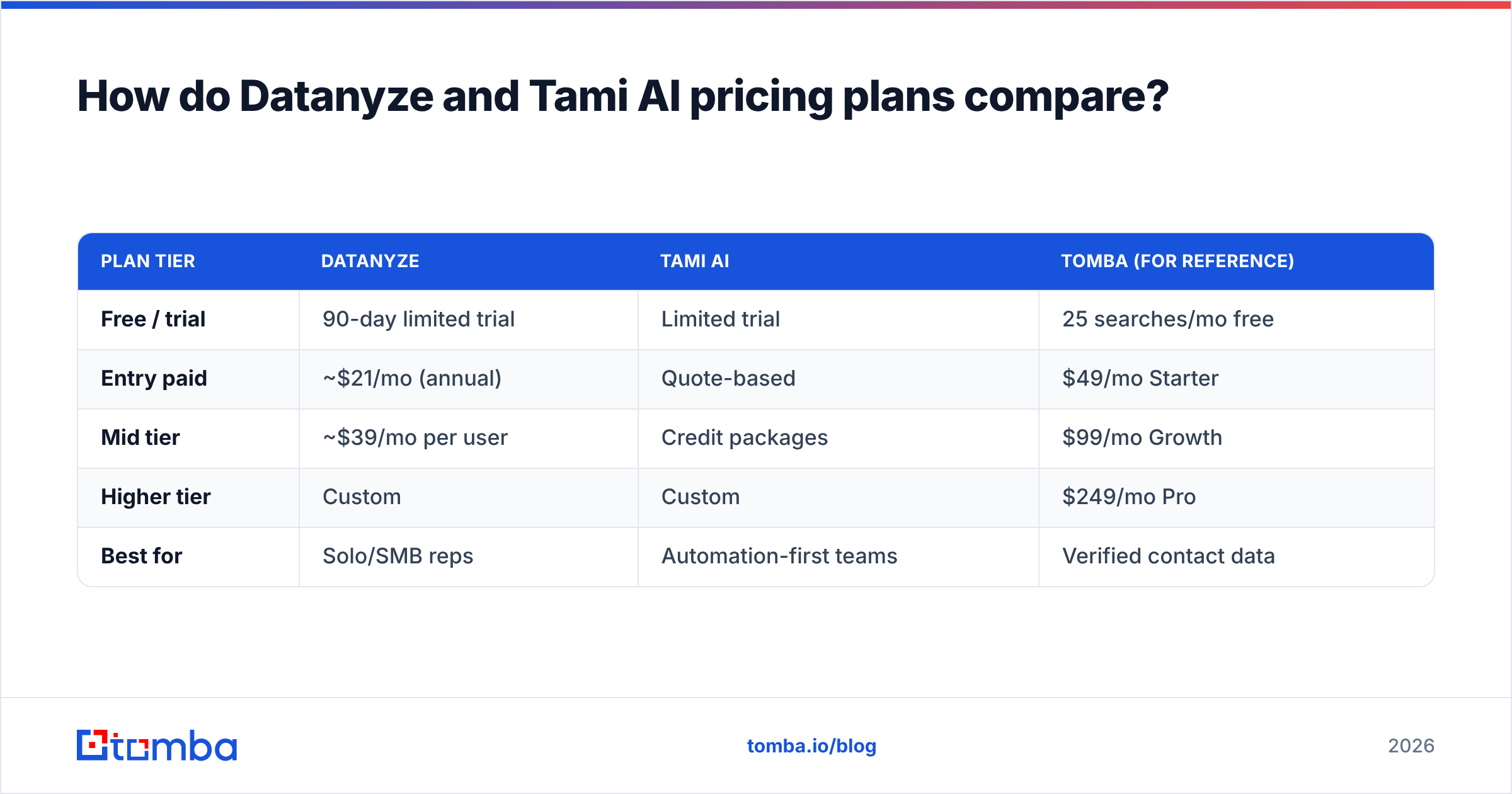
Pricing philosophy differs as much as the products. Datanyze uses transparent tiers with a free trial; Tami AI's pricing tends to be quote-driven or credit-based, which makes direct comparison harder.
| Plan tier | Datanyze | Tami AI | Tomba (for reference) |
|---|---|---|---|
| Free / trial | 90-day limited trial | Limited trial | 25 searches/mo free |
| Entry paid | ~$21/mo (annual) | Quote-based | $49/mo Starter |
| Mid tier | ~$39/mo per user | Credit packages | $99/mo Growth |
| Higher tier | Custom | Custom | $249/mo Pro |
| Best for | Solo/SMB reps | Automation-first teams | Verified contact data |
Datanyze is approachable for individual reps and small teams who want technographic filtering without a big commitment. Tami AI's cost-effectiveness hinges on whether its automation genuinely replaces manual sourcing hours — if it does, the price justifies itself; if you still hand-check every list, you're paying for convenience you don't get.
For teams that mainly need contact data rather than a full intelligence platform, it's worth comparing both against dedicated finders. You can see straightforward Tomba pricing as a baseline — the point isn't that one is universally cheaper, it's that paying suite prices for finder-tool needs is a common overspend.
Which tool is better for your use case?#
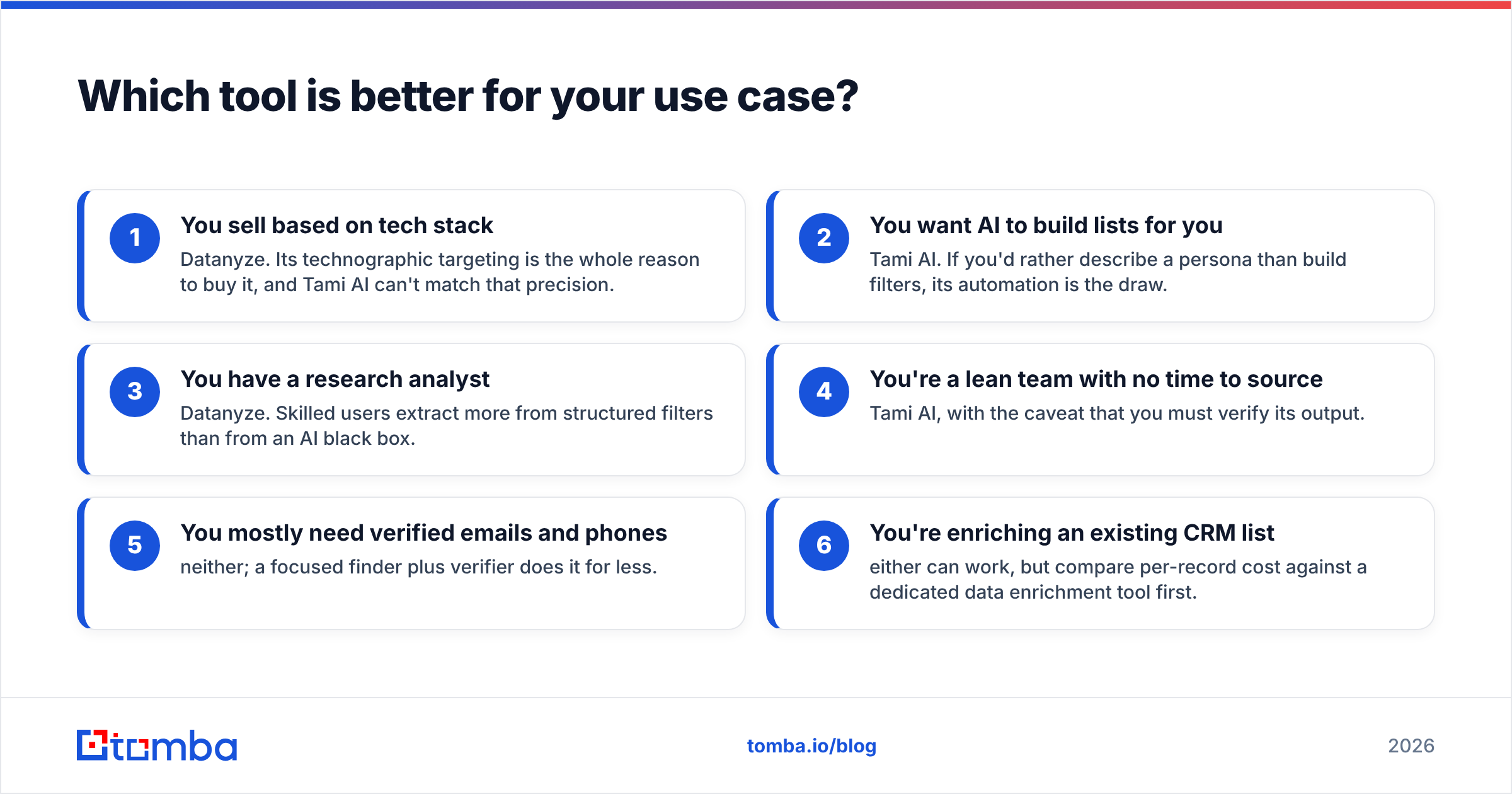
There's no universal winner. Match the tool to the job:
- You sell based on tech stack — Datanyze. Its technographic targeting is the whole reason to buy it, and Tami AI can't match that precision.
- You want AI to build lists for you — Tami AI. If you'd rather describe a persona than build filters, its automation is the draw.
- You have a research analyst — Datanyze. Skilled users extract more from structured filters than from an AI black box.
- You're a lean team with no time to source — Tami AI, with the caveat that you must verify its output.
- You mostly need verified emails and phones — neither; a focused finder plus verifier does it for less.
- You're enriching an existing CRM list — either can work, but compare per-record cost against a dedicated data enrichment tool first.
The honest read: both are legitimate tools with real strengths, but both are broad platforms. If you bought one to solve "I need to reach the right people," you may be paying for a lot of surface area you never touch.
Is there a better alternative for contact discovery?#
If your core problem is finding and verifying business emails — not analyzing tech stacks or delegating research to an AI — a specialized stack usually wins on both price and accuracy.
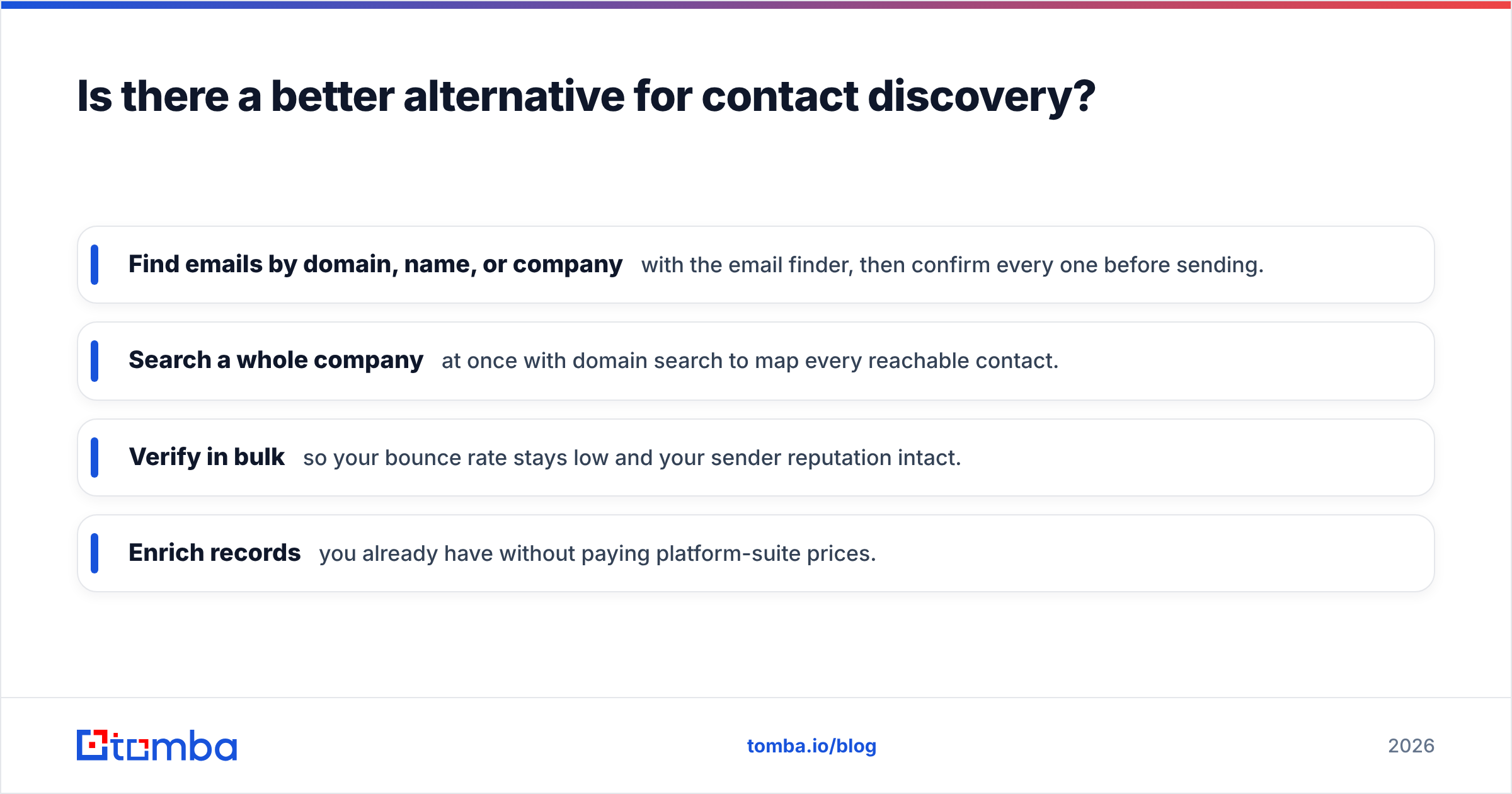
That's the niche Tomba fills. Instead of a sprawling intelligence suite, it focuses on the contact-data layer:
- Find emails by domain, name, or company with the email finder, then confirm every one before sending.
- Search a whole company at once with domain search to map every reachable contact.
- Verify in bulk so your bounce rate stays low and your sender reputation intact.
- Enrich records you already have without paying platform-suite prices.
For a technographics-heavy motion, Datanyze still makes sense. For AI-driven sourcing, Tami AI is worth a trial. But for the most common outbound need — accurate, verified contact data at a predictable price — a dedicated finder is the leaner call. Compare it against broader platforms the same way you'd weigh any Clearbit alternative: match spend to the job you actually do.
When you're evaluating any of these, sanity-check vendor claims against independent analyst coverage from sources like Gartner rather than trusting the pitch deck.
Datanyze vs Tami AI: the verdict#
- Pick Datanyze if technographic targeting is central to your sales motion and you value transparent, low-commitment pricing.
- Pick Tami AI if you want AI to handle sourcing and enrichment, and you're disciplined about verifying its output before it hits your outbox.
- Pick a dedicated finder if your real need is verified emails and phones — you'll spend less and bounce less.
Whatever you choose, the non-negotiable step is verification. A prospect list is a hypothesis; a verified list is a campaign.
Ready to stop paying for data you can't reach?#
If most of your budget goes toward finding people you can actually email, skip the full-suite overhead. Start with the Tomba Email Finder — free for your first 25 searches — find professional emails by domain or name, and verify every address before you send. It's the fastest way to turn a target account into a real conversation, without the platform tax. Test it against your current list and compare the bounce rates yourself.
Related guides#
Ready to find emails that actually work?
Join 150,000+ professionals who stopped guessing and started sending. Free credits on signup — no credit card required.
Get the Tomba newsletter
Practical outbound tactics and product updates — once every two weeks.
About the author