Datanyze vs Techsalerator (2026): Data, Pricing, and the Better Pick
Datanyze and Techsalerator both sell B2B data, but they solve different problems. Here's an honest breakdown of accuracy, coverage, pricing, and when a leaner tool beats both.
Datanyze vs Techsalerator (2026): Data, Pricing, and the Better Pick
Choosing between Datanyze and Techsalerator usually means you've hit a wall: you need reliable company and contact data, and you're not sure whether a technographics-first tool or a raw data-licensing vendor gets you there faster. They look similar on a feature grid, but they're built for two different buyers.
This is a neutral, hands-on comparison. No hype, no "both are amazing." By the end you'll know which one fits your motion, where each one quietly costs more than the sticker price, and when a leaner email-and-enrichment tool beats paying for either.
TL;DR — Datanyze vs Techsalerator at a glance#
- Datanyze is a technographics and prospecting tool. Its sweet spot is spotting which companies use which technologies, plus a Chrome extension for grabbing contact info while you browse LinkedIn.
- Techsalerator is a data-licensing and enrichment vendor. It sells large B2B/B2C datasets, custom lists, and API access across many countries — more "data supplier" than "sales app."
- Accuracy is the real differentiator. Datanyze contact data can go stale; Techsalerator's breadth is huge but quality varies by segment and region.
- Pricing models differ sharply: Datanyze is credit-based and self-serve; Techsalerator is quote-based and volume-driven.
- If your core need is finding and verifying work emails at a predictable price, a focused tool like Tomba often beats both on cost-per-valid-contact.

What is Datanyze and who is it for?#
Datanyze started as a technographics company — its original claim to fame was telling you what software and tools a website runs (CRMs, ad pixels, payment processors, hosting, and so on). That DNA still shapes the product.
Today Datanyze is positioned as a lightweight prospecting tool. You install a browser extension, visit a company site or a LinkedIn profile, and it surfaces contact details and basic firmographics on the spot. It leans toward SDRs and individual reps who want quick, in-the-moment lookups rather than a data team building enrichment pipelines.
Where Datanyze shines:
- Technographic targeting — building lists of companies that use a specific technology (great for competitive displacement plays).
- On-the-fly contact capture — grabbing an email or phone while you're already researching a prospect.
- Simple, self-serve onboarding — no procurement cycle to get started.
Where it frustrates people: contact accuracy. Like most extension-based tools, Datanyze's emails and direct dials are only as fresh as its last data refresh, and job-changer churn means a chunk of any B2B database decays every year. If you've read Datanyze reviews on G2, the recurring theme is "useful, but verify before you send."
What is Techsalerator and who is it for?#
Techsalerator is a different animal. It's a data provider and licensing company — think of it as a wholesaler of B2B and consumer datasets rather than a rep-facing app. You tell them the audience (industry, geography, company size, contact roles), and they deliver a dataset or wire it into your systems via API.
Its strengths are breadth and flexibility:
- Global coverage across many countries and verticals, including markets where U.S.-centric tools thin out.
- Custom list builds — you can request niche segments most self-serve tools can't assemble.
- Bulk and API delivery for teams that want to own the data and enrich internally.
The trade-off is that Techsalerator behaves like an enterprise data vendor. Pricing is quote-based, deals often assume volume, and quality can vary between a well-covered segment (say, U.S. software companies) and a long-tail one (small businesses in a secondary market). You're buying raw material; the QA and de-duplication burden shifts partly to you. If you want a feel for the category, Capterra's B2B data listings show how differently these vendors package the same underlying promise.
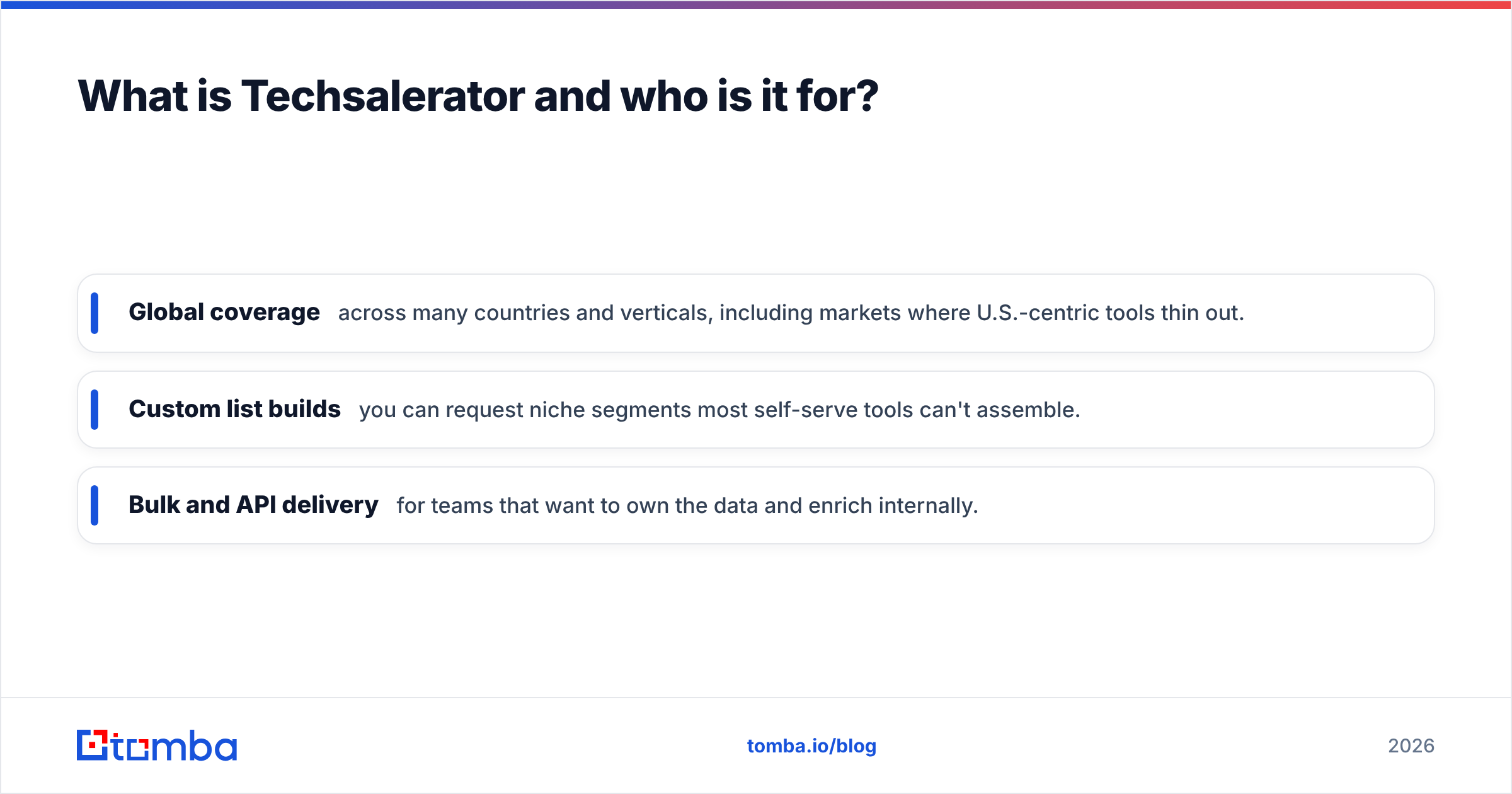
Datanyze vs Techsalerator: side-by-side comparison#
Here's the honest head-to-head. Treat exact prices as directional — Techsalerator in particular is quote-driven — but the shape of each offer is what matters.
| Attribute | Datanyze | Techsalerator |
|---|---|---|
| Primary use case | Technographics + rep prospecting | Data licensing + custom lists |
| Delivery model | Chrome extension + web app | Bulk file + API + managed lists |
| Best-fit buyer | SDRs, small sales teams | Data teams, agencies, ops |
| Contact data freshness | Varies; verify before send | Varies by segment/region |
| Geographic strength | U.S.-centric | Broad global coverage |
| Pricing model | Credit-based, self-serve | Quote-based, volume-driven |
| Entry cost | Low, month-to-month | Higher, contract-oriented |
| Learning curve | Low | Medium (data handling) |
| Email verification | Limited/basic | Not the core focus |
The pattern is clear: Datanyze is a tool a rep opens ten times a day; Techsalerator is a supply agreement a RevOps or growth lead signs once and feeds downstream. Comparing them directly is a bit like comparing a pocket knife to a lumber yard — both cut, but you buy them for different jobs.
Which has better data accuracy?#
Neither wins outright — and that's the uncomfortable truth for both. Accuracy in B2B data isn't one number; it's a function of how recently a record was validated and whether the email actually accepts mail today.
Datanyze's contact records are convenient but prone to the usual extension-tool decay: people change jobs, companies restructure, and an email that resolved six months ago now bounces. Its verification layer is basic, so you're often exporting and then re-checking elsewhere.
Techsalerator's ceiling is higher on coverage — it can reach segments others miss — but breadth and freshness are in tension. A massive multi-country dataset is harder to keep uniformly clean than a narrow, frequently re-verified one. In practice, teams licensing large lists still run them through a dedicated email verifier before any campaign, because sending to unverified data is the fastest way to wreck sender reputation.
The takeaway: whichever you pick, budget for a verification step. The real cost of "bad data" isn't the wasted credit — it's the bounced sends, spam-folder placement, and burned domains that follow. This is exactly why data-quality-conscious teams separate sourcing from verifying, rather than trusting one vendor to do both perfectly.

How do Datanyze and Techsalerator price compare?#
This is where the two tools force different decisions.
Datanyze is credit-based and self-serve. You buy a bucket of credits, each lookup spends some, and you can start small month-to-month. That's friendly for an individual rep or a two-person team testing the water — but credits burn fast if half your lookups return stale or missing contacts, so effective cost-per-valid-contact can be higher than the headline rate suggests.
Techsalerator is quote-based. You'll talk to sales, scope a dataset, and get a price tied to volume, geography, and custom-build effort. That can be efficient at scale (cents per record on large orders) but it's a poor fit if you need 300 verified emails this week without a procurement conversation.
A quick way to think about it:
- Need a few hundred contacts, fast, no contract? Datanyze's model fits better — but watch credit waste.
- Need tens of thousands of records for a specific market, and you have a data team? Techsalerator's licensing model can be cheaper per record.
- Need predictable cost-per-valid-email with verification built in? Neither model is ideal, which is where a transparent pricing page with fixed tiers starts to look attractive.
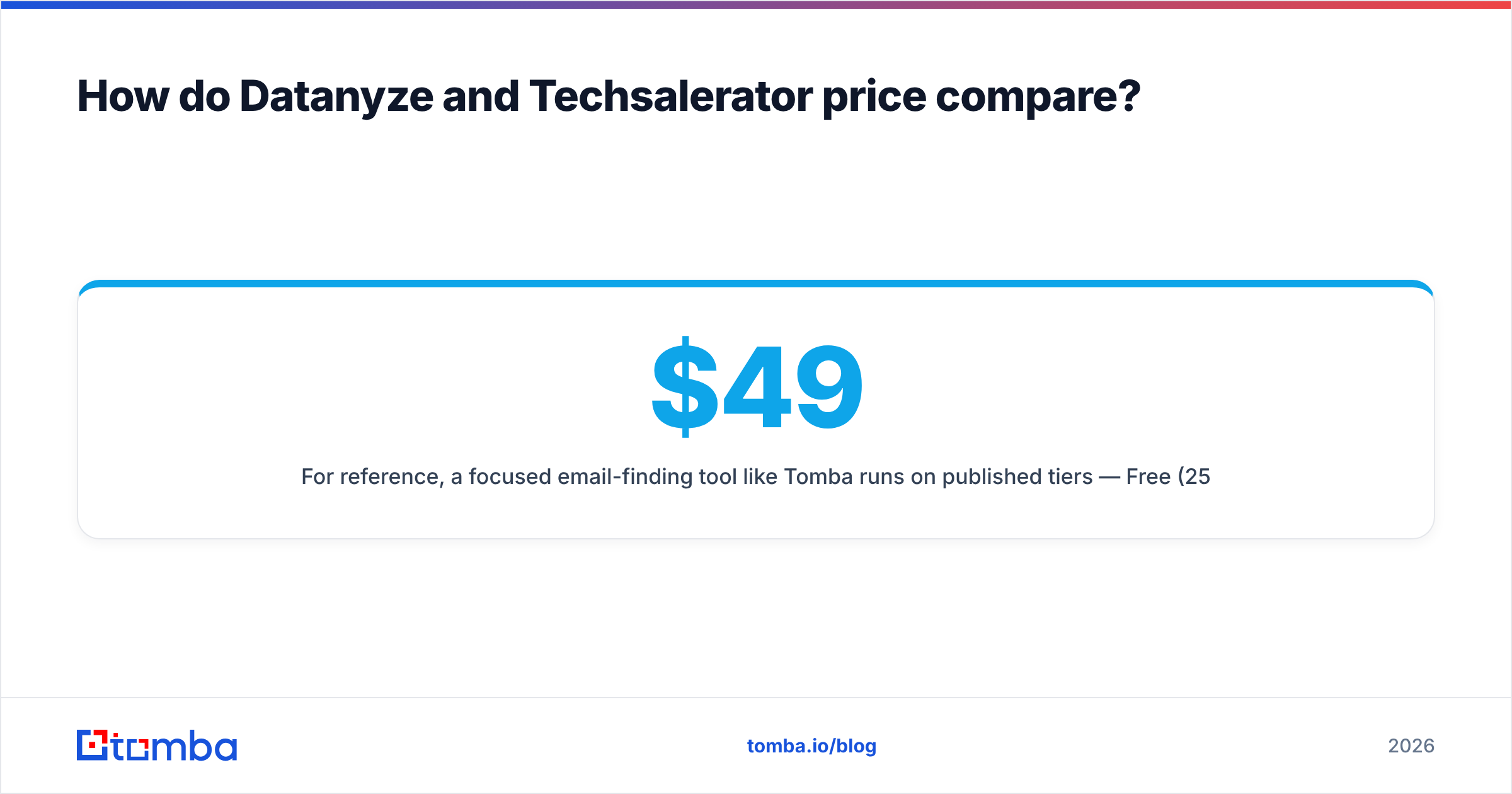
For reference, a focused email-finding tool like Tomba runs on published tiers — Free (25 searches/mo), Starter $49/mo, Growth $99/mo, Pro $249/mo, and custom Enterprise — so you can model spend before you commit. No quote call, no surprise credit burn.
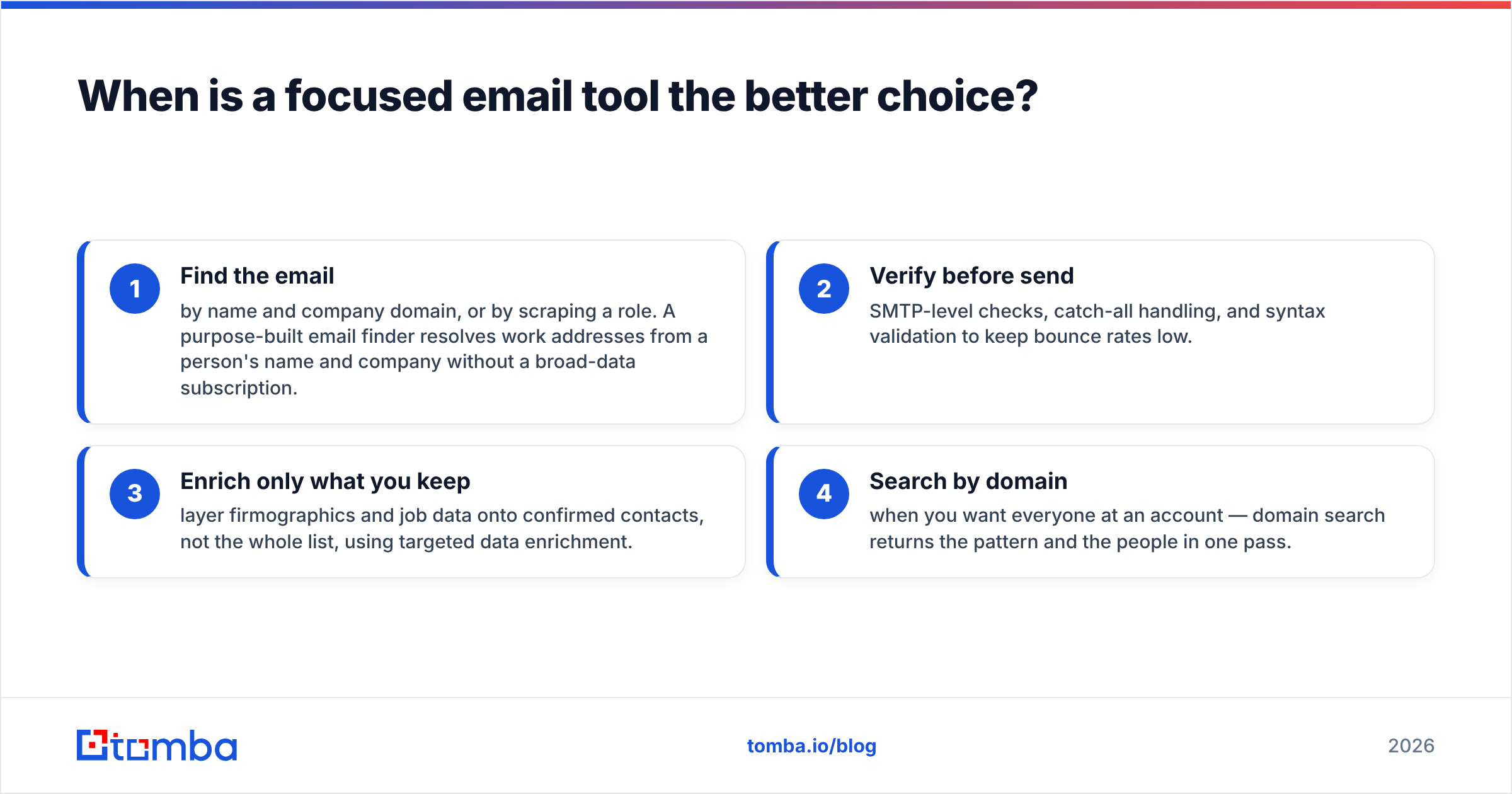
When is a focused email tool the better choice?#
Often — and this is the part most head-to-head posts skip. Datanyze and Techsalerator both bundle a lot you may not need. If your actual job is "find the right person's work email and confirm it's deliverable," you're paying for technographics or bulk-licensing overhead that doesn't move your number.
A dedicated stack tends to look like this:
- Find the email — by name and company domain, or by scraping a role. A purpose-built email finder resolves work addresses from a person's name and company without a broad-data subscription.
- Verify before send — SMTP-level checks, catch-all handling, and syntax validation to keep bounce rates low.
- Enrich only what you keep — layer firmographics and job data onto confirmed contacts, not the whole list, using targeted data enrichment.
- Search by domain when you want everyone at an account — domain search returns the pattern and the people in one pass.
This "find → verify → enrich" order is the opposite of buying a giant list and hoping. It keeps cost-per-usable-contact low and protects email deliverability, because you never send to an address you didn't confirm.
Datanyze and Techsalerator can still play a role — Datanyze for technographic targeting, Techsalerator for exotic segments — but for the everyday motion of reaching decision-makers, a specialist tool usually wins on both price and precision.
Datanyze vs Techsalerator: which should you pick?#
Here's the plain-English verdict:
- Pick Datanyze if you're a rep or small team that wants technographic filters and quick in-browser lookups, and you're willing to verify contacts before sending. It's the better tool experience of the two.
- Pick Techsalerator if you're a data-savvy team that needs large, custom, or international datasets and can handle QA and de-duplication in-house. It's the better raw supply of the two.
- Pick a focused email finder if your real goal is predictable, verified work emails at a known price — and you'd rather not pay for capabilities you won't use.
Most teams overestimate how much broad data they need and underestimate how much a clean, verified email list is worth. Match the tool to the job, not to the longest feature list.
The bottom line#
Datanyze and Techsalerator aren't really competitors — they're two answers to two different questions. Datanyze answers "what does this company use, and who works there?" Techsalerator answers "can you supply me a large, custom audience?" Both are legitimate; neither is a plug-and-play deliverability machine.
If your growth depends on reliably reaching the right people, start where the money is: accurate, verified contact data at a price you can forecast. Tomba's Email Finder is built for exactly that — find professional emails by name, company, or domain, verify them before you send, and keep your sender reputation intact. Spin up the free tier, run a real list through it, and compare your cost-per-valid-contact against a Datanyze credit pack or a Techsalerator quote. The numbers usually make the decision for you.
Related guides#
Ready to find emails that actually work?
Join 150,000+ professionals who stopped guessing and started sending. Free credits on signup — no credit card required.
Get the Tomba newsletter
Practical outbound tactics and product updates — once every two weeks.
About the author