Datanyze vs ZoomInfo (2026): Which B2B Data Tool Wins?
Datanyze and ZoomInfo both sell B2B contact and firmographic data, but they serve very different budgets and teams. Here's an honest, side-by-side breakdown of accuracy, pricing, and fit for 2026.
Datanyze and ZoomInfo get lumped together because both promise the same thing: names, emails, phone numbers, and firmographics for the companies you want to sell to. But choosing between them is less about "who has more data" and more about how much you're willing to pay, how deep your workflows go, and whether a lightweight prospecting tool or a full go-to-market platform matches your team's size.
This is a neutral, hands-on breakdown of Datanyze vs ZoomInfo for 2026 — pricing, accuracy, technographics, and the situations where a leaner tool beats both.
TL;DR: Datanyze vs ZoomInfo at a glance#
- Datanyze is a low-cost, Chrome-extension-first prospecting tool (owned by ZoomInfo) built for reps who need emails and mobiles one profile at a time. Pricing starts around $21/month billed annually.
- ZoomInfo is an enterprise go-to-market platform with deep firmographics, intent data, workflows, and integrations — but pricing typically starts in the five figures per year and locks you into annual contracts.
- Accuracy favors ZoomInfo for coverage and depth; Datanyze is solid for quick lookups but thinner outside North America.
- Technographics are where Datanyze historically shined; ZoomInfo now bundles this into its larger platform.
- If you mainly need accurate emails at a fair price, a focused email-finder like Tomba Email Finder often beats paying enterprise rates for data you won't fully use.
What is Datanyze and who is it for?#
Datanyze is a browser-based prospecting tool that surfaces contact details — business email, direct dial, and mobile — while you browse LinkedIn or company websites. After ZoomInfo acquired it, Datanyze was repositioned as an entry-level option: cheap, simple, and credit-based.
The core appeal is the workflow. You install the Chrome extension, land on a prospect's LinkedIn profile, and pull their contact info without leaving the page. There's no complex platform to learn, no sales call to sit through, and no annual commitment required to start.
Datanyze fits:
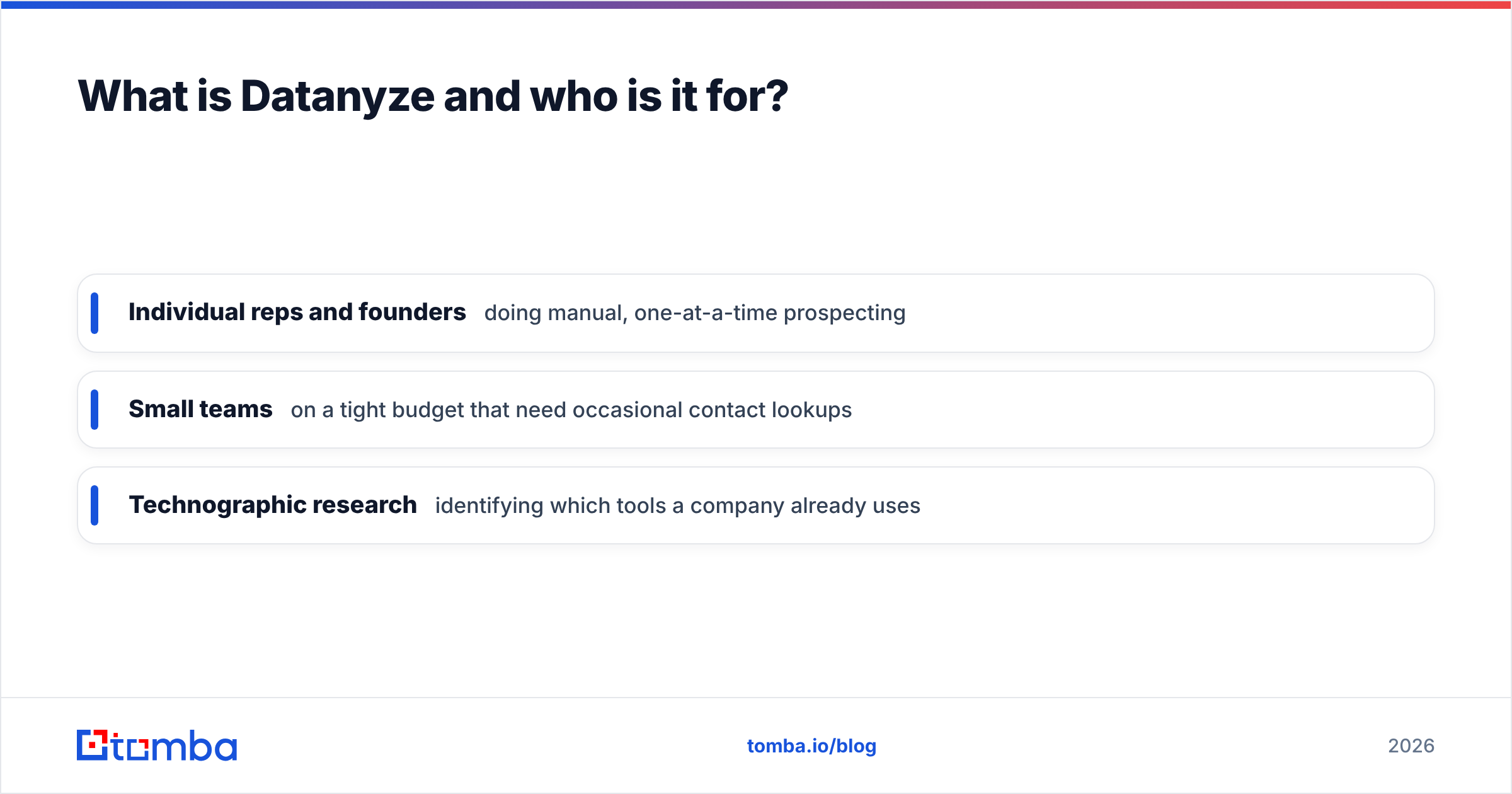
- Individual reps and founders doing manual, one-at-a-time prospecting
- Small teams on a tight budget that need occasional contact lookups
- Technographic research — identifying which tools a company already uses
Where it falls short: bulk workflows, CRM-grade data hygiene, and international coverage. Datanyze is a scalpel, not a data warehouse.

What is ZoomInfo and who is it for?#
ZoomInfo is a full go-to-market intelligence platform. Beyond contact data, it layers on intent signals, org charts, scoops (real-time company news), workflow automation, and native integrations with Salesforce, HubSpot, and Outreach. It's the tool RevOps teams standardize on when data feeds an entire pipeline.
ZoomInfo fits:
- Mid-market and enterprise sales orgs with multi-rep teams
- RevOps and marketing ops that need data enrichment piped into a CRM
- Account-based teams using intent data to time outreach
The catch is cost and commitment. ZoomInfo sells annual contracts, negotiated per seat and per data package, and the total often lands well into five figures. You also buy the whole platform even if you only need a slice of it.

Datanyze vs ZoomInfo: side-by-side comparison#
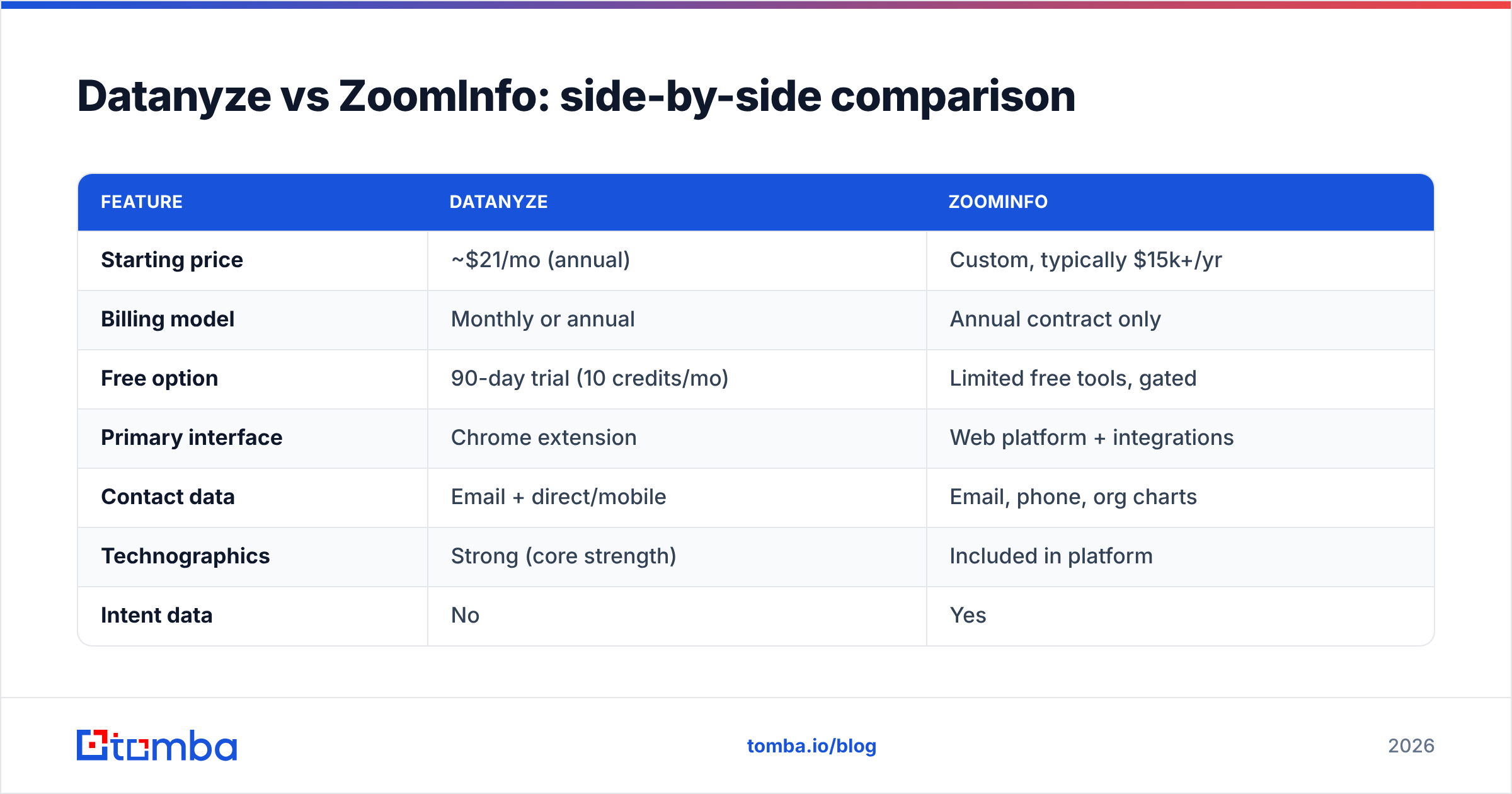
| Feature | Datanyze | ZoomInfo |
|---|---|---|
| Starting price | ~$21/mo (annual) | Custom, typically $15k+/yr |
| Billing model | Monthly or annual | Annual contract only |
| Free option | 90-day trial (10 credits/mo) | Limited free tools, gated |
| Primary interface | Chrome extension | Web platform + integrations |
| Contact data | Email + direct/mobile | Email, phone, org charts |
| Technographics | Strong (core strength) | Included in platform |
| Intent data | No | Yes |
| Bulk enrichment | Limited | Robust |
| CRM integrations | Basic | Deep (SFDC, HubSpot, etc.) |
| International coverage | North America-focused | Global, deeper |
| Best for | Solo reps, quick lookups | Enterprise GTM teams |
The table makes the split obvious: these tools aren't really competing for the same buyer. Datanyze is priced for one person; ZoomInfo is priced for a department.
Is ZoomInfo's data more accurate than Datanyze's?#
Generally yes — but with caveats. ZoomInfo invests heavily in data collection, verification, and refresh cycles, and independent reviews on G2 consistently rank it high for coverage and firmographic depth, especially for mid-to-large enterprises in North America.
Datanyze pulls from a narrower well. For quick lookups on well-known companies, its emails and mobiles hold up. But you'll hit more gaps on smaller companies, non-US regions, and niche roles. Because Datanyze runs on a small monthly credit allotment, most users can't afford to burn credits re-checking questionable records.
The honest framing: ZoomInfo buys you depth and breadth at enterprise prices, while Datanyze buys you convenience for light use. Neither guarantees every email is deliverable, which is why serious senders run any list through a dedicated email verifier before launching a campaign. Bounces hurt your sender reputation regardless of where the data came from.

How does pricing really compare?#
This is the sharpest difference. Datanyze is transparent and cheap; ZoomInfo is opaque and expensive.
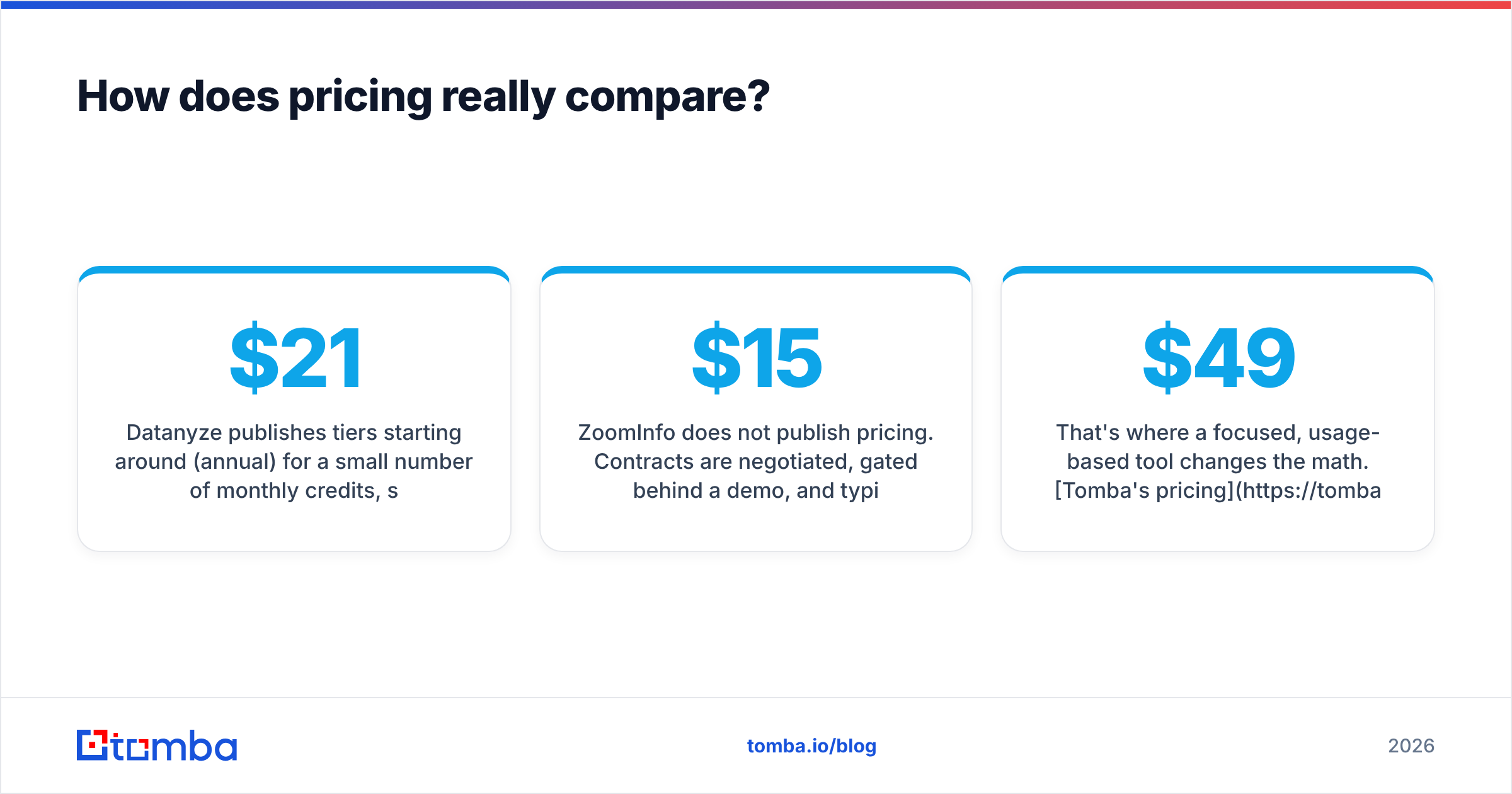
Datanyze publishes tiers starting around $21/month (annual) for a small number of monthly credits, scaling up modestly. You can start on a trial and pay with a card — no sales call required.
ZoomInfo does not publish pricing. Contracts are negotiated, gated behind a demo, and typically start around $15,000/year for a basic professional package, climbing fast once you add intent data, more seats, or advanced integrations. Annual lock-in is standard.
For budget-conscious teams, that gap is decisive. Paying enterprise rates only makes sense if you'll actually use the intent signals, org charts, and workflow automation. If your real need is "find accurate emails and phone numbers," you're overpaying for a platform.
That's where a focused, usage-based tool changes the math. Tomba's pricing runs from a free tier (25 searches/month) to Starter at $49/month and Growth at $99/month — no annual handcuffs, no five-figure floor. You buy email-finding and verification, not a whole GTM suite you'll half-use.
What about technographics and intent data?#
Technographics — knowing which software a company runs — is Datanyze's historical claim to fame. If you sell a product that integrates with or replaces a specific tool, filtering prospects by their tech stack is genuinely useful, and Datanyze does this well for its price.
Intent data — signals that an account is actively researching a solution — is ZoomInfo's territory. Datanyze doesn't offer it. If timing outreach to buying signals is central to your motion, that alone can justify ZoomInfo despite the cost.
So the deciding question isn't "which has more data," it's "which kind of signal drives your pipeline?" Tech-stack targeting points to Datanyze; intent-based timing points to ZoomInfo.

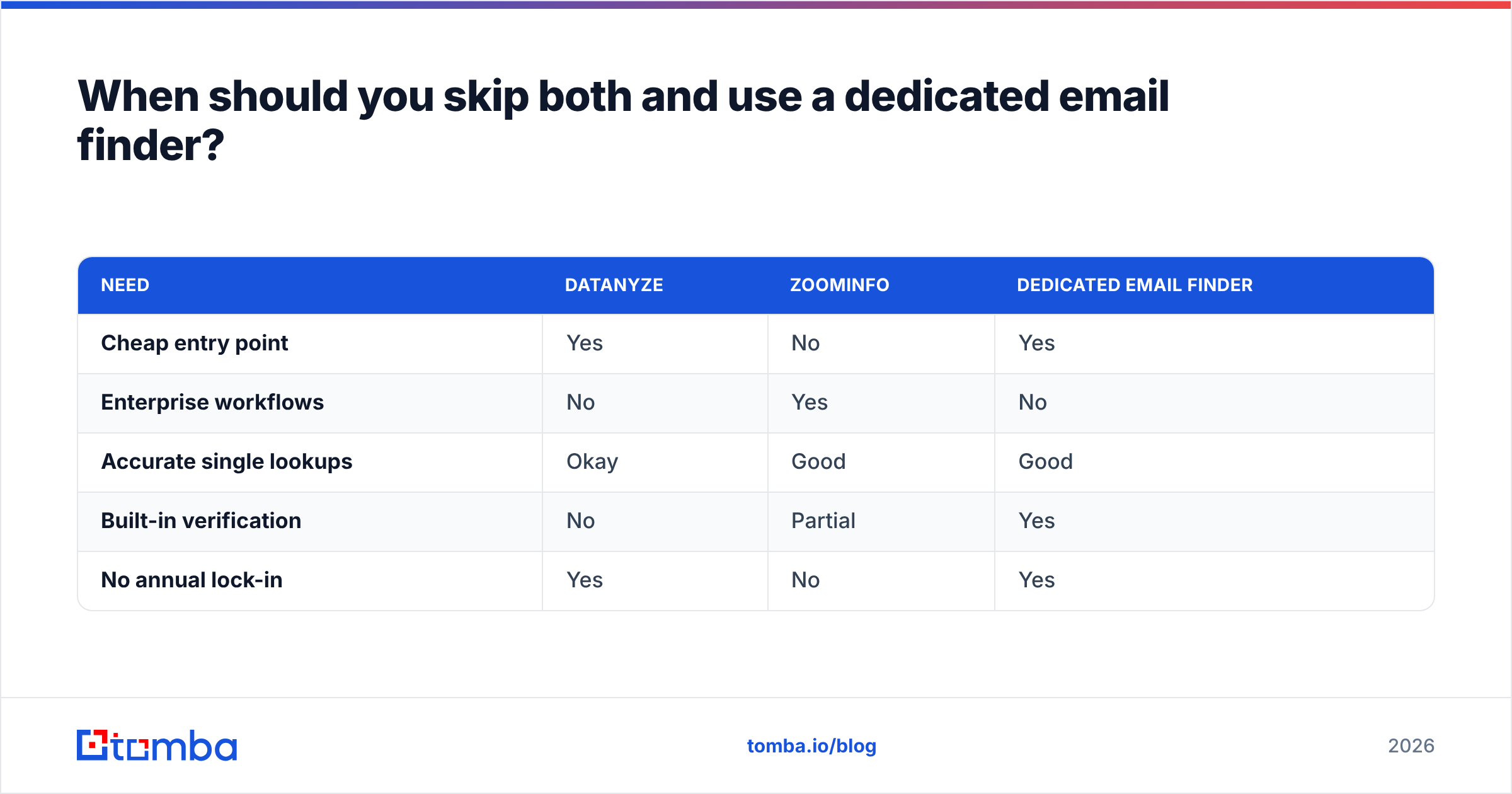
When should you skip both and use a dedicated email finder?#
Skip both when your actual bottleneck is contact discovery, not go-to-market orchestration. A lot of teams buy ZoomInfo, use 20% of it, and still export lists to a separate tool to clean the emails. That's a signal you're paying for the wrong thing.
Consider a focused alternative when:
- Your budget can't absorb a five-figure annual contract. Usage-based pricing scales with you.
- You mostly need emails, not a platform. A domain search that returns every address at a company is faster than paginating a database.
- Deliverability is the real KPI. Finding an email is half the job; verifying it before you send is the other half.
- You want data enrichment on demand. Contact enrichment via API fills CRM gaps without a full platform migration.
- You prospect internationally. A finder with broad domain coverage can outperform a North-America-weighted database.
Here's an honest note: it's not always either/or. Some teams keep a lean database like BookYourData for pre-built lists and pair it with a real-time finder for fresh, single-lookup accuracy. The point isn't to force one tool — it's to stop overbuying.
| Need | Datanyze | ZoomInfo | Dedicated email finder |
|---|---|---|---|
| Cheap entry point | Yes | No | Yes |
| Enterprise workflows | No | Yes | No |
| Accurate single lookups | Okay | Good | Good |
| Built-in verification | No | Partial | Yes |
| No annual lock-in | Yes | No | Yes |
So, which one should you choose?#
Choose ZoomInfo if you're a mid-market or enterprise team that will genuinely use intent data, org charts, and deep CRM integrations — and you have the budget to match. It's a category leader for a reason, and cutting corners on data at scale costs more than the subscription.
Choose Datanyze if you're a solo rep or small team that needs occasional, low-cost lookups and values technographic filtering, and you don't want to sit through an enterprise sales process.
Choose a dedicated email finder if your core problem is finding and verifying accurate contact data at a fair, predictable price — without buying a platform you'll barely touch. For most SMBs and lean outbound teams, this is the honest best value.
The bottom line#
Datanyze and ZoomInfo solve different problems at very different prices. ZoomInfo is the enterprise standard with the depth and cost to match; Datanyze is the budget entry point with a handy extension and strong technographics. The mistake most teams make is assuming they need one of these when what they actually need is accurate emails they can trust.
If that's you, start with Tomba Email Finder. Find professional email addresses by domain, name, or company, verify them before you send, and pay only for what you use — no demo, no annual contract, and a free tier to test it on your real prospect list today. Spend your budget on pipeline, not on platform features you'll never open.
Related guides#
Ready to find emails that actually work?
Join 150,000+ professionals who stopped guessing and started sending. Free credits on signup — no credit card required.
Get the Tomba newsletter
Practical outbound tactics and product updates — once every two weeks.
About the author