A Day in the Life of an SDR: Schedule, Quotas, and Real Tasks
An honest, hour-by-hour breakdown of what SDRs really do all day in 2026 — from morning prospecting blocks to end-of-day CRM hygiene — plus the tools and metrics that separate top reps from the rest.

Ask ten people what a sales development representative does and you'll get ten vague answers: "cold calls," "sends emails," "books meetings." All true, none useful. The real day in the life of an SDR is a tightly scheduled sequence of research, outreach, follow-up, and data hygiene — and the reps who hit quota run it like a factory line, not a scramble.
This is the honest version. Hour by hour, task by task, with the tools, targets, and small habits that actually move the number.
TL;DR#
- An SDR's day is time-blocked, not reactive: prospecting, calling, emailing, and CRM cleanup each get a dedicated window.
- Output targets are concrete — think 50–100 dials, 40–60 personalized emails, and 15–25 meaningful conversations to book 1–3 qualified meetings per day.
- Data quality is the hidden lever. Bad contact data quietly kills 20–30% of outreach before a single message lands.
- Top reps front-load deep work (research + personalization) into the morning and batch admin at the edges of the day.
- The stack matters less than the discipline — but a fast email finder, verifier, and dialer remove the friction that burns junior reps out.
What does an SDR actually do all day?#
An SDR (sales development representative) sits at the top of the sales funnel. Their one job: turn cold or semi-warm prospects into qualified meetings for account executives (AEs). They don't close deals — they create pipeline.
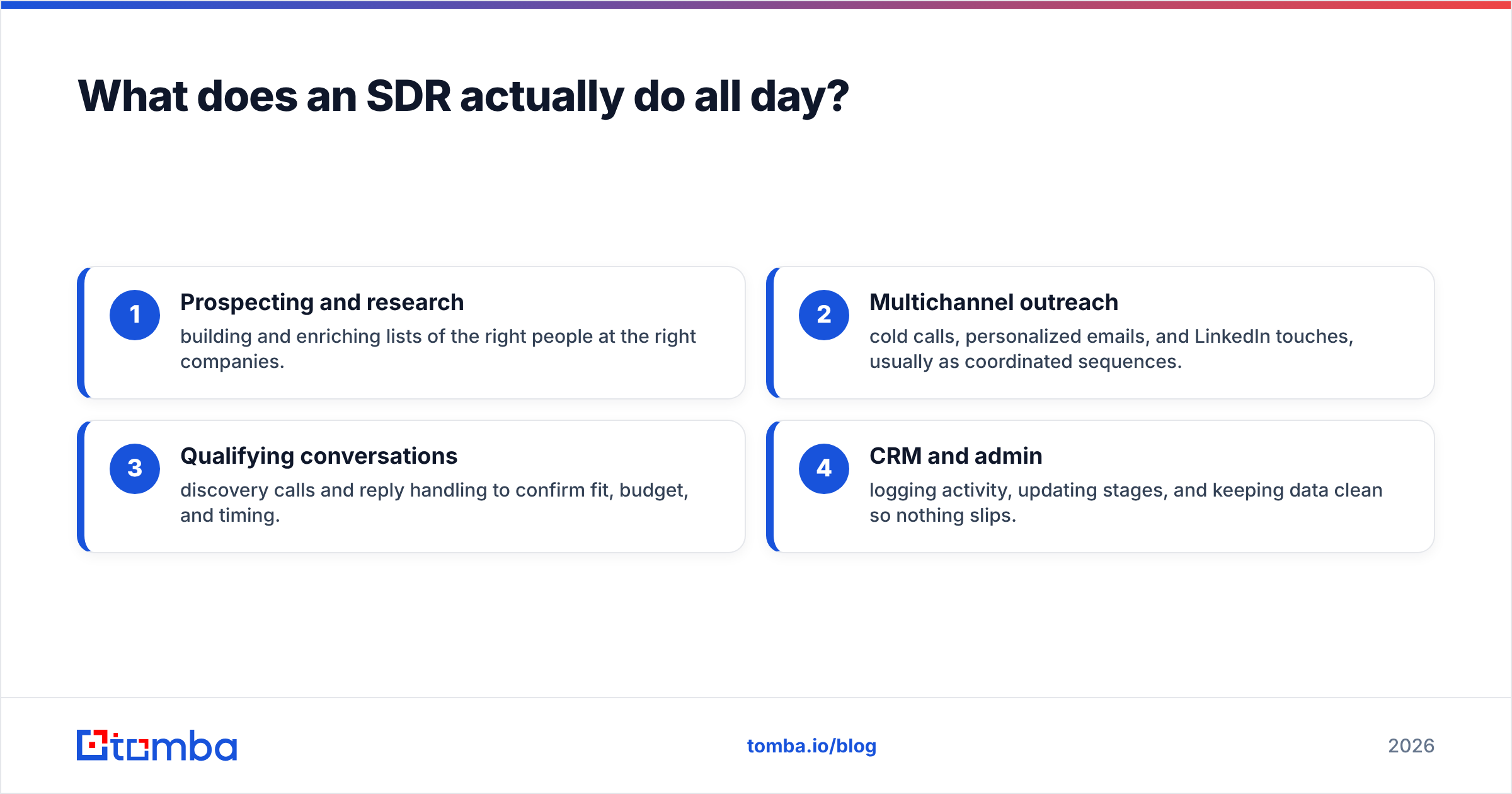
That mission breaks into four recurring activities that fill every working day:
- Prospecting and research — building and enriching lists of the right people at the right companies.
- Multichannel outreach — cold calls, personalized emails, and LinkedIn touches, usually as coordinated sequences.
- Qualifying conversations — discovery calls and reply handling to confirm fit, budget, and timing.
- CRM and admin — logging activity, updating stages, and keeping data clean so nothing slips.
The mix shifts by company. An outbound SDR at a startup might build their own lists from scratch; an inbound-heavy SDR at a larger firm mostly works leads that marketing already surfaced. Either way, the response rate on their outreach is the metric everyone watches.

What does an SDR's hourly schedule look like?#
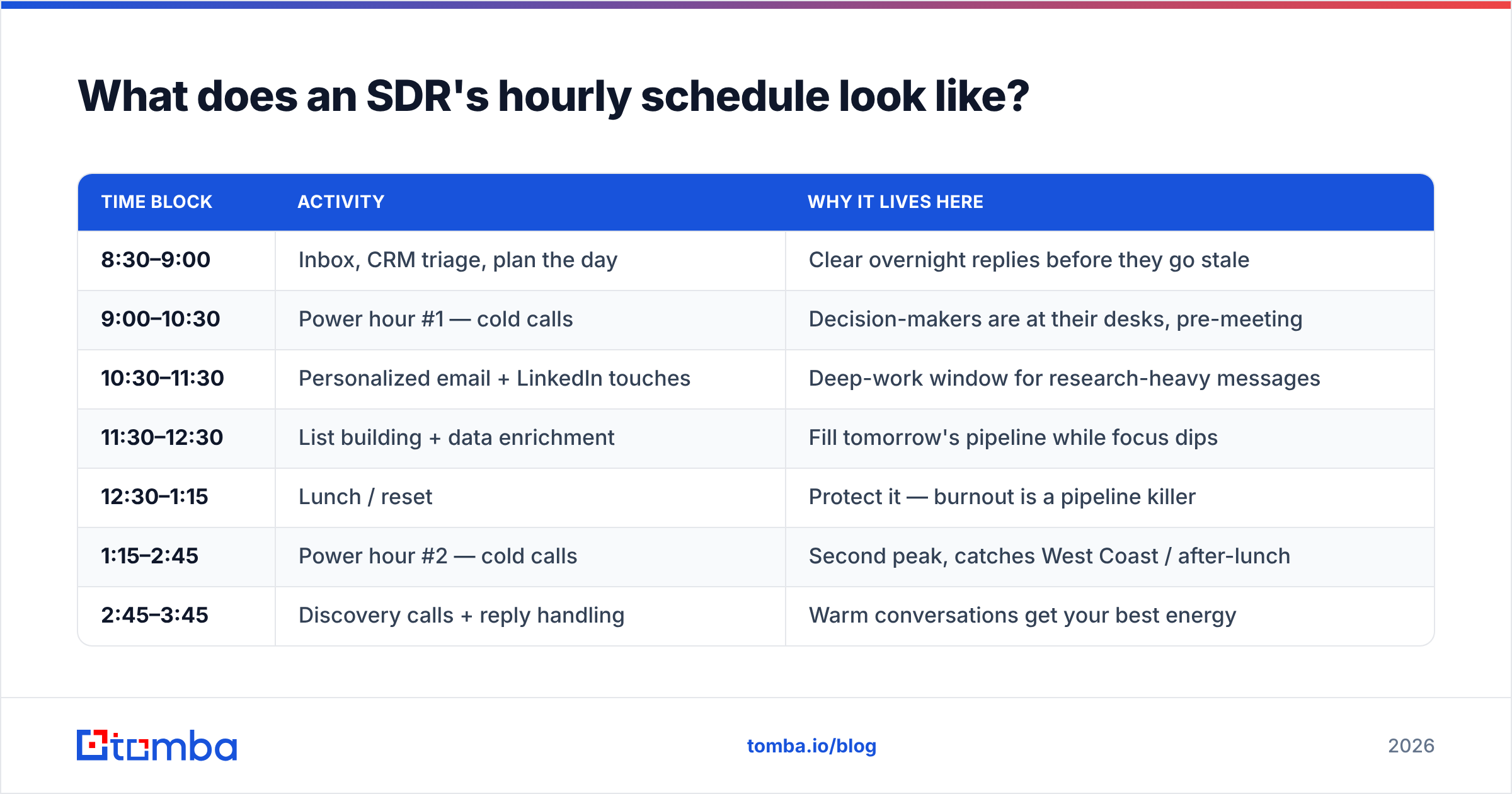
Here's a representative day for a full-cycle outbound SDR working roughly 8:30 to 5:30. Your mileage varies by timezone coverage and team, but the shape is remarkably consistent across high performers.
| Time block | Activity | Why it lives here |
|---|---|---|
| 8:30–9:00 | Inbox, CRM triage, plan the day | Clear overnight replies before they go stale |
| 9:00–10:30 | Power hour #1 — cold calls | Decision-makers are at their desks, pre-meeting |
| 10:30–11:30 | Personalized email + LinkedIn touches | Deep-work window for research-heavy messages |
| 11:30–12:30 | List building + data enrichment | Fill tomorrow's pipeline while focus dips |
| 12:30–1:15 | Lunch / reset | Protect it — burnout is a pipeline killer |
| 1:15–2:45 | Power hour #2 — cold calls | Second peak, catches West Coast / after-lunch |
| 2:45–3:45 | Discovery calls + reply handling | Warm conversations get your best energy |
| 3:45–4:45 | Follow-ups + sequence management | Nudge the 5th–8th touches that book most meetings |
| 4:45–5:30 | CRM hygiene + next-day prep | Log everything; queue tomorrow's first calls |
Notice what this schedule protects: two dedicated calling blocks when humans actually answer phones, and an uninterrupted morning window for the research that makes messages land. The admin work — necessary but low-leverage — gets pushed to the natural energy troughs.
The morning: deep work before the noise#
The first 90 minutes after triage are the most valuable of the day, and good SDRs guard them. This is when you research accounts, find the right contacts, and write emails that don't read like templates. A rushed morning produces generic outreach; a focused one produces the personalization that lifts reply rates.
This is also where data infrastructure earns its keep. If you spend 12 minutes hunting for one prospect's email and phone number, you'll build maybe five contacts before the calling block starts. Automate the lookup — pull verified emails by domain, grab a direct-dial with a phone finder — and that same window produces 20+ ready-to-work contacts.
The afternoon: conversations and momentum#
Post-lunch is for talking to humans. The second power hour catches people back at their desks, and discovery calls slot in right after while your energy is high. Then follow-ups: the unglamorous truth of sales development is that most booked meetings come from the 4th through 8th touch, not the first. The rep who systematically works their sequence out-books the rep chasing shiny new leads every time.
What are the daily targets and KPIs for an SDR?#
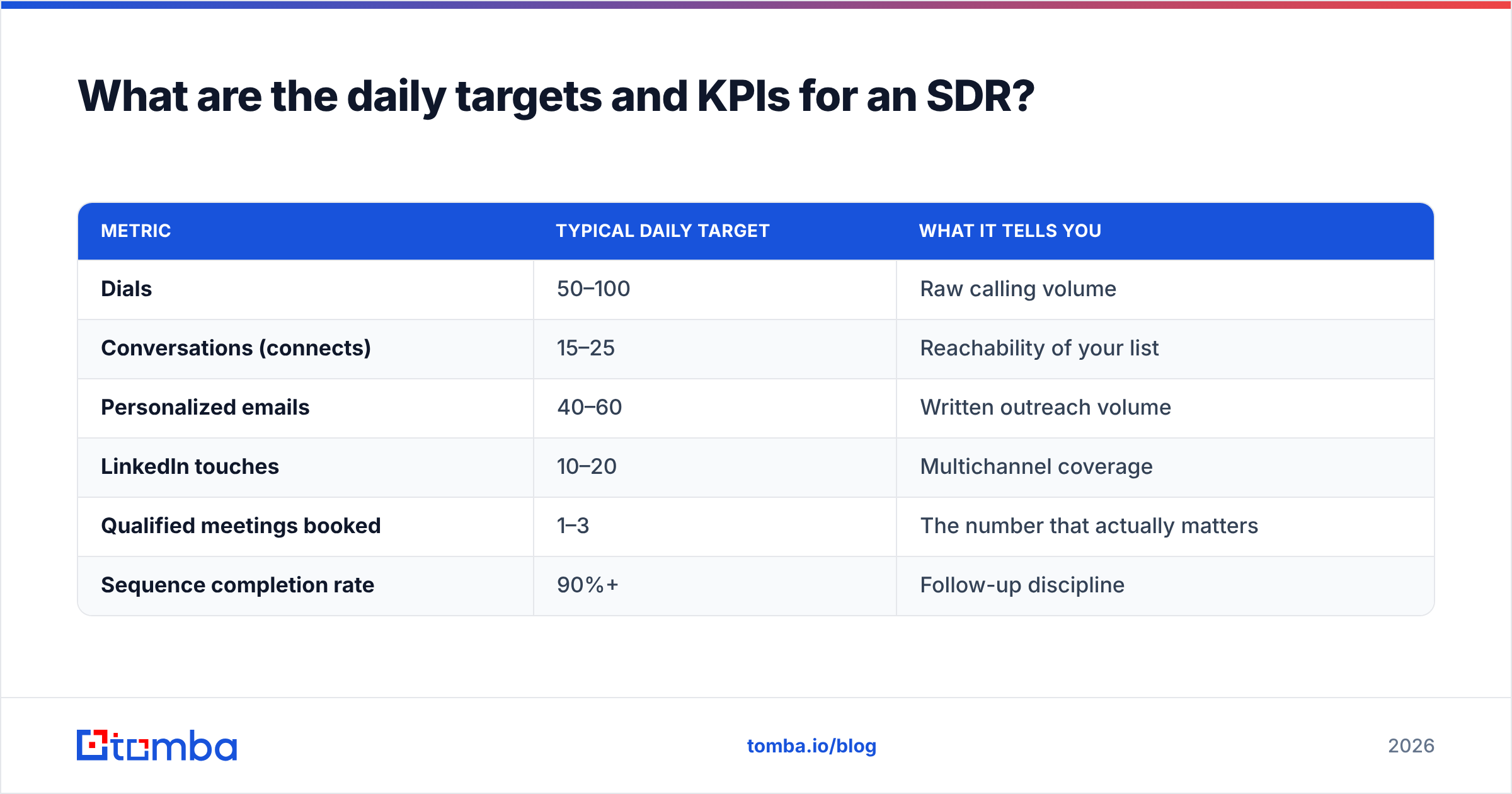
SDRs live and die by activity and outcome metrics. Managers track both because activity predicts results and results validate activity. Here are typical daily and weekly benchmarks for a B2B outbound role in 2026.
| Metric | Typical daily target | What it tells you |
|---|---|---|
| Dials | 50–100 | Raw calling volume |
| Conversations (connects) | 15–25 | Reachability of your list |
| Personalized emails | 40–60 | Written outreach volume |
| LinkedIn touches | 10–20 | Multichannel coverage |
| Qualified meetings booked | 1–3 | The number that actually matters |
| Sequence completion rate | 90%+ | Follow-up discipline |
The trap is optimizing volume in isolation. Doubling dials on a list of stale, unverified numbers just doubles your voicemails. This is why the best teams obsess over data quality upstream — a verified list of 40 contacts will out-perform a raw list of 100. Running new contacts through an email verifier before you send protects both your deliverability and your calendar.
For a broader view of how these roles are measured and compensated, industry benchmarks from G2 and sales methodology guides on the HubSpot blog are worth bookmarking.

What tools does an SDR use every day?#
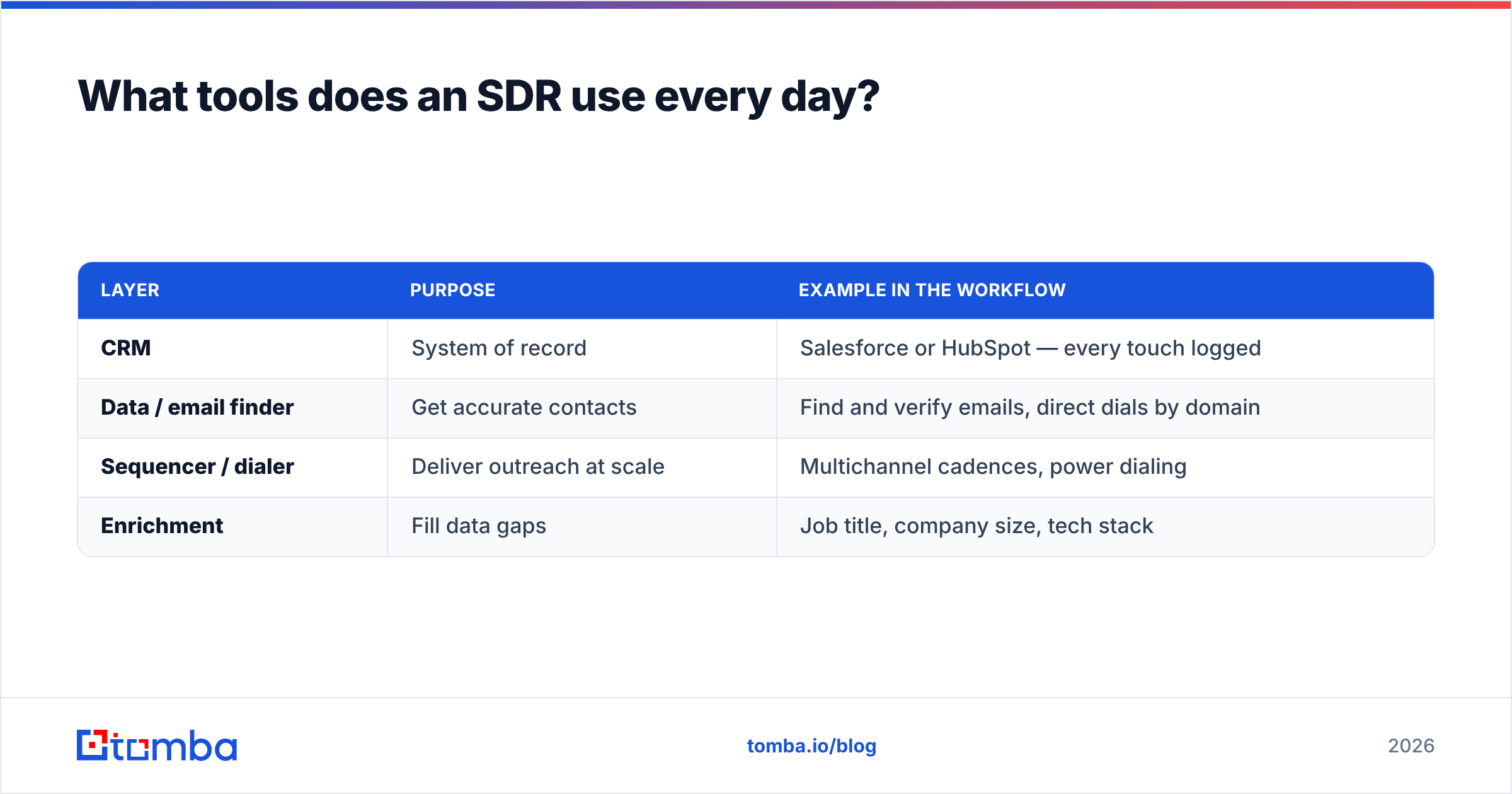
An SDR's stack has three jobs: find contacts, reach them, and remember what happened. Here's how the layers compare and where each one earns its cost.
| Layer | Purpose | Example in the workflow |
|---|---|---|
| CRM | System of record | Salesforce or HubSpot — every touch logged |
| Data / email finder | Get accurate contacts | Find and verify emails, direct dials by domain |
| Sequencer / dialer | Deliver outreach at scale | Multichannel cadences, power dialing |
| Enrichment | Fill data gaps | Job title, company size, tech stack |
The CRM is non-negotiable — it's where the whole CRM discipline of pipeline management happens, and platforms like Salesforce anchor most enterprise stacks. But the layer juniors underrate is data. Every hour spent on the wrong contact, or bouncing off a dead email, is an hour not spent talking to a buyer.
That's why a fast, accurate email finder sits at the center of a productive SDR day. Feed it a company domain, get back verified addresses and patterns for the people you actually want to reach — no guessing, no permutator gymnastics, no burned sender reputation. Pair it with automatic verification and you remove the single biggest source of wasted outreach.
What separates a top SDR from an average one?#
Same tools, same scripts, same territory — wildly different results. The gap almost always comes down to a few habits:
- They time-block ruthlessly. Calls happen in calls-only windows. No "quick email" mid-dial-session. Context-switching is the silent productivity tax.
- They personalize the first line, template the rest. One genuine, specific observation per prospect — then a proven structure. This scales; fully custom emails don't.
- They treat data as sacred. Clean lists, verified contacts, logged activity. Their CRM is trustworthy, so their forecasts are too.
- They follow up relentlessly. Average reps stop at touch two. Top reps run the full sequence and book the meetings everyone else abandoned.
- They review their own numbers. Connect rate low? Fix the list. Reply rate low? Fix the copy. They diagnose, not just grind harder.
None of this is glamorous, and none of it is secret. It's operational discipline applied consistently — the same reason a well-run LinkedIn outreach motion beats spray-and-pray every time.
Is being an SDR worth it?#
For most people entering B2B sales, yes — with eyes open. The role is demanding: high activity, frequent rejection, and constant measurement. But it's also the fastest on-ramp to a sales career. Strong SDRs get promoted to AE in 12–24 months, and the skills you build — research, messaging, resilience, pipeline math — transfer to almost every revenue role.
The reps who thrive are the ones who make the day repeatable. They stop treating each morning as a fresh scramble and start running a system: research block, calling block, follow-up block, clean data underneath it all. The ones who burn out are usually fighting their tools — hunting for contact info, chasing bad numbers, retyping the same email.
How do you make an SDR day less painful?#
Remove friction from the parts that don't require your brain. Contact discovery is the obvious one. Instead of manually digging for emails and phone numbers, plug your target accounts into a tool that returns verified contacts in seconds — then spend your saved hours on the two things that actually book meetings: better research and more conversations.
That's exactly where Tomba fits an SDR's workflow. Point the Tomba Email Finder at a company domain and get accurate, verified professional emails — plus patterns, direct dials, and enrichment data — without leaving your prospecting flow. Start free with 25 searches a month, and when your volume grows, plans scale from $49/mo Starter up through Growth and Pro; the full breakdown lives on the Tomba pricing page. Spend less of your day finding people, and more of it selling to them.
Related guides#
Ready to find emails that actually work?
Join 150,000+ professionals who stopped guessing and started sending. Free credits on signup — no credit card required.
Get the Tomba newsletter
Practical outbound tactics and product updates — once every two weeks.
About the author