Deal Closing in 2026: A Practical Guide to Closing More B2B Deals
Deal closing isn't a single magic line at the end of a call — it's a process you engineer from the first touch. Here's how to close more B2B deals in 2026.
Deal closing feels mysterious until you break it down. The rep who "just has a knack for closing" is usually running a process you can copy: they qualify hard, they surface objections early, they control the timeline, and they never let a champion go dark. This guide takes the mystique out of it and gives you a repeatable system for closing more B2B deals in 2026.
TL;DR#
- Closing is the output of good discovery, not a last-minute trick. Most deals are won or lost long before the "sign here" moment.
- The best closers reduce risk, not price. Buyers stall because they're unsure, not because they're broke.
- Multithread every deal. Single-threaded deals die when your one contact changes jobs or goes quiet.
- Clean contact data is the hidden multiplier. You can't close a champion you can't reach — accurate emails and direct dials keep momentum alive.
- Track closing signals, not just gut feel. Verbal cues, stakeholder involvement, and mutual action plans predict close rates better than optimism.
What is deal closing, really?#
Deal closing is the process of guiding a qualified prospect from "this looks interesting" to a signed agreement — and it's a process, not a moment. Think of it like landing a plane. The touchdown gets all the attention, but a smooth landing is the result of a controlled descent that started miles out. If your approach is wrong at 10,000 feet, no amount of skill in the final ten seconds saves you.
In practical terms, closing spans everything from confirming the buyer has budget and authority, to aligning on success criteria, to handling procurement and legal, to getting a signature. A "closing technique" you deploy in the last five minutes only works when the groundwork underneath it is solid.
The most common mistake reps make is treating closing as a personality trait — charisma, persistence, the perfect line. In reality, the reps with the highest win rate are the ones with the cleanest process. They know exactly where every deal sits, what the next step is, and who needs to say yes.
Why do so many B2B deals stall at the finish line?#
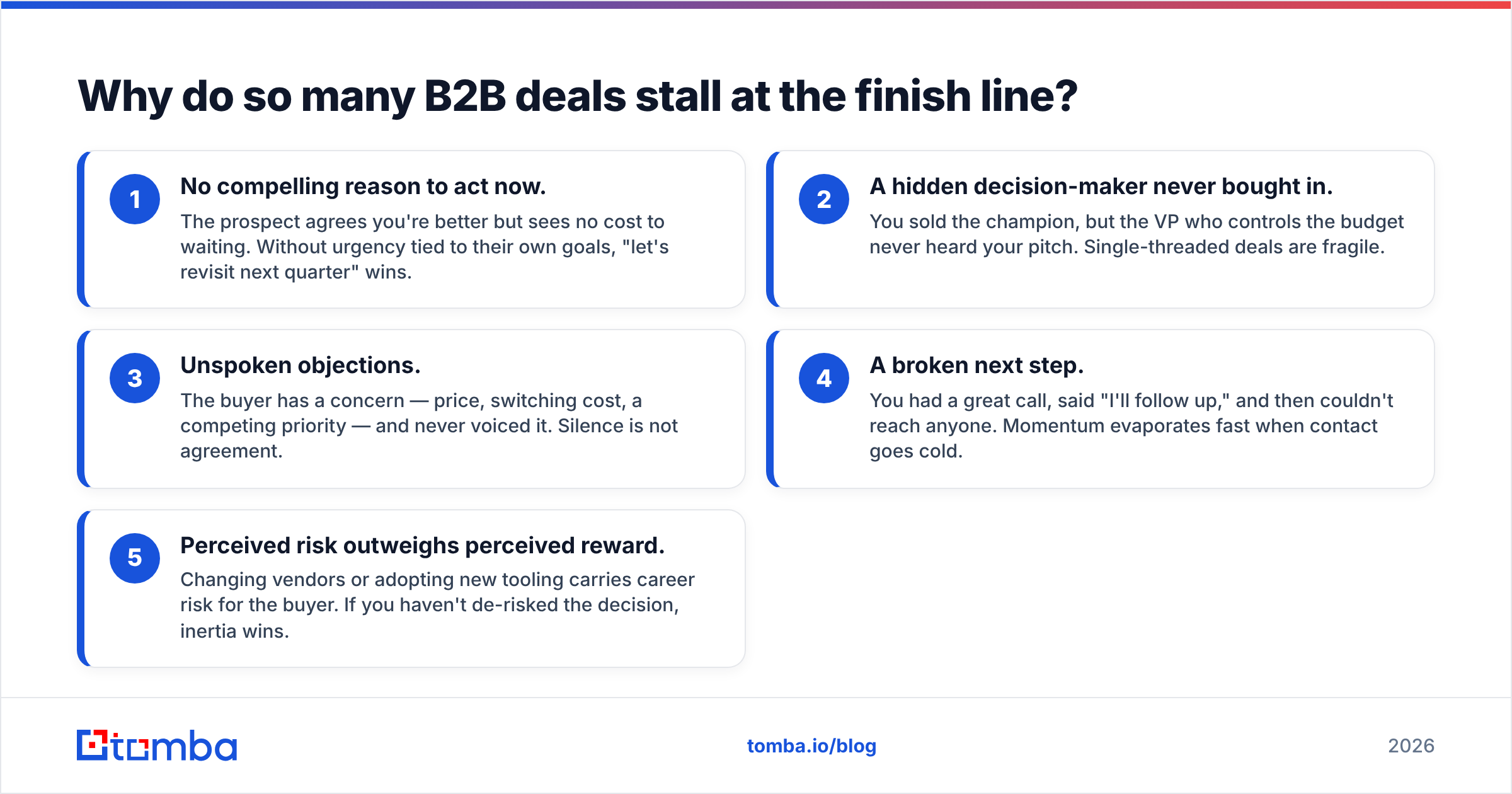
Deals stall for a small set of predictable reasons. If you can name them, you can prevent them.
- No compelling reason to act now. The prospect agrees you're better but sees no cost to waiting. Without urgency tied to their own goals, "let's revisit next quarter" wins.
- A hidden decision-maker never bought in. You sold the champion, but the VP who controls the budget never heard your pitch. Single-threaded deals are fragile.
- Unspoken objections. The buyer has a concern — price, switching cost, a competing priority — and never voiced it. Silence is not agreement.
- A broken next step. You had a great call, said "I'll follow up," and then couldn't reach anyone. Momentum evaporates fast when contact goes cold.
- Perceived risk outweighs perceived reward. Changing vendors or adopting new tooling carries career risk for the buyer. If you haven't de-risked the decision, inertia wins.
Notice that only one of these is about your product. The rest are about process, people, and risk. That's where closing is actually won.
What are the deal closing techniques that actually work in 2026?#
Forget high-pressure "assumptive closes" from 1985 sales books. Modern B2B buyers are informed, skeptical, and allergic to manipulation. The techniques that work now are collaborative and risk-reducing.
- The summary close. Recap the buyer's stated problems, the impact, and how your solution maps to each. This isn't a pitch — it's confirming you listened. When a prospect hears their own words reflected back, agreement feels natural.
- The mutual action plan (MAP). Co-author a written timeline: demo, security review, pilot, procurement, go-live. A shared plan turns "if" into "when" and exposes stalls early because you can both see when a step slips.
- The trial close. Before asking for the deal, test temperature: "If we solved X, is there any reason you wouldn't move forward?" The answer tells you exactly what objections remain.
- The takeaway (used honestly). If a prospect isn't a fit, say so. Scarcity that's real — limited onboarding slots, pricing that changes — creates urgency without deception.
- The next-step close. Never end a conversation without a scheduled, calendared next action with a named owner. "I'll email you" is not a next step; "we meet Thursday at 2 with your CFO" is.
The through-line: every effective technique reduces uncertainty. You're not pressuring a buyer into a corner; you're removing the reasons they'd hesitate.
How does discovery drive the close?#
Discovery is where deals are actually closed — you just collect the signature later. Weak discovery produces weak closes because you're guessing at what the buyer values. Strong discovery hands you the exact language, stakeholders, and success metrics you'll use to close.
A good discovery process surfaces three things you'll need at the finish line:
- The economic buyer. Who signs, and what do they care about? If you don't know this by the second call, your deal is at risk.
- The success metric. What number changes if they buy? Renewal conversations and internal justification both hinge on this.
- The alternatives. What happens if they do nothing, or pick a competitor? You can't position against options you haven't identified.
This is also where lead quality compounds. If your pipeline is full of poorly-qualified marketing qualified leads that were never a fit, no closing technique saves them. Feeding your funnel with accurately targeted, reachable prospects is a closing advantage that starts long before the demo.
Which closing metrics should you track?#
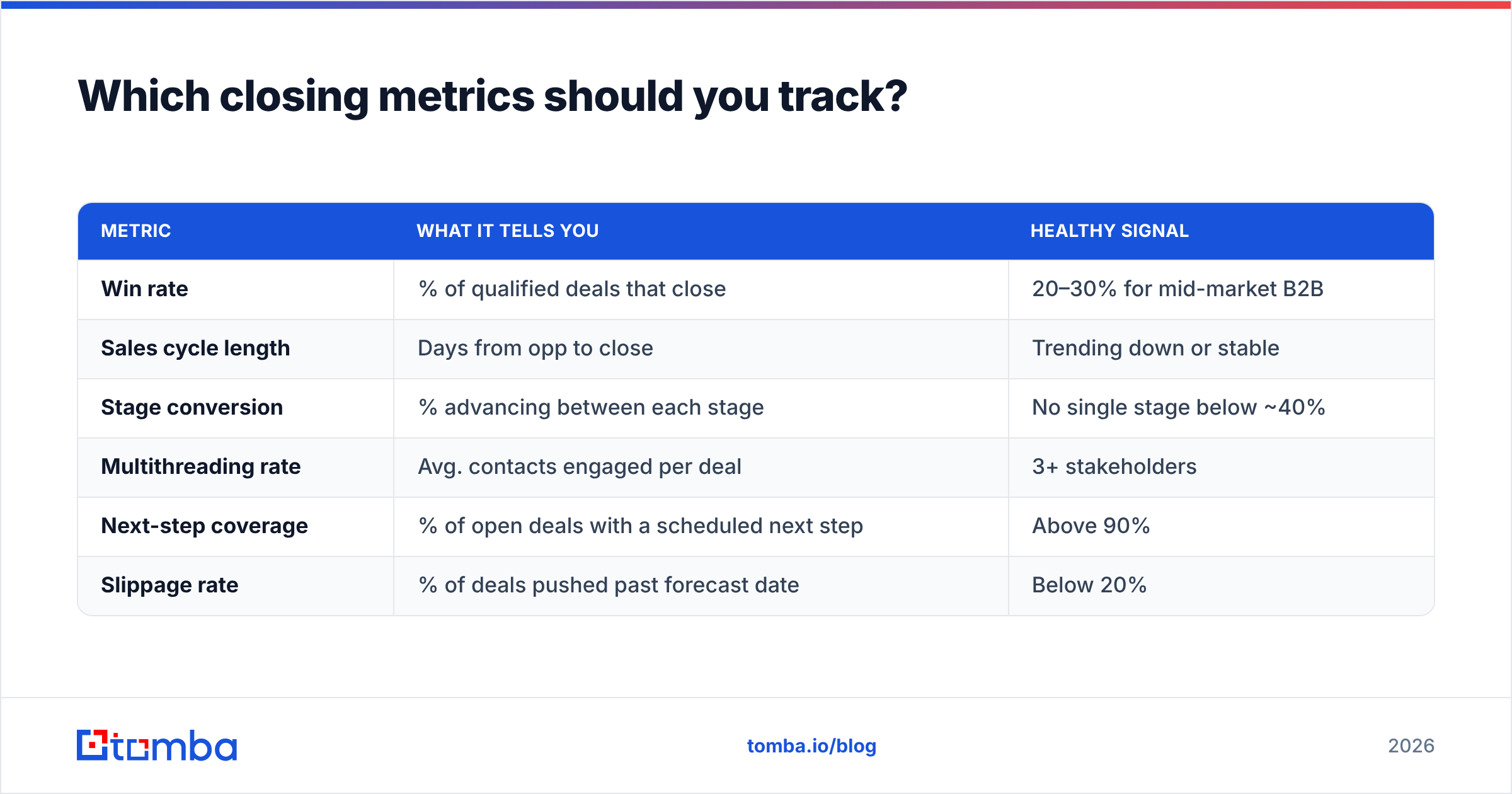
Gut feel is a terrible forecasting tool. These metrics turn "I think this'll close" into evidence.
| Metric | What it tells you | Healthy signal |
|---|---|---|
| Win rate | % of qualified deals that close | 20–30% for mid-market B2B |
| Sales cycle length | Days from opp to close | Trending down or stable |
| Stage conversion | % advancing between each stage | No single stage below ~40% |
| Multithreading rate | Avg. contacts engaged per deal | 3+ stakeholders |
| Next-step coverage | % of open deals with a scheduled next step | Above 90% |
| Slippage rate | % of deals pushed past forecast date | Below 20% |
The two most predictive of the bunch are multithreading rate and next-step coverage. Deals with three or more engaged stakeholders and a firm next step on the calendar close far more reliably than single-threaded deals riding on optimism. If you track only two things, track those.
Why is contact data a closing problem, not just a prospecting problem?#
Bad data doesn't only hurt the top of the funnel — it kills deals at the bottom. Here's the scenario every rep knows: a deal is progressing, then your champion goes quiet. Maybe they got promoted, changed companies, or their inbox is buried. If your only path to them is one stale email address, the deal stalls silently.
This is where accurate, verifiable contact data becomes a closing tool. When you can quickly find a champion's new email after a job change, reach a second stakeholder you hadn't engaged, or pull a direct dial to break through inbox silence, you keep momentum alive. Momentum is the currency of closing.
Tools like Tomba's email finder let you find professional email addresses by name and company, so when a deal needs a fresh contact path you're not stuck. Pairing that with an email verifier means the messages you send to keep a deal warm actually land instead of bouncing — protecting both your sender reputation and your timeline. For enterprise deals where you need to reach several decision-makers fast, domain search surfaces the full team behind an account in one pass.
How do you multithread a deal without annoying your champion?#
Multithreading scares reps because it feels like going behind your champion's back. Done right, it's the opposite — you make your champion look good by arming the whole buying committee.
- Ask, don't sneak. "Who else needs to be comfortable with this decision? I'd love to make sure their questions are answered so this doesn't stall in review." Champions almost always welcome help getting internal buy-in.
- Give your champion an internal deck. A one-pager they can forward turns them into your advocate in rooms you'll never enter.
- Engage the economic buyer early, not at signature. Meeting the CFO for the first time during procurement is a red flag. Get in front of them while there's still time to build value.
- Map the org before you need it. Knowing the reporting structure and who's affected lets you anticipate objections. This is where accurate B2B data — titles, seniority, direct contacts — pays off directly.
The goal isn't more meetings; it's fewer surprises. A deal with four engaged stakeholders rarely dies because one person went on vacation.
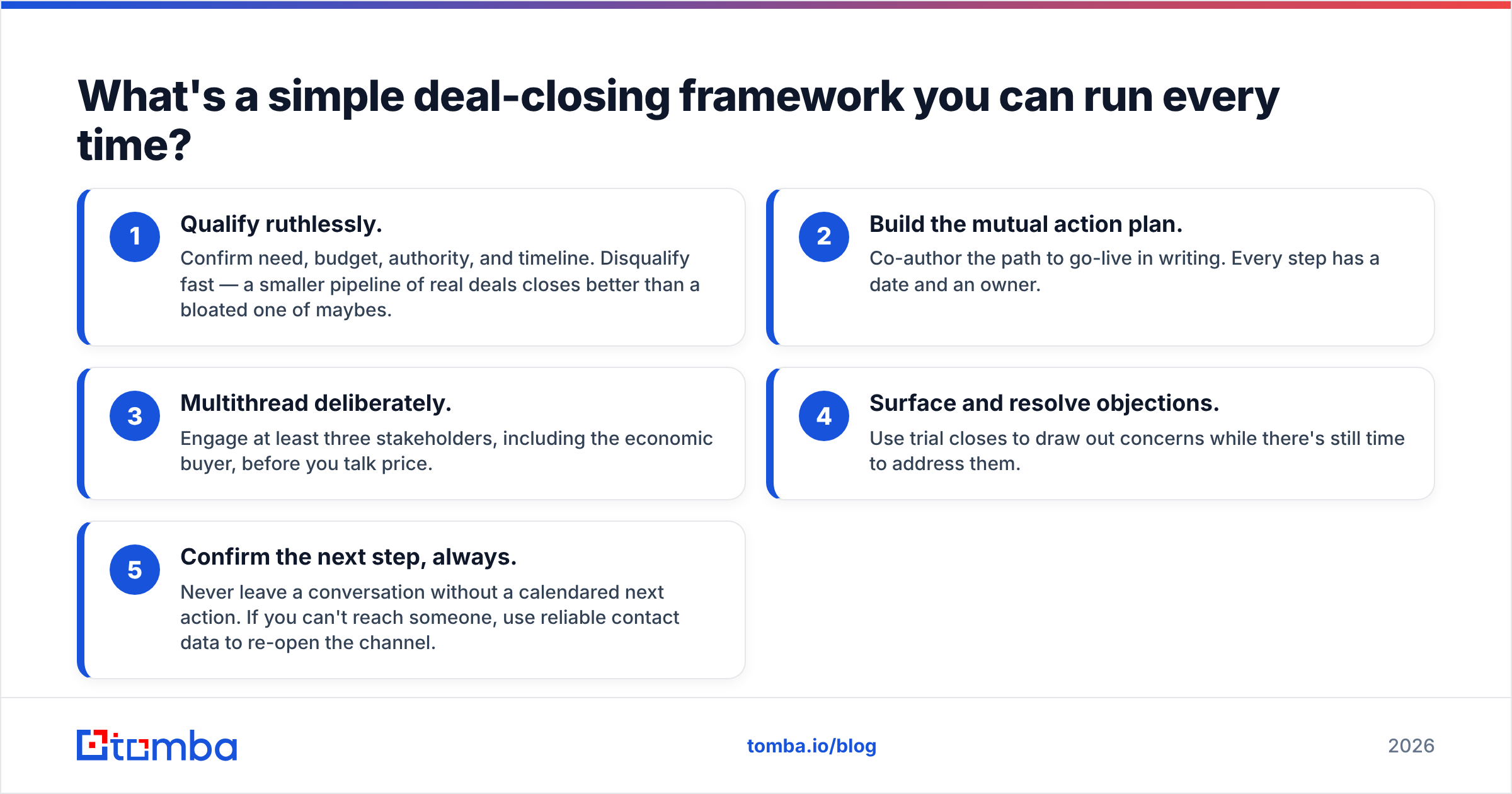
What's a simple deal-closing framework you can run every time?#
Consistency beats brilliance. Here's a five-step loop you can run on any B2B deal, from SMB to enterprise.
- Qualify ruthlessly. Confirm need, budget, authority, and timeline. Disqualify fast — a smaller pipeline of real deals closes better than a bloated one of maybes.
- Build the mutual action plan. Co-author the path to go-live in writing. Every step has a date and an owner.
- Multithread deliberately. Engage at least three stakeholders, including the economic buyer, before you talk price.
- Surface and resolve objections. Use trial closes to draw out concerns while there's still time to address them.
- Confirm the next step, always. Never leave a conversation without a calendared next action. If you can't reach someone, use reliable contact data to re-open the channel.
Run this loop enough times and "closing" stops feeling like a performance. It becomes the natural result of a controlled descent.
Deal closing: myths vs. reality#
| Myth | Reality |
|---|---|
| Closing is a final-moment skill | Closing is the output of the whole process |
| Discounting closes deals | De-risking closes deals; discounts often signal desperation |
| One strong champion is enough | Single-threaded deals are the most likely to die |
| Persistence means following up more | Persistence means always having a scheduled next step |
| More pipeline fixes low close rates | Better-qualified, reachable pipeline fixes close rates |
How do the tools fit together?#
You don't need a bloated tech stack to close well — you need reliable data feeding a disciplined process. A CRM to track stages, a way to keep contact paths open, and clean data to multithread. Compare Tomba pricing against your current data spend and you'll often find you're overpaying for stale records elsewhere.
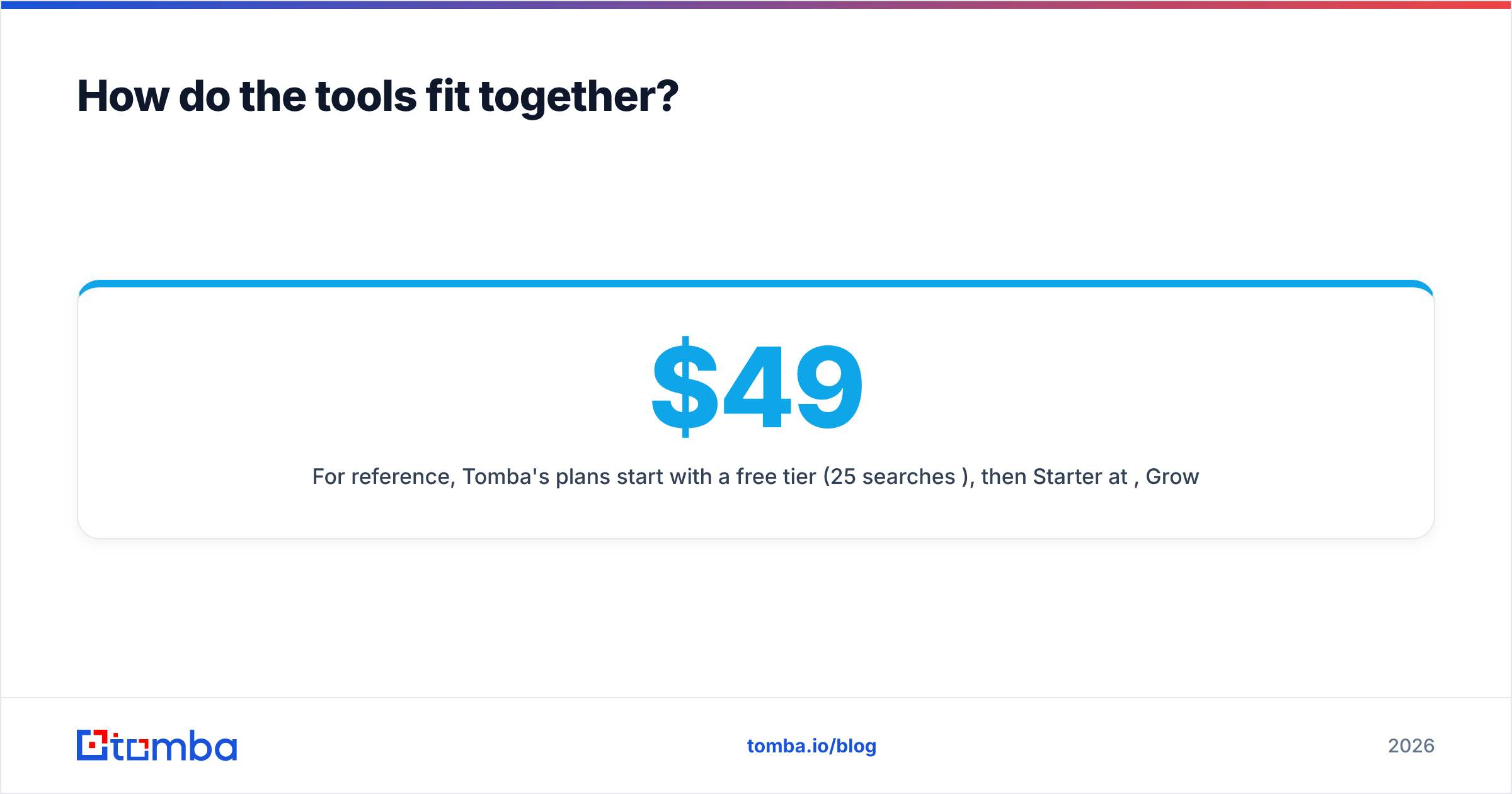
For reference, Tomba's plans start with a free tier (25 searches/month), then Starter at $49/mo, Growth at $99/mo, and Pro at $249/mo, with custom Enterprise pricing. That covers email finding, verification, and enrichment — the data layer that keeps deals reachable. For broader vendor comparisons, sites like G2 and Capterra are useful neutral starting points, and HubSpot's sales blog has solid, free playbooks on closing methodology.
Common closing objections and how to answer them#
- "It's too expensive." Reframe to cost of inaction. What does the status quo cost them per month? Price is only expensive relative to unclear value.
- "We need to think about it." Usually means an unsurfaced objection. Respond: "Totally fair — what specifically would you want to be more sure about?"
- "Now isn't the right time." Tie urgency to their own stated goal and its deadline. If there's genuinely no urgency, you may have skipped qualification.
- "We're happy with our current solution." Don't attack the incumbent. Ask what they wish it did better, and position around that gap.
Every objection is information. The reps who close treat objections as the map to the finish line, not roadblocks in front of it.
Close more of what's already in your pipeline#
The fastest way to close more deals in 2026 isn't more leads — it's losing fewer of the good ones you already have. That means multithreading before deals go dark, keeping a scheduled next step on every opportunity, and making sure you can always reach the people who matter.
That last part is where your data stack earns its keep. When a champion changes jobs, a stakeholder goes quiet, or you need to reach a decision-maker you haven't engaged, Tomba's Email Finder gives you an accurate, verified path back into the conversation — by name, company, or domain. Start on the free tier, keep your deals reachable, and let a disciplined process do the closing. The magic was never the final line. It was never losing the thread in the first place.
Related guides#
Ready to find emails that actually work?
Join 150,000+ professionals who stopped guessing and started sending. Free credits on signup — no credit card required.
Get the Tomba newsletter
Practical outbound tactics and product updates — once every two weeks.
About the author