Deal Execution: The 2026 Playbook for Closing B2B Deals Faster
Deal execution is where good pipeline goes to die or where quota gets hit. Here's the 2026 framework, tools, and metrics that separate reps who close from reps who forecast.
Deal execution is the part of selling nobody puts on a slide, yet it decides whether your forecast is real. You can build a beautiful pipeline, run flawless discovery, and still watch a "committed" deal slip two quarters because the execution motion fell apart after the demo. This guide breaks down what deal execution actually is in 2026, the framework that keeps deals moving, the metrics that expose stalls early, and the tooling that removes the manual drag.
TL;DR#
- Deal execution is the disciplined set of actions between "qualified opportunity" and "signed contract" — mutual action plans, multithreading, and momentum management, not just follow-up.
- Most deals don't die from a bad pitch; they die from execution gaps: single-threaded relationships, no next step booked, and stale contact data.
- A repeatable execution framework (MEDDICC-style qualification + mutual action plan + multithreading) lifts win rates far more than a better opening line.
- Track stage velocity, next-step coverage, and stakeholder count — not just pipeline dollars.
- Clean, current contact data is the fuel; a B2B database and accurate email finder keep multithreading from grinding to a halt.
What is deal execution?#
Deal execution is everything you do to convert a qualified opportunity into signed, paid revenue — reliably and on a predictable timeline. Think of it like landing a plane. Prospecting gets you airborne and discovery gets you cruising, but execution is the approach, the flare, and the touchdown. Most crashes happen on landing, not takeoff, and most sales crashes happen after the deal looks "real," not before.
Concretely, deal execution covers:
- Qualification depth — confirming pain, budget, decision process, and a compelling event, not just interest.
- Mutual action plans (MAPs) — a shared, dated checklist that both you and the buyer commit to.
- Multithreading — building relationships across the buying committee so one champion leaving doesn't kill the deal.
- Momentum management — always having the next meeting booked before you leave the current one.
- Commercial and legal navigation — pricing, security review, procurement, and signature.
The difference between a rep who forecasts and a rep who closes is almost never charisma. It's whether these five things happen on purpose or by accident.
Why do most B2B deals stall during execution?#
Because the deal was single-threaded and had no committed next step. Those two failure modes account for the majority of "went dark" losses. When you rely on one contact, you inherit all of their risk: they get reorganized, deprioritized, or overruled, and the deal evaporates with them.
The other silent killer is stale data. In 2026, B2B data decays at roughly 25–30% per year as people change jobs. A champion who was your inside advocate in Q1 may be at a new company in Q3 — and if your only relationship was with them, you're starting over. This is why execution and data quality are inseparable. You can't multithread a committee if half the emails bounce.
Here are the execution gaps that quietly break deals:
- No compelling event. "Sometime this year" is not a timeline. Without a deadline the buyer feels, the deal has no gravity.
- Champion, not economic buyer. Your champion loves you but can't sign. If you never reach the person who owns the budget, you're negotiating with someone who can only say no.
- Next step is vague. "I'll follow up next week" is not a next step. A calendar invite with an agenda is.
- Procurement surprise. Security reviews and legal redlines add weeks. Deals that ignore them until the end always slip.
What does a deal execution framework look like?#
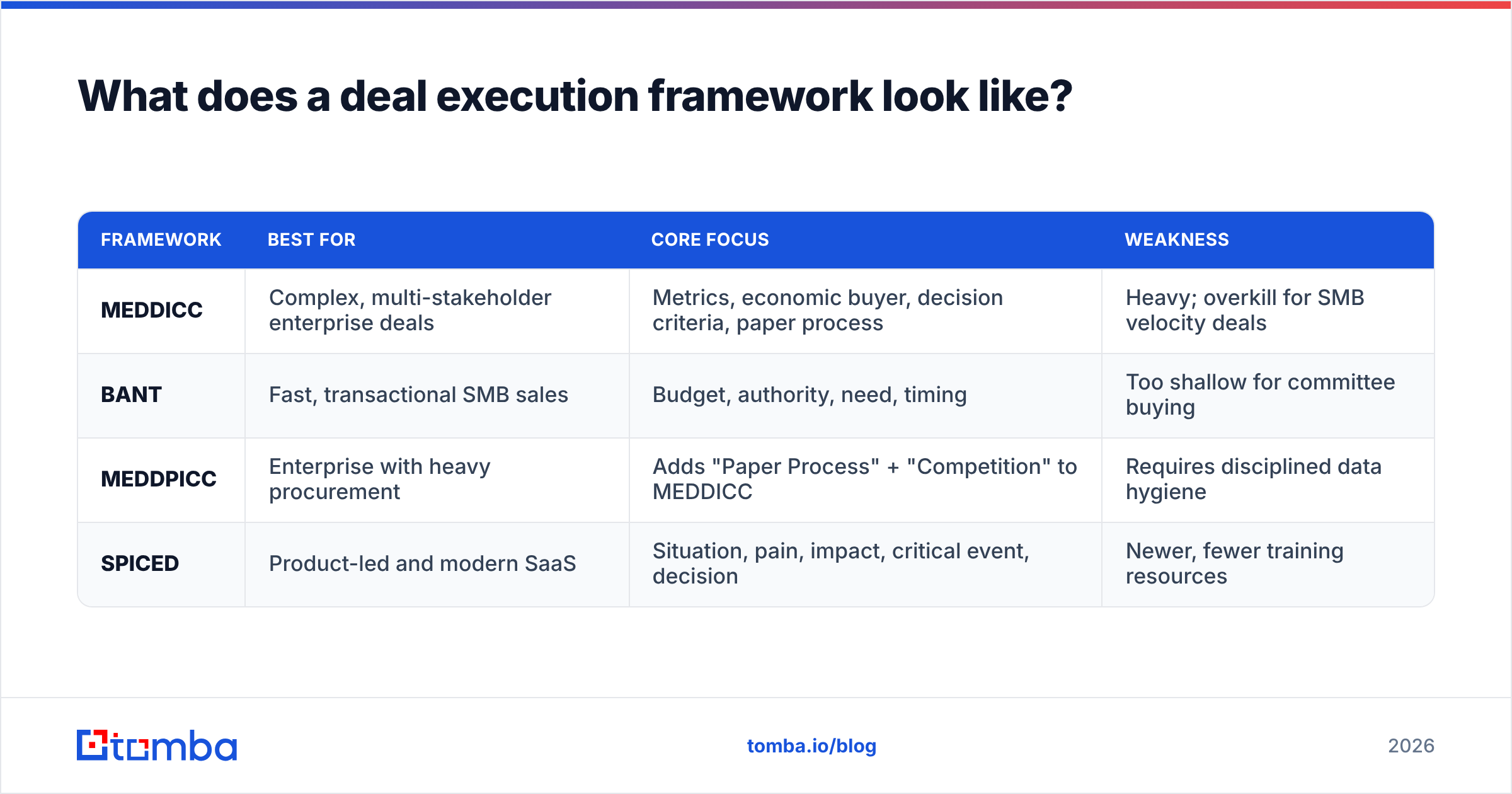
A strong framework layers a qualification method, a mutual action plan, and a multithreading motion on top of your CRM stages. You don't need to invent one — you need to run one consistently. Below is a comparison of the three most common qualification frameworks reps use as the backbone of execution.
| Framework | Best for | Core focus | Weakness |
|---|---|---|---|
| MEDDICC | Complex, multi-stakeholder enterprise deals | Metrics, economic buyer, decision criteria, paper process | Heavy; overkill for SMB velocity deals |
| BANT | Fast, transactional SMB sales | Budget, authority, need, timing | Too shallow for committee buying |
| MEDDPICC | Enterprise with heavy procurement | Adds "Paper Process" + "Competition" to MEDDICC | Requires disciplined data hygiene |
| SPICED | Product-led and modern SaaS | Situation, pain, impact, critical event, decision | Newer, fewer training resources |
The framework matters less than the follow-through. A team running plain BANT with religious discipline will out-execute a team running MEDDPICC on gut feel. Pick one, put its fields in your CRM, and make them required to advance a stage.
The mutual action plan is your execution spine#
A mutual action plan is a shared document listing every step from today to go-live, with owners and dates on both sides. It does three things at once:
- Exposes the real timeline. When the buyer commits to dates, you learn fast whether the "Q3 close" is real.
- Surfaces hidden stakeholders. "Who signs off on security?" reveals a person you hadn't met.
- Creates accountability. A missed buyer-side task is an early warning, not a surprise at quarter-end.
How do you multithread a deal without being annoying?#
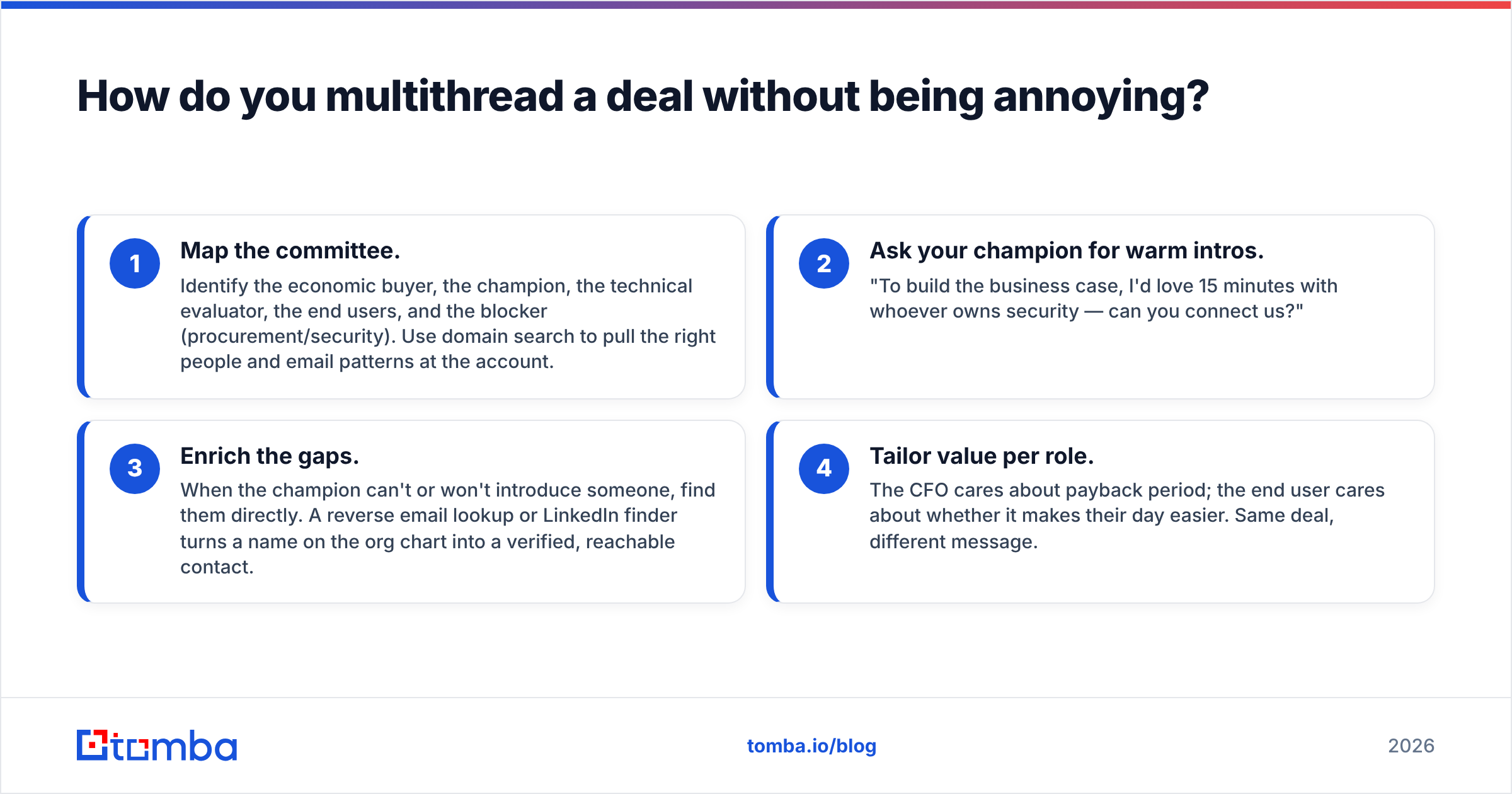
You earn each new relationship by bringing that person specific value, and you use your champion as the introduction path. Multithreading isn't spamming the org chart. It's mapping the buying committee — typically five to eleven people in a B2B purchase — and building a reason to talk to each role.
A practical multithreading sequence:
- Map the committee. Identify the economic buyer, the champion, the technical evaluator, the end users, and the blocker (procurement/security). Use domain search to pull the right people and email patterns at the account.
- Ask your champion for warm intros. "To build the business case, I'd love 15 minutes with whoever owns security — can you connect us?"
- Enrich the gaps. When the champion can't or won't introduce someone, find them directly. A reverse email lookup or LinkedIn finder turns a name on the org chart into a verified, reachable contact.
- Tailor value per role. The CFO cares about payback period; the end user cares about whether it makes their day easier. Same deal, different message.
Multithreading is the single highest-leverage execution habit. Gartner's research on buying groups has consistently shown that larger, more consensus-driven committees are the norm in enterprise software, which means a single-threaded deal is a structurally fragile deal. You can read more on how buying groups behave in Gartner's B2B buying research.
Which metrics tell you a deal is actually executing?#
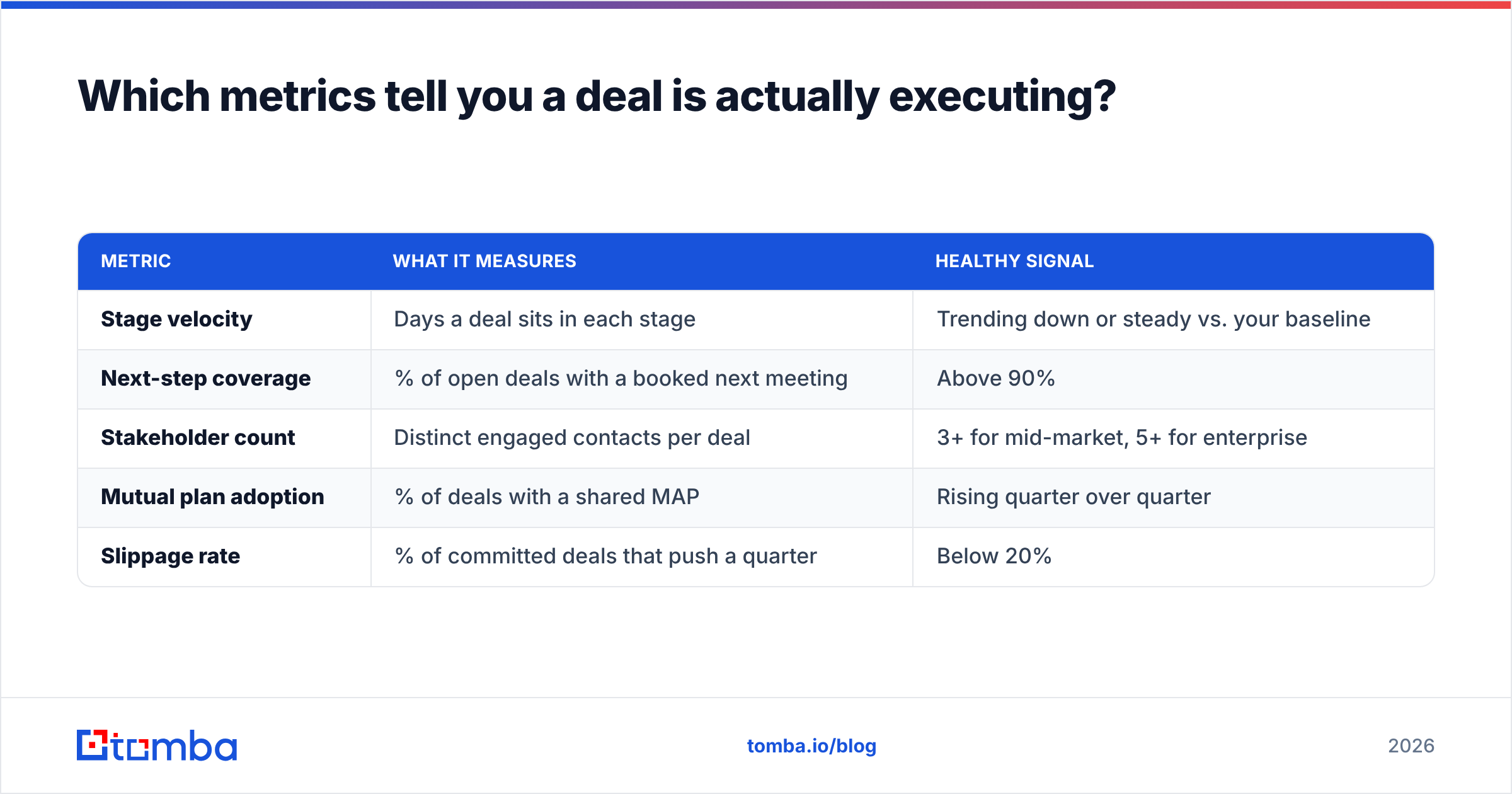
Stop staring at pipeline dollars and start watching movement. Dollar amount tells you what a deal is worth; execution metrics tell you whether it's alive. Track these:
| Metric | What it measures | Healthy signal |
|---|---|---|
| Stage velocity | Days a deal sits in each stage | Trending down or steady vs. your baseline |
| Next-step coverage | % of open deals with a booked next meeting | Above 90% |
| Stakeholder count | Distinct engaged contacts per deal | 3+ for mid-market, 5+ for enterprise |
| Mutual plan adoption | % of deals with a shared MAP | Rising quarter over quarter |
| Slippage rate | % of committed deals that push a quarter | Below 20% |
The most predictive of these is next-step coverage. A deal without a scheduled next meeting is not "in progress" — it's stalled and hasn't told you yet. When you review your pipeline, sort by "no next step" first and treat every one as a fire.
What tools support deal execution in 2026?#
Your execution stack has three jobs: keep data current, keep the committee reachable, and keep momentum visible. Here's how the layers fit together and where each tool earns its keep.
- CRM (system of record). Salesforce or HubSpot hold the stages, MAP, and stakeholder map. This is non-negotiable — if it's not in the CRM, it didn't happen.
- Sales engagement. Sequencing and task tools keep follow-up disciplined so no thread goes cold.
- Data and enrichment. This is the layer teams underinvest in. When a champion changes jobs or you need to reach a new stakeholder, you need a fast, accurate way to find and verify contacts.
That last layer is where deals quietly break, and it's where the right data tooling pays for itself. Tomba fits here without pretending to be your CRM. Use the email verifier before you send anything to a new stakeholder so bounces don't torch your sender reputation, and use data enrichment to keep committee records current as the deal drags on.
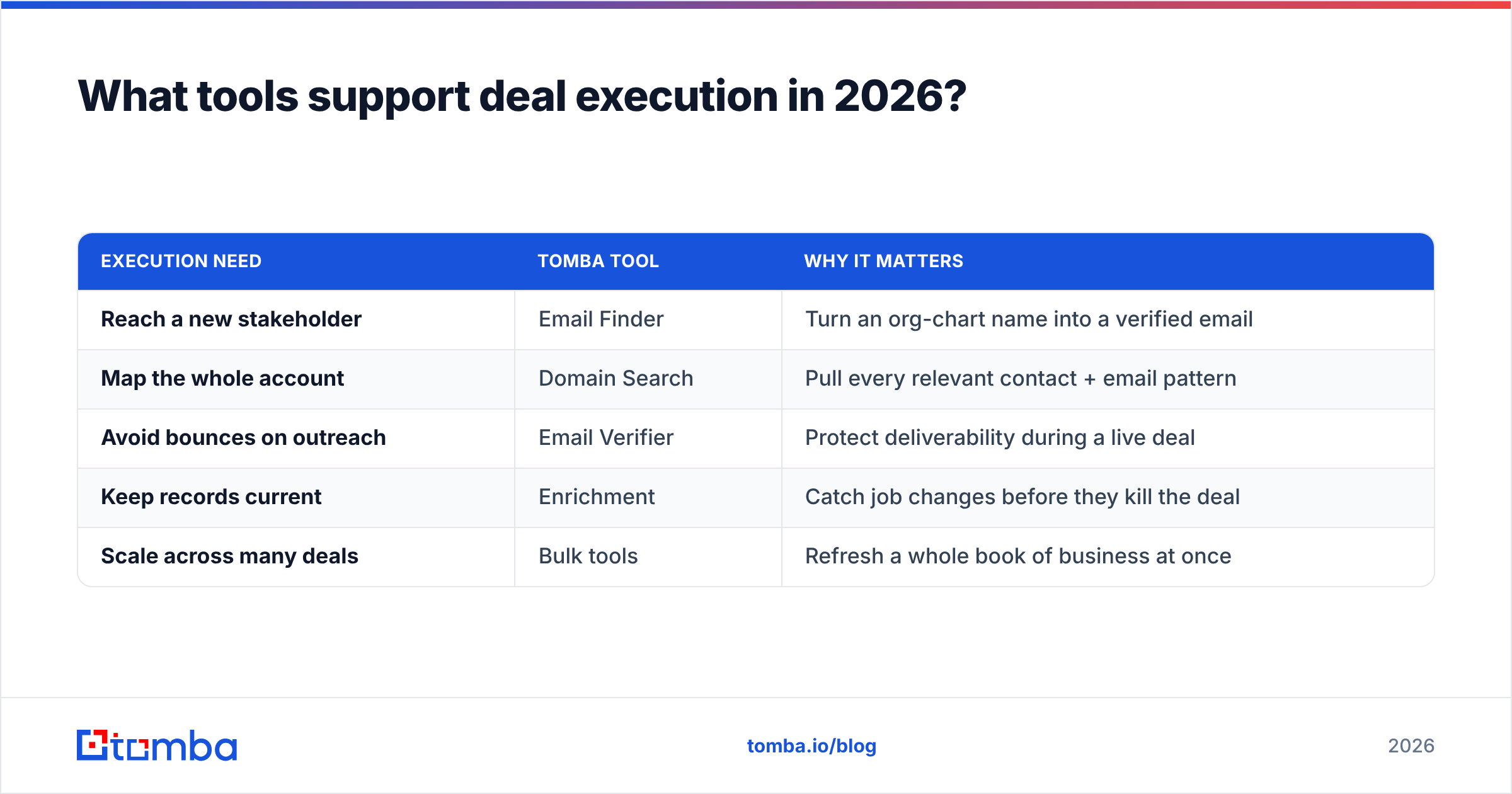
Where Tomba fits in the execution motion#
| Execution need | Tomba tool | Why it matters |
|---|---|---|
| Reach a new stakeholder | Email Finder | Turn an org-chart name into a verified email |
| Map the whole account | Domain Search | Pull every relevant contact + email pattern |
| Avoid bounces on outreach | Email Verifier | Protect deliverability during a live deal |
| Keep records current | Enrichment | Catch job changes before they kill the deal |
| Scale across many deals | Bulk tools | Refresh a whole book of business at once |
Tomba's pricing keeps this affordable for execution work: a free tier with 25 searches a month, Starter at $49/mo, Growth at $99/mo, and Pro at $249/mo. You can see full Tomba pricing before committing. For teams that live in spreadsheets, the Google Sheets add-on and HubSpot integration push verified contacts straight into the workflow you already use.
How do you run a deal execution review?#
Weekly, deal by deal, using a fixed set of questions that expose gaps. A good execution review is not a happy-ears forecast call. It's a stress test. For every committed and best-case deal, ask:
- What is the compelling event, and who feels it? No event, no urgency.
- Who is the economic buyer, and have you met them? If not, that's this week's action.
- What is the literal next step, on the calendar, with an agenda? Vague answers mean the deal is at risk.
- How many stakeholders are engaged? One is a red flag.
- What's the paper process — security, legal, procurement? Unknown means weeks of hidden delay.
Run this consistently and your forecast accuracy climbs because you're grading deals on execution reality, not optimism. Reps quickly learn to walk in with real answers, which changes their behavior in the field.
Common deal execution mistakes to avoid#
- Confusing activity with progress. Ten emails to one contact is not multithreading.
- Skipping the MAP because "the buyer seems bought in." Enthusiasm is not a signed contract.
- Ignoring data decay. Sending to a champion who left three months ago wastes the whole cycle.
- Leaving procurement to the end. Start the security conversation the week you reach technical fit.
- No next step from the current meeting. The single easiest habit to fix, and the highest ROI.
The bottom line#
Deal execution is a discipline, not a personality trait. The reps who hit quota quarter after quarter aren't smoother talkers — they qualify deeper, they build mutual action plans, they multithread relentlessly, and they never leave a meeting without booking the next one. Wrap those habits around clean, verified contact data and your forecast starts telling the truth.
If your execution keeps stalling because you can't reach the second, third, and fourth stakeholder on a deal, fix the fuel first. The Tomba Email Finder turns any name on the buying committee into a verified, reachable email in seconds — so multithreading stops being the reason your deals go dark. Start free with 25 searches, and only scale up when your pipeline does.
Related guides#
Ready to find emails that actually work?
Join 150,000+ professionals who stopped guessing and started sending. Free credits on signup — no credit card required.
Get the Tomba newsletter
Practical outbound tactics and product updates — once every two weeks.
About the author