Deal Insights in 2026: The Signals That Predict Revenue
Most deal insight dashboards measure activity and call it intent. Here's what actually predicts a closed deal in 2026, which tools surface those signals, and how to build a lightweight insights layer without a six-figure contract.
TL;DR
- Deal insights are the signals — buyer-side, not seller-side — that tell you whether an open opportunity will actually close, slip, or die. Activity counts are not deal insights.
- The four signals with the strongest predictive value are multi-threading depth, buyer-initiated momentum, stage-entry criteria completion, and time-in-stage decay. Everything else is noise dressed as a dashboard.
- Revenue intelligence platforms (Clari, Gong, Salesforce, HubSpot) all promise deal insights but differ enormously in what they observe: conversations, CRM fields, email metadata, or all three.
- Your insights are only as good as your contact records. Missing stakeholder emails silently cap your multi-threading score and corrupt every downstream forecast.
- You can build a usable deal insights layer in a spreadsheet plus an enrichment API before you sign a $60k platform contract. Start there.
What are deal insights, exactly?#
Deal insights are evidence-based signals about the health and likely outcome of a specific open opportunity. They answer one question: based on what the buyer has done, not what the rep has logged, how likely is this deal to close in the stated period?
That distinction matters more than any tooling decision you'll make. A dashboard showing "42 calls logged, 118 emails sent, next step scheduled" is an activity report. It tells you the rep is busy. It tells you nothing about whether the CFO has seen the business case.
Think of it like a doctor's chart. Activity metrics are "the patient came in six times this month." Deal insights are blood pressure, lab results, and family history. Both go in the file. Only one predicts the outcome.
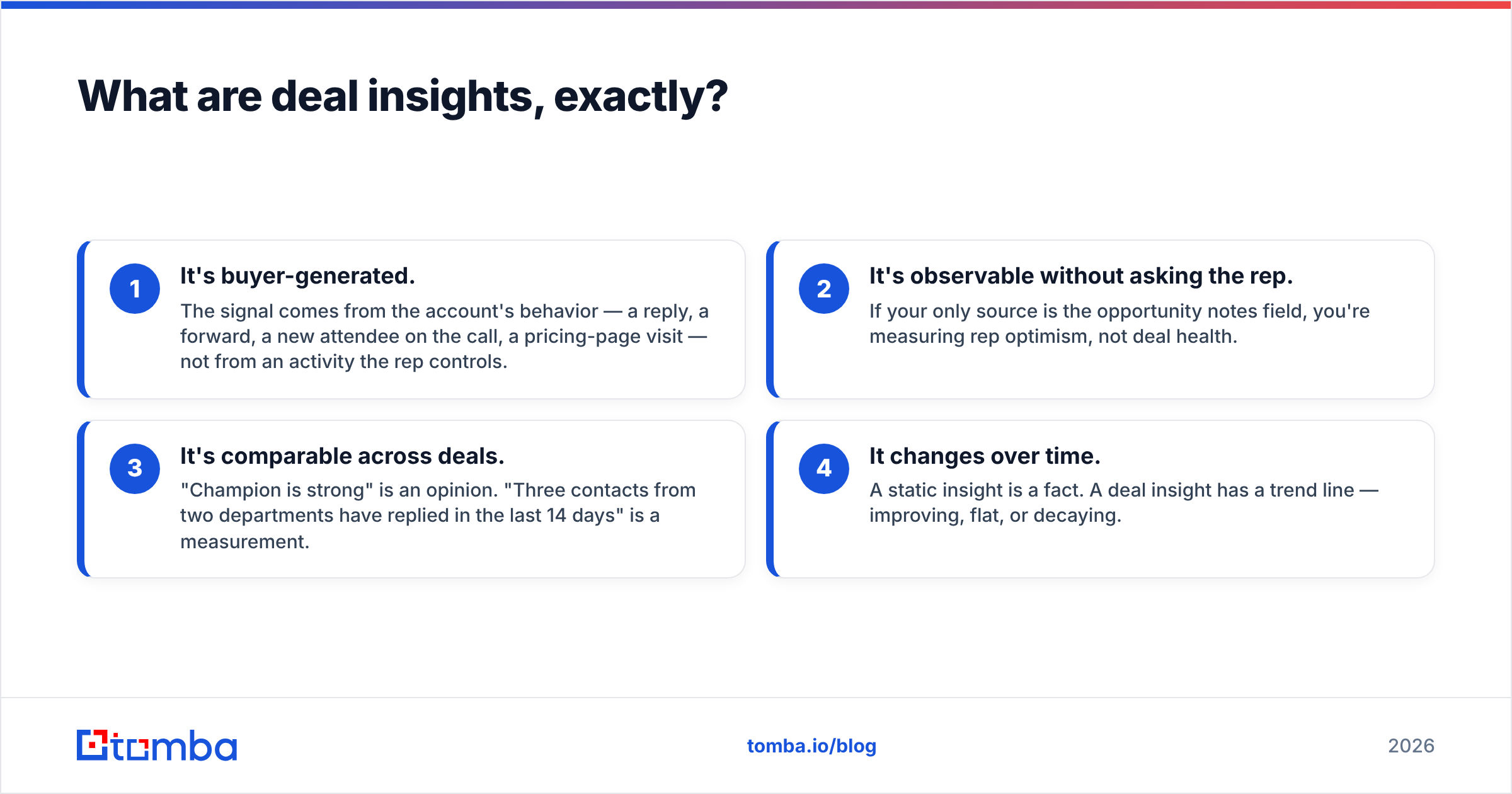
A real deal insight has three properties:
- It's buyer-generated. The signal comes from the account's behavior — a reply, a forward, a new attendee on the call, a pricing-page visit — not from an activity the rep controls.
- It's observable without asking the rep. If your only source is the opportunity notes field, you're measuring rep optimism, not deal health.
- It's comparable across deals. "Champion is strong" is an opinion. "Three contacts from two departments have replied in the last 14 days" is a measurement.
- It changes over time. A static insight is a fact. A deal insight has a trend line — improving, flat, or decaying.
Most teams collect item 4 and skip items 1 through 3, which is why forecast accuracy stays stuck around coin-flip territory.
Why do most deal insight dashboards fail?#
Because they're built on the fields reps are asked to fill in, and reps fill in fields to make the pipeline review go faster.
Here's the failure chain most revenue teams recognize: leadership asks for better forecasting → someone adds required fields to the opportunity object → reps enter plausible values in 20 seconds → the dashboard now shows precise, confidently-wrong data → the forecast misses again → leadership asks for more fields.
Gartner's sales research has repeatedly flagged the same root cause: CRM data entered for compliance rather than utility degrades faster than it can be analyzed. The fix isn't more discipline. It's shifting the source of truth from what the rep typed to what the buyer did.
The second failure mode is aggregation too early. A VP looks at a rolled-up pipeline number and asks "is this real?" The rolled-up number cannot answer that, because deal risk isn't normally distributed — one $400k deal with a single-threaded champion who just went quiet can swing a quarter more than forty healthy small deals. Deal insights have to be evaluated per-opportunity first, then rolled up with the risk flags attached.
The third: treating a sentiment score as a decision. Several AI tools will now hand you "Deal Health: 72." That number is a compression of a dozen underlying variables, and it's useless in a pipeline review unless you can expand it back into which variable dropped and what the rep should do about it.
Which signals actually predict a closed deal?#
These are the five that hold up across most B2B motions. Weight them to your own sales cycle, but start here.
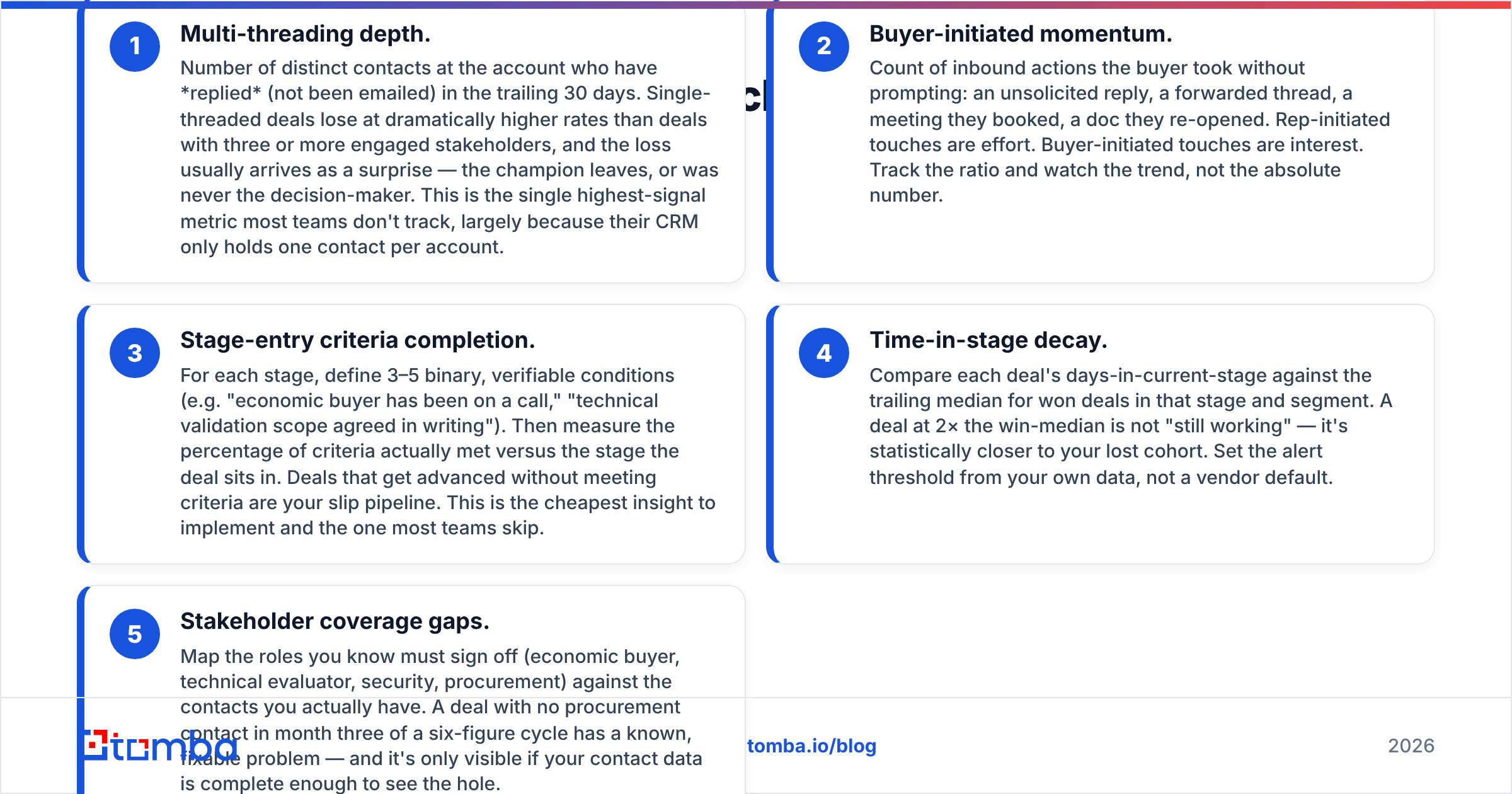
- Multi-threading depth. Number of distinct contacts at the account who have replied (not been emailed) in the trailing 30 days. Single-threaded deals lose at dramatically higher rates than deals with three or more engaged stakeholders, and the loss usually arrives as a surprise — the champion leaves, or was never the decision-maker. This is the single highest-signal metric most teams don't track, largely because their CRM only holds one contact per account.
- Buyer-initiated momentum. Count of inbound actions the buyer took without prompting: an unsolicited reply, a forwarded thread, a meeting they booked, a doc they re-opened. Rep-initiated touches are effort. Buyer-initiated touches are interest. Track the ratio and watch the trend, not the absolute number.
- Stage-entry criteria completion. For each stage, define 3–5 binary, verifiable conditions (e.g. "economic buyer has been on a call," "technical validation scope agreed in writing"). Then measure the percentage of criteria actually met versus the stage the deal sits in. Deals that get advanced without meeting criteria are your slip pipeline. This is the cheapest insight to implement and the one most teams skip.
- Time-in-stage decay. Compare each deal's days-in-current-stage against the trailing median for won deals in that stage and segment. A deal at 2× the win-median is not "still working" — it's statistically closer to your lost cohort. Set the alert threshold from your own data, not a vendor default.
- Stakeholder coverage gaps. Map the roles you know must sign off (economic buyer, technical evaluator, security, procurement) against the contacts you actually have. A deal with no procurement contact in month three of a six-figure cycle has a known, fixable problem — and it's only visible if your contact data is complete enough to see the hole.
Notice that four of the five depend on knowing who is at the account. That's the dependency almost nobody budgets for.
How do deal insight platforms compare in 2026?#
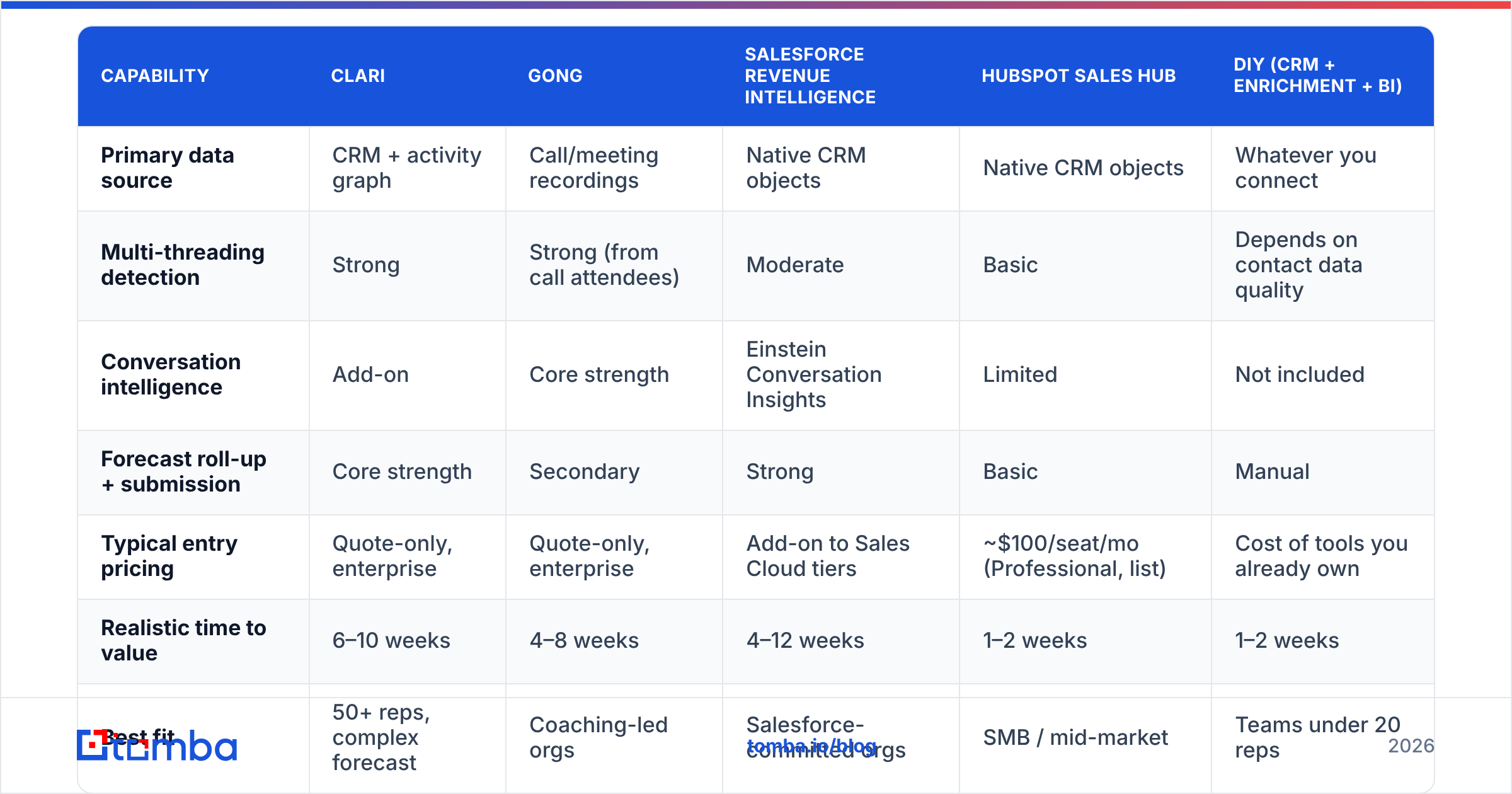
The category splits into three architectures: conversation-first (record calls, extract signals), CRM-first (score the fields you already have), and activity-graph-first (parse email and calendar metadata). Each sees a different slice of reality.
| Capability | Clari | Gong | Salesforce Revenue Intelligence | HubSpot Sales Hub | DIY (CRM + enrichment + BI) |
|---|---|---|---|---|---|
| Primary data source | CRM + activity graph | Call/meeting recordings | Native CRM objects | Native CRM objects | Whatever you connect |
| Multi-threading detection | Strong | Strong (from call attendees) | Moderate | Basic | Depends on contact data quality |
| Conversation intelligence | Add-on | Core strength | Einstein Conversation Insights | Limited | Not included |
| Forecast roll-up + submission | Core strength | Secondary | Strong | Basic | Manual |
| Typical entry pricing | Quote-only, enterprise | Quote-only, enterprise | Add-on to Sales Cloud tiers | ~$100/seat/mo (Professional, list) | Cost of tools you already own |
| Realistic time to value | 6–10 weeks | 4–8 weeks | 4–12 weeks | 1–2 weeks | 1–2 weeks |
| Best fit | 50+ reps, complex forecast | Coaching-led orgs | Salesforce-committed orgs | SMB / mid-market | Teams under 20 reps |
Two honest caveats. First, enterprise pricing in this category is quote-only and moves with seat count, so treat any published number as a starting point — check current G2 category listings and vendor pages like gong.io and hubspot.com before you build a business case. Second, none of these platforms fix bad contact data. They inherit it.
That's the part buyers consistently underestimate. If your CRM holds one contact per account, a $60k revenue intelligence platform will confidently report that 100% of your deals are single-threaded — which is technically true of your data and says nothing about your deals.
What data quality do deal insights actually require?#
Three things, in this order.
Complete stakeholder records. You cannot measure multi-threading depth against contacts you never captured. Before evaluating any insights platform, run an audit: for each open opportunity above your average deal size, count distinct contacts with a valid, deliverable email address. If the median is one or two, your data is the bottleneck, not your analytics.
Closing that gap is mechanical work. Pull the org chart from LinkedIn or the company site, resolve the missing addresses with a bulk email finder, then push verified contacts back into the CRM so the insights layer can see them. Running everything through an email verifier first matters more than it sounds — bounced sends corrupt engagement signals by making a live stakeholder look unresponsive.
Consistent stage definitions. If two reps interpret "Proposal" differently, time-in-stage decay is meaningless. Write stage-entry criteria down, put them in the CRM as checkboxes, and audit them quarterly. This costs nothing and improves forecast accuracy more than most software purchases.
Firmographic context. A 40-day cycle is healthy for a 50-person prospect and alarming for a 5,000-person enterprise. Segment your benchmarks by company size, industry, and deal band, or your "insights" will just track your ICP mix. Contact enrichment at the point of account creation keeps those segments clean without asking reps to research anything.
How do you build a deal insights layer without buying a platform?#
If you're under about 20 reps, do this first. It takes a week and it will tell you whether you actually need a platform.
Step 1 — Define the signal set. Pick four metrics from the list above. Four. Not twelve. Write the exact definition and calculation for each in a doc everyone can see.
Step 2 — Fix the contact layer. Export every open opportunity. For each, list the roles you need and the contacts you have. Fill the gaps with a domain search against the account's website, verify the results, and re-import. Expect this to roughly double your contact count on mid-market accounts — that's normal and it's the whole point.
Step 3 — Instrument buyer-initiated actions. Most CRMs already log inbound email replies and meeting acceptances. Create a rollup field: inbound touches in the trailing 30 days. This alone catches deals going quiet two to three weeks before a rep admits it.
Step 4 — Build the decay benchmark. Pull your last 12 months of closed-won deals. Compute median days-in-stage per stage, split by deal band. Those medians are your thresholds. Any open deal above 2× gets a flag.
Step 5 — Change the pipeline review agenda. Stop reviewing every deal. Review only flagged deals, and require the rep to state which signal will change before next week. This is the step that converts insight into revenue, and it's free.
Step 6 — Re-evaluate in one quarter. If the manual version measurably improves forecast accuracy and you're drowning in maintenance, buy a platform. If it didn't improve accuracy, a platform won't either — your problem is upstream, in CRM hygiene or qualification.
What deal insight metrics should you report upward?#
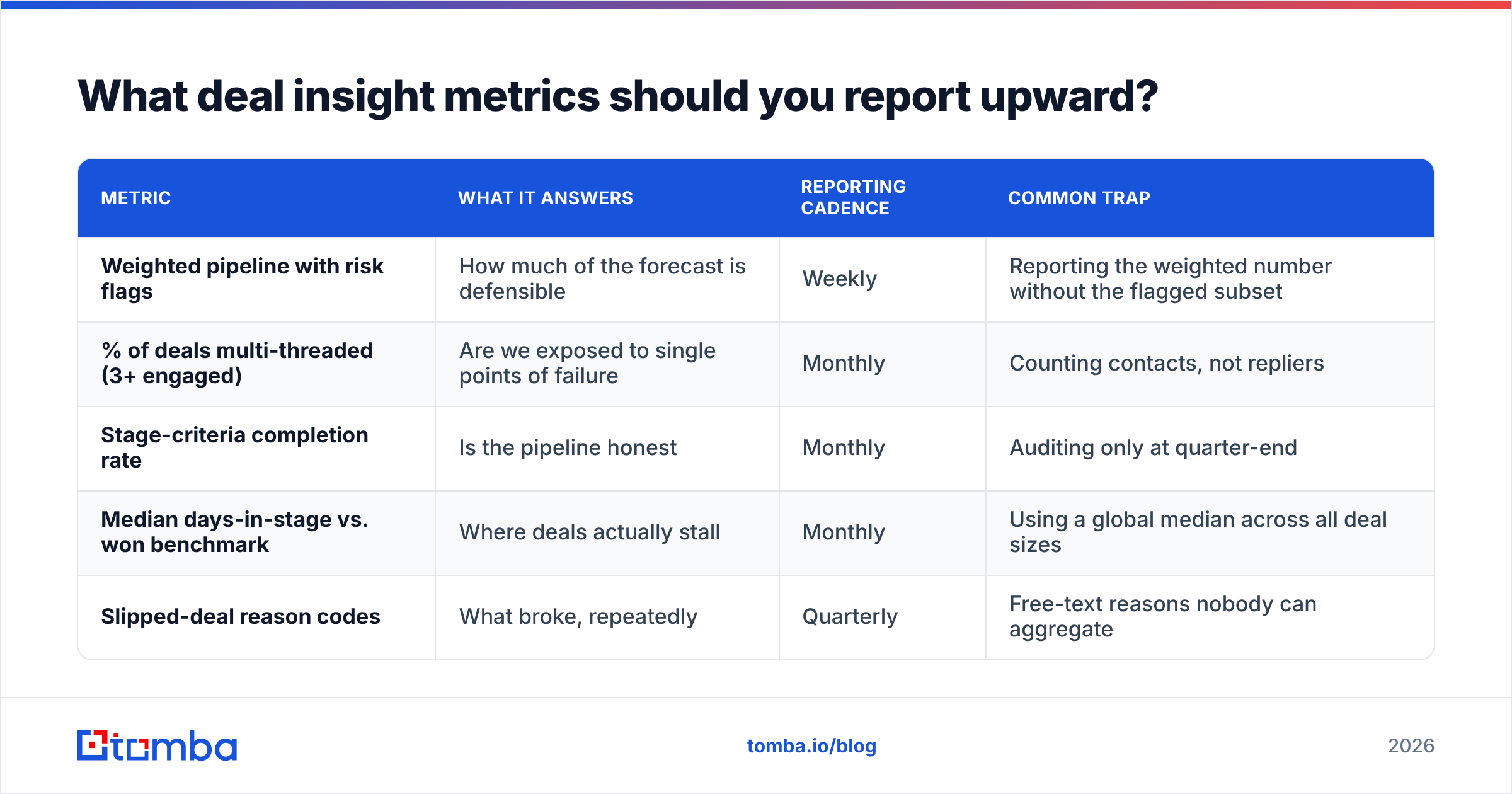
Executives don't need signal-level detail. They need three numbers per segment, with the risk attached.
| Metric | What it answers | Reporting cadence | Common trap |
|---|---|---|---|
| Weighted pipeline with risk flags | How much of the forecast is defensible | Weekly | Reporting the weighted number without the flagged subset |
| % of deals multi-threaded (3+ engaged) | Are we exposed to single points of failure | Monthly | Counting contacts, not repliers |
| Stage-criteria completion rate | Is the pipeline honest | Monthly | Auditing only at quarter-end |
| Median days-in-stage vs. won benchmark | Where deals actually stall | Monthly | Using a global median across all deal sizes |
| Slipped-deal reason codes | What broke, repeatedly | Quarterly | Free-text reasons nobody can aggregate |
Pair these with your win rate trend by segment. If multi-threading percentage rises and win rate doesn't follow within two cycles, your multi-threading is cosmetic — reps are cc'ing people, not engaging them.
What's the biggest mistake teams make with deal insights?#
Treating them as a reporting project instead of a coaching system.
The point of knowing that a deal is single-threaded and 41 days stale is not to color the row red. It's to trigger a specific next action: identify the missing stakeholder, find their contact details, and get a buyer-initiated response inside two weeks. If your insights layer doesn't end in an action a rep can take on Monday morning, you've built an expensive rearview mirror.
The second-biggest mistake is scoring deals with a model nobody can interrogate. When a rep asks "why is this deal at 34?" and the answer is "the model says so," the score gets ignored within a month. Keep the components visible.
Where to start this week#
Pull your open pipeline, count distinct engaged contacts per opportunity, and compare that against the roles you know have to sign off. The gap you find is your highest-leverage deal insight — and unlike conversation intelligence or forecast modeling, it's fixable today.
When you find those gaps, Tomba Email Finder resolves the missing stakeholders by name and company domain, with verification built in so your engagement signals stay clean. The free tier covers 25 searches a month to test the workflow on a handful of accounts; Tomba pricing starts at $49/mo for Starter and scales to Growth at $99/mo when you're enriching whole segments. Close the contact gap first — every deal insight you build after that gets more accurate for free.
Related guides#
Ready to find emails that actually work?
Join 150,000+ professionals who stopped guessing and started sending. Free credits on signup — no credit card required.
Get the Tomba newsletter
Practical outbound tactics and product updates — once every two weeks.
About the author