9 Deal Intelligence Alternatives for 2026 (Tested & Priced)
Gong and Clari are not the only way to see inside your pipeline. Here are 9 deal intelligence alternatives compared on price, data depth, setup time, and the kind of team each one actually fits.
TL;DR
- "Deal intelligence" is three different products wearing one label: conversation capture, forecast/pipeline inspection, and CRM hygiene automation. Pick the category first, then the vendor.
- The enterprise leaders (Gong, Clari, People.ai) start around $1,000–$1,600 per seat per year plus a platform fee, and most require an annual contract with a minimum seat count.
- Mid-market alternatives — BoostUp, Aviso, Weflow, Scratchpad, Nektar — cover 70–85% of the same jobs for a fraction of the cost, often month-to-month.
- Every one of these tools is downstream of your contact data. If your CRM is missing the economic buyer's email, no AI can tell you the deal is single-threaded.
- The cheapest real upgrade for most teams is contact completeness plus a lightweight inspection tool — not a six-figure revenue intelligence platform.
What is deal intelligence software, exactly?#
Deal intelligence is software that tells you which deals are actually going to close, and why the ones that die, die. In practice, vendors bundle three separate capabilities under that name:
- Conversation intelligence — records calls and meetings, transcribes them, and scores talk ratio, competitor mentions, next-step commitments. This is Gong's original wedge.
- Forecast and pipeline inspection — rolls opportunities into a submitted number, tracks how the number moves week over week, and flags deals that slipped. This is Clari's home turf.
- CRM hygiene and activity capture — auto-logs emails, meetings, and contacts into Salesforce or HubSpot so the pipeline data is complete enough to analyze in the first place. People.ai, Nektar, and Weflow live here.
Almost nobody needs all three on day one. Teams that buy all three at once end up paying enterprise prices for a product they use like a call recorder. That single mismatch is the number one reason buyers go looking for deal intelligence alternatives six months after signing.

Why do teams look for deal intelligence alternatives?#
Four reasons come up repeatedly in buyer reviews on G2 and in renewal conversations:
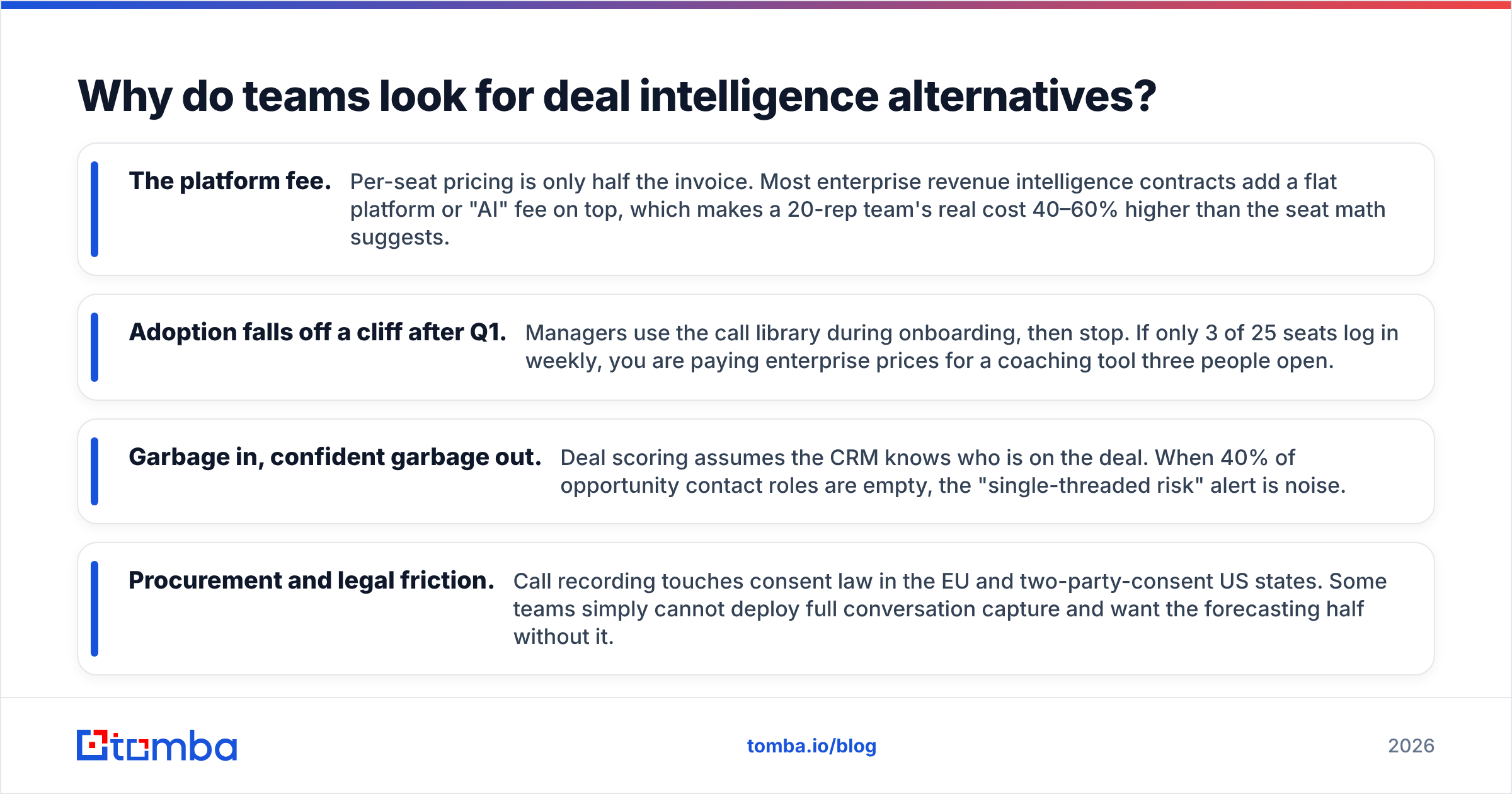
- The platform fee. Per-seat pricing is only half the invoice. Most enterprise revenue intelligence contracts add a flat platform or "AI" fee on top, which makes a 20-rep team's real cost 40–60% higher than the seat math suggests.
- Adoption falls off a cliff after Q1. Managers use the call library during onboarding, then stop. If only 3 of 25 seats log in weekly, you are paying enterprise prices for a coaching tool three people open.
- Garbage in, confident garbage out. Deal scoring assumes the CRM knows who is on the deal. When 40% of opportunity contact roles are empty, the "single-threaded risk" alert is noise.
- Procurement and legal friction. Call recording touches consent law in the EU and two-party-consent US states. Some teams simply cannot deploy full conversation capture and want the forecasting half without it.
If any of those describe you, the honest answer is usually not "switch to a cheaper Gong." It's "unbundle."
How do the main deal intelligence alternatives compare?#
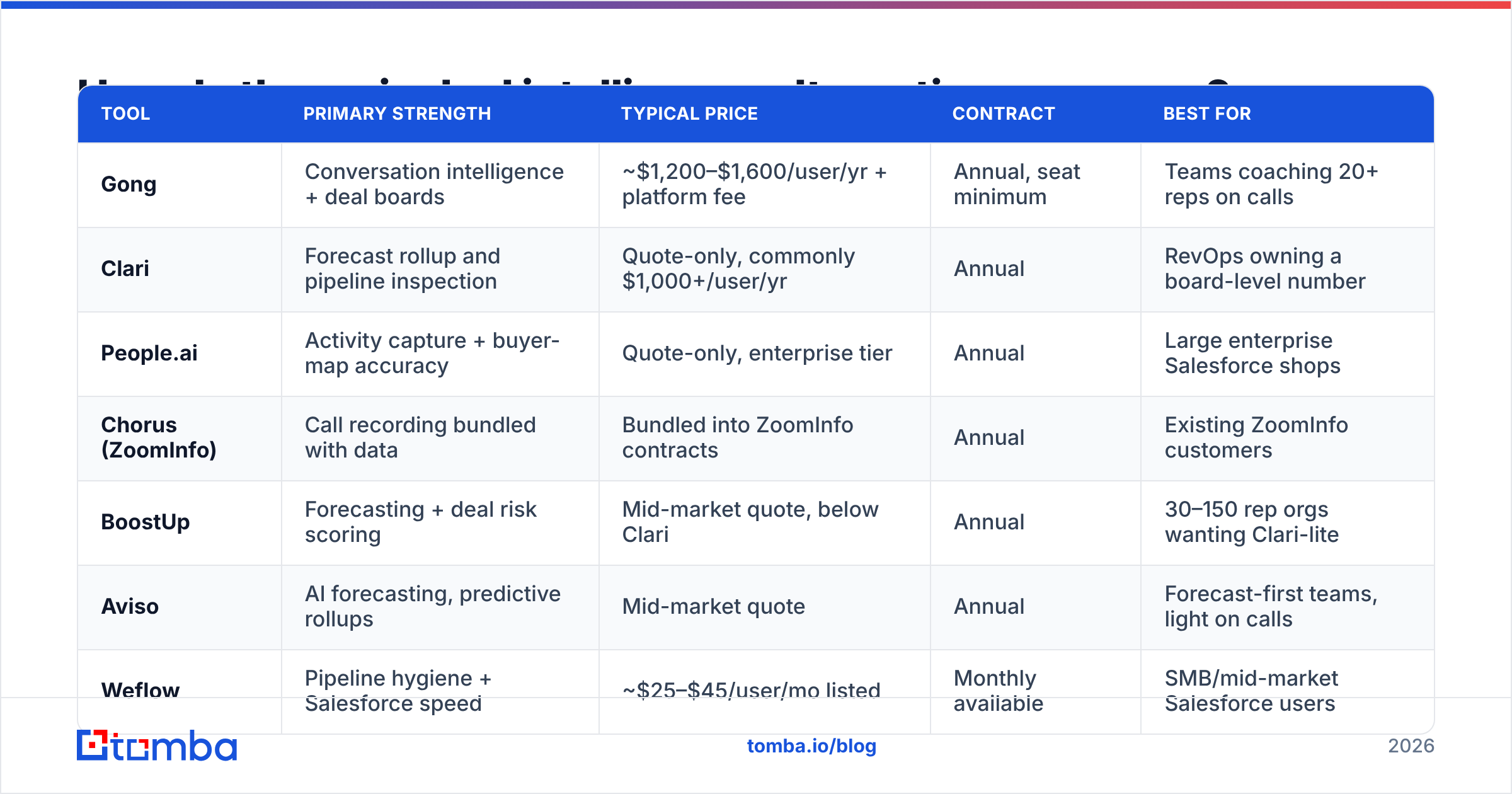
Pricing below reflects publicly listed rates and commonly reported contract ranges as of early 2026. Enterprise vendors quote per deal, so treat those as ranges, not quotes.
| Tool | Primary strength | Typical price | Contract | Best for |
|---|---|---|---|---|
| Gong | Conversation intelligence + deal boards | ~$1,200–$1,600/user/yr + platform fee | Annual, seat minimum | Teams coaching 20+ reps on calls |
| Clari | Forecast rollup and pipeline inspection | Quote-only, commonly $1,000+/user/yr | Annual | RevOps owning a board-level number |
| People.ai | Activity capture + buyer-map accuracy | Quote-only, enterprise tier | Annual | Large enterprise Salesforce shops |
| Chorus (ZoomInfo) | Call recording bundled with data | Bundled into ZoomInfo contracts | Annual | Existing ZoomInfo customers |
| BoostUp | Forecasting + deal risk scoring | Mid-market quote, below Clari | Annual | 30–150 rep orgs wanting Clari-lite |
| Aviso | AI forecasting, predictive rollups | Mid-market quote | Annual | Forecast-first teams, light on calls |
| Weflow | Pipeline hygiene + Salesforce speed | ~$25–$45/user/mo listed | Monthly available | SMB/mid-market Salesforce users |
| Scratchpad | Rep-side CRM workspace, fast updates | Free tier, paid ~$19–$39/user/mo | Monthly | Reps who hate Salesforce UI |
| Nektar.ai | Contact + activity capture into CRM | Mid-market quote | Annual | Fixing missing buying-group data |
Two things jump out of that table. First, the price gap between the top three and the rest is roughly 5–10x, not 20%. Second, the cheaper tools are not stripped-down clones — they solve a narrower job properly. Weflow and Scratchpad make CRM updates fast; they do not pretend to score sentiment on a discovery call.
Which deal intelligence alternative fits which team?#
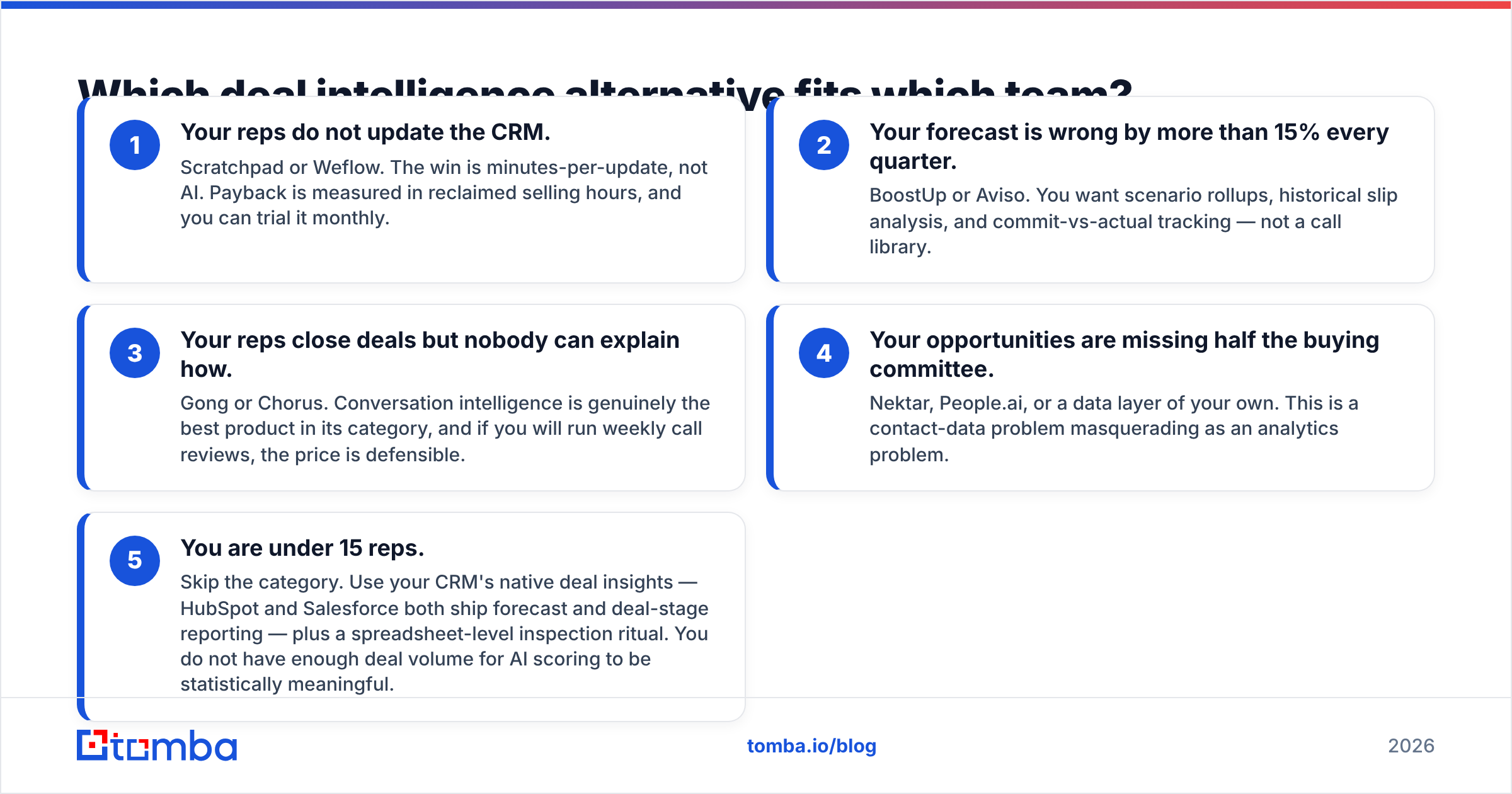
Match the tool to the failure mode you actually have:
- Your reps do not update the CRM. Scratchpad or Weflow. The win is minutes-per-update, not AI. Payback is measured in reclaimed selling hours, and you can trial it monthly.
- Your forecast is wrong by more than 15% every quarter. BoostUp or Aviso. You want scenario rollups, historical slip analysis, and commit-vs-actual tracking — not a call library.
- Your reps close deals but nobody can explain how. Gong or Chorus. Conversation intelligence is genuinely the best product in its category, and if you will run weekly call reviews, the price is defensible.
- Your opportunities are missing half the buying committee. Nektar, People.ai, or a data layer of your own. This is a contact-data problem masquerading as an analytics problem.
- You are under 15 reps. Skip the category. Use your CRM's native deal insights — HubSpot and Salesforce both ship forecast and deal-stage reporting — plus a spreadsheet-level inspection ritual. You do not have enough deal volume for AI scoring to be statistically meaningful.
That fifth point deserves emphasis. Deal scoring models need training data. With 40 closed-won deals a year, the model is mostly reflecting your own stage definitions back at you.
What does deal intelligence actually cost in 2026?#
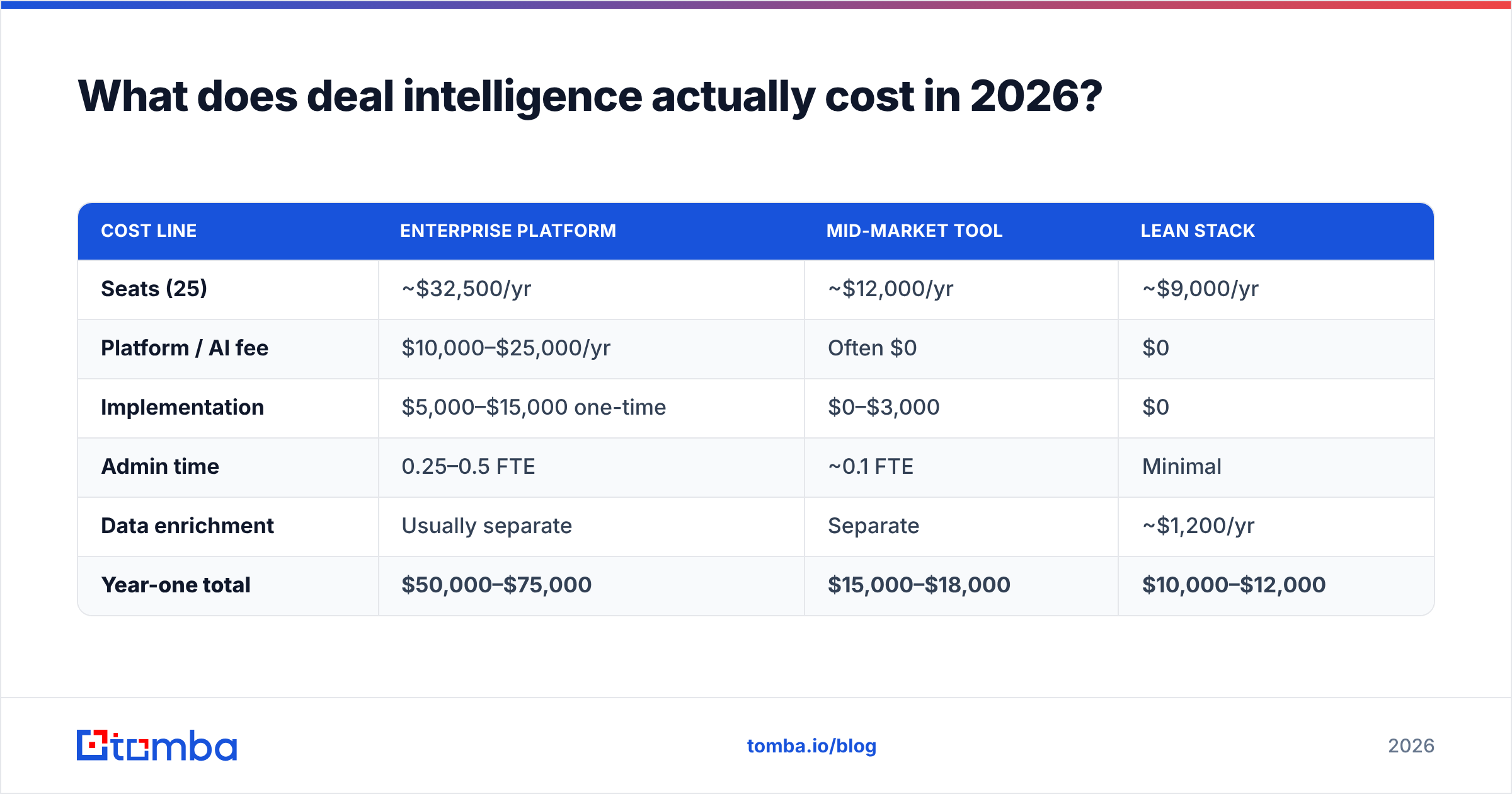
Run the total, not the sticker. Here is a realistic 25-rep comparison:
| Cost line | Enterprise platform | Mid-market tool | Lean stack |
|---|---|---|---|
| Seats (25) | ~$32,500/yr | ~$12,000/yr | ~$9,000/yr |
| Platform / AI fee | $10,000–$25,000/yr | Often $0 | $0 |
| Implementation | $5,000–$15,000 one-time | $0–$3,000 | $0 |
| Admin time | 0.25–0.5 FTE | ~0.1 FTE | Minimal |
| Data enrichment | Usually separate | Separate | ~$1,200/yr |
| Year-one total | $50,000–$75,000 | $15,000–$18,000 | $10,000–$12,000 |

The line most buyers forget is enrichment. Every vendor in this category assumes your CRM contains the right people. None of them find those people for you — People.ai and Nektar capture contacts that already appeared in your reps' inboxes, which by definition excludes the executive nobody has emailed yet.
Can you build a lean deal intelligence stack yourself?#
Yes, for a large minority of teams. The DIY stack has three layers, and only one of them costs real money.
Layer 1 — Complete contact data. Before any scoring is meaningful, every open opportunity needs the full buying group: champion, economic buyer, technical evaluator, and at minimum one blocker. Use data enrichment to fill in missing roles from company domains, and an email finder to get verified addresses for the people your reps have identified but never contacted. Push it into the CRM through the Tomba API so it runs on opportunity creation rather than as a quarterly cleanup project.
Layer 2 — A weekly inspection ritual. Three questions per deal, asked the same way every week: Who else is involved that we have not met? What is the next scheduled commitment with a date? What has changed since last week? Most of what enterprise deal boards surface is a UI wrapper around those three questions.
Layer 3 — A single hygiene tool. Scratchpad or Weflow at $19–$45 per user per month makes layer 2 fast enough that reps actually comply. This is where the money goes.
What you give up: call transcription and AI-scored sentiment. That is a real loss for coaching-heavy orgs and a non-issue for teams selling three-call deals. Be honest about which you are.
Here is the multithreading math that makes layer 1 worth doing first. Deals with four or more engaged contacts close materially more often than single-threaded deals — the effect shows up in nearly every published win-rate study. If your CRM only knows about one contact per opportunity, your deal intelligence tool is scoring a fiction. Fixing contact coverage is cheaper than any platform in the table above, and it improves the input for whichever tool you eventually buy. Check your own numbers by pulling your win rate split by contacts-per-opportunity before you sit through another demo.
What should you check before you switch?#
Run this list against any vendor on your shortlist:
- Ask for the platform fee in writing. Not the seat price. The all-in year-one invoice for your exact seat count.
- Ask what happens to your recordings and transcripts at churn. Export format, retention window, cost of export.
- Test the CRM write-back, not the read. Anything can display Salesforce data. The value is in writing clean data back without duplicating records.
- Check contact-role coverage today. Pull the percentage of open opportunities with two or more contacts. If it is under 60%, fix the data layer before buying analytics.
- Demand a 30-day usage report from a reference customer. Weekly active users divided by seats. Anything under 50% tells you what your own adoption will look like.
- Confirm recording consent handling for every region you sell into, including automatic disclosure and opt-out.
The fifth item kills more deals in this category than pricing does. Vendors will happily give you a customer reference; they rarely volunteer login data.
Is a full revenue intelligence platform ever worth it?#
Yes — under specific conditions. Buy the enterprise tier when all four are true: you have 50+ quota-carrying reps, sales cycles longer than 60 days, a dedicated enablement or RevOps owner who will run weekly call reviews, and a forecast that a board actually reads. Under those conditions the coaching lift alone justifies the number, and the platform fee amortizes across enough seats to stop mattering.
Below that bar, the pattern is consistent: teams buy the platform, use 20% of it, renew once out of sunk-cost reflex, then downgrade to a mid-market tool and report no loss in forecast accuracy. That is not a knock on the products. It is a mismatch between an enterprise product and a mid-market problem.
The cheapest version of the mistake is buying analytics to fix a data problem. If your reps are single-threading and your CRM is missing decision-makers, no amount of AI scoring changes the outcome — it just tells you, expensively, that the deal is at risk.
Where should you start this quarter?#
Start with the input, not the dashboard. Pull your open pipeline, count contacts per opportunity, and enrich the gaps. Tomba Email Finder gets you verified, role-matched contacts for every account already in your CRM — so when you do evaluate a deal intelligence platform, you are scoring real buying groups instead of half-empty records. The free tier covers 25 searches a month to test coverage on your own accounts, and paid plans start at $49/mo; see Tomba pricing for the full breakdown. Fix the data first, then decide whether you still need the six-figure platform.
Related guides#
Ready to find emails that actually work?
Join 150,000+ professionals who stopped guessing and started sending. Free credits on signup — no credit card required.
Get the Tomba newsletter
Practical outbound tactics and product updates — once every two weeks.
About the author