Deal Progression: How to Stop Deals From Stalling in 2026
Most B2B deals do not get rejected — they go quiet and rot in stage three. Here is a practical deal progression system: exit criteria, real buying signals, the metrics that expose stalls, and the tooling that fixes them.
TL;DR
- Deal progression is the measurable movement of an opportunity from one stage to the next, proven by buyer actions — not by rep optimism.
- Most B2B deals do not get a "no." They stall: no next meeting booked, one contact on the thread, no written mutual plan. Silence is the default failure mode.
- Fix progression with hard exit criteria per stage (buyer-verified, not rep-asserted), plus multithreading into 3+ contacts before you build a proposal.
- Track four numbers: stage conversion rate, stage aging, slippage rate, and next-step coverage. If you only track pipeline dollars, you are tracking a fantasy.
- Bad contact data quietly kills progression — you cannot multithread into a buying committee you cannot reach. Enrichment is a progression tool, not a prospecting toy.
What is deal progression?#
Deal progression is the rate and reliability with which an opportunity moves forward through defined stages toward a closed-won or closed-lost outcome.
Think of it like a hospital triage board rather than a conveyor belt. A conveyor belt moves everything at the same speed regardless of condition. A triage board asks a specific question at each step — is this patient stable enough to move to the next ward? — and refuses to advance anyone who has not met the criteria. Healthy pipelines work the same way. A deal moves not because two weeks passed, but because the buyer did something that proves it should move.
That distinction matters because "stage" in most CRMs is a rep-controlled dropdown. A rep can drag a deal from Discovery to Proposal at 4:55pm on the last day of the month with no buyer involvement whatsoever. The stage changed. The deal did not progress. Everything downstream — forecast, capacity planning, quota coverage — inherits that lie.
Real progression has three properties:
- It is buyer-evidenced. Something the buyer did — attended a technical review, shared a security questionnaire, introduced a second stakeholder — triggers the move.
- It is reversible. A deal that loses its champion should move backward or to closed-lost. Pipelines that only move one direction are inventory, not forecasts.
- It is time-bounded. Every stage has an expected duration. Past that, the deal is flagged, not silently aged.
Why do most B2B deals stall instead of getting rejected?#
Because saying "no" costs the buyer something and saying nothing costs them nothing.
The largest competitor in most B2B deals is not another vendor. It is the status quo — the buyer continuing to do what they were already doing, using the spreadsheet or the incumbent tool that is annoying but survivable. Analyst coverage of B2B buying, including Gartner's sales research, has consistently pointed at buying-group complexity and low buyer confidence as the drivers of no-decision outcomes, not competitive losses.
Here is what stalling actually looks like in the CRM:
- The deal has been in "Proposal" for 61 days with a close date that has moved three times.
- There is exactly one contact on the opportunity, and their last reply was "let me check internally."
- The next step field says "follow up" — which is not a next step, it is a hope.
- Nobody in your company has spoken to anyone in finance, security, or procurement, but the deal is forecast for this quarter.
Each of these is a progression failure with a specific cause. Single-threading is the most expensive one. When your entire deal depends on one champion, you have written a contract with that person's calendar, attention span, and job tenure — and roughly a fifth of B2B contacts change roles every year. Your champion leaving is not bad luck. It is a base-rate event you failed to hedge.

The second cause is a missing mutual action plan. If neither side has written down what happens between today and go-live, the deal has no forward momentum of its own. It moves only when your rep pushes it, and reps push in a burst at end of quarter, which is exactly when buyers are least receptive.
What does a working deal progression framework look like?#
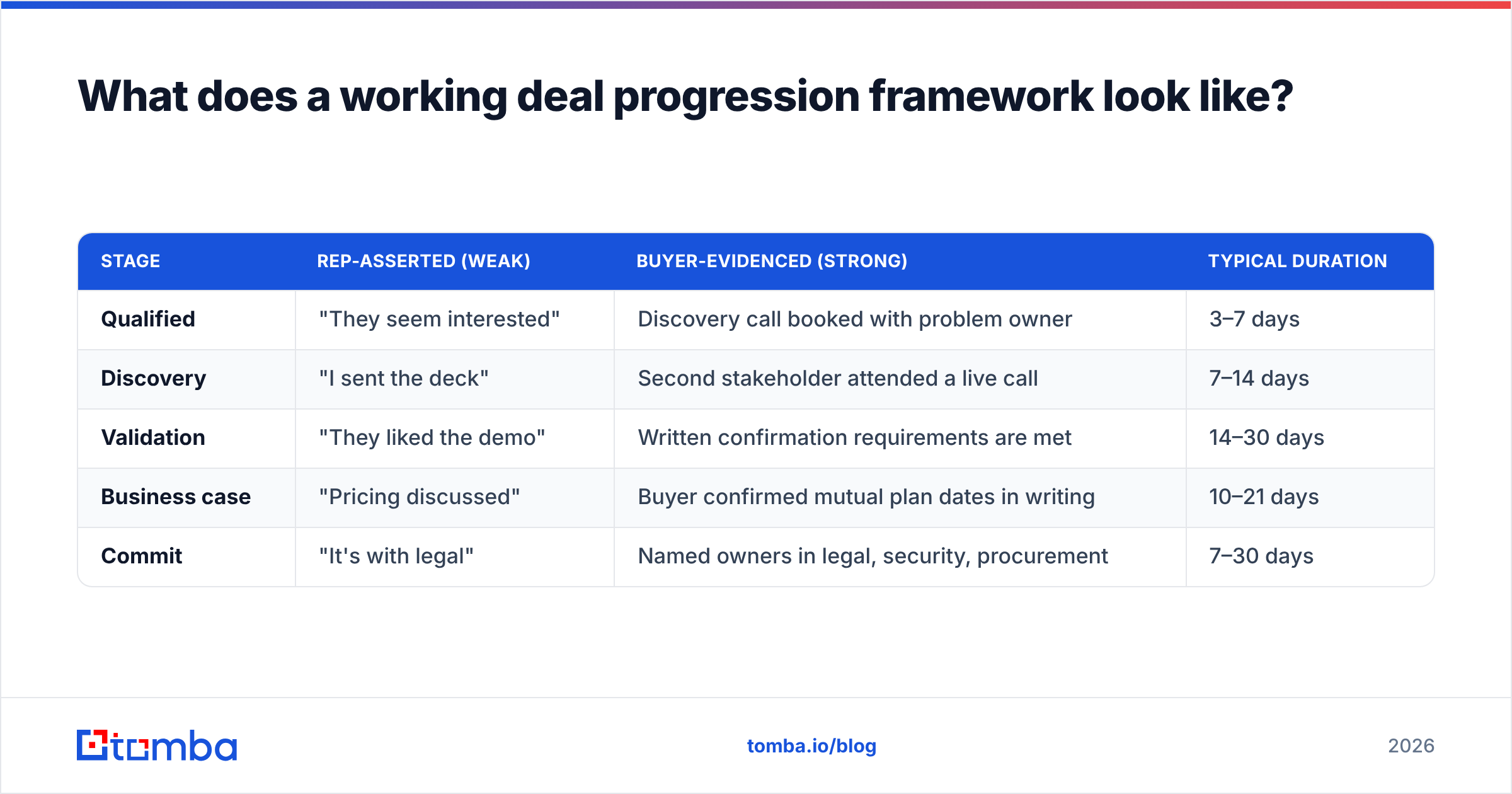
Define stages by buyer state, not by your internal activity. Then attach exit criteria that a manager could verify without asking the rep.
Here is a five-stage model that survives contact with reality:
- Qualified — You have confirmed a compelling problem, a rough budget range, and one named person who owns the outcome. Exit requires a scheduled discovery call with that owner on the calendar.
- Discovery — You have documented current state, quantified cost of inaction, and identified at least two additional stakeholders by name and role. Exit requires a second stakeholder to have joined a live call.
- Validation — The buyer has tested your claim: a pilot, a technical review, a security questionnaire, a reference call. Exit requires written confirmation that your solution meets requirements.
- Business case — Pricing is on the table, the economic buyer has engaged directly, and a mutual action plan with dates exists in writing. Exit requires the buyer confirming the plan's dates.
- Commit — Legal, security, and procurement are in motion with named owners on each. Exit is signature.
Notice that every exit criterion requires a buyer action. That is the whole design. A rep cannot self-certify progression.
| Stage | Rep-asserted (weak) | Buyer-evidenced (strong) | Typical duration |
|---|---|---|---|
| Qualified | "They seem interested" | Discovery call booked with problem owner | 3–7 days |
| Discovery | "I sent the deck" | Second stakeholder attended a live call | 7–14 days |
| Validation | "They liked the demo" | Written confirmation requirements are met | 14–30 days |
| Business case | "Pricing discussed" | Buyer confirmed mutual plan dates in writing | 10–21 days |
| Commit | "It's with legal" | Named owners in legal, security, procurement | 7–30 days |
The duration column is not a target — it is an alarm threshold. When a deal exceeds it, the deal gets reviewed. Not scolded. Reviewed. Half the time the fix is that the rep needs a second contact and does not have one.
Which signals actually predict that a deal will close?#
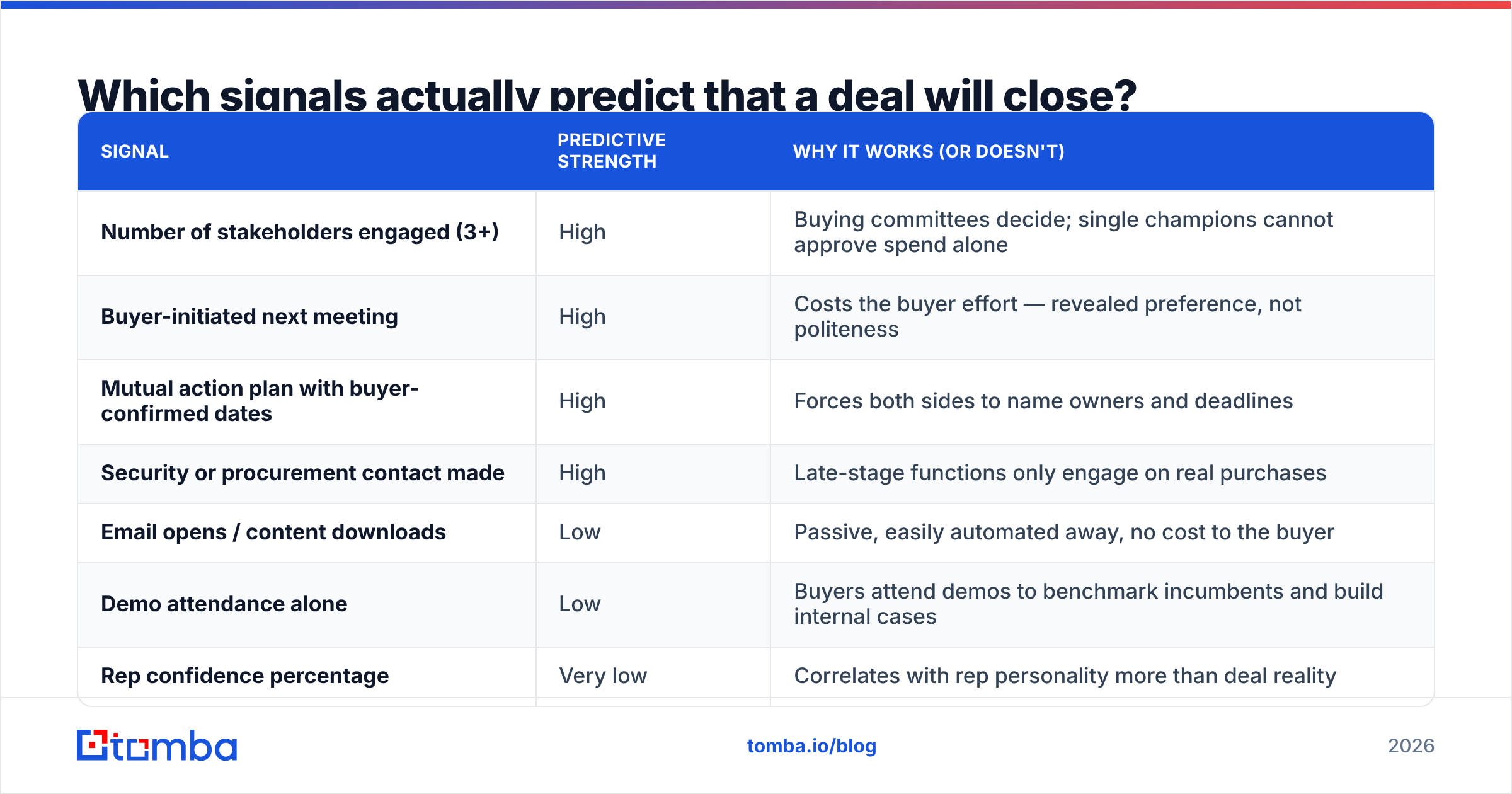
Some signals are noise dressed as progress. Others genuinely predict outcomes. Separating them is the highest-leverage analysis a sales leader can run on their own closed-won and closed-lost data.
| Signal | Predictive strength | Why it works (or doesn't) |
|---|---|---|
| Number of stakeholders engaged (3+) | High | Buying committees decide; single champions cannot approve spend alone |
| Buyer-initiated next meeting | High | Costs the buyer effort — revealed preference, not politeness |
| Mutual action plan with buyer-confirmed dates | High | Forces both sides to name owners and deadlines |
| Security or procurement contact made | High | Late-stage functions only engage on real purchases |
| Email opens / content downloads | Low | Passive, easily automated away, no cost to the buyer |
| Demo attendance alone | Low | Buyers attend demos to benchmark incumbents and build internal cases |
| Rep confidence percentage | Very low | Correlates with rep personality more than deal reality |
The pattern: signals that cost the buyer something — time, political capital, internal coordination — predict closes. Signals that cost them nothing predict nothing. Vendor-side sales research, including HubSpot's sales data, repeatedly lands on the same conclusion from a different angle: multithreaded deals with committed next steps close at meaningfully higher rates than single-threaded ones.
Apply this ruthlessly to your forecast reviews. If your pipeline inspection questions are "how confident are you?" and "when will it close?", you are collecting rep sentiment. Replace both with "who else at the account have we spoken to, and what did the buyer do last?"
How do you fix single-threading when you cannot reach the other stakeholders?#
This is where progression frameworks usually break down in practice. Everyone agrees you should multithread. Then the rep opens LinkedIn, identifies the VP of Security and the CFO, and has no way to actually reach either of them.
The gap is contact data, and it is a progression problem, not a prospecting problem. You already have the account. You already have the deal. What you lack is a reachable address for the four other people who will decide it.
Three practical moves:
- Ask your champion for the introduction first. It is free, warm, and it tests champion strength. A champion who will not introduce you internally is not a champion, and you have just learned that cheaply.
- Map the committee before you need it. During Discovery, ask directly: who signs, who can veto, who gets blamed if this fails. Write the names in the CRM.
- Enrich the names you cannot get warm access to. Use a domain search to pull the verified email pattern for the company, then resolve specific people. For roles that respond better to a call than an email — procurement, ops, field leadership — a phone finder closes the loop faster than a fourth unanswered email.
One caveat worth stating plainly: reaching a new stakeholder cold, inside an active deal, is a delicate move. Do it with context ("I'm working with Priya on X and wanted to make sure security requirements are covered early") rather than a generic cold pitch. And verify the address before you send. A bounce inside a live opportunity is not just a wasted send — it signals to your own systems that the account is unreachable and quietly degrades your sender reputation on a domain you need for the rest of the deal. Running new contacts through an email verifier before outreach takes seconds and prevents both problems.
What tools support deal progression, and where does each one fit?#
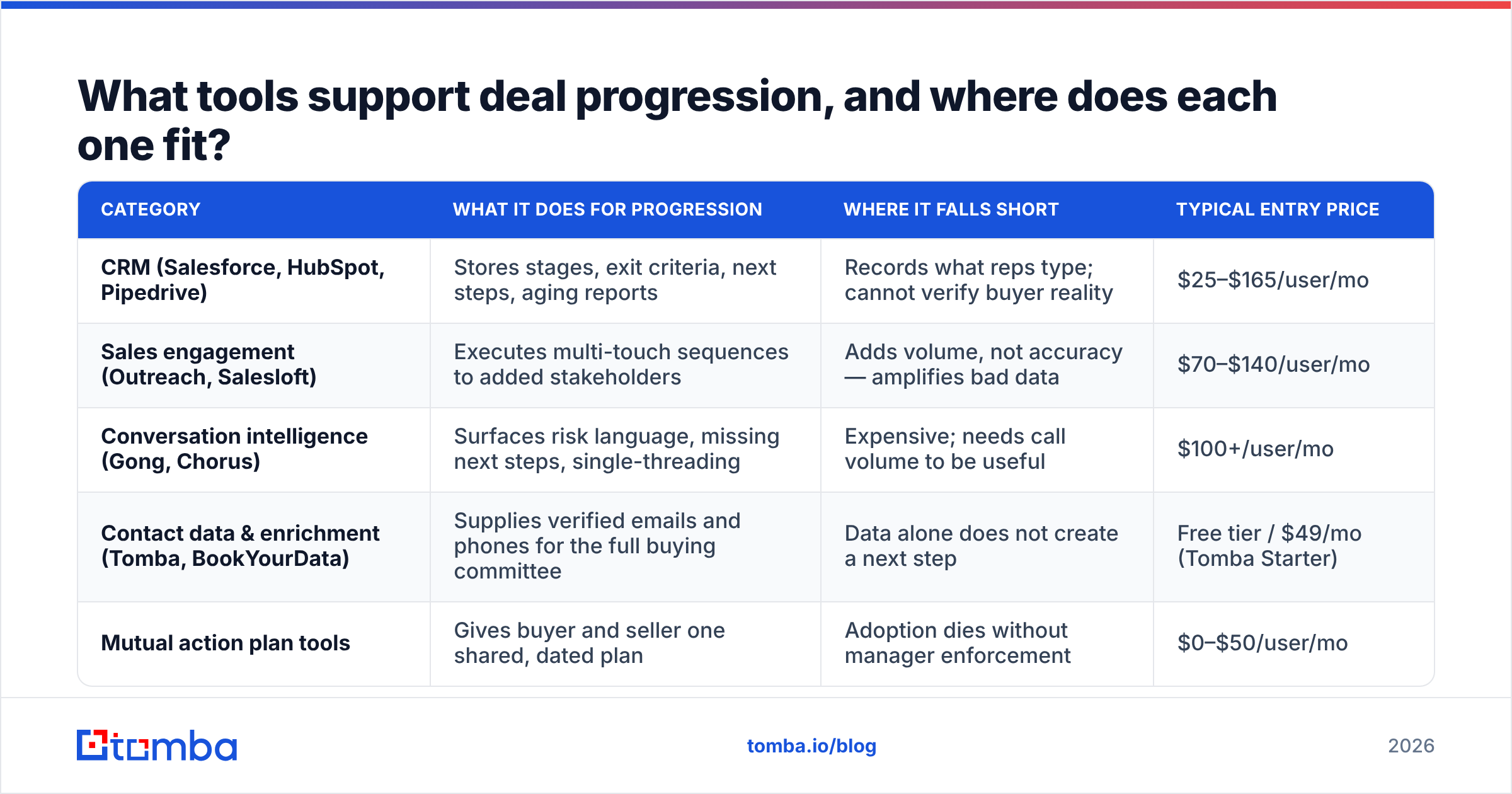
No single category owns progression. The CRM records it, engagement platforms execute against it, conversation intelligence reveals it, and data providers make multithreading physically possible.
| Category | What it does for progression | Where it falls short | Typical entry price |
|---|---|---|---|
| CRM (Salesforce, HubSpot, Pipedrive) | Stores stages, exit criteria, next steps, aging reports | Records what reps type; cannot verify buyer reality | $25–$165/user/mo |
| Sales engagement (Outreach, Salesloft) | Executes multi-touch sequences to added stakeholders | Adds volume, not accuracy — amplifies bad data | $70–$140/user/mo |
| Conversation intelligence (Gong, Chorus) | Surfaces risk language, missing next steps, single-threading | Expensive; needs call volume to be useful | $100+/user/mo |
| Contact data & enrichment (Tomba, BookYourData) | Supplies verified emails and phones for the full buying committee | Data alone does not create a next step | Free tier / $49/mo (Tomba Starter) |
| Mutual action plan tools | Gives buyer and seller one shared, dated plan | Adoption dies without manager enforcement | $0–$50/user/mo |
A quick note on the data layer, since it is the one most teams under-invest in. Providers differ in shape as much as quality: BookYourData sells prebuilt, pay-as-you-go lists that suit teams who want a bounded upfront buy, while Tomba is built around on-demand lookup and verification through an email finder and Tomba API — better when you are resolving specific named people inside deals you already have. Both are legitimate answers to different questions. Match the model to the workflow: list-buying for top-of-funnel volume, on-demand resolution for mid-funnel multithreading.
If you want to compare the broader category yourself rather than take any vendor's word for it, the review corpora on G2's sales intelligence category are more useful than feature grids, because reviewers volunteer the failure modes vendors omit.
How do you measure deal progression?#
Four metrics. If your dashboard has forty, nobody looks at it; if it has these four, weekly pipeline reviews get shorter and more honest.
- Stage conversion rate — the percentage of deals entering a stage that exit forward. Compute it per stage, per segment. A stage converting below 40% either has wrong exit criteria or is catching deals that were never qualified.
- Stage aging — median days in stage, and the count of deals past the threshold. This is your stall detector. Report the count of aged deals, not the average, because averages hide the tail.
- Slippage rate — the percentage of deals whose close date moved out at least once. Above 30% and your close dates are decorative. Track slippage per rep; it is one of the cleanest signals of forecast discipline.
- Next-step coverage — the percentage of open deals with a scheduled, dated, buyer-confirmed next meeting. This is the single best leading indicator in the list. Deals without a next step do not progress; they decay.
Add a fifth if you have the data: stakeholder count per open deal. Plot it against your closed-won rate. Nearly every team that runs this analysis finds a threshold — often around three engaged contacts — where win rate jumps sharply. That threshold becomes your Validation exit criterion, backed by your own numbers instead of a blog post's.
How do you actually run a pipeline review that improves progression?#
Change the questions. A pipeline review that asks "will it close?" produces negotiation between a rep and a manager. A review that audits progression produces work.
Run each deal against five questions, in order, and stop at the first "no":
- What did the buyer do last, and when? If the answer is older than 14 days, the deal is stalled regardless of stage.
- How many people have we spoken to? Under three in a committee purchase, the next action is multithreading, full stop.
- What is the exact next step, with a date and attendees? "Following up next week" fails this test.
- Does the buyer have a written plan with dates they confirmed? If not, that is the next step.
- Who could kill this that we have not met? Security, legal, procurement, finance, and the incumbent vendor's internal advocate.
The output of a good review is never a revised probability percentage. It is two or three named actions with owners and dates. If your review ends with numbers changing in a spreadsheet and no actions assigned, you held a status meeting and called it management.
One implementation note: enforce this in the CRM, not in culture. Make the next-step field required with a date. Make stage advancement require a stakeholder count. Reps optimize for what the system blocks, not for what the training deck recommended.
What should you do this week?#
Pick one thing. Progression frameworks fail when teams try to install all five stages, four metrics, and three tools in the same quarter.
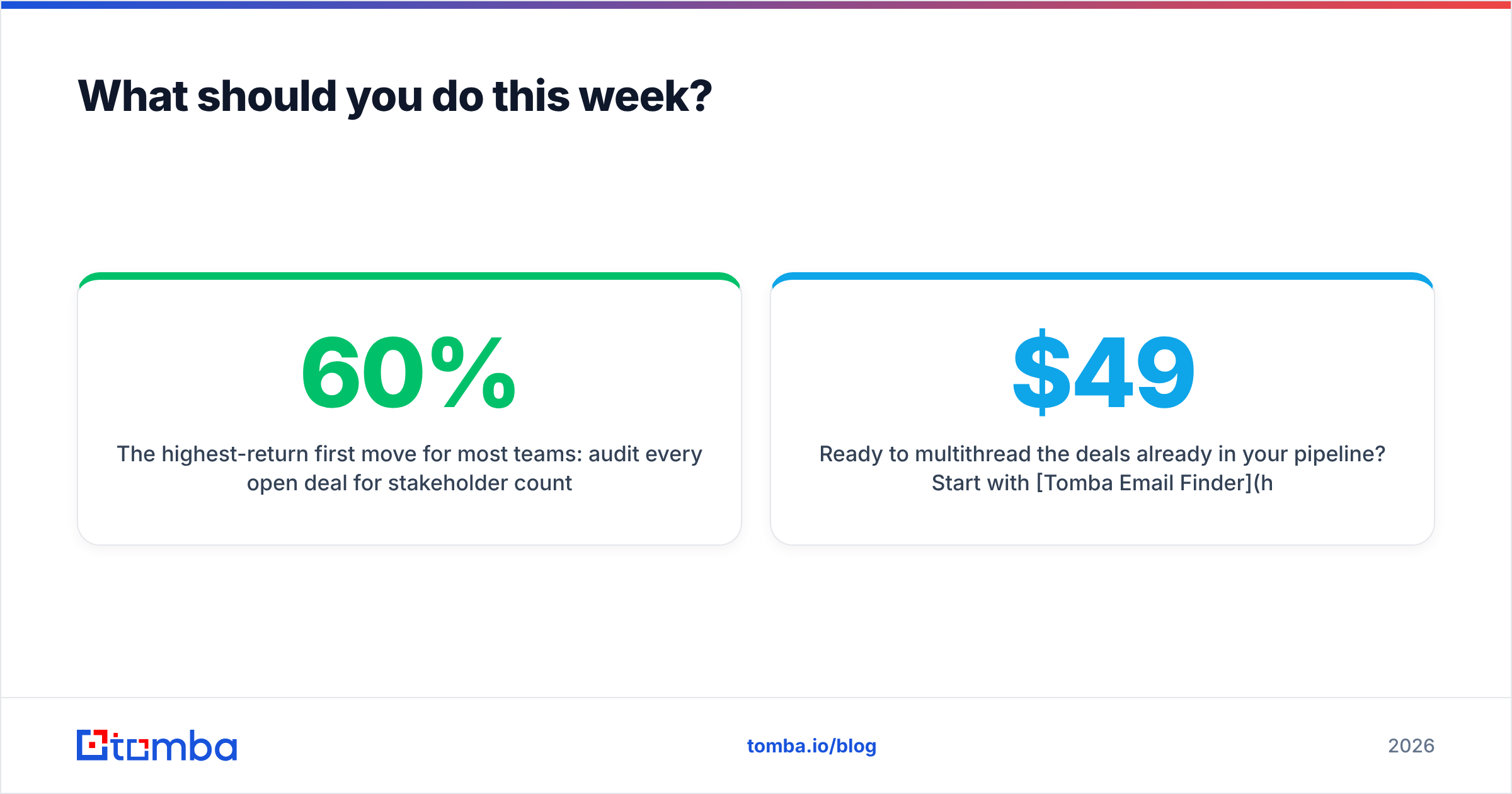
The highest-return first move for most teams: audit every open deal for stakeholder count and next-step coverage. That takes an afternoon and usually reveals that 40–60% of forecast pipeline is single-threaded with no scheduled next meeting. That number, presented to leadership, buys you the mandate to change everything else.
Then fix the reachability problem, because multithreading mandates fail immediately when reps cannot find the other stakeholders. Map the committee for your top 20 open deals, and resolve verified contact details for every named person you cannot reach through your champion — contact enrichment turns a list of LinkedIn names into a list of people you can actually schedule.
Ready to multithread the deals already in your pipeline? Start with Tomba Email Finder — find verified professional emails for the stakeholders your deals depend on, by name or by company domain, with verification built in so nothing bounces mid-deal. The free tier covers 25 searches a month, and paid plans start at $49/mo on Starter, $99/mo on Growth, and $249/mo on Pro. See full Tomba pricing to match a plan to your pipeline volume, and stop losing deals to people you were never able to reach.
Related guides#
Ready to find emails that actually work?
Join 150,000+ professionals who stopped guessing and started sending. Free credits on signup — no credit card required.
Get the Tomba newsletter
Practical outbound tactics and product updates — once every two weeks.
About the author