Deal Reviews: The 2026 Framework for Honest Pipeline Calls
Most deal reviews are status updates wearing a suit. Here's the agenda, scoring rubric, cadence, and metrics that turn deal reviews into a forecasting advantage instead of a weekly tax on your reps.
TL;DR
- A deal review inspects one opportunity's risk, not a rep's whole pipeline. If you're reading a list of accounts out loud, that's a pipeline review — different meeting, different value.
- Most deal reviews fail for three reasons: no entry criteria, no scoring rubric, and no decision at the end. Fix those and the meeting pays for itself.
- Run deal reviews on the top 20% of open value, not every deal. Weekly for late-stage, biweekly for mid-stage, never for anything under your inspection threshold.
- Force evidence, not opinion: a documented next step with a date, a named economic buyer you've actually spoken to, and written confirmation of the problem you're solving.
- The single best predictor of a slipped deal is single-threading. If your rep has one contact at a 6-person buying committee, the deal isn't a deal — it's a conversation.
What is a deal review, and what is it not?#
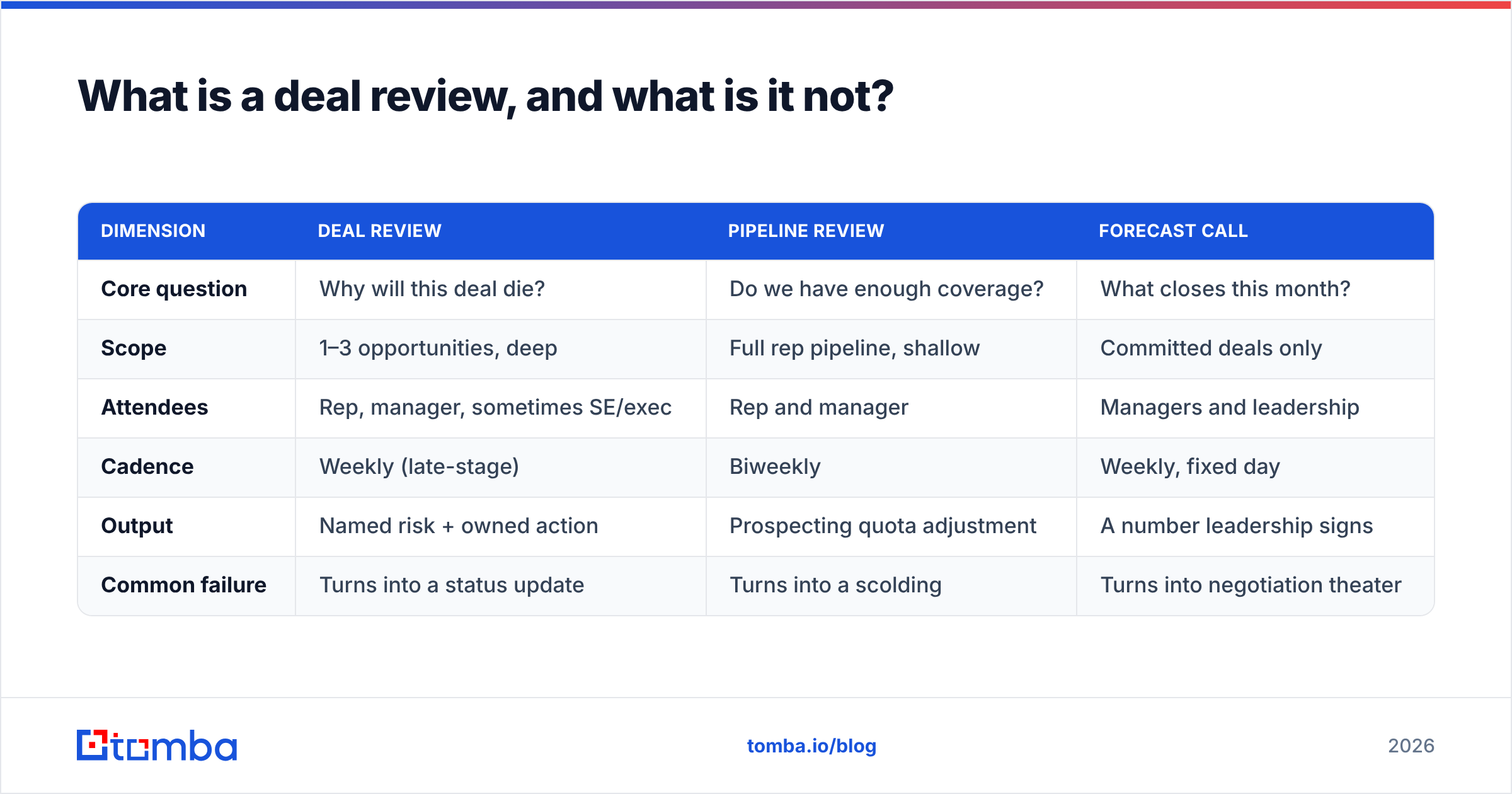
A deal review is a structured inspection of one opportunity, run to find the risk that will kill it and to decide what happens next. That's it. Everything else — coaching, forecasting, morale, CRM hygiene — is a side effect.
The reason this needs saying is that "deal review" has become a catch-all label for any meeting where deals get mentioned. Three distinct meetings routinely get collapsed into one, and the collapse is why reps hate them.
| Dimension | Deal review | Pipeline review | Forecast call |
|---|---|---|---|
| Core question | Why will this deal die? | Do we have enough coverage? | What closes this month? |
| Scope | 1–3 opportunities, deep | Full rep pipeline, shallow | Committed deals only |
| Attendees | Rep, manager, sometimes SE/exec | Rep and manager | Managers and leadership |
| Cadence | Weekly (late-stage) | Biweekly | Weekly, fixed day |
| Output | Named risk + owned action | Prospecting quota adjustment | A number leadership signs |
| Common failure | Turns into a status update | Turns into a scolding | Turns into negotiation theater |
If you try to run all three in one 30-minute block, the deal review always loses. Forecast pressure crowds out real inspection, because nobody wants to admit a "commit" deal has no next meeting booked.
Keep them separate. The deal review is the only one of the three where the manager's job is to be curious rather than decisive.
Why do most deal reviews fail?#
Because they reward narrative skill instead of evidence. The rep who tells the best story about the champion who "loves us" gets left alone; the rep who honestly says "I haven't reached the CFO" gets grilled. You've just trained your team to hide risk.
Four failure patterns show up in almost every org:
- No entry criteria. Every deal gets reviewed, so nothing gets reviewed properly. Twelve deals in 45 minutes is four minutes each — enough time for a status update and nothing more.
- Opinion as evidence. "They're excited" is not a data point. "They forwarded our business case to procurement on the 14th" is.
- The manager talks 70% of the time. The person who knows the deal is the rep. If the manager fills the silence, the rep stops thinking and starts nodding.
- No decision at the end. The meeting closes with "great, keep me posted." Nothing changes in the CRM, nothing changes in the deal, and the same conversation repeats next week.
There's a fifth, quieter failure: reviewing deals your team can't actually influence anymore. If the proposal has been sitting with legal for three weeks, another review changes nothing. Inspect deals where an intervention this week can move the outcome.
What should a deal review agenda look like?#
Twenty-five minutes, five blocks, same order every time. Predictability is the point — reps prepare for a format they can rehearse.
- The one-line deal statement (2 min). Rep states company, use case, dollar value, close date, and the single biggest risk. If it takes longer than 60 seconds, the rep doesn't understand the deal.
- Buying committee map (5 min). Who is the economic buyer, champion, technical evaluator, and blocker? Which ones have you personally spoken to in the last 21 days? Names and dates, not titles.
- Evidence review (8 min). Walk the qualification framework. Every claim gets a "how do you know?" follow-up. Written confirmation beats verbal beats inference.
- Risk and counter-move (7 min). Name the one thing most likely to kill this. Then decide the specific counter-move — an exec intro, a mutual action plan, a pricing concession, or a disqualification.
- Commit the action (3 min). Who does what, by when, and what gets updated in the CRM before end of day. If no action is committed, the deal drops out of the review rotation.
The hardest discipline is block five. Managers routinely run out of time in block three because "how do you know?" opens a hole. That's a signal, not an interruption — but the action still has to get committed, even if it's just "book a meeting with the CFO by Thursday."
Which qualification framework should drive the review?#
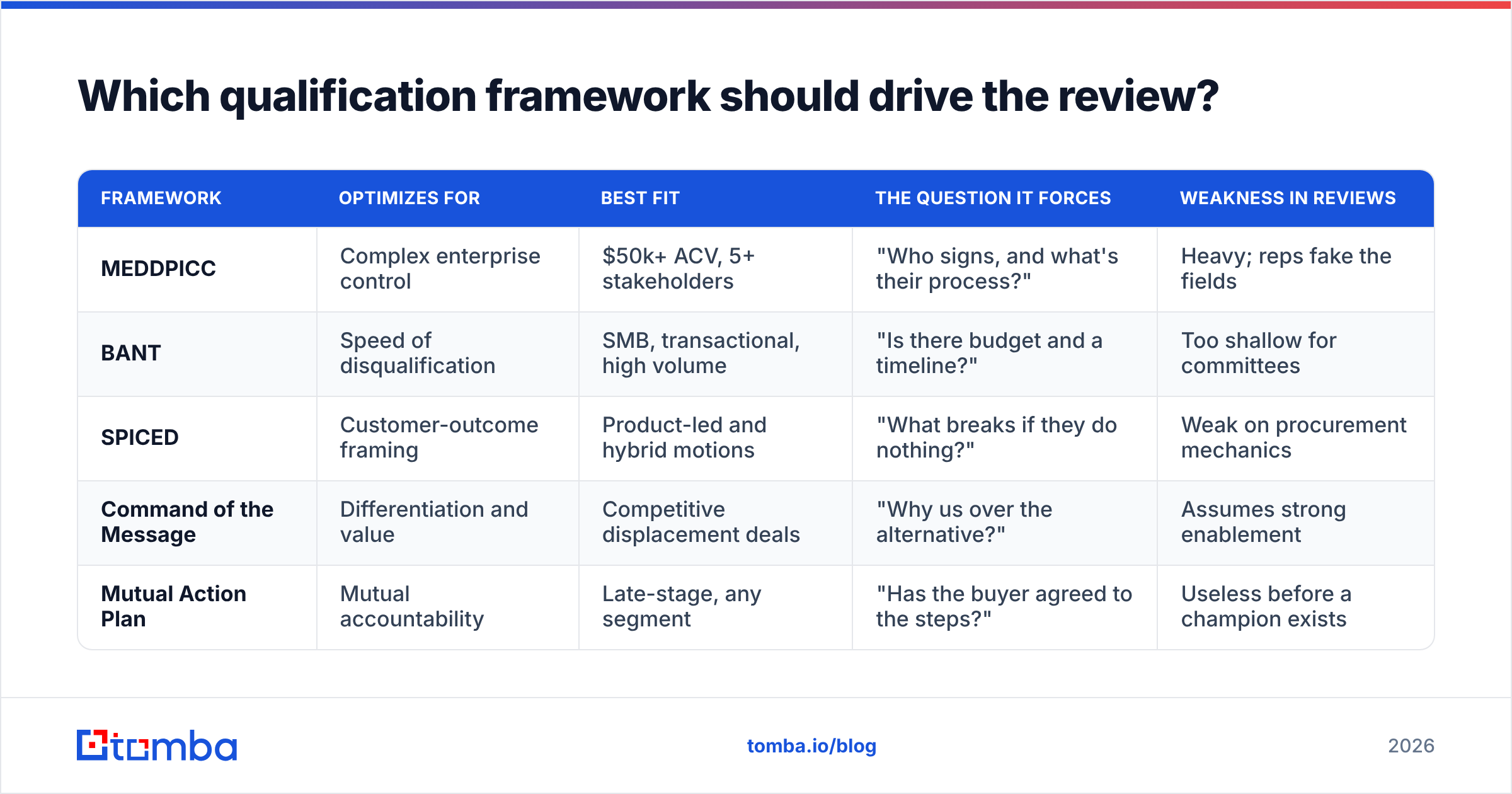
Whichever one your team can recite from memory. The framework's job is to standardize the questions so reps can self-inspect before the meeting. A mediocre framework applied consistently beats a brilliant one applied occasionally.
| Framework | Optimizes for | Best fit | The question it forces | Weakness in reviews |
|---|---|---|---|---|
| MEDDPICC | Complex enterprise control | $50k+ ACV, 5+ stakeholders | "Who signs, and what's their process?" | Heavy; reps fake the fields |
| BANT | Speed of disqualification | SMB, transactional, high volume | "Is there budget and a timeline?" | Too shallow for committees |
| SPICED | Customer-outcome framing | Product-led and hybrid motions | "What breaks if they do nothing?" | Weak on procurement mechanics |
| Command of the Message | Differentiation and value | Competitive displacement deals | "Why us over the alternative?" | Assumes strong enablement |
| Mutual Action Plan | Mutual accountability | Late-stage, any segment | "Has the buyer agreed to the steps?" | Useless before a champion exists |
Two practical notes. First, don't run two frameworks at once — pick one for qualification and layer a mutual action plan for late stage. Second, treat framework fields in your CRM as evidence stores, not checkboxes. A "Decision Criteria" field containing "they want a good product" tells you the rep hasn't asked. Vendors like Salesforce and HubSpot ship qualification objects out of the box; the field existing is not the same as the field being true.
How do you score deal health without guessing?#
Score the things a rep can prove. Anything subjective gets gamed within two quarters — analysts at Gartner have documented for years that self-reported confidence is a poor forecast input.
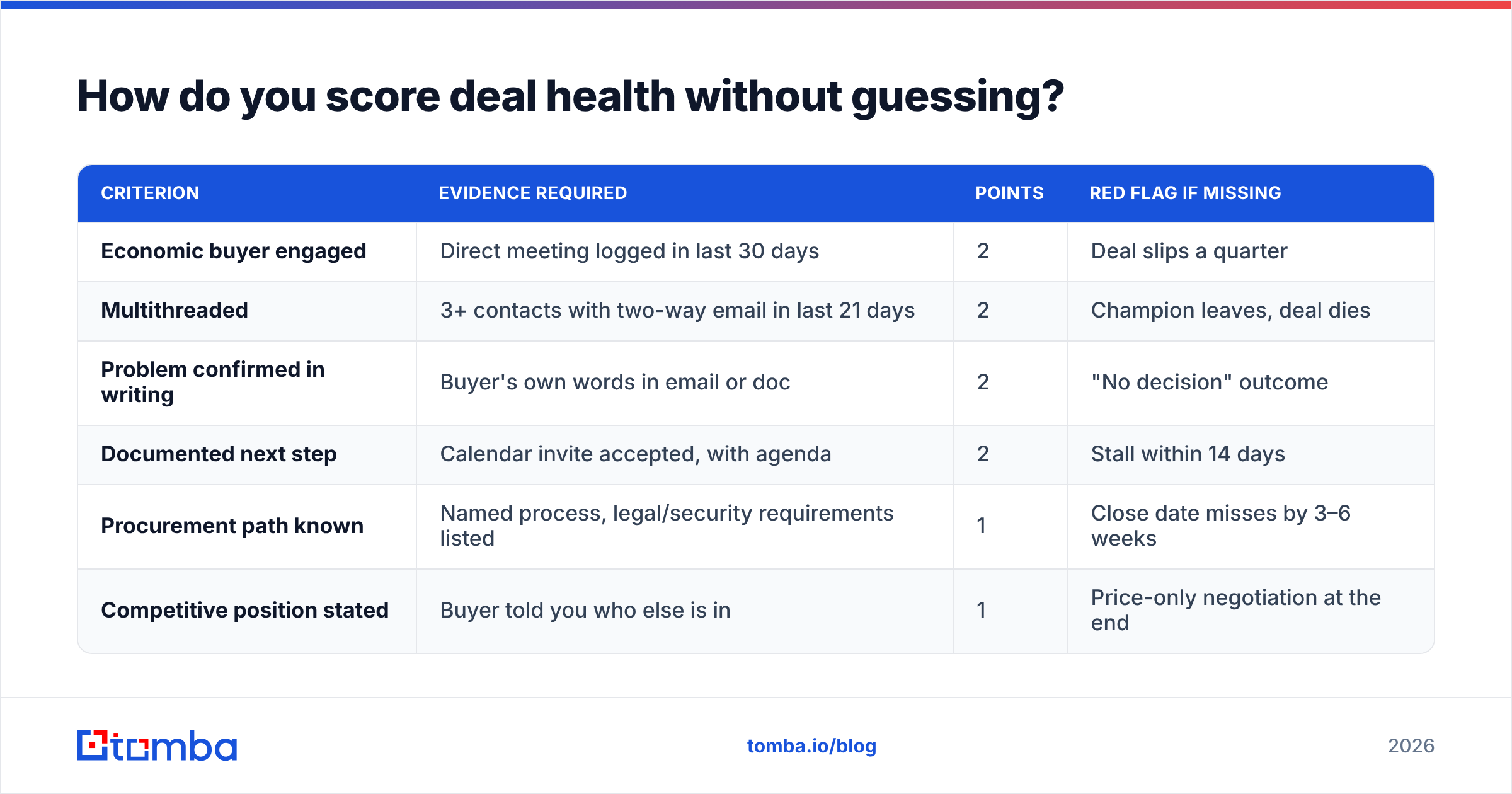
Here's a rubric that holds up. Each criterion is binary: you have the evidence or you don't.
| Criterion | Evidence required | Points | Red flag if missing |
|---|---|---|---|
| Economic buyer engaged | Direct meeting logged in last 30 days | 2 | Deal slips a quarter |
| Multithreaded | 3+ contacts with two-way email in last 21 days | 2 | Champion leaves, deal dies |
| Problem confirmed in writing | Buyer's own words in email or doc | 2 | "No decision" outcome |
| Documented next step | Calendar invite accepted, with agenda | 2 | Stall within 14 days |
| Procurement path known | Named process, legal/security requirements listed | 1 | Close date misses by 3–6 weeks |
| Competitive position stated | Buyer told you who else is in | 1 | Price-only negotiation at the end |
Eight to ten points is a real deal. Five to seven is a deal with one fixable gap. Below five, it doesn't belong in your commit category regardless of how the call felt. Track the correlation between rubric score and actual close outcome for a quarter — you'll usually find one or two criteria doing most of the predictive work, and you can drop the rest.
Watch win rate by rubric band rather than overall. Overall win rate hides the fact that your team wins 60% of 9-point deals and 8% of 4-point deals, which is the only insight that changes behavior.
What data do you need before the meeting starts?#
Everything on the rubric should already be in the CRM. The recurring problem is contact data: reps can't multithread into a buying committee they can't reach.
This is where deal reviews quietly become a data problem. A manager asks "have you engaged the VP of Finance?" and the honest answer is "I know her name from LinkedIn but I don't have a way to reach her." That's not a coaching issue — it's a tooling gap, and it's fixable in about ninety seconds.
Before the review, the rep should be able to produce:
- A named committee, four to six people, with role labels (economic buyer, champion, technical, blocker, procurement).
- Verified contact paths for at least three of them — a working email or a direct line, not a switchboard number.
- Last-touch dates per contact, so single-threading is visible at a glance.
- Account context — headcount, funding, tech stack — pulled from data enrichment rather than a rep's memory of the discovery call.
Teams that fill contact gaps with a domain search before the review spend the meeting talking about strategy instead of logistics. Teams that don't spend the meeting assigning homework that should have taken two minutes.

How often should you run deal reviews?#
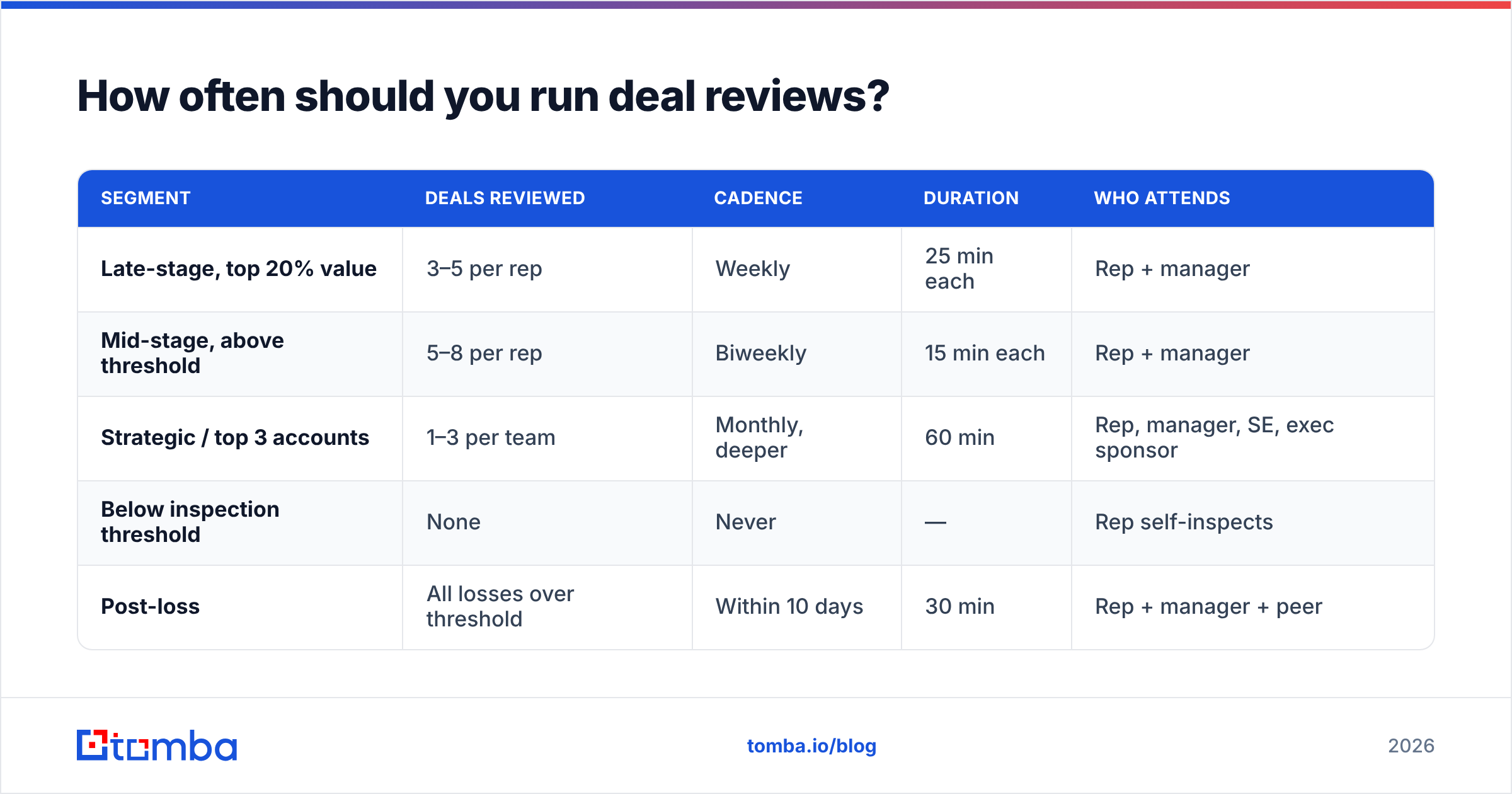
Match cadence to deal stage and value, not to the calendar's convenience.
| Segment | Deals reviewed | Cadence | Duration | Who attends |
|---|---|---|---|---|
| Late-stage, top 20% value | 3–5 per rep | Weekly | 25 min each | Rep + manager |
| Mid-stage, above threshold | 5–8 per rep | Biweekly | 15 min each | Rep + manager |
| Strategic / top 3 accounts | 1–3 per team | Monthly, deeper | 60 min | Rep, manager, SE, exec sponsor |
| Below inspection threshold | None | Never | — | Rep self-inspects |
| Post-loss | All losses over threshold | Within 10 days | 30 min | Rep + manager + peer |
That last row is the one everyone skips and shouldn't. A loss review ten days after the fact, while the buyer's feedback is still fresh, produces better pattern data than any amount of forward-looking optimism. Ask the buyer directly — a surprising number will tell you exactly what happened if you ask without pitching.
Set the inspection threshold explicitly. If your median deal is $12k, reviewing $3k opportunities burns manager hours that would return more if spent on the $40k deal nobody's touched in two weeks.
How do you keep deal reviews from becoming a manager-only ritual?#
Give the meeting away. Three moves work:
- Peer review rotation. Once a month, a rep reviews another rep's deal using the same rubric. Reps ask sharper questions than managers because they've lost the same deals.
- Rep-led format. The rep runs the agenda, the manager only asks questions. Managers who can't resist solving should mute themselves for block three.
- Pre-work gate. If the rubric fields aren't filled in before the meeting, the review is cancelled, not rescheduled. Two cancellations fix the habit permanently.
You'll know it's working when reps start disqualifying their own deals in block one. That's the highest-value outcome of the whole ritual: a rep voluntarily removing a $30k phantom from the forecast is worth more than any coaching moment, because it returns their time to deals that can actually close. Solid revenue operations teams measure exactly this — deals disqualified per quarter as a percentage of created — and treat a rising number as a health signal, not a failure.
What metrics prove your deal reviews are working?#
Four, tracked quarterly:
- Forecast accuracy delta. Compare committed-vs-closed variance before and after you implemented structured reviews. A 10-point tightening is a strong result.
- Slip rate. Percentage of deals whose close date moves more than once. Structured reviews with mandatory next steps typically cut this meaningfully within two quarters.
- Average stakeholders per closed-won deal. If reviews are pushing multithreading, this number climbs. If it's flat, your "have you multithreaded?" question isn't producing action.
- Time-to-disqualify. Days from creation to closed-lost for deals that never had a chance. Shorter is better; it means reviews are catching phantoms early.
Don't measure "meetings held" or "CRM fields completed." Both go to 100% while the underlying inspection stays theatrical.
Where should you start?#
Pick one team, one segment, and run the 25-minute format on late-stage deals only for four weeks. Use the six-criterion rubric as-is, log the score, and at the end of the quarter compare scores against outcomes. You'll have your own calibrated version of this framework, built on your own deal data, in about ninety days.
The prerequisite for all of it is contact coverage. You cannot inspect multithreading if your reps can't reach the committee. If your deal reviews keep stalling on "I don't have her email," fix the input first: Tomba's Email Finder turns a name and a company domain into a verified work address, so a rep can go from "I know who the economic buyer is" to "I've booked time with her" between one review and the next. The free tier covers 25 searches a month if you want to test it against a live deal, and Tomba pricing starts at $49/mo for teams that need it in the weekly workflow. Better inputs, better reviews, better forecast — in that order.
Related guides#
Ready to find emails that actually work?
Join 150,000+ professionals who stopped guessing and started sending. Free credits on signup — no credit card required.
Get the Tomba newsletter
Practical outbound tactics and product updates — once every two weeks.
About the author