Deal Sourcing Platforms in 2026: The No-Fluff Buyer's Guide
Deal sourcing platforms promise proprietary deal flow, but most buyers overpay for coverage they never use. Here is how the categories differ, what they actually cost, and where the contact data breaks.
TL;DR
- Deal sourcing platforms are databases plus signals, not deal generators. They tell you which companies exist and which look ready to transact. Getting a reply is still your job.
- Four distinct categories exist — private-company databases, signal/intent engines, deal marketplaces, and pipeline CRMs. Most firms buy one when they needed a different one.
- Expect $18,000–$60,000 per year for a serious seat-based subscription. Almost nobody publishes list pricing, and quotes swing by 40% depending on seat count and data exports.
- Contact data is the weakest layer in almost every platform. Founder and owner emails on lower-mid-market targets go stale fast, which is why most teams bolt on a dedicated finder and verifier.
- The winning stack is layered: one universe database, one signal source, one contact-enrichment layer, one CRM. Buying a single "all-in-one" is usually how the budget gets wasted.
What is a deal sourcing platform?#
A deal sourcing platform is software that helps investors and acquirers find, filter, and reach companies that might be for sale — or could be persuaded to sell.
Think of it like a real-estate portal for private companies. Zillow does not build houses or negotiate for you; it maintains an index of what exists, layers on signals (price cuts, days on market, tax records), and lets you filter down to a shortlist. Deal sourcing platforms do the same for private businesses: they maintain an index of companies, layer on signals (hiring, funding, ownership age, growth), and let you filter to a target list.
Technically, most of these products are three things stacked together:
- A company universe — millions of private-company records built from web crawls, filings, licensing data, job boards, and vendor partnerships.
- A search and screening layer — industry taxonomies, revenue and headcount estimates, geography, ownership type, and increasingly natural-language search ("HVAC companies in the Southeast, founder-owned, 50–200 employees").
- A workflow layer — lists, tags, ownership assignment, and CRM sync so a sourcing associate can move from screen to outreach without exporting to a spreadsheet.
What they are not: a source of warm intros, and rarely a source of reliable direct contact data. That distinction drives most of the disappointment buyers report after year one.
Why did sourcing get harder between 2019 and 2026?#
Because everyone bought the same tools. When a hundred firms screen the same industry taxonomy with the same revenue filter, they produce the same list — and the owner of a $12M distribution business gets fourteen nearly identical emails in a month.
Three structural changes made the old playbook weaker:
- Intermediary-led flow is saturated. Banker-run processes are competitive by design. If your differentiated advantage is being on a broker's list, you have no differentiated advantage.
- Company data commoditized. Firmographic coverage that was a moat in 2019 is now table stakes. Multiple vendors sell overlapping universes of the same 15–20 million private companies.
- Reply rates collapsed on generic outreach. Owner inboxes filter aggressively, and mailbox providers now punish senders with weak lists. Bad contact data does not just waste time — it damages your domain's email deliverability for every future campaign.
The firms winning proprietary deals in 2026 are not the ones with the biggest database. They are the ones with a narrower thesis, a cleaner contact layer, and a faster loop from signal to first touch.
What are the main types of deal sourcing platforms?#
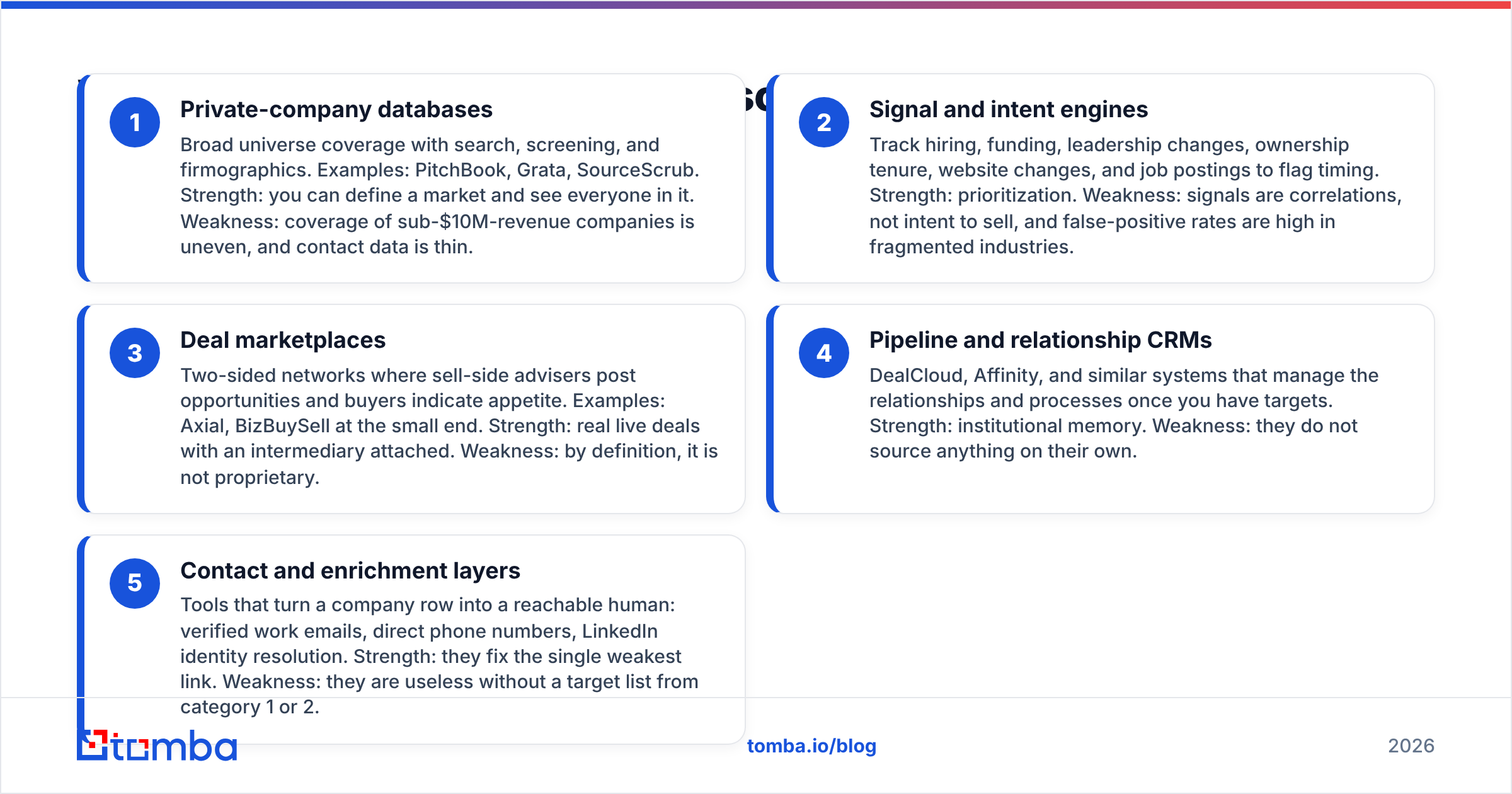
Buying the wrong category is the most expensive mistake in this market. Here is how the four types actually differ:
- Private-company databases — Broad universe coverage with search, screening, and firmographics. Examples: PitchBook, Grata, SourceScrub. Strength: you can define a market and see everyone in it. Weakness: coverage of sub-$10M-revenue companies is uneven, and contact data is thin.
- Signal and intent engines — Track hiring, funding, leadership changes, ownership tenure, website changes, and job postings to flag timing. Strength: prioritization. Weakness: signals are correlations, not intent to sell, and false-positive rates are high in fragmented industries.
- Deal marketplaces — Two-sided networks where sell-side advisers post opportunities and buyers indicate appetite. Examples: Axial, BizBuySell at the small end. Strength: real live deals with an intermediary attached. Weakness: by definition, it is not proprietary.
- Pipeline and relationship CRMs — DealCloud, Affinity, and similar systems that manage the relationships and processes once you have targets. Strength: institutional memory. Weakness: they do not source anything on their own.
- Contact and enrichment layers — Tools that turn a company row into a reachable human: verified work emails, direct phone numbers, LinkedIn identity resolution. Strength: they fix the single weakest link. Weakness: they are useless without a target list from category 1 or 2.
Most firms need one from category 1 or 2, one from category 5, and one from category 4. Nobody needs all five.
Which deal sourcing platforms matter in 2026?#
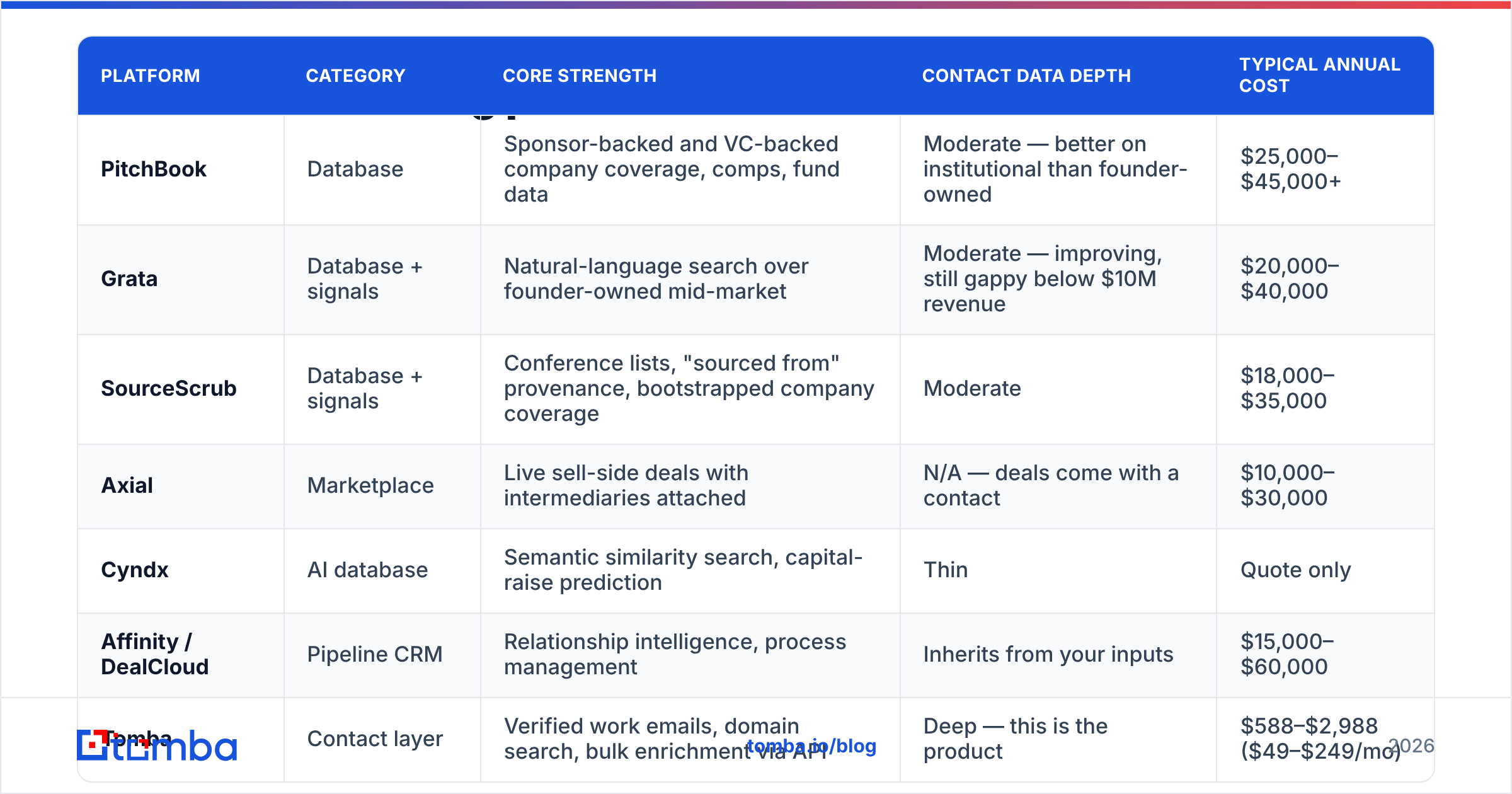
The table below compares the platforms that show up most often in mid-market sourcing stacks. Pricing is directional — nearly every vendor here quotes per firm, so treat these as ranges from buyer-reported figures on review sites, not list prices.
| Platform | Category | Core strength | Contact data depth | Typical annual cost |
|---|---|---|---|---|
| PitchBook | Database | Sponsor-backed and VC-backed company coverage, comps, fund data | Moderate — better on institutional than founder-owned | $25,000–$45,000+ |
| Grata | Database + signals | Natural-language search over founder-owned mid-market | Moderate — improving, still gappy below $10M revenue | $20,000–$40,000 |
| SourceScrub | Database + signals | Conference lists, "sourced from" provenance, bootstrapped company coverage | Moderate | $18,000–$35,000 |
| Axial | Marketplace | Live sell-side deals with intermediaries attached | N/A — deals come with a contact | $10,000–$30,000 |
| Cyndx | AI database | Semantic similarity search, capital-raise prediction | Thin | Quote only |
| Affinity / DealCloud | Pipeline CRM | Relationship intelligence, process management | Inherits from your inputs | $15,000–$60,000 |
| Tomba | Contact layer | Verified work emails, domain search, bulk enrichment via API | Deep — this is the product | $588–$2,988 ($49–$249/mo) |
Two things stand out. First, the price gap between a company universe and a contact layer is roughly an order of magnitude — which is why treating them as substitutes is a costly error. Second, no vendor in the top half of this table sells contact accuracy as its headline claim. That is not an accident; maintaining verified emails for millions of small private companies is a different engineering problem than maintaining firmographics, and it decays much faster.
How accurate is the contact data behind sourced deals?#
Assume 20–35% of the owner and executive emails inside a general-purpose deal database are stale, role-based, or wrong on any given pull. That number is worse for companies under 50 employees, which is exactly the segment most lower-middle-market funds and searchers care about.
Why the decay is so steep:
- Small companies change infrastructure often. A migration from a hosted domain to Google Workspace can silently break every stored address at that company.
- Catch-all domains hide failures. A catch-all server accepts everything, so a naive verification pass marks garbage as valid. You need a dedicated catch-all verifier to distinguish "accepted" from "deliverable."
- Founders use personal-ish aliases. The pattern
first@company.comis far more common in a 30-person business than in an enterprise, and pattern-guessing engines trained on enterprise data miss it.
The practical consequence is a bounce rate you cannot afford. Once you cross roughly 3% hard bounces, mailbox providers start throttling your domain, and your carefully built target list becomes unreachable — including the ones with correct addresses.
The fix is boring and cheap relative to platform spend: export the company list from your sourcing platform, run it through a dedicated finder keyed on domain plus name, then verify before a single send. A domain search pass on a 400-company target list surfaces the actual email pattern per company, and a verification pass strips the addresses that would otherwise burn your sender reputation.
What should a deal sourcing stack actually cost?#
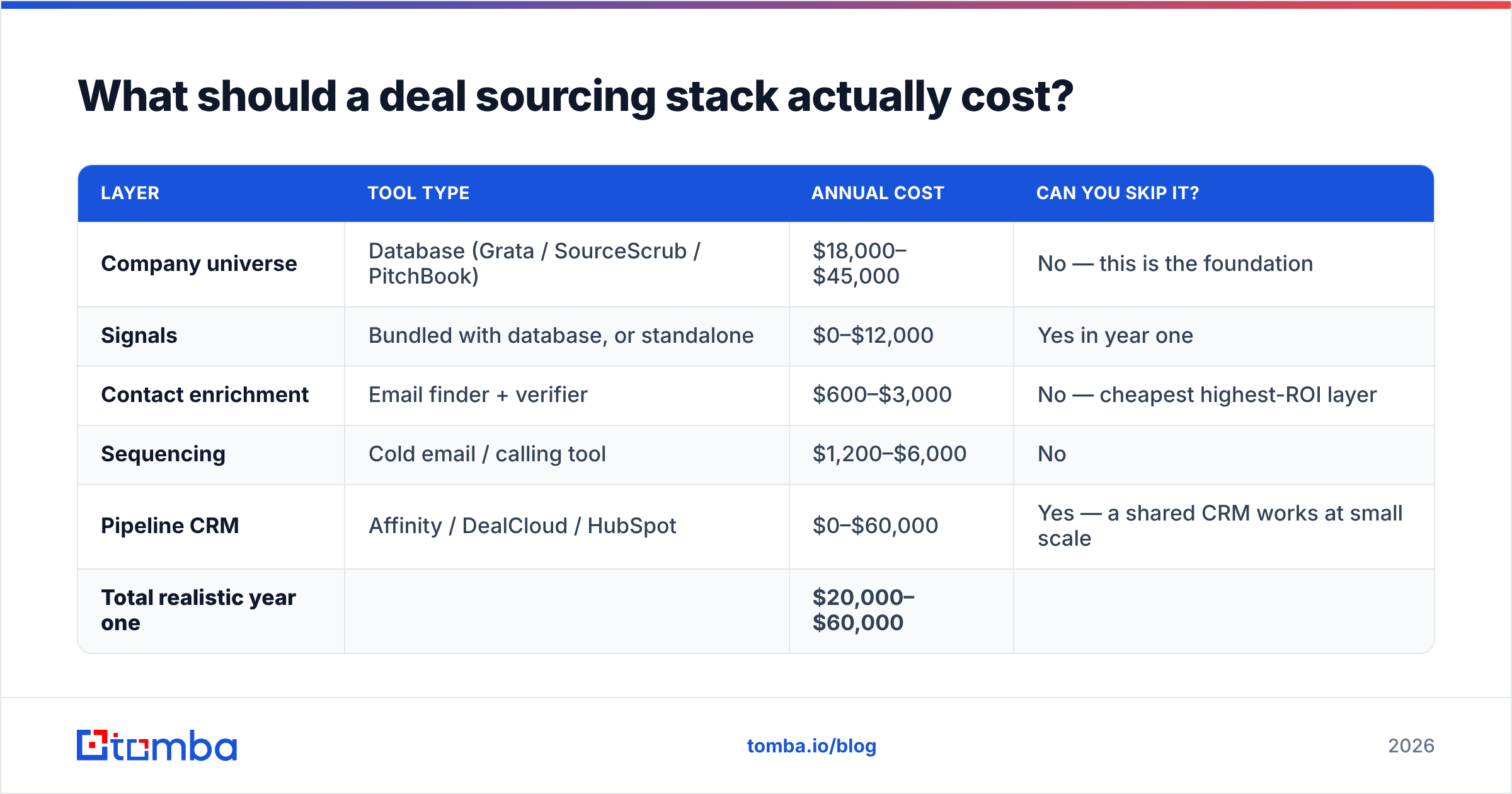
Here is a realistic budget for a lower-middle-market firm running one or two sourcing associates:
| Layer | Tool type | Annual cost | Can you skip it? |
|---|---|---|---|
| Company universe | Database (Grata / SourceScrub / PitchBook) | $18,000–$45,000 | No — this is the foundation |
| Signals | Bundled with database, or standalone | $0–$12,000 | Yes in year one |
| Contact enrichment | Email finder + verifier | $600–$3,000 | No — cheapest highest-ROI layer |
| Sequencing | Cold email / calling tool | $1,200–$6,000 | No |
| Pipeline CRM | Affinity / DealCloud / HubSpot | $0–$60,000 | Yes — a shared CRM works at small scale |
| Total realistic year one | $20,000–$60,000 |
Notice what the table implies: the contact layer is typically 1–5% of total stack spend but gates the performance of everything above it. A $40,000 database that produces undeliverable outreach returns nothing. Tomba's own pricing runs from a free tier at 25 searches per month to $49/mo Starter, $99/mo Growth, and $249/mo Pro — which means the enrichment layer costs less per year than a single week of an associate's time.
How do you build a sourcing motion that books meetings?#
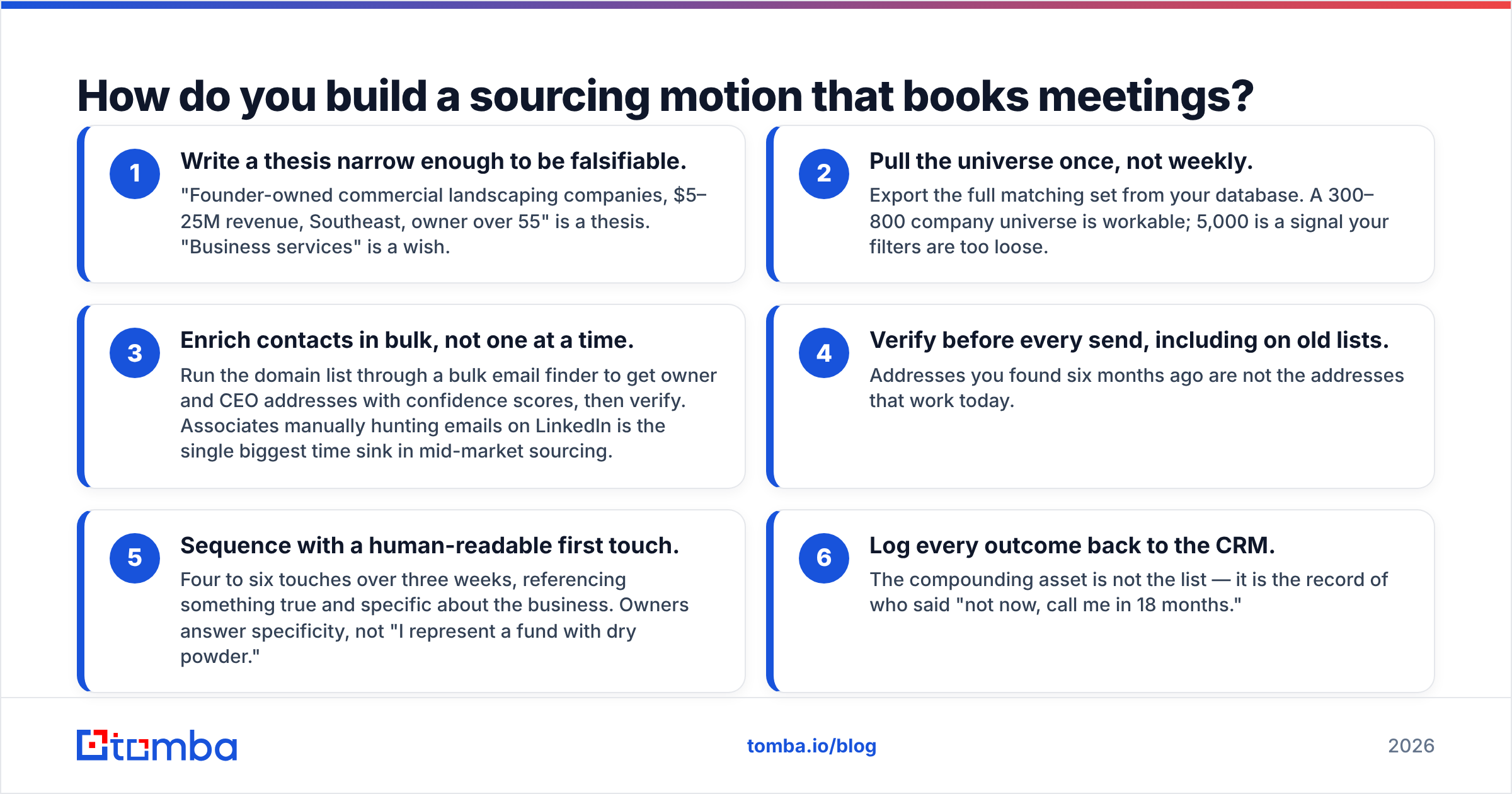
- Write a thesis narrow enough to be falsifiable. "Founder-owned commercial landscaping companies, $5–25M revenue, Southeast, owner over 55" is a thesis. "Business services" is a wish.
- Pull the universe once, not weekly. Export the full matching set from your database. A 300–800 company universe is workable; 5,000 is a signal your filters are too loose.
- Enrich contacts in bulk, not one at a time. Run the domain list through a bulk email finder to get owner and CEO addresses with confidence scores, then verify. Associates manually hunting emails on LinkedIn is the single biggest time sink in mid-market sourcing.
- Verify before every send, including on old lists. Addresses you found six months ago are not the addresses that work today.
- Sequence with a human-readable first touch. Four to six touches over three weeks, referencing something true and specific about the business. Owners answer specificity, not "I represent a fund with dry powder."
- Log every outcome back to the CRM. The compounding asset is not the list — it is the record of who said "not now, call me in 18 months."
Firms that automate steps 2–4 through an API rather than manual exports cut the time from thesis to first touch from three weeks to about two days. Tomba's email finder API exists for exactly this: pipe a domain and a name in, get a scored, verified address out, and write it straight into the CRM without a human touching a CSV.
What mistakes kill sourcing programs?#
- Buying coverage you never query. Global coverage sounds valuable and is irrelevant if your thesis is three US states. Negotiate scope down and price with it.
- Confusing a signal with intent. A company that just hired a CFO is not selling. It is a slightly better guess than random.
- Treating the database's contact field as truth. Always re-verify. Always.
- Running outreach off a single domain. One bad list can take a firm's primary domain out of the inbox for months. Use a dedicated sending domain and monitor sender reputation.
- No feedback loop. If nobody reviews which thesis segments produced calls after 90 days, you are paying $40,000 a year for a very expensive random-number generator.
- Over-indexing on reviews. Vendor comparison sites like G2 are useful for spotting churn complaints and support issues, but coverage claims are only testable against your target list. Ask every vendor for a blind test on 50 companies you already know.
How should you choose between platforms?#
Run a bake-off, not a demo. Give two or three vendors the same 50-company list drawn from your actual thesis — companies you already know exist. Then score each platform on:
- Coverage: How many of your 50 are in the index at all?
- Accuracy: How close are the revenue and headcount estimates to reality?
- Contactability: How many usable, verified decision-maker emails come out the other end?
- Speed: How long does it take an associate to go from filter to enriched, CRM-ready list?
- Export rights: Can you take the data out, and how much does that cost extra? This clause is where the real negotiation happens.
Most buyers score the first two and skip the third. Contactability is the metric most correlated with meetings booked, and it is the one where a $49/month tool routinely outperforms the field.
Where does Tomba fit in a sourcing stack?#
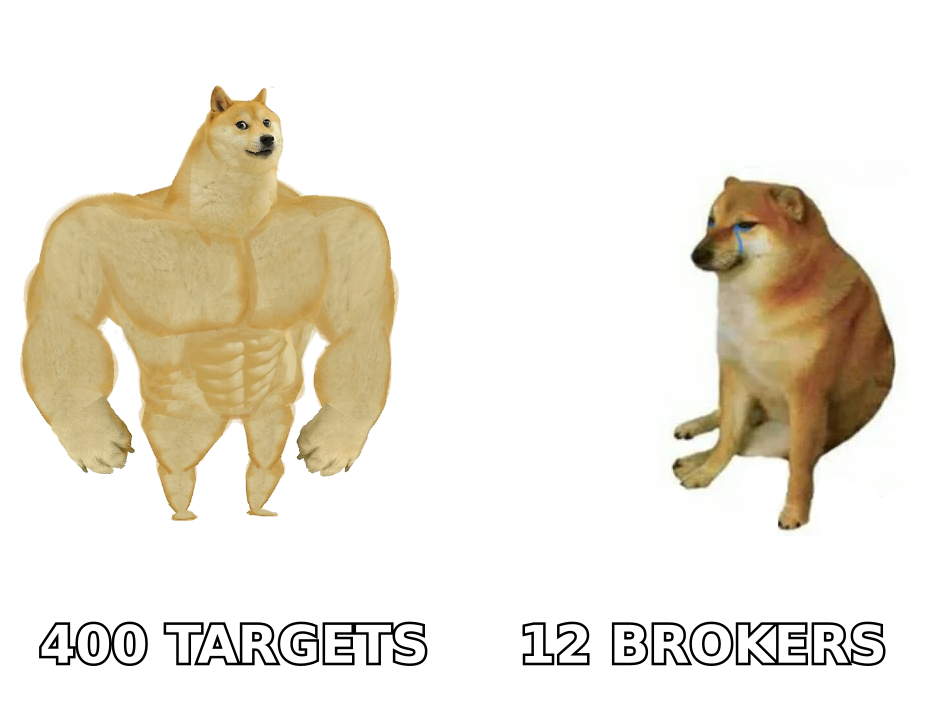
Tomba is not a deal database and does not pretend to be one. It is the layer that turns a list of company domains into people you can actually reach — the step between "we identified 400 targets" and "we sent 400 emails that landed."
If your database is producing target lists faster than your team can find owner contacts, start with the Tomba Email Finder. Run your next target list through it — free tier covers 25 searches so you can benchmark against whatever your current platform returns before you pay anything. Bring 50 domains you already have verified contacts for, compare hit rate and bounce rate, and let the numbers decide.
Related guides#
// get started
Find, verify and enrich your first contacts today
Start on the free plan with 25 searches a month, then scale when your team is ready.
Free plan · No credit card required · GDPR & CCPA
// about the author