Deal Stages: How to Build a Sales Pipeline That Forecasts
Deal stages are supposed to tell you what a buyer has done, not what a rep hopes. Here's a 7-stage model with hard exit criteria, plus how to audit the pipeline you already have.
TL;DR
- Deal stages should describe what the buyer has done, not what the rep has done. "Demo delivered" is an activity; "buyer confirmed budget owner" is a stage.
- Five to seven stages is the sweet spot for most B2B teams. Fewer than four hides risk; more than eight creates data-entry theater and dirty forecasts.
- Every stage needs a written exit criterion that a manager can verify without asking the rep. No criterion, no stage.
- Stage-weighted probability is a diagnostic, not a forecast. Use historical conversion by stage instead of the default percentages your CRM shipped with.
- Stage hygiene collapses if the top of the funnel is junk. Bad contact data creates fake Stage 1 volume that never converts and permanently skews your ratios.
What are deal stages?#
Deal stages are the named checkpoints an opportunity passes through between "we think this could be a customer" and "signed" or "lost." They live in your CRM as a picklist on the opportunity record, and they drive almost everything downstream: forecast rollups, pipeline coverage math, rep coaching, quota capacity planning, and the board slide nobody enjoys building.
Think of them like the security checkpoints at an airport. Nobody clears security because they want to — they clear it because there's an objective gate: boarding pass scanned, ID matched, bag through the scanner. You can't talk your way past it. A deal stage should work the same way. The deal advances because something verifiable happened, not because a rep had a good call and feels optimistic.
That distinction is where most pipelines break. Ask ten reps what "Stage 3 — Evaluation" means and you'll get ten answers, which means your forecast is ten different forecasts averaged into one number.
Why do most deal stage models fail?#
Three failure modes, in order of how often I see them:
1. The stages describe seller activity. "Discovery call booked," "Demo delivered," "Proposal sent." Every one of these can be true while the buyer is completely disengaged. A rep can send a proposal to someone who never asked for one. Activity-named stages let deals advance without the buyer doing anything, which is exactly how you end up with 40% of pipeline sitting in "Proposal Sent" for 90 days.
2. There are no exit criteria. If the definition of Stage 4 is "the deal is in Stage 4," managers can't inspect anything. Inspection becomes an interrogation of the rep's confidence level rather than a review of evidence.
3. Nobody ever moves a deal backwards. Stages are treated as a one-way ratchet. In reality, if your champion leaves the company, that deal is not still in "Negotiation" — it's back in "Discovery," or it's dead. Teams that never regress deals are the same teams that get surprised in the last week of the quarter.
A fourth, subtler failure: stages that don't match how buyers actually buy. Gartner's research on the B2B buying journey describes it as a set of parallel, looping "jobs" rather than a clean linear path — buyers revisit problem exploration after they've already started requirements building. A rigid seven-step linear model can still work, but only if you accept that deals will move sideways and backwards, and you build regression into the process instead of punishing it.
What does a good deal stage model look like?#
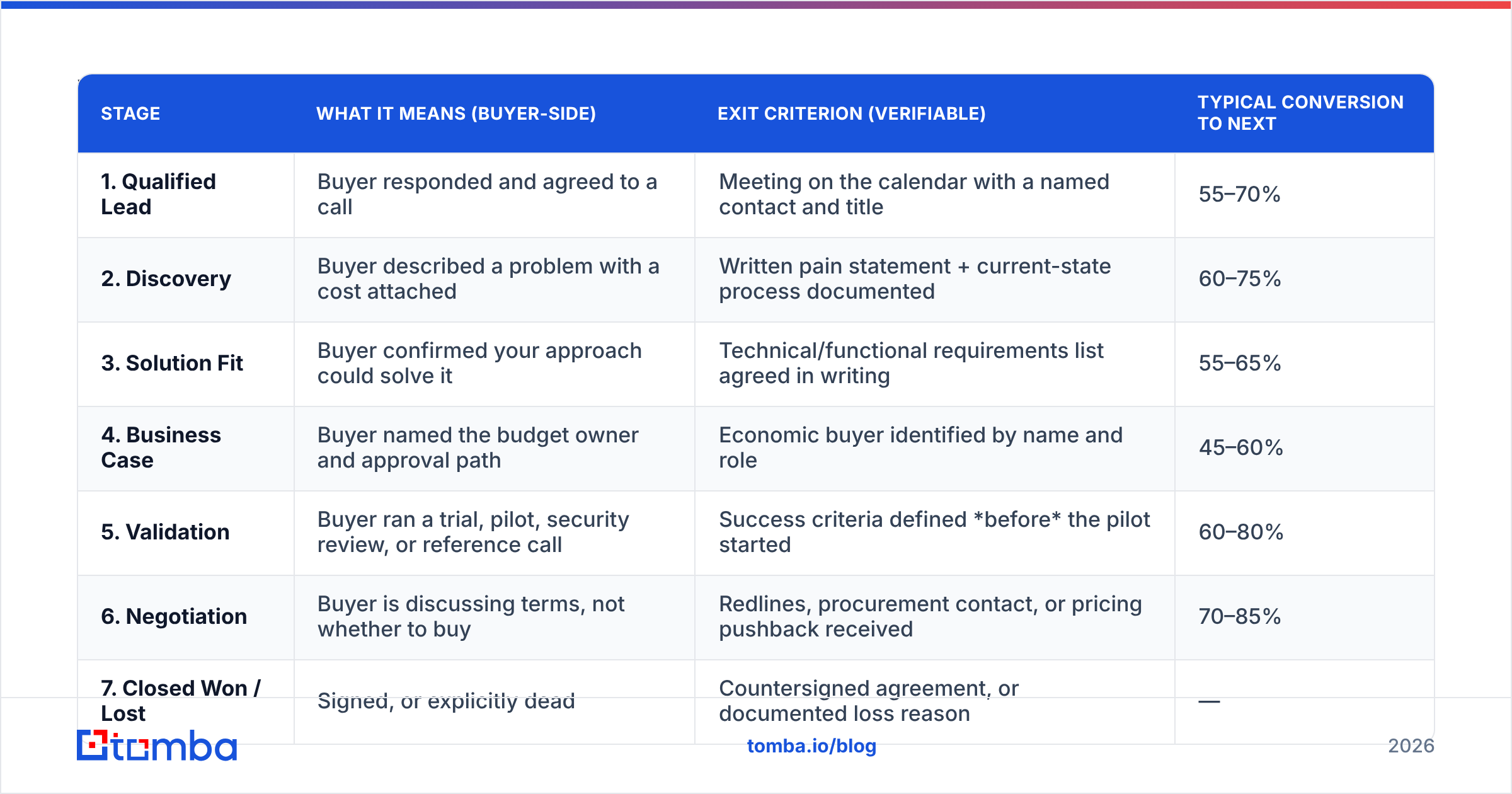
Here's a seven-stage model that works for most mid-market and enterprise B2B motions. The critical column is the third one — that's what makes it inspectable.
| Stage | What it means (buyer-side) | Exit criterion (verifiable) | Typical conversion to next |
|---|---|---|---|
| 1. Qualified Lead | Buyer responded and agreed to a call | Meeting on the calendar with a named contact and title | 55–70% |
| 2. Discovery | Buyer described a problem with a cost attached | Written pain statement + current-state process documented | 60–75% |
| 3. Solution Fit | Buyer confirmed your approach could solve it | Technical/functional requirements list agreed in writing | 55–65% |
| 4. Business Case | Buyer named the budget owner and approval path | Economic buyer identified by name and role | 45–60% |
| 5. Validation | Buyer ran a trial, pilot, security review, or reference call | Success criteria defined before the pilot started | 60–80% |
| 6. Negotiation | Buyer is discussing terms, not whether to buy | Redlines, procurement contact, or pricing pushback received | 70–85% |
| 7. Closed Won / Lost | Signed, or explicitly dead | Countersigned agreement, or documented loss reason | — |
Notice that no stage name is a seller activity. "Demo delivered" appears nowhere. A demo can happen in Stage 2, 3, or 5 — it's a tactic, not a milestone.
The conversion percentages above are a starting reference, not gospel. Your own historical rates are the only ones that matter, and you should recompute them quarterly. If your Stage 4 → 5 rate is 20%, you don't have a Stage 4 problem — you have a qualification problem two stages earlier.
What exit criteria should each stage require?#
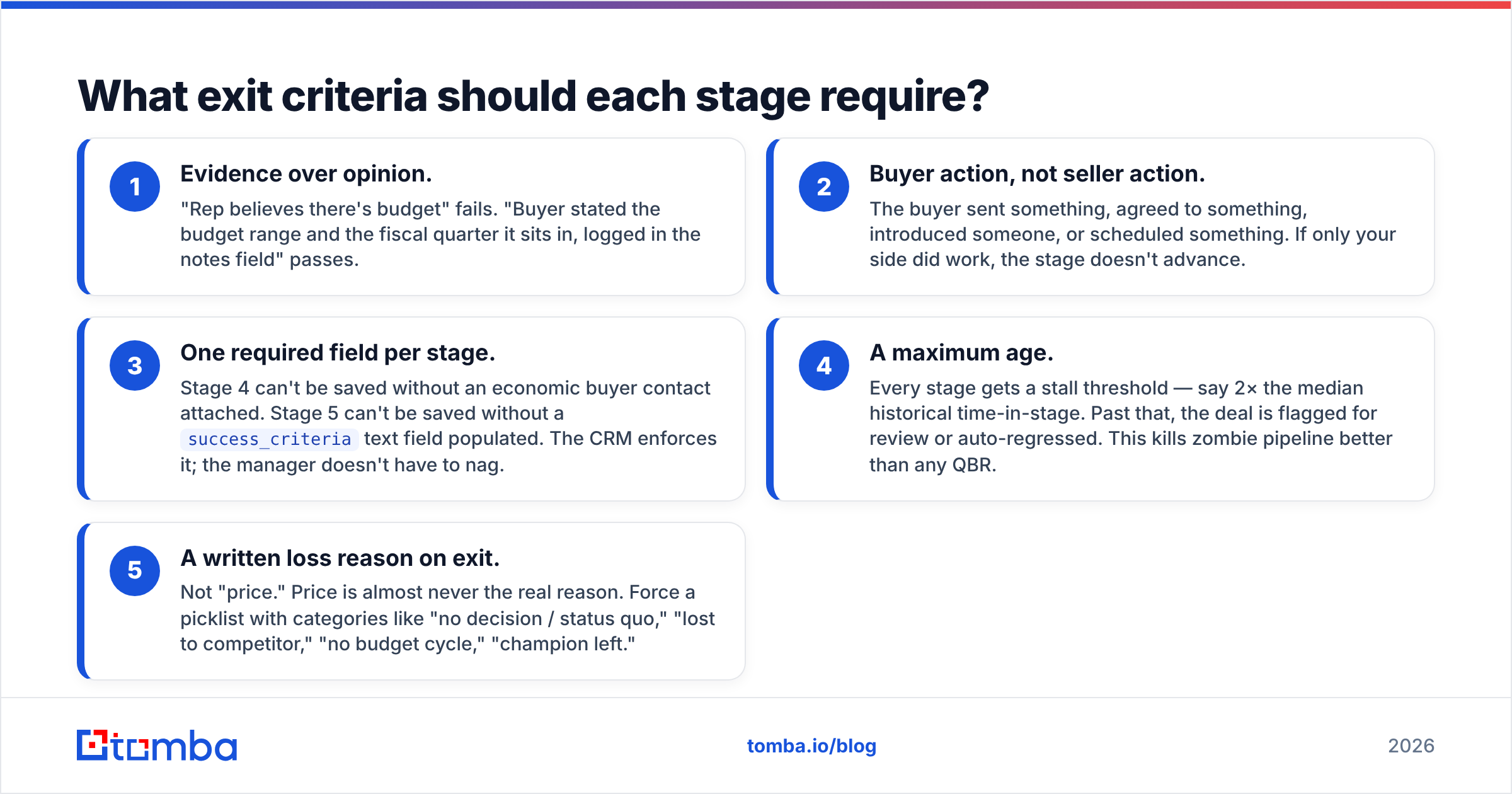
Exit criteria are the whole game. Here's the test: a sales manager should be able to open the CRM record and confirm the stage is correct without talking to the rep. If they can't, the criterion is too soft.
Use these five rules when you write them:
- Evidence over opinion. "Rep believes there's budget" fails. "Buyer stated the budget range and the fiscal quarter it sits in, logged in the notes field" passes.
- Buyer action, not seller action. The buyer sent something, agreed to something, introduced someone, or scheduled something. If only your side did work, the stage doesn't advance.
- One required field per stage. Stage 4 can't be saved without an economic buyer contact attached. Stage 5 can't be saved without a
success_criteriatext field populated. The CRM enforces it; the manager doesn't have to nag. - A maximum age. Every stage gets a stall threshold — say 2× the median historical time-in-stage. Past that, the deal is flagged for review or auto-regressed. This kills zombie pipeline better than any QBR.
- A written loss reason on exit. Not "price." Price is almost never the real reason. Force a picklist with categories like "no decision / status quo," "lost to competitor," "no budget cycle," "champion left."
That third rule is the one teams skip and then regret. Required fields feel bureaucratic for about three weeks and then quietly become the reason your forecast is accurate. HubSpot's guidance on sales pipeline stages makes a similar point — the stage definitions are worth less than the enforcement mechanism behind them.
How many deal stages should you have?#
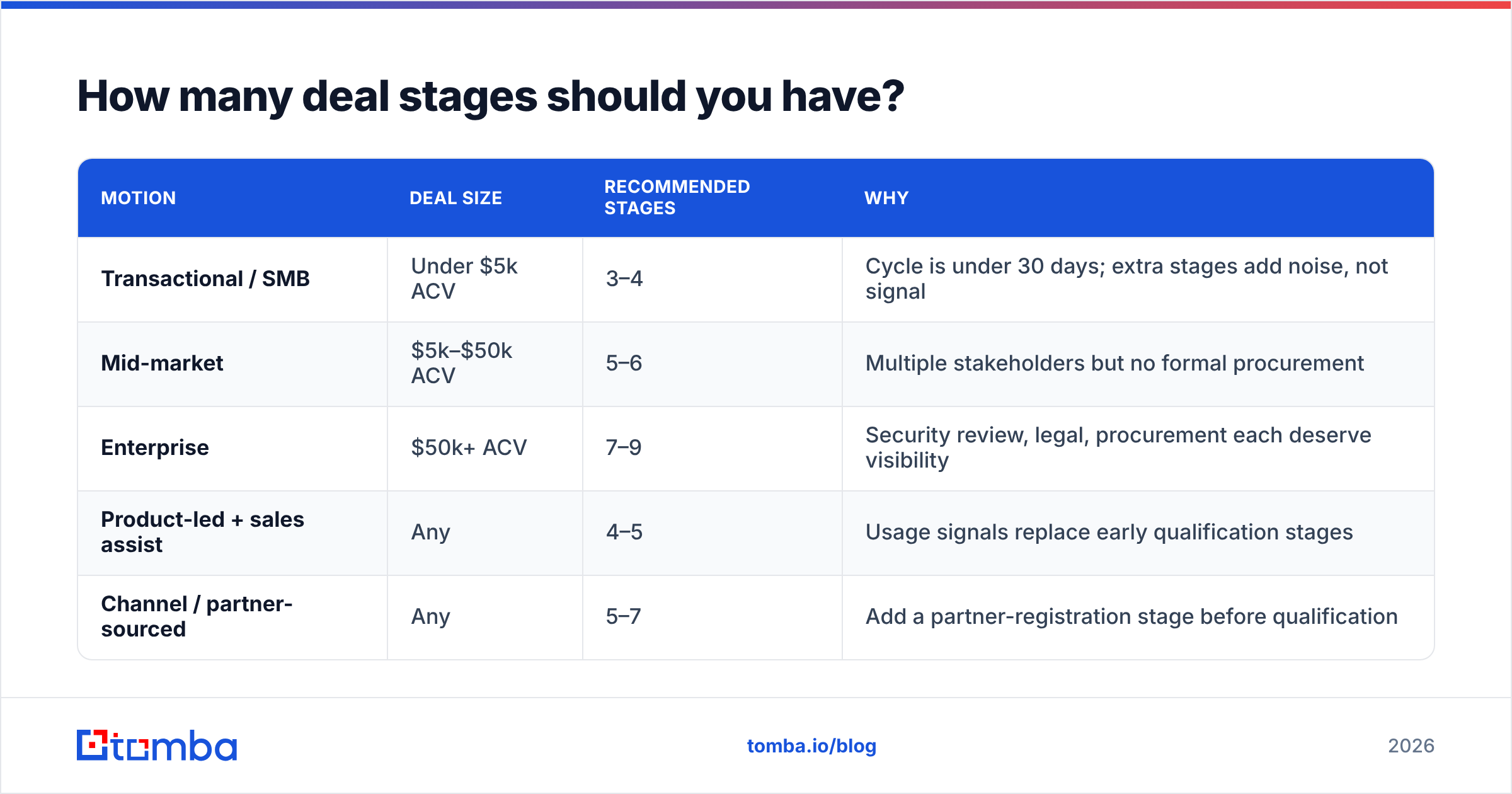
Depends on deal size and cycle length. More stages only pay off when the cycle is long enough that you need intermediate signal.
| Motion | Deal size | Recommended stages | Why |
|---|---|---|---|
| Transactional / SMB | Under $5k ACV | 3–4 | Cycle is under 30 days; extra stages add noise, not signal |
| Mid-market | $5k–$50k ACV | 5–6 | Multiple stakeholders but no formal procurement |
| Enterprise | $50k+ ACV | 7–9 | Security review, legal, procurement each deserve visibility |
| Product-led + sales assist | Any | 4–5 | Usage signals replace early qualification stages |
| Channel / partner-sourced | Any | 5–7 | Add a partner-registration stage before qualification |
A practical heuristic: if the median time-in-stage for any stage is under four days, merge it into the neighbor. You're not learning anything from a checkpoint deals blow through in 72 hours.
Should stage probability drive your forecast?#
No — at least not the default percentages. Every CRM ships with something like 10/25/50/75/90%, and those numbers are pure invention. They exist so the software has something to multiply by.
Replace them with historical conversion rates by stage, segmented by deal size band and rep tenure. Then treat stage-weighted pipeline as one of three forecast inputs, not the forecast itself:
- Stage-weighted pipeline — mechanical, unbiased, good at catching optimism.
- Rep commit / best case — subjective, good at catching things the CRM doesn't know (the buyer's CFO just resigned).
- Historical run-rate — what this team closed in the last four comparable quarters, adjusted for headcount.
When those three diverge by more than about 15%, that's your signal to dig in. Salesforce's overview of sales forecasting methods walks through several of these models in more depth; the useful takeaway is that no single method survives contact with a real quarter, so triangulate.
One more thing worth tracking: stage-skip rate. If deals routinely jump from Stage 2 to Stage 5, either your stages are wrong or your reps are backfilling the CRM after the fact. Both are worth knowing about. And watch your win rate by entry stage — deals that enter your pipeline at Stage 3 from a warm referral behave nothing like deals that grind up from Stage 1 cold outbound.
How do deal stages break down by go-to-market motion?#
The seven-stage model above assumes a rep-led sales cycle. Adjust it if your motion is different:
- Product-led with sales assist: Replace Stages 1–2 with usage-threshold triggers. A workspace that hits 5 active seats and 200 API calls is further along than any discovery call would tell you. Your first human stage is effectively "Business Case."
- Enterprise with procurement: Split Stage 6 into "Commercial Terms" and "Legal/Security Review." These run in parallel and stall for entirely different reasons, and lumping them together hides which one is actually blocking.
- Renewal and expansion pipeline: Use a separate pipeline entirely. Renewal deals don't have a discovery stage, and mixing them into new-business pipeline inflates your coverage ratio and flatters your win rate.
- Partner-sourced: Add a pre-Stage-1 "Registered" stage so you can measure partner lead quality separately from your own outbound.
How do you audit and fix a pipeline that's already messy?#
Do this in one afternoon, not one quarter:
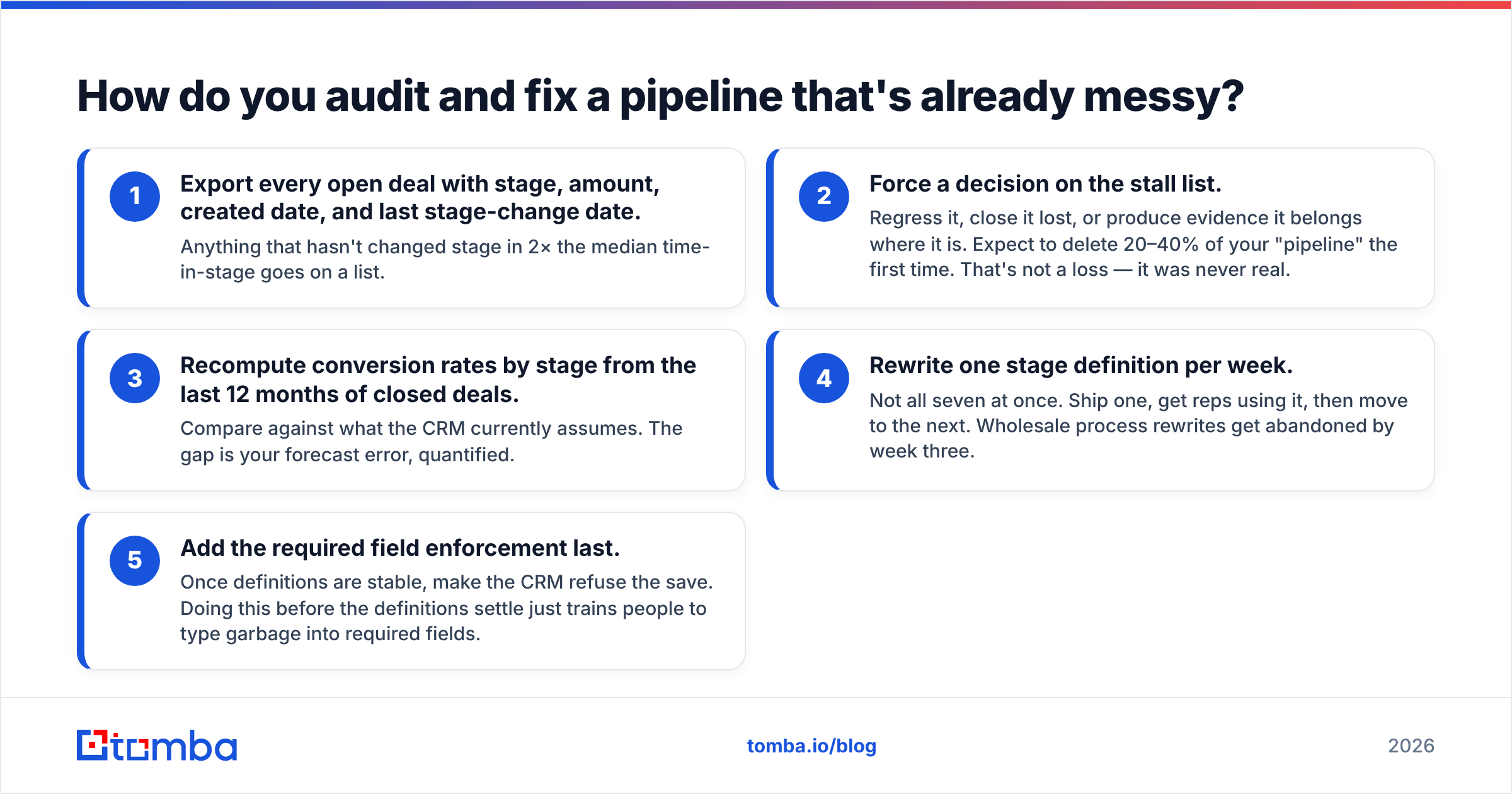
- Export every open deal with stage, amount, created date, and last stage-change date. Anything that hasn't changed stage in 2× the median time-in-stage goes on a list.
- Force a decision on the stall list. Regress it, close it lost, or produce evidence it belongs where it is. Expect to delete 20–40% of your "pipeline" the first time. That's not a loss — it was never real.
- Recompute conversion rates by stage from the last 12 months of closed deals. Compare against what the CRM currently assumes. The gap is your forecast error, quantified.
- Rewrite one stage definition per week. Not all seven at once. Ship one, get reps using it, then move to the next. Wholesale process rewrites get abandoned by week three.
- Add the required field enforcement last. Once definitions are stable, make the CRM refuse the save. Doing this before the definitions settle just trains people to type garbage into required fields.
How does data quality upstream affect your deal stages?#
More than anyone wants to admit. Your stage conversion rates are only meaningful if Stage 1 contains real, reachable buyers. If a third of your top-of-funnel contacts have wrong or dead email addresses, you get three compounding problems: inflated early-stage volume, a Stage 1 → 2 conversion rate that looks alarming for no real reason, and coverage ratios that tell your VP to hire when the actual problem is list quality.
Clean that up at the source rather than in the pipeline report. Verifying addresses before they become opportunity records means your Stage 1 count reflects people who can actually receive an email — use an email verifier as a gate on lead creation, and enrich leads with title, company size, and seniority so your qualification stage has something to qualify against. Titles matter especially for Stage 4: you can't confirm the economic buyer if you don't know who reports to whom.
The other habit worth building: log the source of every contact on the opportunity. Six months in, you'll be able to see that referral-sourced deals convert Stage 3 → 4 at twice the rate of scraped-list deals, which is a far more actionable finding than "our win rate is down."
Where should you start?#
Pick one thing: write exit criteria for your two worst-performing stages, and enforce a required field on each. That single change usually surfaces more hidden risk than a full CRM migration.
Then work backwards to the top of the funnel. Deal stages measure what happens after a real conversation starts — and real conversations start with reaching the right person at the right company. If your Stage 1 is padded with contacts you can't actually reach, the Tomba Email Finder will get you verified, deliverable addresses by domain, name, or company so your pipeline reflects buyers instead of guesses. The free tier gives you 25 searches a month to test it against a list you already have; paid plans start at $49/mo, and you can compare the tiers on Tomba pricing.
Related guides#
Ready to find emails that actually work?
Join 150,000+ professionals who stopped guessing and started sending. Free credits on signup — no credit card required.
Get the Tomba newsletter
Practical outbound tactics and product updates — once every two weeks.
About the author