Dealfront Pricing in 2026: Plans, Real Costs, and Alternatives
Dealfront pricing is quote-based and bundled across four modules, which makes the real cost hard to pin down. Here's how the plans break down, what drives the price up, and a flat-rate alternative worth checking first.
Dealfront is one of the better-known go-to-market platforms in Europe, but its pricing is famously hard to read. Unlike tools that publish a clean $49/$99/$249 ladder, Dealfront hides almost everything behind a "book a demo" button. This guide breaks down what you actually pay, what pushes the number up, and when a simpler, flat-rate tool does the same job for less.
TL;DR: What does Dealfront cost in 2026?#
- Dealfront pricing is quote-based. Most plans require a sales call, an annual contract, and custom scoping — there is no public self-serve price for the full suite.
- It's a bundle, not one tool. You're paying across four modules (Target, Promote, Connect, and Leadfeeder), and the quote depends on which you enable and your data volume.
- The free entry point is Leadfeeder Lite, a limited web-visitor tool — useful, but a fraction of the platform.
- Real-world spend typically starts in the low-to-mid four figures per year and scales with seats, credits, and territories. Expect annual commitment.
- If your core need is finding and verifying contact emails, a focused tool like the Tomba Email Finder covers that at a fraction of the price — with transparent Tomba pricing you can read in ten seconds.
What is Dealfront and what are you actually paying for?#
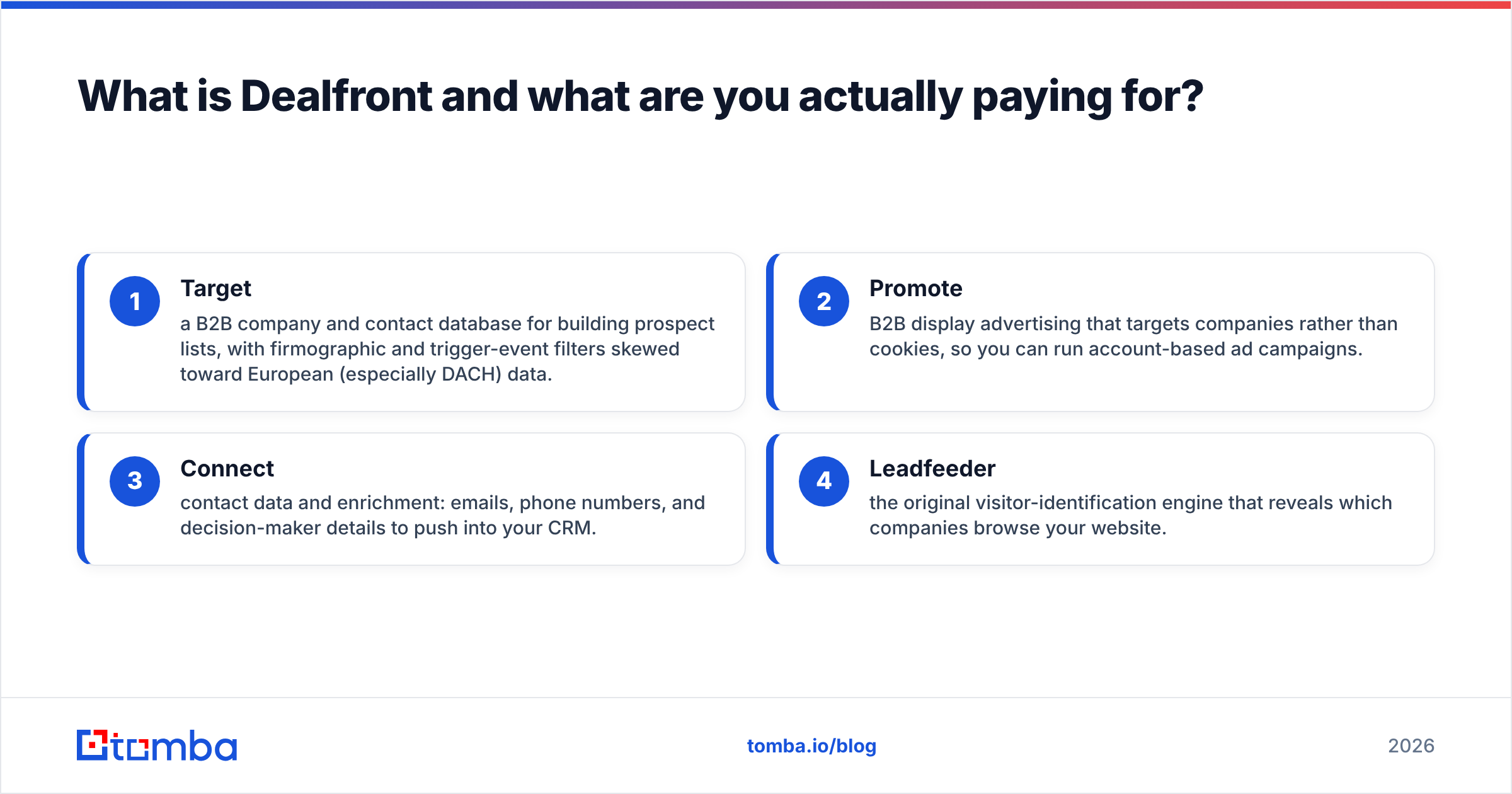
Dealfront was formed in 2022 from the merger of Finland's Leadfeeder (web-visitor identification) and Germany's Echobot (a European company and contact database). That history matters, because the "platform" you buy is really four products stitched together:
- Target — a B2B company and contact database for building prospect lists, with firmographic and trigger-event filters skewed toward European (especially DACH) data.
- Promote — B2B display advertising that targets companies rather than cookies, so you can run account-based ad campaigns.
- Connect — contact data and enrichment: emails, phone numbers, and decision-maker details to push into your CRM.
- Leadfeeder — the original visitor-identification engine that reveals which companies browse your website.
When people search for "Dealfront pricing," they're usually trying to price one or two of these, not all four. That's the first cost trap: the sales conversation tends to bundle. If you only need website visitor de-anonymization, you're being quoted a platform, and platforms cost more than point tools. (For that one job specifically, a dedicated website visitor reveal tool is worth comparing on price.)
How does Dealfront's pricing model work?#
Here's the conclusion first: Dealfront uses annual, quote-based contracts scoped to your modules, seats, and data volume. There is no monthly credit-card checkout for the full suite. You request a demo, describe your use case, and receive a proposal.
The main variables that move your quote:
- Which modules you enable. Target + Leadfeeder is a very different price from all four.
- Number of user seats. Sales-team-wide access costs more than a single prospecter.
- Data / export volume. Contact reveals and list exports are metered; heavier usage tiers up.
- Territory and data depth. European decision-maker data (Dealfront's strength) is a premium.
- Contract length. Annual is the norm; expect friction on short commitments.
Because of this, two companies can both "use Dealfront" and pay wildly different amounts. Public reports on G2 and reseller pages suggest entry points in the low-to-mid four figures per year for a modest configuration, climbing quickly with seats and modules. Treat any single number you see online as a rough anchor, not a guarantee — I'd verify with a live quote before budgeting.
Is there a free version of Dealfront?#
Yes, but scoped. Leadfeeder Lite is the free tier, and it's limited: you see a small window of identified companies (historically the last few days) with reduced detail and no full history. It's a genuine way to test whether visitor identification is useful for you, but it is not a free version of the Target database or Connect enrichment. For steady pipeline work, you'll be pushed to a paid plan fast.
Dealfront pricing tiers at a glance#
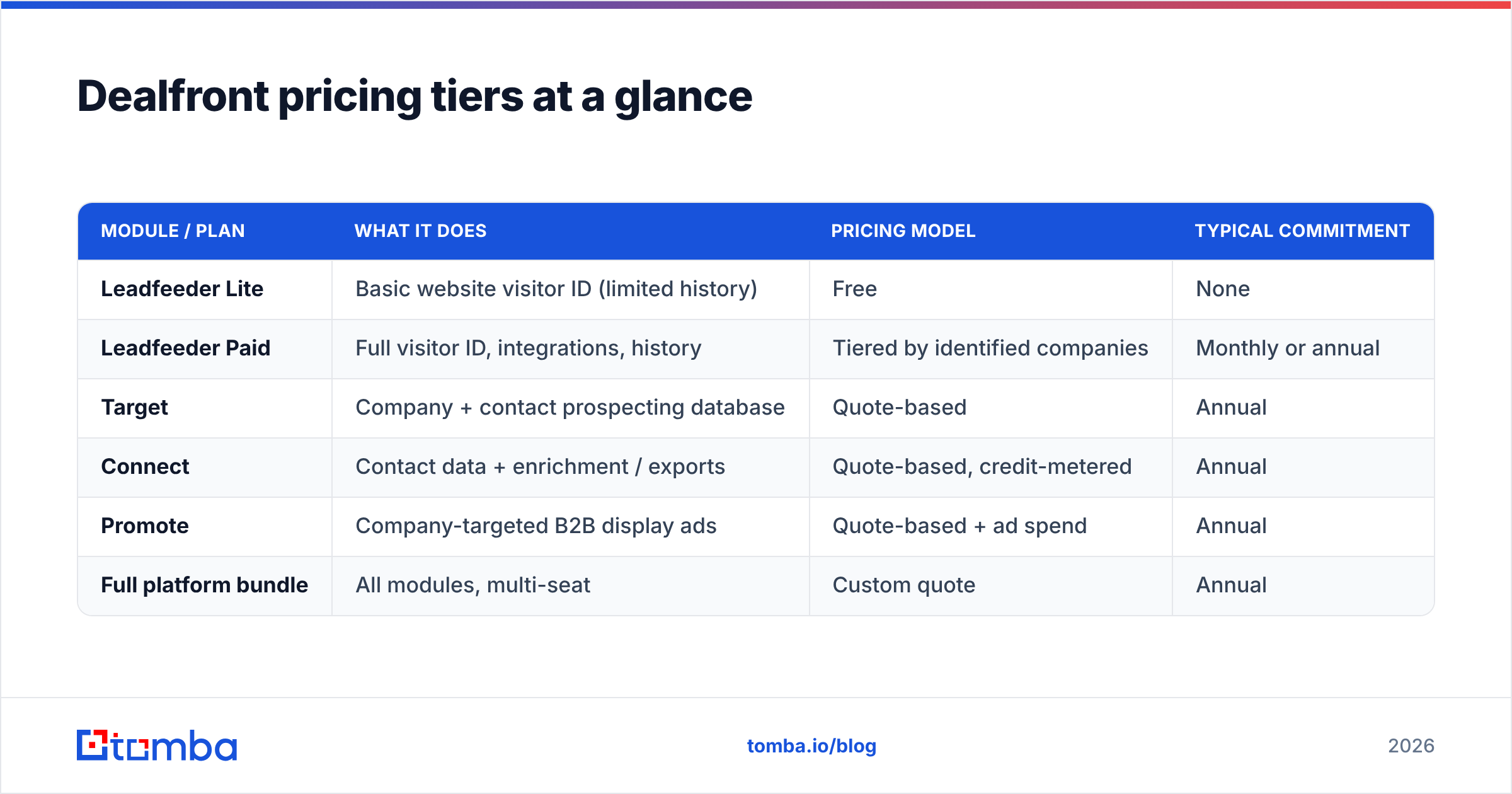
Because Dealfront doesn't publish a fixed table, the cleanest way to think about cost is by module and commitment. Here's how the pieces line up:
| Module / Plan | What it does | Pricing model | Typical commitment |
|---|---|---|---|
| Leadfeeder Lite | Basic website visitor ID (limited history) | Free | None |
| Leadfeeder Paid | Full visitor ID, integrations, history | Tiered by identified companies | Monthly or annual |
| Target | Company + contact prospecting database | Quote-based | Annual |
| Connect | Contact data + enrichment / exports | Quote-based, credit-metered | Annual |
| Promote | Company-targeted B2B display ads | Quote-based + ad spend | Annual |
| Full platform bundle | All modules, multi-seat | Custom quote | Annual |
The takeaway: only Leadfeeder has anything close to transparent, self-serve pricing. Everything that touches the database or contact exports runs through sales.
What are the hidden costs of Dealfront?#
The sticker shock with quote-based tools usually isn't the base fee — it's the extras. Watch for these:
- Annual lock-in. You commit for a year even if adoption stalls. There's no casual month-to-month.
- Seat-based scaling. Rolling the tool out to a full SDR team multiplies the cost line.
- Metered exports. Pulling large contact lists or enriching in bulk consumes credits; heavy months mean upsell conversations.
- Module creep. A quote for Target alone often becomes "and you'll want Connect and Promote too."
- Ad spend on top of Promote. The software fee doesn't include the media budget you actually spend on ads.
- Data coverage gaps outside Europe. Dealfront's DACH and EU data is strong; if your ICP is US-heavy, you may pay platform prices for data that's thinner where you need it.
None of these are unique to Dealfront — they're standard for enterprise GTM suites. But they explain why the "starting price" you hear on a call rarely matches the invoice twelve months later.

Is Dealfront worth it?#
Short answer: Dealfront is worth it if you need the full European GTM stack — visitor ID, EU-compliant company data, and account-based ads — in one contract, and you have the budget and volume to justify a platform. For DACH-focused teams that value GDPR-aligned data sourcing and want prospecting, advertising, and web analytics under one roof, the bundle can genuinely simplify a fragmented stack.
It's not worth it if:
- Your main job is finding and verifying business email addresses at scale.
- You want transparent, self-serve pricing without a sales cycle.
- Your target market is primarily North American, where Dealfront's European data edge matters less.
- You need to start small and prove ROI before an annual commitment.
In those cases you're buying a suite to use a slice of it — the classic sign you're overpaying.
How does Dealfront pricing compare to alternatives?#
Think of Dealfront like an all-inclusive resort: convenient if you'll use the pool, spa, and restaurants, but expensive if all you wanted was a clean room. A focused tool is the boutique hotel — cheaper, and it does the one thing you came for well.
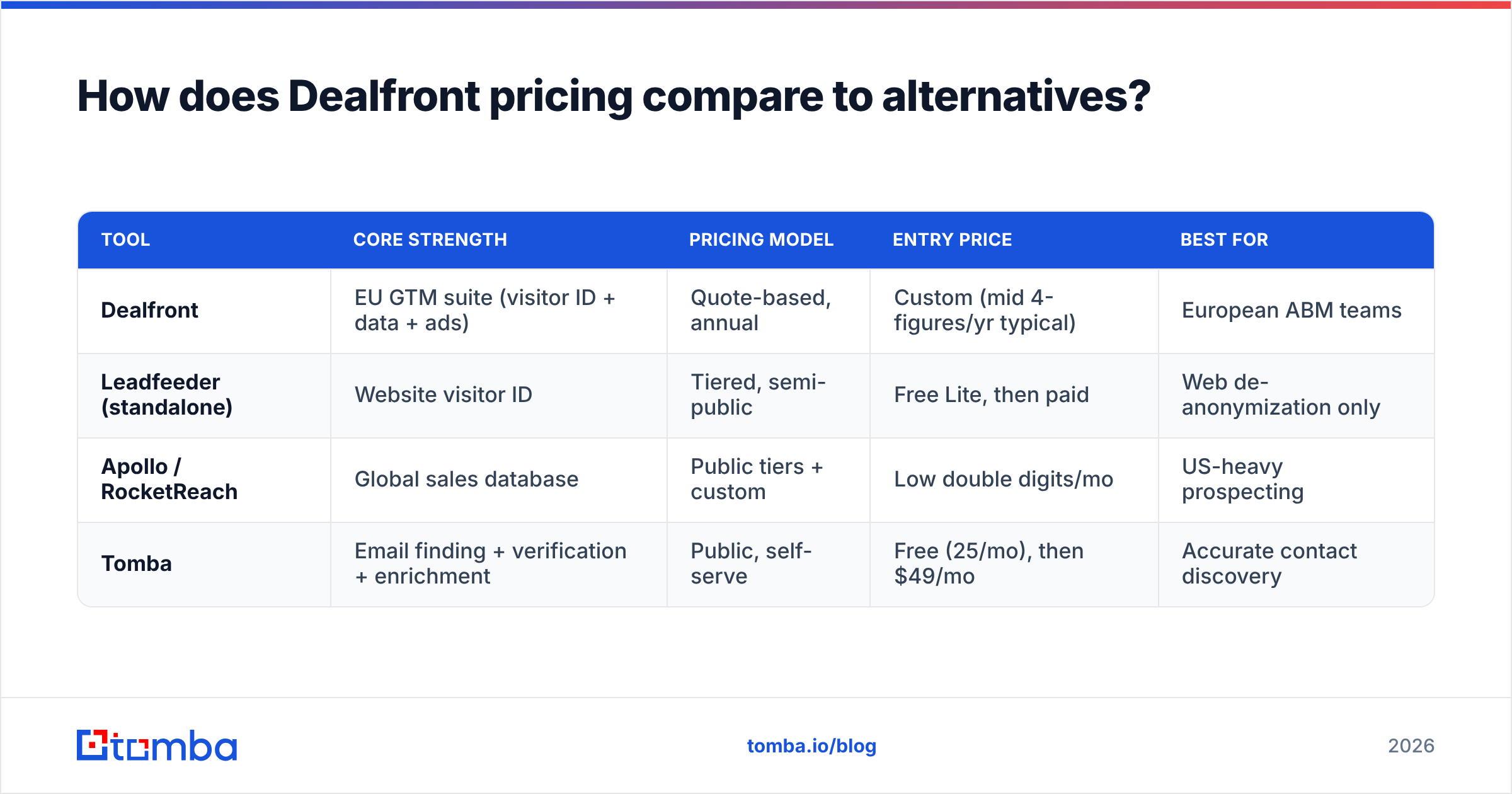
Here's how the pricing philosophy compares against common alternatives, including where a dedicated email-finding tool fits:
| Tool | Core strength | Pricing model | Entry price | Best for |
|---|---|---|---|---|
| Dealfront | EU GTM suite (visitor ID + data + ads) | Quote-based, annual | Custom (mid 4-figures/yr typical) | European ABM teams |
| Leadfeeder (standalone) | Website visitor ID | Tiered, semi-public | Free Lite, then paid | Web de-anonymization only |
| Apollo / RocketReach | Global sales database | Public tiers + custom | Low double digits/mo | US-heavy prospecting |
| Tomba | Email finding + verification + enrichment | Public, self-serve | Free (25/mo), then $49/mo | Accurate contact discovery |
Notice the pattern: the closer a tool is to a full suite, the more opaque and annual its pricing gets. The closer it is to a single job, the more transparent and month-to-month it becomes.
If your actual goal is contact discovery, Tomba pricing is the opposite of Dealfront's: a Free tier with 25 searches per month, then Starter at $49/mo, Growth at $99/mo, and Pro at $249/mo, with an Enterprise option only when you truly need it. You can start today, no call required, and use domain search to pull every professional email pattern behind a company you already identified.
Where the two tools actually overlap#
Dealfront's Connect module and a dedicated email finder solve the same last-mile problem: turning "I know the company" into "I have the decision-maker's verified email." The difference is that Dealfront wraps that capability inside a platform quote, while a focused finder prices it directly. If you already know your target accounts — from your CRM, a visitor-ID tool, or a list — the enrichment step doesn't require a four-module contract.
How to decide: a quick buyer's checklist#
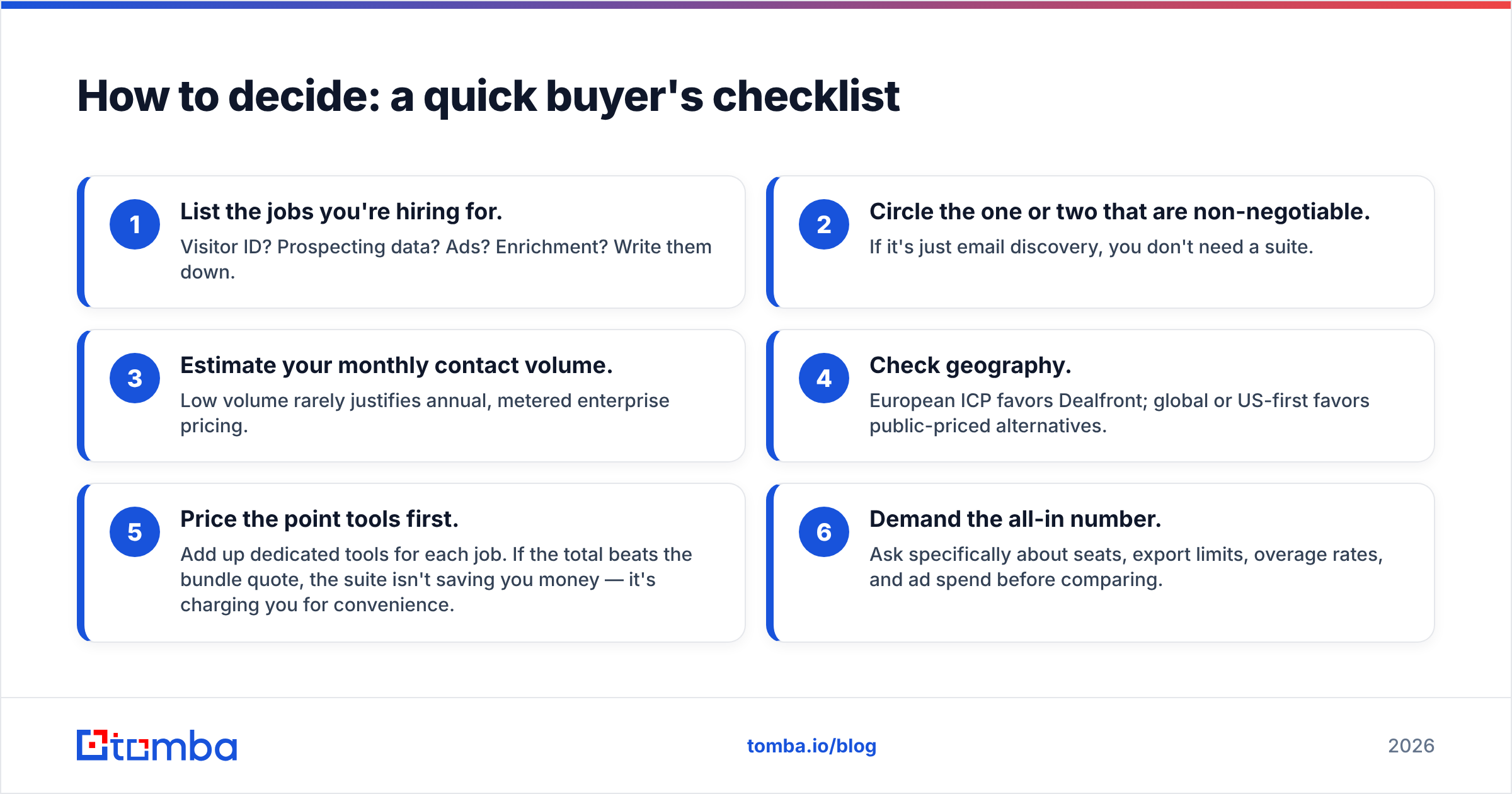
Run through these before you book any demo:
- List the jobs you're hiring for. Visitor ID? Prospecting data? Ads? Enrichment? Write them down.
- Circle the one or two that are non-negotiable. If it's just email discovery, you don't need a suite.
- Estimate your monthly contact volume. Low volume rarely justifies annual, metered enterprise pricing.
- Check geography. European ICP favors Dealfront; global or US-first favors public-priced alternatives.
- Price the point tools first. Add up dedicated tools for each job. If the total beats the bundle quote, the suite isn't saving you money — it's charging you for convenience.
- Demand the all-in number. Ask specifically about seats, export limits, overage rates, and ad spend before comparing.
This ordering matters because vendors quote the bundle first. Pricing the point tools yourself is the only way to know whether you're paying for capability or for packaging.
The bottom line on Dealfront pricing#
Dealfront is a capable European GTM platform, and for the right team the bundled convenience is real. But the quote-based, annual, multi-module model means the honest answer to "what does it cost?" is "it depends — and you'll need a sales call to find out." For anyone whose real need is accurate, verifiable contact data rather than a full advertising-and-database suite, that's a lot of friction and budget for one slice of the product.
If contact discovery is the job, start where the pricing is already on the table. The Tomba Email Finder finds professional email addresses by name, domain, or company, backs them with built-in email verification, and does it on a plan you can read — and cancel — without a contract. Try the free tier first, confirm it fits your workflow, and upgrade only when your volume actually calls for it. That's the transparency Dealfront's model doesn't offer, and for most teams it's the faster path to a full pipeline.
Related guides#
Ready to find emails that actually work?
Join 150,000+ professionals who stopped guessing and started sending. Free credits on signup — no credit card required.
Get the Tomba newsletter
Practical outbound tactics and product updates — once every two weeks.
About the author