Dealpad Pricing Reviews Pros and Cons: 2026 Buyer Guide
Dealpad sells digital sales rooms on quote-only pricing. Here is what buyers actually pay, where the platform earns its seat count, and where it quietly falls short.
This guide puts the Dealpad pricing reviews pros and cons in one place. You get what teams really pay, what buyers praise, and where the platform falls short.
TL;DR
- Dealpad is a digital sales room (DSR) platform — shared buyer-seller workspaces, mutual action plans, and buying-committee engagement tracking. It is not a prospecting or contact-data tool.
- Pricing is quote-only. Public reviews and vendor comparisons put practical entry cost in the $1,000–$2,000/month range for a small team, with annual contracts and platform fees stacked on top of per-seat costs.
- The strongest pros: genuine buyer-side engagement visibility, mutual action plans that actually get used, and clean Salesforce/HubSpot write-back.
- The strongest cons: opaque pricing, a seat model that punishes wide rollouts, thin value for teams with short sales cycles, and zero contact data — you still need a separate email finder to fill the room.
- Buy Dealpad if your average deal has 6+ stakeholders and a 90+ day cycle. Skip it if your motion is high-velocity outbound, where a $49/mo data tool moves the number more than a $1,500/mo deal room.
What is Dealpad and who actually buys it?#
Dealpad is a digital sales room platform. Normally you email a deck, a security questionnaire, and three pricing spreadsheets to one champion. That champion forwards them to eleven people you never meet. With Dealpad you build one shared microsite per opportunity instead. Content, timelines, next steps, and stakeholders all live in that room, and you see who opened what.
Think of it as a shared kitchen instead of takeout delivery. With takeout (email attachments), you hand food over at the door. You never learn who ate it, whether it was reheated, or if half of it went in the bin. With a shared kitchen, everyone cooks in the same space. You see who showed up, what they touched, and what they still need.
The buyer profile is specific: enterprise and mid-market B2B sellers with long, multi-threaded deals. Software companies selling six-figure contracts into committees of 5–15 people. If you're a two-rep team closing $8k deals in 14 days, Dealpad is the wrong fit no matter what it costs.
Dealpad competes with Aligned, Trumpet, GetAccept, and the DSR modules inside larger platforms. It's a real category. Gartner has tracked buyer-enablement tooling as its own segment for years. The core idea also holds up: buyers do most of their evaluation without you in the room.
How much does Dealpad actually cost in 2026?#
Here is the honest answer: Dealpad does not publish pricing. The website routes every plan inquiry to a demo booking. That is a deliberate choice, and it's worth naming as a con on its own before we get to numbers.
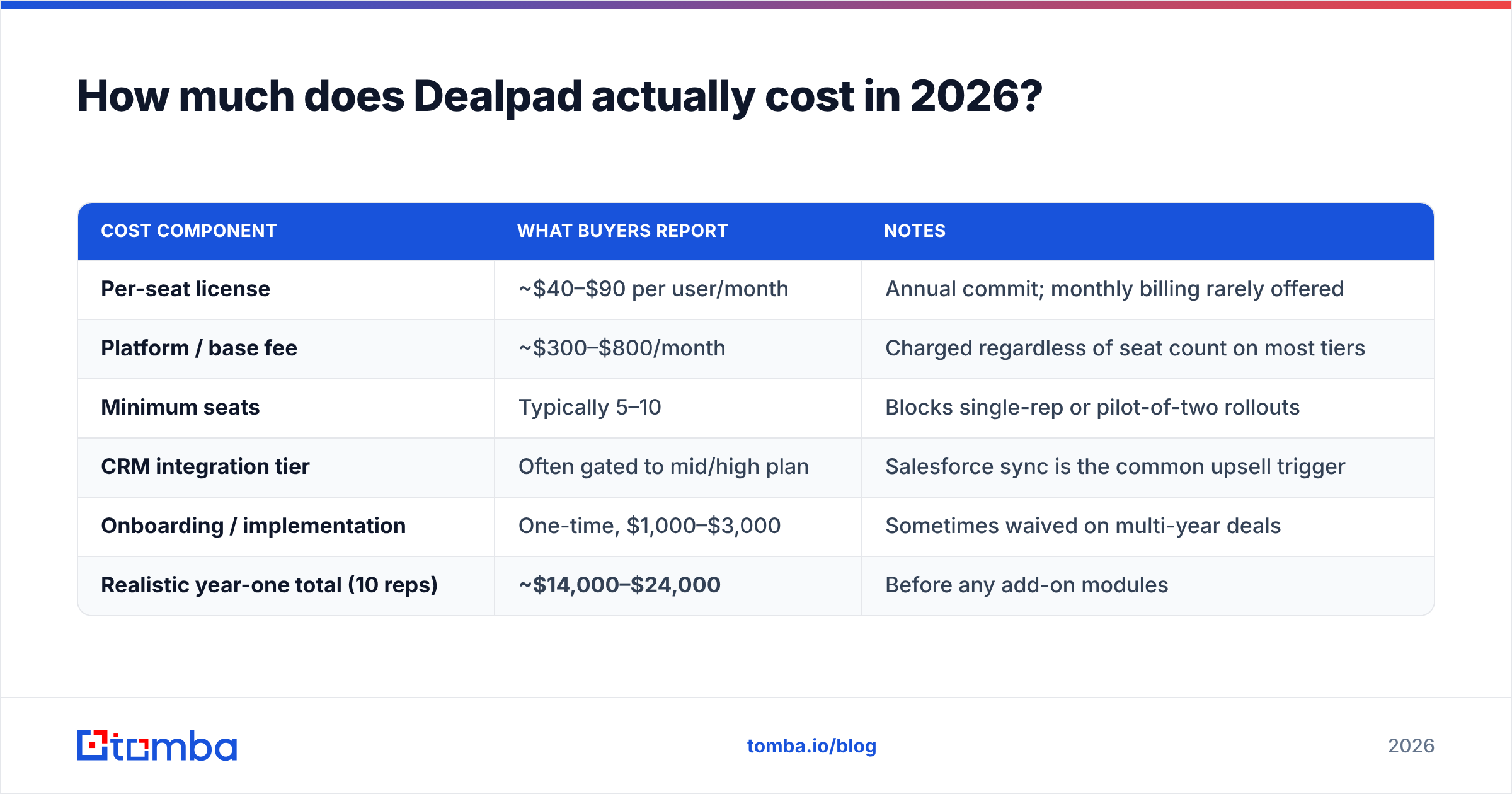
What we can reconstruct comes from buyer reports on G2, Capterra, procurement threads, and the pricing shape of comparable DSR vendors. Treat the table below as a directional model, not a quote sheet. Your actual number depends on seat count, contract length, and how hard your procurement team pushes.
| Cost component | What buyers report | Notes |
|---|---|---|
| Per-seat license | ~$40–$90 per user/month | Annual commit; monthly billing rarely offered |
| Platform / base fee | ~$300–$800/month | Charged regardless of seat count on most tiers |
| Minimum seats | Typically 5–10 | Blocks single-rep or pilot-of-two rollouts |
| CRM integration tier | Often gated to mid/high plan | Salesforce sync is the common upsell trigger |
| Onboarding / implementation | One-time, $1,000–$3,000 | Sometimes waived on multi-year deals |
| Realistic year-one total (10 reps) | ~$14,000–$24,000 | Before any add-on modules |
The number that surprises people is not the per-seat rate. It's the platform fee plus the seat minimum. A five-person team that just wants to test the concept gets quoted like a twenty-person rollout, because the base fee doesn't scale down.

Why quote-only pricing costs you more than the sticker#
Quote-only pricing is not automatically predatory. Enterprise software has real configuration variance. But it does four specific things to you as a buyer:
- It removes your anchor. You walk into the call with no reference price, so the first number you hear becomes the anchor. That number is set by the vendor.
- It price-discriminates on company size. The vendor looks up your firmographics before the call. A 400-person company and a 40-person company ask identical questions and get very different quotes.
- It hides the ratchet. Year-one discounts expire at renewal. That is far easier to bury when there was never a list price to discount from.
- It slows your evaluation. Two demo calls and a procurement round, all to learn a number a competitor puts on a public page. That is a real cost in rep hours.
The counter-move is simple. Get three DSR quotes in parallel. Ask for the list price before discount. Then ask what the renewal rate looks like in year two. Vendors who won't answer the second question are telling you the answer.
Dealpad pricing reviews pros and cons: what buyers actually say#
Review sentiment on Dealpad follows a familiar DSR pattern. Champions who rolled it out well give high praise. Teams that bought it without changing their process are frustrated.
What reviewers consistently like:
- Buyer engagement telemetry. Knowing that the CFO opened the pricing page four times last Tuesday is genuinely useful. Reps report this as the single feature that changed forecast accuracy.
- Mutual action plans. Shared close plans live inside the room, with owners and dates on both sides. Reviewers say this is where the product earns its keep. It turns vague "we're aligned" deals into dated commitments.
- Buying-committee discovery. The room gets forwarded internally, so you find stakeholders your champion never mentioned.
- Clean CRM write-back. Engagement data lands on the opportunity record instead of sitting in a silo. Teams already running a mature CRM get value here fast.
What reviewers consistently complain about:
- Pricing opacity and renewal creep. The most common single complaint across DSR reviews generally.
- Adoption cliff. If reps don't build the room, the tool is a $1,500/month screensaver. Several reviews describe 40–60% actual seat utilization six months in.
- Template rigidity. Customization exists, but reviewers hit walls on branding and layout compared with a purpose-built microsite.
- Overkill for SMB motions. Multiple reviewers with sub-30-day cycles found the room added friction rather than removing it.
- No contact data whatsoever. You still need to find and verify the stakeholders before you can invite them.
That last point matters more than it sounds. A digital sales room is a container. It does nothing until real people with real, deliverable email addresses are inside it. That is a completely separate tooling problem.
How does Dealpad compare to its alternatives?#
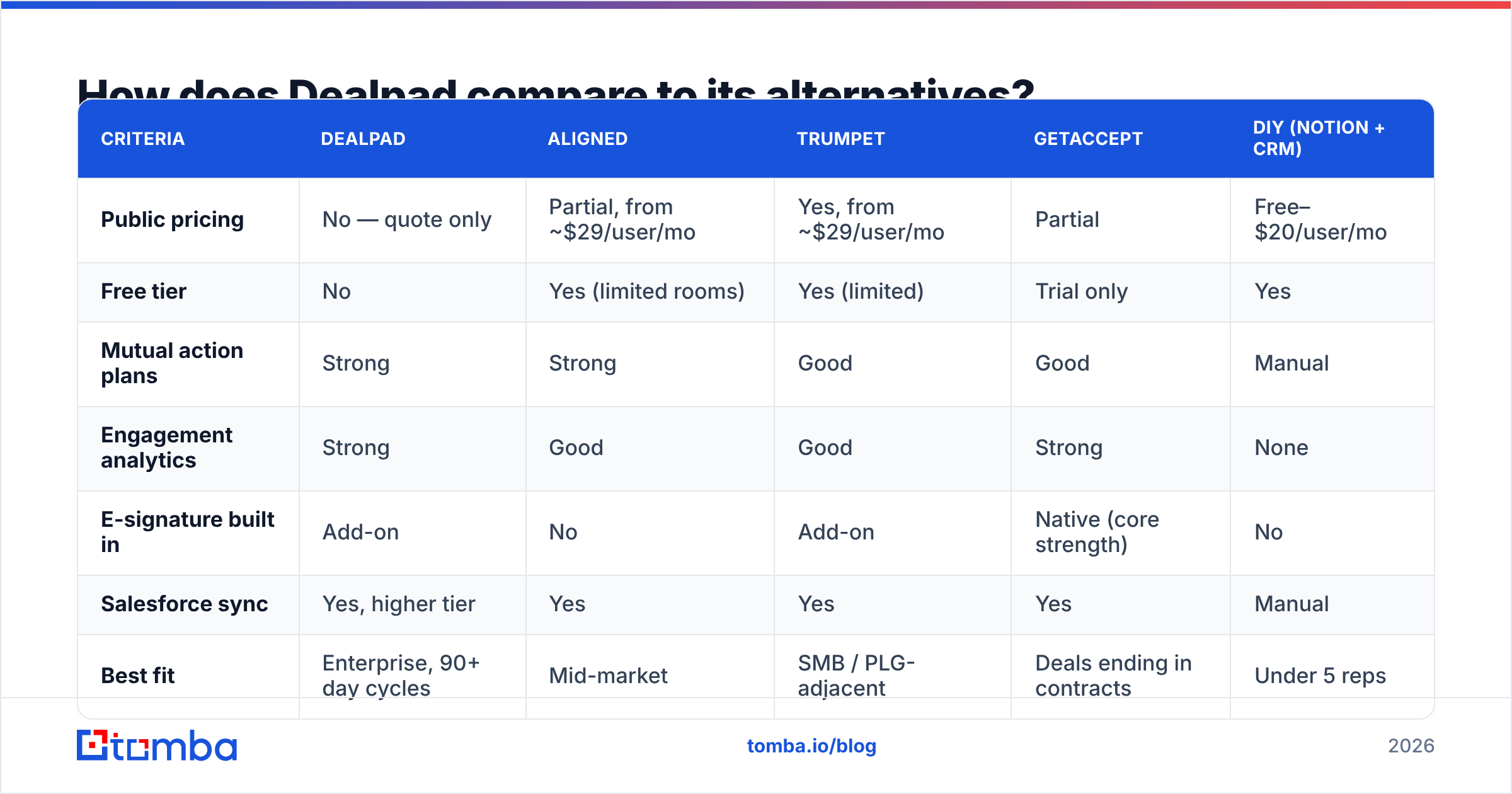
Here's the practical comparison across the DSR category and the adjacent tools teams often buy instead.
| Criteria | Dealpad | Aligned | Trumpet | GetAccept | DIY (Notion + CRM) |
|---|---|---|---|---|---|
| Public pricing | No — quote only | Partial, from ~$29/user/mo | Yes, from ~$29/user/mo | Partial | Free–$20/user/mo |
| Free tier | No | Yes (limited rooms) | Yes (limited) | Trial only | Yes |
| Mutual action plans | Strong | Strong | Good | Good | Manual |
| Engagement analytics | Strong | Good | Good | Strong | None |
| E-signature built in | Add-on | No | Add-on | Native (core strength) | No |
| Salesforce sync | Yes, higher tier | Yes | Yes | Yes | Manual |
| Best fit | Enterprise, 90+ day cycles | Mid-market | SMB / PLG-adjacent | Deals ending in contracts | Under 5 reps |
| Realistic 10-seat annual cost | ~$14k–$24k | ~$4k–$9k | ~$3.5k–$8k | ~$8k–$18k | Under $2k |
The honest read: Dealpad is not overpriced for what it does. It's overpriced for what most teams will use. The enterprise feature depth is real. The question is whether your deals are complex enough to consume it.
A useful gut-check before you sign anything:
- Stakeholder count — do your typical won deals involve 6+ people on the buyer side? If it's 2–3, skip the DSR category entirely.
- Cycle length — are you above 60 days? Rooms compound over time, and short cycles never let them.
- Deal value — is your ACV above ~$25k? Below that, a $1,500/mo platform fee eats an uncomfortable share of gross margin.
- Process maturity — do reps already run written close plans? If not, the tool won't create the discipline. It will just expose the gap.
- Pipeline coverage — is your problem "deals stall late" or "not enough deals"? Dealpad only fixes the first one.

Is Dealpad worth it, or should you fix the top of the funnel first?#
Conclusion first: if your problem is pipeline volume rather than late-stage stall, buy data before you buy a deal room. This is the most common misdiagnosis in the DSR purchase.
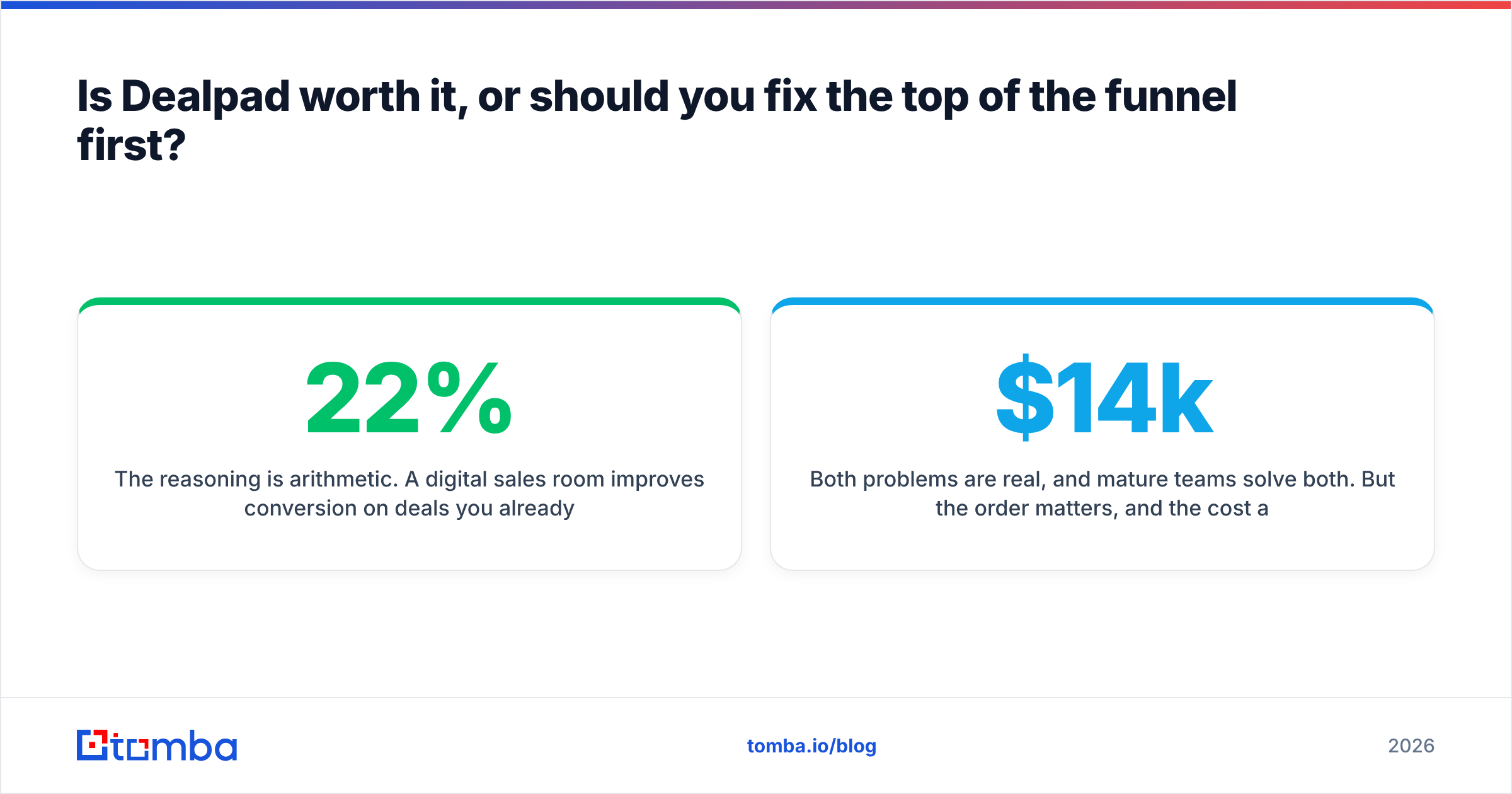
The reasoning is arithmetic. A digital sales room improves conversion on deals you already have. Say you have 30 late-stage opportunities and Dealpad lifts win rate from 22% to 26%. That's roughly one extra deal per quarter — meaningful at enterprise ACV, invisible at $10k ACV. But if you only have 12 opportunities because prospecting is starved, no amount of room polish fixes that. You need more qualified conversations, and that means accurate contact data for more of the right people.
Both problems are real, and mature teams solve both. But the order matters, and the cost gap is stark. A ten-rep Dealpad rollout runs $14k–$24k a year. A ten-rep contact-data stack costs a fraction of that, while keeping email deliverability intact and bounce rates under 2%. Tomba pricing starts at a free tier with 25 searches per month, then $49/mo Starter, $99/mo Growth, and $249/mo Pro. That is not a like-for-like feature comparison. It's a comparison of where the next dollar produces revenue.
There's also a dependency worth naming. Dealpad's core mechanic requires you to already know the buying committee. The engagement analytics only work on people you invited. Finding those people is a data problem, not a room problem — the VP of Security who was never on a call, or the finance approver your champion mentioned once. Teams pair a DSR with data enrichment and a reliable email verifier for exactly this reason. Every stakeholder you can't reach is a room seat sitting empty.
What questions should you ask on the Dealpad demo call?#
Go in with these written down. The answers separate a fair deal from a bad one.
- What is the list price per seat before any discount? If they won't say, that's data.
- What is the platform fee, and does it change at renewal? Ask for the year-two number in writing.
- What's the seat minimum, and can we pilot below it? A vendor confident in the product will usually find a way.
- Which tier includes Salesforce/HubSpot bi-directional sync? This is the most common surprise upsell.
- What's your median seat utilization at 6 months across customers our size? Almost nobody asks this. The reaction tells you as much as the number.
- Is there a usage cap on rooms or storage? Some DSR contracts meter active rooms.
- What's the out clause? Annual auto-renew with a 90-day notice window is standard and easy to miss.
Want market context on how buyer-enablement tooling gets positioned? HubSpot's sales enablement material and the vendor-neutral listings on G2's digital sales room category are worth 20 minutes before the call. Read them as context, not as a substitute for your own numbers.
Who should buy Dealpad — and who should walk away?#
Buy it if:
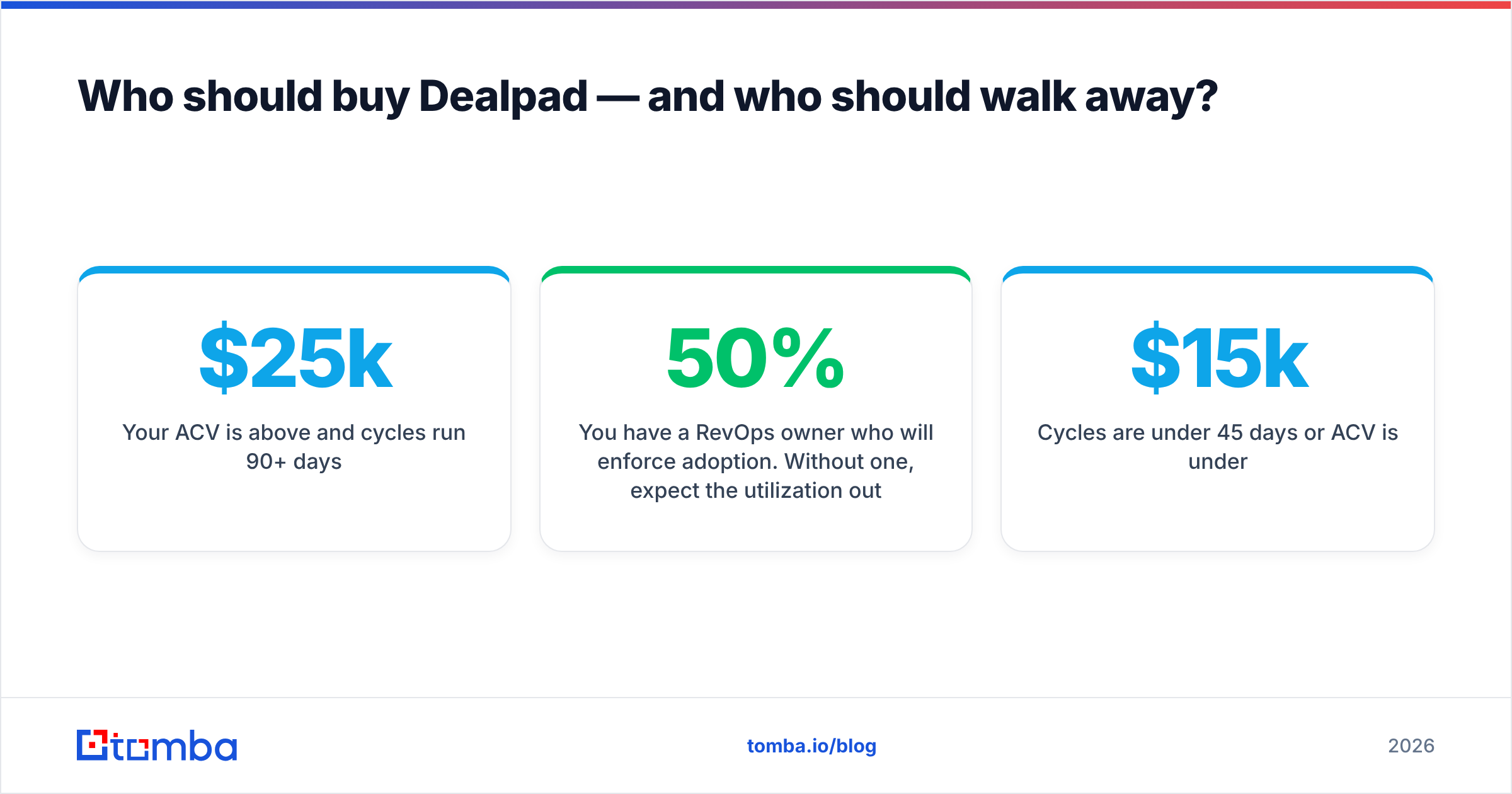
- Your ACV is above $25k and cycles run 90+ days.
- Deals routinely involve 6+ buyer-side stakeholders across multiple functions.
- You already run written mutual action plans manually and want them instrumented.
- Late-stage stall — not pipeline volume — is your documented bottleneck.
- You have a RevOps owner who will enforce adoption. Without one, expect the 50% utilization outcome.
Walk away if:
- Cycles are under 45 days or ACV is under $15k.
- You have fewer than five reps. The platform fee math is brutal at that size.
- Your pipeline is thin. Fix acquisition first; the room can wait a quarter.
- Nobody owns process enforcement. A DSR amplifies existing discipline; it does not create it.
- You need contact data, phone numbers, or prospecting in the same purchase. Dealpad does none of that, so you'd be buying half a stack.
The fair summary on Dealpad pricing reviews pros and cons: it is a competent, genuinely useful product sold behind an opaque price wall. The audience is narrower than the marketing implies. If you're in that audience, the pros hold up under scrutiny. If you're not, you'll spend enterprise money on a problem you don't have.
Where should your next dollar go instead?#
If this analysis pushed you toward "our problem is upstream," start where the leverage is: reaching the right people with addresses that actually land.
The Tomba Email Finder finds professional email addresses by domain, name, or company. That includes the stakeholders your champion mentions but never introduces. Pair it with the built-in verifier to keep bounce rates low and your sending domain healthy. Run bulk email finder jobs for whole account lists. Push results into your CRM through the Tomba API or the native HubSpot integration.
Start on the free tier at 25 searches a month. Move to Starter at $49/mo once it's working. Then put the $14,000 you didn't spend on a deal room toward filling the pipeline that would have gone in it.
Related guides#
Ready to find emails that actually work?
Join 150,000+ professionals who stopped guessing and started sending. Free credits on signup — no credit card required.
Get the Tomba newsletter
Practical outbound tactics and product updates — once every two weeks.
About the author