Dealroom vs Finderio: Which B2B Data Tool Wins in 2026?
Dealroom maps startups, funding and investors. Finder.io hunts down work emails. They get compared constantly and they are not the same product. Here is the honest breakdown of who each one is actually for in 2026.
Dealroom vs Finderio is a match-up that search results get wrong. One tool maps startups and funding. The other hunts down work emails. Here is the short version first, then the detail.
TL;DR
- They are not real rivals. Dealroom is a company and funding database. Finder.io is an email finder sold inside the 500apps bundle.
- Pick Dealroom if you are a VC, a corp dev team, a researcher, or you sell to funded startups.
- Pick Finder.io if you want cheap bulk email lookups and already pay for 500apps.
- Neither is a full outbound stack. Dealroom rarely hands you a verified inbox. Finder.io hands you emails with no company context.
- The 2026 setup is a signal source plus a dedicated finder. That is where Tomba Email Finder sits.
Dealroom vs Finderio: what each tool actually is#
Most "Dealroom vs Finderio" write-ups fail in the first paragraph. They treat both tools as one product type. They are not.
Dealroom.co is an Amsterdam-based data platform. It tracks startups, scaleups, funding rounds, investors, and whole tech ecosystems. Its buyers are venture funds, corporate teams, public agencies, and sales teams chasing fresh Series A rounds.
The core record is the company profile: headcount trend, funding history, investor links, sector tags, and value estimates. Cities and governments publish startup maps built on Dealroom data. That is a fair sign the company data holds up.
Finder.io (often typed "Finderio") is an email finder from 500apps. Its core record is the email address. You give it a domain, or a name plus a company. It returns likely work emails. You also get verification, bulk uploads, a Chrome extension, and an API.
It ships with about fifty other business apps on one seat price. That is its best selling point. It is also its main weak spot.
So here is the honest frame. Dealroom answers "which accounts are worth my time?" Finder.io answers "how do I reach a person there?" If you are picking just one, you may be solving the wrong problem.
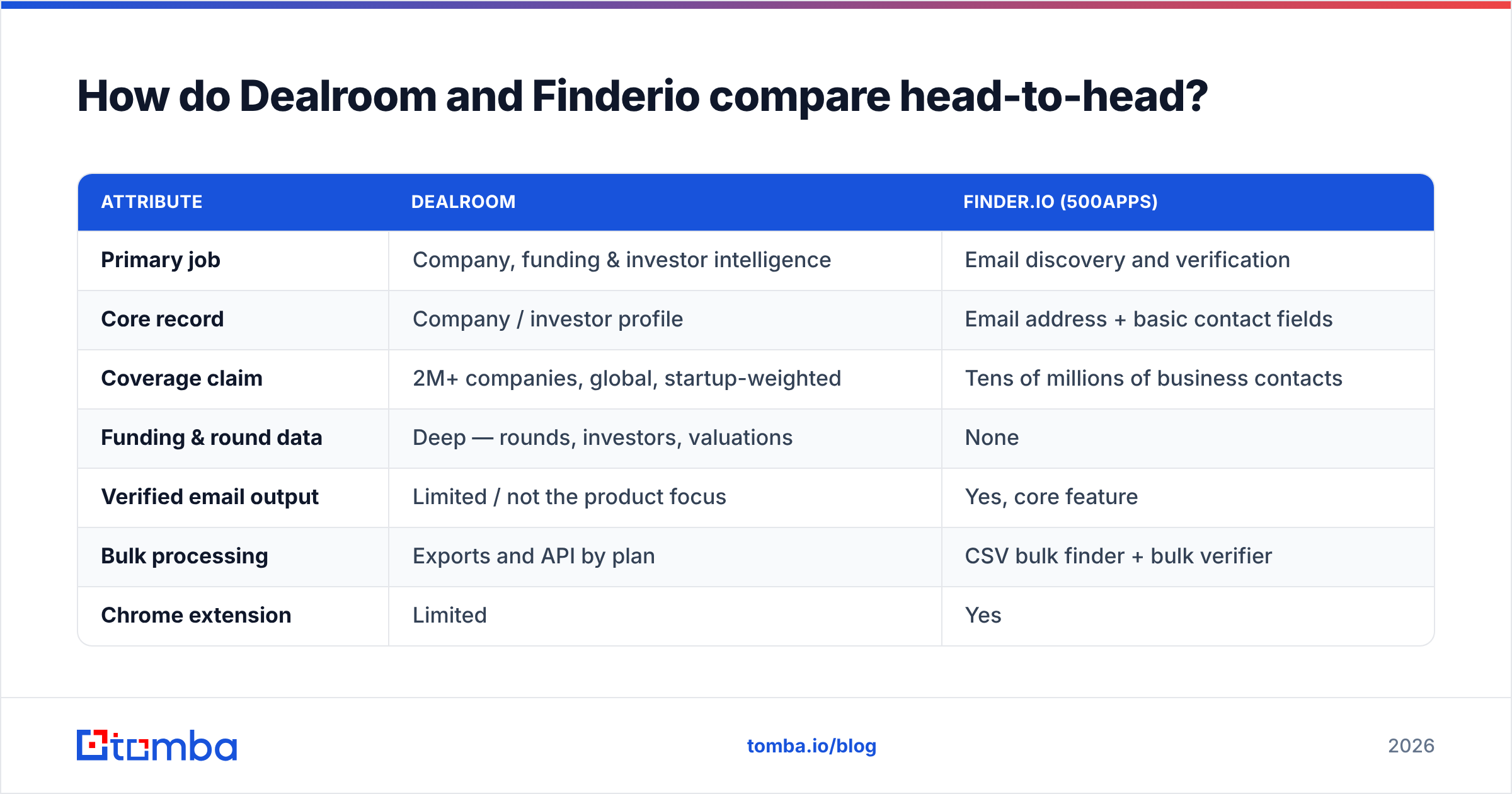
Dealroom vs Finderio: the head-to-head table#
Here is the side-by-side on the things that change your day. Figures are public as of early 2026. Both vendors move, so check their pricing pages first.
| Attribute | Dealroom | Finder.io (500apps) |
|---|---|---|
| Primary job | Company, funding & investor intelligence | Email discovery and verification |
| Core record | Company / investor profile | Email address + basic contact fields |
| Coverage claim | 2M+ companies, global, startup-weighted | Tens of millions of business contacts |
| Funding & round data | Deep — rounds, investors, valuations | None |
| Verified email output | Limited / not the product focus | Yes, core feature |
| Bulk processing | Exports and API by plan | CSV bulk finder + bulk verifier |
| Chrome extension | Limited | Yes |
| API access | Yes, enterprise-tier | Yes, included in bundle |
| Pricing model | Quote-based, annual contracts | Per-user bundle subscription |
| Entry price signal | Four-figure annual, not self-serve | Low double-digit per user/month |
| Free tier | Limited public profile browsing | Trial period |
| Best fit | VC, corp dev, ABM targeting | Volume email lookups on a budget |
| Weakest point | No usable outbound contact layer | Thin company data, bundle lock-in |
The pattern is clear. They are strong in opposite columns. Dealroom's weakest row is Finder.io's best one, and the reverse holds too.
What does Dealroom do well?#
Four things, and they are hard to copy.
- Funding triggers, fast. When a company closes a round, the next spend is easy to guess. Hiring, tools, servers. Dealroom shows those rounds with the investors attached. That is the most reliable buying signal in B2B SaaS.
- The investor graph. Find a fund, list its portfolio, and build an account list that shares one thesis. If you sell to venture-backed firms, this beats filtering by industry code.
Two more, both about scope:
- Market maps. Dealroom's sub-sector tags (climate tech, defense tech, vertical AI) are curated, not scraped. Say your target is "seed to Series B fintech in the EU". Dealroom builds that list fast.
- Trusted data. Public agencies publish dashboards that run on Dealroom numbers. That is not proof of perfection. It is still a higher bar than most vendor stats.
What Dealroom will not do is hand you the inbox of the VP of Engineering. You export accounts, then go elsewhere for people. Teams keep underrating the cost of that handoff.
What does Finderio do well?#
Finder.io's pitch is simple. Cheap email lookup at volume, with checks built in, and no new line item on the invoice.
- Cost per lookup is tiny. If you already pay for the suite, email finding is close to free at the margin.
- The basics are all there. Domain search, name-plus-company search, bulk CSV upload, an email verifier-style check, a browser add-on, and an API.
- Easy for current 500apps users. One login, one bill, one admin panel.
The caveats matter, though. A bundled tool follows the roadmap of fifty apps at once.
Email-specific problems get less attention as a result: catch-all domains, role-based addresses, thin coverage abroad, and SMTP checks. Reviews on G2 for suite products flag the same thing. Breadth is real, depth is uneven.
Small volume and US mid-market targets? You may never hit the ceiling. Thousands of lookups a month into EU or APAC domains? You probably will.
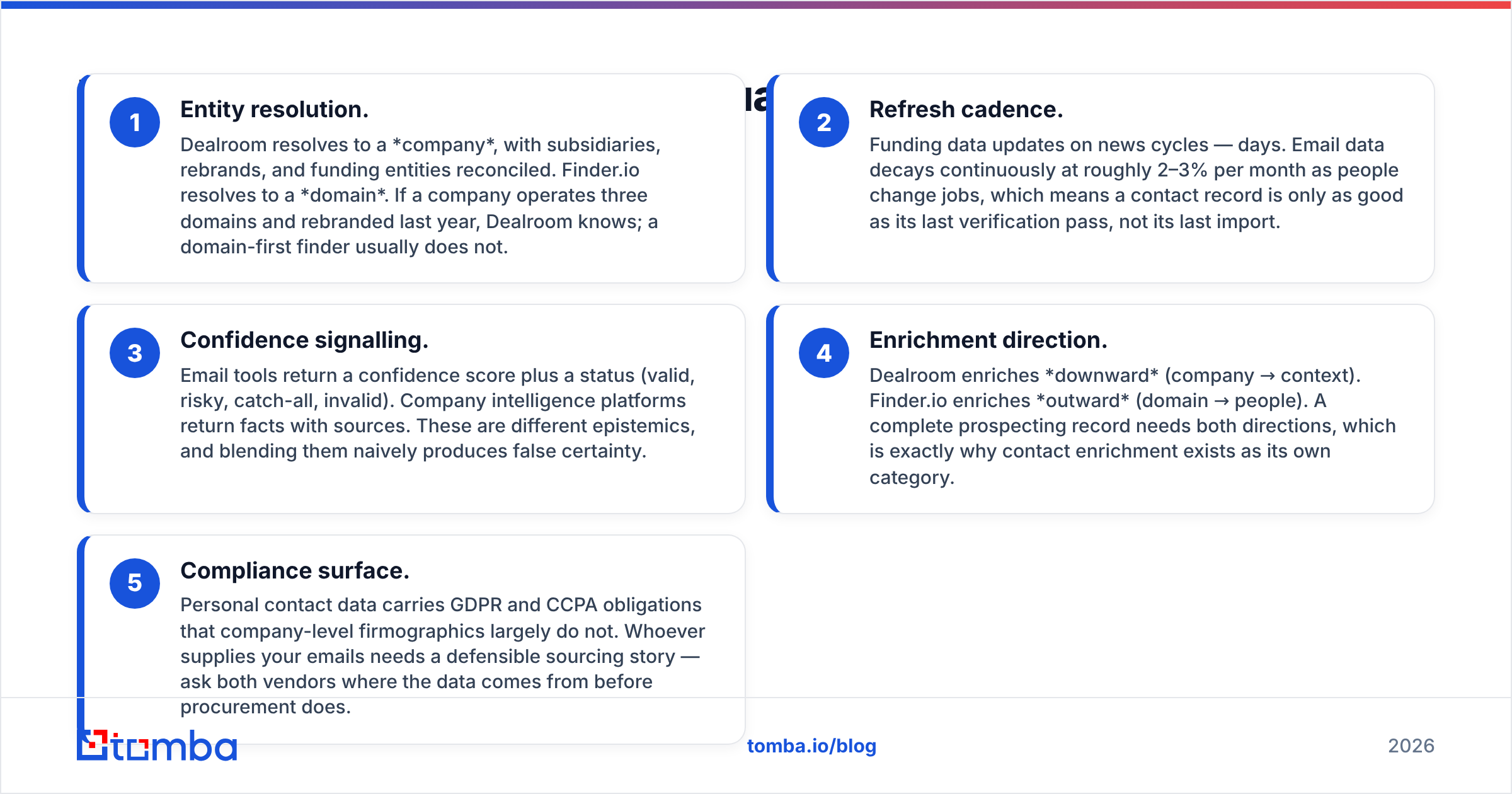
Dealroom vs Finderio: how the data models differ#
This is the part that should decide your purchase.
- What they resolve to. Dealroom resolves a company, with brands, subsidiaries, and funding entities tied together. Finder.io resolves a domain. If a firm runs three domains and rebranded last year, Dealroom knows. A domain-first finder often does not.
- How fast data ages. Funding news updates in days. Email data rots by about 2–3% a month as people switch jobs. A contact record is only as good as its last check.
- What "sure" means. Email tools return a score and a status: valid, risky, catch-all, invalid. Company platforms return facts with sources. Mixing the two creates false comfort.
Two more that come up late, usually in procurement:
- Which way they enrich. Dealroom goes company → context. Finder.io goes domain → people. A full record needs both, which is why contact enrichment is its own category.
- Legal exposure. Personal contact data carries GDPR and CCPA duties. Company facts mostly do not. Ask any email vendor where the data comes from before you sign.
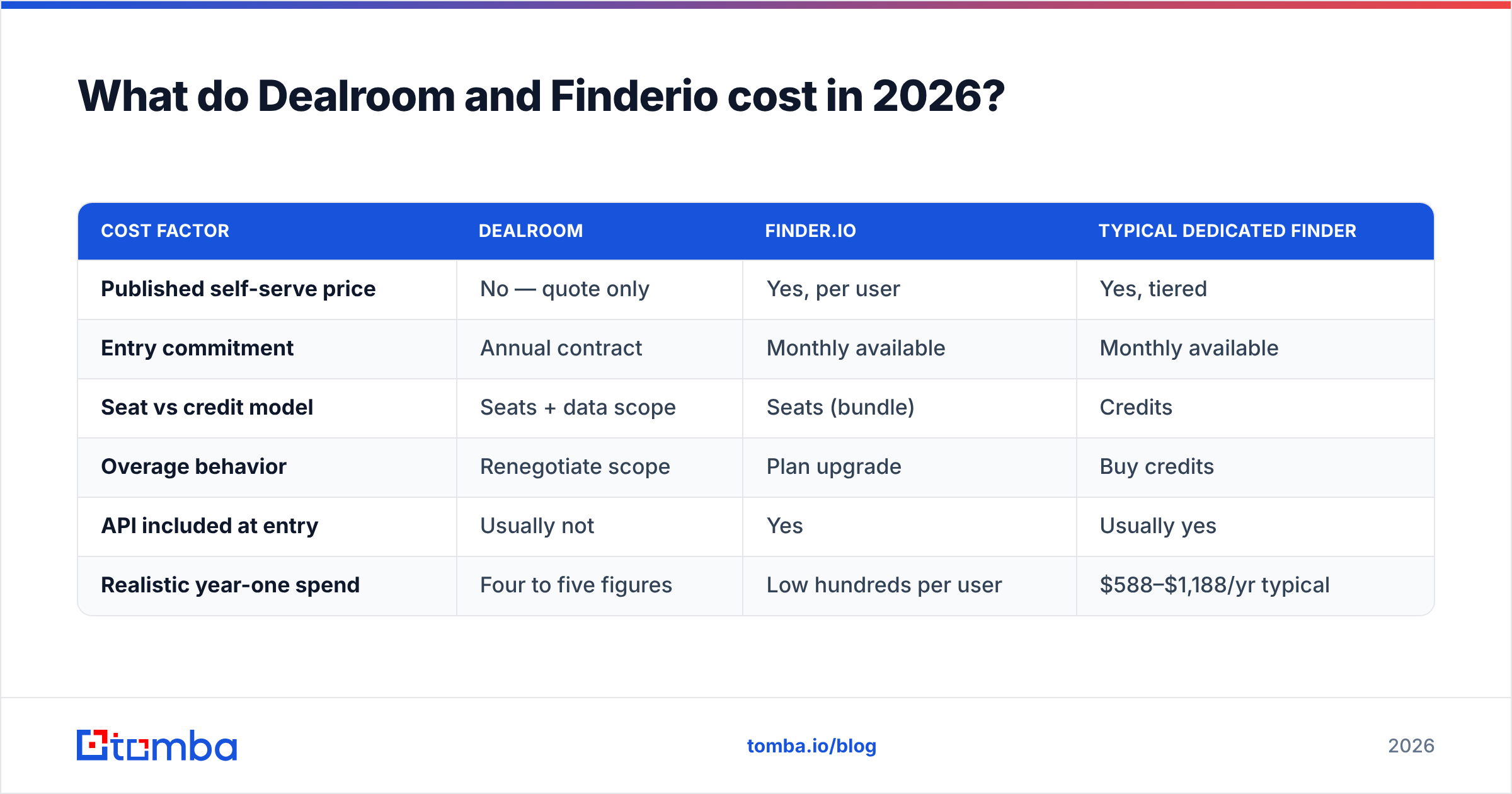
What do Dealroom and Finderio cost in 2026?#
Neither one makes this simple, in opposite ways.
| Cost factor | Dealroom | Finder.io | Typical dedicated finder |
|---|---|---|---|
| Published self-serve price | No — quote only | Yes, per user | Yes, tiered |
| Entry commitment | Annual contract | Monthly available | Monthly available |
| Seat vs credit model | Seats + data scope | Seats (bundle) | Credits |
| Overage behavior | Renegotiate scope | Plan upgrade | Buy credits |
| API included at entry | Usually not | Yes | Usually yes |
| Realistic year-one spend | Four to five figures | Low hundreds per user | $588–$1,188/yr typical |
A note on the third column. Tomba pricing starts free at 25 searches a month. Starter is $49/mo, Growth is $99/mo, Pro is $249/mo, plus custom plans.
That is the band a standalone finder sits in. Use it to judge Finder.io once you drop the bundle framing. If you would not buy the other forty-nine apps on their own, the bundle is not a discount.
Dealroom sits in another price world. It is sold as market research, not as a sales tool. That is easy to justify for a fund. It is much harder for a four-person SDR team.
Dealroom vs Finderio: which one wins for outbound?#
Match the tool to the job, not to the shortlist you inherited.
Choose Dealroom if:
- Your target list is defined by funding stage, investor, or sector.
- You must justify account choices to a board or a strategy team.
- You do market maps, competitor research, or corp dev sourcing.
- You already have contact data, and the gap is targeting.
Choose Finder.io if:
- You use 500apps already and email lookup is a side need.
- Volume matters more than precision per lookup.
- Your prospects sit on plain corporate domains in well-covered regions.
- Budget is the hard limit and you can live with a lower hit rate.
Choose neither, and build two layers, if:
- You need funding signals and inboxes that work.
- Bounce rate is a board metric because your send volume is growing.
- You sell outside North America and Western Europe.

Where neither tool fits, and what fills the gap#
The gap sits in the middle. You need to turn a target account into a real person you can email. Three tabs and a CSV shuffle should not be the answer.
Dealroom hands you stripe.com, plus its funding history and investors. It does not hand you firstname.lastname@stripe.com with a live SMTP check behind it. Finder.io hands you addresses, but no reason to think the account is in-market now.
A dedicated finder-verifier closes that gap in one step. What to look for:
- Domain search. Paste the domain, get the email pattern and every address found on it, with team filters.
- Pattern detection, not guessing. Permutation tools make junk that looks real. Patterns drawn from seen addresses lift a hit rate from 60% to 95%.
- Honest catch-all handling. About one in five B2B domains accepts any address. A tool that calls those "valid" is lying to you.
- Checks at send time. A six-month-old check is not a check.
- An API and a sheet path. Run it where your list lives: a Tomba API call, or an add-in over the sheet RevOps keeps.
Run Dealroom for account picking. Then run a dedicated finder over the domains it gives you. Two layers beat either tool alone. The pair often costs less than one enterprise seat.
Is a single tool ever enough?#
Only if you accept a trade. All-in-one platforms like Apollo, ZoomInfo, and Cognism mix company data with contacts. But their startup and funding data is thinner than Dealroom's. Their contact data also varies more than a specialist's.
Specialist list vendors take another route. BookYourData sells pre-checked B2B lists with an accuracy promise. That suits teams who want a clean list today, not an ongoing search workflow.
The rule is short. If your block is knowing who to target, buy data. If your block is reaching them, buy a finder. If you have both blocks, buy both.
Frequently asked questions#
Is Dealroom vs Finderio even a fair fight? Not really. They only overlap where both touch company data. Dealroom does not sell email discovery. Finder.io does not sell funding data.
Can Dealroom export contact emails? Some contact data exists on higher tiers. It is not the product's strength. Plan for a separate contact layer.
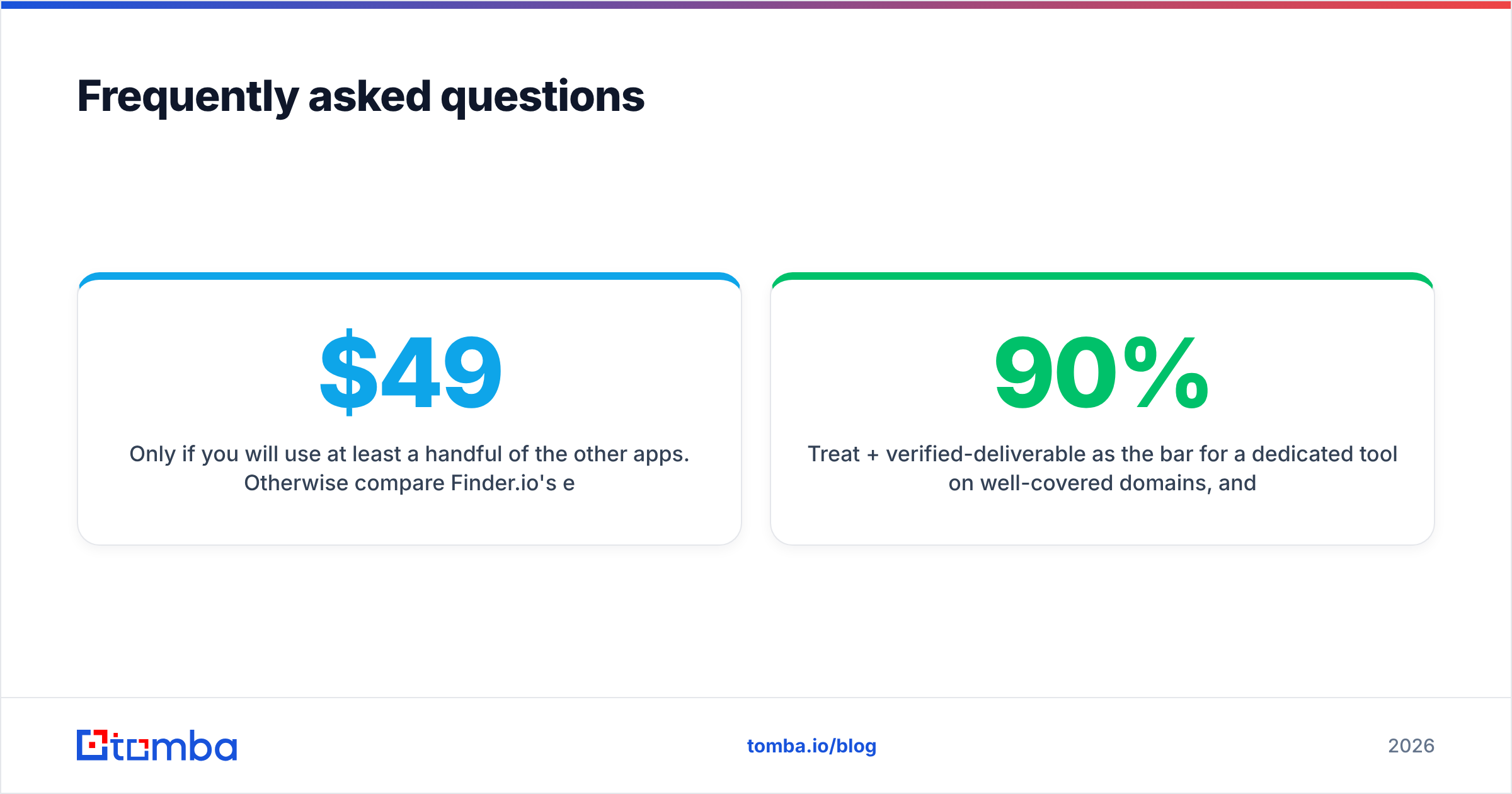
Is the 500apps bundle worth it just for Finder.io? Only if you will use several of the other apps. If not, compare the real per-user cost with a $49–$99/mo standalone finder. Judge on hit rate, not on app count.
What accuracy should I expect in 2026? Set the bar at 90%+ deliverable for a dedicated tool on common domains. Expect less on small firms, catch-all domains, and some regions. A single global accuracy number is marketing.
How do I test both fairly? Take 100 real accounts from your pipeline, not a vendor sample. Run them through each tool. Measure found rate, verified rate, and bounce rate after a send. That settles it in an afternoon.
The bottom line on Dealroom vs Finderio#
They are not rivals. They are two halves of one workflow that teams keep buying as an either-or.
Dealroom wins on account data. It earns its price for funds and for sellers who target startups. Finder.io wins on cost per lookup inside the 500apps bundle. Neither one alone gets a message into an inbox with confidence.
If your gap is the contact layer, start with the Tomba Email Finder. The free tier gives you 25 searches a month, enough for your own 100-account test. Starter is $49/mo. The same data runs through the API, the Chrome extension, and sheet add-ins. Test it on your real pipeline and let the bounce rate decide.
Related guides#
Ready to find emails that actually work?
Join 150,000+ professionals who stopped guessing and started sending. Free credits on signup — no credit card required.
Get the Tomba newsletter
Practical outbound tactics and product updates — once every two weeks.
About the author