Dealroom vs Tomba 2026: Which B2B Data Tool Should You Buy?
Dealroom maps startup funding and investor signals. Tomba finds and verifies the contact behind the company. Here's an honest breakdown of which one your team actually needs — and when you need both.
Dealroom vs Tomba looks like a head-to-head, but it isn't one. One tool finds the companies worth chasing. The other finds the people inside them. Here's how to tell which gap you actually have.
TL;DR
- Dealroom and Tomba are not competitors. Dealroom is a company database: startups, funding rounds, investors, market maps. Tomba is a contact-data platform: email finding, verification, enrichment. One tells you which company to chase. The other tells you who to email.
- Dealroom wins on triggers. If your ICP is "Series A SaaS in Benelux that raised in the last 90 days," its private-market funding depth is hard to match.
- Tomba wins on reach. If you have 400 target domains and no verified contacts, Tomba fixes that directly — from $49/mo, with a free tier of 25 searches.
Two more things worth knowing before you pick:
- Pricing works differently. Tomba publishes its plans. Dealroom quotes you. Contracts usually land in the four- to five-figure range per year, depending on seats and data scope.
- Most teams need a stack, not a tool. A signal source feeds a contact layer, which feeds a sequencer. Buy only one and half the pipeline stays broken.
What is Dealroom and who actually uses it?#
Dealroom.co is an Amsterdam-based private-market intelligence platform. It tracks startups, scaleups, funding rounds, investors, corporate innovation, and market maps. Coverage is deepest in Europe and growing worldwide.
The core dataset is company-level, not person-level. You get founding year, headcount trend, capital raised, round history, investors, valuation estimates, and industry tags. Dealroom also powers many public dashboards you have already seen: government innovation portals, VC market reports, accelerator scouting tools.
Who buys it:
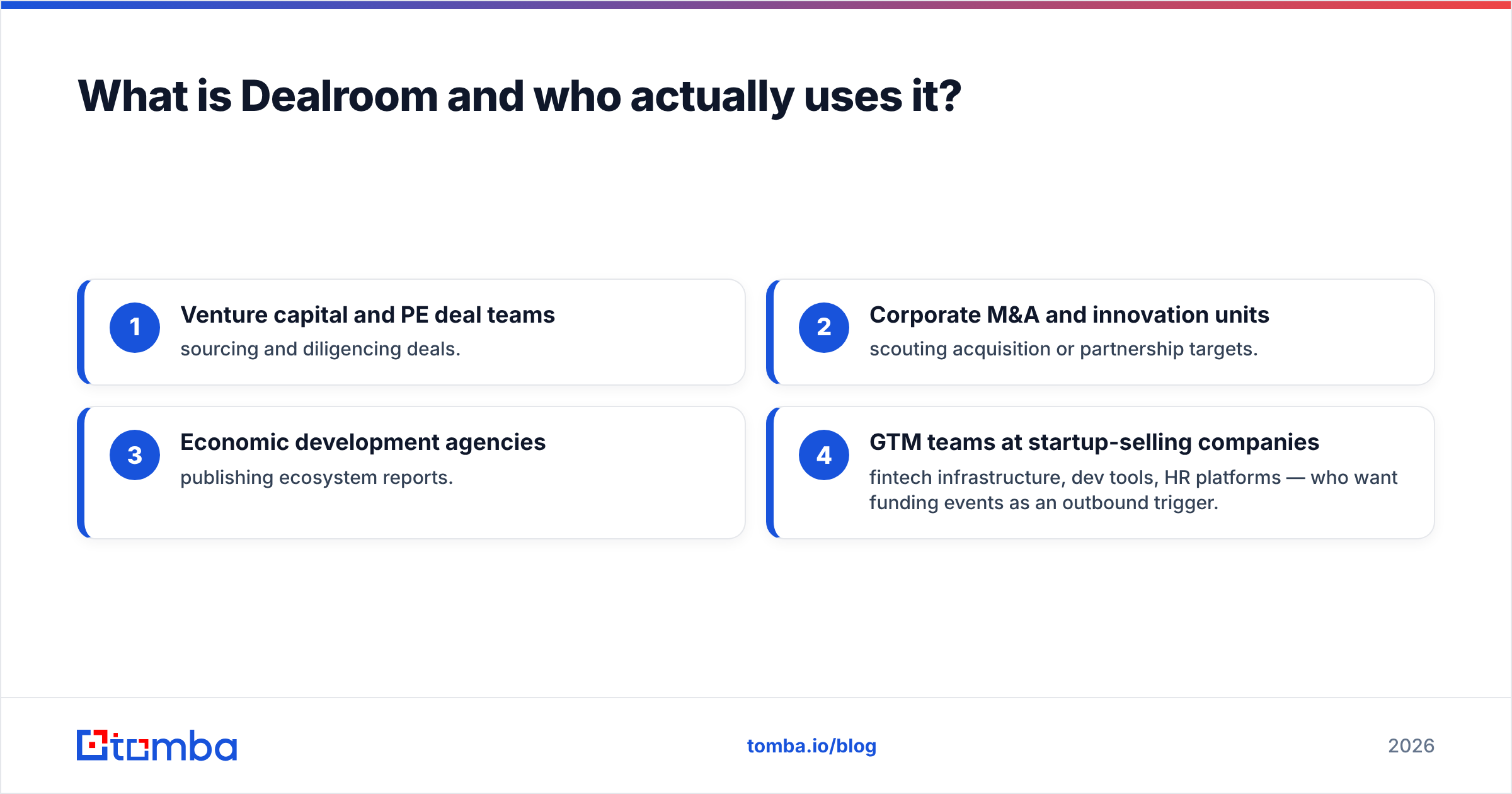
- Venture capital and PE deal teams sourcing and vetting deals.
- Corporate M&A and innovation units scouting acquisition or partnership targets.
- Economic development agencies publishing ecosystem reports.
- GTM teams that sell to startups — fintech infrastructure, dev tools, HR platforms — who use funding events as an outbound trigger.
That fourth group is the only one where a Dealroom vs Tomba question makes sense. Everyone else is comparing apples to a screwdriver.
What is Tomba and what problem does it solve?#
Tomba is a contact-data platform with one job. Give it a company or a person, and it returns a business email. Then it proves the address is deliverable before you send.
The product surface:
- Email finder — name + domain in, professional email out.
- Domain search — every discoverable email pattern and contact at a company, with roles and sources.
- Email verifier — SMTP-level validation with a confidence score, plus a dedicated catch-all verifier for domains that accept everything.
- Data enrichment and phone finder for filling out records you already have.
- Tomba API, CLI, MCP server, Chrome extension, Sheets and Excel add-ins.
Tomba does not tell you that a company just raised a Series B. There is no funding graph, no investor network, no valuation model. That is a deliberate scope choice. It is also why the two tools sit next to each other rather than on top of each other.

Placeholder: side-by-side product screenshots — Dealroom company profile page with funding timeline, next to a Tomba domain-search result showing verified contacts and confidence scores.
Is Dealroom better than Tomba for prospecting?#
Better at targeting. Useless at reaching.
Here is the failure mode. You run a Dealroom search: European B2B SaaS, Series A, raised in the last 60 days, 20-100 employees. You get 140 companies. Great list. Now you need to email the VP of Engineering at each one.
Dealroom gives you the company domain, sometimes founder names, occasionally a LinkedIn URL. It will not reliably give you a verified work email for a non-founder decision-maker at scale. Where contact fields do exist, they are not checked against a live mail server before you send.
So you export those 140 domains and hand them to a contact layer. That is the bulk email finder step. Skip it and you either guess patterns and bounce, or spend 20 minutes per company on manual research.
The reverse gap is just as clear. Tomba will find contacts at all 140 companies. It will not tell you which of them just closed a round and have budget to spend this quarter.
Dealroom vs Tomba: how do they compare feature by feature?#
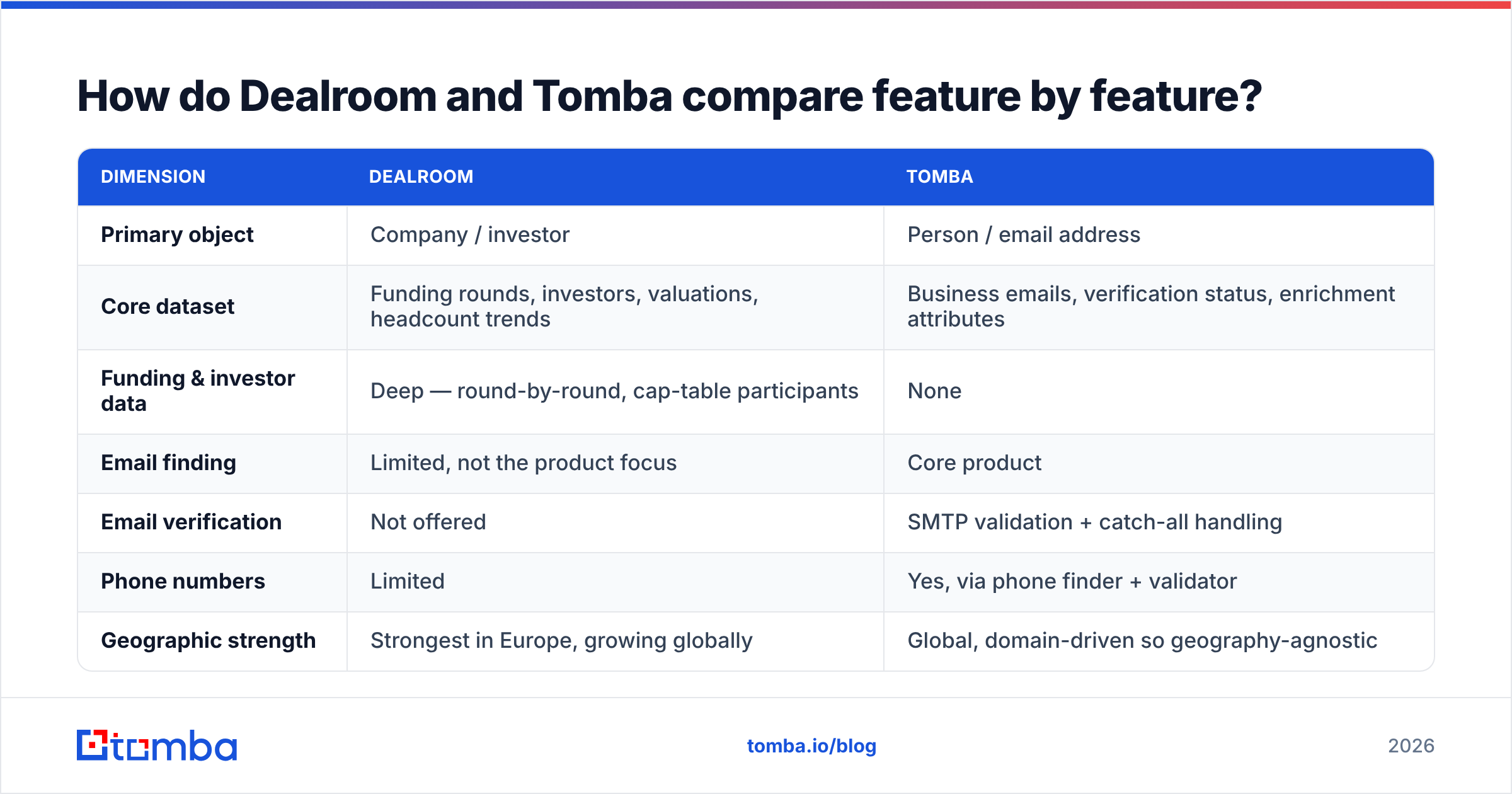
| Dimension | Dealroom | Tomba |
|---|---|---|
| Primary object | Company / investor | Person / email address |
| Core dataset | Funding rounds, investors, valuations, headcount trends | Business emails, verification status, enrichment attributes |
| Funding & investor data | Deep — round-by-round, cap-table participants | None |
| Email finding | Limited, not the product focus | Core product |
| Email verification | Not offered | SMTP validation + catch-all handling |
| Phone numbers | Limited | Yes, via phone finder + validator |
| Geographic strength | Strongest in Europe, growing globally | Global, domain-driven so geography-agnostic |
| Free tier | Limited public search, no export | 25 searches/mo |
| Entry paid price | Quote-based (enterprise contract) | $49/mo Starter |
| API access | Enterprise tier | All paid plans |
| Typical buyer | VC, corp dev, ecosystem analysts | SDR teams, agencies, growth engineers |
| Contract length | Annual, negotiated | Monthly or annual, self-serve |
The table shows the real relationship. Only two rows overlap: email finding and phone numbers. On both, Tomba is the specialist and Dealroom is the incidental provider.
What does each one cost in 2026?#
Tomba publishes everything. Tomba pricing runs:
| Plan | Price | Best for |
|---|---|---|
| Free | $0 (25 searches/mo) | Testing accuracy on your own domains |
| Starter | $49/mo | Solo founders, one SDR, light agency work |
| Growth | $99/mo | Small outbound teams, moderate bulk volume |
| Pro | $249/mo | Multi-seat SDR orgs, heavy API usage |
| Enterprise | Custom | High-volume, compliance requirements, SLAs |
Dealroom does not publish list pricing. It runs a sales-led motion. You book a demo, they scope seats and modules (core database, investor data, API access, dashboards), and you get an annual quote. User reviews on G2 and Capterra put typical contracts in the thousands per year. API and full-export access push that higher.
That gap matters when you evaluate. You can test Tomba in an afternoon on 25 of your own target domains. Testing Dealroom means a sales cycle, a trial, and usually procurement. Budget the evaluation time for it.
Which one should you buy first?#
Buy the tool that unblocks your current bottleneck. Diagnose it honestly.
If the gap is targeting:
- "We don't know who to target." List-building is guesswork, your ICP is fuzzy, and you email companies with no buying trigger. → Start with a signal source. Dealroom fits if you sell to funded startups. Pick something narrower and cheaper if you don't.
If the gap is reaching people:
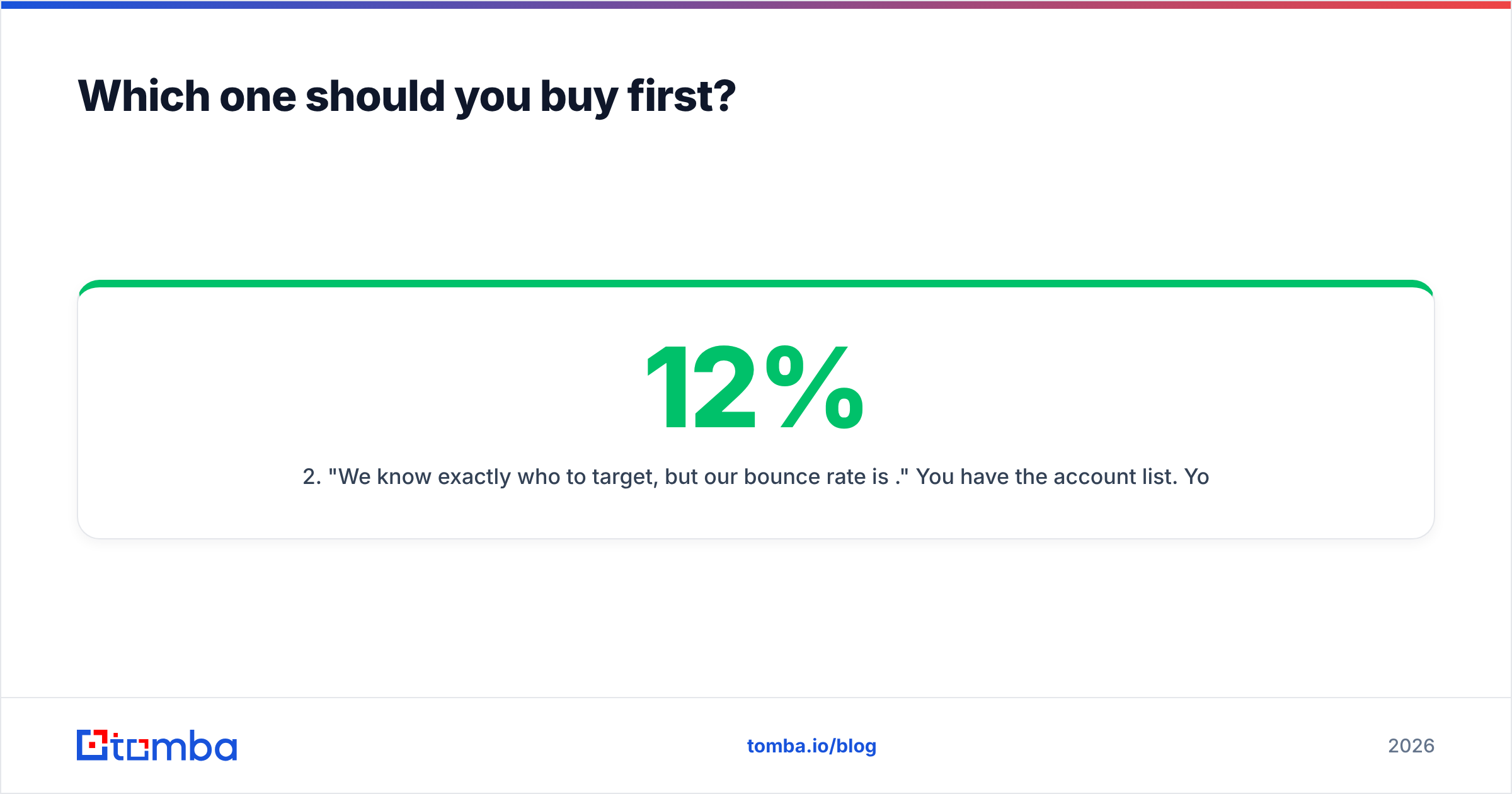
- "We know who to target, but 12% of our email bounces." You have the account list. You are guessing at
firstname.lastname@. → Start with a contact layer. This is a $49-$99/mo fix, not a $10k/yr one. - "We're burning SDR hours on manual research." Reps toggle between LinkedIn, company sites, and a spreadsheet. → Add automation. The Tomba API or the Google Sheets add-on removes most of that work.
- "Our CRM is full of stale records." Half your contacts left their companies. → Enrich and re-verify each quarter. Neither funding data nor fresh lists fix rot.
- "We need both, but budget is one line item." Start with the contact layer. It costs far less, and it makes every list you already own usable. Add the signal source once outbound converts.
That order is a sequencing argument, not a Tomba pitch. A perfect target list with unverified emails books zero meetings. An average list with verified emails books some. Fix deliverability first, then optimize targeting.
What about using them together?#
Most teams that sell to funded startups end up here. The pipeline looks like this:
Step 1 — Trigger. Pull companies from Dealroom that match your ICP and raised recently. Export the domains.
Step 2 — Contact discovery. Feed those domains into domain search or the bulk endpoint. Filter by department and seniority, so you get the VP of Engineering and not the office manager.
Step 3 — Verification. Run every address through the email verifier. Drop anything below your confidence threshold. Send catch-all domains to a separate, low-volume sequence instead of your main pool. Catch-alls inflate your apparent deliverability while quietly hurting sender reputation.
Step 4 — Enrich and route. Push records into your CRM with the HubSpot integration or Salesforce integration. Stamp the funding event as a custom property so reps can use it in the opener.
Step 5 — Sequence. Use whatever sender you already have. Keep the funding trigger in the first line. It is the only reason the email is not cold.
Placeholder: annotated screenshot of a CRM record showing a funding-round property populated from a signal source alongside a verified-email confidence badge.
Step 3 is where this pipeline usually breaks. Teams pull a great list, find emails, and send without verifying, because verification feels like an optional extra. It is not. Email deliverability drops fast once your bounce rate passes roughly 3%. Mailbox providers are slow to forgive.
Are there alternatives worth considering on either side?#
On the signal side, Dealroom's closest peers are Crunchbase, PitchBook, and Tracxn. Crunchbase covers the US more broadly but Europe less deeply. PitchBook has richer financials at a much higher price. If you only need to know that a company raised, a funding-news feed costs a fraction of a full platform.
On the contact side, the field is crowded: Apollo, RocketReach, Hunter, Findymail, and BookYourData. Each one optimizes for something different. Apollo bundles a sequencer with its database. Tomba optimizes for verification accuracy and developer access. BookYourData sells pre-built, pay-as-you-go lists with no subscription, which suits teams that would rather buy a list than run searches.
If you are weighing an all-in-one platform against a focused contact layer, the Apollo alternative comparison covers that trade-off in detail.
One caveat applies to every contact-data vendor, Tomba included. Coverage varies by region and company size. Enterprise contacts in North America and Western Europe are well covered across the market. Companies under 20 people in emerging markets are thin everywhere. Test on your ICP before you commit. That is exactly what a free tier is for. Tomba documents where its data comes from if procurement asks about sourcing.
Dealroom vs Tomba: what's the verdict?#
They solve different halves of the same problem, so the answer depends on your gap:
- Choose Dealroom if your edge is spotting companies before your competitors do, and you sell into the European startup ecosystem. The funding graph is hard to replicate. It is worth an enterprise contract when funding events drive your pipeline.
- Choose Tomba if your lists exist but your contact data doesn't — or bounces. It is cheap next to an SDR salary, self-serve enough to test today, and API-first enough to automate.
- Choose both if you sell to funded startups at real volume. They compose cleanly. Neither replaces the other.
Do not buy an expensive intelligence platform and expect it to solve your contact-data problem. Do not buy a contact tool and expect it to tell you which accounts have budget. That mismatch is where most "the tool didn't work" complaints come from.
Start with Tomba Email Finder if your gap is contacts, not targets. The free tier gives you 25 searches. Run your real target list through it and check the hit rate and confidence scores on your own ICP first. If the numbers hold up, the $49/mo Starter plan covers most single-rep motions. The API is included on every paid tier when you are ready to automate the whole chain.
Related guides#
Ready to find emails that actually work?
Join 150,000+ professionals who stopped guessing and started sending. Free credits on signup — no credit card required.
Get the Tomba newsletter
Practical outbound tactics and product updates — once every two weeks.
About the author