DealSignal vs EasyLeadz (2026): Which B2B Data Tool Wins
DealSignal sells verified, on-demand B2B records to enterprise RevOps teams. EasyLeadz sells direct dials by the credit. They solve different problems — here's which one actually fits your pipeline, and when neither does.
TL;DR
- DealSignal is an enterprise B2B data platform. You define an ICP, and it builds and re-verifies the list on demand. Pricing is quote-based, usually an annual contract.
- EasyLeadz (the "Mr. E" extension) is a credit-based lookup tool. It is known for direct dial phone numbers, with strong coverage in India and APAC. It is self-serve and cheap to start.
- In a DealSignal vs EasyLeadz matchup, the two are not real rivals. DealSignal competes with ZoomInfo-class platforms. EasyLeadz competes with browser lookup extensions.
- If your bottleneck is email accuracy at a steady cost, neither is the natural pick. A finder-plus-verifier stack costs far less than an enterprise data contract.
- Choose by failure mode. Pick DealSignal if stale CRM records hurt your campaigns. Pick EasyLeadz if you cold call APAC. Pick an email finder if you mostly need work emails that land.
What are DealSignal and EasyLeadz?#
DealSignal calls itself a B2B data platform, not a static database. The pitch is simple. Instead of licensing a frozen list of 200 million contacts, you name the accounts and personas you want. DealSignal then builds and verifies those records on demand, using machine research plus human checks.
The output lands in Salesforce, HubSpot, Marketo, or a CSV. Old CRM records can be re-checked and enriched on a schedule.
That model has a clear buyer. Think of a RevOps lead who owns 50,000 records, watches deliverability drop each quarter, and can defend a five-figure line item.
EasyLeadz is a different animal. Its main product is the Mr. E Chrome extension. You open a LinkedIn profile, click the icon, and get a direct dial number, often with an email.
Credits are spent per successful reveal. Plans are self-serve, and a free allowance lets you test. Its reputation — visible in G2 reviews — rests on mobile coverage in markets where Western vendors are thin. India, Southeast Asia, and the Middle East are the strong spots.
So the honest framing of DealSignal vs EasyLeadz is not "which is better." It is "which gap in your funnel are you paying to fix?"
How do DealSignal and EasyLeadz compare at a glance?#
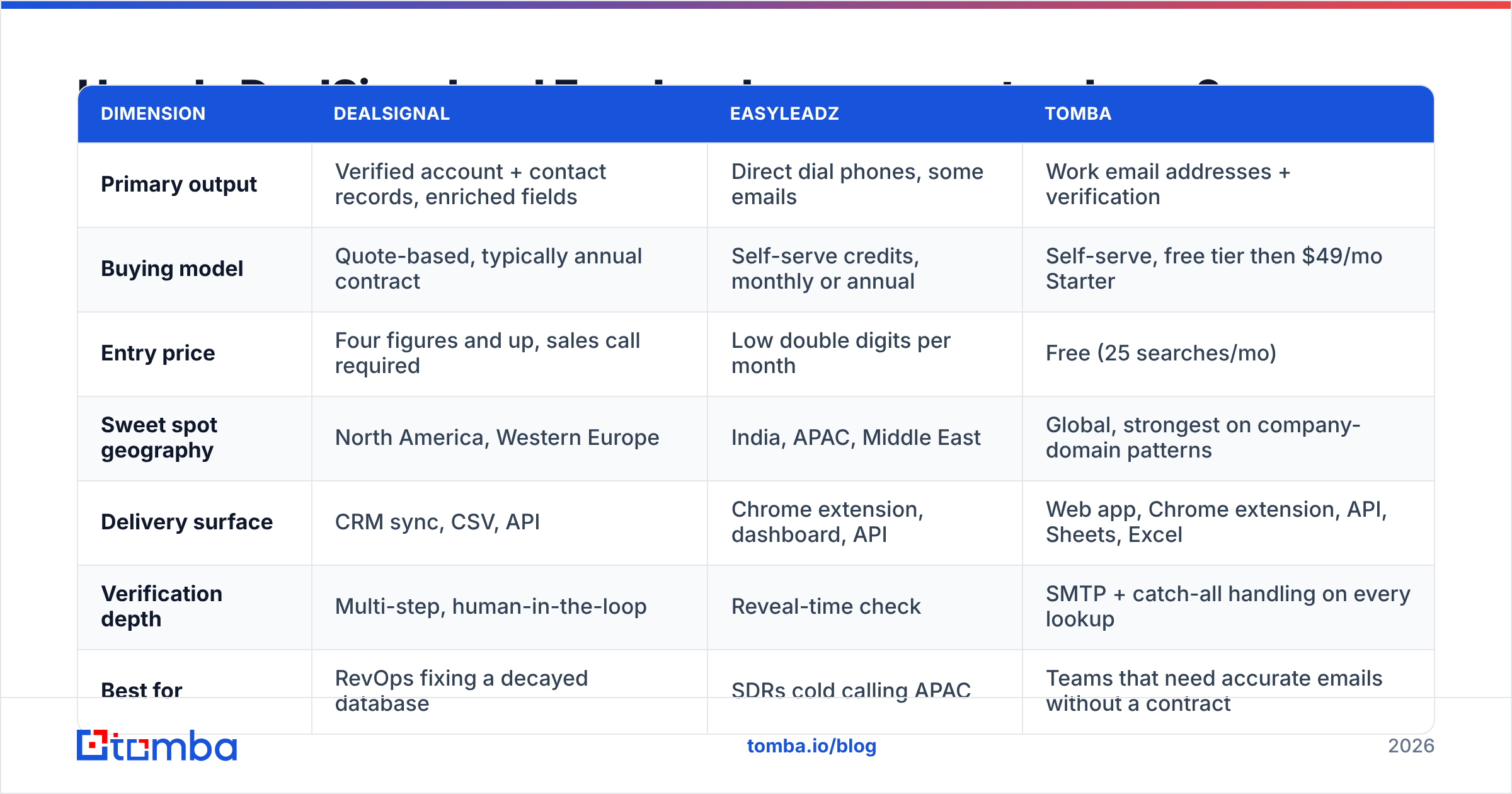
| Dimension | DealSignal | EasyLeadz | Tomba |
|---|---|---|---|
| Primary output | Verified account + contact records, enriched fields | Direct dial phones, some emails | Work email addresses + verification |
| Buying model | Quote-based, typically annual contract | Self-serve credits, monthly or annual | Self-serve, free tier then $49/mo Starter |
| Entry price | Four figures and up, sales call required | Low double digits per month | Free (25 searches/mo) |
| Sweet spot geography | North America, Western Europe | India, APAC, Middle East | Global, strongest on company-domain patterns |
| Delivery surface | CRM sync, CSV, API | Chrome extension, dashboard, API | Web app, Chrome extension, API, Sheets, Excel |
| Verification depth | Multi-step, human-in-the-loop | Reveal-time check | SMTP + catch-all handling on every lookup |
| Best for | RevOps fixing a decayed database | SDRs cold calling APAC | Teams that need accurate emails without a contract |
| Contract friction | High — procurement, legal, annual term | Low | Low — cancel any time |
The table makes the DealSignal vs EasyLeadz split clear. DealSignal is a database program. EasyLeadz is a per-lookup tool. The third column is there because most teams asking this question have an email problem in disguise.
Whose data is actually more accurate?#
Accuracy claims mean little without a definition. So pin down what you measure.
DealSignal verifies at build time. It does not ship you a record scraped 14 months ago. That is a real structural edge. A record verified this week beats a record from a stale index, no matter how big that index is.
The trade-off is speed and cost. On-demand research is slower and pricier than a database query. Coverage on niche personas or small firms can come back thin.
EasyLeadz measures accuracy mostly by phone connect rate. For Indian and APAC mobile numbers, users report hit rates that Western vendors do not match. For North American and European emails, results are patchier.
Credit burn matters too. Learn exactly when a credit is spent, and whether weak results still charge you.

Three things to test before you trust anyone's number, including ours:
- Bounce rate on a live send. Vendor stats come from their sample, not yours. Pull 200 records for your real ICP and send.
- Catch-all handling. Any vendor can claim 98% accuracy if it marks catch-all domains as valid. Ask how catch-alls are labeled. Then test with a catch-all verifier.
- Coverage on your segment. A vendor strong on US SaaS VPs may be useless on German plant managers. Segment coverage beats total database size.
Run that test with both vendors on the same 200-row list. The debate ends there.
What does DealSignal vs EasyLeadz actually cost?#
This is where the two split hardest. It is also where buyers get surprised.
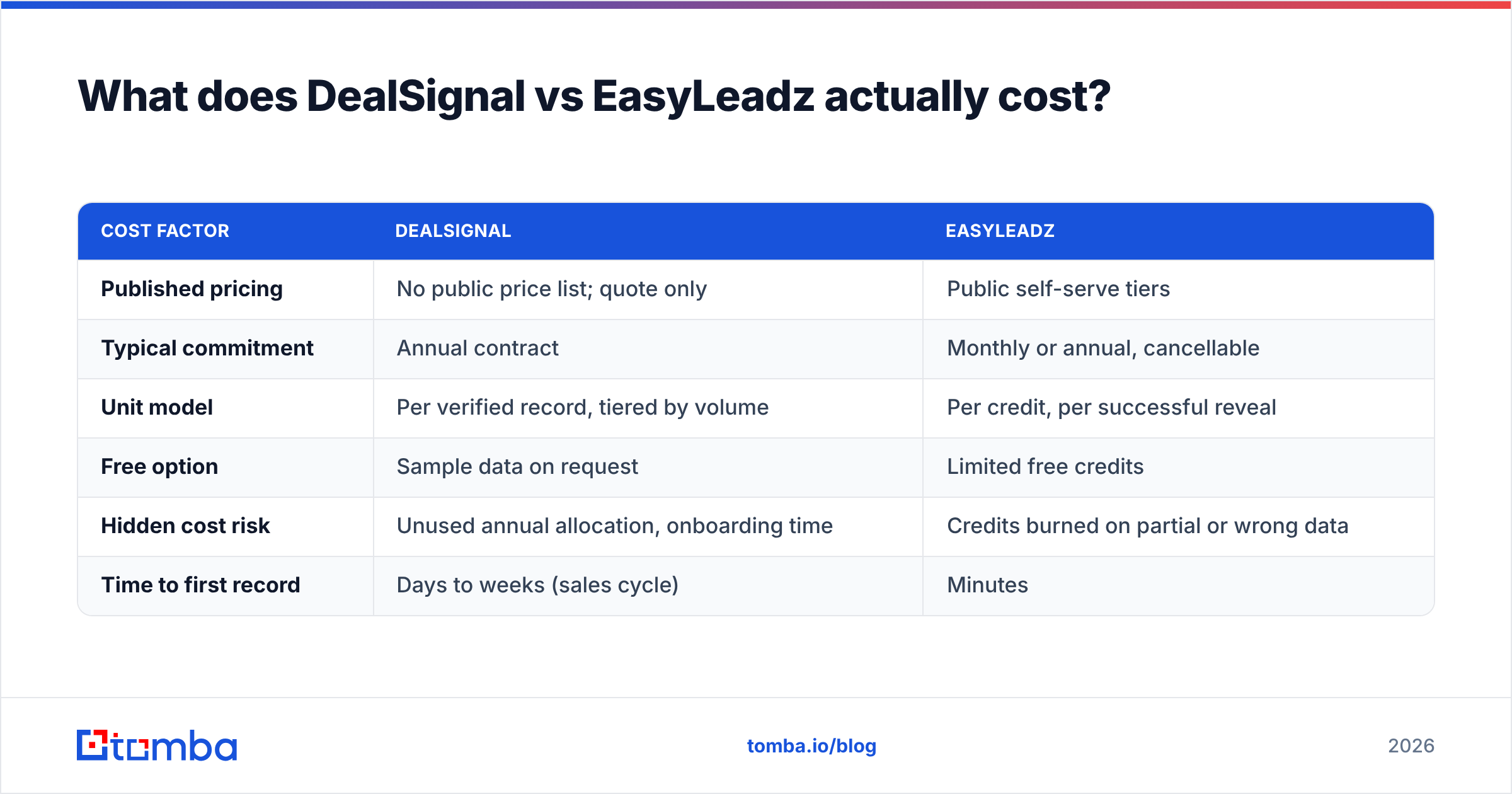
| Cost factor | DealSignal | EasyLeadz |
|---|---|---|
| Published pricing | No public price list; quote only | Public self-serve tiers |
| Typical commitment | Annual contract | Monthly or annual, cancellable |
| Unit model | Per verified record, tiered by volume | Per credit, per successful reveal |
| Free option | Sample data on request | Limited free credits |
| Hidden cost risk | Unused annual allocation, onboarding time | Credits burned on partial or wrong data |
| Time to first record | Days to weeks (sales cycle) | Minutes |
Neither vendor publishes a like-for-like number. So compare them on cost per usable record, not sticker price. A $12,000 annual contract that yields 20,000 sendable records costs $0.60 each. A cheap credit pack is no bargain if a third of reveals come back blank.
Transparent per-seat tooling removes the math. Tomba pricing starts free at 25 searches per month. Starter is $49/mo, Growth $99/mo, and Pro $249/mo, with Enterprise on request. There is no procurement cycle and no annual lock. You can cancel the month a campaign ends.

Which one fits your workflow?#
Tools that do not sit where your reps work get dropped in six weeks. Map the surface honestly:
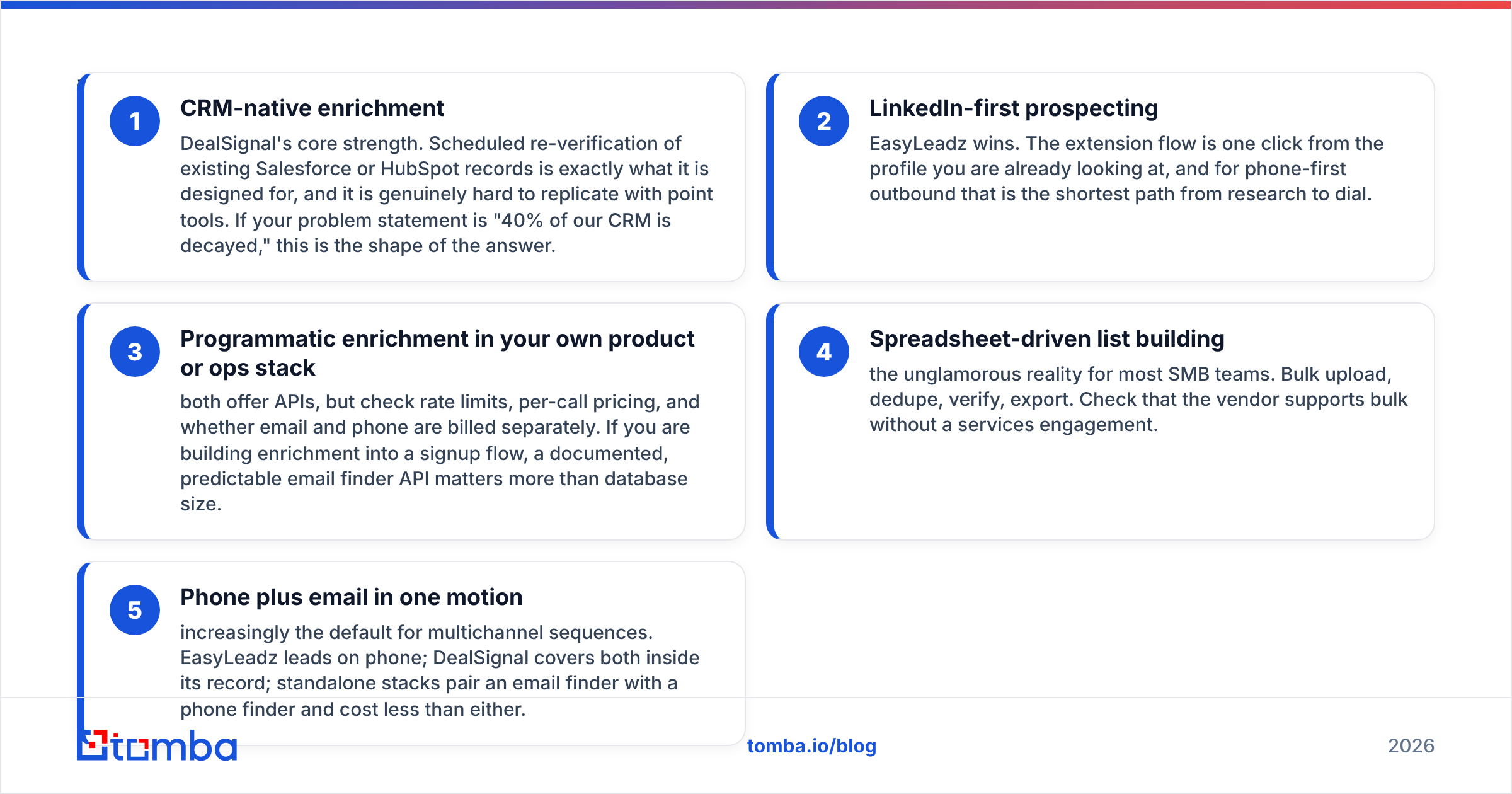
- CRM-native enrichment — DealSignal's core strength. Scheduled re-checks of Salesforce or HubSpot records are what it was built for. If 40% of your CRM is decayed, this is the shape of the fix.
- LinkedIn-first prospecting — EasyLeadz wins. The extension is one click from the profile you already have open. For phone-first outbound, that is the shortest path to a dial.
- Programmatic enrichment — both offer APIs. Check rate limits, per-call pricing, and whether email and phone bill separately. For a signup flow, a documented email finder API matters more than database size.
- Spreadsheet list building — the daily reality for most SMB teams. Upload, dedupe, verify, export. Check that bulk work does not need a services contract.
- Phone plus email in one motion — now the default for multichannel. EasyLeadz leads on phone. DealSignal covers both. A standalone stack pairs an email finder with a phone finder for less than either.
Where does each tool fall short?#
DealSignal's limits:
- No public pricing means no fast test. You cannot try an idea Tuesday and buy Wednesday.
- The on-demand model can return sparse results for narrow or non-Western personas. You may still pay for the research cycle.
- Annual deals punish seasonal demand. Need 30,000 records in Q1 and 2,000 in Q3? You overpay for three quarters.
- It is overkill for a three-person sales team. The setup work alone outweighs the value.
EasyLeadz's limits:
- Coverage outside its core regions is uneven. Test your market before you commit budget.
- Credits burned on weak or partial results are the most common complaint. Read the credit policy closely.
- It is a lookup tool, not a database program. It has no real answer to "re-verify my 80,000 stale CRM records."
- Email checks are not its focus. Pair it with a dedicated email verifier if deliverability matters.
Both critiques share one root cause. Each product is very good at the job it was built for, and average outside it. The buying mistake is stretching one to cover the other.
Is there a better middle ground for email-first teams?#
Yes, if your real constraint is email accuracy rather than database governance.
Most teams weighing DealSignal vs EasyLeadz want an answer to a simpler question. How do we get correct work emails for a defined list, without an enterprise contract or wasted credits? That problem is solved, and it does not need a platform.

The lean stack looks like this:
- Find — domain search plus name lookup, built from company domains you already know.
- Verify — SMTP checks with clear catch-all labels, run before every send.
- Enrich — add phone, title, and company fields only where you will use them.
- Automate — push into your CRM or sequencer by API, Sheets, or a native integration.
That stack runs on a self-serve plan for a fraction of enterprise data spend. It also fails safe. If coverage on a segment is poor, you learn it in an afternoon, not after signing.
Some teams do need a full platform. If you run account-based marketing across 5,000 target accounts with intent signals and territory routing, DealSignal-class tooling earns its price. Peers like BookYourData serve the bulk-list end of that market well.
DealSignal vs EasyLeadz: which should you choose in 2026?#
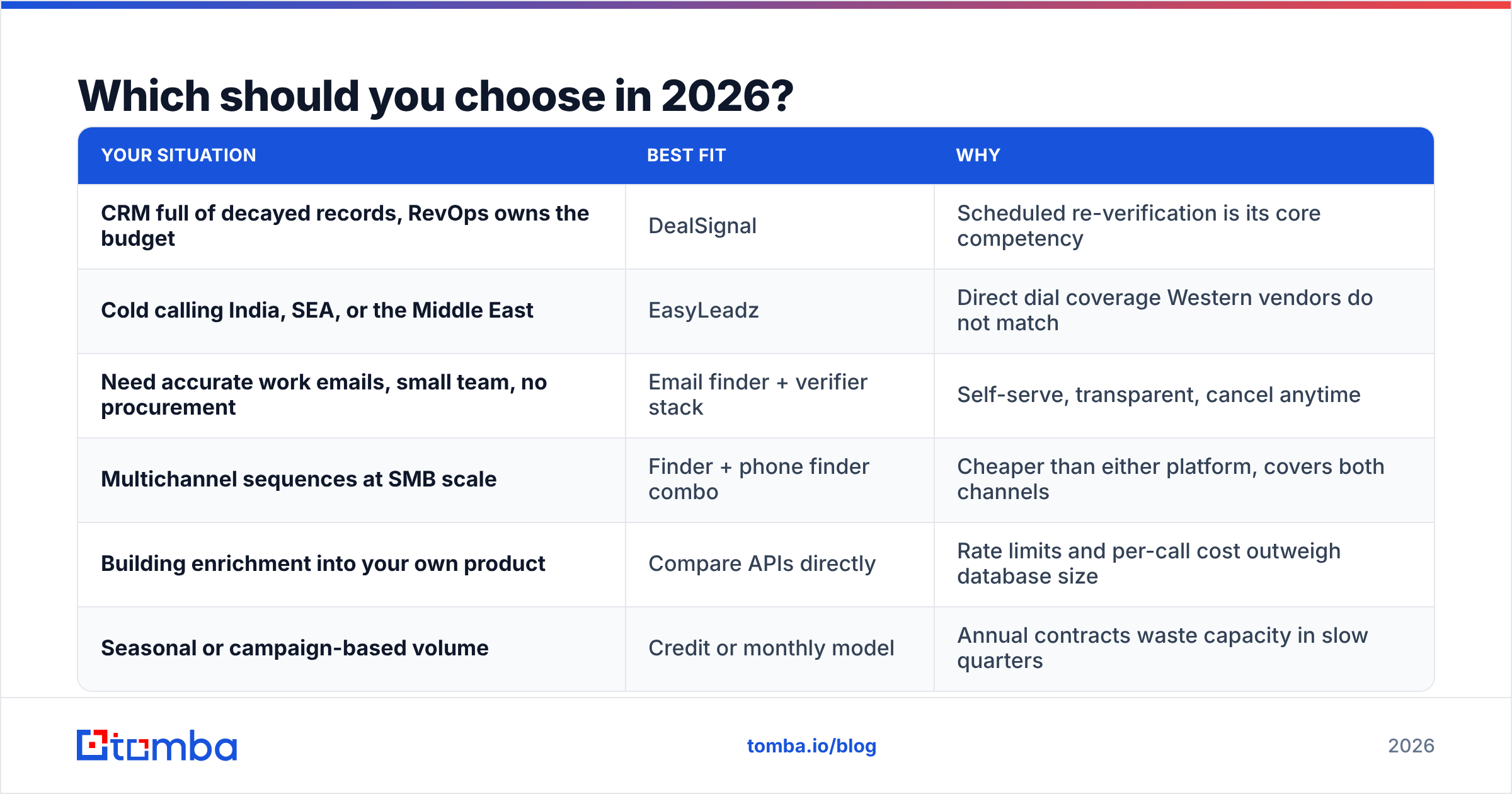
Match the tool to your main failure mode:
| Your situation | Best fit | Why |
|---|---|---|
| CRM full of decayed records, RevOps owns the budget | DealSignal | Scheduled re-verification is its core competency |
| Cold calling India, SEA, or the Middle East | EasyLeadz | Direct dial coverage Western vendors do not match |
| Need accurate work emails, small team, no procurement | Email finder + verifier stack | Self-serve, transparent, cancel anytime |
| Multichannel sequences at SMB scale | Finder + phone finder combo | Cheaper than either platform, covers both channels |
| Building enrichment into your own product | Compare APIs directly | Rate limits and per-call cost outweigh database size |
| Seasonal or campaign-based volume | Credit or monthly model | Annual contracts waste capacity in slow quarters |
One rule applies to everyone. Run a 200-record bake-off before you sign anything. Same list, same ICP, same week, same sequencer. Measure bounce rate, connect rate, and how many records you had to throw out. The test costs a day. It often overturns the vendor chart, including this one.
Ready to test email accuracy on your own list?#
If your real bottleneck is work emails that deliver, start with the Tomba Email Finder. Find contacts by domain, name, or company. Verify them before you send. Export straight into your CRM. There is no sales call and no annual commitment.
The free tier gives you 25 searches a month, enough for the bake-off above. Starter is $49/mo when you are ready to scale. Run the same 200 records through DealSignal, EasyLeadz, and Tomba, then let the bounce rate settle your DealSignal vs EasyLeadz decision.
Related guides#
Ready to find emails that actually work?
Join 150,000+ professionals who stopped guessing and started sending. Free credits on signup — no credit card required.
Get the Tomba newsletter
Practical outbound tactics and product updates — once every two weeks.
About the author