DealSignal vs FindThatLead: Which B2B Data Tool Wins in 2026?
DealSignal sells enterprise-grade, on-demand verified B2B data. FindThatLead sells cheap, self-serve email discovery. They solve different problems at wildly different prices — here's which one actually fits your team.
Choosing between DealSignal vs FindThatLead comes down to one question: do you buy data on a contract, or on a credit card? This guide settles the DealSignal vs FindThatLead decision on price, accuracy, coverage, and team fit. Start with the TL;DR, then use the tables.
TL;DR
- DealSignal is an enterprise B2B data platform. You get custom-built contact lists, verification at delivery, annual contracts, and a sales call before you see a price.
- FindThatLead is a self-serve email finder. Prospect by domain, name, or LinkedIn, export CSVs, and run small cold email campaigns from about $49/mo.
- They are not really competitors. DealSignal competes with ZoomInfo and Clearbit. FindThatLead competes with Hunter, Snov.io, and Tomba.
- Pick DealSignal if you need 50k+ enriched records with firmographic and intent layers, and you have budget approval. Pick FindThatLead if you need a few thousand verified emails a month without a procurement cycle.
- Want DealSignal-grade verification at FindThatLead-grade prices? A finder plus verifier stack (Tomba, Hunter, Findymail) is usually the honest third answer.
What are DealSignal and FindThatLead?#
DealSignal is a B2B data platform with one core promise. Your contact data is verified when it is delivered, not scraped once and left to go stale. You define an ideal customer profile: industry, headcount, revenue band, job titles, tech stack. DealSignal then builds the list, checks each record against several sources, and returns a confidence score per contact. It markets accuracy in the high 90s and a pool of more than 100 million contacts. Buying is enterprise-shaped. You talk to a rep. You sign an annual deal. Prices are quoted, never published.
FindThatLead sits at the other end. It is a self-serve prospecting tool built in Barcelona. Paste a domain and get the emails behind it. Upload a CSV of names and companies and get addresses back. Pull contacts off LinkedIn with the Chrome extension. Unlike most finders, it can also send cold email from the same product. You sign up with a card, you get credits, you export. No sales call. No annual commit.
That difference in shape matters more than any feature checklist. One is a data supply contract. The other is a tool you expense.
DealSignal vs FindThatLead: how do they differ?#
Five structural differences drive almost every buying decision here:
- Buying motion. DealSignal needs a demo and a quote. FindThatLead is instant self-serve checkout. If you need contacts this afternoon, that alone decides it.
- Verification timing. DealSignal verifies records on demand, as your list is built. FindThatLead verifies at lookup time. Quality holds up on standard corporate MX and slips on catch-all domains.
- Data breadth. DealSignal ships firmographics, technographics, org hierarchy, and intent signals with the email. FindThatLead ships the contact — name, email, company, sometimes role — and expects your CRM to hold the rest.
- Volume economics. DealSignal's cost per record drops as annual volume rises. FindThatLead's credits are cheap, but the ceiling is low. Large enrichment jobs get awkward fast.
- Sending. FindThatLead bundles a cold email sender and the "Scrab.in" LinkedIn companion. DealSignal has no sending layer. It feeds your Outreach, Salesloft, or Salesforce stack.

DealSignal vs FindThatLead: side-by-side comparison#
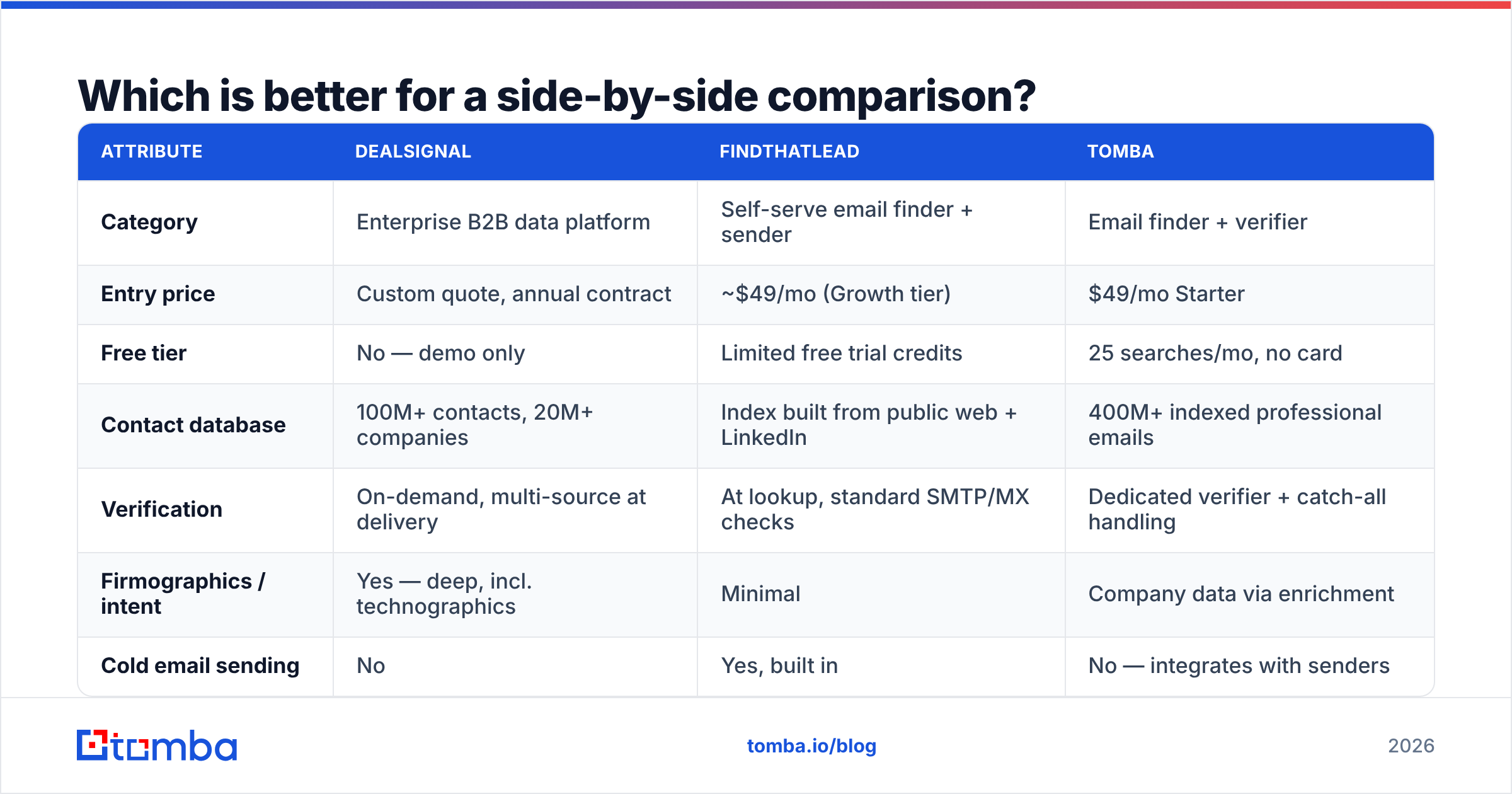
Here is the head-to-head, as clearly as it can be drawn. Prices below reflect public plans at the time of writing. DealSignal publishes no rates, so treat any figure you find online as an estimate and confirm it with the vendor.
| Attribute | DealSignal | FindThatLead | Tomba |
|---|---|---|---|
| Category | Enterprise B2B data platform | Self-serve email finder + sender | Email finder + verifier |
| Entry price | Custom quote, annual contract | ~$49/mo (Growth tier) | $49/mo Starter |
| Free tier | No — demo only | Limited free trial credits | 25 searches/mo, no card |
| Contact database | 100M+ contacts, 20M+ companies | Index built from public web + LinkedIn | 400M+ indexed professional emails |
| Verification | On-demand, multi-source at delivery | At lookup, standard SMTP/MX checks | Dedicated verifier + catch-all handling |
| Firmographics / intent | Yes — deep, incl. technographics | Minimal | Company data via enrichment |
| Cold email sending | No | Yes, built in | No — integrates with senders |
| LinkedIn extension | Via integrations | Yes (Chrome + Scrab.in) | Yes |
| API access | Yes, enterprise tiers | Yes, on higher plans | Yes, all paid plans |
| Bulk processing | Managed list builds | CSV bulk, credit-limited | Bulk finder + verifier |
| Best fit | 50+ seat revenue orgs | Solo founders, small agencies | SMB to mid-market outbound teams |

Two things jump out of that table. First, the free tier row matters. DealSignal's demo gate means you cannot test data quality on your own accounts before you commit. That is the single most important test any data vendor should pass.
Second, FindThatLead's bundled sender cuts both ways. It is a real convenience for a one-person outbound motion. It becomes a liability at scale, because a sender built as a side feature rarely keeps pace with dedicated platforms like Instantly or Smartlead.
DealSignal vs FindThatLead: whose data is more accurate?#
DealSignal wins on raw accuracy, and it should. That is the whole product thesis, and it is what the price premium buys. On-demand verification means a record built for you on Tuesday was checked on Tuesday, not in a quarterly refresh. For a 20,000-record ABM list going into Salesforce, that matters. Bad data there creates reporting damage you feel for quarters.
FindThatLead's accuracy is fair for the price band, but it swings by domain type. Standard corporate domains with clear patterns resolve well. Catch-all domains are the weak spot, and they now cover a large slice of mid-market companies. Cheap finders tend to hand back guesses dressed as results. If your list leans toward catch-all setups, run every export through a dedicated email verifier before it reaches your sequencer. That holds no matter which tool you buy.

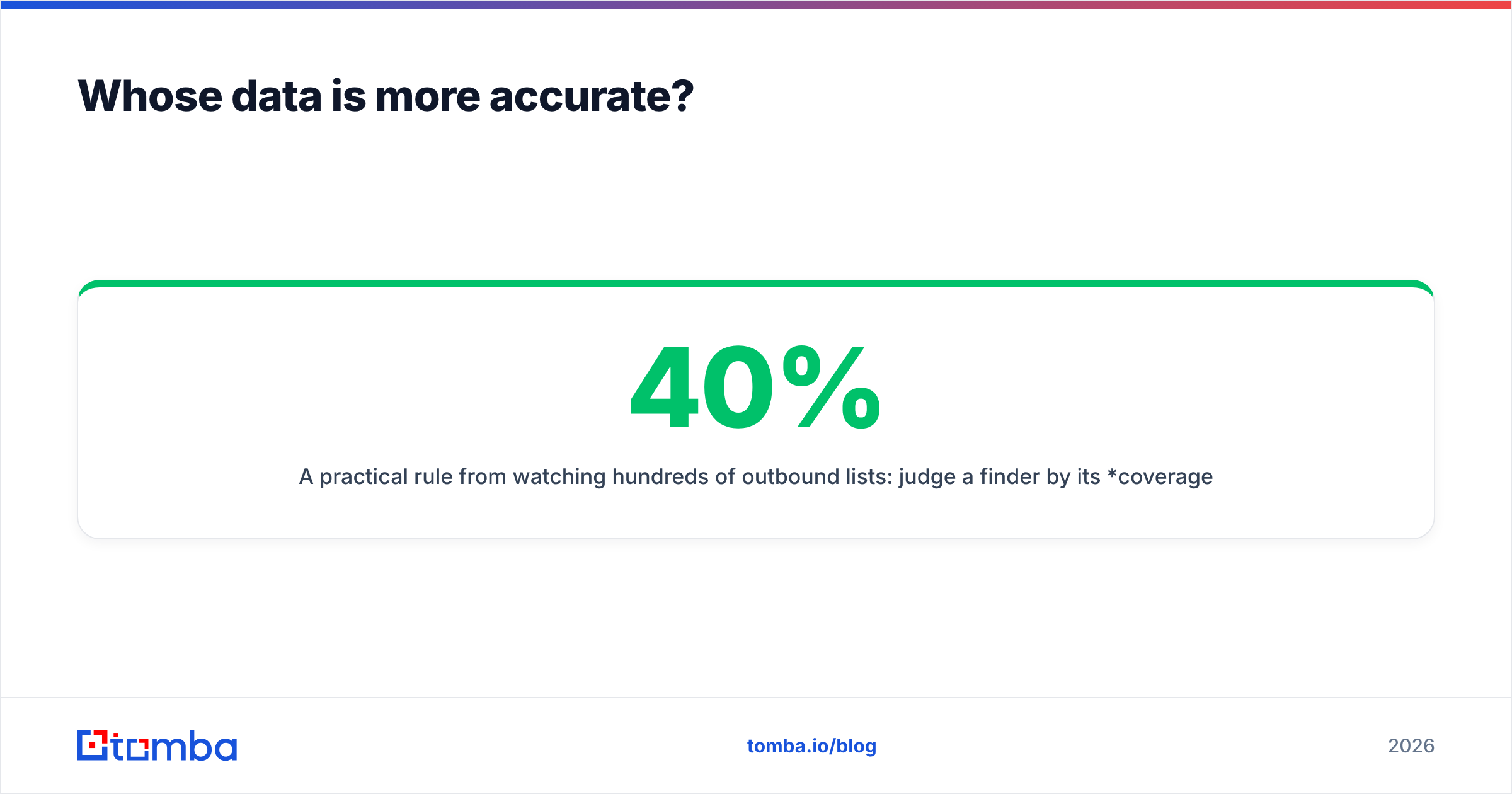
One practical rule, drawn from watching hundreds of outbound lists: judge a finder by its coverage-adjusted accuracy, not its headline number. A tool that returns emails for 40% of your list at 98% accuracy can be worse than one returning 70% at 94%. The first leaves you to research the other 60% by hand.
So ask both vendors for a blind test on 500 of your own target accounts. Score hit rate and bounce rate together. Any vendor that refuses a sample test is telling you something.
DealSignal vs FindThatLead: what does each one cost?#
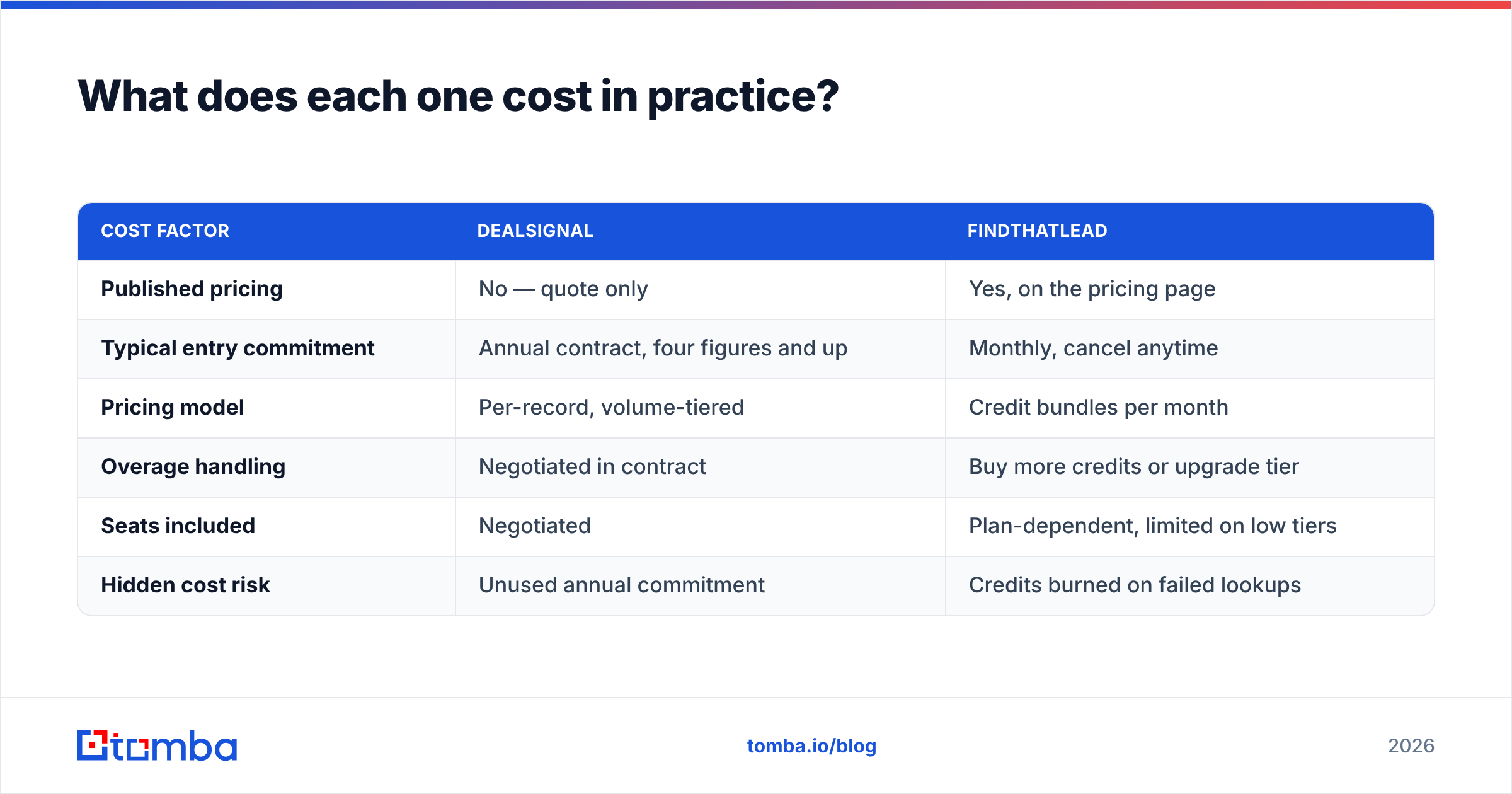
| Cost factor | DealSignal | FindThatLead |
|---|---|---|
| Published pricing | No — quote only | Yes, on the pricing page |
| Typical entry commitment | Annual contract, four figures and up | Monthly, cancel anytime |
| Pricing model | Per-record, volume-tiered | Credit bundles per month |
| Overage handling | Negotiated in contract | Buy more credits or upgrade tier |
| Seats included | Negotiated | Plan-dependent, limited on low tiers |
| Hidden cost risk | Unused annual commitment | Credits burned on failed lookups |
FindThatLead's public tiers have run about $49/mo for a Growth plan. Higher credit volumes step up to a few hundred a month. Check the pricing page before you buy, since credit allocations move. DealSignal publishes nothing. That is normal for its category, but it stretches your evaluation by weeks.

The hidden cost most teams miss is credit burn. On some credit-based finders, a lookup that returns nothing still spends budget. On others it does not. Read that clause closely. It is the difference between a $49 plan and a real $49 plan.
Who should choose DealSignal?#
Choose DealSignal when three things are true at once:
- You buy data as a contract, not a subscription. You have a procurement process, an annual budget line, and someone who manages vendors.
- You need more than an email. Intent signals, technographics, org charts, and account hierarchy are what you are paying for. If you only need the address, you are overpaying by a wide margin.
- Data decay is an operational problem. You run a large CRM base where stale records cause routing errors, misfired campaigns, and shaky forecasts. Re-verifying an existing database is DealSignal's strongest use case, arguably stronger than net-new list building.
Where DealSignal is the wrong call: any team that needs to move this week, any team under about ten reps, and any team whose main workflow is "I found a company on LinkedIn, get me the VP of Marketing's email." That last one is a finder job, not a platform job.
Who should choose FindThatLead?#
Choose FindThatLead when you run lean and want one tool for find-and-send:
- Solo founders and two-person GTM teams doing 500–3,000 contacts a month.
- Small agencies running client prospecting at modest volumes on a per-project budget.
- Anyone who wants the sender bundled and has no dedicated cold email platform yet.
Its ceiling is real, though. Once you pass a few thousand contacts a month, the bundled sender starts to hold you back. The same happens once deliverability becomes a discipline rather than an afterthought.
At that point you want a specialist stack: dedicated finder, dedicated verifier, dedicated sender. That is the standard setup at scale, and it costs less than it sounds. Compare notes on G2 first. User reviews on credit burn and catch-all handling tell you more than any vendor page.
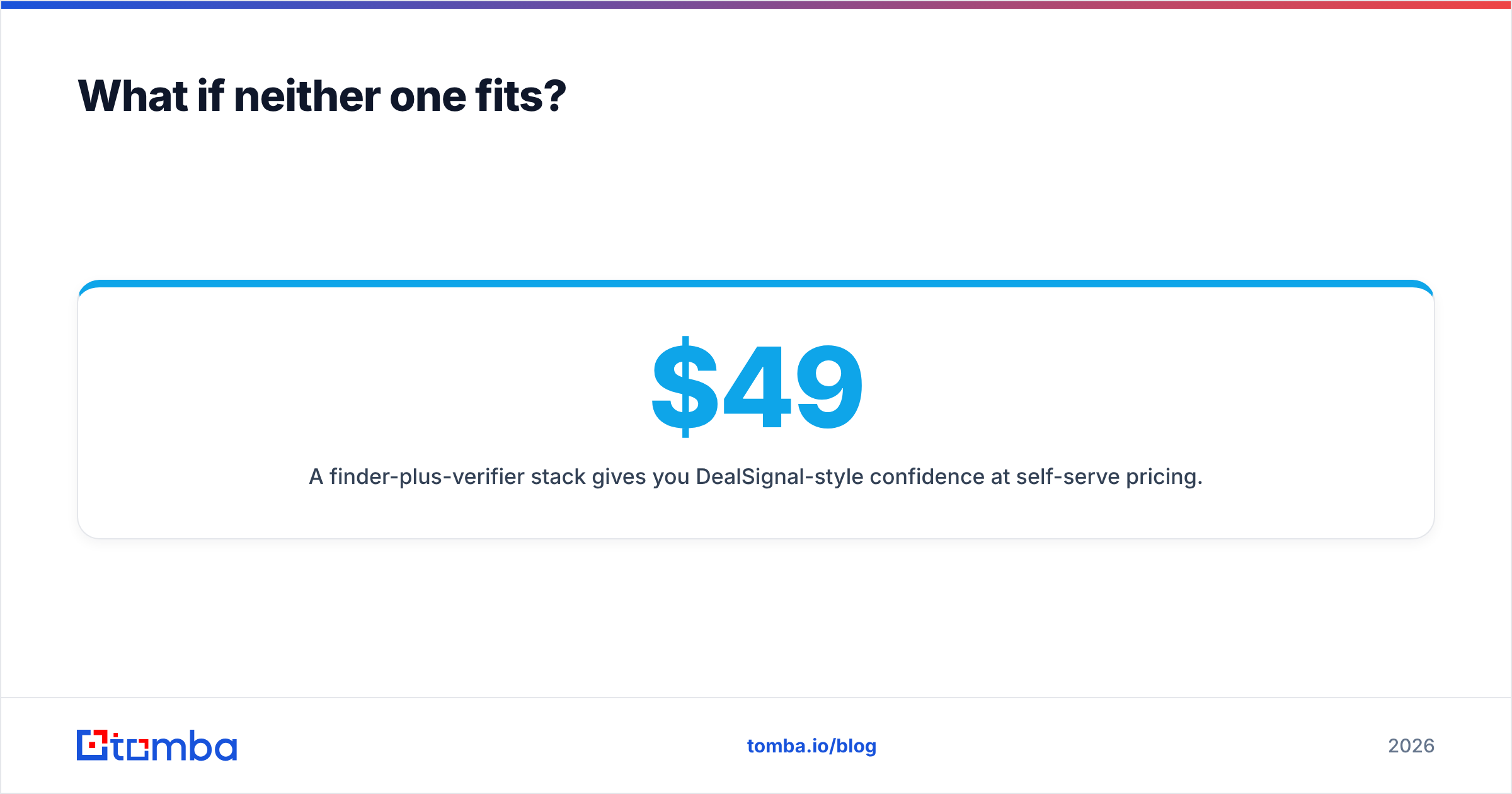
DealSignal vs FindThatLead: what if neither one fits?#
Most teams weighing DealSignal vs FindThatLead are stuck between two poles. Enterprise pricing they cannot justify, and budget accuracy they cannot trust. There is a middle.
A finder-plus-verifier stack gives you DealSignal-style confidence at self-serve prices. That is the shape of Tomba: a dedicated email finder with a separate verification layer, a real catch-all verifier for the domains that break cheap tools, bulk processing for list work, and a full API so it all runs inside your own automation.
Tomba pricing starts free at 25 searches a month. Paid plans run $49/mo Starter, $99/mo Growth, and $249/mo Pro. All published, all monthly, no quote call.
The evaluation shortcut is simple. Run the same 200 target accounts through all three tools. Score four numbers: hit rate, bounce rate, cost per valid email, and minutes of manual cleanup.
The winner is almost never the tool with the best marketing page. It is the one with the lowest cost per valid email after cleanup. That number often favors a specialist stack over both a platform contract and a bundled budget tool.
Frequently asked questions#
Is DealSignal better than FindThatLead? For enterprise list building and CRM re-verification, yes. For a founder who needs 500 emails this week, no. They are built for different buyers. "Better" only means something once you fix your volume and your budget.
Does FindThatLead work on catch-all domains? Partly. Catch-all domains accept any address at the SMTP layer, so no finder can confirm delivery with a standard check alone. Run catch-all results through a tool with pattern-confidence scoring before you send.
Can I use DealSignal without an annual contract? Not usually. Its model is built on annual agreements with volume commitments. If monthly flexibility matters, look at self-serve options instead.
Do both integrate with Salesforce and HubSpot? DealSignal treats CRM sync as a core workflow. FindThatLead connects more lightly, often via CSV or Zapier. Confirm the object mapping you need before you sign.
Which one has a free tier? FindThatLead offers limited trial credits. DealSignal does not, so evaluation runs through a sales-led sample. Tomba's free tier gives 25 searches a month with no card, which makes it the easiest of the three to blind-test.
Start with a test, not a contract#
The honest verdict on DealSignal vs FindThatLead: DealSignal is the right buy for revenue orgs with real budget and real data-decay problems. FindThatLead is the right buy for lean teams who need speed over depth. Neither is a mistake in the setting it was built for. Both are costly mistakes outside it.
If you sit somewhere in the middle, start with the cheapest experiment you can run. Send your next 25 target accounts through the Tomba Email Finder free — no card, no demo call — and measure hit rate and bounce rate yourself. Whatever you decide next, you will decide on your own data instead of someone's accuracy claim.
Related guides#
Ready to find emails that actually work?
Join 150,000+ professionals who stopped guessing and started sending. Free credits on signup — no credit card required.
Get the Tomba newsletter
Practical outbound tactics and product updates — once every two weeks.
About the author