DealSignal vs Goava (2026): Which B2B Data Tool Wins?
DealSignal sells verified global contact data on demand. Goava scores Nordic accounts and tells you who to call next. They solve different problems — here is how to pick, and what each one quietly costs you.
DealSignal vs Goava is a choice about where you sell, not about which tool is better. DealSignal builds and verifies contact data across the world. Goava scores and ranks accounts inside the Nordics. This guide compares coverage, pricing, and accuracy. It also shows a cheaper path if all you need is a verified email.
TL;DR
- DealSignal is a global B2B contact and account data provider built around on-demand verification. You request records. Its pipeline re-verifies them. You get emails, phones, and firmographics with a freshness guarantee.
- Goava is a Nordic sales intelligence platform. It is strong at finding and ranking accounts in Sweden, Norway, Denmark, and Finland. It is not built for global contact volume.
- They are not really substitutes. Sell across North America and EMEA, and Goava's database will feel thin. Sell only to Swedish mid-market firms, and DealSignal's global index is overkill you still pay for.
- Both are quote-based, annual-contract products. Expect four to five figures a year. Expect a procurement cycle too, before you touch a single record.
- Maybe you only need verified work emails at the moment of outreach. A per-credit email finder covers that for a fraction of either contract.
What is DealSignal and what does it actually sell?#
DealSignal calls itself a data-as-a-service provider rather than a static database you browse. The pitch on dealsignal.com starts with decay. People change jobs. Companies get bought. Phone extensions die. So you do not license a snapshot. You name the accounts and personas you want, and DealSignal builds and verifies records against that request.
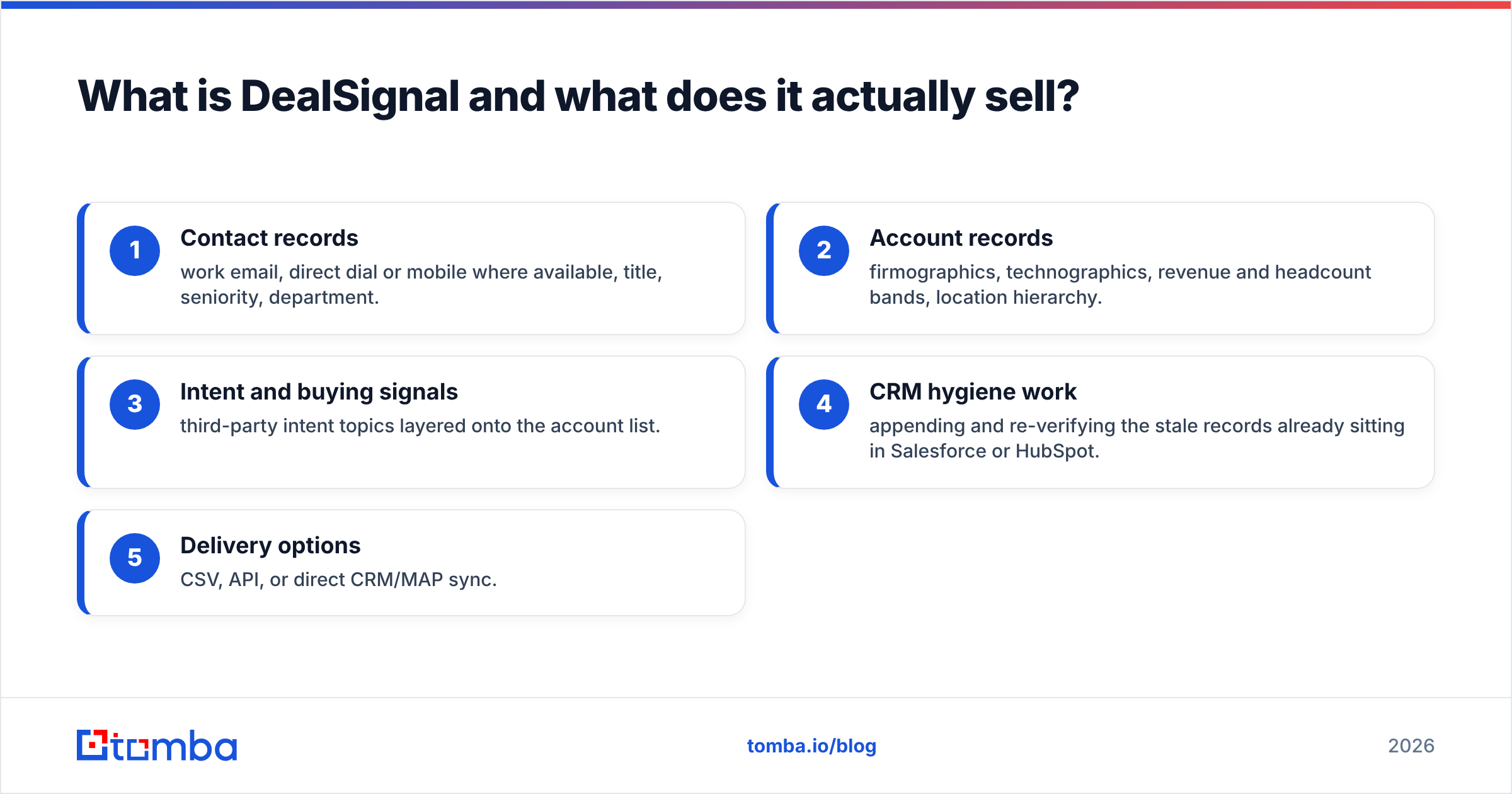
What you get in practice:
- Contact records — work email, direct dial or mobile where available, title, seniority, department.
- Account records — firmographics, technographics, revenue and headcount bands, location hierarchy.
- Intent and buying signals — third-party intent topics layered onto the account list.
- CRM hygiene work — appending and re-verifying the stale records already sitting in Salesforce or HubSpot.
- Delivery options — CSV, API, or direct CRM/MAP sync.
The model matters more than the feature list. Records are built to order and checked again close to delivery. That makes DealSignal's accuracy claims easier to defend than a vendor selling a five-year-old scrape. The trade-off is time and paperwork. You are buying a service engagement, not opening a self-serve app on a Tuesday afternoon.
What is Goava and who is it for?#
Goava is a Swedish sales intelligence tool. Its core product, Goava Discover, pulls in Nordic company registry data, financial filings, hiring signals, website technology, and news. It then recommends which accounts a rep should work next. The ranking is based on the customers you have already won.
That is a genuinely different job. DealSignal answers get me 4,000 verified VP-of-Ops contacts at US manufacturers. Goava answers a Nordic question instead: of the 90,000 registered companies in Sweden, which 200 look most like last quarter's wins, and what changed there this week?
Goava's data depth in the Nordics is its moat. Nordic company registries are unusually rich. Official financials, board members, ownership, and employee counts are all public. In the US they simply are not. Goava turns that public data into scores. Outside the Nordics the advantage fades, and coverage becomes the limit.

DealSignal vs Goava: how do they compare head-to-head?#
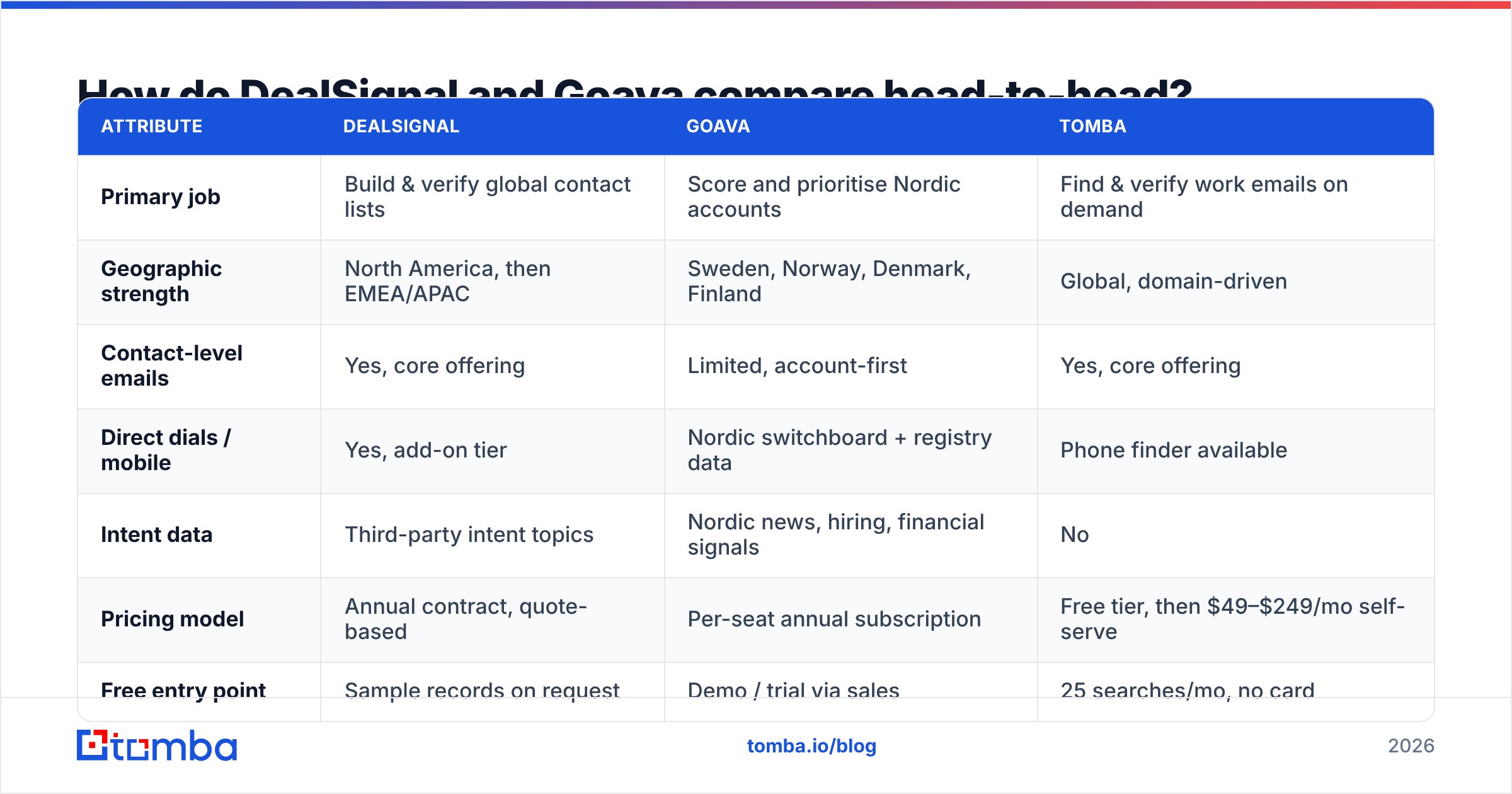
Here is the honest side-by-side. Treat every price as directional. Both vendors quote rather than publish. Your number will depend on seats, record volume, and contract length.
| Attribute | DealSignal | Goava | Tomba |
|---|---|---|---|
| Primary job | Build & verify global contact lists | Score and prioritise Nordic accounts | Find & verify work emails on demand |
| Geographic strength | North America, then EMEA/APAC | Sweden, Norway, Denmark, Finland | Global, domain-driven |
| Contact-level emails | Yes, core offering | Limited, account-first | Yes, core offering |
| Direct dials / mobile | Yes, add-on tier | Nordic switchboard + registry data | Phone finder available |
| Intent data | Third-party intent topics | Nordic news, hiring, financial signals | No |
| Pricing model | Annual contract, quote-based | Per-seat annual subscription | Free tier, then $49–$249/mo self-serve |
| Free entry point | Sample records on request | Demo / trial via sales | 25 searches/mo, no card |
| Time to first record | Days to weeks (scoped request) | Days (onboarding + ICP setup) | Minutes |
| API access | Yes | Limited | Yes, full REST API |
| Best for | US/global outbound at volume | Nordic account-based selling | Any team that needs emails now |
The row that decides most evaluations is geographic strength. Everything else is negotiable. Coverage is not.
Which one has better data coverage?#
It depends on your territory. The answer flips hard at the border.
Inside the Nordics, Goava wins on account depth. It knows a Swedish company's filed financials, its board, its filing history, and whether it just posted three developer roles. DealSignal can find contacts at that company. It will not hand you the audited revenue from the Bolagsverket filing.
Outside the Nordics, DealSignal wins by default. Goava is not really competing there. If your ICP includes US SaaS companies or German manufacturers, Goava's recommendation engine has far less to work with.
There is a subtler point that trips up a lot of evaluations: contact coverage is not account coverage. Goava is excellent at telling you which company to approach. It is much weaker at giving you the work email of the operations director inside it. Nordic privacy norms and registry structures get you a switchboard number and a generic info@ address. They rarely get you firstname.lastname@company.se.
That gap is where teams bolt on a second tool. You use Goava to build the target account list. Then you run those domains through a domain search to get named contacts and their email patterns. It is not an elegant stack. It is the one a lot of Nordic sales teams actually run.
DealSignal vs Goava pricing: what does each one cost?#
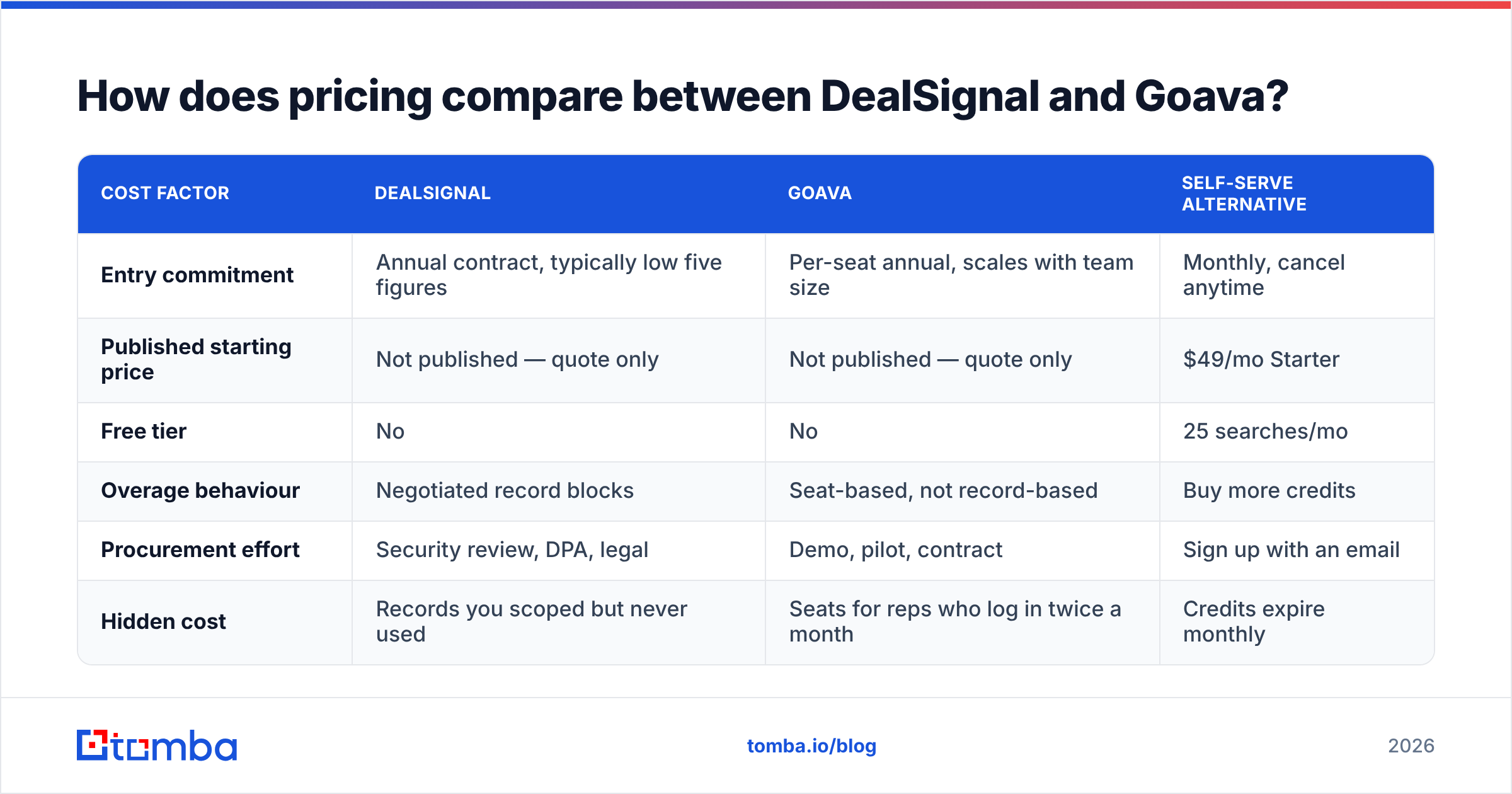
Neither vendor publishes a price list. That alone tells you something about the sales motion. Based on public reviews on G2 and normal enterprise buying patterns, here is what to budget for.
| Cost factor | DealSignal | Goava | Self-serve alternative |
|---|---|---|---|
| Entry commitment | Annual contract, typically low five figures | Per-seat annual, scales with team size | Monthly, cancel anytime |
| Published starting price | Not published — quote only | Not published — quote only | $49/mo Starter |
| Free tier | No | No | 25 searches/mo |
| Overage behaviour | Negotiated record blocks | Seat-based, not record-based | Buy more credits |
| Procurement effort | Security review, DPA, legal | Demo, pilot, contract | Sign up with an email |
| Hidden cost | Records you scoped but never used | Seats for reps who log in twice a month | Credits expire monthly |
The hidden cost row is the one finance teams miss. With a scoped-record contract, you commit to volume up front. Then your ICP shifts in Q2. Now you have paid for 20,000 records against a persona you no longer sell to. Per-seat tools fail the other way. You buy 12 seats in January. By June four reps have churned, but the seats stay locked until renewal.
Per-credit pricing does not have that failure mode. You spend on the contacts you actually enrich, in the month you enrich them. That is the whole argument for keeping a self-serve layer in your stack, even when you also run an enterprise data contract. It is also why Tomba pricing starts at a $49/mo Starter plan with a free tier above it, rather than a signature on an annual agreement.
Is DealSignal or Goava more accurate?#
Accuracy claims in this market are hard to test as marketed. Judge the method instead of the percentage.
DealSignal's method holds up. Records are checked close to the point of delivery, not sold from a static index, so the decay window is short. A vendor may tell you it is 97% accurate. If the record was checked 14 months ago, the number is fiction. Recency beats percentage every time.
Goava's method is different in kind. Its accuracy comes from official Nordic registries. Those are authoritative for company facts: revenue, employee count, ownership, legal status. You can trust them more than any scraped headcount estimate. But registry data says nothing about whether a person's mailbox still exists.
That distinction matters for outbound. Firmographic accuracy protects your targeting. Email accuracy protects your sender reputation. They are separate risks. Only one of them gets your domain blocked.
Whatever list source you use, run the final send list through an email verifier before it touches your sequencer. A 4% bounce rate on a 5,000-contact campaign is 200 hard bounces. That is enough to dent email deliverability at most inbox providers. No data vendor's SLA covers the damage to your sending domain.
Catch-all domains deserve a note here. Both platforms will return addresses at domains that accept all mail. Standard verification marks those unknown rather than valid. Catch-all setups are common in the European mid-market. If a big share of your ICP sits on them, a catch-all verifier is the difference between guessing and knowing.

When should you choose Goava over DealSignal?#
Pick Goava when all of these are true:
- Your territory is Nordic-first. Sweden, Norway, Denmark, and Finland make up most of your pipeline.
- Account selection is your bottleneck, not contact discovery. Your reps know how to reach a person once they know which company to chase.
- You want a workflow tool, not a data feed. Goava's value is the daily here is who to work next surface, which reps actually open.
- You value registry-grade firmographics. Audited financials and ownership data change how you qualify.
Pick DealSignal when:
- Your ICP is global or US-centric, and you need contact volume that Nordic registries cannot supply.
- You run list-based outbound at scale — thousands of net-new contacts per quarter against defined personas.
- CRM decay is the real problem. Appending and re-verifying an existing Salesforce instance is a first-class DealSignal use case.
- You need direct dials for a phone-heavy motion. Nordic registry data will not get you a mobile number.
Pick neither, yet when you are a small team validating a segment. Signing an annual data contract before you know your ICP is how companies end up with 30,000 records for a persona that never converted. Start with per-search tooling. Prove the segment. Then buy volume.
What does a lean alternative stack look like?#
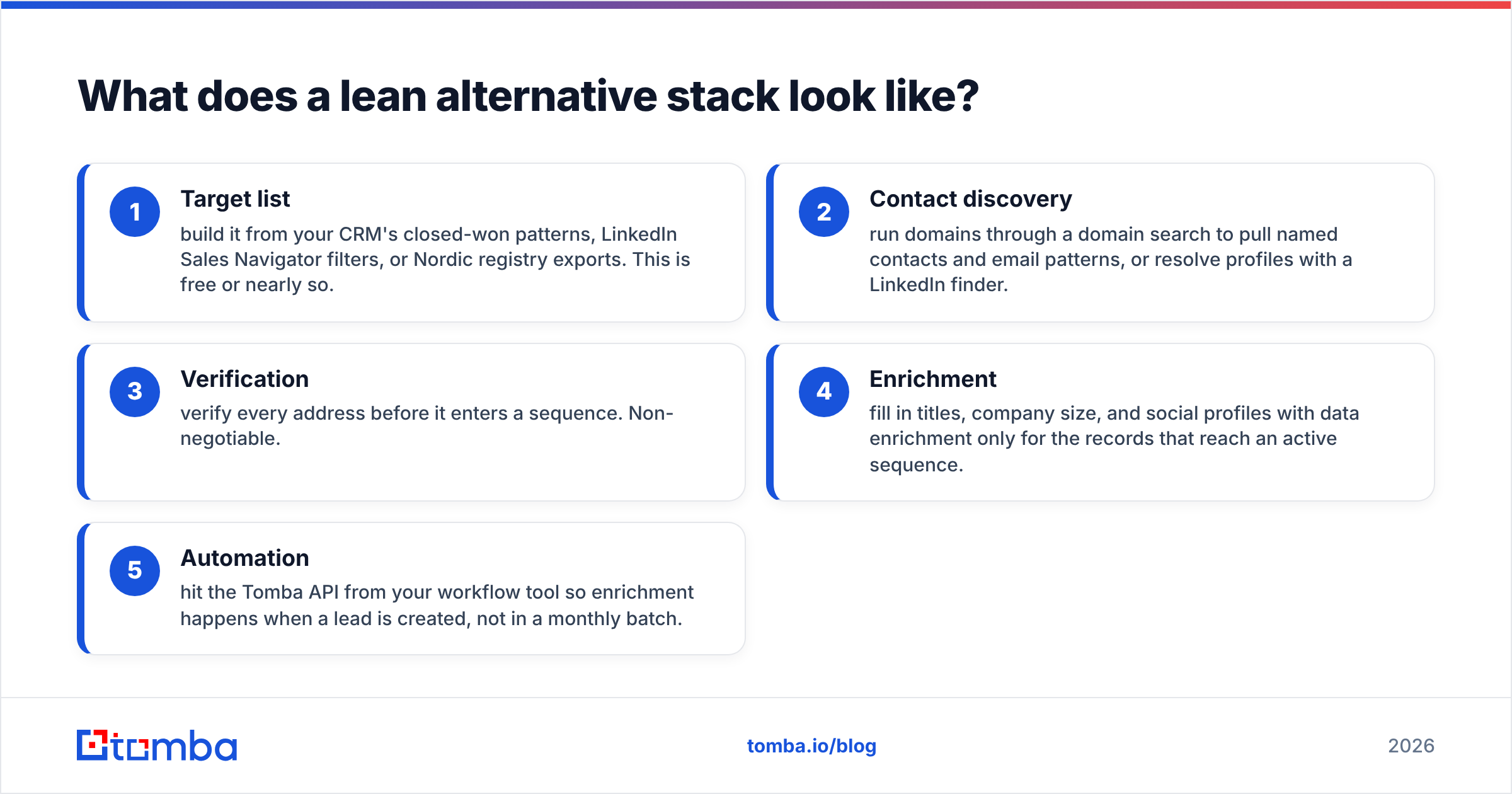
The DealSignal vs Goava debate assumes you need one of them. For most teams under 20 reps, the practical stack is thinner than either vendor's pitch deck implies:
- Target list — build it from your CRM's closed-won patterns, LinkedIn Sales Navigator filters, or Nordic registry exports. This is free or nearly so.
- Contact discovery — run domains through a domain search to pull named contacts and email patterns, or resolve profiles with a LinkedIn finder.
- Verification — verify every address before it enters a sequence. Non-negotiable.
- Enrichment — fill in titles, company size, and social profiles with data enrichment, and only for the records that reach an active sequence.
- Automation — hit the Tomba API from your workflow tool, so enrichment happens when a lead is created rather than in a monthly batch.
This stack costs a small fraction of an enterprise data contract. It covers the same job for teams whose constraint is execution, not data volume. It does not replace DealSignal if you genuinely need 50,000 verified US direct dials a year. At that scale, a negotiated contract is the right instrument. Be honest about which situation you are in.
DealSignal vs Goava: which should you pick?#
Short answer: they rarely belong on the same shortlist. If you are comparing them seriously, one of two things is true. Either your territory spans the Nordics and the wider world, so you need Goava for account selection plus a global contact source for people. Or you have not yet defined which problem you are solving.
Define that first. Write down where your pipeline stalls. Do reps not know which companies to call? Or can they not reach anyone at the companies they already picked? Goava fixes the first. DealSignal fixes the second. Buying the wrong one is an expensive way to learn the difference.
Before you sign either contract, test the cheap idea. Maybe your real blocker is simply that you lack reliable email addresses. For a lot of teams it is. That problem does not need a procurement cycle to solve.
Start there. Run 25 free searches through the Tomba Email Finder. Take the same 25 companies you would hand a vendor in a pilot. See how much of the gap closes for $0. If it closes most of it, you just saved yourself a year-long contract. If it does not, you walk into that vendor call knowing exactly what you need. That is a far better spot than walking in hopeful.
Related guides#
Ready to find emails that actually work?
Join 150,000+ professionals who stopped guessing and started sending. Free credits on signup — no credit card required.
Get the Tomba newsletter
Practical outbound tactics and product updates — once every two weeks.
About the author