DealSignal vs GrowMeOrganic: Which B2B Data Tool Wins in 2026?
DealSignal sells verified enterprise contact data at enterprise prices. GrowMeOrganic sells cheap unlimited scraping plus a sequencer. We put both through pricing, accuracy, and workflow tests to find who each one actually fits.
DealSignal vs GrowMeOrganic comes down to one trade: pay for verified data, or pay for volume. DealSignal sells re-verified records to enterprise teams. GrowMeOrganic sells cheap scraping with a sender bolted on. Here is how the two compare on price, accuracy, and fit — and when neither is the right buy.
TL;DR
- DealSignal is a verified-on-demand B2B data provider built for enterprise demand gen and RevOps teams. It re-verifies records at request time. Pricing runs on credit packages that usually start in the four figures a year. Data pushes into Salesforce and Marketo. High accuracy, high price, sales-call procurement.
- GrowMeOrganic is a $39–$99/month all-in-one. You get LinkedIn and Sales Navigator scraping, "unlimited" email finding, and a built-in cold-email sequencer. It is fast to start and cheap. Data quality is noticeably looser.
- They are not really competitors. They sit at opposite ends of the same shelf. One sells confidence, the other sells volume.
- If you send under ~2,000 cold emails a month, both are the wrong shape. You either pay for a sequencer you don't need or an enterprise contract you can't justify.
- Middle path: pair a precise email finder plus verifier (Tomba, $49/mo Starter) with the sending tool you already own. Keep the data layer separate from the sending layer.
What is DealSignal and who actually buys it?#
DealSignal is a B2B contact and account data platform. Its core pitch is verification at the moment of request rather than serving records from a stale warehouse. When you pull a contact, the platform runs machine and human validation passes first. That is why its published accuracy claims sit in the high 90s.
The buyer profile is specific. DealSignal typically lands with:
- Demand-gen teams running paid programs — where a bad record wastes ad spend downstream, not just an email send.
- RevOps teams doing CRM hygiene — bulk re-enrichment of a 100k-row Salesforce instance where 30% of the records have rotted.
- ABM programs — where you need every buying-committee member at 400 named accounts, complete, not 60% complete.
- Compliance-sensitive orgs — GDPR/CCPA documentation and data-provenance answers that a scraper simply cannot produce.
- Teams with a data budget line — because pricing is quote-based and starts well above self-serve territory.
What you don't get: a sending tool. DealSignal is a data layer. It expects you to already own Outreach, Salesloft, Marketo, or HubSpot and to route data there via native integration or API.
What is GrowMeOrganic and where does its data come from?#
GrowMeOrganic is an all-in-one prospecting suite sold on price and breadth. One subscription gets you a Chrome extension that scrapes LinkedIn and Sales Navigator, a B2B database, an email finder marketed as unlimited, a Google Maps / local-business scraper, and an email sequencer with follow-up automation.
The mechanics matter. Most of GrowMeOrganic's contact data is derived at extraction time. You scrape a Sales Navigator list, the tool guesses the corporate email pattern, checks it against known formats, and returns a best-guess address.
That is a legitimate technique. It is roughly how every pattern-based email finder works. But the guess is only as good as the verified signal behind the pattern library. Thin library, confident guess, hard bounce.
"Unlimited" also deserves a footnote. In practice it means unlimited lookups, subject to fair-use throttles, extraction caps per day, and the LinkedIn account limits you're already bound by. Nobody hands you infinite verified email addresses for $49.
DealSignal vs GrowMeOrganic: how do the two compare head to head?#
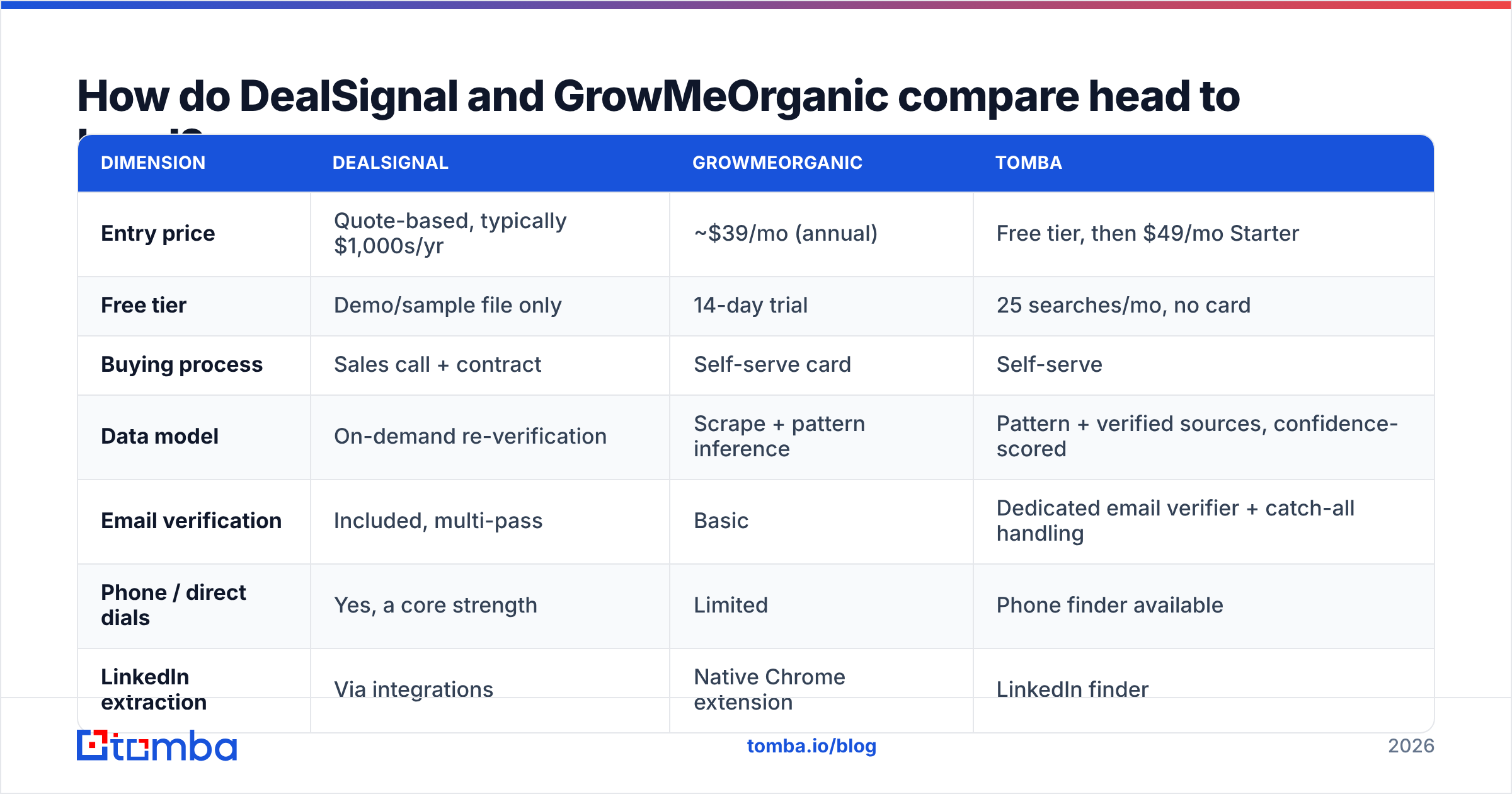
| Dimension | DealSignal | GrowMeOrganic | Tomba |
|---|---|---|---|
| Entry price | Quote-based, typically $1,000s/yr | ~$39/mo (annual) | Free tier, then $49/mo Starter |
| Free tier | Demo/sample file only | 14-day trial | 25 searches/mo, no card |
| Buying process | Sales call + contract | Self-serve card | Self-serve |
| Data model | On-demand re-verification | Scrape + pattern inference | Pattern + verified sources, confidence-scored |
| Email verification | Included, multi-pass | Basic | Dedicated email verifier + catch-all handling |
| Phone / direct dials | Yes, a core strength | Limited | Phone finder available |
| LinkedIn extraction | Via integrations | Native Chrome extension | LinkedIn finder |
| Built-in email sending | No | Yes, full sequencer | No — integrates with your sender |
| CRM sync | Salesforce, Marketo, HubSpot, API | HubSpot, Pipedrive, Zapier | HubSpot, Salesforce, Pipedrive, Zapier |
| Best for | Enterprise ABM, CRM enrichment | Solo founders, agencies, high-volume SDRs | Teams who want accuracy without a contract |
| Worst for | Anyone under 10 seats | Regulated industries, enterprise deals | Teams needing a built-in sequencer |
The table exposes the real decision. You are choosing between paying for confidence and paying for volume. Almost nobody needs to make that choice as a binary.
Is DealSignal's accuracy premium worth the price?#
Sometimes. The math is unromantic, so run it.
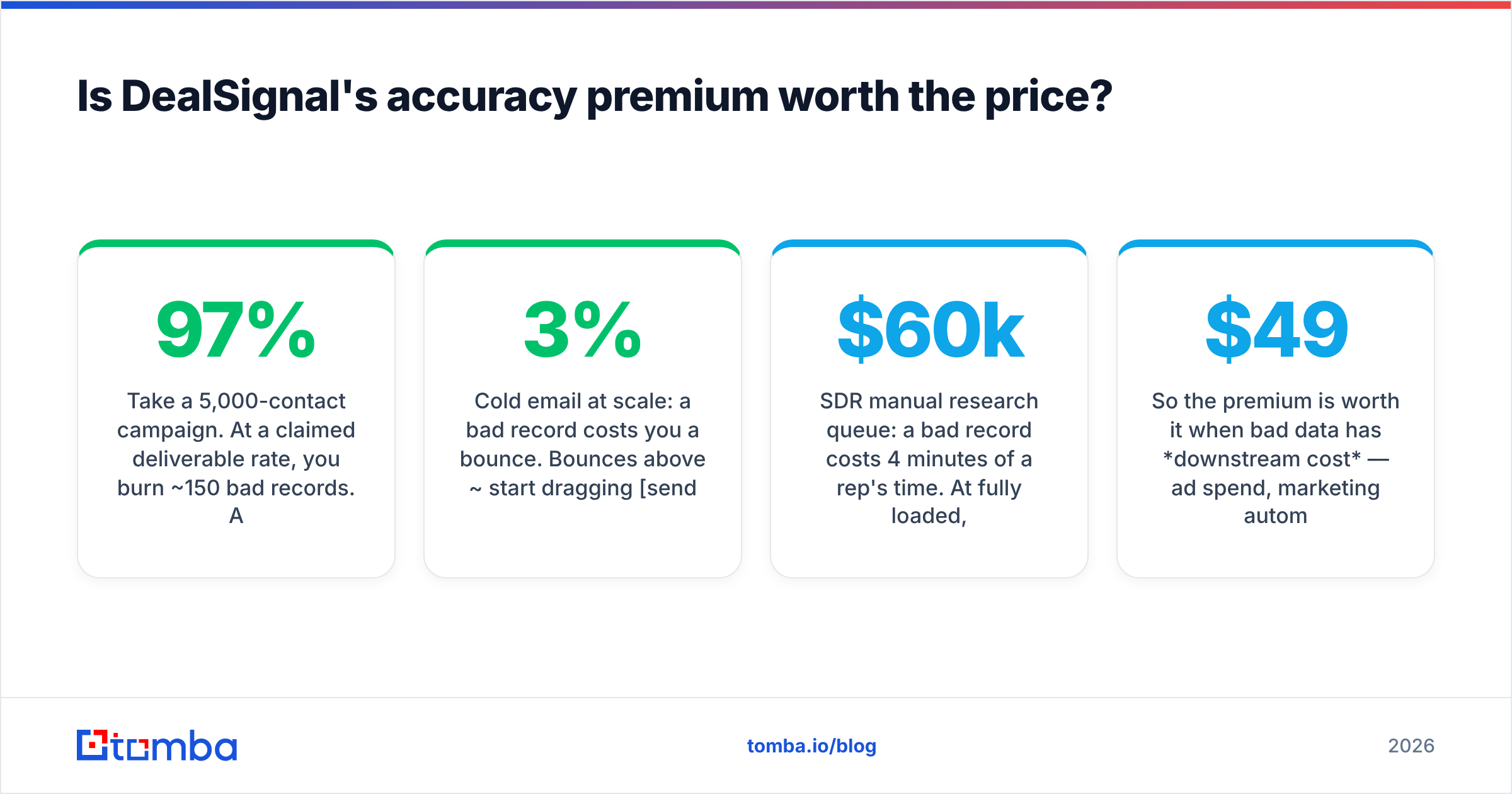
Take a 5,000-contact campaign. At a claimed 97% deliverable rate, you burn ~150 bad records. At a realistic 80–85% scraped-and-guessed rate, you burn 750–1,000. The question isn't which number is bigger. It's what each bad record costs you.
- Cold email at scale: a bad record costs you a bounce. Bounces above ~3% start dragging sender reputation. Once a domain is scorched, the cleanup costs more than the data ever did. Accuracy matters a lot here — but a standalone verifier fixes it for a fraction of enterprise pricing.
- Paid retargeting off a contact list: a bad record costs real ad dollars with zero recovery. Accuracy matters enormously.
- SDR manual research queue: a bad record costs 4 minutes of a rep's time. At $60k fully loaded, that's about $2. Enterprise data rarely closes that gap. The rep is cheaper than the premium.
- Enterprise ABM with 300 named accounts: coverage completeness beats cost entirely. You cannot skip the VP of Ops because the vendor didn't have her.
So the premium is worth it when bad data has downstream cost: ad spend, marketing automation seats, compliance exposure. It is not worth it when the only cost is a bounce. A $49 tier plus a verification pass gets you 95%+ deliverability for less than 5% of the contract.
What does GrowMeOrganic get right, and where does it break?#
Credit where due. GrowMeOrganic's strongest feature is that it collapses four purchases into one line item. For a two-person agency running lead-gen for clients, scraping, finding, and sending under one login genuinely removes friction. And friction is what kills small-team outbound.
It breaks in four predictable places:
- Bounce rates on non-obvious domains. Pattern inference works great on
firstname.lastname@bigcorp.com. It falls apart on companies with mixed formats, acquired subsidiaries, or catch-all domains that accept everything and deliver nothing. You'll need a second verification pass regardless. - Sending from a shared-infrastructure sequencer. All-in-one senders often route through pooled IPs. Your deliverability is partly hostage to whoever else is on that pool. Dedicated senders and warmed domains outperform this. Check your SPF record and authentication before blaming the data.
- LinkedIn scraping risk. Aggressive extraction triggers account restrictions. LinkedIn's User Agreement explicitly prohibits automated scraping, and enforcement has gotten sharper. That's a business risk you own, not the vendor.
- Enterprise data gaps. Direct dials, org-chart hierarchy, intent signals, and technographics are thin to absent. If your motion needs those, this isn't the tool.
Which one fits your team size and motion?#
Match the tool to the job rather than the feature list:
- Solo founder, <500 sends/month. Neither. Use a free tier and a verifier. Tomba's free plan covers 25 searches monthly, and the free email checker handles spot verification. Buy nothing until volume justifies it.
- Agency running 5–15 client campaigns. GrowMeOrganic's economics are hard to beat if you accept a mandatory verification step before every send. Budget for that step — it's not optional.
- Seed-to-Series-A SaaS, 2–5 SDRs. The middle. Your ICP is narrow, so every account matters, but a five-figure data contract is out of reach. Separate your layers: precise finding and verification from one vendor, sending from a dedicated cold-email tool you control.
- Series B+ with marketing ops. DealSignal earns its price once you re-enrich a CRM quarterly and run paid programs off first-party lists. The G2 category listings are a reasonable place to cross-check its peers before you take a demo.
- Regulated industry (fintech, health, gov). DealSignal or a comparable compliance-documented provider. Scraped data with no provenance trail is a liability, not a bargain.
Is there a better middle option than either?#
Yes. The DealSignal vs GrowMeOrganic debate hides a third answer, and it's structural rather than a brand preference. Decouple your data layer from your sending layer.
All-in-one tools like GrowMeOrganic tie your data quality to your sending infrastructure. When deliverability drops, you can't isolate the cause. You also can't swap one component without ripping out the other. Enterprise platforms like DealSignal solve accuracy, but they force an annual commitment sized for a team you may not have yet.
The middle path looks like this:
- Source contacts precisely. Use domain search to pull every reachable address at a target company, or the email finder for named individuals. Confidence scores tell you which records to trust before you spend a send on them.
- Verify before every send. Run the list through a real verification pass: SMTP checks, catch-all detection, role-account flagging. This is the highest-ROI step in outbound and it costs cents per record.
- Enrich only what you'll act on. Contact enrichment on your 200 priority accounts beats enriching 20,000 you'll never touch.
- Send from infrastructure you control. Your own warmed domains, your own sequencer, your own reputation. HubSpot's deliverability guidance is a solid baseline for the fundamentals.
- Automate the pipeline. The Tomba API or the bulk email finder handles list-scale work without manual exports.
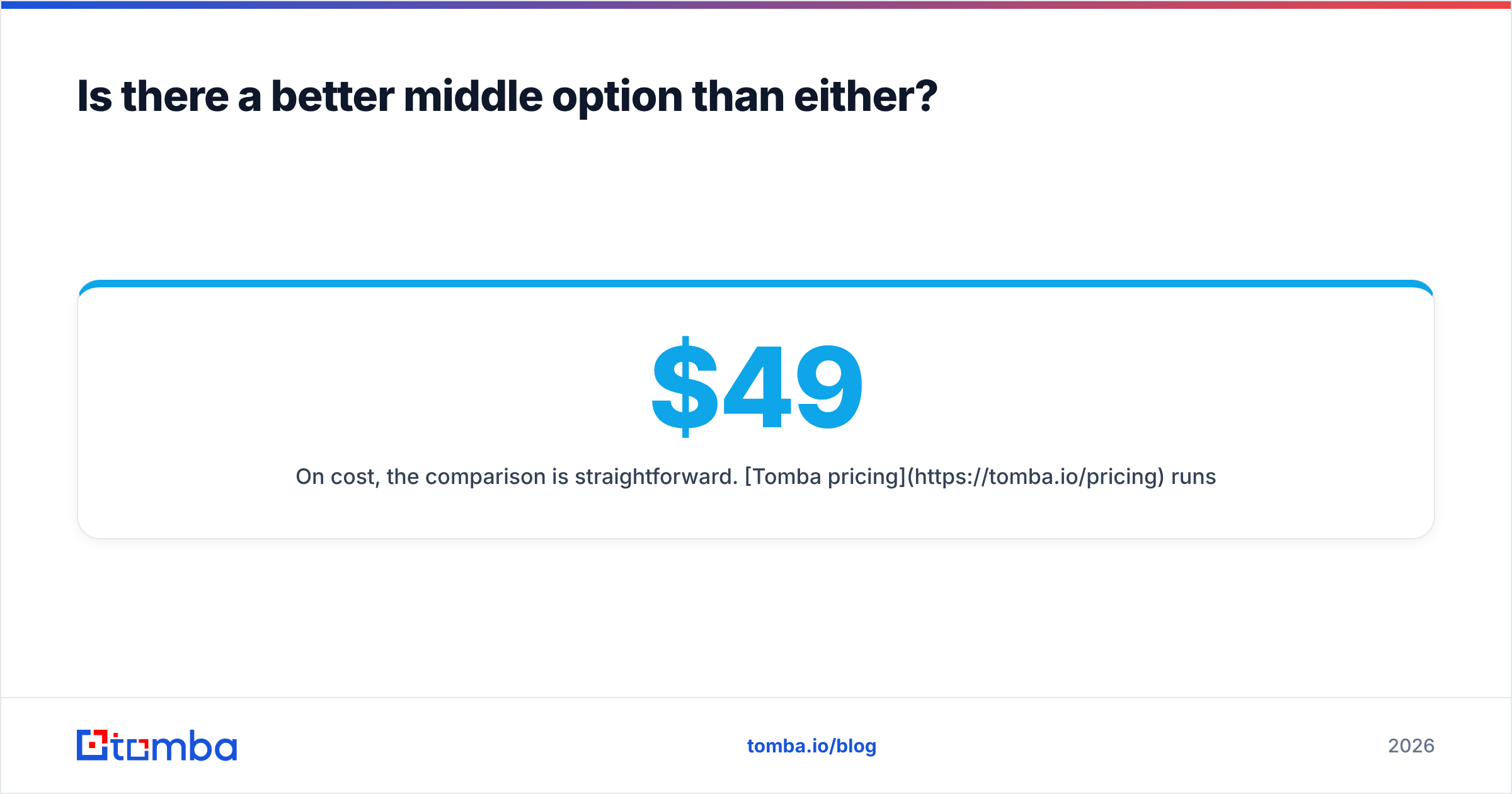
On cost, the comparison is straightforward. Tomba pricing runs Free (25 searches/mo), Starter at $49/mo, Growth at $99/mo, and Pro at $249/mo.
It's self-serve, with no sales call. Verification, catch-all handling, and enrichment sit in the same account. That covers the accuracy requirement without an enterprise contract, and your sending stack stays independent.
Worth noting for completeness: some teams need a large pre-built list of verified contacts rather than on-demand lookup. Providers like BookYourData occupy that niche — pay-as-you-go verified lists with no subscription — and are a fair comparison point alongside both tools here.
What should you check before you commit to either?#
Run these five tests on any trial, in this order. Most vendors survive the first two and fail the third.
- The known-contact test. Feed 25 contacts you already have verified emails for. Score exact matches, not "found something." Anything under 80% is a red flag.
- The hard-domain test. Pick 10 companies with non-obvious email formats: subsidiaries, rebranded firms, catch-all domains. This is where marketing claims meet reality.
- The bounce test. Send 200 records to a throwaway domain and measure actual bounces, not the vendor's confidence score. Confidence scores are marketing until you validate them.
- The export test. Can you get your data out in clean CSV without a support ticket? Vendors that make export hard are planning to make leaving hard.
- The cancellation test. Read the renewal clause before signing. Auto-renew with a 60-day notice window has trapped more RevOps teams than bad data ever has.
DealSignal vs GrowMeOrganic: the verdict#
DealSignal wins if you're an enterprise team where a bad record costs more than a bounce: paid programs, ABM, CRM re-enrichment at scale, regulated industries. You're buying documented accuracy and coverage depth, and it's priced accordingly.
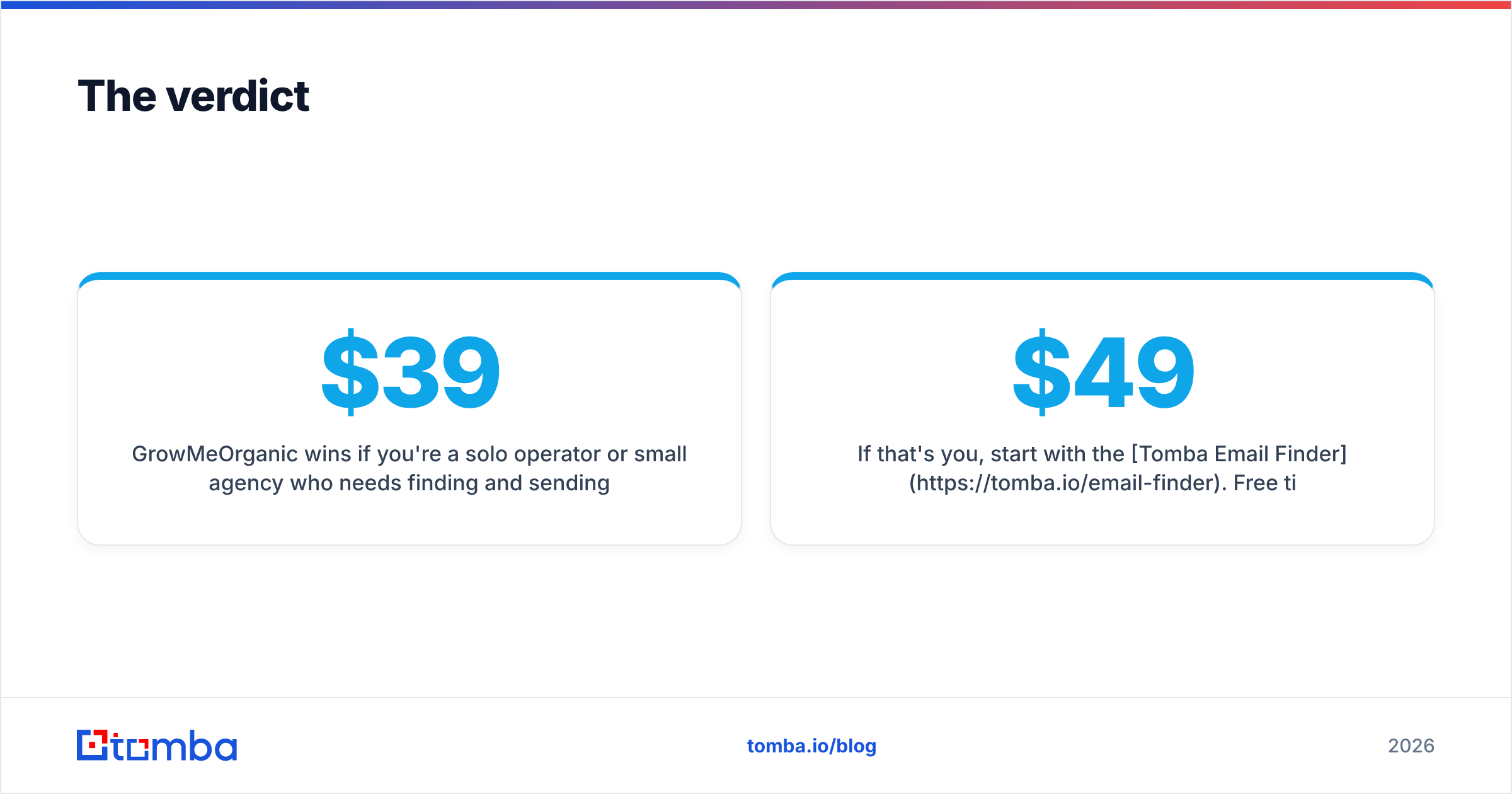
GrowMeOrganic wins if you're a solo operator or small agency. You get finding and sending under one $39–$99 subscription, and you can absorb a 15–20% bounce rate with an external verifier. It's an economics play, and the economics are real.
Neither wins for the largest group: small-to-mid B2B teams with a narrow ICP who need accurate data but already own their sending stack. That team is overpaying for a sequencer it doesn't use, or for a contract sized for a company it isn't yet.
If that's you, start with the Tomba Email Finder. The free tier gives you 25 searches, enough to run the known-contact test on your own list. No card, no demo call.
If the match rate holds, $49/mo on Starter buys finding, verification, catch-all detection, and enrichment in one account. You still send from whatever infrastructure you already trust. Test any vendor against your own ICP before you believe an accuracy claim — including ours.
Related guides#
Ready to find emails that actually work?
Join 150,000+ professionals who stopped guessing and started sending. Free credits on signup — no credit card required.
Get the Tomba newsletter
Practical outbound tactics and product updates — once every two weeks.
About the author