DealSignal vs LeadIQ (2026): Which B2B Data Tool Wins?
DealSignal sells verified-on-demand records at enterprise pricing. LeadIQ sells one-click LinkedIn capture into your CRM. They solve different problems — here's which one fits your motion, and where a cheaper third option beats both.
TL;DR
- DealSignal is a research-on-demand B2B database: you define an ICP, it verifies records against that spec (often with human-in-the-loop QA) and delivers a list. Best for ABM and enterprise data ops that need coverage of hard-to-reach titles.
- LeadIQ is a capture-and-push tool: you browse LinkedIn Sales Navigator, click, and contacts land enriched in Salesforce or HubSpot without manual entry. Best for SDRs building lists prospect-by-prospect.
- They barely compete head-to-head. DealSignal wins on list-building at scale; LeadIQ wins on rep workflow speed.
- Both are seat-priced and quote-gated. Neither publishes a starter price, and both meter credits in ways that punish verification-heavy workflows.
- If your actual need is "find and verify work emails without a seat contract," a pure email finder like Tomba ($49/mo Starter, free tier included) covers 80% of the job at a fraction of the cost — details in the comparison table below.
What are DealSignal and LeadIQ, actually?#
They get lumped into the same "B2B data" bucket on G2, but they were built for opposite jobs.
DealSignal (dealsignal.com) is a demand-side data platform. You give it an ideal customer profile — industry, headcount, tech stack, job function, geography — and it returns a list of contacts that were verified for that request, rather than pulled from a static warehouse that was last refreshed at some unknown date. That on-demand verification model is the entire pitch: instead of buying a 40-million-row database and hoping the slice you care about isn't rotten, you buy the slice, freshly checked.
LeadIQ (leadiq.com) is a prospecting workflow tool. Its center of gravity is a Chrome extension that sits on top of LinkedIn Sales Navigator. A rep finds a prospect, clicks "capture," and LeadIQ pulls the work email and mobile, checks it against your CRM for duplicates, and pushes a clean record into Salesforce, HubSpot, Outreach, or Salesloft. It also ships Scribe, an AI email-writing layer that drafts personalized openers from the prospect's activity.
The distinction matters more than any feature checklist: DealSignal is bought by data ops and demand gen; LeadIQ is bought for reps.

How do DealSignal and LeadIQ compare on features and pricing?#
Neither vendor publishes transparent self-serve pricing, which is the first thing to budget for — both require a sales call, and both quote per seat plus credits. Numbers below reflect publicly reported ranges and vendor documentation as of 2026; always confirm during your own quote.
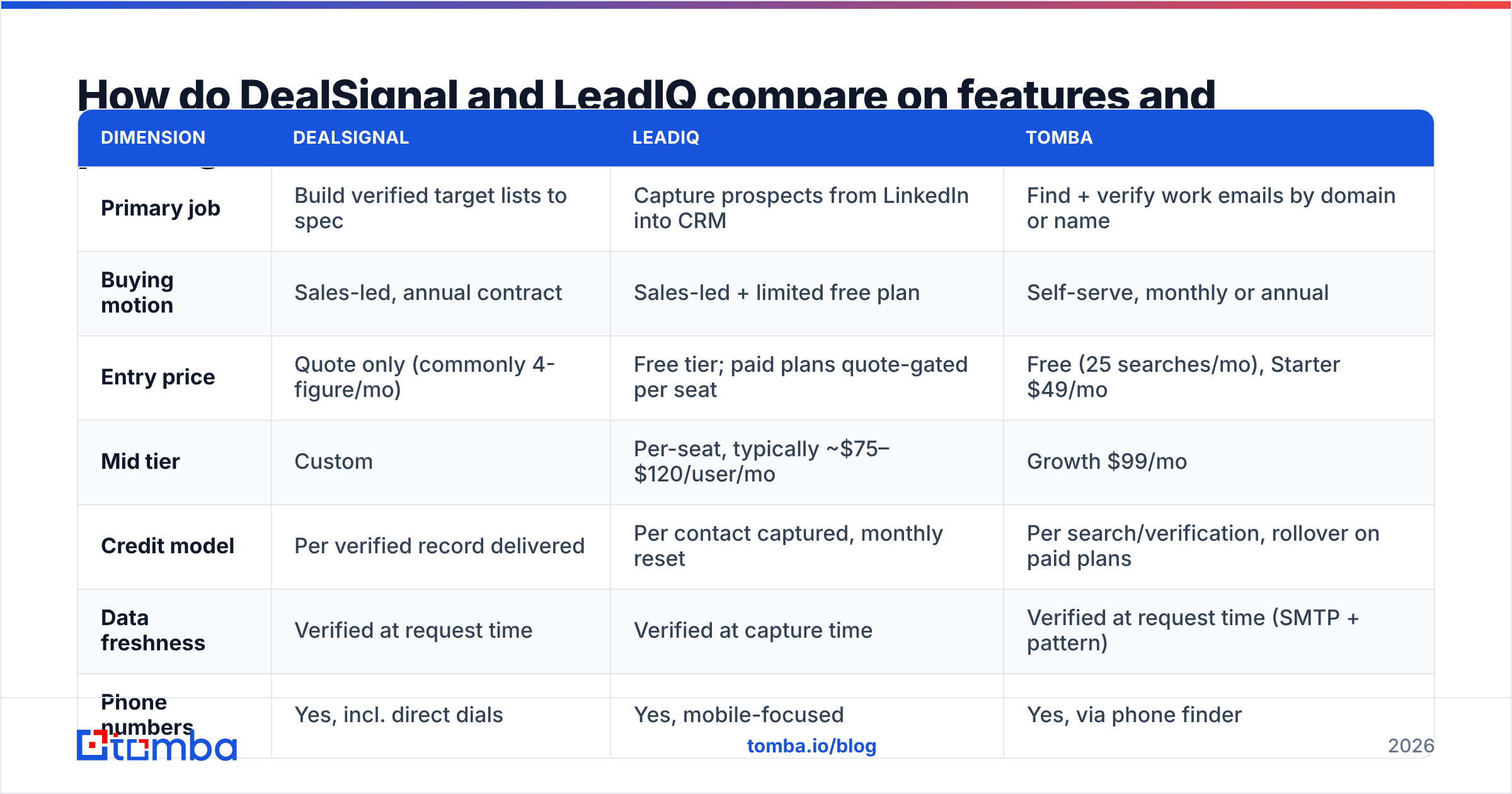
| Dimension | DealSignal | LeadIQ | Tomba |
|---|---|---|---|
| Primary job | Build verified target lists to spec | Capture prospects from LinkedIn into CRM | Find + verify work emails by domain or name |
| Buying motion | Sales-led, annual contract | Sales-led + limited free plan | Self-serve, monthly or annual |
| Entry price | Quote only (commonly 4-figure/mo) | Free tier; paid plans quote-gated per seat | Free (25 searches/mo), Starter $49/mo |
| Mid tier | Custom | Per-seat, typically ~$75–$120/user/mo | Growth $99/mo |
| Credit model | Per verified record delivered | Per contact captured, monthly reset | Per search/verification, rollover on paid plans |
| Data freshness | Verified at request time | Verified at capture time | Verified at request time (SMTP + pattern) |
| Phone numbers | Yes, incl. direct dials | Yes, mobile-focused | Yes, via phone finder |
| CRM push | Via integrations/exports | Native, one-click, dedupe-aware | Via integrations + API |
| Bulk / API | Yes | Limited on lower tiers | Yes — bulk email finder and Tomba API |
| Free trial | Sample list on request | Yes, permanent free tier | Yes, permanent free tier |
Two things stand out. First, DealSignal has no meaningful free entry point — you are evaluating it through a sample list a vendor curated for you, which is the least representative test possible. Second, LeadIQ's free tier is real but small, and its per-seat model means costs scale with headcount rather than usage, which is either a feature or a tax depending on your team shape.
Which one has better data accuracy?#
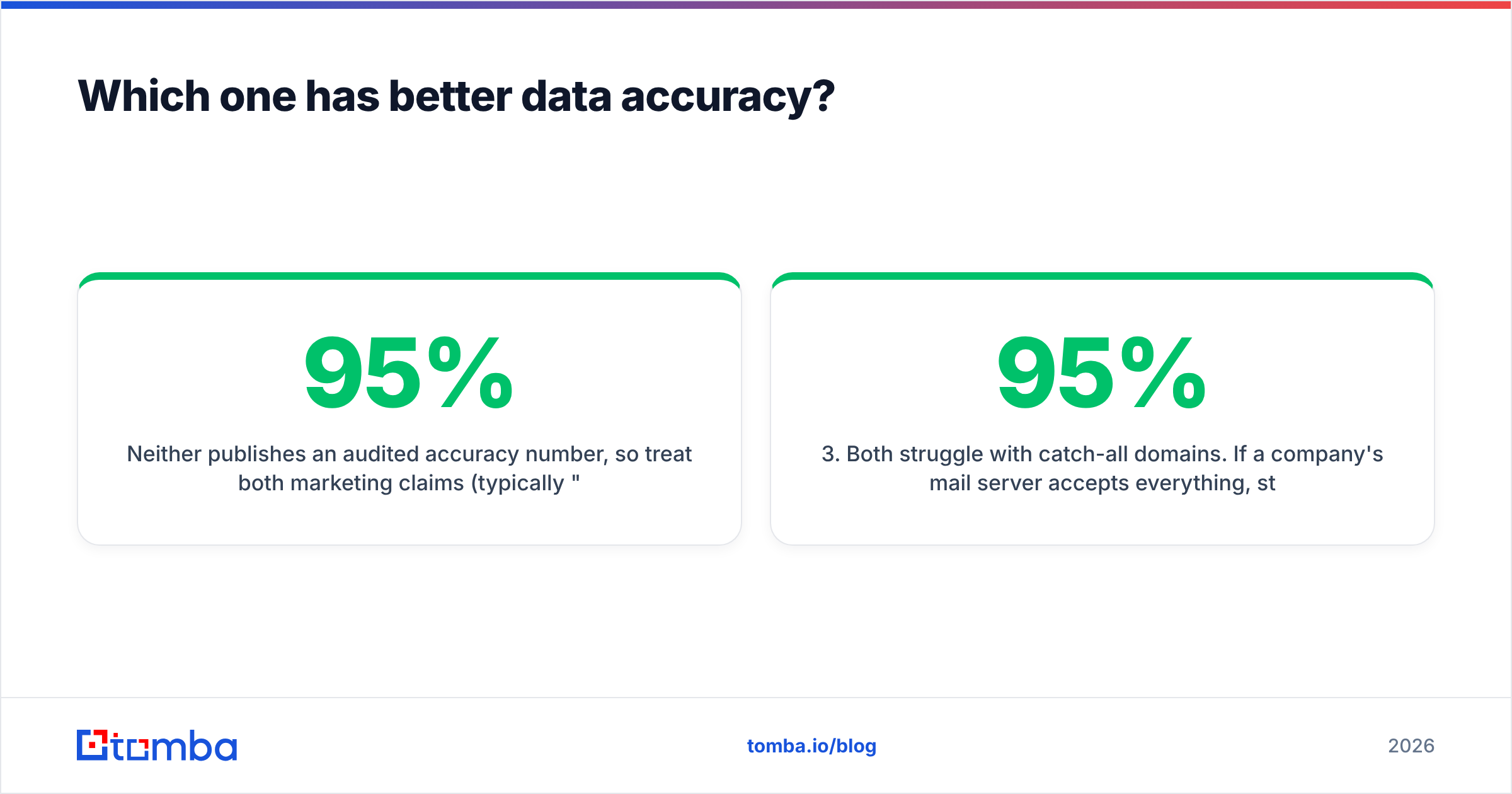
Neither publishes an audited accuracy number, so treat both marketing claims (typically "95%+" and "97%+") as unverified until you run your own test.
What differs is how each one gets to accuracy:
- DealSignal verifies on delivery. Records are checked when your request runs, so a list delivered Tuesday reflects Tuesday's reality. This genuinely helps in high-churn segments — tech, startups, anywhere reorg cycles are short.
- LeadIQ verifies at capture. Same freshness principle, but scoped to one contact at a time. Good hygiene for rep-driven prospecting, less useful when you need 5,000 records this week.
- Both struggle with catch-all domains. If a company's mail server accepts everything, standard SMTP verification returns "unknown" and the record either gets dropped or shipped as a guess. Ask each vendor directly how they classify catch-alls — this is where "95% accurate" claims quietly leak. A dedicated catch-all verifier exists for exactly this gap.
- Coverage ≠ accuracy. DealSignal's edge is finding people other databases miss (non-obvious titles, mid-market, non-US). LeadIQ's edge is that you already know the person exists — you're looking at their profile.
- Neither replaces a verification pass before send. Whatever you buy, run the list through an email verifier before it touches your sending domain. Bounce rate is your reputation, not your vendor's.
The practical test: pull 200 records from each vendor's trial, run them through an independent verifier, and count hard bounces on a real send. That number is worth more than every accuracy claim on both websites combined.
Is DealSignal or LeadIQ better for outbound teams?#
Depends entirely on who touches the data.
Choose DealSignal if:
- You run ABM and need whole-account coverage — every buying-committee member, not just the one who showed up in a search.
- Your ICP is specific enough that generic databases return junk (e.g., "plant managers at 200–500 employee food manufacturers in the EU").
- You have a marketing ops or RevOps function that can ingest, dedupe, and route a delivered file.
- You're feeding a paid-media audience, a nurture program, or an enrichment gap in your CRM — not a single rep's daily queue.
Choose LeadIQ if:
- Reps build their own lists and you want to eliminate copy-paste from LinkedIn into the CRM.
- Your CRM hygiene is a real problem — LeadIQ's dedupe-on-capture is genuinely good and saves ops hours.
- You already run Outreach or Salesloft and want capture-to-sequence in two clicks.
- You want AI-assisted first drafts inside the same tool (Scribe), rather than bolting on a separate writer.
Choose neither if: your job is simply "I have a list of companies and names; get me valid work emails." That's a solved, commoditized problem, and paying enterprise seat pricing for it is how data budgets get wasted. A domain search returns every published address at a company in seconds, and a bulk email finder handles the spreadsheet version.
It's also worth naming a third category: verified-database vendors like BookYourData sell downloadable, pre-verified lists with self-serve pricing — a respectable middle ground when you want DealSignal-style list delivery without the annual contract. If your evaluation is really about "buy a list vs. build one," put them on the shortlist too.
What do DealSignal and LeadIQ actually cost per usable contact?#
Cost per record is marketing. Cost per usable record is the number that matters, and it's computed the same way regardless of vendor:
(Annual contract + seat fees) ÷ (records delivered × verified-deliverable rate × ICP-match rate)
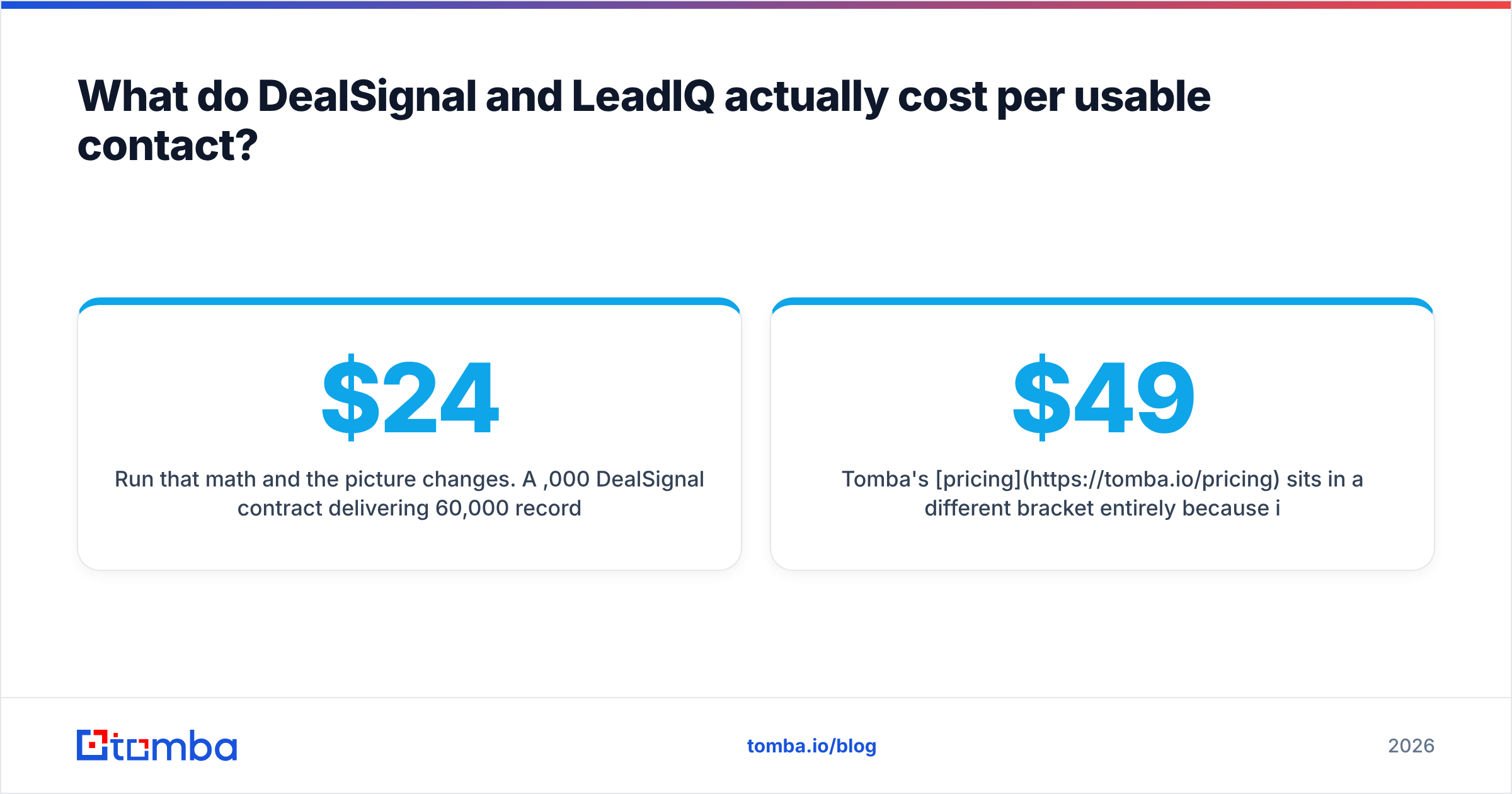
Run that math and the picture changes. A $24,000/year DealSignal contract delivering 60,000 records at a 92% deliverable rate and 80% ICP match works out to roughly $0.54 per usable contact. A 5-seat LeadIQ deployment at $100/user/month is $6,000/year; if each rep captures 400 contacts a month at similar quality, that's about $0.31 per usable contact — but only if reps actually use it daily. Shelfware destroys per-seat economics faster than any accuracy gap.
Tomba's pricing sits in a different bracket entirely because it does less: Starter at $49/mo, Growth at $99/mo, Pro at $249/mo, no seat minimums, no annual lock-in. You don't get intent signals, buying-committee mapping, or a Sales Navigator overlay. You get email discovery and verification with an API, which for many teams is the only line item they were ever really using.

What are the real limitations of each tool?#
Every vendor's weakest spot is the one their sales deck skips.
DealSignal's constraints:
- Turnaround time. On-demand verification is not instant — expect hours to days for large custom builds. If a rep needs a contact now, this is the wrong tool.
- Contract minimums. There is effectively no way to spend $200 and see if it works.
- Opacity. You can't easily audit which sources produced a given record, which matters for GDPR documentation.
- No rep-facing workflow. It hands you a file; connecting that file to daily prospecting is your problem.
LeadIQ's constraints:
- Coverage is bounded by LinkedIn. If a prospect isn't on Sales Navigator or has a locked-down profile, LeadIQ has little to offer.
- Mobile-number availability varies widely by region — strong in North America, thin in EMEA and APAC.
- Per-seat pricing punishes teams with occasional users. A marketer who needs 50 contacts a quarter still costs a full seat.
- Credit resets are monthly on most plans; unused capture credits evaporate.
- Bulk and API access are gated to higher tiers, so programmatic enrichment isn't a cheap add-on.
What both share: limited transparency on data sourcing, and pricing that requires a call. If procurement speed matters to you, that's friction on both sides.
For compliance-sensitive buyers, review each vendor's data-processing documentation directly and check how they handle deletion requests — HubSpot's guide to B2B data compliance and your own DPA review will do more than any comparison post, including this one.
How should you run the evaluation?#
Don't demo. Test.
- Pick 100 real accounts from a live pipeline. Not a curated ICP sample — the messy, half-known accounts your reps actually work.
- Request the same list from both vendors. Same titles, same geography, same headcount band. Compare fill rate first: how many of your 100 accounts returned at least one valid contact?
- Verify independently. Run every returned address through a third-party verifier you control. Count valid, invalid, catch-all, and unknown separately — vendors love to bundle catch-alls into "valid."
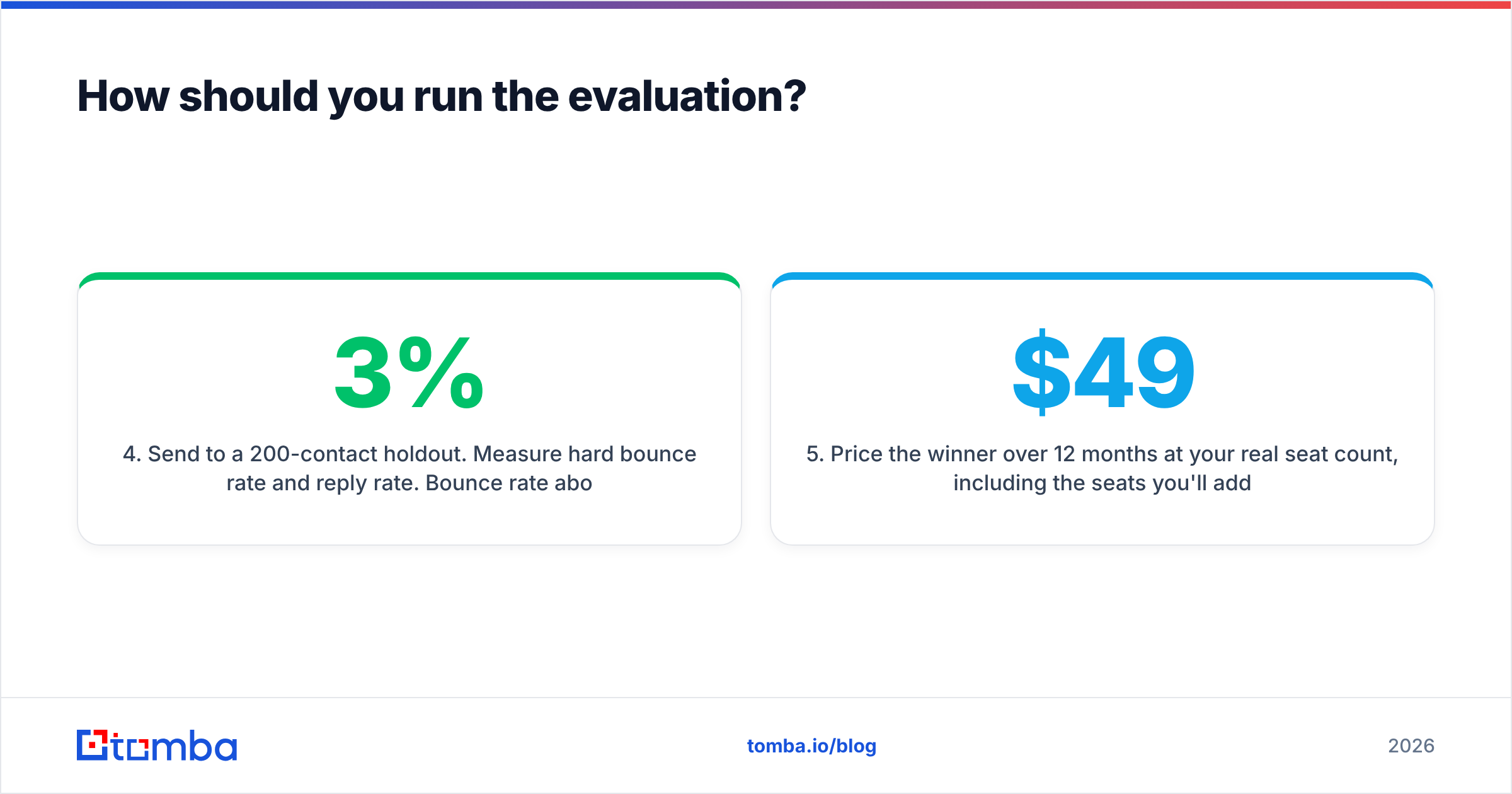
- Send to a 200-contact holdout. Measure hard bounce rate and reply rate. Bounce rate above 3% on a supposedly verified list is a red flag regardless of what the dashboard says.
- Price the winner over 12 months at your real seat count, including the seats you'll add mid-year. Then compare against the "boring" option — a $49–$99/mo email finder plus your existing CRM — and see whether the delta buys anything your team will genuinely use.
Most teams that run this test discover two things: their fill-rate gap is smaller than expected, and their biggest quality loss happens at the catch-all classification step, not at the sourcing step. Fixing the second is cheap. Paying for the first at enterprise rates often isn't.
So which one wins?#
For list-building at scale and ABM coverage: DealSignal. The on-demand verification model is real, the coverage of hard-to-find segments is its genuine moat, and if your ICP is narrow enough that generic databases fail you, this is what you're paying for. Budget for a contract, not a card swipe.
For rep productivity and CRM hygiene: LeadIQ. Capture-to-CRM with dedupe is the single highest-leverage workflow improvement most SDR teams can make, and LeadIQ does it as well as anyone. Just make sure your seat count matches your daily active users, not your org chart. If you're comparing it against similar tools, our LeadIQ alternative breakdown goes deeper on the capture-tool category.
For everyone whose real problem is "get me valid work emails, cheaply, via API": neither. That's the majority of teams, and it's the case both vendors quietly overserve.
Start with the free tier of the Tomba Email Finder — 25 searches a month, no card, no call. Run your 100-account test against it before you sit through a single enterprise demo. If Tomba covers your accounts at the fill rate you need, you just saved a five-figure contract. If it doesn't, you'll walk into those demos knowing exactly which coverage gap you're paying to close — which is a much better position than taking a vendor's word for it.
Related guides#
Ready to find emails that actually work?
Join 150,000+ professionals who stopped guessing and started sending. Free credits on signup — no credit card required.
Get the Tomba newsletter
Practical outbound tactics and product updates — once every two weeks.
About the author