DealSignal vs Leadzenai 2026: Which B2B Data Tool Wins?
DealSignal sells enterprise-grade verified contact data at enterprise prices. Leadzen.ai sells volume and speed at a fraction of the cost. Here is where each one actually wins, and where a cheaper third option beats both.
DealSignal vs Leadzenai — TL;DR
- DealSignal is a managed, verification-first B2B data platform. You buy accuracy and depth of coverage. You pay enterprise prices for it: quote-based contracts, annual terms, and a sales call before you see a number.
- Leadzen.ai is a self-serve lead tool with low prices, real-time search, and strong India and APAC coverage. Data quality varies more, and the tooling is thinner.
- Neither is a good fit if you only need verified work emails at companies you already know. That job is cheaper and faster with a dedicated email finder.
- Price is the headline gap. DealSignal deals often start in the four figures per month. Leadzen.ai starts near the cost of a team lunch.
- Our pick depends on scale. Under 5,000 contacts a month, neither pricing model works in your favour.
What are DealSignal and Leadzen.ai?#
DealSignal is a US-based B2B data provider built around on-demand verification. It does not ship you a static database dump. Instead it re-checks each contact record when you request it: email validation, phone checks, and title and employer confirmation. The pitch targets demand-gen and RevOps teams who have been burned by stale lists. They now care more about bounce rate than raw record count. See their official site for the current feature set.
Leadzen.ai attacks the same problem from the other end. It is a self-serve lead tool with a Chrome extension, real-time and bulk search, and a pricing page you can read without booking a demo. Its home turf is India and the wider APAC region. It indexes company and contact data that most US-first vendors cover thinly. Details are on the Leadzen.ai homepage.
The short version: DealSignal sells confidence. Leadzen.ai sells throughput.
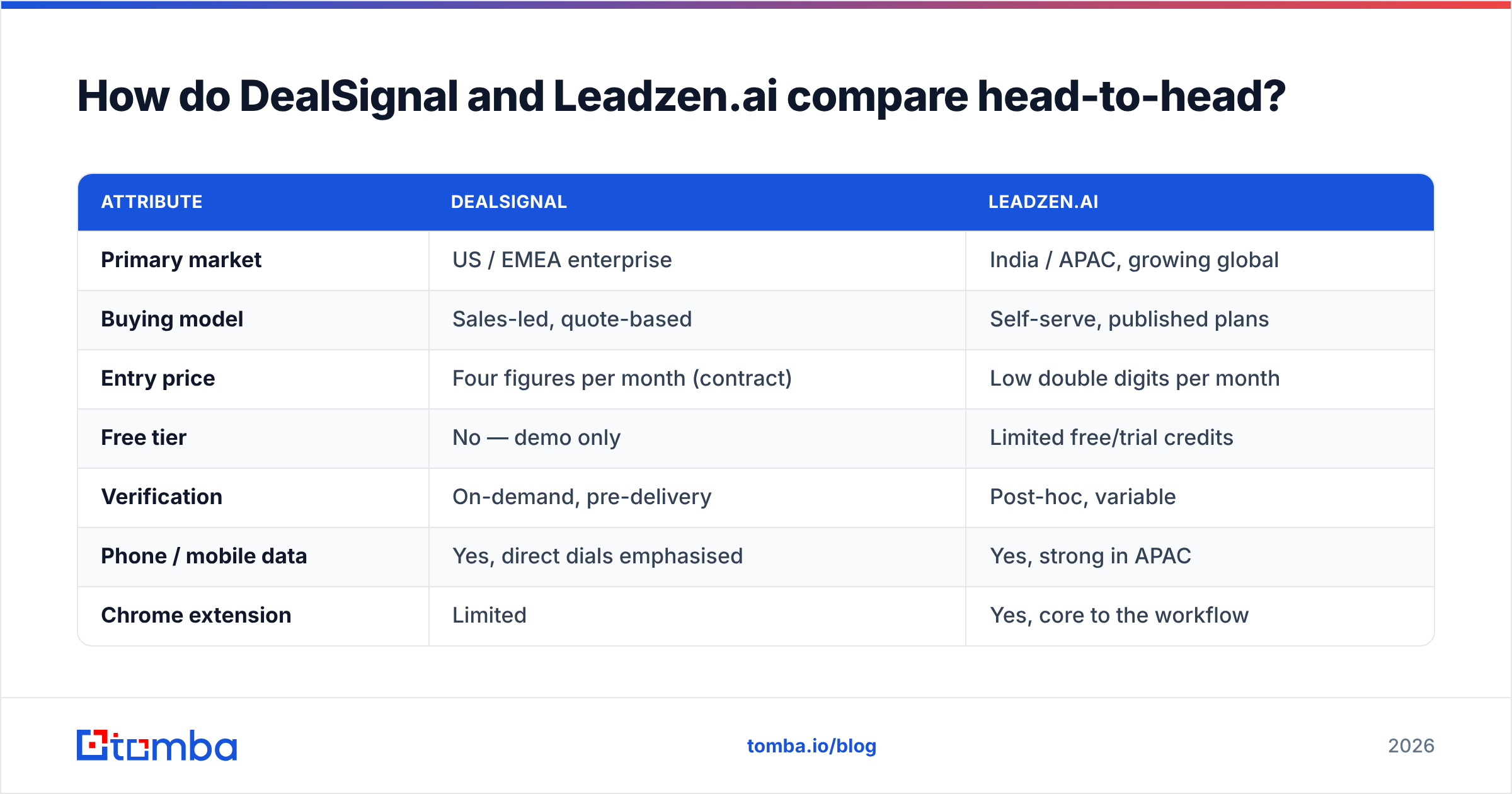
DealSignal vs Leadzenai: how do they compare head-to-head?#
| Attribute | DealSignal | Leadzen.ai |
|---|---|---|
| Primary market | US / EMEA enterprise | India / APAC, growing global |
| Buying model | Sales-led, quote-based | Self-serve, published plans |
| Entry price | Four figures per month (contract) | Low double digits per month |
| Free tier | No — demo only | Limited free/trial credits |
| Verification | On-demand, pre-delivery | Post-hoc, variable |
| Phone / mobile data | Yes, direct dials emphasised | Yes, strong in APAC |
| Chrome extension | Limited | Yes, core to the workflow |
| API access | Yes, enterprise tier | Yes, on higher plans |
| CRM sync | Salesforce, HubSpot, Marketo | Basic export + integrations |
| Best for | Enterprise ABM, data hygiene programs | SMB prospecting, high-volume outbound |
Read that table as two budget conversations, not two versions of the same product. If your CFO signs off on a $30k annual data line item, DealSignal is a real candidate. If your whole prospecting stack costs less than that, it never makes the shortlist.
How accurate is the data from each?#
Accuracy is where DealSignal earns its premium. It is also where Leadzen.ai's low price starts to make sense.
DealSignal verifies at the moment you ask. When you pull a list, records are checked before delivery. They do not sit in a warehouse and decay at 2–3% a month as people change jobs. That cuts hard bounces. Hard bounces are the thing that damages your sender reputation and, in turn, your email deliverability.
Leadzen.ai indexes broadly and verifies less. In practice you get higher match rates on obscure companies, especially outside North America. You also get more records you should re-check before you send. Reviewers on G2 split along this same line for both kinds of tool: praise for coverage, complaints about verification.

The takeaway for either tool is the same: run your own verification pass before the first send. Even a dataset claimed at 95% will drift between export and launch. Three weeks in a spreadsheet is enough to do it. A standalone email verifier costs far less than a blocklisting.
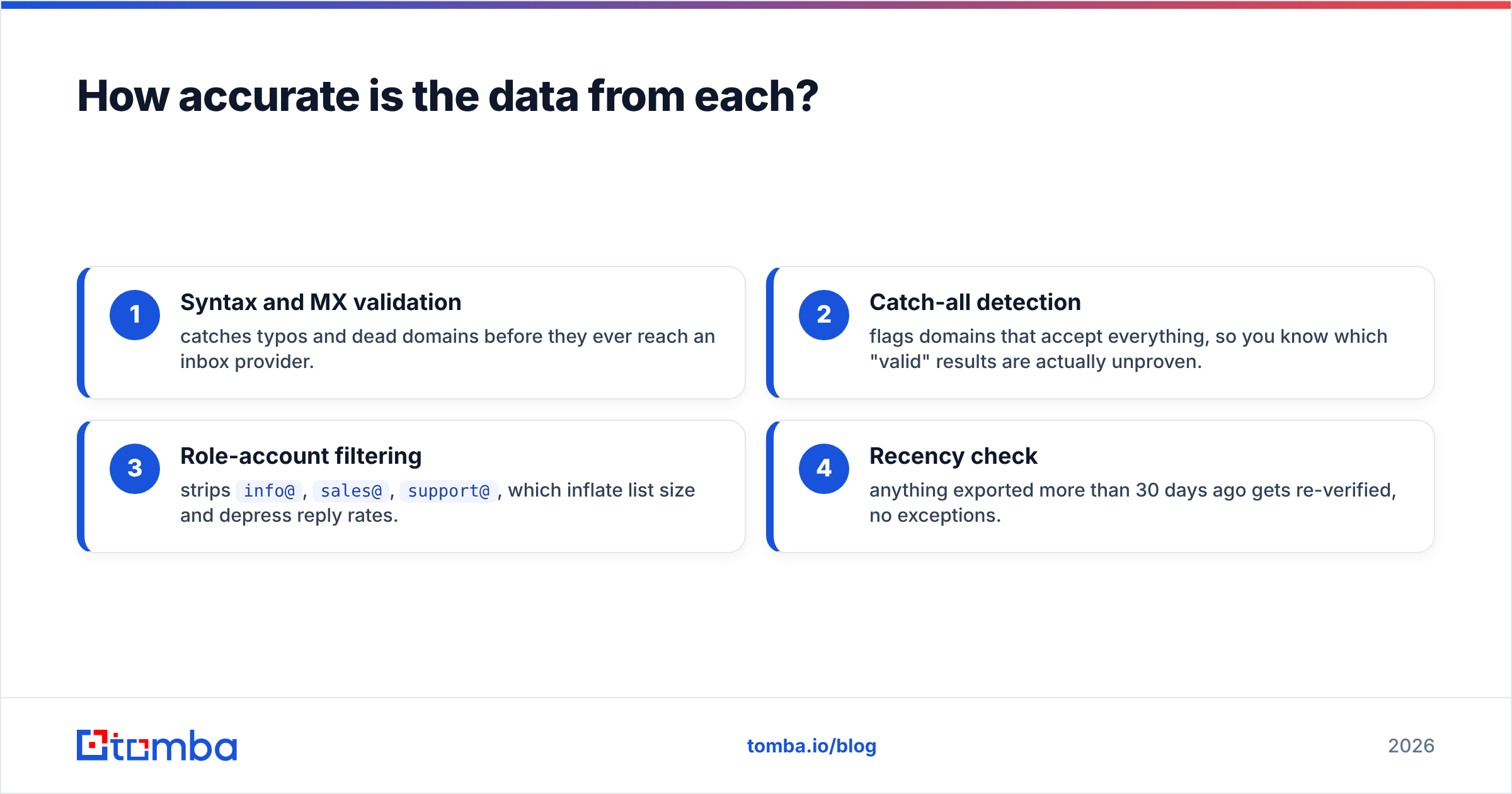
Four checks are worth building into your process, whatever you buy:
- Syntax and MX validation — catches typos and dead domains early.
- Catch-all detection — flags domains that accept every address, so you know which "valid" results are unproven.
- Role-account filtering — strips
info@,sales@, andsupport@. They pad your list and drag down reply rates. - Recency check — anything exported more than 30 days ago gets re-verified. No exceptions.
What does each one actually cost?#
Neither vendor makes this easy. The shape of the pricing is still clear enough.
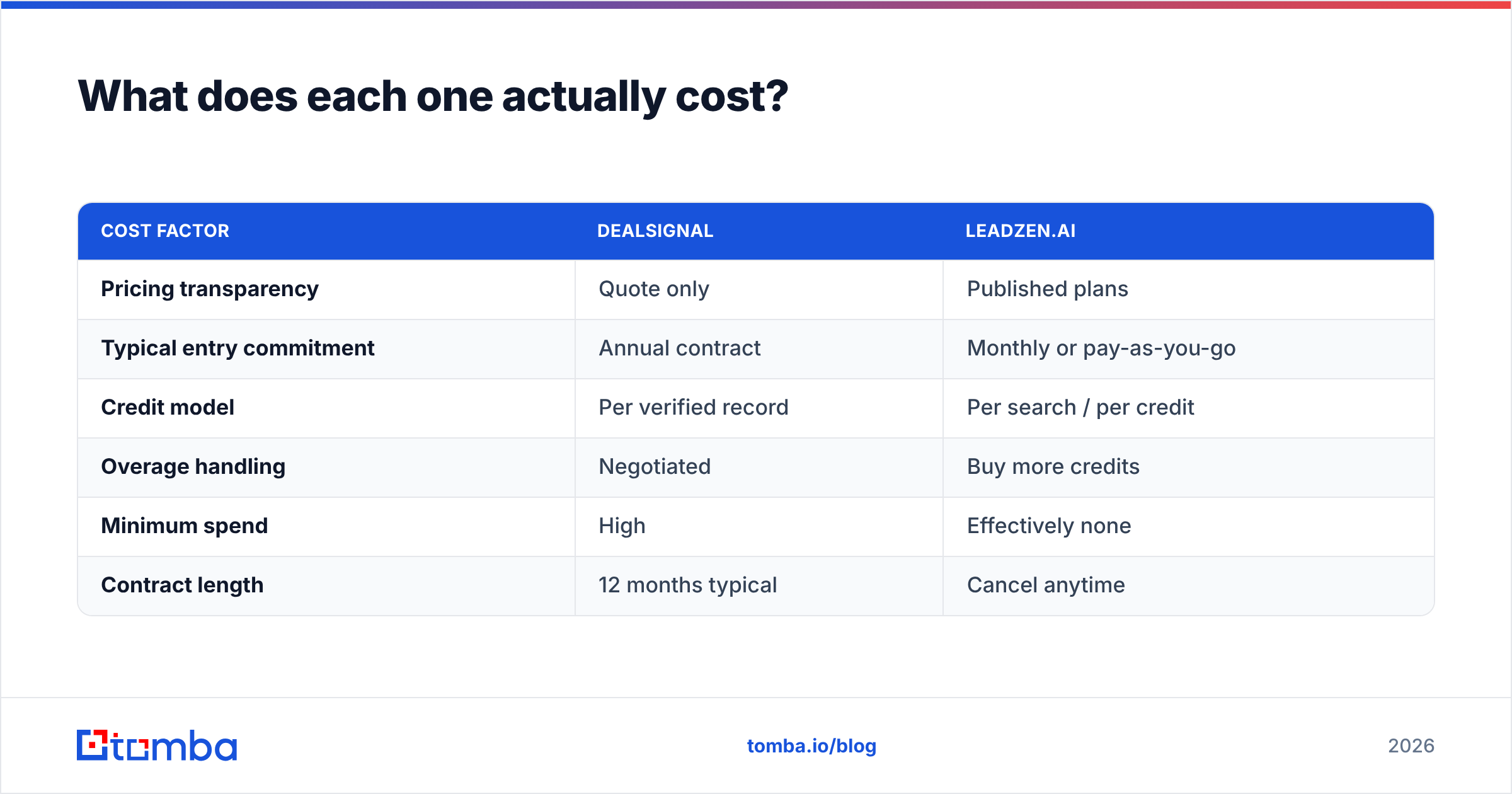
| Cost factor | DealSignal | Leadzen.ai |
|---|---|---|
| Pricing transparency | Quote only | Published plans |
| Typical entry commitment | Annual contract | Monthly or pay-as-you-go |
| Credit model | Per verified record | Per search / per credit |
| Overage handling | Negotiated | Buy more credits |
| Minimum spend | High | Effectively none |
| Contract length | 12 months typical | Cancel anytime |
DealSignal uses standard enterprise data pricing. You commit to a volume. You get a per-record rate. Unused credits are a negotiating point, not a promise. That works when your data need is large, steady, and easy to forecast: ABM list builds, CRM enrichment cycles, quarterly TAM refreshes.
Leadzen.ai suits the opposite pattern. Think bursty, exploratory prospecting where next month's volume is a guess. The trade-off is that per-record economics get worse as you scale. Support also becomes self-service.
The awkward middle case is a team that needs 2,000–10,000 verified contacts a month. That is too big for cheap pay-as-you-go credits and too small for enterprise leverage. A focused email finder with flat, published tiers beats both here. Tomba pricing runs from a free tier at 25 searches a month to Starter at $49/mo, Growth at $99/mo, and Pro at $249/mo. There is no sales call in between.
Which platform fits which team?#
Pick by the shape of the buying motion, not by feature checklist.
- Enterprise ABM with a data governance mandate — DealSignal. When legal, procurement, and RevOps all get a say, contracts with SLAs and documented sourcing are a feature, not a bug.
- India or APAC outbound — Leadzen.ai. Regional coverage beats most US-first vendors here. No budget fixes a thin regional index.
- SMB team running high-volume cold outbound — Leadzen.ai on price. Budget for outside verification. Bounce rates above 3% cost more in domain damage than you saved on data.
- Agency running campaigns for several clients — neither, cleanly. You need per-client cost tracking and no annual lock-in, which points to usage-based tools with an API.
- Product or growth team enriching signups — neither, again. You want a data enrichment endpoint you can call in code, not a UI-first prospecting tool.
- Small team targeting 200 known accounts — a domain search plus verification does this in an afternoon, for the price of one onboarding call.

Where does each platform fall short?#
DealSignal's weak points:
- No self-serve entry. You cannot test the data without a sales process, so head-to-head bake-offs move slowly.
- Annual deals punish seasonal demand. If your outbound pauses for a quarter, you still pay.
- The value drops below a few thousand records a month. You pay for enterprise plumbing you never use.
- Coverage outside North America and Western Europe is thinner than the marketing implies. Test your own geography before you sign.
Leadzen.ai's weak points:
- Verification is the recurring complaint. Plan on a second check as a permanent step in the workflow.
- Tooling is lighter than enterprise platforms. Fewer native CRM syncs, thinner admin controls.
- Support scales the way self-serve support usually does. Fine at $30/mo, painful when a campaign is stuck.
- Coverage outside APAC is uneven. A regional strength is being sold as a global one.
Neither list is a dealbreaker. These are the honest costs of each vendor's position. Both show up in public reviews on Capterra once you filter to your own company size.
Is there a better third option for most teams?#
For one common job, yes: finding and verifying work email addresses at companies you have already chosen.
The DealSignal vs Leadzenai debate assumes you need a database. Plenty of teams do not. Say your ICP is already set. You know the 500 accounts you want. You have a list of names from LinkedIn or a conference page. Then paying for a 200-million-record index solves the wrong problem. You need resolution, not discovery.

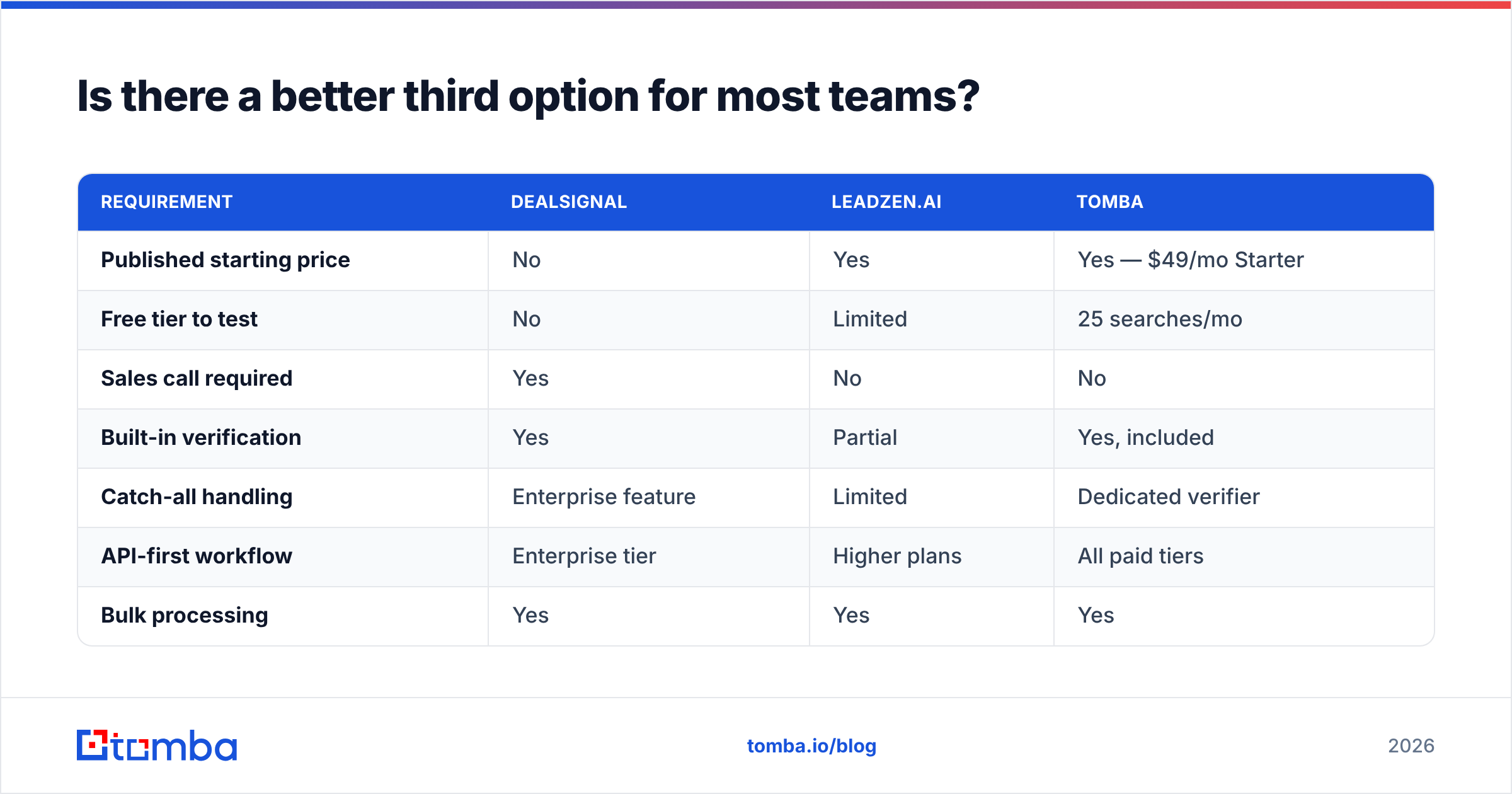
| Requirement | DealSignal | Leadzen.ai | Tomba |
|---|---|---|---|
| Published starting price | No | Yes | Yes — $49/mo Starter |
| Free tier to test | No | Limited | 25 searches/mo |
| Sales call required | Yes | No | No |
| Built-in verification | Yes | Partial | Yes, included |
| Catch-all handling | Enterprise feature | Limited | Dedicated verifier |
| API-first workflow | Enterprise tier | Higher plans | All paid tiers |
| Bulk processing | Yes | Yes | Yes |
| Spreadsheet add-ons | Via export | Via export | Sheets, Excel, Airtable |
| Annual lock-in | Typical | No | No |
The third-option argument does have a limit. If you truly need firmographic filters across millions of companies you have never heard of, a finder will not replace a database. Buy the database. But first count how many deals you closed last year that started with cold database discovery. Then count the ones that came from a named account list, an inbound signal, or a referral. For most B2B teams, that math reframes the whole purchase.
How should you run the evaluation?#
Do not buy on marketing claims. Run the same test against every candidate.
- Build a 100-contact ground-truth set. Use people you can check yourself: current customers, past colleagues, contacts you already email.
- Query each tool for those exact contacts. Track match rate and accuracy rate separately. Vendors blur the two on purpose.
- Run every returned address through an outside verifier. Not the vendor's own. You are testing their claim, not repeating it.
- Work out the true cost per usable contact. Divide total spend by verified-correct records, not by credits consumed. The result is often 2–4× the headline rate.
- Test your worst geography and your smallest targets. Everyone looks good on Fortune 500 US contacts. No one's data holds up on a 40-person manufacturer in Pune or Porto.
The test takes about half a day. It routinely saves teams from five-figure contract mistakes. If a vendor will not let you run it before you sign, that is data too.
Which one should you buy?#
Buy DealSignal if you are an enterprise with a governed data program, a real budget line, and steady volume across US and EMEA markets. The price makes sense when accuracy failures are expensive.
Buy Leadzen.ai if you are a lean team doing high-volume outbound in India or APAC, you can live with variable data quality, and you will build verification into the process rather than assume it away.
Buy neither if your real job is turning known people at known companies into verified, sendable email addresses. That is a narrower problem with a cheaper answer. Paying database prices for it is the most common overspend in the outbound stack.
Start narrow. Expand only when you can prove the database is the constraint. Tomba's Email Finder gives you 25 free searches a month to test against your own ground-truth list. No demo call, no annual commitment, and verification on every result. Run the five-step test above on it next to DealSignal and Leadzenai, then let your own cost-per-usable-contact number decide.
Related guides#
Ready to find emails that actually work?
Join 150,000+ professionals who stopped guessing and started sending. Free credits on signup — no credit card required.
Get the Tomba newsletter
Practical outbound tactics and product updates — once every two weeks.
About the author