DealSignal vs Oceanio: Which B2B Data Tool Wins in 2026?
DealSignal sells verified contact depth. Ocean.io sells lookalike account targeting. They solve different halves of the same problem — here is which one your pipeline actually needs, and what each really costs.
DealSignal vs Oceanio is a choice between two different jobs. DealSignal verifies people data on demand. Ocean.io finds companies that look like your best customers. Here is how the two compare in 2026 — and when neither one is what you actually need.
TL;DR
- DealSignal and Ocean.io are not really competitors. DealSignal is a contact-data platform built around on-demand verification; Ocean.io is an account-intelligence platform built around lookalike company search.
- Pick DealSignal if your bottleneck is "we have the target account list, we need accurate people and emails inside it."
- Pick Ocean.io if your bottleneck is "we don't know which companies to target" — its similarity engine expands a seed list of your best customers into a ranked ICP.
- Both are quote-only, annual-contract, seat-plus-credit vendors. Neither publishes transparent self-serve pricing, and both usually land in the four-to-five-figure annual range.
- If all you actually need is verified work emails at the contact level, a per-lookup tool like Tomba's email finder starts at $49/mo and skips the procurement cycle entirely.
What are DealSignal and Ocean.io, exactly?#
Think of building a pipeline like planning a dinner party. Ocean.io helps you write the guest list — it looks at the people who already showed up and loved it, then finds more people like them. DealSignal helps you get their actual phone numbers and addresses so the invitations arrive. Confusing the two is costly. You end up paying for a beautiful account list you cannot contact, or for verified emails at companies that were never going to buy.
DealSignal is a US-based B2B data provider (Foster City, CA) whose pitch is verification-on-demand. Rather than serving you a static database snapshot, it re-verifies records at the moment you request them, using a blend of machine validation and human research. It sells contact and account data with a wide attribute set: title, seniority, department, direct dials, firmographics, technographics, and intent signals. The typical buyer is a demand-gen or marketing-ops team that needs clean records flowing into Marketo, HubSpot, or Salesforce.
Ocean.io is a Copenhagen-based account-intelligence platform. Its core asset is a company graph built largely from website content and public web signals. That graph powers "lookalike" search: upload your closed-won accounts, and Ocean.io returns companies that resemble them semantically, not just by SIC code. It also offers contact data and ICP scoring, but the company layer is what people buy it for.
That difference cascades into everything else — coverage, pricing model, integrations, and who on your team gets the seat.
DealSignal vs Oceanio: how do they compare head to head?#
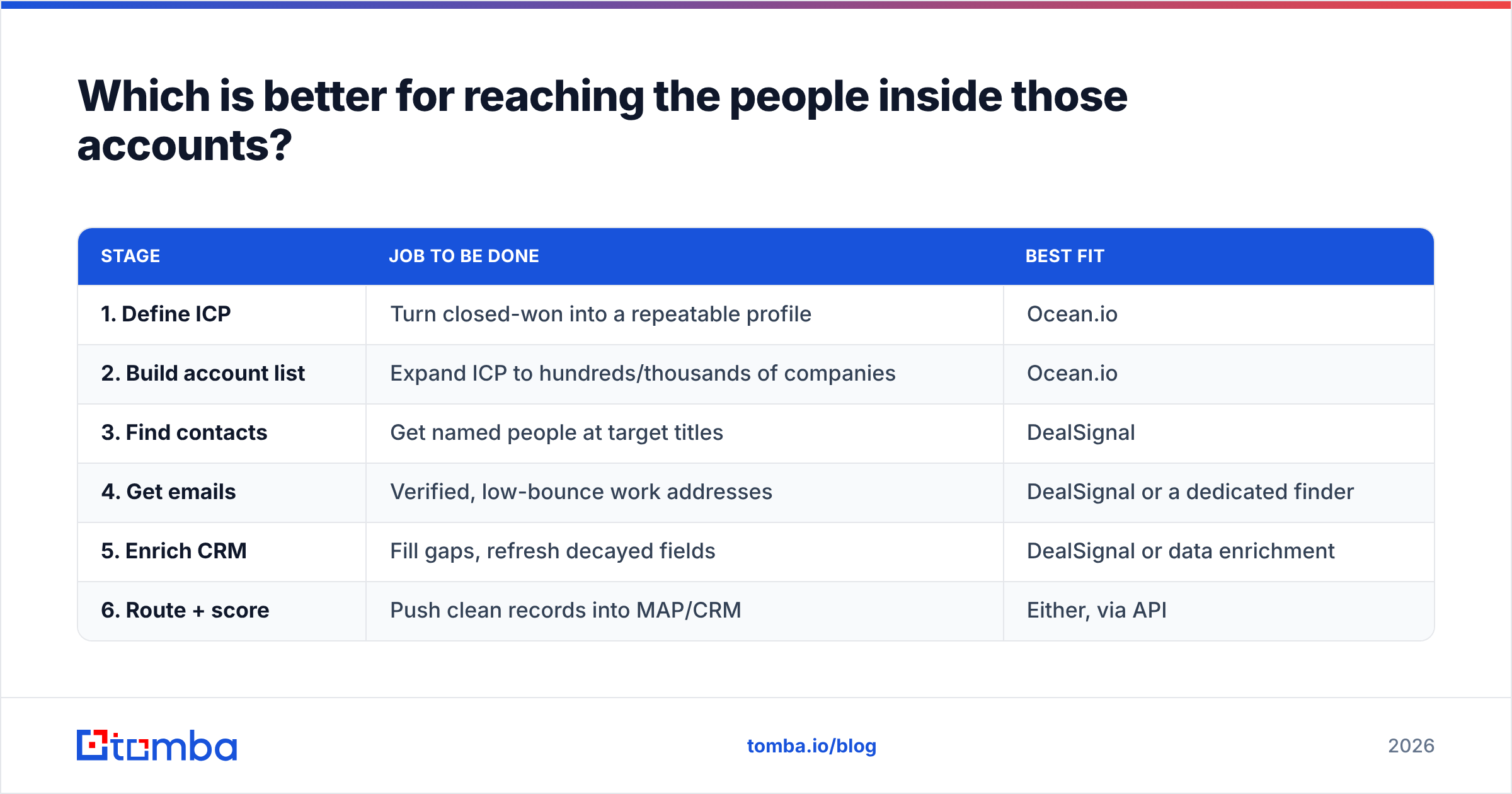
Here is the practical comparison, with Tomba included as the lightweight third option teams often end up combining with one of them.
| Attribute | DealSignal | Ocean.io | Tomba |
|---|---|---|---|
| Primary job | Verified contact + account records | ICP definition and lookalike account search | Email finding and verification |
| Core asset | Continuously re-verified people data | Company similarity graph from web content | Domain-level email patterns + verification |
| Best buyer | Demand gen / marketing ops | Founders, GTM strategy, ABM leads | SDRs, growth, developers |
| Entry price | Custom quote, annual | Custom quote, annual | Free tier, then $49/mo |
| Contract length | Typically 12 months | Typically 12 months | Monthly, cancel anytime |
| Free self-serve trial | No — demo-gated | Limited / demo-gated | Yes, 25 searches/mo |
| Direct dials | Yes, a headline feature | Limited | Phone finder add-on |
| Intent data | Yes (bundled/partnered) | Limited signals | No |
| API access | Yes | Yes | Yes, on all paid plans |
| CRM sync | Salesforce, HubSpot, Marketo | Salesforce, HubSpot, Pipedrive | HubSpot, Salesforce, Pipedrive, Zapier, Make |
| Geographic strength | Strongest in North America | Strongest in EMEA | Global, domain-driven |

The row that decides most deals is contract length. Both DealSignal and Ocean.io are annual commitments with a sales cycle attached. If you are testing a new segment for one quarter, that is a poor fit regardless of data quality.
Which one has better data accuracy?#
Neither vendor's marketing number should be taken at face value. This is the single most expensive mistake in data procurement.
Every B2B data vendor quotes accuracy somewhere between 90% and 98%. Those figures are self-reported. They are measured on samples the vendor chose, and they rarely define what "accurate" means. A record can be "accurate" because the person still works there, even though the email format changed. It can be "accurate" because the domain resolves, even if the mailbox bounces.
What actually differs between these two:
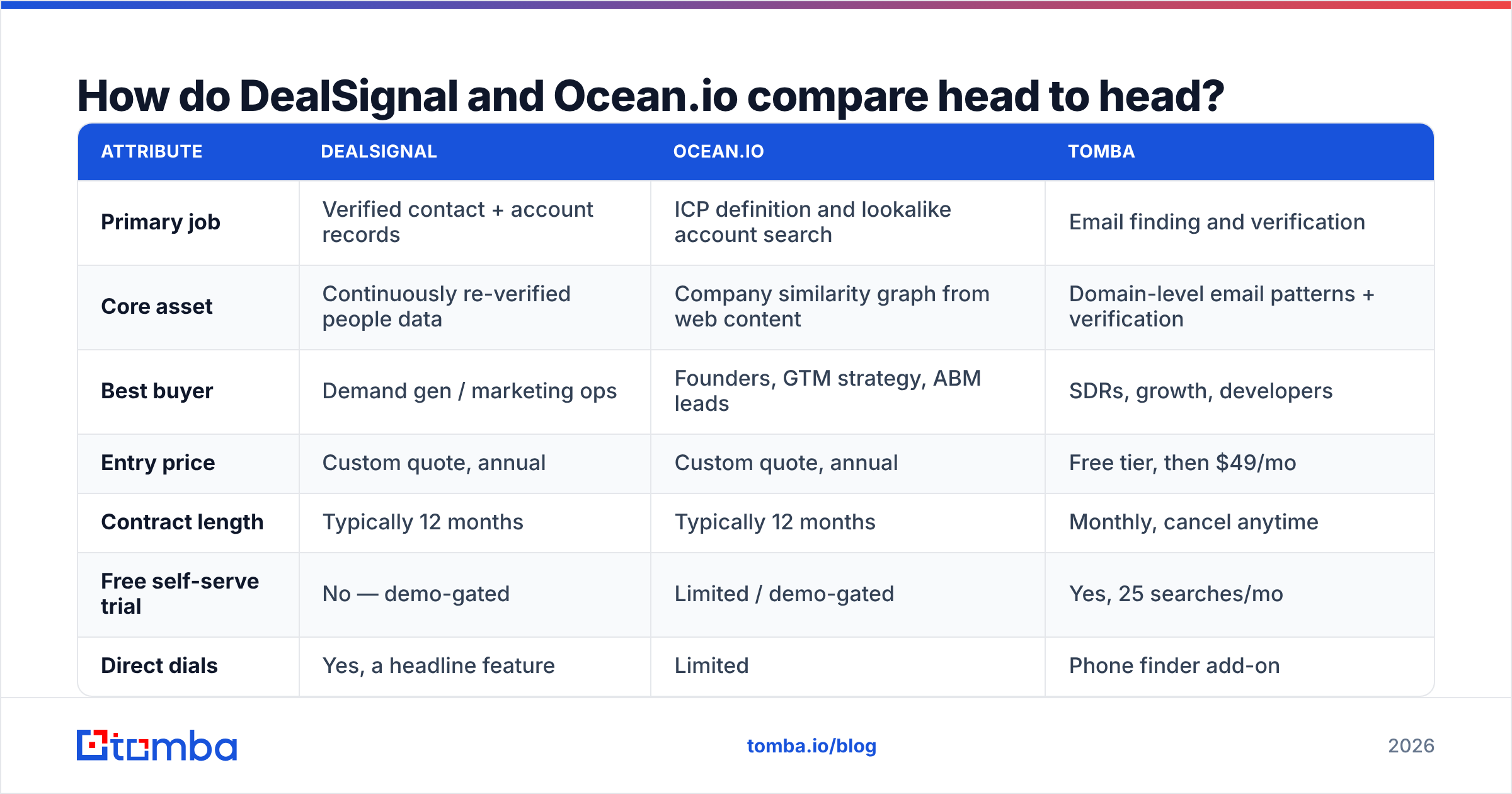
- DealSignal verifies at request time. This is a genuine architectural advantage over snapshot databases. When you pull a list, the records go through a fresh verification pass. They are not served from a cache that was last touched eight months ago. It costs more per record and it is slower for very large pulls. But decay is the number-one killer of B2B data, and this design attacks it directly.
- Ocean.io optimizes for company-level truth, not person-level truth. Its similarity engine reads what companies say about themselves on their own sites. That makes firmographic classification unusually good, including for private European companies that traditional providers miss. Contact-level emails are the weaker layer.
Coverage and edge cases matter just as much as the headline number:
- Coverage is regional, not universal. DealSignal skews North American. Ocean.io was built in Denmark, and its EMEA company coverage — especially DACH and the Nordics — is a real differentiator against US-first vendors.
- Catch-all domains break both. Roughly a fifth of business domains accept all mail, so no provider can confirm a mailbox via SMTP. Vendors either guess and inflate accuracy claims, or they flag the record. Ask each rep directly how catch-alls are scored. Then test with your own catch-all verifier before you trust the label.
- Bounce rate is the only metric that matters. Not "accuracy %". Run 500 records from each vendor through a neutral third-party email verifier and count hard bounces after a real send. That is your number.
Run that test during the trial, not after signing. Both vendors will give you a sample file if you ask. If a rep refuses to hand over 200 records for independent verification, treat that as an answer in itself.
Is Ocean.io better than DealSignal for finding new accounts?#
Yes — and it is not close, because that is the entire product.
Traditional account selection means picking industry codes, an employee-count band, and a geography. Then you hope the resulting list resembles your customers. It usually doesn't. SIC and NAICS codes were designed for government statistics decades before SaaS existed, and they cheerfully file a vertical AI compliance startup and a paper mill under adjacent codes.
Ocean.io's lookalike search reads what a company actually does, straight from its own website copy, and finds semantic neighbors. Feed it 30 closed-won logos and it returns a ranked list of companies that look like them the way a human researcher would judge similarity — not the way a taxonomy does.
Where this pays off:
- Net-new market expansion. Entering a vertical or region where you have no list to start from.
- ABM tiering. Scoring a large universe of accounts by fit before SDRs spend a minute on them.
- Founder-led GTM. You have 12 happy customers and need the next 400 companies that look like them.
DealSignal can also build lists. It has firmographic and technographic filters and can suppress against your CRM. But it is filtering a database, not modeling similarity. If you already know your ICP definition in filter terms, DealSignal's approach is fine and often faster. If your ICP is fuzzy and lives in your head, Ocean.io earns its price.
Which is better for reaching the people inside those accounts?#
DealSignal, clearly. Once the account list exists, the job shifts to contact discovery: the right titles, verified emails, direct dials, and enough attributes to personalize.
DealSignal's persona-based targeting and direct-dial coverage are its strongest selling points. Its verification-on-demand model also means the phone number you dial was checked recently, not in a quarterly refresh. For a marketing-ops team feeding a nurture engine, that is the whole value proposition.
Ocean.io does ship contact data, and it has improved. Still, buyers consistently report thinner coverage at the person level, especially outside common revenue-facing titles. Reviews on G2 for both products echo the same split: praise for Ocean.io's targeting logic, praise for DealSignal's record quality, and complaints about pricing opacity on both sides.
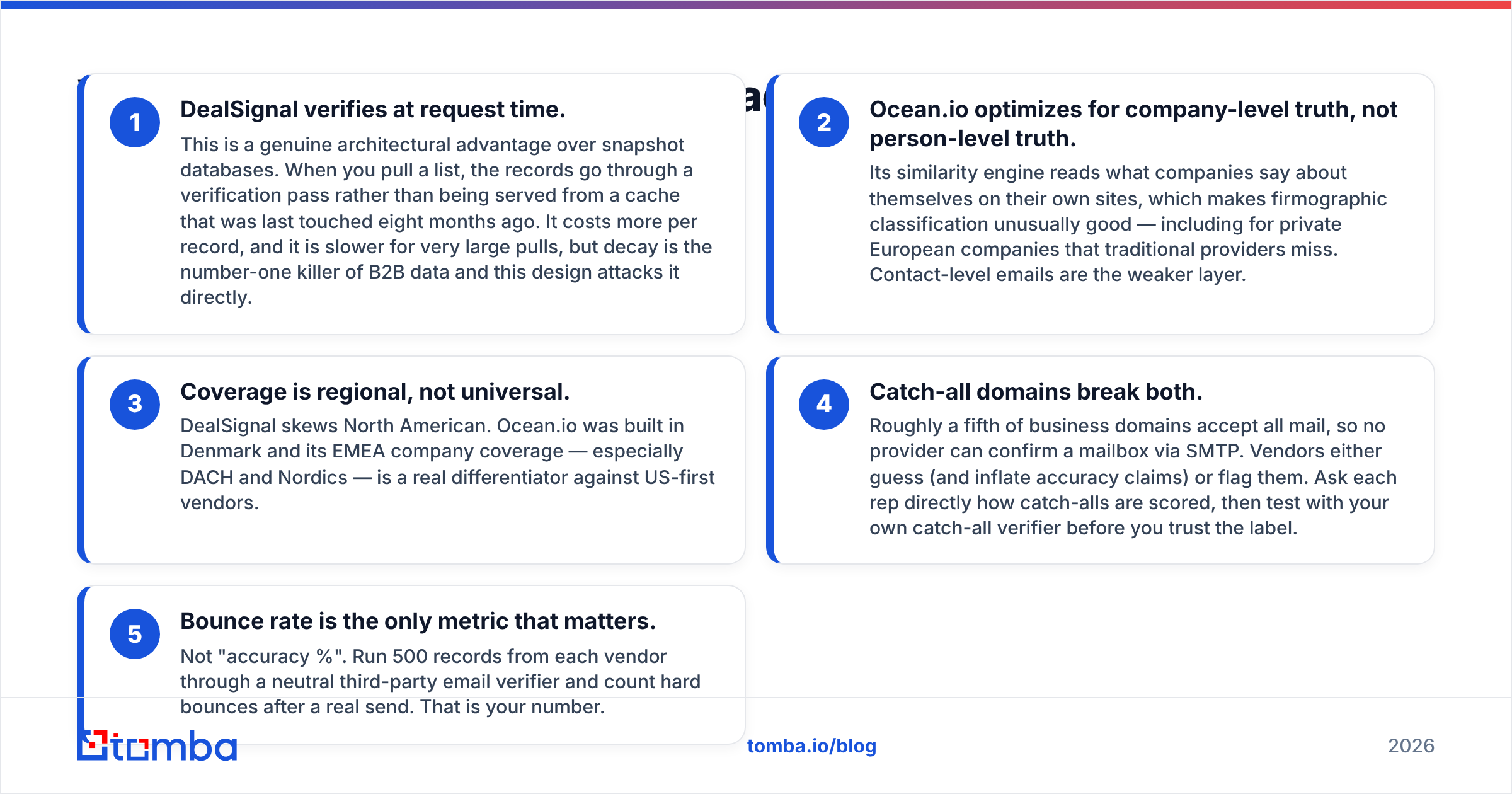
The common pattern in mature stacks is to use them for different stages:
| Stage | Job to be done | Best fit |
|---|---|---|
| 1. Define ICP | Turn closed-won into a repeatable profile | Ocean.io |
| 2. Build account list | Expand ICP to hundreds/thousands of companies | Ocean.io |
| 3. Find contacts | Get named people at target titles | DealSignal |
| 4. Get emails | Verified, low-bounce work addresses | DealSignal or a dedicated finder |
| 5. Enrich CRM | Fill gaps, refresh decayed fields | DealSignal or data enrichment |
| 6. Route + score | Push clean records into MAP/CRM | Either, via API |
Very few teams need both platforms at full price. Most need one of them plus something cheap for stage 4.
What do DealSignal and Ocean.io actually cost?#
Neither publishes a price. Both are quote-driven, seat-based, and typically annual, with a credit allocation layered on top.

What that means in practice:
- Expect a discovery call before a number. Both vendors qualify by team size and use case first. Budget two to four weeks from first contact to signature.
- Credits are the real meter. Ask exactly what consumes a credit: a revealed email, a revealed phone, an enrichment call, an export. Vendors differ, and a "500,000 record" plan can mean far fewer usable exports than it sounds like.
- Seats multiply fast. A price that looks reasonable for three users often doubles at eight.
- Rollover and overage terms matter more than the headline. Unused credits that expire monthly are effectively a price increase.
- Annual lock-in is the hidden cost. If the data underperforms in month two, you are still paying in month eleven.
Compare that to per-lookup tooling. Tomba's pricing is public: a free tier with 25 searches per month, Starter at $49/mo, Growth at $99/mo, Pro at $249/mo, and custom Enterprise. You can validate whether the data works for your segment on a Tuesday afternoon, without a procurement thread.
That is not a claim that Tomba replaces an enterprise account-intelligence platform. It doesn't do lookalike modeling or intent. It is a claim that a large share of teams buying these platforms only ever use the "find and verify the email" slice, and are paying enterprise rates for it.
Which should you choose in 2026?#
Match the tool to the actual bottleneck. The DealSignal vs Oceanio call is rarely about which database is better. It is about which gap you are filling first.
Choose DealSignal if:
- You have a defined ICP and named target accounts already.
- Direct dials matter — you run a calling motion, not just email.
- You need records flowing continuously into Marketo, HubSpot, or Salesforce with decay control.
- Your primary market is North America.
- You have budget for an annual contract and someone to own the vendor relationship.
Choose Ocean.io if:
- Your ICP is unclear or you are entering a new market.
- You sell into Europe, especially DACH and the Nordics, where US-first databases thin out.
- ABM tiering and account scoring are the work, and contacts come later.
- Semantic company matching beats filter-based list building for your category.
Choose a per-lookup email finder if:
- You already know who you want to reach and just need verified addresses.
- You want to test a segment this month, not next fiscal year.
- Your volume is a few thousand contacts a month, not hundreds of thousands.
- You want bulk email finder runs and domain search without a seat license per teammate.
Many teams land on a cheaper hybrid. Use Ocean.io, or a one-time list build, to define and source the account universe. Then run per-domain contact discovery and verification through a cheap, API-first finder. You pay the strategy premium once and the contact cost per unit.
How should you run the evaluation?#
Do not evaluate on the demo. Evaluate on your list.
- Bring 100 accounts you already know. Include 20 you have hard data on — current customers, recent closed-lost, companies where you know the exact org chart. Every vendor looks great on a list they picked.
- Measure fill rate, not database size. "600M contacts" is irrelevant. What percentage of your 100 accounts returned a usable contact at the right title?
- Verify externally. Export the emails and run them through an independent checker. Count hard bounces on a real send of 200.
- Time the export. Verification-on-demand is slower than cached lookups. If you need 50,000 records by Friday, ask about queue times.
- Read the credit clause twice. Rollover, expiry, overage rate, and what counts as a consumed credit.
- Ask for month-to-month. Both vendors say no by default. Some say yes at a premium. It is worth the ask when you are unsure.
Run the same six steps against both vendors and one cheap alternative in parallel. The answer is usually obvious by step three, and it is frequently not the vendor with the best deck.
Ready to test contact data without an annual contract?#
Plenty of DealSignal vs Oceanio evaluations end the same way: the team mostly needed verified work emails, fast. If that sounds like yours, start there before you sign anything. Tomba's Email Finder gives you domain-level discovery, per-contact lookups, and verification through one API, with a free tier of 25 searches a month and paid plans from $49/mo. Run your 100-account benchmark against it alongside DealSignal and Ocean.io. If the fill rate and bounce rate hold up on your segment, you just saved a procurement cycle and four figures a month.
Related guides#
Ready to find emails that actually work?
Join 150,000+ professionals who stopped guessing and started sending. Free credits on signup — no credit card required.
Get the Tomba newsletter
Practical outbound tactics and product updates — once every two weeks.
About the author