DealSignal vs OutboundView: Which Fits Your 2026 Pipeline?
DealSignal sells verified B2B contact data. OutboundView sells the humans who do the outbound. Here's how the two actually compare on price, output, and when each one is the wrong call.
TL;DR
- These are not competitors. DealSignal is a B2B contact data platform that sells verified records. OutboundView is a services agency that sells SDR labor, campaign strategy, and appointment setting. Comparing them is comparing a parts supplier to a mechanic.
- DealSignal is priced per record with annual contracts that typically start in the $5,000–$12,000/year range depending on volume and enrichment depth. You get data, an API, and CRM sync — not people.
- OutboundView is a retainer engagement, usually $4,000–$10,000+/month for managed outbound or SDR-as-a-service. You get campaign execution — but you're renting an outcome, not building an asset.
- The honest third option: if you already have someone who can write and send, you don't need either. A per-lookup email finder at $49/mo covers most sub-500-prospect-per-month teams for a fraction of both.
- Decide by what you're missing: missing contacts → data tool. Missing headcount → agency. Missing both but under 10 employees → start with cheap data and one internal rep.
What are DealSignal and OutboundView, actually?#
Most "DealSignal vs OutboundView" searches come from someone who Googled "B2B lead generation" and landed on two vendors that sell completely different things. Sorting that out first saves you a wasted demo call.
DealSignal is a B2B data platform. It maintains a contact and company database, runs on-demand verification against records at the moment of delivery, and pushes enriched data into Salesforce, HubSpot, Marketo, or wherever your GTM stack lives. Its pitch is freshness: rather than serving a static database snapshot, DealSignal claims to re-verify records when you request them. You buy credits, you build a target list by filters (title, industry, headcount, tech stack, geography), you export or sync.
OutboundView is a B2B lead generation and appointment-setting agency out of Indianapolis. It runs outbound campaigns on your behalf — email, LinkedIn, sometimes phone — and delivers meetings on your calendar. It also does SDR consulting: building the playbook, hiring guidance, tech-stack setup. You're paying for humans and process, not a database seat.
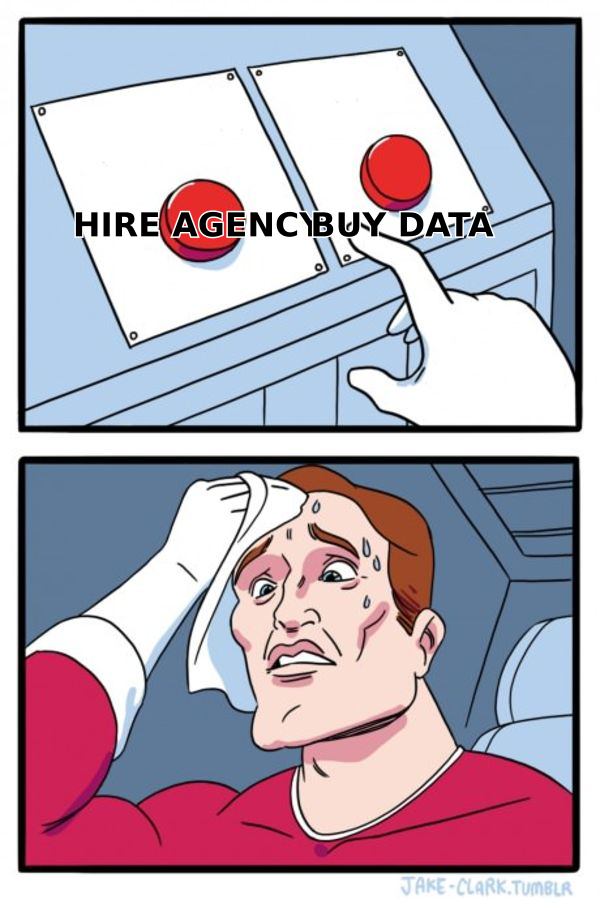
So the real question isn't "which is better." It's which gap in your revenue motion are you filling?

How do DealSignal and OutboundView compare head-to-head?#
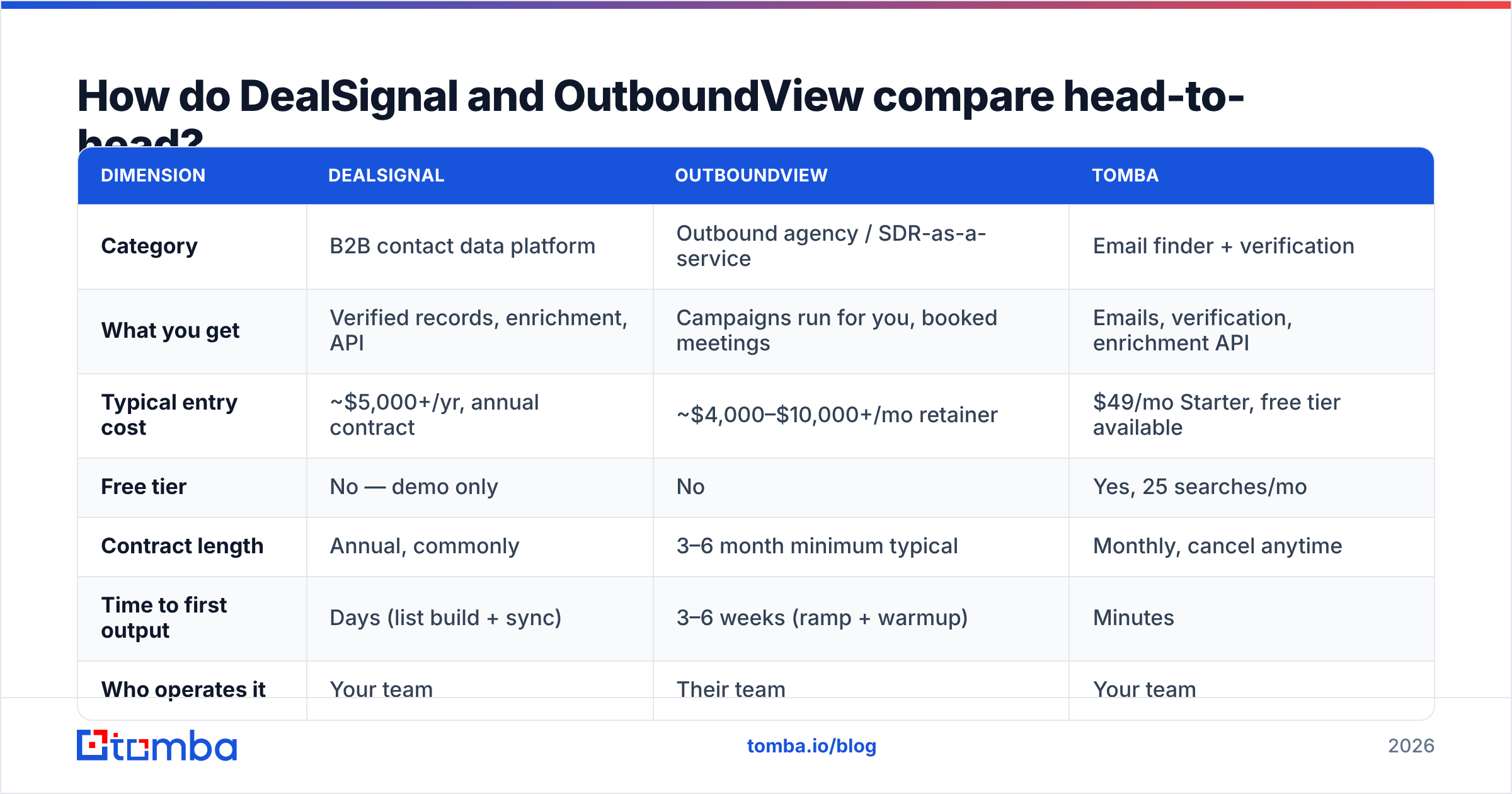
Here's the split laid out plainly. Prices reflect publicly reported ranges and typical mid-market deal sizes as of 2026 — both vendors quote custom, so treat these as a planning range, not a quote.
| Dimension | DealSignal | OutboundView | Tomba |
|---|---|---|---|
| Category | B2B contact data platform | Outbound agency / SDR-as-a-service | Email finder + verification |
| What you get | Verified records, enrichment, API | Campaigns run for you, booked meetings | Emails, verification, enrichment API |
| Typical entry cost | ~$5,000+/yr, annual contract | ~$4,000–$10,000+/mo retainer | $49/mo Starter, free tier available |
| Free tier | No — demo only | No | Yes, 25 searches/mo |
| Contract length | Annual, commonly | 3–6 month minimum typical | Monthly, cancel anytime |
| Time to first output | Days (list build + sync) | 3–6 weeks (ramp + warmup) | Minutes |
| Who operates it | Your team | Their team | Your team |
| Best for | RevOps teams with existing SDRs | Companies with budget but no SDRs | Founders, small teams, developers |
| Scales with | Record volume | Headcount you rent | API calls |
| Asset you keep | The data | The meetings (and learnings) | The data |
The row that matters most is the last one. With a data platform you keep an asset. With an agency you keep the meetings but the institutional knowledge — what messaging landed, which segments replied — often walks out the door when the contract ends unless you demand documentation in writing.
When is DealSignal the right choice?#
DealSignal makes sense in a specific configuration: you already have reps, you already have sequencing software, and your bottleneck is that your existing list is decayed or too narrow.
Signs DealSignal fits:
- You have 2+ SDRs already sending. Data without senders is a spreadsheet.
- Your CRM is polluted. Enrichment and re-verification against an existing 50,000-record Salesforce instance is where per-record platforms earn their price.
- You target a defined ICP with hard filters. DealSignal's value is in slicing by firmographics and technographics, not in one-off lookups.
- You need compliance documentation. Mid-market and enterprise buyers care about GDPR/CCPA sourcing records, and data vendors at this tier provide them. Check where the data comes from with any vendor before you sign — sourcing transparency separates the serious from the scraped.
- Annual budget is already allocated. Per-record platforms rarely do useful monthly terms.
Signs it doesn't: you're a two-person startup, your ICP changes every quarter, or you need 200 emails this week and not 20,000 this year. Annual data contracts punish experimentation. If your ICP is still moving, you're paying to lock in a definition you haven't validated yet.
When is OutboundView the right choice?#
Agencies get unfairly maligned by the "just hire an SDR" crowd. The math is often better than it looks — a fully loaded SDR in a US metro runs $75,000–$95,000 with ramp time, tooling, and management overhead. A retainer at $6,000/month is $72,000/year with no hiring risk, no ramp, and no severance.
OutboundView fits when:
- You have product-market fit but no outbound muscle. You know who buys and why; you just have nobody to reach them.
- Your ACV justifies it. At a $2,000 ACV you need to close roughly 36 deals a year just to break even on a $6k/mo retainer before considering your own delivery costs. At a $40,000 ACV, two closed deals pay for the year.
- You want a playbook, not just meetings. OutboundView's consulting arm is arguably stronger positioning than pure appointment-setting — the deliverable is a repeatable motion you can eventually take in-house.
- You need speed to market. Six weeks to a running campaign beats four months to hire, onboard, and ramp a rep.
It doesn't fit when your product needs deep technical qualification, when your sales cycle is heavily relationship-driven, or when you're pre-PMF. No agency can sell a product whose buyer you haven't identified. Every outbound agency's worst client is the one who hasn't figured out their own positioning — and they'll burn 90 days of retainer proving it.
Is there a cheaper path than either one?#
Yes, for a large slice of buyers. Here's the uncomfortable arithmetic: most companies searching "DealSignal vs OutboundView" are sending fewer than 1,000 cold emails a month. At that volume you are massively overbuying with either vendor.
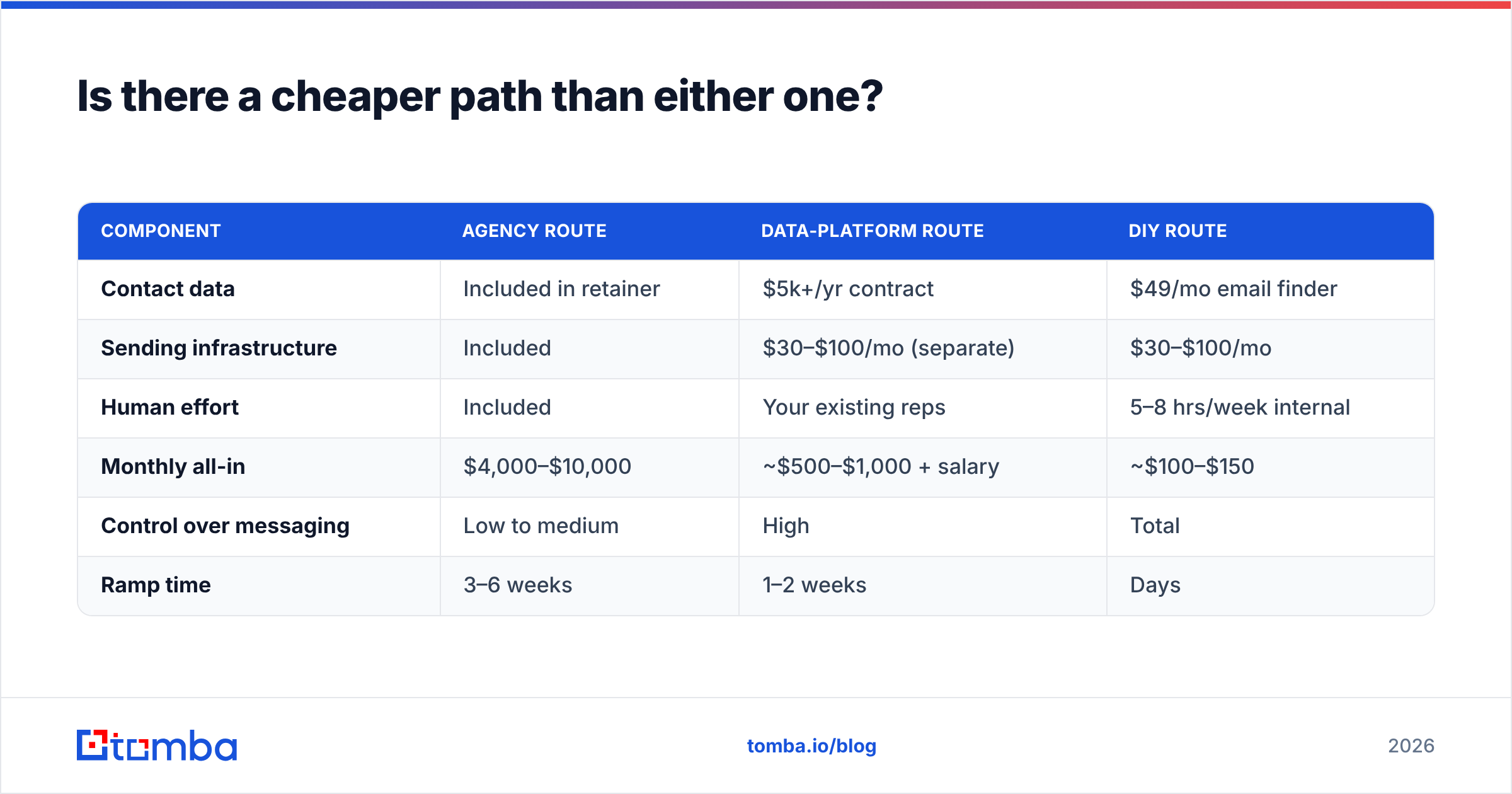
Break outbound into its three components and price each honestly:
| Component | Agency route | Data-platform route | DIY route |
|---|---|---|---|
| Contact data | Included in retainer | $5k+/yr contract | $49/mo email finder |
| Sending infrastructure | Included | $30–$100/mo (separate) | $30–$100/mo |
| Human effort | Included | Your existing reps | 5–8 hrs/week internal |
| Monthly all-in | $4,000–$10,000 | ~$500–$1,000 + salary | ~$100–$150 |
| Control over messaging | Low to medium | High | Total |
| Ramp time | 3–6 weeks | 1–2 weeks | Days |
The DIY route only works if someone on your team will genuinely spend those 5–8 hours a week. If nobody will, the agency is not expensive — it's the only option that produces anything at all. A cheap stack that nobody operates costs infinitely more per meeting than a $6,000 retainer that books eight.
For teams that will do the work, the stack is straightforward: find contacts with a domain search across target companies, run everything through an email verifier before it touches your sending domain, and push into whatever sequencer you already pay for. Tomba's pricing runs Free (25 searches/mo), Starter at $49/mo, Growth at $99/mo, and Pro at $249/mo — the Growth tier covers most teams sending under 2,000 emails monthly.
How do you evaluate data accuracy claims from either vendor?#
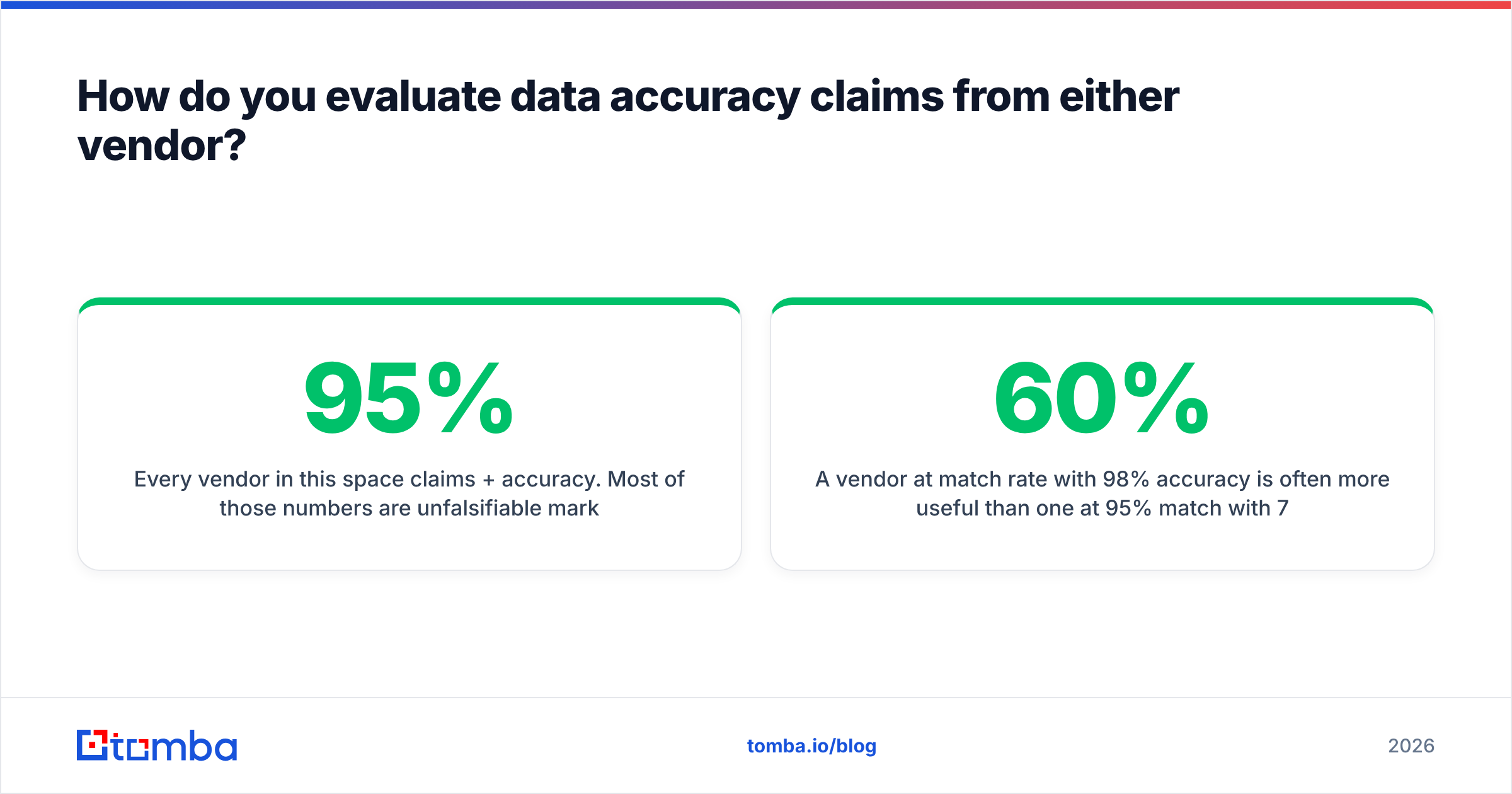
Every vendor in this space claims 95%+ accuracy. Most of those numbers are unfalsifiable marketing. Here's how to force a real answer.
Run a blind sample test. Take 100 contacts you already know are correct — current employees at accounts you've closed, people you've emailed successfully in the last 90 days. Ask each vendor to enrich that list. Measure:
- Match rate: what percentage did they return anything for?
- Accuracy on matched records: of the returns, how many match your known-good data?
- Bounce rate on the delta: for records they returned that you didn't have, send a verification-only pass and count hard bounces.
A vendor at 60% match rate with 98% accuracy is often more useful than one at 95% match with 70% accuracy — the second one poisons your sender reputation. Every hard bounce compounds against your email deliverability, and a domain burned in month one costs more than the entire annual data contract.
For agencies, the equivalent test is different. Ask OutboundView (or any agency) for:
- Three references in your exact ACV band and industry
- The actual meeting-to-opportunity conversion from those accounts, not just meetings booked
- Who specifically writes the copy — a strategist or an offshore contractor
- What happens to the domain reputation if the campaign underperforms (are they sending from your domain or theirs?)
That last question separates the professionals from the churn shops. Sending from your primary domain on a campaign you don't control is how companies end up in Gmail's spam folder for a year. Reputable agencies buy secondary domains, warm them properly, and never risk your corporate mail flow.
Independent review platforms are worth twenty minutes here. Both G2 and Capterra carry verified reviews for data vendors, and for agencies the more useful signal is Clutch-style reference checks. Read the two-star reviews specifically — five-star reviews tell you the pitch worked, two-star reviews tell you where the product breaks.
What does a sensible 2026 stack look like at each stage?#
Rather than picking one vendor, match spend to stage.
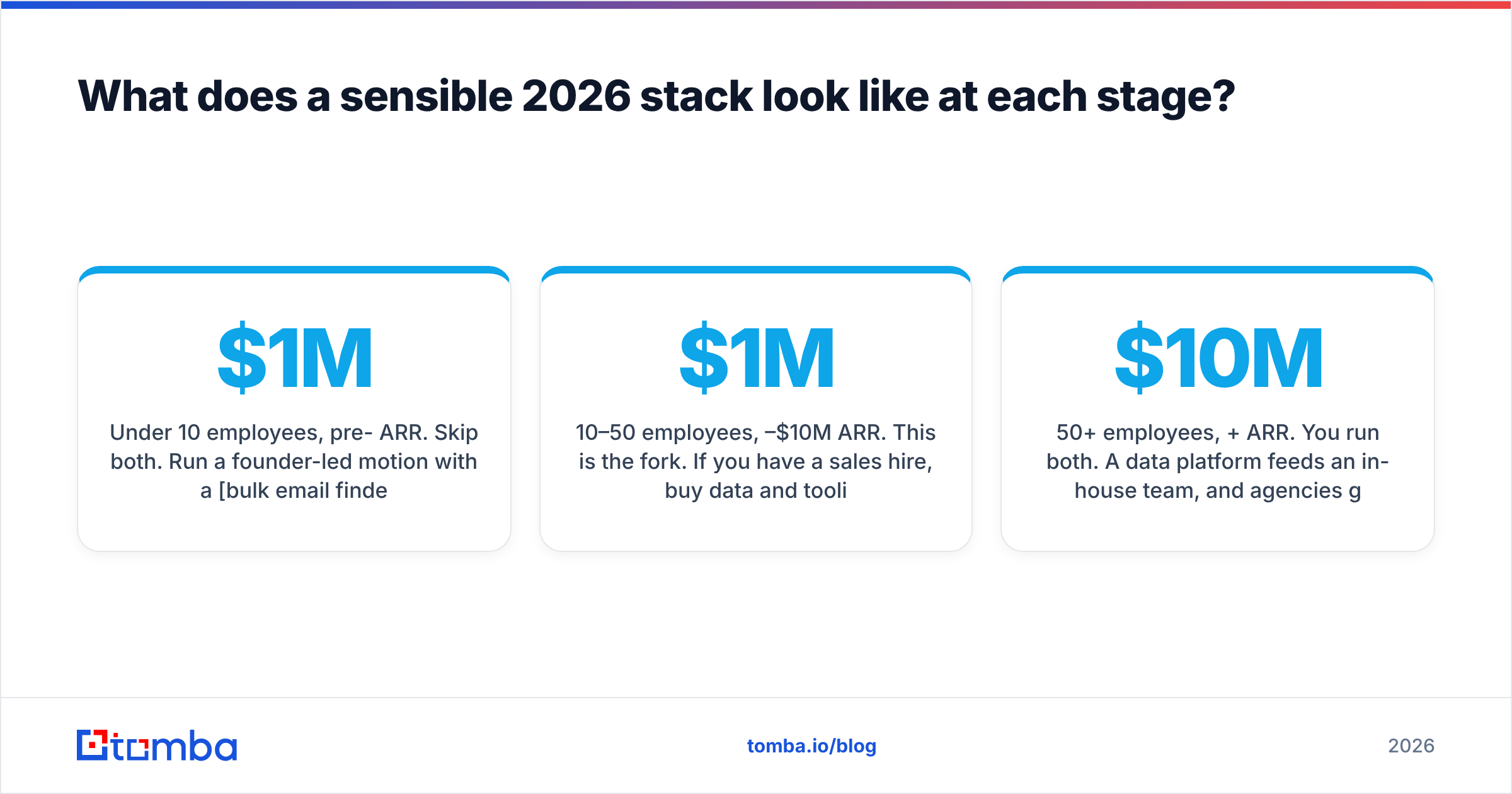
Under 10 employees, pre-$1M ARR. Skip both. Run a founder-led motion with a bulk email finder and a $30/mo sequencer. Your total outbound cost should be under $200/month. Your constraint is message quality, not data volume, and no vendor fixes message quality.
10–50 employees, $1M–$10M ARR. This is the fork. If you have a sales hire, buy data and tooling — that's the DealSignal-shaped slot, though you should price it against other enrichment vendors before signing annual. If you don't have a sales hire and won't for two quarters, an agency retainer buys you time and a playbook.
50+ employees, $10M+ ARR. You run both. A data platform feeds an in-house team, and agencies get used for specific plays — new market entry, an event push, a segment you don't want to distract core reps with. At this stage the enrichment API matters more than any UI, because your ops team is piping data programmatically into a CRM that's the actual source of truth. HubSpot's sales research and Gartner's B2B buying studies both point the same direction: the winning teams aren't the ones with the biggest lists, they're the ones with the tightest routing between data, message, and follow-up.
Worth naming another category entirely: verified-database vendors like BookYourData sell pay-as-you-go lists with bounce guarantees, which sidesteps the annual-contract problem that makes platform-tier data hard for smaller teams to justify. If your objection to DealSignal is the contract length rather than the data itself, that model is worth a look before you default to an agency.
What's the actual verdict on DealSignal vs OutboundView?#
Buy DealSignal if you have reps, a defined ICP, a polluted CRM, and annual budget. You're buying an input to a machine that already runs.
Buy OutboundView if you have budget, PMF, a healthy ACV, and no outbound headcount. You're buying the machine itself, rented.
Buy neither if you're under 1,000 sends a month, have someone willing to own outbound internally, or are still testing which ICP responds. At that stage, the annual contract and the retainer are both premature — you'd be paying enterprise prices to answer a question a $49/mo tool answers in a week.
The failure mode to avoid is buying the expensive option to compensate for an unanswered strategic question. No data vendor and no agency can tell you who your buyer is. They can both execute brilliantly against an answer you supply, and both will burn your budget efficiently against an answer you don't have.
Start with the cheapest tool that produces real replies. When it works and the constraint becomes volume, buy data. When it works and the constraint becomes hours, buy people. In that order.
Ready to test outbound before committing to a contract? Tomba's Email Finder gets you verified professional emails by domain, name, or company — 25 free searches to prove the motion works, then $49/mo when it does. No annual commitment, no six-week ramp. Find your first 100 prospects today and let the results decide what you buy next.
Related guides#
Ready to find emails that actually work?
Join 150,000+ professionals who stopped guessing and started sending. Free credits on signup — no credit card required.
Get the Tomba newsletter
Practical outbound tactics and product updates — once every two weeks.
About the author