DealSignal vs Pubrio: Which B2B Data Platform Wins in 2026?
DealSignal sells verified, on-demand contact data to enterprise RevOps teams. Pubrio sells AI-assisted prospecting to small outbound teams. Here is the honest breakdown of pricing, accuracy, coverage, and which one actually fits your motion.
DealSignal vs Pubrio comes down to one question. Do you need governed enterprise data, or a fast self-serve list? This guide covers price, accuracy, coverage, and fit.
TL;DR
- DealSignal is an enterprise B2B data platform. It is built around on-demand verification and large custom data builds. It wins on coverage depth, firmographic fields, and CRM hygiene work. It also prices like an enterprise vendor.
- Pubrio is an AI-first prospecting tool for small outbound teams and founders. It wins on speed to first list, a usable free tier, and self-serve signup. No sales call needed.
- Neither tool is a pure email finder. If you only need to find and verify work emails by API, you are paying for a lot of extra product.
- Both bill in credits. Credits are where budgets quietly break. Model your monthly contact volume before you sign an annual deal.
- DealSignal vs Pubrio in one line: enterprise data supply versus fast, cheap prospecting. Pick a dedicated finder-plus-verifier stack if accuracy per dollar is the whole game.
What are DealSignal and Pubrio?#
DealSignal sells itself as a B2B data platform for demand gen and revenue operations teams. The pitch is not "we have the biggest database." It is "we verify records on demand, so your export is fresh the moment you pull it."
That framing matters. DealSignal leans into custom data builds, ICP list creation, CRM enrichment, and deep firmographic filters. The buyer is usually a RevOps or marketing ops lead. Data quality is their KPI. They are not an SDR who needs 200 emails by Friday.
Pubrio starts from the other end. It is an AI-assisted lead gen tool. You describe your ICP, get a list, and enrich it with emails and phone numbers. You can layer on intent and website-visitor signals, then push the list into your sequencer.
Signup is self-serve, and a free tier lets you test it. The product assumes you want to send email today, not scope a data project this quarter.
So the honest framing of DealSignal vs Pubrio is simple. It is not "which is better." It is which end of the market you stand in — governed enterprise data, or fast self-serve prospecting.

DealSignal vs Pubrio: how do they compare head-to-head?#
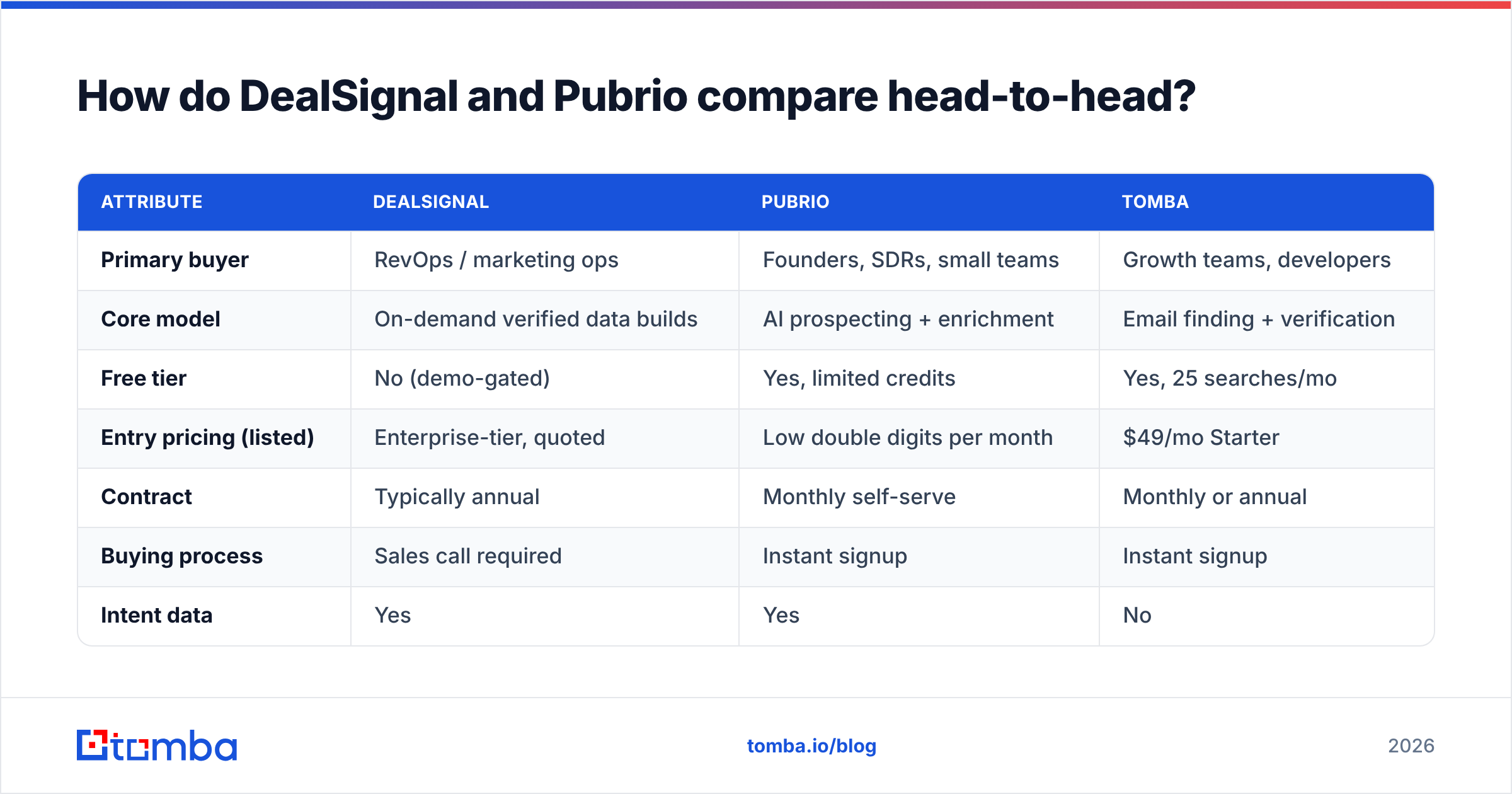
| Attribute | DealSignal | Pubrio | Tomba |
|---|---|---|---|
| Primary buyer | RevOps / marketing ops | Founders, SDRs, small teams | Growth teams, developers |
| Core model | On-demand verified data builds | AI prospecting + enrichment | Email finding + verification |
| Free tier | No (demo-gated) | Yes, limited credits | Yes, 25 searches/mo |
| Entry pricing (listed) | Enterprise-tier, quoted | Low double digits per month | $49/mo Starter |
| Contract | Typically annual | Monthly self-serve | Monthly or annual |
| Buying process | Sales call required | Instant signup | Instant signup |
| Intent data | Yes | Yes | No |
| Phone numbers | Yes | Yes | Yes |
| Public API | Yes | Yes | Yes, documented + CLI/MCP |
| Bulk CSV workflow | Yes, core strength | Yes | Yes |
| Best at | Coverage depth, CRM hygiene | Speed to first list | Accuracy per dollar on email |
Pricing on both platforms moves. DealSignal quotes rather than publishes. Treat the table as directional, and confirm current numbers on each vendor's own page before you commit.
Tomba's numbers are fixed and public. The free tier gives 25 searches per month. Paid plans run $49/mo Starter, $99/mo Growth, and $249/mo Pro, with Enterprise quoted. You can check Tomba pricing without booking a call.
One structural difference shows up in every evaluation. DealSignal wants to learn your data model before it sells you anything. Pubrio wants you signed up in ninety seconds. Both are fair. They simply filter for different buyers.
Which platform has better data accuracy?#
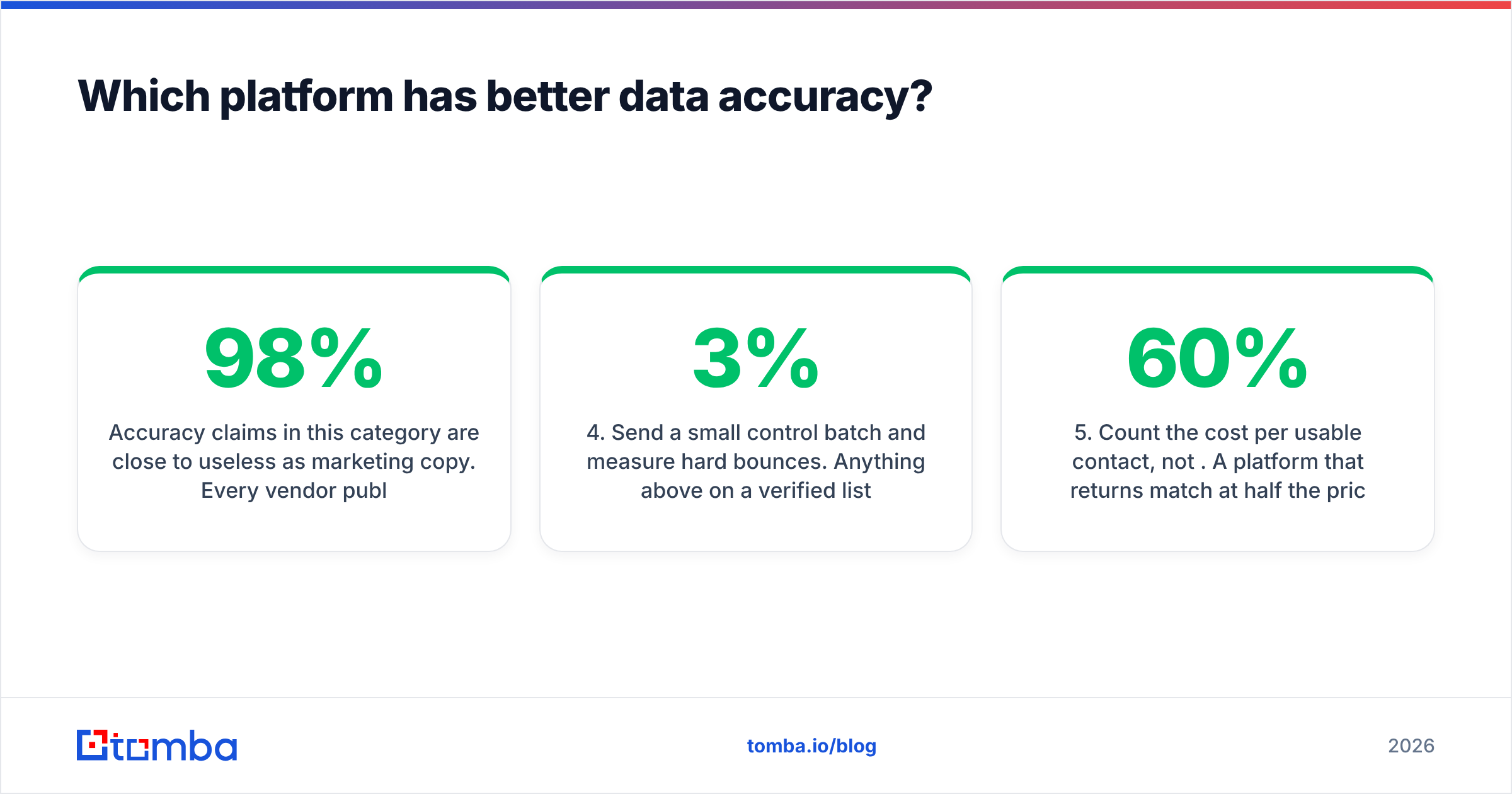
Accuracy claims in the DealSignal vs Pubrio debate are near useless as marketing copy. Every vendor quotes a number between 95% and 98%. Every number uses the vendor's own definition of a valid record. The only test that counts is the one you run on your own ICP.
Here is that test. It takes about an hour:
- Build a 200-row seed list of real target accounts. Use the accounts you actually sell to, not a random sample. Mix company sizes, because coverage drops differently at 20 employees than at 5,000.
- Run the same list through each platform. Record match rate and accuracy as two separate numbers. Match rate is how many rows returned a contact. Accuracy is how many of those contacts were correct.
- Verify independently. Do not trust the platform's own confidence score. Run the output through a neutral email verifier, so you grade with a different ruler than the one that made the answer.
- Send a small control batch and measure hard bounces. Anything above 3% on a verified list means catch-all domains are slipping through as valid.
- Count cost per usable contact, not cost per credit. A 60% match rate at half the price beats an 85% match rate at triple the price. The exception is a small TAM, where the missing 25% is your whole quarter.

In practice, DealSignal returns fresher records on known mid-market and enterprise accounts. Verification happens at export, not whenever a crawler last touched the record. That edge narrows on long-tail SMB domains, where nobody has good coverage.
Pubrio's accuracy is solid for the price. Its weak spot is the usual one for AI list building. The ICP layer can return companies that look right but sit outside your segment. You get a list fast, then prune it by hand.
That trade works for a two-person team, where your time is cheaper than a data contract. It does not work when a bad list poisons a CRM that 40 reps use every day.
The catch-all problem deserves its own note. Both tools will hand you addresses on domains that accept everything and confirm nothing. Enterprise IT and finance are full of them. If your ICP sits there, add a dedicated catch-all verifier to the stack. Neither platform makes that problem go away.
DealSignal vs Pubrio pricing: how do the models differ?#
Most DealSignal vs Pubrio evaluations should start here. Price rules one option out for most teams before you compare a single feature.
DealSignal prices like an enterprise data vendor. Quotes are credit-based and usually annual, sized to a projected record volume. That model is good when you have a defined project, such as a 50,000-record CRM cleanse or a TAM build. You can scope it and defend the spend.
It is bad when your volume is spiky. You pre-buy capacity, then either overpay or run dry mid-quarter.
Pubrio prices like a SaaS tool. Tiers are published, billing is monthly, and you can upgrade or downgrade yourself. Start free, prove the workflow, then expand. The ceiling is lower. At high volume, self-serve credit rates stop being competitive, and you end up shopping for a data contract anyway.
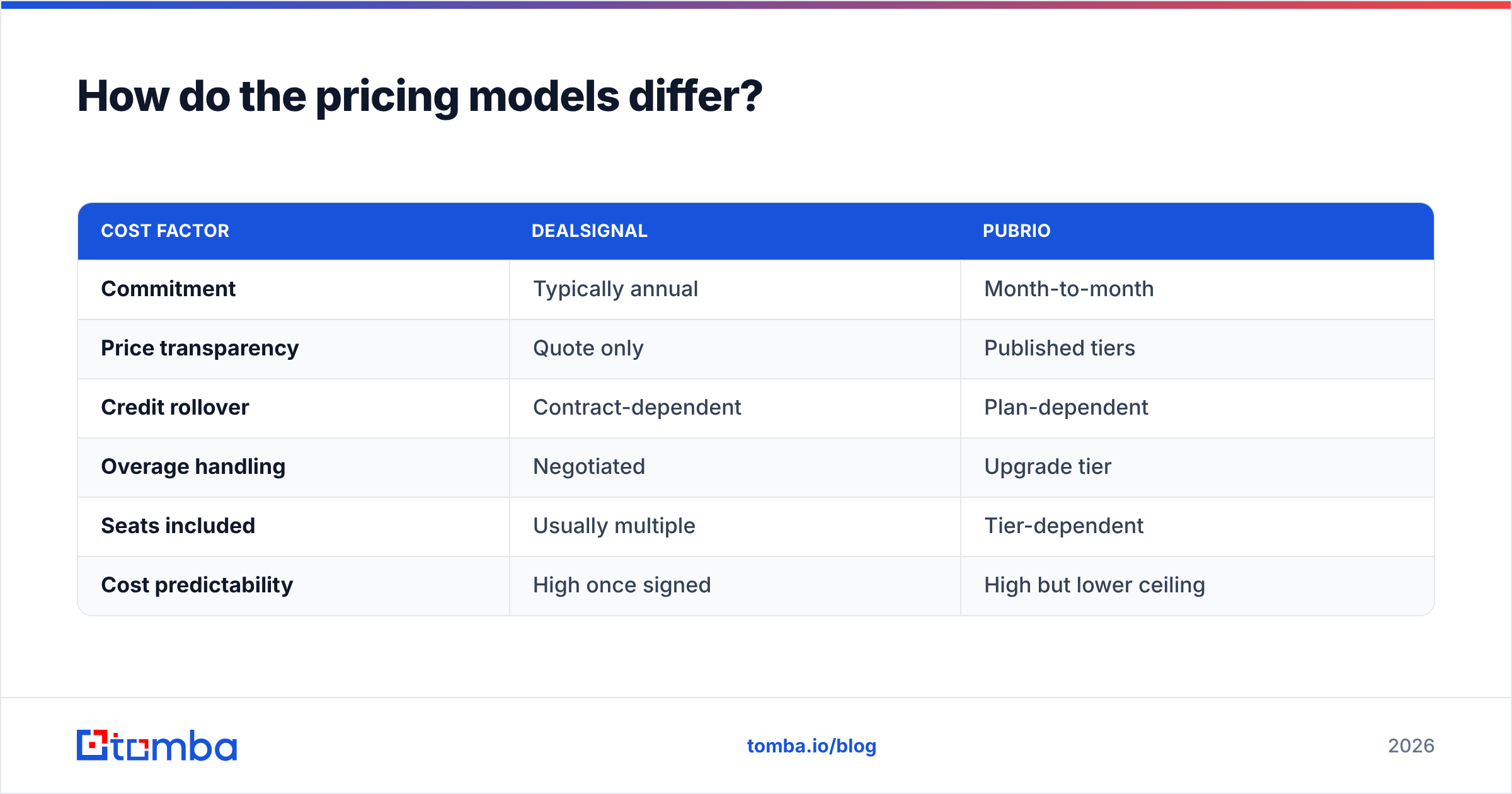
| Cost factor | DealSignal | Pubrio |
|---|---|---|
| Commitment | Typically annual | Month-to-month |
| Price transparency | Quote only | Published tiers |
| Credit rollover | Contract-dependent | Plan-dependent |
| Overage handling | Negotiated | Upgrade tier |
| Seats included | Usually multiple | Tier-dependent |
| Cost predictability | High once signed | High but lower ceiling |
Watch three cost traps on either side. Credits burned on failures — some tools charge for a lookup that returns nothing, so get the policy in writing. Export caps that limit how much of your paid data you can pull each month. Seat fees that turn a fair per-credit rate into a bad total once the team needs access.
Compare that to a flat published stack. At $49/mo you know the number. If the month is quiet, you lose nothing you prepaid. That is why many small teams pair a cheap, accurate finder with a separate intent tool.
Which one fits your workflow?#
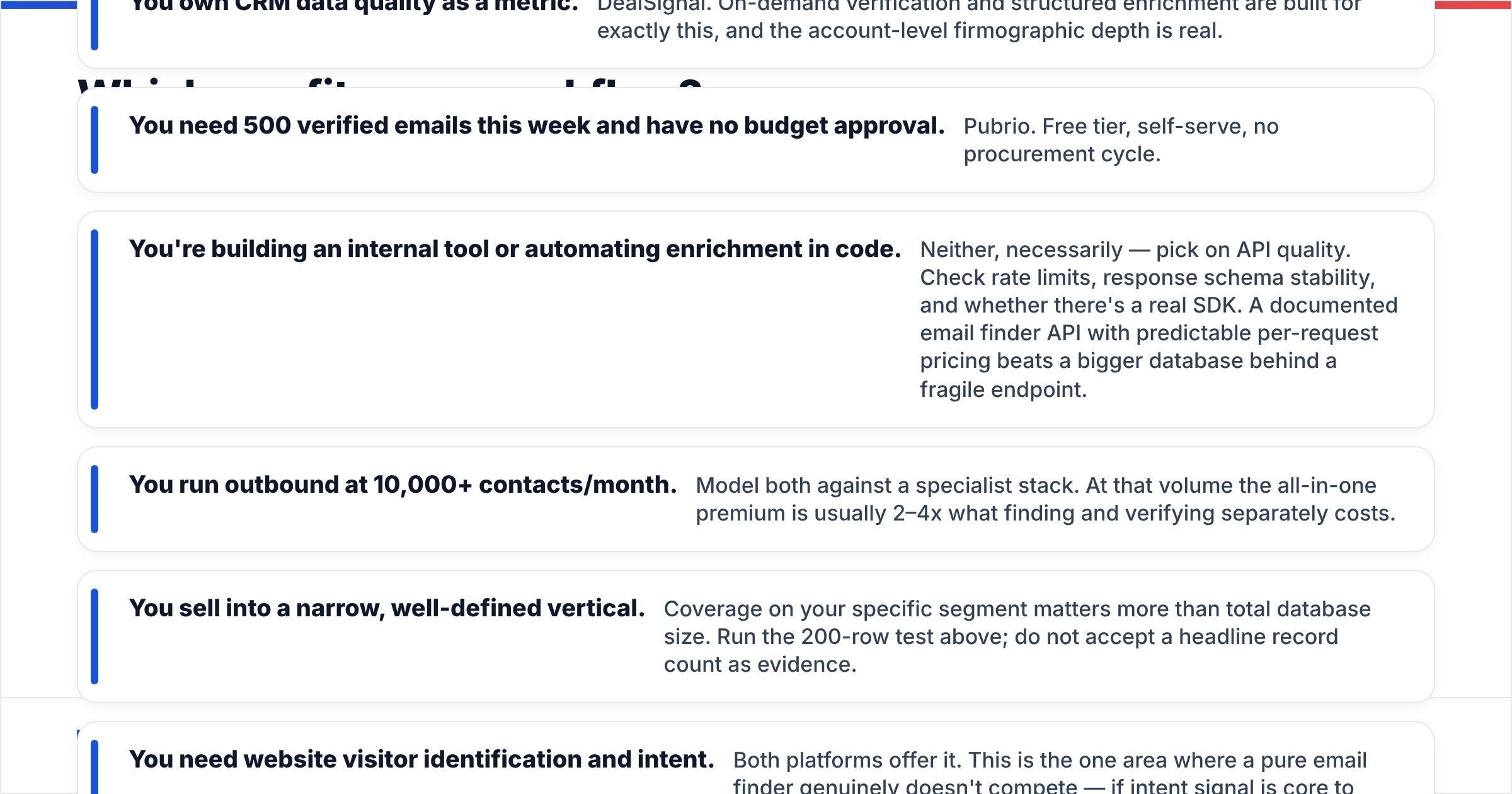
- You own CRM data quality as a metric. Pick DealSignal. On-demand verification and structured enrichment are built for this, and the firmographic depth is real.
- You need 500 verified emails this week with no budget approval. Pick Pubrio. Free tier, self-serve, no procurement cycle.
- You are automating enrichment in code. Pick on API quality instead. Check rate limits, schema stability, and whether a real SDK exists. A documented email finder API with flat per-request pricing beats a big database behind a fragile endpoint.
- You run outbound at 10,000+ contacts a month. Model both against a specialist stack. At that volume, the all-in-one premium is often 2–4x the cost of finding and verifying separately.
- You sell into a narrow vertical. Coverage on your segment matters more than total database size. Run the 200-row test. Do not accept a headline record count as proof.
- You need visitor identification and intent. Both platforms offer it. This is the one area where a pure email finder does not compete.
Where do both tools fall short?#
The DealSignal vs Pubrio comparison hides one shared flaw. Both bundle. You buy a database, an enrichment engine, an intent layer, and a prospecting UI as one unit. You pay for all four, even if you use one. Teams that already run a sequencer, a CRM, and an intent tool often buy a third copy of what they own.
Coverage thins out fast outside North America and Western Europe. If your ICP is APAC, LATAM, or Eastern European mid-market, test before you buy. This is where headline accuracy and real match rate split apart.
Neither tool protects deliverability. Verified at source does not mean inbox-safe. Sender reputation, domain warmup, and volume ramp are separate problems. Better data will not fix a burned domain.
Both are also vague about the costliest failure mode: a stale record marked confident. A "valid" address that bounces hurts more than an unknown one, because you sent to it. Ask each vendor how often they refresh, and what happens when a paid record bounces. That answer beats any accuracy percentage.
Is a dedicated email finder a better fit?#
For many teams comparing DealSignal vs Pubrio, neither tool is the right shape.
Maybe your bottleneck is simple. You have a list of companies and names, and you need correct work emails. Then you are shopping for platforms when you should shop for a finder. Specialist tools do one job, publish their pricing, and cost a fraction of a data contract.
A domain search returns every discoverable address at a company. Add bulk verification before send. That covers the workflow most outbound teams run every week.

The counter-argument holds where intent matters. A platform earns its premium if reps change what they do based on a signal. If nobody has opened the intent dashboard in three weeks, you are paying platform prices for a spreadsheet.
Peer reviews on G2 help, but filter hard for your company size and region. A glowing enterprise review says nothing about SMB coverage.
DealSignal vs Pubrio: which should you choose in 2026?#
Choose DealSignal if you are an enterprise or upper-mid-market team with a defined data project. You need budget authority and a RevOps owner who will use the enrichment. On-demand verification is a real edge over static databases, and the firmographic depth supports serious segmentation.
Choose Pubrio if you are a small team that needs pipeline now. It suits buyers who prefer self-serve over sales calls and want intent signals without a contract. Start free, run the 200-row test, and upgrade only when the match rate on your ICP earns it.
Choose a specialist stack if you mainly need accurate contact data at a set price. Combine a finder, a verifier, and the sequencer you already pay for. You will usually land well under platform cost with better email accuracy, because each tool does one job instead of six.
That is the real DealSignal vs Pubrio answer. Whatever you pick, verify before you send. The most expensive record in your database is the confident one that bounces.
Ready to test the accuracy side yourself? Tomba Email Finder gives you 25 free searches a month, with no card and no demo call. That is enough to run the 200-row test on a slice of your real ICP. Compare match rate and bounce rate against whatever quote sits in your inbox. If the numbers hold up, plans start at $49/mo with the same data sources and verification pipeline behind every lookup.
Related guides#
Ready to find emails that actually work?
Join 150,000+ professionals who stopped guessing and started sending. Free credits on signup — no credit card required.
Get the Tomba newsletter
Practical outbound tactics and product updates — once every two weeks.
About the author