DealSignal vs SMARTe (2026): Which B2B Data Tool Wins?
DealSignal and SMARTe both promise verified B2B contacts, but they sell to very different buyers. Here is how their accuracy, coverage, pricing model and contract terms actually compare in 2026 — plus a cheaper way to cover the same job.
DealSignal vs SMARTe comes down to one question: do you want a research service, or a fast lookup tool? DealSignal builds and re-checks lists for you. SMARTe hands your reps a database and a Chrome extension. Below we compare accuracy, coverage, price and contract terms — and name a cheaper third option.
TL;DR
- DealSignal is a quote-only, on-demand data platform for enterprise demand-gen and RevOps teams. Expect an annual contract in the four-to-five-figure range.
- SMARTe is a self-serve contact database with a Chrome extension, strong mobile-number coverage and a free tier. It is far cheaper to test.
- Neither is a cheap way to answer one simple question: "what is this person's work email?"
- Both claim 95%+ accuracy. The real difference is when the record was checked — on request, or during some past database sweep.
- If your bottleneck is finding and verifying emails at a set price, a dedicated email finder at $49/mo does that job without a procurement cycle.
What are DealSignal and SMARTe?#
Both solve the same surface problem: "I need contact data for people who match my ICP." They solve it with opposite business models.
DealSignal calls itself an on-demand B2B data platform. You define an ICP — industry, headcount, revenue, tech stack, job function, seniority. DealSignal then assembles the matching records and re-verifies them before delivery.
The pitch is freshness on delivery. Instead of pulling from an index last touched eight months ago, records get re-checked when you ask for them. It sells to demand-gen, marketing ops and RevOps teams doing list builds, CRM enrichment and TAM analysis.
SMARTe is a contact and company database with a browser extension on top. Reps work inside LinkedIn Sales Navigator or a company site, hit the extension, and pull emails and mobile numbers into a sequence or the CRM.
SMARTe leans on two things: mobile-phone coverage outside North America, and its privacy posture. GDPR, CCPA and regional data-residency handling sit front and centre in its marketing.
The short version: DealSignal sells a research service wrapped in software. SMARTe sells a database with a fast retrieval UI. That single difference drives almost everything below.
DealSignal vs SMARTe: how do they compare head-to-head?#
Here is the practical comparison. Treat every price as directional and confirm it on the vendor's own page. Both companies negotiate, and both have changed packaging in the last 18 months.
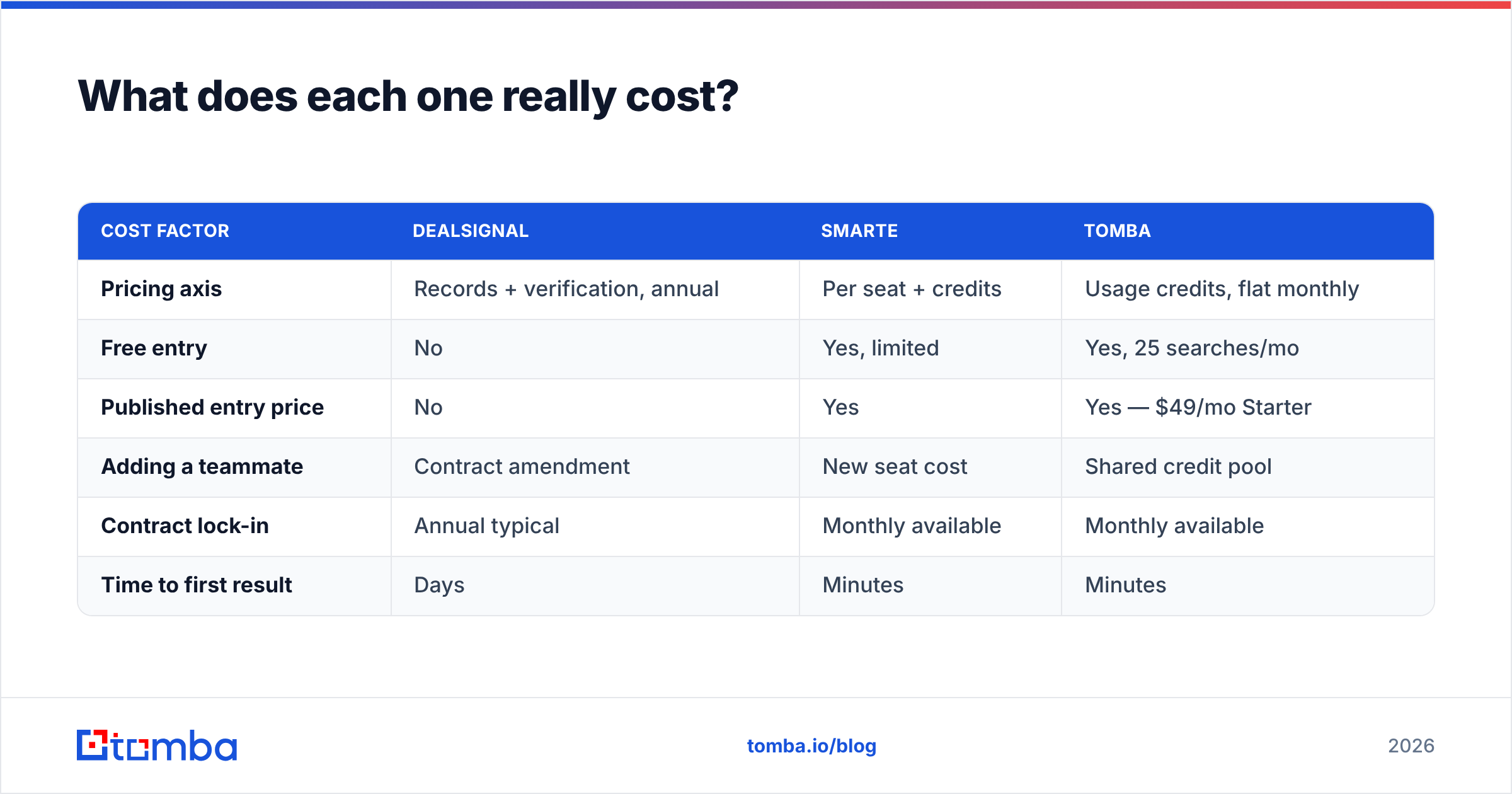
| Dimension | DealSignal | SMARTe |
|---|---|---|
| Primary model | On-demand research + re-verification | Maintained contact database + extension |
| Best for | Enterprise demand gen, RevOps, ABM list builds | SDRs and small sales teams working live |
| Free tier | No — demo/pilot only | Yes, limited monthly credits |
| Entry pricing | Quote-only; annual contracts typical | Published self-serve tiers, per user/month |
| Contract | Annual commitment standard | Monthly and annual options |
| Mobile numbers | Available, add-on dependent | Core strength, heavily marketed |
| Coverage claim | 600M+ contacts, 30M+ companies | 220M+ contacts across 200+ countries |
| Chrome extension | Limited | Yes — LinkedIn/Sales Nav workflow |
| CRM sync | Salesforce, HubSpot, Marketo | Salesforce, HubSpot, Outreach, Salesloft |
| API | Yes | Yes |
| Time to first record | Days (scoping + delivery) | Minutes (self-serve) |
| Compliance posture | Standard US/EU handling | GDPR/CCPA emphasised, regional residency |
Two things jump out. First, time to value differs by an order of magnitude. You can trial SMARTe this afternoon. DealSignal needs a scoping call, an ICP exercise and a delivery window.
That is not a criticism — it is the product. But it does mean you cannot run a quick bake-off week without starting DealSignal's sales cycle.
Second, the pricing floors are nowhere near each other. A single rep can expense SMARTe's self-serve tier. DealSignal contracts are budget-line items that need a VP signature.

Whose data is actually more accurate?#
Treat every published accuracy number with suspicion, including these two.
Both vendors claim high-90s accuracy. Neither is lying. They simply measure different things:
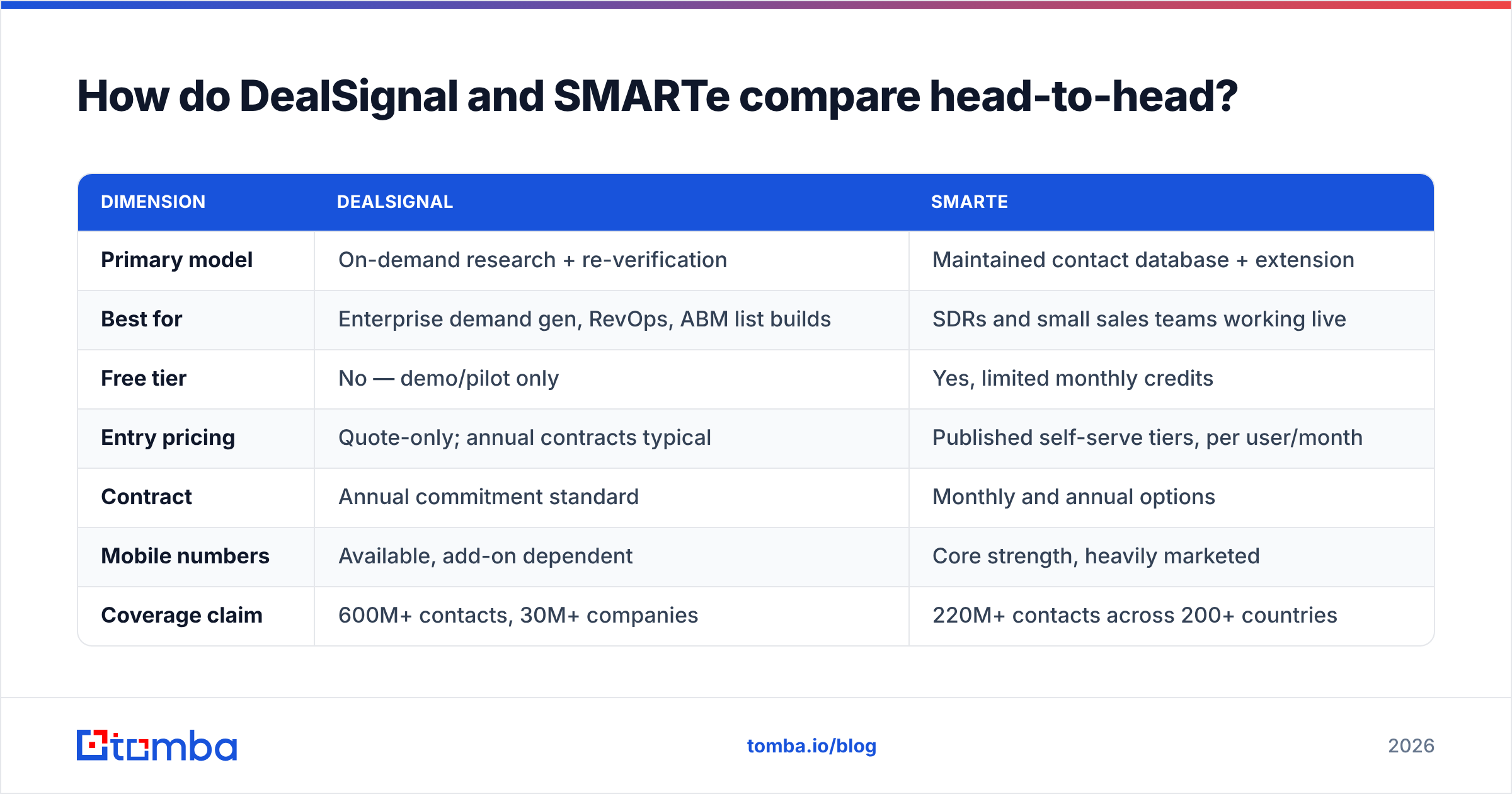
- DealSignal's number is a delivery-time claim. Records are re-verified during fulfilment, so the figure applies to the file you get on day one. It says nothing about day 200. B2B contact data decays roughly 2–3% a month as people change jobs.
- SMARTe's number is a database-state claim. It reflects the share of records that passed a check at their last sweep. Some sweeps are recent. Some are not.

In any DealSignal vs SMARTe trial, the only accuracy number that counts is the one you measure. Run this test before you sign anything:
- Pick 200 accounts you already know well. Existing customers, churned logos, accounts your team has worked.
- Request the same list from both vendors with identical filters. Any gap in how each reads a filter is itself a signal.
- Measure fill rate first, accuracy second. 180 contacts at 92% beats 60 contacts at 99%.
- Re-verify both files independently with a neutral email verifier, so neither vendor grades its own homework.
- Check catch-all handling. Ask how many returned emails sit on catch-all domains. A catch-all verifier tells you what the vendor won't.
- Send a small live batch. Bounce rate is the ground truth. Over 3% on a verified list is a problem.
Across the vendors we have tested, the spread on fill rate is far wider than the spread on accuracy. Everyone looks accurate on the easy 40% of a list. The money sits in who covers the hard 60%.
DealSignal vs SMARTe pricing: what does each one really cost?#
Cost comparison is awkward here, because the two vendors price on different axes.
DealSignal prices on records and re-verification volume, packaged annually. Reviews on G2 and buyer chatter put typical annual commitments in the low-to-mid five figures for mid-market deals. Pilots exist at lower volume.
There is no published price list. Your cost is a function of your negotiating position and the vendor's fiscal quarter.
SMARTe prices per user per month with credit allocations, plus a free tier that gets reps hooked before a manager pays. The model is clear and cheap to start. It also carries the usual seat-based flaw: cost scales with headcount even when usage does not. Ten reps who each need 200 lookups a month still pay ten seat prices.
Most comparison posts skip the real issue. For many teams, neither pricing model matches the job. Say your workflow is "here are 3,000 companies and target titles — find the decision-maker emails." You are then paying for account intelligence, intent signals and org charts you will never open.
That is where a focused tool changes the math. Tomba pricing runs Free (25 searches/mo), Starter at $49/mo, Growth at $99/mo, Pro at $249/mo, and Enterprise on quote. It is usage-based, not seat-based, so a five-person team shares one pool instead of buying five licences.
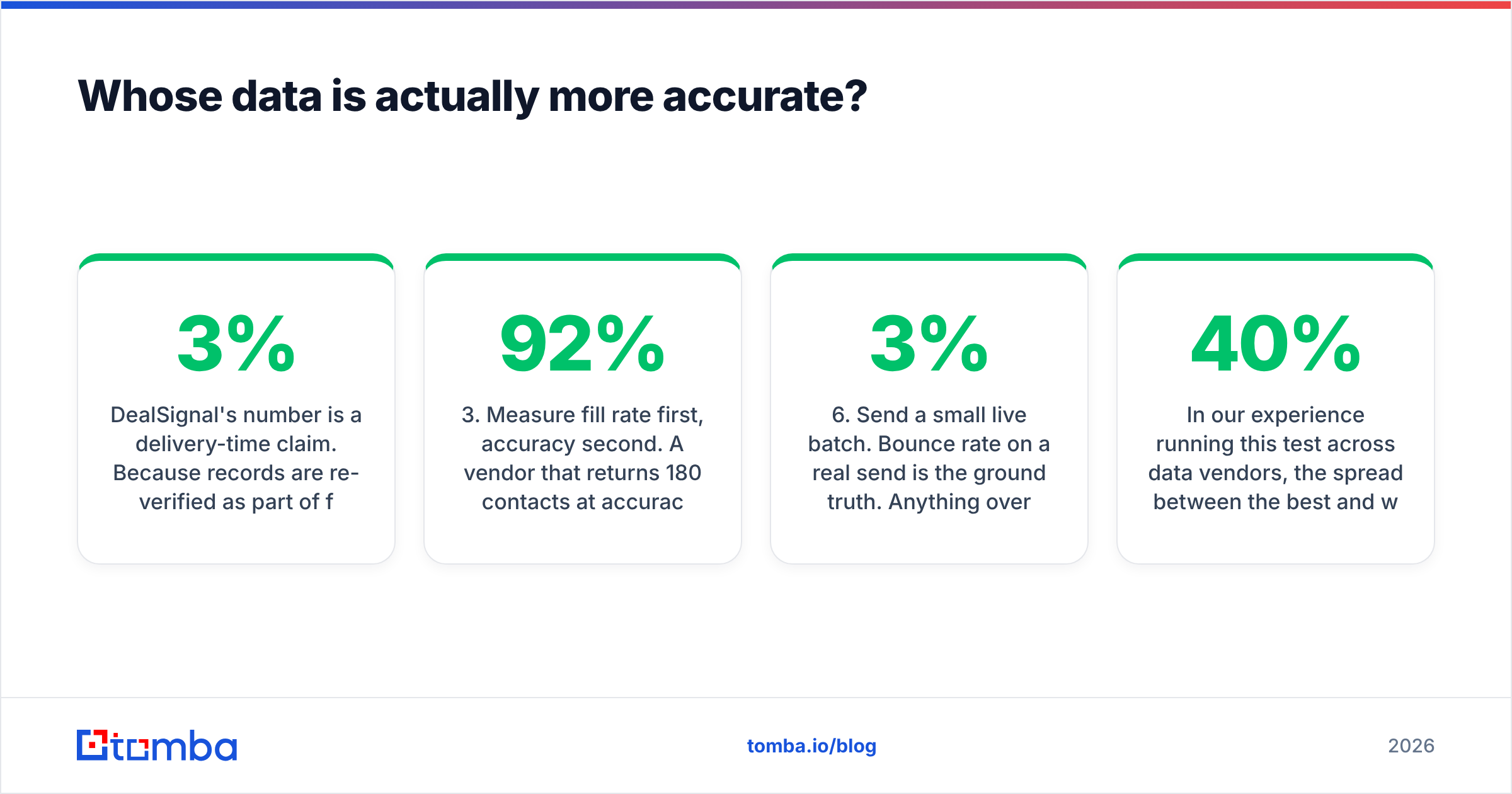
| Cost factor | DealSignal | SMARTe | Tomba |
|---|---|---|---|
| Pricing axis | Records + verification, annual | Per seat + credits | Usage credits, flat monthly |
| Free entry | No | Yes, limited | Yes, 25 searches/mo |
| Published entry price | No | Yes | Yes — $49/mo Starter |
| Adding a teammate | Contract amendment | New seat cost | Shared credit pool |
| Contract lock-in | Annual typical | Monthly available | Monthly available |
| Time to first result | Days | Minutes | Minutes |

Which tool fits which team?#
Pick on what your bottleneck actually is, not on which feature list is longer.
- Choose DealSignal if your problem is list construction, not lookup. You have a defined TAM, you need it segmented and deduped against your CRM, and you can sign an annual deal. The service layer is the product.
- Choose SMARTe if your reps live in Sales Navigator and your bottleneck is phone numbers. The mobile coverage holds up well in EMEA and APAC. The free tier lets you check that in a week.
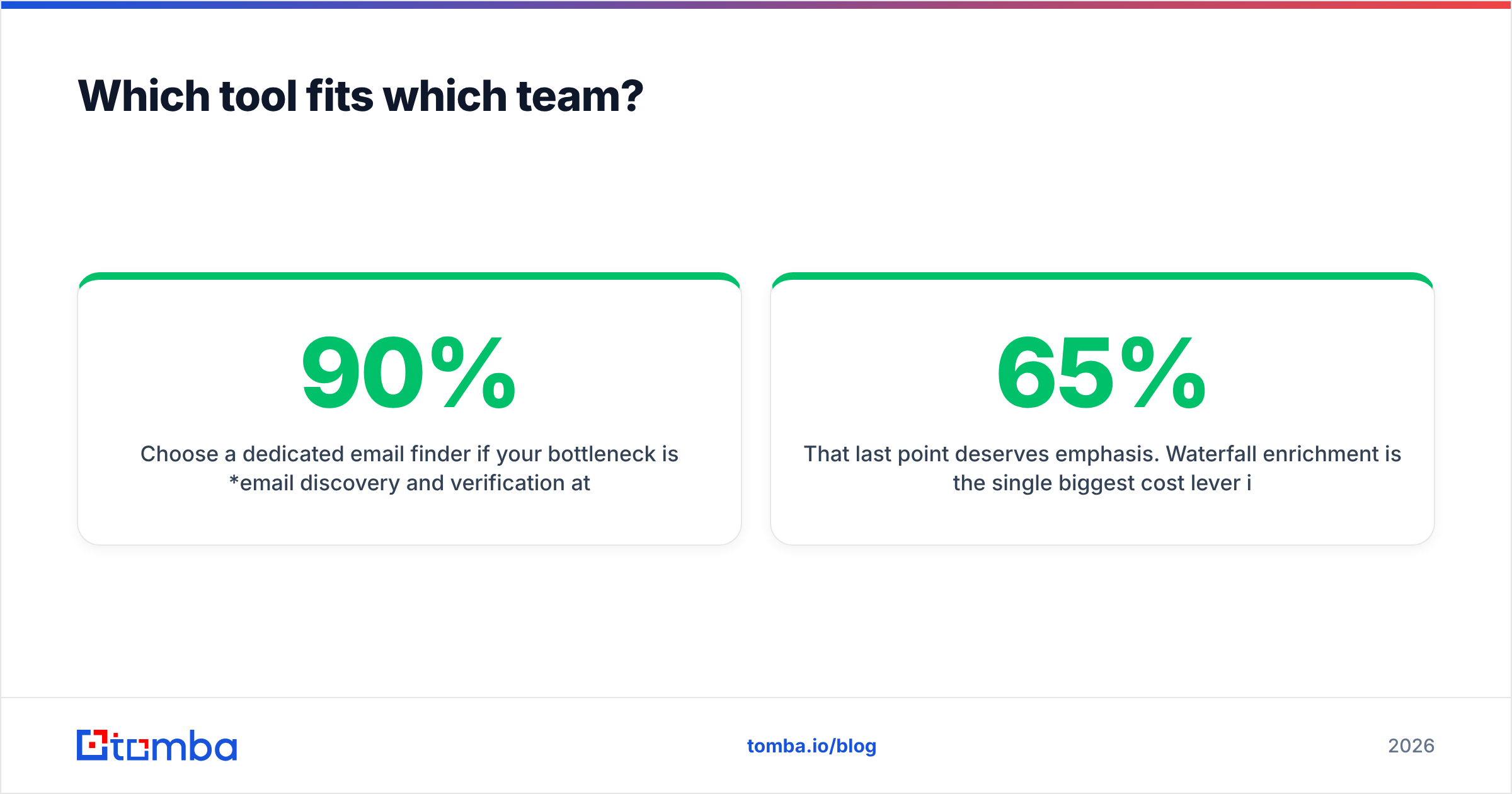
- Choose a dedicated email finder if your bottleneck is email discovery at volume. Domain search plus bulk verification does 90% of the job at 10% of the cost.
- Choose a combination if no single vendor covers your list. Most strong outbound teams run one broad database plus one specialist finder for waterfall enrichment.
That last point deserves emphasis. Waterfall enrichment is the biggest cost lever in B2B data. Say your primary source resolves 65% of a list. Route only the other 35% to a premium vendor and you cut premium spend by two-thirds, without losing a contact.

Where do both tools fall short?#
Neither vendor will volunteer these in a demo.
Both suffer from decay you cannot see. Any accuracy number applies at a point in time. A record pulled in January and sitting in your CRM in July is a different asset.
Neither platform tells your CRM "this person left." Build a re-verification cadence — quarterly at minimum for active lists — or your bounce rate will creep up whichever vendor you picked.
Filter fidelity is shaky on both. "VP of Marketing" means one thing at a 40-person startup and another at a 40,000-person enterprise. Both rely on title strings people self-report on LinkedIn. Seniority filters are approximations, so hand-review the top of any list you plan to sequence.
Coverage is geographically lumpy. North American tech coverage is strong everywhere. Manufacturing, logistics, public sector and non-English markets drop off sharply. If your ICP is mid-market German manufacturing, test before you buy. The headline contact count says nothing about your slice.
Neither is a deliverability fix. Verified data cuts hard bounces. It does nothing for your SPF, DKIM and DMARC setup, or your sender reputation. Teams often blame the data vendor for what is really a domain-warmup problem.
Is there a cheaper alternative to DealSignal and SMARTe?#
Yes — several, depending on which part of the job you are solving.
If you want a large purchasable database with transparent per-record pricing, BookYourData is worth a look. Its pay-as-you-go model suits teams that need a one-time list rather than a subscription. Its accuracy guarantee is one of the more concrete commitments in the category.
If your job is finding and verifying business emails at a predictable cost, a specialist finder is the efficient answer. Tomba's Email Finder resolves an address from a name plus a domain. Domain search pulls every discoverable address at a company. The bulk email finder processes lists, and the Tomba API drops it into your own pipeline.
You also get 25 free searches a month. Test the fill rate on your real accounts before spending anything — that is more than DealSignal gives you without a call.
If your job is phone-first outbound, SMARTe earns real consideration. Pair it with a phone validator to screen out dead numbers before your dialler burns connect attempts.
So which one wins?#
For enterprise ABM list construction, with budget to match: DealSignal. Re-verification on delivery is real value when stale lists are killing your campaigns.
For rep-level, LinkedIn-native prospecting with mobile numbers: SMARTe. Faster to adopt, cheaper to test, better phone coverage outside the US.
For everyone whose real bottleneck is email discovery: neither. Buying an enterprise data subscription to solve a lookup problem is the most common and most expensive mistake in this category.
Ready to test the cheap option first?#
Before you sit through two demo cycles, set a baseline. Run 25 free searches through the Tomba Email Finder on the accounts you actually target, and measure the fill rate yourself.
If it covers 60–70% of your list — and for most B2B ICPs it will — the decision changes shape. You are no longer choosing a primary data vendor. You are choosing a fallback for the misses. That is a smaller contract to negotiate, and an easier one to walk away from.
Related guides#
Ready to find emails that actually work?
Join 150,000+ professionals who stopped guessing and started sending. Free credits on signup — no credit card required.
Get the Tomba newsletter
Practical outbound tactics and product updates — once every two weeks.
About the author