DealSignal vs Tomba: Which B2B Data Tool Wins in 2026?
DealSignal sells verified B2B data through a sales team and an annual contract. Tomba sells self-serve email finding from $49/mo. Here is where each one actually wins, and which one your team should buy.
DealSignal vs Tomba is a choice between two very different products. DealSignal builds and verifies lists for you under an annual contract. Tomba is a self-serve email finder that starts free and scales to $249/mo. Here is where each one wins.
TL;DR
DealSignal is a managed B2B data service. You describe an ICP, their team builds and re-verifies the list, and you pay through an annual contract negotiated with sales. No public price list, no free self-serve tier.
Tomba is a self-serve email finder and verification stack. Free tier with 25 searches/mo, Starter at $49/mo, Growth at $99/mo, Pro at $249/mo, and an API you can hit the same afternoon you sign up.
They are not really the same product. DealSignal is closer to data-as-a-service; Tomba is closer to infrastructure. Comparing them on "records" alone will mislead you.
Buy DealSignal if you need a large, custom-built, human-checked list for a marketing-ops motion and you have budget authority plus procurement patience.
Buy Tomba if you already know who you want to reach and you need verified addresses on demand, in bulk, or inside your own product via API — without a demo call.
What is DealSignal?#
DealSignal, based in the San Francisco Bay Area, sells on-demand B2B contact and account data. Most databases decay 25–30% a year. DealSignal's answer is to skip the static list. You describe your ideal customer profile. Their platform then builds matching records and re-verifies them at delivery, using automated checks plus human review.
That model has real advantages. Records get built and checked when you ask for them. So you avoid buying a snapshot that was true eighteen months ago. DealSignal also pushes hard on completeness: direct dials, job function, seniority, firmographics, technographics — not just an email address. It plugs into Salesforce, Marketo, HubSpot and similar tools, so records land where your revenue team already works.
The trade-off is the buying process. Pricing is quote-based. There is no published tier list on dealsignal.com, no free plan you can poke at, and typical engagements are annual. You are buying a service relationship, not a utility.
What is Tomba?#
Tomba is an email-finding and verification platform. The core product is the email finder. Give it a name and a domain, or just a domain. You get back professional email addresses with a confidence score and the public sources behind them. Around that core sit an email verifier, domain search, catch-all verification, phone finder, and enrichment.
The philosophy is the opposite of DealSignal's. Tomba assumes you already know who you want to reach. Maybe your SDR built a LinkedIn list. Maybe RevOps exported accounts from the CRM. Maybe your product needs a work email at signup. Tomba turns that intent into deliverable contact data fast, at a price you can see before you talk to anyone.
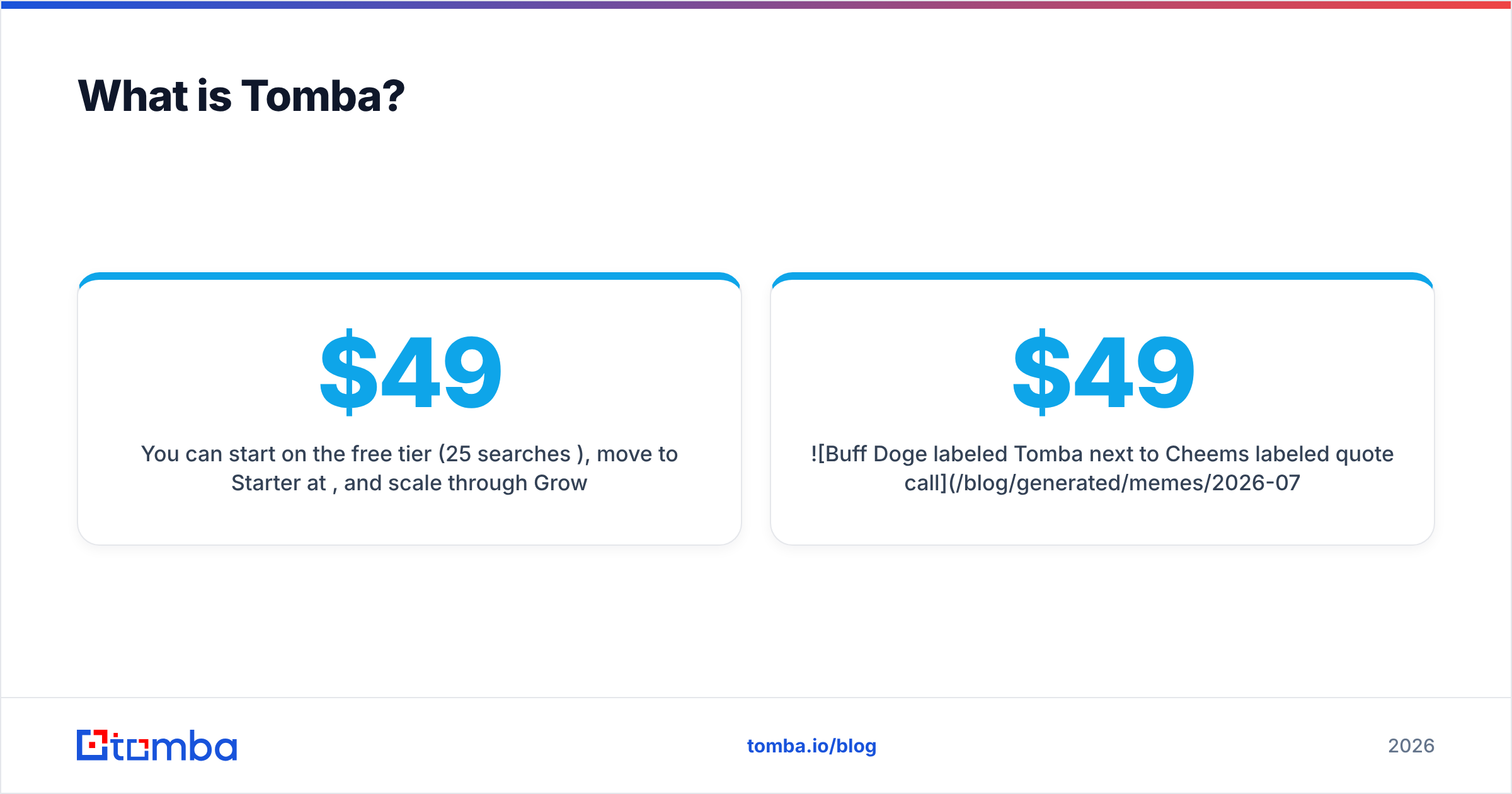
You can start on the free tier (25 searches/mo), move to Starter at $49/mo, and scale through Growth ($99/mo) and Pro ($249/mo). Enterprise pricing exists, but it is the exception, not the entry point. Full details are on the Tomba pricing page.

DealSignal vs Tomba: how do they compare head-to-head?#
Here is the honest side-by-side. Where a vendor does not publish a number, this table says so rather than guessing.
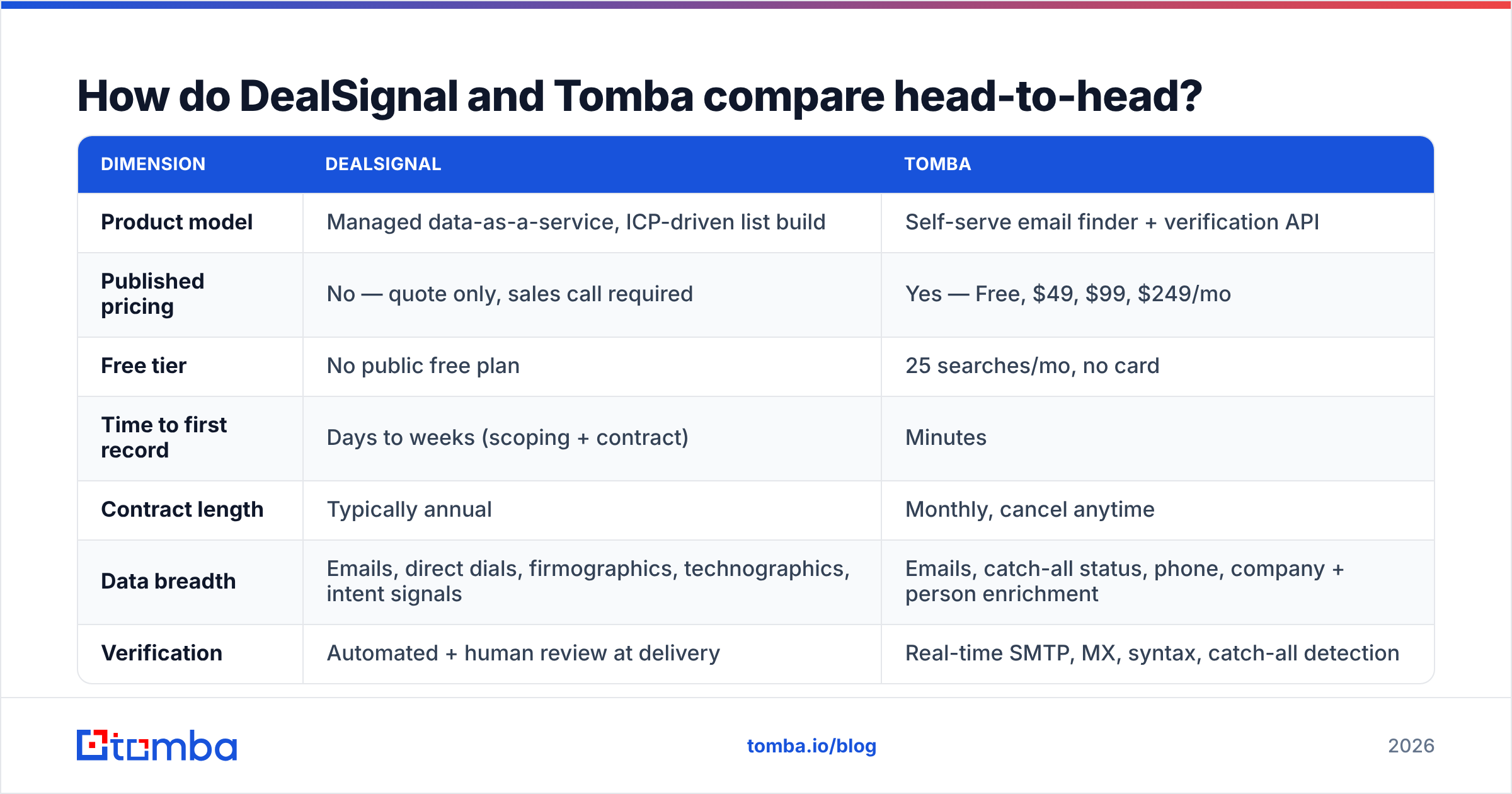
| Dimension | DealSignal | Tomba |
|---|---|---|
| Product model | Managed data-as-a-service, ICP-driven list build | Self-serve email finder + verification API |
| Published pricing | No — quote only, sales call required | Yes — Free, $49, $99, $249/mo |
| Free tier | No public free plan | 25 searches/mo, no card |
| Time to first record | Days to weeks (scoping + contract) | Minutes |
| Contract length | Typically annual | Monthly, cancel anytime |
| Data breadth | Emails, direct dials, firmographics, technographics, intent signals | Emails, catch-all status, phone, company + person enrichment |
| Verification | Automated + human review at delivery | Real-time SMTP, MX, syntax, catch-all detection |
| API access | Available, enterprise-oriented | Included from paid plans; CLI, MCP, Sheets, Excel, Zapier |
| Best fit | Marketing ops building a large TAM list | SDRs, growth teams, agencies, developers |
| Buying friction | High (demo, scoping, procurement) | Low (sign up, run a search) |
That last row is not a snark. It is the single biggest practical difference between these two products, and it decides most evaluations before anyone looks at match rates.
Which one should you actually pick?#
Pick based on the shape of your problem, not the length of the feature list:
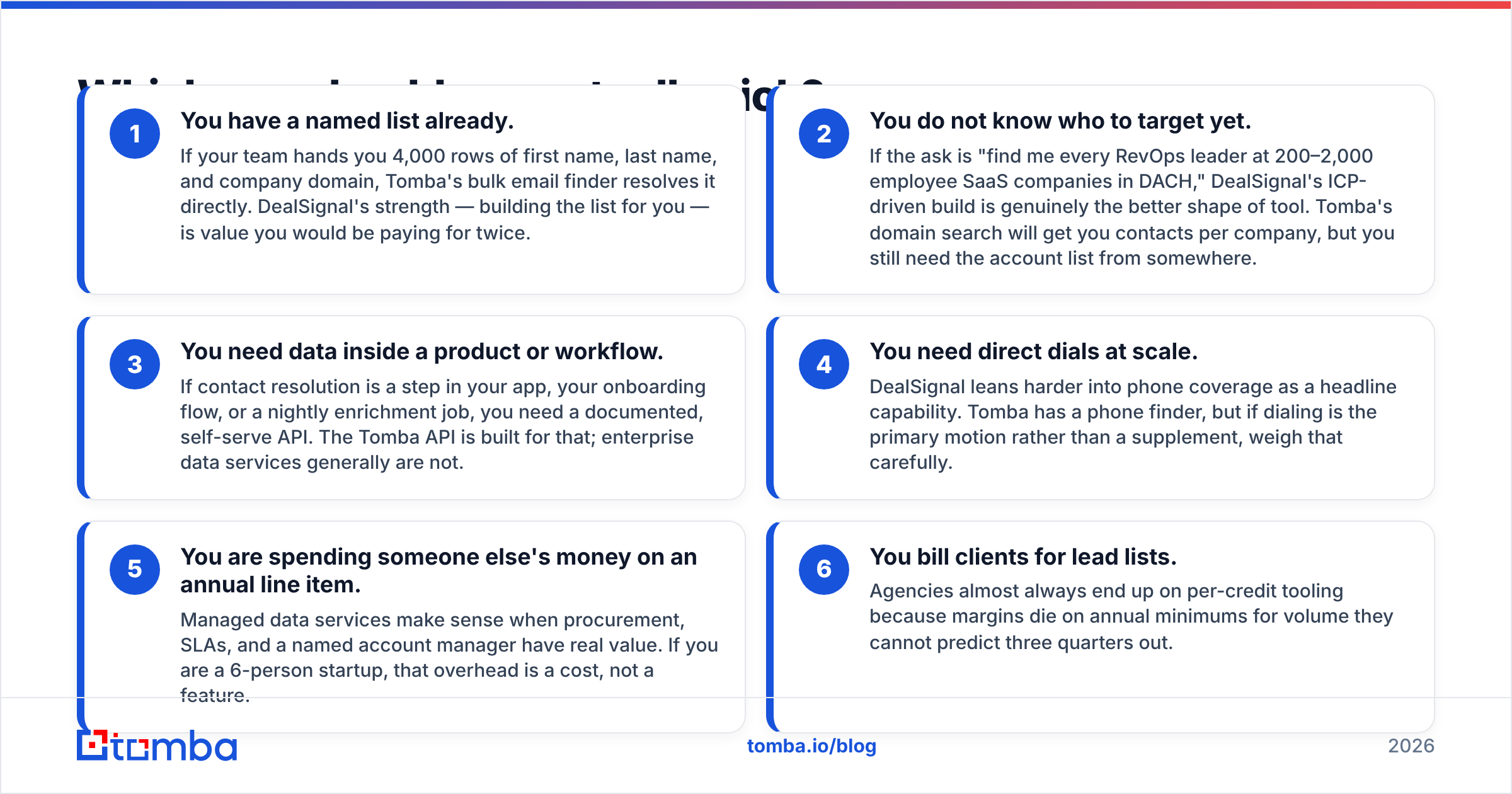
You have a named list already. Say your team hands you 4,000 rows of first name, last name, and company domain. Tomba's bulk email finder resolves it directly. DealSignal's strength is building the list for you, so you would be paying for that twice.
You do not know who to target yet. If the ask is "find me every RevOps leader at 200–2,000 employee SaaS companies in DACH," DealSignal's ICP-driven build is the better shape of tool. Tomba's domain search gets you contacts per company, but you still need the account list from somewhere.
You need data inside a product or workflow. Contact resolution might be a step in your app, your onboarding flow, or a nightly enrichment job. Then you need a documented, self-serve API. The Tomba API is built for that; enterprise data services generally are not.
Three more situations tip the decision:
You need direct dials at scale. DealSignal leans harder into phone coverage as a headline capability. Tomba has a phone finder. But if dialing is the primary motion rather than a supplement, weigh that carefully.
You are spending someone else's money on an annual line item. Managed data services make sense when procurement, SLAs, and a named account manager have real value. If you are a 6-person startup, that overhead is a cost, not a feature.
You bill clients for lead lists. Agencies almost always end up on per-credit tooling. Margins die on annual minimums for volume they cannot predict three quarters out.
How accurate is the data on each side?#
Read accuracy claims in this category carefully, because vendors measure different things. "95% accurate" can mean the email passed a syntax and MX check. It can mean it passed an SMTP handshake. It can mean a human confirmed the person still holds that title. Those are wildly different bars.

DealSignal's differentiator is human-in-the-loop verification at delivery. When it works, it catches what pure automation cannot: a contact who is still routable at an old employer but has moved on. That is a real category of waste, and it is the strongest argument for the managed model.
Tomba's approach is transparency plus real-time checking. Every result carries a confidence score and the sources it came from. The email verifier runs syntax, MX, disposable, role-account, and SMTP checks before you send. Catch-all domains quietly wreck bounce math for everyone in this category, so they get their own handling rather than a silent "valid."
The practical advice for either vendor: run your own test. Take 200 contacts you already know are good, submit them blind, and measure. Do not accept a marketing-page percentage from anyone, including us. A 30-minute test on real data beats a week of reading comparison pages.
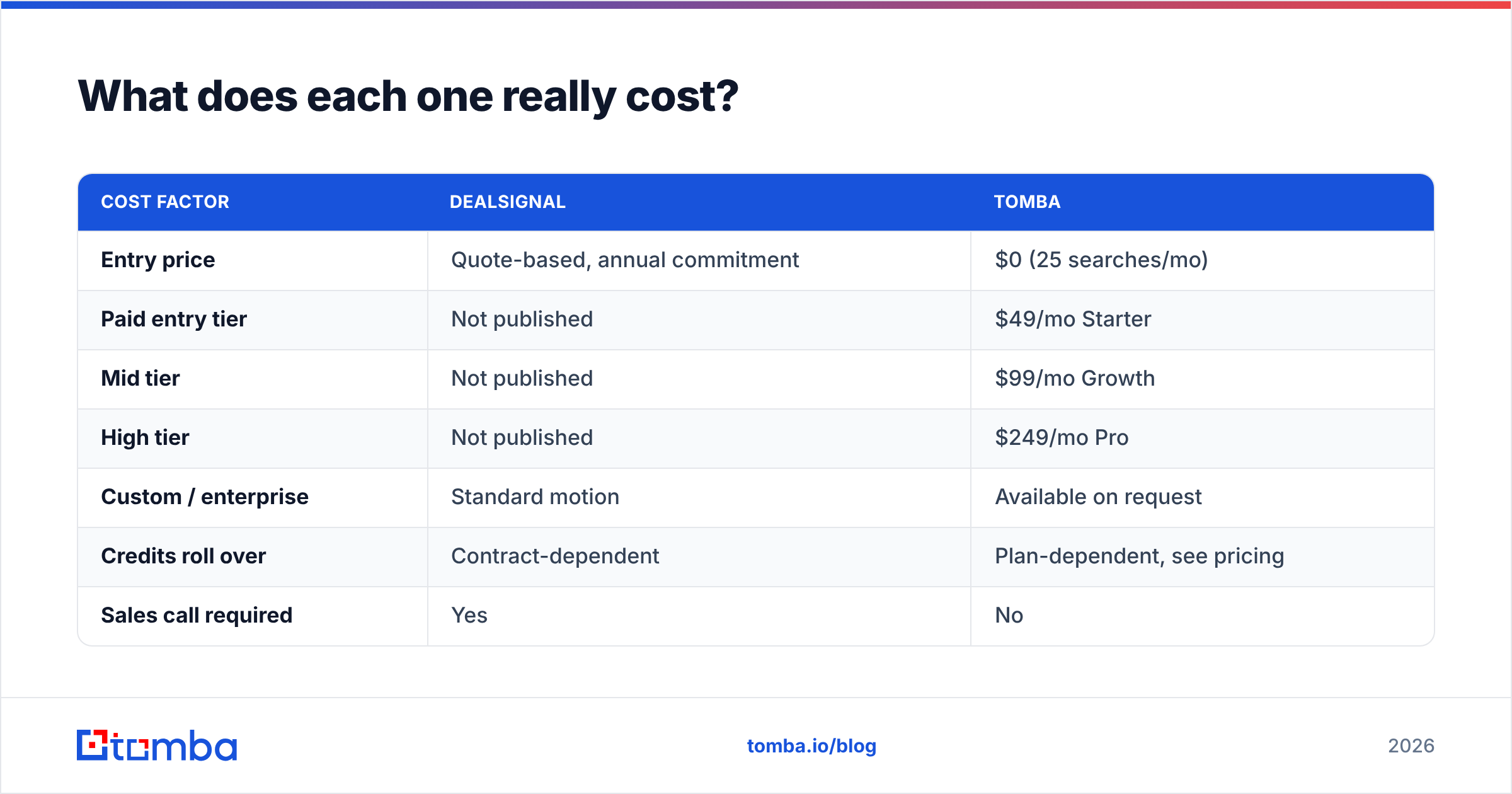
DealSignal vs Tomba pricing: what does each one really cost?#
| Cost factor | DealSignal | Tomba |
|---|---|---|
| Entry price | Quote-based, annual commitment | $0 (25 searches/mo) |
| Paid entry tier | Not published | $49/mo Starter |
| Mid tier | Not published | $99/mo Growth |
| High tier | Not published | $249/mo Pro |
| Custom / enterprise | Standard motion | Available on request |
| Credits roll over | Contract-dependent | Plan-dependent, see pricing |
| Sales call required | Yes | No |
| Cancel mid-year | Contract-dependent | Monthly plans, cancel anytime |

The asymmetry here is not a gotcha. It is a deliberate market position. DealSignal prices per engagement because engagements differ enormously in scope. That is defensible. But it means you cannot budget without a call. You cannot pilot cheaply. And you cannot benchmark cost-per-verified-contact against alternatives before you commit.
For a team evaluating three vendors on a Tuesday afternoon, that friction is often decisive regardless of who has the better data.
Where does DealSignal genuinely beat Tomba?#
Being neutral means naming this clearly. There are three situations where DealSignal is the better buy:
Custom TAM construction. Say you need a defensible total-addressable-market list built to a spec, with firmographic filters, technographic overlays, and org-chart depth. A managed service delivers that faster than any self-serve tool plus internal effort. Tomba does not build your account list for you.
Human verification on high-value records. For a 500-account ABM program, a single bad contact can cost a quarter of pipeline. Paying humans to check records is rational there. Automation is cheaper per record but has a different failure profile.
Enterprise procurement requirements. DPAs, SLAs, security reviews, a named CSM, invoicing on net-60. If your legal team requires all of that, a quote-based vendor is built for you and a $49/mo credit card plan is not.
If none of those three describe you, the managed model is mostly overhead you will not use. G2 reviews for both categories are worth skimming — G2's B2B data section is a reasonable place to sanity-check vendor claims against practitioner complaints.
Where does Tomba beat DealSignal?#
Speed to value. Sign up, run a domain search, export. There is no scoping call between you and your first verified address.
Price transparency. You can model annual spend from a public page. That matters more than teams admit. Half of tool evaluations die because no one could get a number in time for the budget meeting.
Developer surface. API, CLI, MCP server, Chrome extension, Google Sheets and Excel add-ins, Zapier and HubSpot integrations. Contact resolution becomes a function call rather than a quarterly data delivery.
Verification you control. Verification runs on demand. So you can re-check a list the morning you send, rather than trusting a delivery from six weeks ago. Combine the finder with data enrichment and records stay fresh continuously instead of in batches.
Low downside risk. A $49 month that does not work out is a $49 lesson. A twelve-month data contract that does not work out is a budget conversation with your CFO.
What about using both?#
More teams land here than either vendor's marketing suggests. Use a managed service for the annual, high-effort TAM build that anchors your ABM program. Use Tomba for the day-to-day resolution work: the inbound lead whose work email is missing, the 300-row list an AE dumped on you Friday afternoon, the enrichment job running nightly against your CRM.
The two spend categories are different. One is a strategic data purchase. The other is operational plumbing. Teams that force both into a single vendor usually overpay on one side and underserve the other.
The verdict#
If you need someone to build and human-verify a large custom list, and you have the budget and the patience for a procurement cycle, DealSignal is a legitimate choice with a real methodological advantage.
If you already know who you want to reach and you need verified email addresses now — in the browser, in bulk, or through an API — Tomba is the faster, cheaper, lower-risk path. You can also prove it works before you spend anything.
Start with the Tomba Email Finder on the free tier. Run 25 searches against contacts you already know are correct. Check the confidence scores against reality, then decide. If the match rate holds, $49/mo gets you the whole stack. If it does not, you have lost nothing but twenty minutes — which is exactly how a vendor evaluation should start.
Related guides#
Ready to find emails that actually work?
Join 150,000+ professionals who stopped guessing and started sending. Free credits on signup — no credit card required.
Get the Tomba newsletter
Practical outbound tactics and product updates — once every two weeks.
About the author