Dear Sir or Madam Email: When to Use It and What to Send Instead
"Dear Sir or Madam" is not automatically wrong — it is just wrong in about 90% of the emails people use it in. Here is the decision rule, the alternatives ranked, and the templates.
TL;DR
- "Dear Sir or Madam" is not grammatically wrong or offensive by default — it is a formality signal that also broadcasts "I did not find out who you are."
- It still belongs in a narrow set of emails: formal complaints, legal correspondence, tenders, embassy and government submissions, and some non-US business cultures.
- It does not belong in cold sales outreach, job applications where a hiring manager is nameable, partnership pitches, or anything you expect a fast reply to.
- The greeting itself is a small lever; the reason you reached for it — no name, no research — is the big one. Named openers outperform generic ones mostly because named emails come from better-researched lists.
- The durable fix is not a better fallback greeting. It is a workflow where you almost always have the first name before you write.
What does "Dear Sir or Madam" actually signal in 2026?#
Three things, in this order: formality, distance, and absence of research.
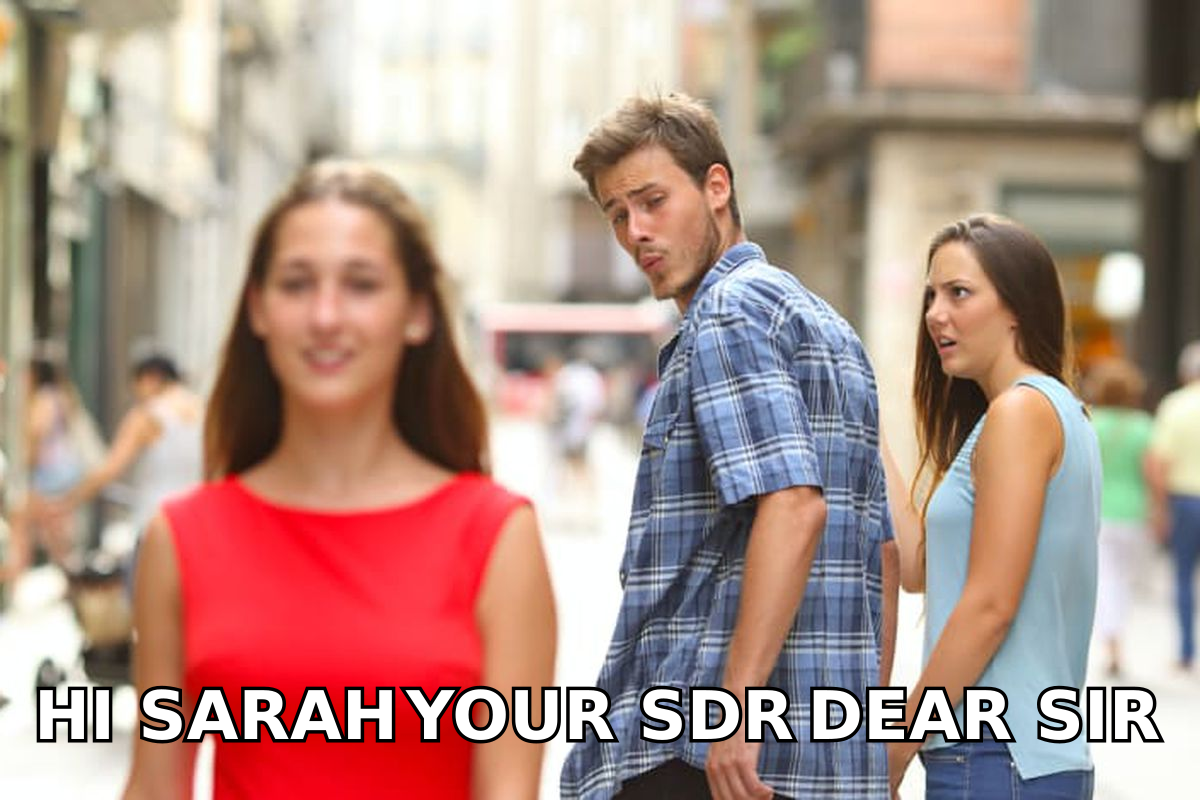
The first two can be deliberate. If you are filing a written complaint with a bank's compliance department, distance is the point — you are addressing an office, not a person. The third is the problem. When a recipient at a 40-person SaaS company opens an email that starts "Dear Sir or Madam," they are reading a message where the sender could have spent 90 seconds on LinkedIn and did not.
There is also a mechanical issue. The phrase presumes a binary and presumes you cannot tell which half applies. In 2015 that read as neutral. In 2026, plenty of recipients read it as dated at best — the salutation conventions most style guides now recommend have shifted toward role-based or name-based openers precisely because gendered fallbacks age badly.
None of that means you must never write it. It means the phrase carries baggage, and you should only pay that cost when formality is genuinely worth more to you than warmth.
When is a "Dear Sir or Madam" email still acceptable?#
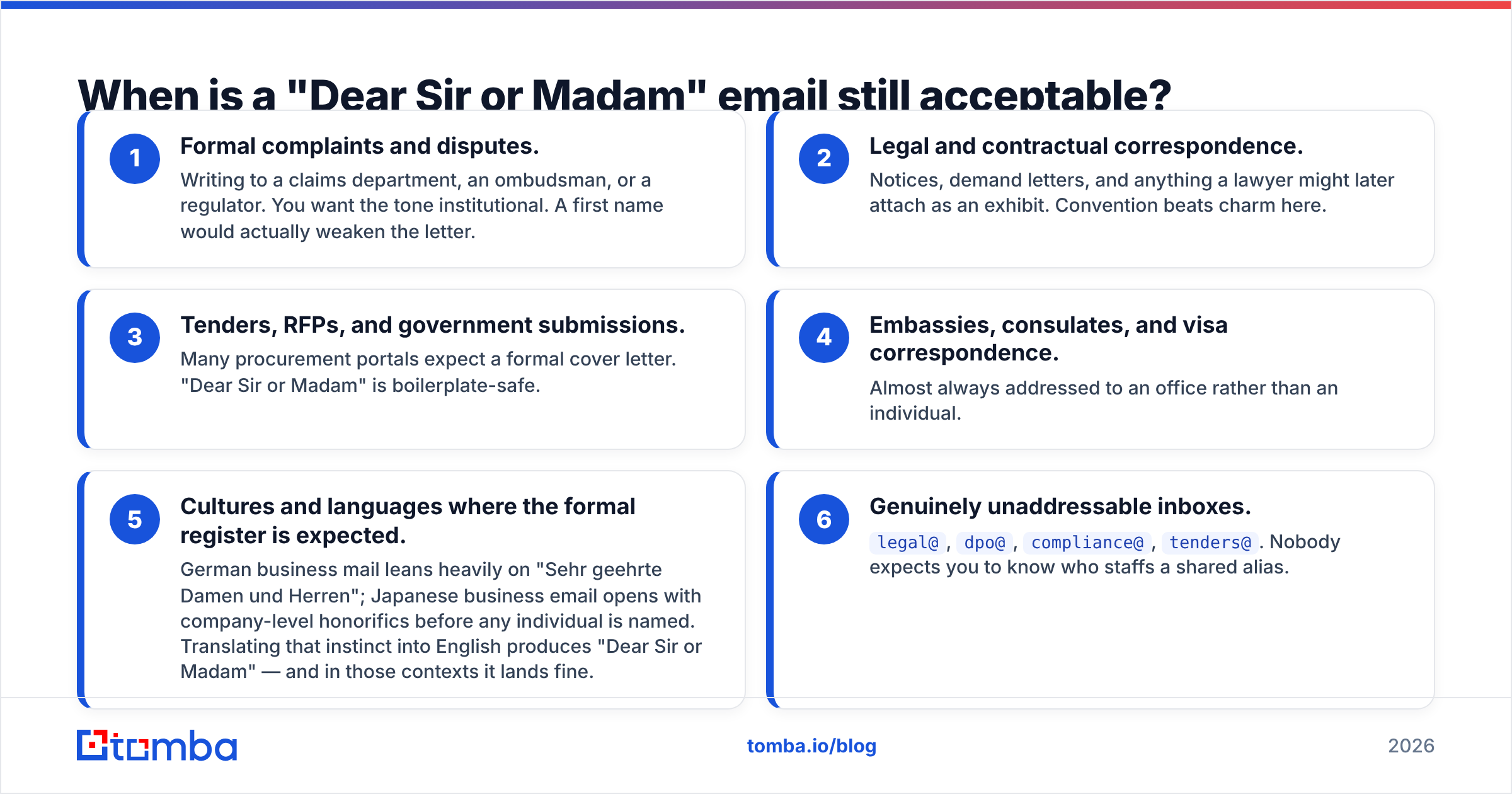
There is a real list, and it is short:
- Formal complaints and disputes. Writing to a claims department, an ombudsman, or a regulator. You want the tone institutional. A first name would actually weaken the letter.
- Legal and contractual correspondence. Notices, demand letters, and anything a lawyer might later attach as an exhibit. Convention beats charm here.
- Tenders, RFPs, and government submissions. Many procurement portals expect a formal cover letter. "Dear Sir or Madam" is boilerplate-safe.
- Embassies, consulates, and visa correspondence. Almost always addressed to an office rather than an individual.
- Cultures and languages where the formal register is expected. German business mail leans heavily on "Sehr geehrte Damen und Herren"; Japanese business email opens with company-level honorifics before any individual is named. Translating that instinct into English produces "Dear Sir or Madam" — and in those contexts it lands fine.
- Genuinely unaddressable inboxes.
legal@,dpo@,compliance@,tenders@. Nobody expects you to know who staffs a shared alias.
Notice what is missing: sales, recruiting, partnerships, PR pitches, link building, investor outreach, and job applications. In every one of those, a named human exists and is findable, and the recipient knows it.
Is "To Whom It May Concern" any better?#
Marginally, and only in the same narrow contexts. It removes the gender assumption but keeps — and arguably amplifies — the distance. It reads as a form letter, because for decades it was the opener on form letters.
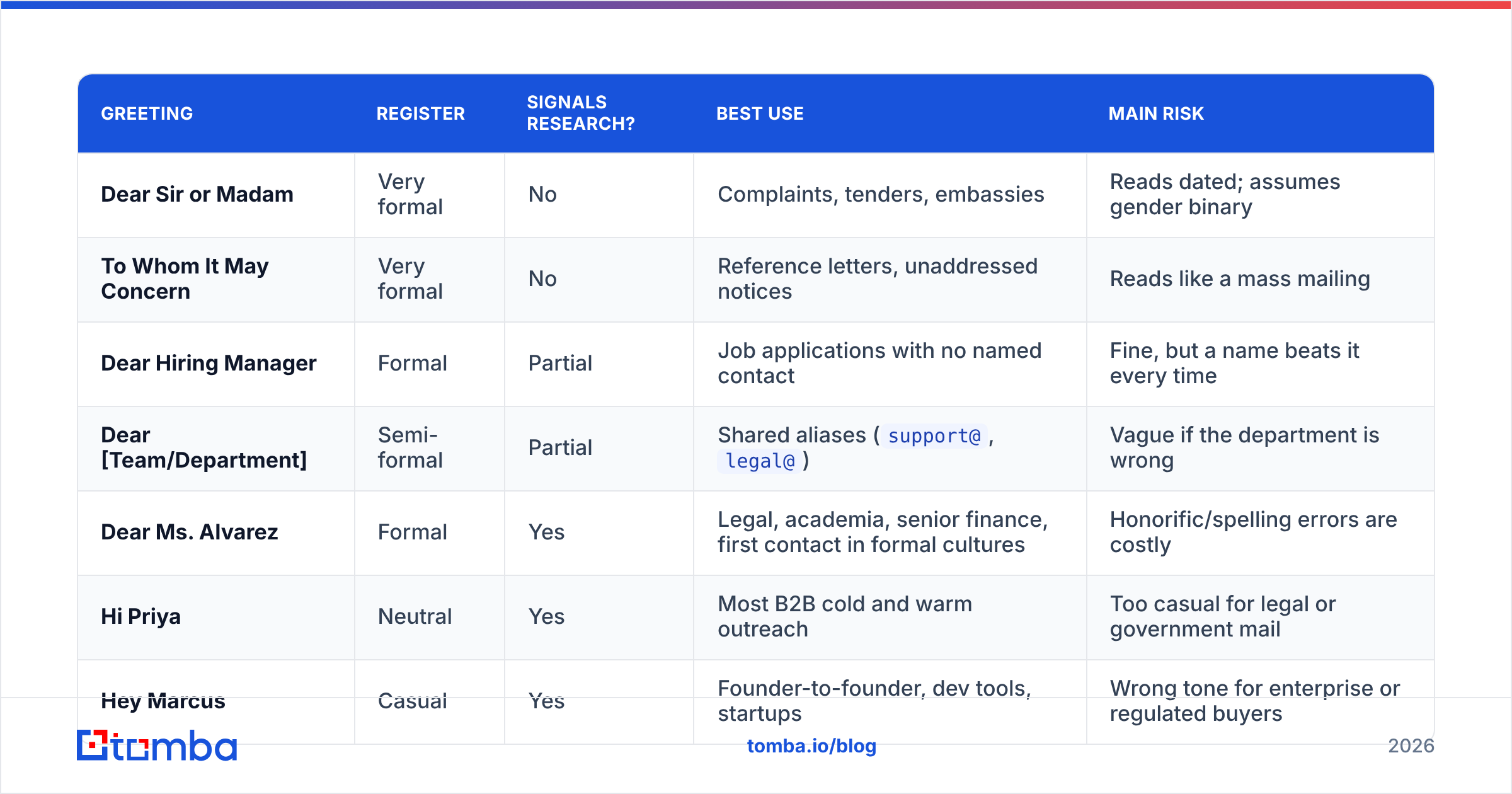
Here is how the common options actually compare when you are writing a business email that you want answered:
| Greeting | Register | Signals research? | Best use | Main risk |
|---|---|---|---|---|
| Dear Sir or Madam | Very formal | No | Complaints, tenders, embassies | Reads dated; assumes gender binary |
| To Whom It May Concern | Very formal | No | Reference letters, unaddressed notices | Reads like a mass mailing |
| Dear Hiring Manager | Formal | Partial | Job applications with no named contact | Fine, but a name beats it every time |
| Dear [Team/Department] | Semi-formal | Partial | Shared aliases (support@, legal@) |
Vague if the department is wrong |
| Dear Ms. Alvarez | Formal | Yes | Legal, academia, senior finance, first contact in formal cultures | Honorific/spelling errors are costly |
| Hi Priya | Neutral | Yes | Most B2B cold and warm outreach | Too casual for legal or government mail |
| Hey Marcus | Casual | Yes | Founder-to-founder, dev tools, startups | Wrong tone for enterprise or regulated buyers |
The pattern is consistent: everything above the "Dear Ms. Alvarez" line trades reply probability for institutional safety. That trade is correct maybe one email in ten.
How much does the greeting actually change reply rates?#
Less than greeting-obsessed LinkedIn posts claim, and more than nothing.
Be skeptical of anyone quoting a precise percentage lift for a salutation. In practice, when teams isolate the greeting in a clean A/B — same list, same body, same send window — the delta is usually small, often in the low single digits. The greeting is one line in an email whose subject, first sentence, and relevance do most of the work.
The reason "personalized greeting = huge lift" studies keep appearing is a confound: emails that start with a first name come from lists where somebody verified who the person was. The lift is coming from list quality, not from the word "Hi." If you bolt first names onto a scraped, unverified list, you get "Hi {{first_name}}" errors and the lift evaporates — sometimes into negative territory, because a broken merge tag is worse than no name at all.
So the honest framing is: the greeting is a symptom test. If you cannot write a name, your data pipeline has a hole. Fix the hole and the greeting fixes itself. If you want to go deeper on what actually moves the number, our glossary entry on response rate breaks down the inputs in order of impact.
What should you write instead?#
Ranked from best to acceptable, with the conditions each one needs:
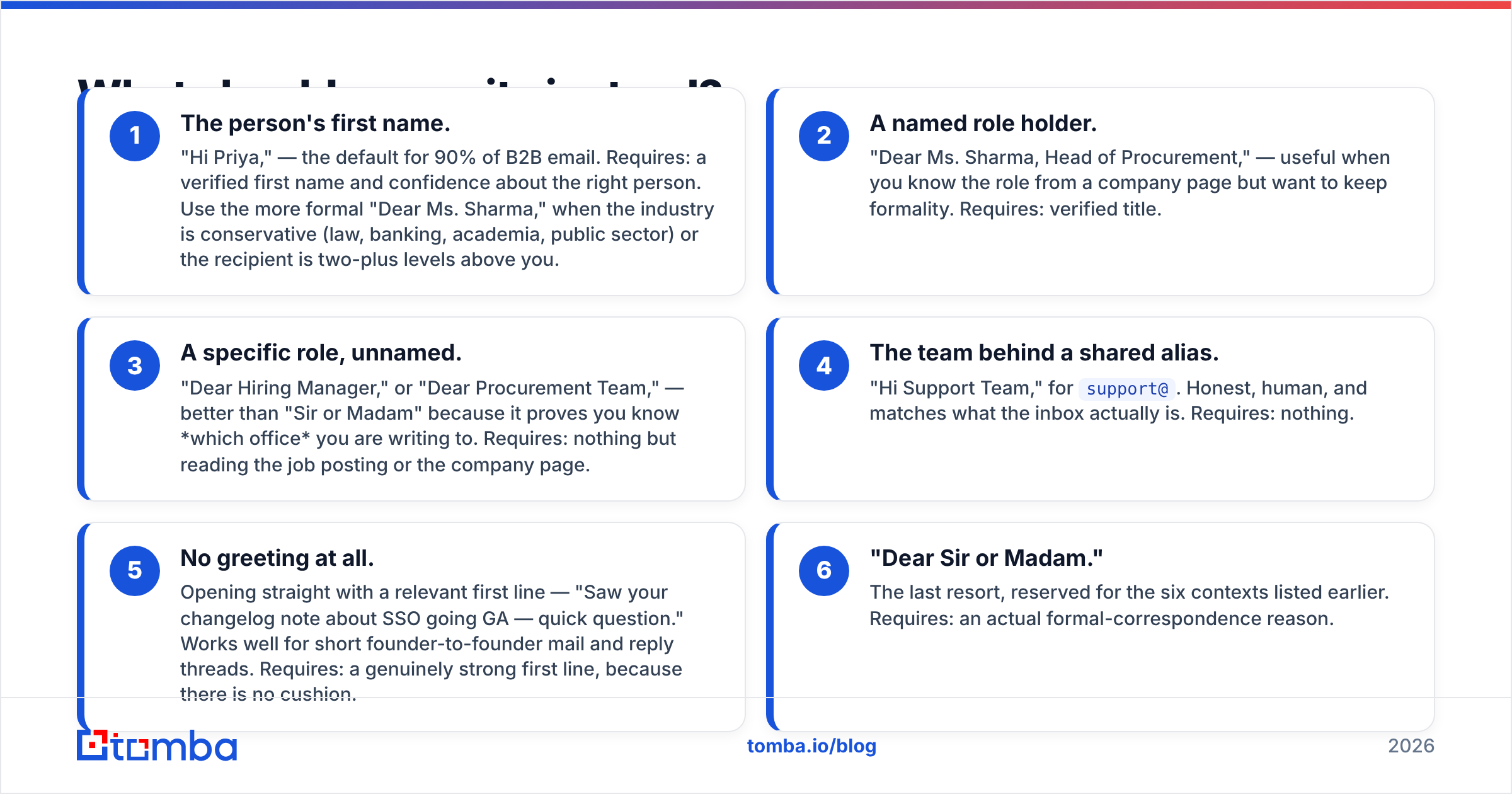
- The person's first name. "Hi Priya," — the default for 90% of B2B email. Requires: a verified first name and confidence about the right person. Use the more formal "Dear Ms. Sharma," when the industry is conservative (law, banking, academia, public sector) or the recipient is two-plus levels above you.
- A named role holder. "Dear Ms. Sharma, Head of Procurement," — useful when you know the role from a company page but want to keep formality. Requires: verified title.
- A specific role, unnamed. "Dear Hiring Manager," or "Dear Procurement Team," — better than "Sir or Madam" because it proves you know which office you are writing to. Requires: nothing but reading the job posting or the company page.
- The team behind a shared alias. "Hi Support Team," for
support@. Honest, human, and matches what the inbox actually is. Requires: nothing. - No greeting at all. Opening straight with a relevant first line — "Saw your changelog note about SSO going GA — quick question." Works well for short founder-to-founder mail and reply threads. Requires: a genuinely strong first line, because there is no cushion.
- "Dear Sir or Madam." The last resort, reserved for the six contexts listed earlier. Requires: an actual formal-correspondence reason.
If you have to fall back to option 6 for a sales email, the email should probably not be sent yet.
How do you find the name so you never need the fallback?#
This is where the problem is actually solved. A repeatable name-and-email workflow looks like this:
- Start from the company, not the person. Run a domain search on the company's domain to see who is publicly associated with it and in what roles. You get the shape of the org before you commit to a target.
- Resolve the specific person. Once you have a name and title, an email finder turns "Priya Sharma at acme.com" into a deliverable address with a confidence score attached, rather than a guessed pattern.
- Verify before you send. Run the address through an email verifier so a bounced first-touch does not quietly damage your sending reputation. This step matters more than the greeting by an order of magnitude.
- Enrich, then write. Pull title, seniority, and location so the greeting and the first sentence both match the person. A correct first name attached to a wrong-seniority pitch still fails.
- Keep a real fallback. When a person genuinely cannot be resolved — a shared alias, a stealth-mode company — use the role-based greeting from option 3, not "Sir or Madam."
The point of the workflow is not that automation writes warmer emails. It is that you stop sending the category of email where "Dear Sir or Madam" felt necessary.
What do the fixed versions look like?#
Three rewrites, same message, three contexts.
Cold B2B outreach — before:
Dear Sir or Madam,
I am writing to introduce our solution which helps companies like yours improve efficiency. Would you be available for a 15-minute call this week?
After:
Hi Priya,
Noticed Acme moved billing in-house last quarter — congrats on shipping that. Most teams that make that switch end up rebuilding dunning logic from scratch within six months. If that is on your roadmap, I can send the two-page teardown we wrote on it. No call needed.
Job application — before:
Dear Sir or Madam,
Please find attached my CV for the Senior Analyst position.
After:
Dear Ms. Okafor,
I am applying for the Senior Analyst role (req #4412). The posting mentions consolidating three reporting stacks — I ran that exact migration at [Company] last year and cut close time from nine days to four. CV attached; happy to walk through the approach.
Formal complaint — keep it:
Dear Sir or Madam,
I am writing regarding account #83201 and the fee assessed on 14 May 2026, which I dispute for the reasons set out below.
That third one is the whole argument in miniature. The formality is doing a job. In the first two, it was doing nothing but announcing laziness.
Does this change for non-English or cross-border email?#
Yes, and it is worth calibrating rather than applying a single rule:
- Germany, Austria, Switzerland: the formal register is expected on first contact. "Sehr geehrte Frau Sharma" if you have the name; the company-level equivalent if you do not. Direct-translating to "Dear Sir or Madam" in English mail to a German enterprise buyer is unremarkable.
- Japan and Korea: hierarchy and company-first framing dominate. A named, title-correct greeting is strongly preferred; a generic one signals you did not check.
- France: "Madame, Monsieur," remains standard in formal French correspondence and does not carry the dated feeling its English counterpart does.
- US, UK, Australia, Nordics, Netherlands: first names on first contact are normal across most industries. Formality here reads as distance, not respect — with the usual exceptions for law, government, and finance.
- Regulated buyers anywhere: procurement, legal, and compliance contacts expect more formality than marketing or engineering contacts at the same company.
The practical rule: match the register of the function you are writing to, not the country's stereotype. A German developer advocate will happily take "Hi Jonas." A US general counsel will not appreciate "Hey Bob."
What should you actually change this week?#
Three things, in order of return:
One — audit your templates. Search your sequencer for "Dear Sir or Madam" and "To Whom It May Concern." Every instance in a sales, recruiting, or partnership sequence is a bug. Replace with a name variable plus a role-based fallback.
Two — fix the fallback logic, not just the string. Most tools let you set a default when a merge field is empty. If your default is "there" you get "Hi there," which is fine but forgettable. Set it to the department: "Hi Marketing Team." Better still, filter the send so contacts with no first name never enter the sequence at all.
Three — close the data gap upstream. Track what percentage of your contacts have a verified first name and a verified email. If it is below 90%, the greeting was never the problem. Pull the missing fields with a bulk email finder run before the sequence goes live rather than patching it mid-campaign.
For further reading on structuring the rest of the email once the greeting is sorted, HubSpot's sales blog has durable coverage of opener and CTA structure, and the sales intelligence category on G2 is a reasonable place to compare how different data vendors handle name and title coverage.
Get the name before you write the greeting#
"Dear Sir or Madam" is a fallback for a problem you can eliminate. If you know who you are writing to, the greeting question answers itself — and so does the first sentence, the proof point, and the ask.
The Tomba Email Finder resolves a name and company into a verified, confidence-scored business email, so your sequences start with a real person instead of a placeholder. The free tier includes 25 searches a month to test it against a list you already have; paid plans start at $49/mo for Starter, $99/mo for Growth, and $249/mo for Pro — full details on Tomba pricing. Run your next 50 prospects through it, count how many still need a generic greeting, and you will have your answer.
Related guides#
Ready to find emails that actually work?
Join 150,000+ professionals who stopped guessing and started sending. Free credits on signup — no credit card required.
Get the Tomba newsletter
Practical outbound tactics and product updates — once every two weeks.
About the author