Dear vs Hi in Email: Which Greeting Gets More Replies?
"Dear" reads formal and safe. "Hi" reads human and fast. Here's how the two greetings actually perform in cold email, who should use which, and the one variable that matters far more than either.
Dear vs hi in email comes down to one thing: how far you are from the reader. A formal opener signals an institution. A casual one signals a person. This guide covers which greeting wins replies, where the exceptions sit, and the variable that beats both.
TL;DR
- "Hi {FirstName}" is the default for cold B2B email in most English-speaking markets. It reads like a person wrote it, it survives mobile preview panes, and it doesn't trip the "mass mail" pattern recognition most buyers have developed.
- "Dear" is not dead — it's specialized. Use it for regulated industries, government, academia, legal, executive-level intros in Japan/Germany/France, and any thread that started formally.
- The greeting is worth about 1-3 percentage points of reply rate. The name after the greeting is worth far more. "Hi there" and "Dear Sir/Madam" both signal you don't know who you're writing to.
- The worst option isn't "Dear" — it's a broken merge tag.
Hi {{first_name}}orHi FNAMEkills the whole email, not just the opener. - Test greeting per segment, not globally. A greeting that lifts replies with startup founders can flatten with hospital procurement.
Dear vs hi in email: what are you actually deciding?#
You're setting the reader's expectation for the next 60 words. That's it. The greeting sells nothing. It answers one question the reader asks in half a second: is this a person, a robot, or a lawsuit?
"Dear" carries institutional weight. It reads like a letter, and letters in 2026 usually mean invoices, notices, HR, or something you have to file. "Hi" carries conversational weight. It reads like the notes they already answer all day in Slack and LinkedIn.
Neither is always right. The real mistake is picking one out of habit, then never checking how your audience reads it.

What is the difference between "Dear" and "Hi" in email?#
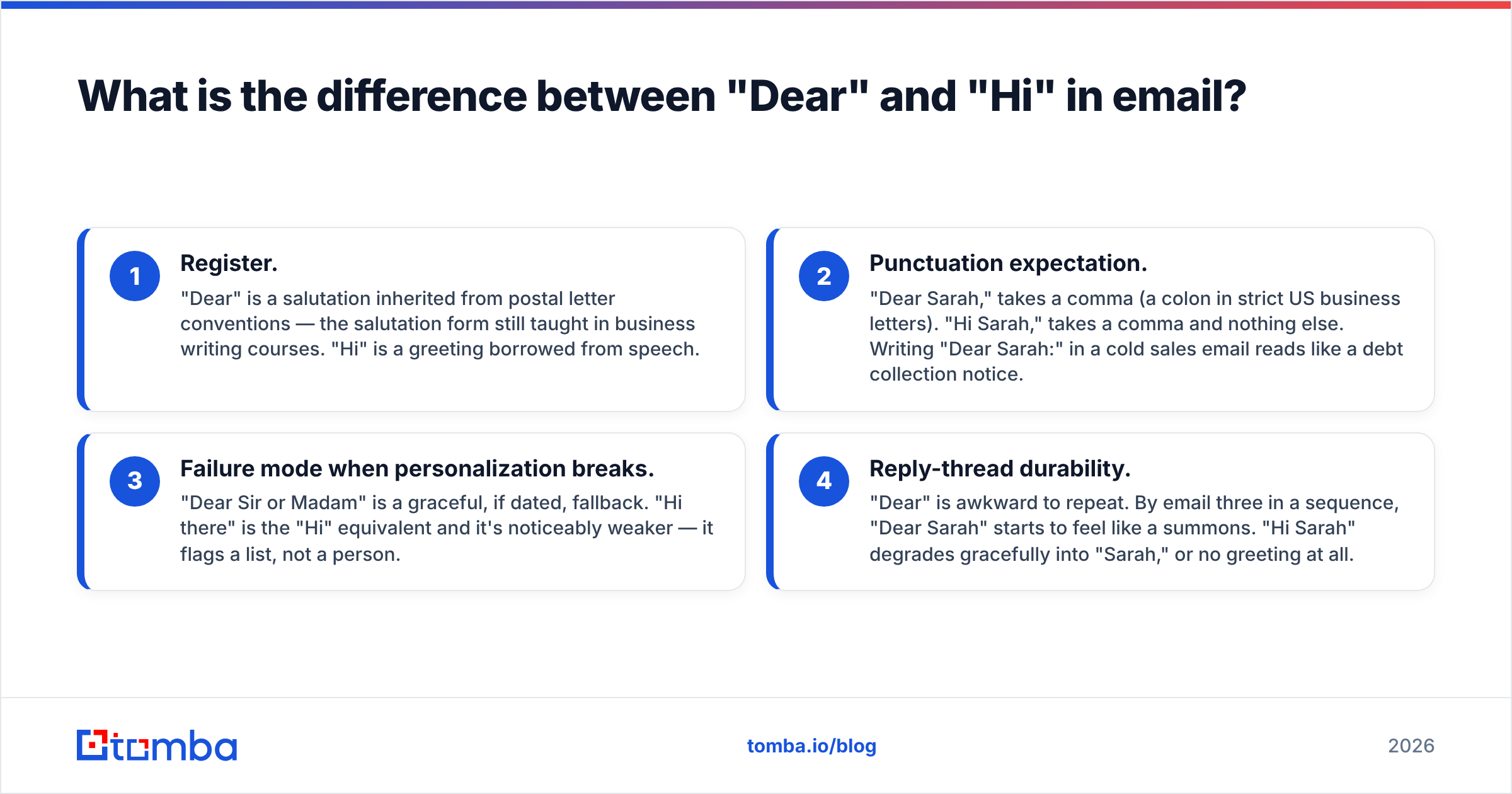
Mechanically, almost nothing. Practically, four things:
- Register. "Dear" is a salutation inherited from postal letter conventions — the salutation form still taught in business writing courses. "Hi" is a greeting borrowed from speech.
- Punctuation expectation. "Dear Sarah," takes a comma (a colon in strict US business letters). "Hi Sarah," takes a comma and nothing else. Writing "Dear Sarah:" in a cold sales email reads like a debt collection notice.
- Failure mode when personalization breaks. "Dear Sir or Madam" is a graceful, if dated, fallback. "Hi there" is the "Hi" equivalent and it's noticeably weaker — it flags a list, not a person.
- Reply-thread durability. "Dear" is awkward to repeat. By email three in a sequence, "Dear Sarah" starts to feel like a summons. "Hi Sarah" degrades gracefully into "Sarah," or no greeting at all.
That last point matters more than most people realize. You're not choosing a greeting for one email. You're choosing a register for a five-touch sequence.
Which greeting gets more replies in cold email?#
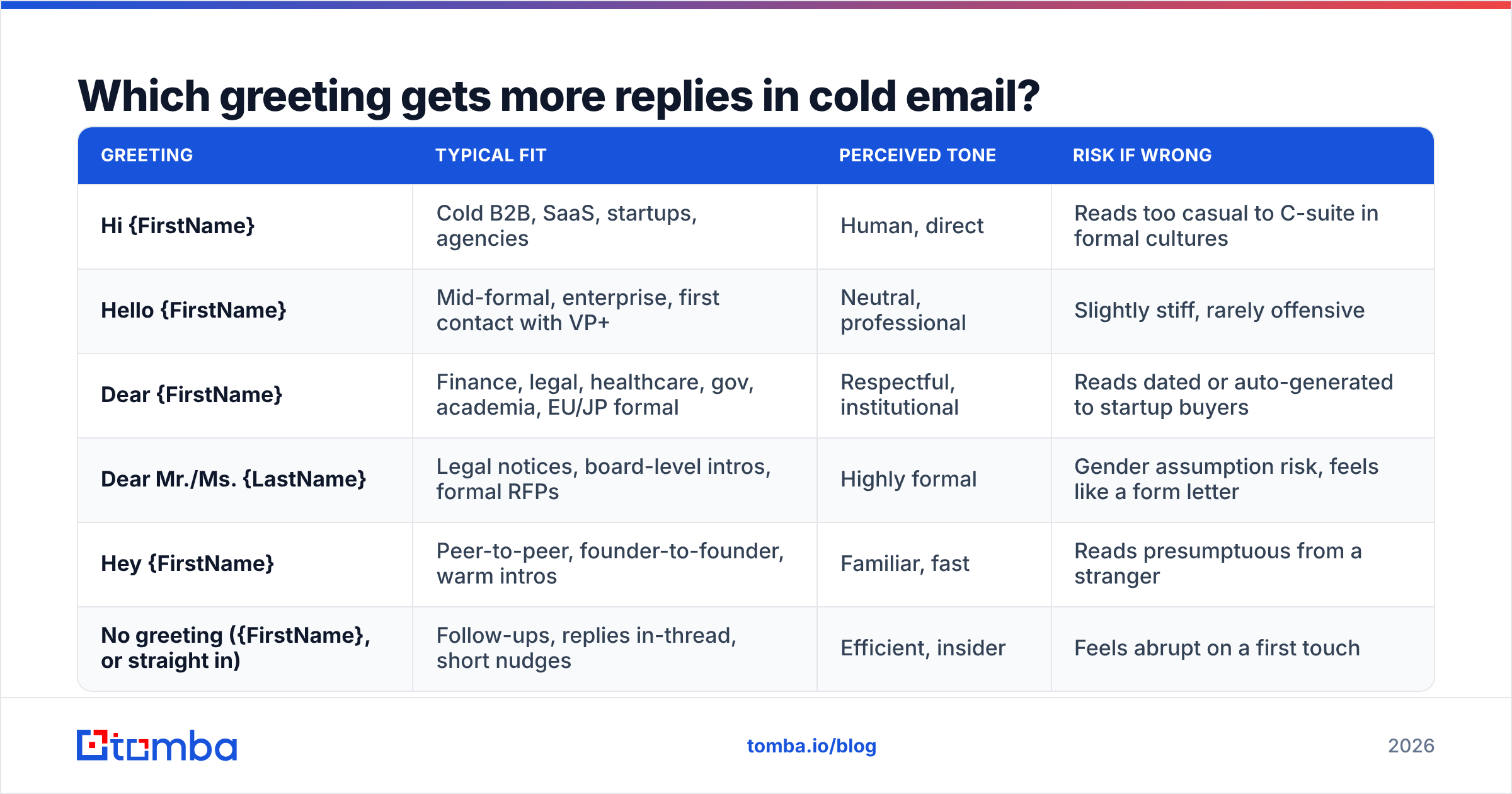
Short answer: "Hi" wins in most B2B tech, SaaS, agency, ecommerce, and startup contexts — usually by a small but consistent margin. "Dear" wins in a narrow set of formal verticals, and it wins decisively there.
Be skeptical of anyone quoting a precise universal number. Greeting effects are small, and they're confounded by subject line, sender domain, list quality, and send time. Public analyses from sales-content teams like HubSpot and writing resources like Grammarly point the same way: conversational openers beat formal ones in cold outreach. But the size of that lift is specific to your list.
Here's the honest framing:
| Greeting | Typical fit | Perceived tone | Risk if wrong |
|---|---|---|---|
| Hi {FirstName} | Cold B2B, SaaS, startups, agencies | Human, direct | Reads too casual to C-suite in formal cultures |
| Hello {FirstName} | Mid-formal, enterprise, first contact with VP+ | Neutral, professional | Slightly stiff, rarely offensive |
| Dear {FirstName} | Finance, legal, healthcare, gov, academia, EU/JP formal | Respectful, institutional | Reads dated or auto-generated to startup buyers |
| Dear Mr./Ms. {LastName} | Legal notices, board-level intros, formal RFPs | Highly formal | Gender assumption risk, feels like a form letter |
| Hey {FirstName} | Peer-to-peer, founder-to-founder, warm intros | Familiar, fast | Reads presumptuous from a stranger |
| No greeting ({FirstName}, or straight in) | Follow-ups, replies in-thread, short nudges | Efficient, insider | Feels abrupt on a first touch |
The pattern: your greeting should match the distance between you and the recipient, not your personal preference. A stranger writing "Hey" is overclaiming intimacy. A peer writing "Dear Mr. Chen" is underclaiming it. That reads as sarcastic or automated.
When should you still use "Dear"?#
Use "Dear" when at least two of these are true:
- The industry is regulated or credential-heavy. Healthcare administration, banking compliance, insurance, law, pharma, defense contracting, public sector procurement.
- The recipient's own outbound is formal. Check their LinkedIn posts, their company blog, and any auto-reply you've received. Mirror them.
- The recipient is a Dr., Prof., or holds an elected/appointed office. Titles come with expectations.
Two more signals point the same way:
- The market has strong formality norms. German business email still leans formal ("Sehr geehrte Frau…"). Japanese business correspondence is formal by default. French B2B expects "Bonjour Madame/Monsieur" at minimum on first contact.
- The email carries legal or contractual weight. Anything that might be printed and filed.
- You are writing to a group inbox with an unknown reader. "Dear Procurement Team" beats "Hi there" every time.
Use "Hi" everywhere else. That's roughly 80% of B2B outbound.
How do regional norms change the answer?#
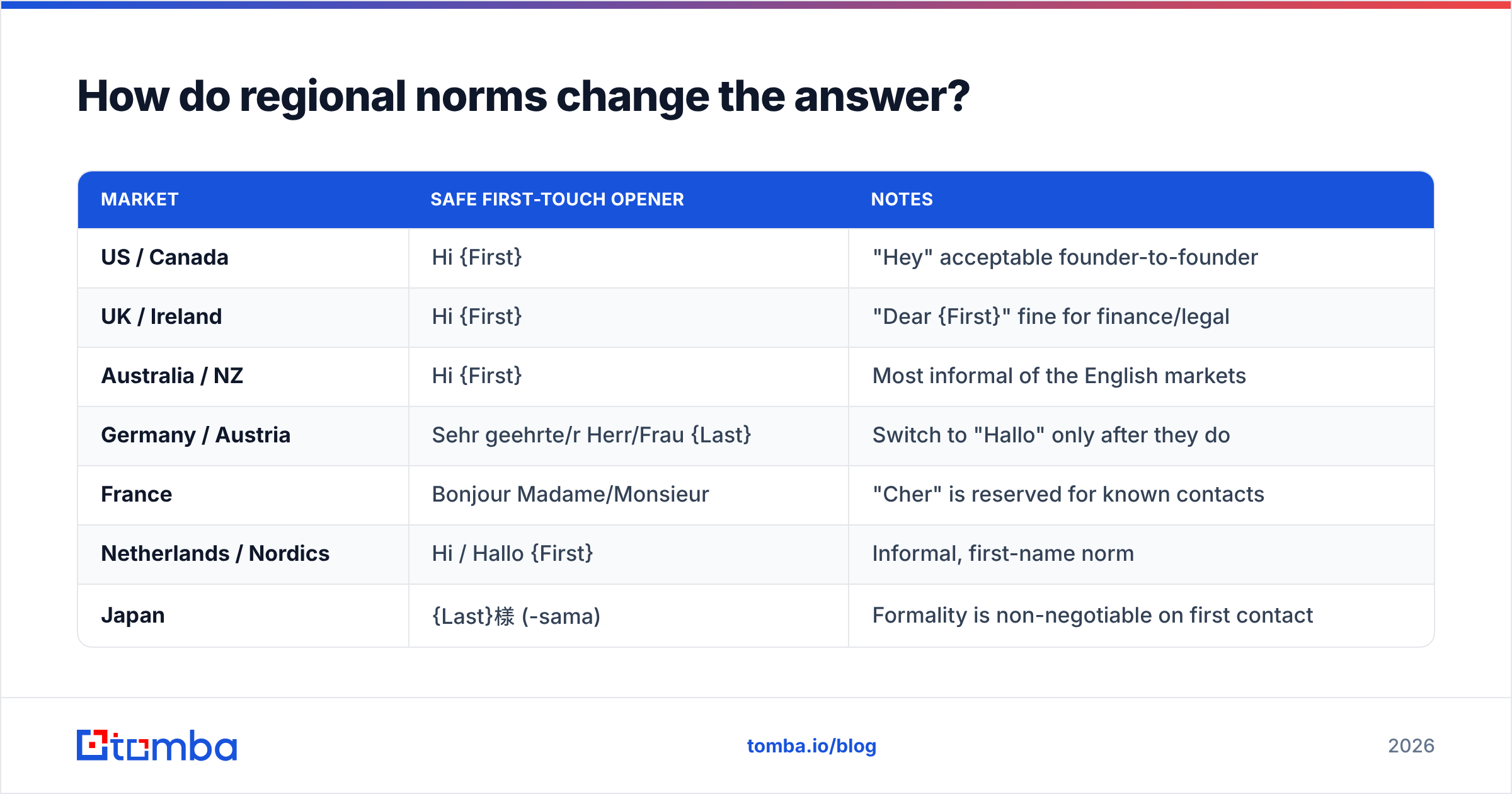
Language-specific, not translatable. A direct translation of "Hi Sarah" into German or Japanese lands badly. Rough guide for first-contact outbound:
| Market | Safe first-touch opener | Notes |
|---|---|---|
| US / Canada | Hi {First} | "Hey" acceptable founder-to-founder |
| UK / Ireland | Hi {First} | "Dear {First}" fine for finance/legal |
| Australia / NZ | Hi {First} | Most informal of the English markets |
| Germany / Austria | Sehr geehrte/r Herr/Frau {Last} | Switch to "Hallo" only after they do |
| France | Bonjour Madame/Monsieur | "Cher" is reserved for known contacts |
| Netherlands / Nordics | Hi / Hallo {First} | Informal, first-name norm |
| Japan | {Last}様 (-sama) | Formality is non-negotiable on first contact |
| UAE / Saudi | Dear Mr./Ms. {Last} | Formal titles expected; check honorifics |
Run one sequence across all of these with a single greeting token and you pay for it in reply rate somewhere. You just can't see where. Segment by country before you segment by greeting.
Why does the name after the greeting matter more than the greeting?#
"Hi Sarah" and "Dear Sarah" are separated by a nudge in register. "Hi Sarah" and "Hi there" are separated by a credibility cliff.
Every buyer has learned the tells of bulk mail. A missing first name is the loudest one. Second loudest is a wrong first name — writing "Hi Michael" to Mike's colleague Michelle because your data source guessed. Third is the merge tag that never fired: Hi {{first_name}}, sitting there in raw form at the top of the message.
That's a data problem, not a copywriting problem. The fix sits upstream of the draft:
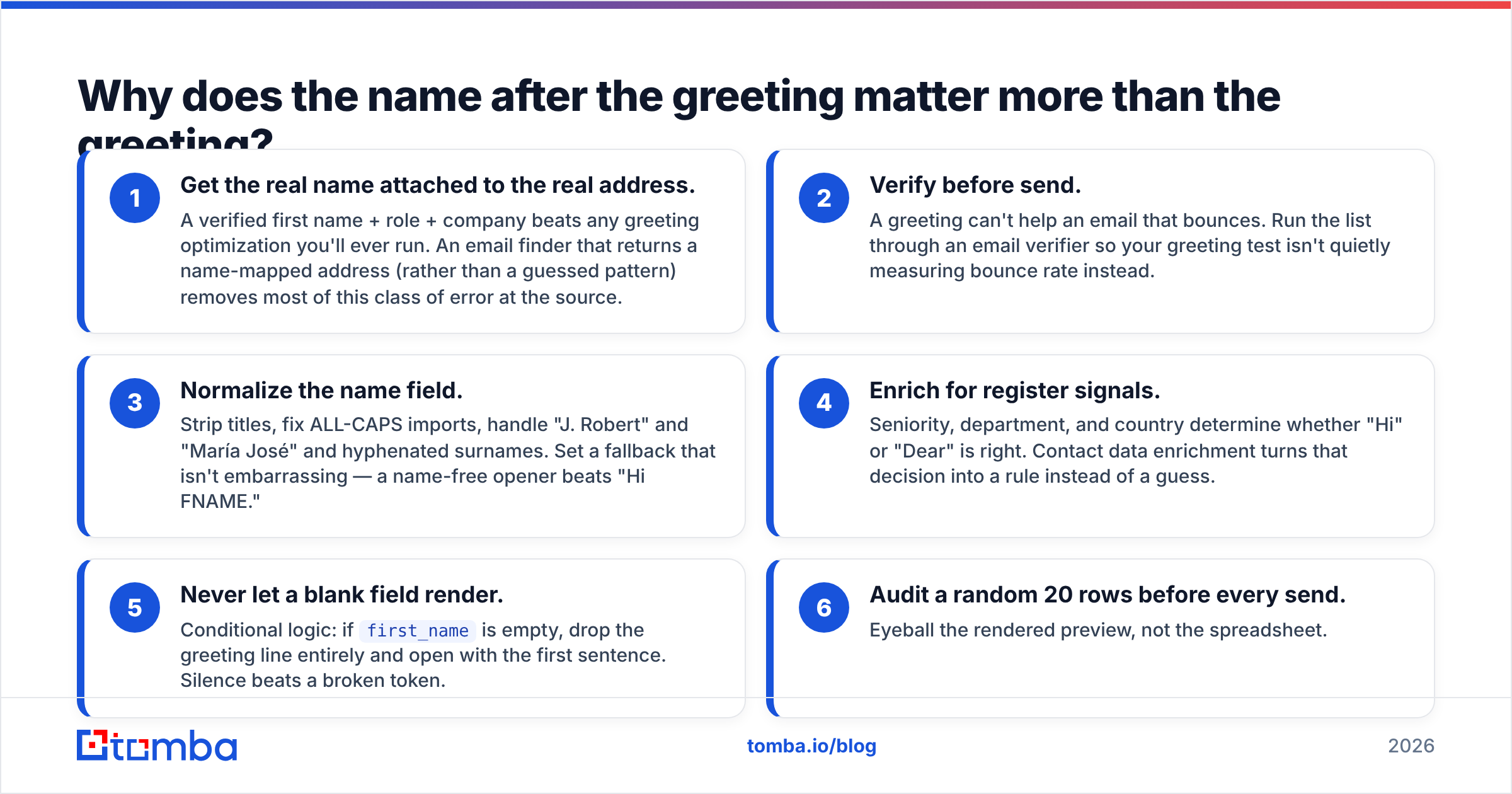
- Get the real name attached to the real address. A verified first name + role + company beats any greeting optimization you'll ever run. An email finder that returns a name-mapped address (rather than a guessed pattern) removes most of this class of error at the source.
- Verify before send. A greeting can't help an email that bounces. Run the list through an email verifier so your greeting test isn't quietly measuring bounce rate instead.
- Normalize the name field. Strip titles, fix ALL-CAPS imports, handle "J. Robert" and "María José" and hyphenated surnames. Set a fallback that isn't embarrassing — a name-free opener beats "Hi FNAME."
Then guard the edge cases:
- Enrich for register signals. Seniority, department, and country decide whether "Hi" or "Dear" is right. Contact data enrichment turns that call into a rule instead of a guess.
- Never let a blank field render. Use conditional logic: if
first_nameis empty, drop the greeting line and open with the first sentence. Silence beats a broken token. - Audit a random 20 rows before every send. Eyeball the rendered preview, not the spreadsheet.
How do you test dear vs hi in email without fooling yourself?#
Greeting A/B tests are easy to run badly. The effect is small and the noise is loud.
Set it up like this:
- Split by segment, not by list. Run the test inside a single ICP slice — same seniority band, same industry, same country. Mixing a German enterprise segment with US startups guarantees a muddy result.
- Change one variable. Same subject line, same body, same send window, same sending domain, same signature. If you also "improved" the CTA, you've learned nothing about greetings.
- Size it honestly. With a 5% baseline reply rate and a 1-point expected lift, you need thousands of sends per arm to reach any statistical confidence. Send 200 per arm and the result is a hint, not a finding.
Then read the result honestly:
- Measure replies, not opens. Open tracking has been unreliable since privacy proxies became the default. Reply rate and positive-reply rate are the metrics that survive.
- Re-run quarterly per segment. Norms drift. What reads fresh in one quarter reads formulaic three quarters later, especially once a tactic spreads through your category.
If you can't reach meaningful volume, skip the test. Pick the greeting your segment's own emails use and spend the effort on the first line instead. The first sentence after the greeting is worth ten times more.
What are the most common greeting mistakes?#
- "Dear Sir or Madam." Signals zero research and assumes a gender binary. If you truly don't have a name, address the role: "Dear Hiring Team," "Dear Procurement."
- "Hi there." The "Dear Sir or Madam" of informal email. Same problem, less dignity.
- "Hi [Company Name] team" on a one-to-one email. It's a group greeting sent to an individual — it reads as a mass send because it is one.
- Guessing gender from a first name. "Ms." on a name you assumed is a coin flip in many languages. Use first names or role-based greetings and skip the coin flip.
Four more that quietly cost replies:
- Formality mismatch inside the thread. Opening "Dear Ms. Novak" and signing "Cheers, Dan" is two people writing one email.
- Greeting the wrong person. Copy-paste errors between rows. This is the single most damaging mistake in outbound, and it's entirely a data-hygiene issue.
- Overlong greeting lines. "Dear Ms. Sarah Novak, VP of Operations at Acme Industries," eats the whole mobile preview before you've said anything.
- Nickname overreach. "Hi Kate" when her signature says Katherine. Use what they use.
If you want a starting point rather than a blank page, working from proven cold email templates and swapping the greeting per segment is faster than rewriting from scratch — and it keeps the rest of the message constant, which is exactly what a clean greeting test needs.
So which should you use?#
Default to "Hi {FirstName}," for cold B2B outreach in English-speaking markets. Escalate to "Hello {FirstName}," when writing to VP-level and above at large enterprises. Escalate to "Dear {FirstName}," or "Dear Mr./Ms. {LastName}," for regulated industries, formal cultures, government, academia, and anything with contractual weight.
Then stop thinking about it. Dear vs hi in email is a two-minute decision that people turn into a two-week debate. The compounding work is upstream: a clean, verified list where the name in the greeting is the right name for the right address, and downstream: a first sentence that earns the second one.
Get those two right and either greeting works. Get them wrong and no greeting saves you.
Start with the name, not the salutation. If your greeting keeps rendering as "Hi there" because your list has addresses but no verified people behind them, fix the input. Tomba's Email Finder returns name-matched professional addresses by domain, company, or person — so the first word of your email is a real name, not a fallback. The free tier covers 25 searches a month; paid plans start at $49/mo on Tomba pricing if you need volume. Fix the data, then argue about "Dear."
Related guides#
Ready to find emails that actually work?
Join 150,000+ professionals who stopped guessing and started sending. Free credits on signup — no credit card required.
Get the Tomba newsletter
Practical outbound tactics and product updates — once every two weeks.
About the author