DeBounce vs DealSignal: Which B2B Email Tool Wins in 2026?
DeBounce cleans lists you already have. DealSignal builds lists you don't. Here's an honest breakdown of pricing, accuracy, data coverage, and which one actually belongs in your outbound stack in 2026.
TL;DR
- DeBounce and DealSignal are not competitors. DeBounce is a bulk email verifier; DealSignal is a managed B2B contact-data provider. Comparing them head-to-head only makes sense if you're deciding where to spend your next data dollar.
- DeBounce is cheap, pay-as-you-go, and credits don't expire — good for cleaning lists you already own, terrible if you have no list.
- DealSignal is quote-based, contract-driven, and built for RevOps teams that want on-demand research and CRM enrichment at scale. Expect a sales call before you see a number.
- If your real problem is "I need verified emails for a target account list," neither one alone solves it — you need a finder plus verification in the same workflow.
- Best combined setup for most SMB and mid-market teams: a finder-first tool with built-in verification (Tomba at $49/mo, Hunter, Findymail) and a bulk verifier as a second opinion on cold lists.
What are DeBounce and DealSignal, exactly?#
They solve two different halves of the same problem.
DeBounce (debounce.io) is an email list validation service. You upload a CSV, it runs syntax checks, MX record lookups, SMTP handshakes, disposable-domain detection, role-account flagging, and catch-all identification, then hands back a scored list. It also offers a real-time API, an inbox-level abuse detector, and integrations with the usual ESPs. It does not find email addresses. It tells you whether the ones you have will bounce.
DealSignal (dealsignal.com) is a B2B contact and account data platform. It sells verified contact records — emails, direct dials, job titles, firmographics, technographics, intent signals — sourced from a blend of machine research and human verification, with on-demand research for accounts it doesn't already cover. It's positioned against ZoomInfo, Cognism, and Lusha, and it sells into RevOps and demand-gen teams that need CRM records enriched continuously rather than one CSV cleaned once.
So the honest framing of DeBounce vs DealSignal is: do you have a list that's dirty, or do you have no list at all?

How do DeBounce and DealSignal compare head-to-head?#
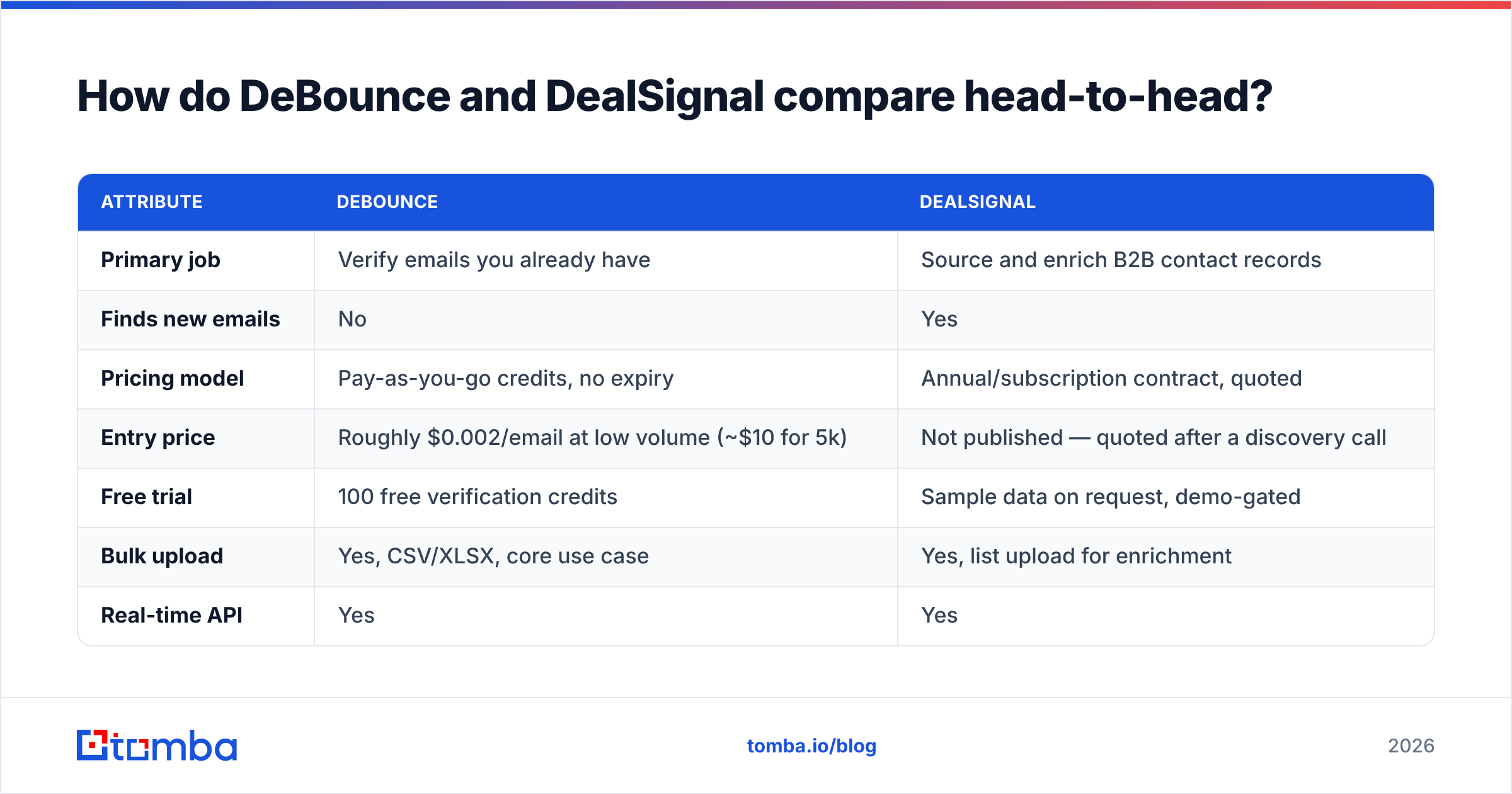
| Attribute | DeBounce | DealSignal |
|---|---|---|
| Primary job | Verify emails you already have | Source and enrich B2B contact records |
| Finds new emails | No | Yes |
| Pricing model | Pay-as-you-go credits, no expiry | Annual/subscription contract, quoted |
| Entry price | Roughly $0.002/email at low volume (~$10 for 5k) | Not published — quoted after a discovery call |
| Free trial | 100 free verification credits | Sample data on request, demo-gated |
| Bulk upload | Yes, CSV/XLSX, core use case | Yes, list upload for enrichment |
| Real-time API | Yes | Yes |
| Catch-all handling | Flags catch-all, limited resolution | Human-verified records reduce catch-all exposure |
| Direct dials / phone | No | Yes |
| Intent data | No | Yes |
| CRM sync | Via integrations/Zapier | Native Salesforce, HubSpot, Marketo |
| Typical buyer | Marketer or founder with a list | RevOps / demand-gen at 50+ headcount |
| Time to first value | Minutes | Days to weeks (onboarding + research turnaround) |
The table makes the decision obvious in most cases. If you can't answer "where does the list come from?", DeBounce doesn't help you. If you're spending four figures a month to fix a bounce problem you could fix for $30, DealSignal is overkill.
Which one actually costs more?#
DeBounce, by an enormous margin, is cheaper — but that's because it does far less.
DeBounce publishes transparent, self-serve pricing: you buy credits in blocks, the per-email rate drops as volume rises, and unused credits don't expire. A team verifying 50,000 addresses a quarter is looking at a bill in the tens of dollars, not hundreds. There's no seat licensing and no contract.
DealSignal does not publish a public rate card. Pricing is quoted based on record volume, refresh cadence, seats, and whether you want on-demand research for accounts outside the existing database. Reviews on G2 and buyer reports consistently place it in the "annual contract, four-figure monthly commitment" tier, in line with other managed data providers. That's not a criticism — human-verified records with a coverage guarantee genuinely cost more to produce than an SMTP ping. It's just a different budget line.
Where this matters: teams routinely buy an enterprise data contract when their actual failure mode is a bad list-building process. Before you sign anything annual, price the alternative stack.
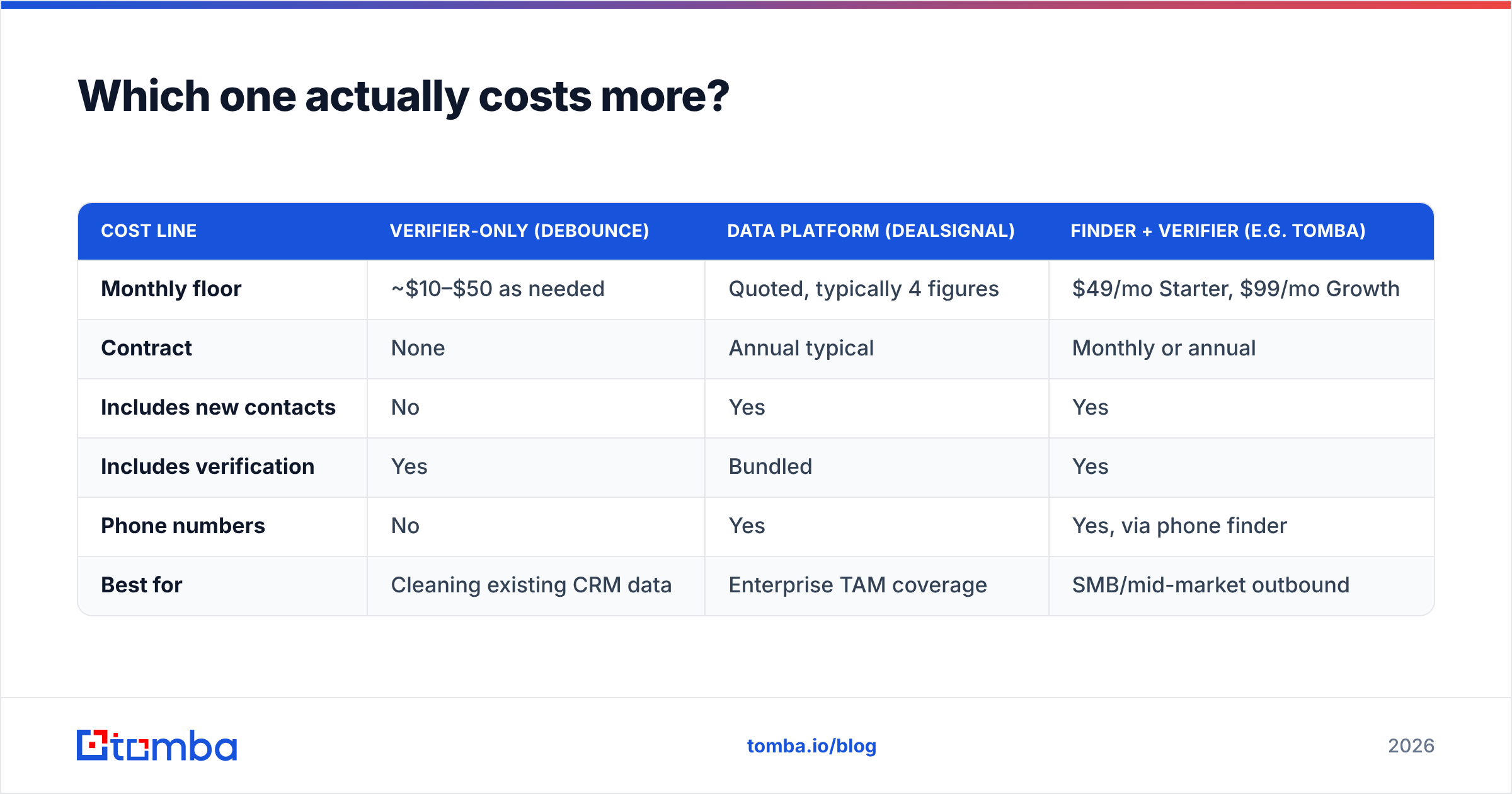
| Cost line | Verifier-only (DeBounce) | Data platform (DealSignal) | Finder + verifier (e.g. Tomba) |
|---|---|---|---|
| Monthly floor | ~$10–$50 as needed | Quoted, typically 4 figures | $49/mo Starter, $99/mo Growth |
| Contract | None | Annual typical | Monthly or annual |
| Includes new contacts | No | Yes | Yes |
| Includes verification | Yes | Bundled | Yes |
| Phone numbers | No | Yes | Yes, via phone finder |
| Best for | Cleaning existing CRM data | Enterprise TAM coverage | SMB/mid-market outbound |
Tomba's published pricing — Free (25 searches/mo), Starter $49/mo, Growth $99/mo, Pro $249/mo, Enterprise custom — sits in the gap between the two: it finds addresses like a data provider and validates them like a verifier, without the procurement cycle.
How accurate is each one, really?#
Accuracy claims in this category are marketing numbers until you test them on your own list. Here's how to read them honestly:
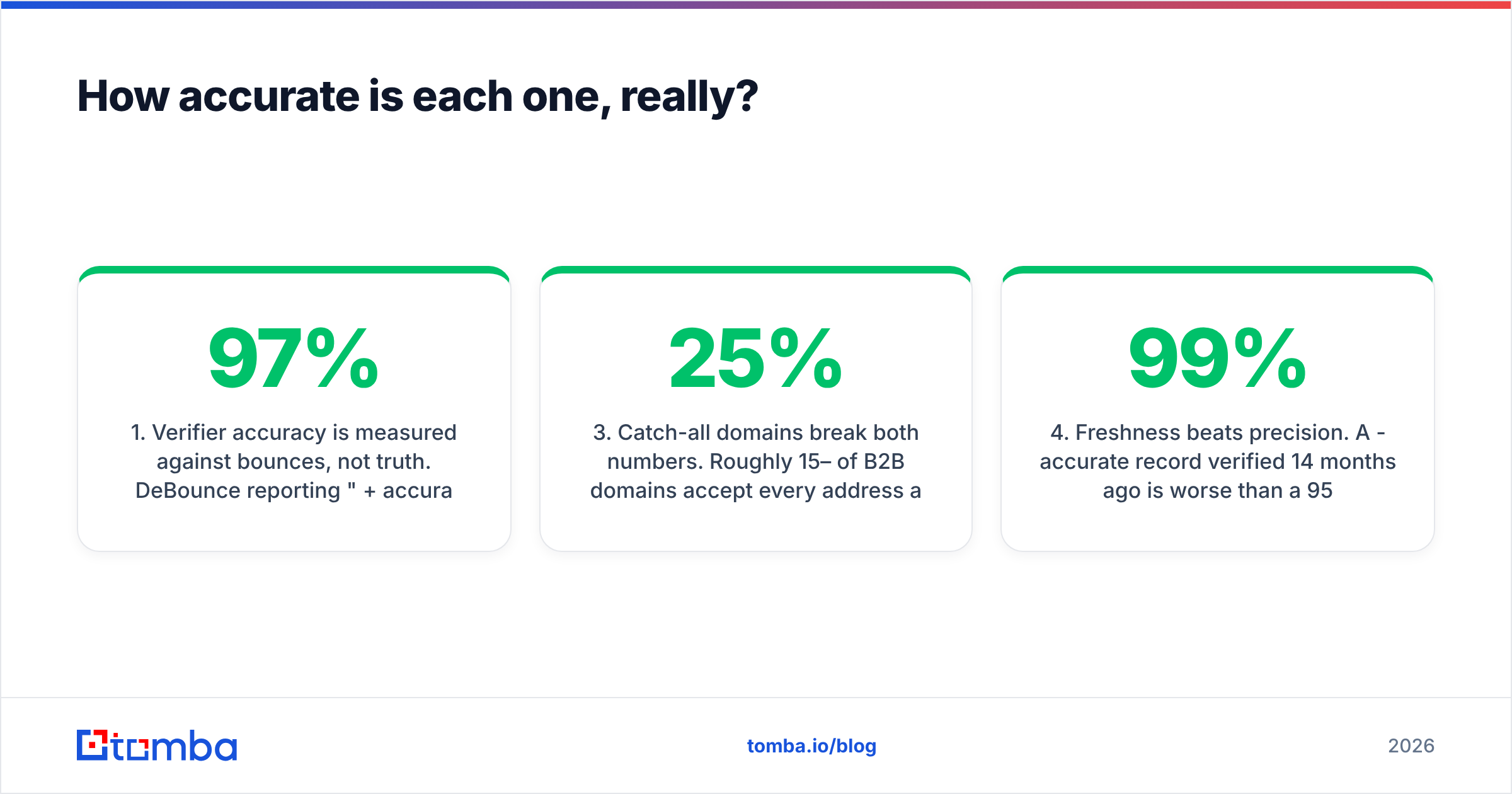
- Verifier accuracy is measured against bounces, not truth. DeBounce reporting "97%+ accuracy" means its valid/invalid calls line up with what your ESP observes when you send. That's the right metric for a verifier — and DeBounce performs competitively in independent list-cleaning tests against ZeroBounce, NeverBounce, and Bouncer.
- Data-provider accuracy is measured against reality. DealSignal's pitch is human verification plus continuous refresh — its number claims to describe whether the person still works there, in that role, at that address. That's a harder problem and a more valuable guarantee, which is why it costs more.
- Catch-all domains break both numbers. Roughly 15–25% of B2B domains accept every address at the SMTP layer, so no verifier can prove validity by handshake alone. Tools differ enormously here — some mark catch-alls "unknown" and charge you anyway. A dedicated catch-all verifier that resolves rather than shrugs is worth more than a percentage point of headline accuracy.
- Freshness beats precision. A 99%-accurate record verified 14 months ago is worse than a 95%-accurate record verified last week. B2B job-change churn runs well above 20% annually. Ask any vendor when the record was last confirmed, not just whether it's "verified."
- Test with a 500-row control set. Take addresses you know are good and addresses you know are dead, run them through both tools, and compare. Vendor benchmarks are self-graded homework; yours aren't.
Run that test before you commit to anything annual. It takes an afternoon and it settles arguments that otherwise last a quarter.
Do you need a verifier, a data provider, or both?#
Most teams need a finder and treat that as the missing piece. Here's the decision framework:
- You have a CRM full of aging contacts and a rising bounce rate. → Verification problem. DeBounce solves it for pocket change. Add an email verifier into your workflow so new records get checked on entry, not once a year in a panic.
- You have a defined ICP but no contacts in it. → Sourcing problem. DealSignal, Cognism, or a self-serve finder solves it. A verifier does nothing for you here.
- You have a target account list and need the right person at each one. → Finder problem. This is the most common real scenario and the one both tools handle badly on their own. Domain search plus role filtering gets you there faster than either.
- You're running multichannel and need phone as well as email. → Data-provider or finder-with-phone. DeBounce is email-only; DealSignal includes direct dials; Tomba covers it through its phone finder.
- You're an agency handling client lists of unknown provenance. → Verifier, always, as a mandatory gate. Never send on a list you didn't validate, regardless of who swore it was clean.

When is DeBounce the right pick?#
Choose DeBounce when the following are true:
You already have volume — an exported CRM, a webinar list, a scraped set, an inherited database — and your only question is which addresses will bounce. You want to pay for exactly what you use with no seat fees or annual commitment. You need a fast API to validate signups at the form level. And you're comfortable that catch-all domains will come back as "unknown" and require a judgment call.
DeBounce's genuine strengths are price transparency, non-expiring credits, and a no-friction self-serve flow. For a founder cleaning 20,000 rows before a launch, it's hard to beat. It's also a sane second opinion on any list a vendor sold you — including lists from good vendors. Reputable list providers like BookYourData build verification into delivery and hold up well under audit, but running an independent check before your first send is standard hygiene, not an insult to the source.
Where DeBounce stops: it will never tell you the VP of Engineering's address at an account you've never touched. That's outside its job description.
When is DealSignal the right pick?#
Choose DealSignal when you're operating at a scale where data operations is a function, not a task.
Signals that you're in that bracket: you have a RevOps team; your CRM has hundreds of thousands of records that need continuous refresh rather than one-time cleaning; you're running ABM against a fixed account list and need coverage guarantees for accounts a self-serve tool can't reach; you need intent signals feeding lead scoring; and you have procurement, legal review, and a budget line that can absorb an annual contract.
DealSignal's on-demand research model is a real differentiator here. If your ICP is niche — regional manufacturers, specific compliance roles, non-English markets — generic databases will show thin coverage and a research-backed provider can actually fill the gap. That's worth paying for.
Where DealSignal stops: it's a poor fit for a two-person team that needs 200 emails this week. The onboarding overhead alone exceeds the value.
What do most teams actually end up buying?#
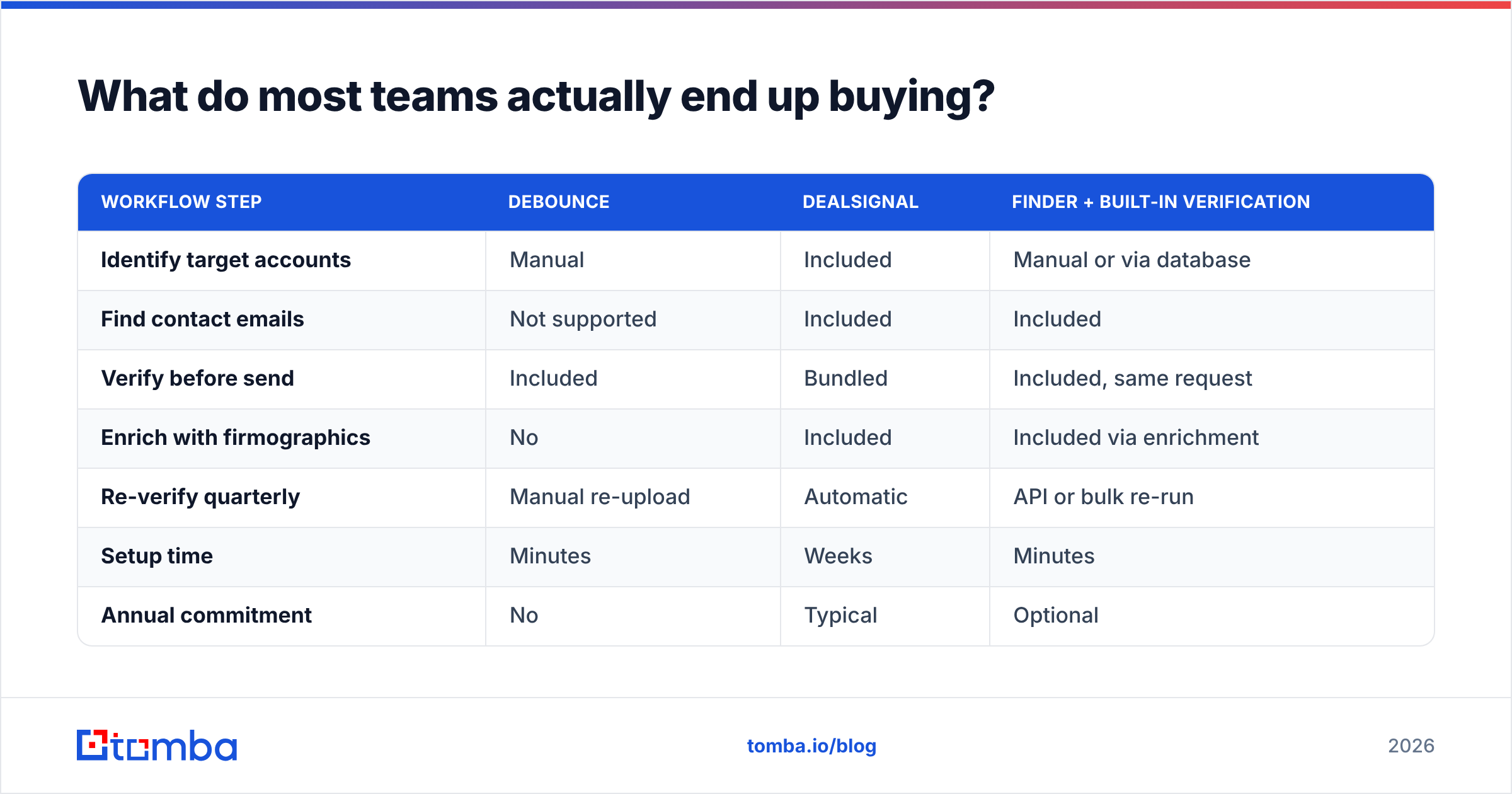
A third thing: a finder-first tool with verification built into the same call.
The reason is workflow, not features. Splitting sourcing and verification across two vendors means exporting, re-uploading, reconciling, and losing a day per campaign. Tools that find and validate in one step — Tomba Email Finder, Hunter, Findymail — collapse that into a single action, and most now expose it through an API and a spreadsheet add-on so the ops burden disappears entirely.
| Workflow step | DeBounce | DealSignal | Finder + built-in verification |
|---|---|---|---|
| Identify target accounts | Manual | Included | Manual or via database |
| Find contact emails | Not supported | Included | Included |
| Verify before send | Included | Bundled | Included, same request |
| Enrich with firmographics | No | Included | Included via enrichment |
| Re-verify quarterly | Manual re-upload | Automatic | API or bulk re-run |
| Setup time | Minutes | Weeks | Minutes |
| Annual commitment | No | Typical | Optional |
For a mid-market team, the practical stack is: a finder for net-new contacts, its native verification on every result, and a dedicated bulk verifier as a periodic audit on imported or purchased lists. That covers 90% of what DealSignal delivers at roughly 5% of the cost — and the remaining 10% (intent data, guaranteed coverage on obscure accounts, managed research) is exactly what should trigger the enterprise conversation when you actually need it.
How do you avoid wasting budget on either one?#
Four rules that survive contact with reality:
- Fix the source before you buy a filter. A 30% bounce rate usually means bad sourcing, not bad verification. Cleaning the output of a broken process is a permanent tax.
- Never buy annual before a paid pilot. Run 30 days on a monthly plan or a credit block. Measure bounce rate, connect rate, and reply rate — not "data quality" as a feeling.
- Verify at entry, not at send. Validation belongs at the moment a record is created. Batch cleaning is remedial work.
- Track cost per delivered contact. Not cost per credit. A cheap tool with 40% unusable output is more expensive than a pricier one at 90% usable, and only this metric shows it.
Frequently asked questions#
Is DeBounce a DealSignal alternative? No. If you're evaluating them against each other, one of them is the wrong category for your problem. The real alternative to DealSignal is Cognism, Apollo, or ZoomInfo; the real alternative to DeBounce is ZeroBounce, Bouncer, or a Debounce alternative with catch-all resolution built in.
Can I use both? Yes, and some enterprises do — DealSignal for sourcing, an independent verifier as a QA gate before high-value sends. It's redundant for most teams but defensible at scale.
Which is better for cold outbound? Neither alone. Cold outbound needs sourcing plus verification plus deliverability hygiene. Get the finder right first; verification is the cheap part.
Do free verifiers work? For spot checks, yes — a free email checker is fine for validating a single address before an important send. For lists, no: free tiers cap out fast and rarely handle catch-alls.
Where should you start?#
If your bottleneck is finding the right people at the accounts you care about — and for most teams under 200 employees, it is — start with the finder, not the verifier or the enterprise contract. Tomba Email Finder locates professional addresses by domain, name, or company, validates each result in the same request, and covers catch-all domains, phone lookup, and CRM enrichment from one plan. The free tier gives you 25 searches a month to test against your own known-good list; Starter is $49/mo when you're ready to run real volume. Test it on 100 accounts from your ICP, compare the delivered-contact cost against a DealSignal quote and a DeBounce credit block, and let your own numbers pick the winner.
Related guides#
Ready to find emails that actually work?
Join 150,000+ professionals who stopped guessing and started sending. Free credits on signup — no credit card required.
Get the Tomba newsletter
Practical outbound tactics and product updates — once every two weeks.
About the author