Debounce vs FindThatLead: Which Tool Wins in 2026?
Debounce verifies lists. FindThatLead builds them. Here's an honest side-by-side on pricing, accuracy, and coverage — plus which one your outbound stack actually needs.
TL;DR
- Debounce and FindThatLead are not really competitors — Debounce is a bulk email verifier, FindThatLead is a prospecting and lead-finding tool with light verification bolted on.
- If you already have a list and just need it cleaned, Debounce is the cheaper, more focused pick: pay-as-you-go credits from around $0.0016 each, no subscription required.
- If you need to build the list from domains, LinkedIn, or keyword searches, FindThatLead does more — but its verification layer is thinner than a dedicated verifier's.
- Running both means two subscriptions, two credit pools, and two APIs to maintain. Most teams under 50 seats do better with one platform that finds and verifies.
- Our pick for the combined job: a single find-plus-verify stack. Tomba starts at $49/mo (free tier: 25 searches) and covers domain search, finding, and verification on one credit pool.
What are Debounce and FindThatLead, actually?#
They solve different halves of the same problem, which is why comparing them head-to-head confuses people.
Debounce (debounce.io) is a bulk email verification service. You upload a CSV of addresses you already have, and it runs syntax checks, DNS and MX lookups, disposable-domain detection, role-account flagging, and SMTP-level mailbox probing. It returns a status per address — deliverable, invalid, accept-all, unknown — plus a risk score. It does not find email addresses. It has no prospect database, no browser extension for scraping LinkedIn, no sequencer.
FindThatLead (findthatlead.com) is a lead-generation suite. Its core features are domain search (give it a company URL, get employee emails), a Chrome extension that pulls contacts from LinkedIn profiles and searches, a "Prospector" that filters by role/industry/location, and a built-in cold email sender for drip campaigns. It includes email verification, but that verification is a supporting feature rather than the product.
So the honest framing: Debounce competes with ZeroBounce, NeverBounce, and Bouncer. FindThatLead competes with Apollo, Hunter, and Snov.io. They overlap on exactly one function — verification — and that overlap is where the comparison gets interesting.

How do they compare on features and pricing?#
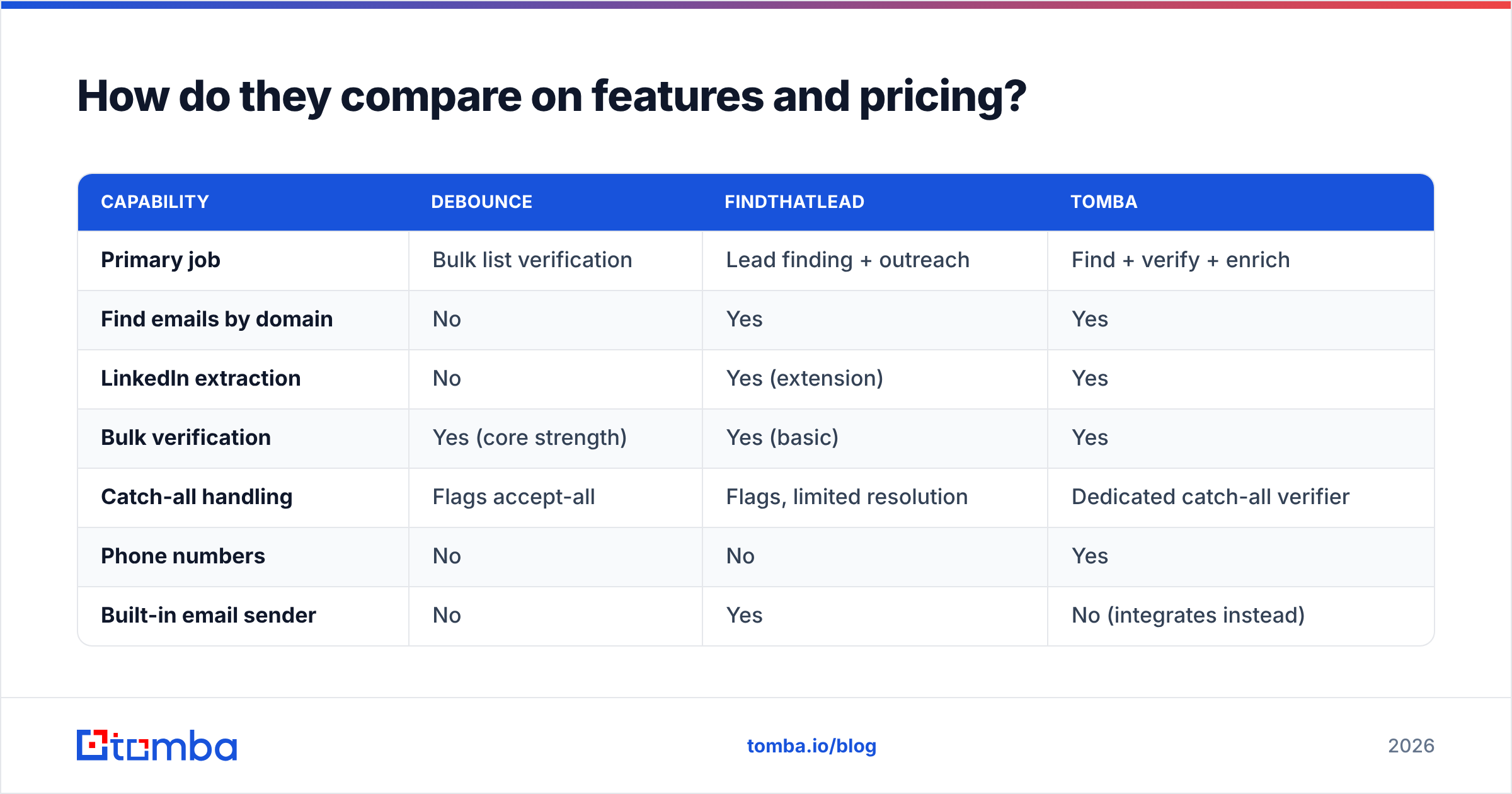
Here's the side-by-side on what each tool actually ships.
| Capability | Debounce | FindThatLead | Tomba |
|---|---|---|---|
| Primary job | Bulk list verification | Lead finding + outreach | Find + verify + enrich |
| Find emails by domain | No | Yes | Yes |
| LinkedIn extraction | No | Yes (extension) | Yes |
| Bulk verification | Yes (core strength) | Yes (basic) | Yes |
| Catch-all handling | Flags accept-all | Flags, limited resolution | Dedicated catch-all verifier |
| Phone numbers | No | No | Yes |
| Built-in email sender | No | Yes | No (integrates instead) |
| Entry price | ~$4.50 for 1k credits (PAYG) | ~$49/mo (Growth) | $49/mo Starter |
| Free tier | 100 free credits | 50 credits/mo trial | 25 searches/mo |
| API | Yes | Yes | Yes |
| Credit expiry | Credits never expire (PAYG) | Monthly reset | Monthly reset |
Two things stand out.
First, Debounce's pay-as-you-go model is genuinely cheap for occasional use. If you clean a 10,000-record list twice a year, you'll spend roughly $30-40 total and the credits sit there until you use them. No subscription tool matches that for infrequent, bursty verification.
Second, FindThatLead's pricing is subscription-only, and its lower tiers cap monthly credits hard. Once you exhaust them, you wait for the reset or upgrade. For a team running continuous outbound, that ceiling arrives faster than the marketing pages suggest.
Which one is more accurate?#
Different questions, different answers — and accuracy means two separate things here.
For verification accuracy, Debounce wins on paper and in practice. A dedicated verifier maintains SMTP infrastructure, rotating IPs, and per-provider heuristics specifically to avoid false positives and greylisting. Third-party comparisons on G2 consistently place dedicated verifiers ahead of general prospecting suites on bounce-prediction quality. Debounce publishes an accuracy claim in the 97-98% range for deliverable/invalid classification on non-catch-all domains, which is in line with what serious verifiers deliver.
For finding accuracy — the percentage of returned emails that actually exist — FindThatLead is mid-pack. Its domain search performs well on companies with a predictable pattern (first.last@) and degrades on smaller firms, agencies, and anything with a non-obvious format. Users regularly report a meaningful share of guessed-but-unverified addresses in exports, which is why running finder output through a separate verifier is standard practice.
The catch-all problem is where both tools get uncomfortable. Roughly 15-20% of B2B domains accept all mail at the SMTP layer, so no verifier can prove the mailbox exists from outside. Debounce marks these "accept-all" and leaves the decision to you. FindThatLead marks them too, with less nuance. If catch-all domains are a large share of your ICP — common in enterprise and in European mid-market — you need a tool with a purpose-built catch-all verifier rather than a binary flag.

When should you pick Debounce?#
Pick Debounce when all of the following are true:
- You already have the list. It came from a partner, a trade-show scan, a CRM export, an old newsletter database, or a data vendor. Your problem is dirt, not discovery.
- Your volume is bursty. You clean 50k records in March and nothing until September. PAYG credits that never expire beat a monthly subscription you'd pay through the quiet months.
- You want a single-purpose tool. Fewer features means fewer things to configure, and the integration surface (API, CSV, Zapier) is small enough to wire up in an afternoon.
- Deliverability is the immediate fire. If your bounce rate crossed 3% and your ESP is threatening you, a dedicated verifier is the fastest lever you can pull. Pair it with an email reputation checker to see whether the damage already hit your sending domain.
Do not pick Debounce if your actual bottleneck is "we don't have enough contacts." It will not solve that, and no amount of verification credits changes it.
When should you pick FindThatLead?#
FindThatLead makes sense when:
- You're starting from zero contacts. You have a target account list — company names or domains — and need names and emails attached to them.
- You want finding and sending in one login. FindThatLead's built-in sender means you can go from search to sequence without exporting to a separate tool. That's real convenience for a solo founder or a two-person team.
- Your ICP is well-covered. FindThatLead skews toward Spanish and broader European coverage compared to some US-first tools, which matters if you sell into those markets.
- You're volume-light. The lower tiers work fine at a few hundred contacts a month. They stop working at a few thousand.
Where it disappoints: the sender is basic compared to a real sequencer, the verification is not a substitute for a dedicated verifier, and export limits on lower plans frustrate anyone building large lists. If the sending side is what you actually care about, an Instantly alternative comparison is a more useful read than this one.
Do you actually need both tools?#
This is the question most buyers arrive at after two weeks of trials, and the honest answer is: usually not — but the naive stack says yes.
The naive stack looks like this: FindThatLead finds addresses, you export a CSV, upload to Debounce, verify, download, re-import to your sequencer. That's two subscriptions, one manual handoff, and a data round-trip every single time you build a list. It works. It's also slow, and the handoff is where records get dropped, duplicated, or silently mangled by a spreadsheet's encoding.
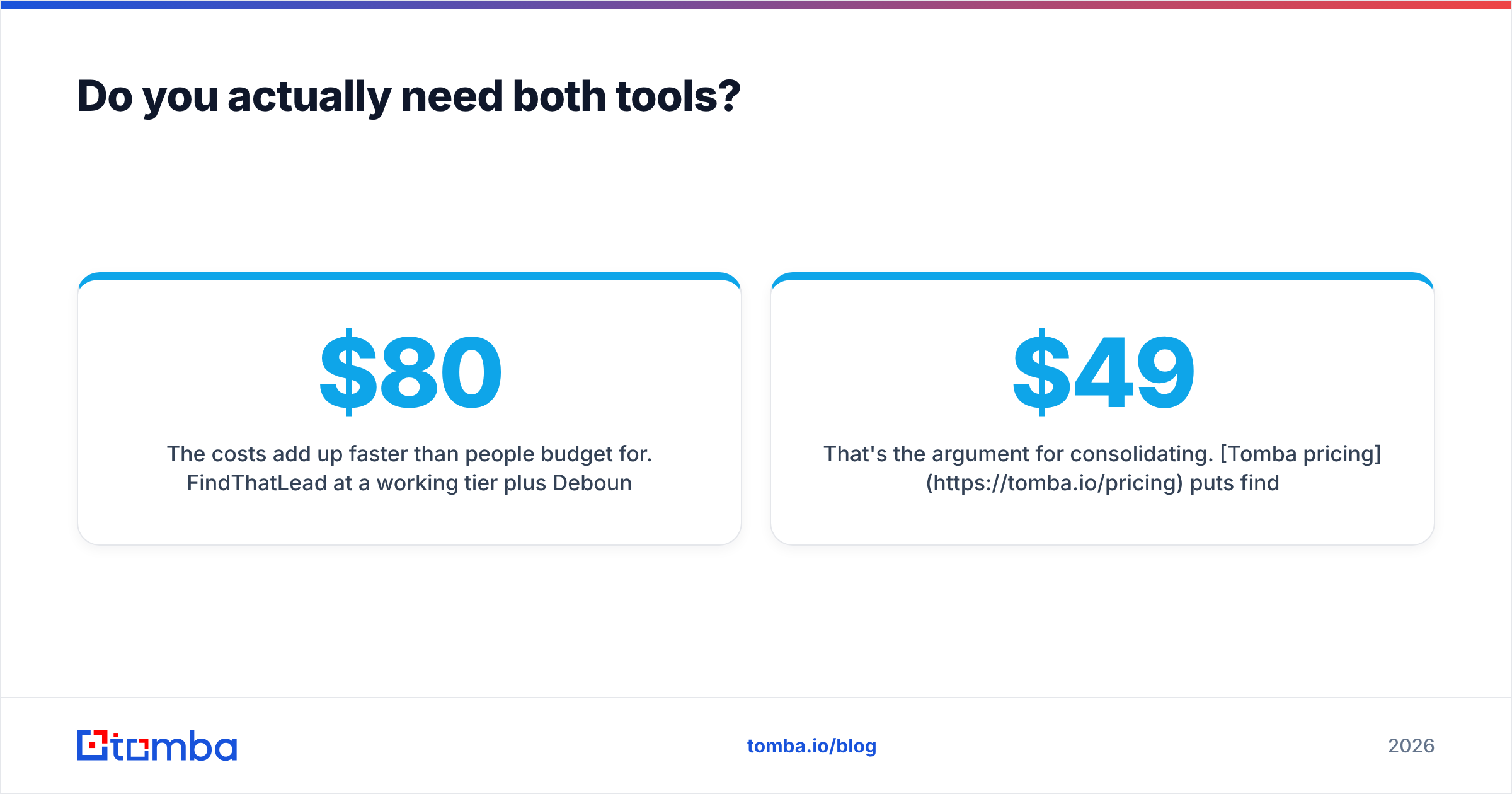
The costs add up faster than people budget for. FindThatLead at a working tier plus Debounce credits at real volume lands most teams between $80 and $150/month, before you've sent a single email. And you still don't have phone numbers, firmographic enrichment, or a catch-all resolution path.

The alternative: use a platform where finding and verification share one credit pool and one API. Every address the finder returns is already scored before it reaches your export. No round-trip, no second invoice, no format mismatch between two vendors' CSV schemas.
That's the argument for consolidating. Tomba pricing puts finder plus verifier plus data enrichment on one plan — $49/mo Starter, $99/mo Growth, $249/mo Pro, with a free tier at 25 searches/mo to test the match rate on your own domains before paying. Whether you land on Tomba, Hunter, or something else, the principle holds: one pipeline beats two.
How do the three options stack up on total cost?#
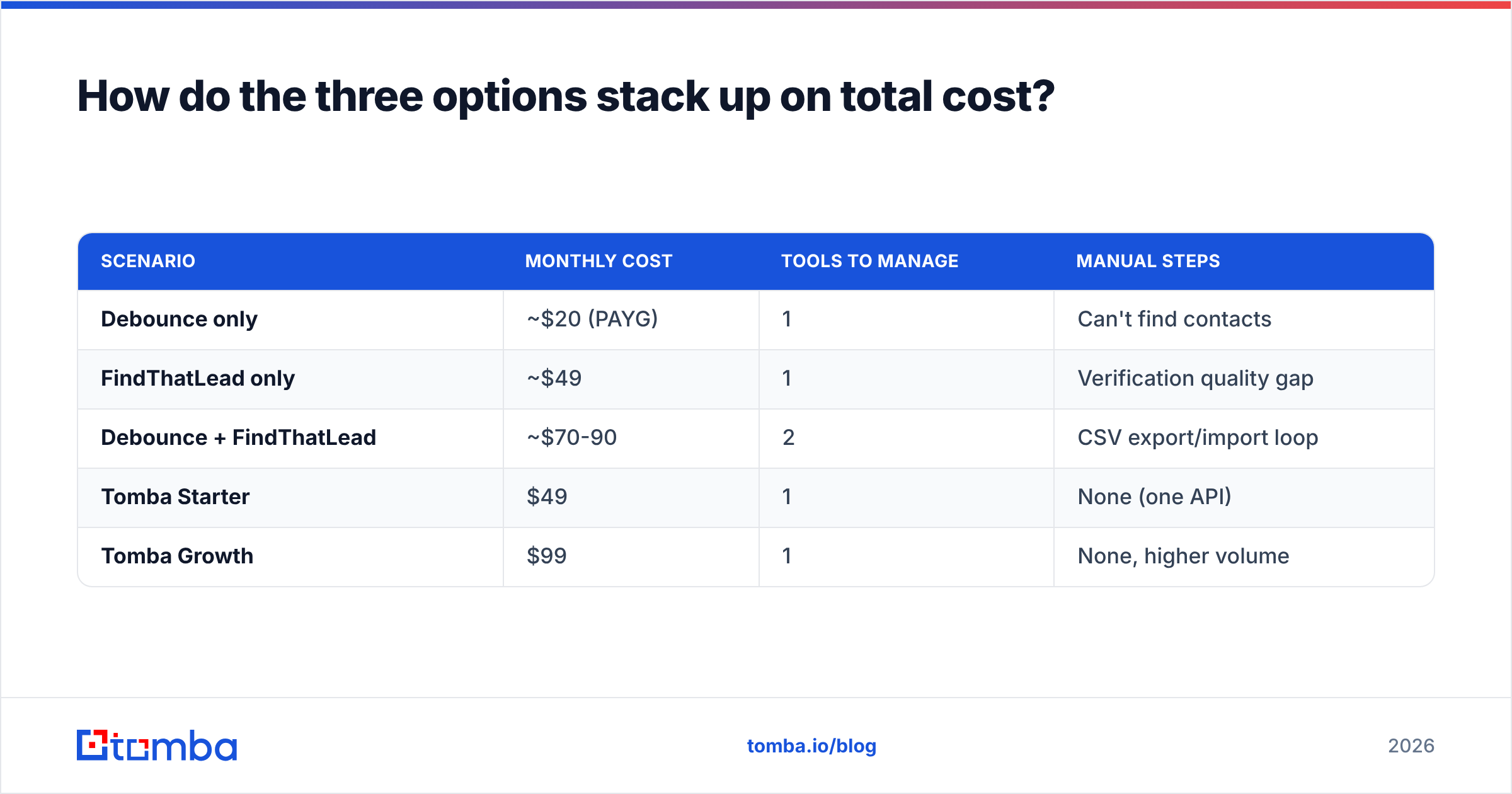
Model it on a realistic month — 2,000 new contacts found, 5,000 addresses verified.
| Scenario | Monthly cost | Tools to manage | Manual steps |
|---|---|---|---|
| Debounce only | ~$20 (PAYG) | 1 | Can't find contacts |
| FindThatLead only | ~$49 | 1 | Verification quality gap |
| Debounce + FindThatLead | ~$70-90 | 2 | CSV export/import loop |
| Tomba Starter | $49 | 1 | None (one API) |
| Tomba Growth | $99 | 1 | None, higher volume |
The two-tool stack isn't wildly expensive — it's the operational tax that costs you. Every CSV round-trip is a place where someone forgets to re-verify, or verifies the wrong column, or ships a list that's three weeks stale. Consolidation buys back that time more than it buys back dollars.
What should you check before you commit?#
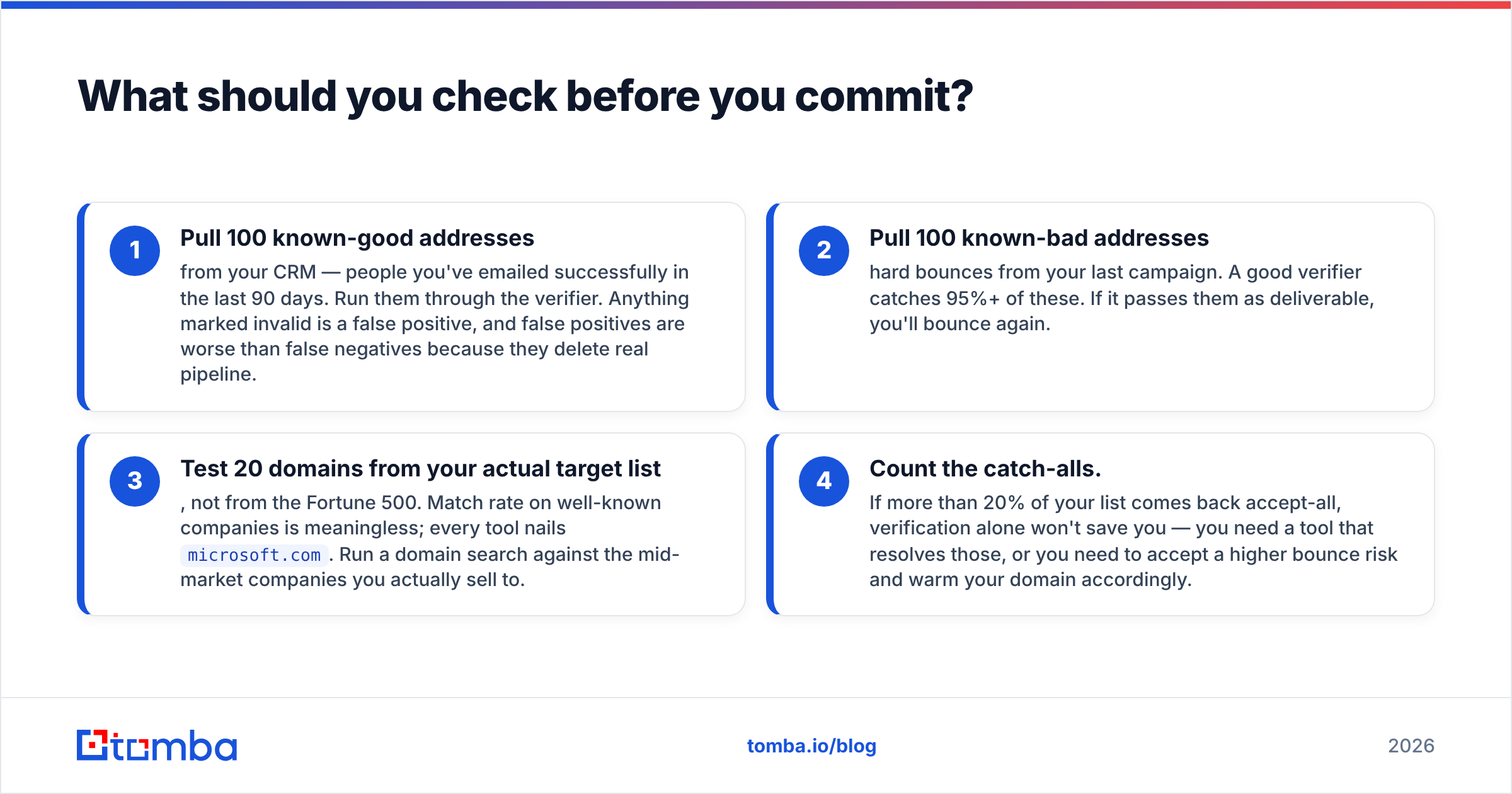
Run these four tests during any trial, on your own data. Vendor-published accuracy numbers are measured on the vendor's test set, not your ICP.
- Pull 100 known-good addresses from your CRM — people you've emailed successfully in the last 90 days. Run them through the verifier. Anything marked invalid is a false positive, and false positives are worse than false negatives because they delete real pipeline.
- Pull 100 known-bad addresses — hard bounces from your last campaign. A good verifier catches 95%+ of these. If it passes them as deliverable, you'll bounce again.
- Test 20 domains from your actual target list, not from the Fortune 500. Match rate on well-known companies is meaningless; every tool nails
microsoft.com. Run a domain search against the mid-market companies you actually sell to. - Count the catch-alls. If more than 20% of your list comes back accept-all, verification alone won't save you — you need a tool that resolves those, or you need to accept a higher bounce risk and warm your domain accordingly.
Document the numbers. A one-page comparison of false-positive rate, false-negative rate, and match rate on your data settles the decision faster than any review site. HubSpot's research on email deliverability is a decent baseline for what bounce thresholds you should be targeting once you've cleaned up.
So which one wins?#
Debounce wins if you have a list and need it clean. It's cheaper, more focused, and better at the one job it does. The never-expiring PAYG credits are a real advantage for irregular use.
FindThatLead wins if you have nothing and need contacts fast, especially in European markets, and you value having a sender in the same login.
Neither wins if you need both jobs done continuously — which describes most outbound teams. At that point you're paying two vendors to hand data to each other through a CSV, and the right move is a single platform.
That's the case for consolidating on Tomba Email Finder. One search returns the address and its verification status together, pulled from the same credit pool, exposed through the same email finder API. Start on the free tier — 25 searches a month, no card — and run the four tests above against your own target accounts. If the match rate holds on your ICP, you've replaced two tools with one. If it doesn't, you've lost nothing but an afternoon, and you'll know exactly which of Debounce or FindThatLead to buy instead.
Related guides#
Ready to find emails that actually work?
Join 150,000+ professionals who stopped guessing and started sending. Free credits on signup — no credit card required.
Get the Tomba newsletter
Practical outbound tactics and product updates — once every two weeks.
About the author