Debounce vs Generect (2026): Verification vs Lead Data
Debounce cleans lists. Generect builds them. They solve opposite halves of the same problem — here's how pricing, accuracy, and workflow fit compare, and when one tool is enough.
TL;DR
- Debounce and Generect are not really competitors. Debounce is a bulk email verification service. Generect is a LinkedIn-driven lead sourcing platform. One cleans a list you already have; the other creates one.
- Pick Debounce if you inherited a big, stale CSV and just need bounce protection before you send. Its pay-as-you-go credits never expire, which suits irregular cleaning jobs.
- Pick Generect if your problem is upstream — you need contacts that don't exist in your CRM yet, built from LinkedIn-style filters and enriched in real time.
- You will likely end up paying for both, which is where the math gets annoying: two vendors, two credit systems, two API keys, and duplicate spend on the same contact.
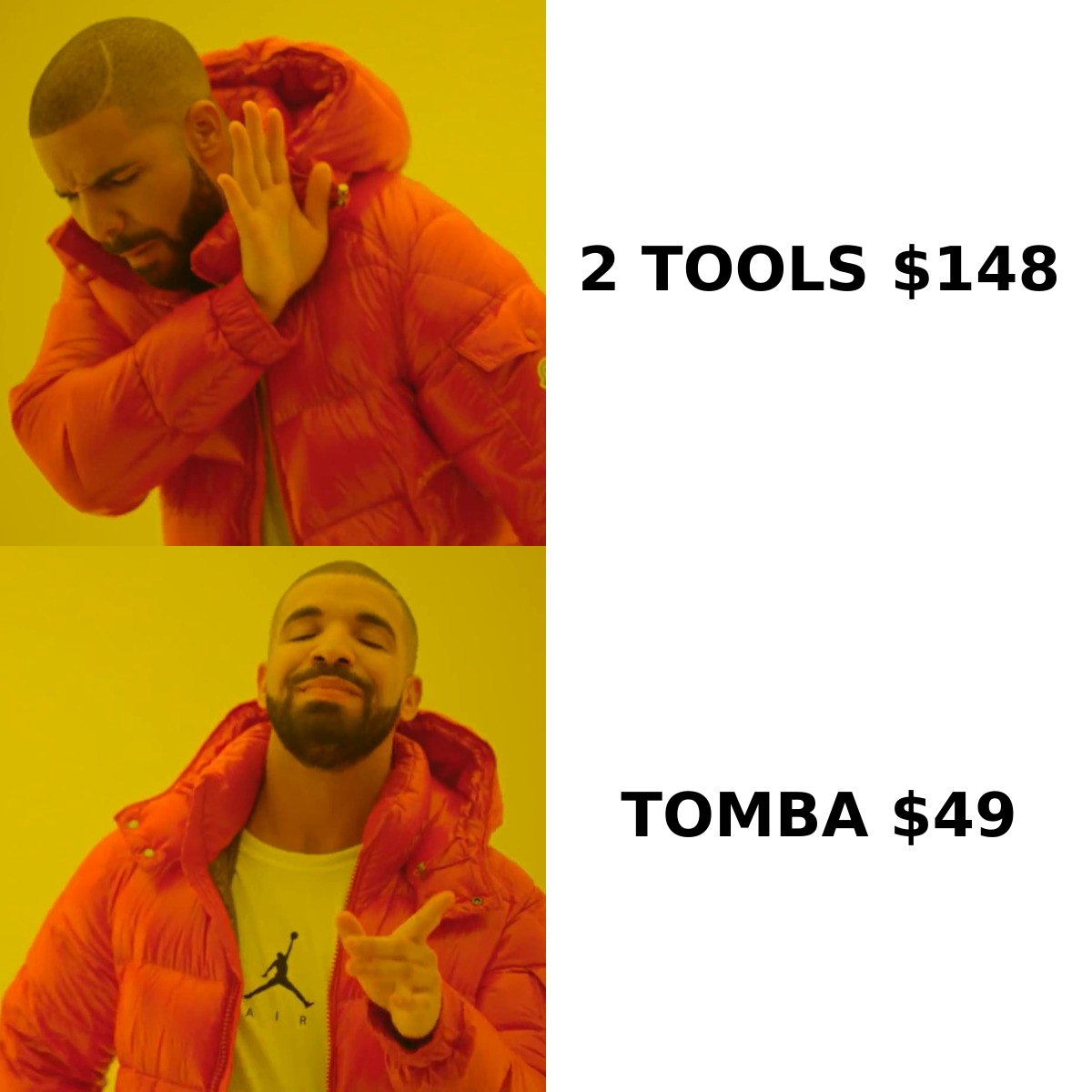
- The consolidation option: a single platform that finds and verifies in one call — Tomba starts at $49/mo (free tier: 25 searches) and covers finding, verification, catch-all checks, and enrichment through one API.
What problem does each tool actually solve?#
Think of your outbound list as a water supply. Generect is the well — it goes out and finds new water. Debounce is the filter — it removes what would make you sick. You can't drink from an empty well, and you shouldn't drink unfiltered water. That's the whole comparison in one sentence.
Debounce launched as a pure email validation service and has stayed close to that core: upload a list, get back a per-address verdict (deliverable, invalid, catch-all, disposable, role-based), download the cleaned file. It added a lead-finder module later, but the product's centre of gravity — and its reputation on G2 — is still bulk cleaning.
Generect approaches from the opposite end. It's built around finding people: search by company, headcount, role, geography and LinkedIn attributes, then pull emails and phone numbers with real-time validation attached. Its API and integrations are aimed at teams building lists programmatically rather than uploading spreadsheets.
So "debounce vs generect" is rarely the right question. The right question is: which half of my list problem is currently costing me the most money?
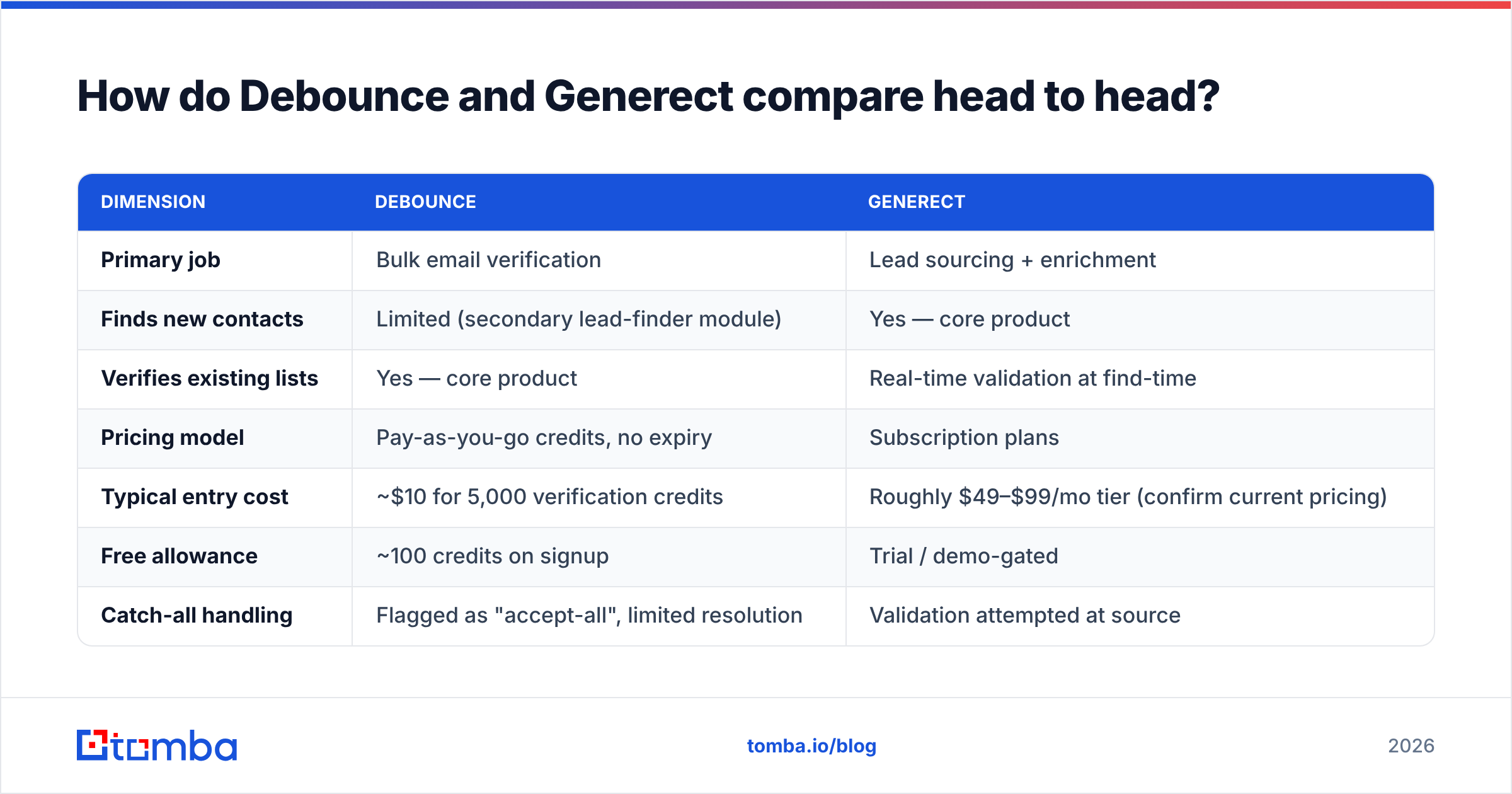
How do Debounce and Generect compare head to head?#
| Dimension | Debounce | Generect |
|---|---|---|
| Primary job | Bulk email verification | Lead sourcing + enrichment |
| Finds new contacts | Limited (secondary lead-finder module) | Yes — core product |
| Verifies existing lists | Yes — core product | Real-time validation at find-time |
| Pricing model | Pay-as-you-go credits, no expiry | Subscription plans |
| Typical entry cost | ~$10 for 5,000 verification credits | Roughly $49–$99/mo tier (confirm current pricing) |
| Free allowance | ~100 credits on signup | Trial / demo-gated |
| Catch-all handling | Flagged as "accept-all", limited resolution | Validation attempted at source |
| API | Yes | Yes, developer-oriented |
| Best for | Cleaning inherited or aging databases | Building net-new prospect lists |
| Weak spot | Won't grow your list | Won't clean a list it didn't build |
The table makes the trap obvious. Neither column covers both rows that matter. If you buy Debounce, you still need a source. If you buy Generect, you still need a way to re-clean contacts six months later when 22–30% of them have changed jobs.
Which one is more accurate?#
Accuracy means two different things here, and conflating them is how teams end up disappointed.
Verification accuracy is about false verdicts: how often a tool says "valid" and the message bounces anyway, or says "invalid" on an address that would have delivered fine. Debounce competes on this axis directly, and dedicated verifiers generally do well on standard mailboxes — the hard cases are catch-all domains and Microsoft 365 tenants that refuse SMTP probes.
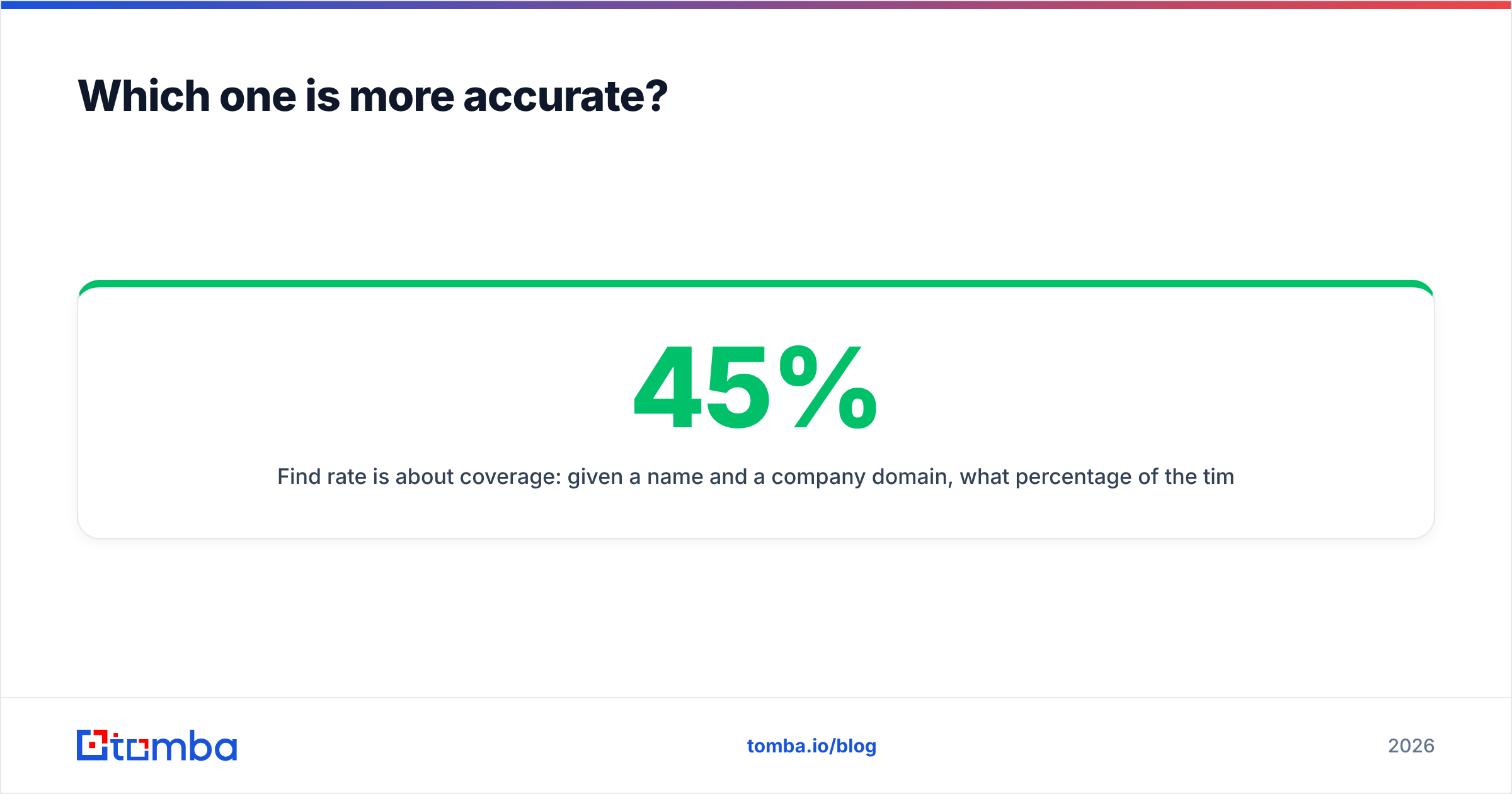
Find rate is about coverage: given a name and a company domain, what percentage of the time does the tool return a real, working address? Generect competes here. A tool with a 45% find rate and 98% precision is not "more accurate" than one with a 72% find rate and 95% precision — it's just quieter about its misses.

When you benchmark, do it on your own ICP, not on the vendor's sample file. Take 200 contacts you already have confirmed replies from, strip the emails, and run them through each tool. Count three numbers:
- True positives — correct address returned and marked valid.
- False negatives — the tool returned nothing or "invalid" for an address you know works. This is the expensive one; it silently shrinks your TAM.
- False positives — marked valid, then bounced. This is the dangerous one; it damages sender reputation.
- Catch-all limbo — returned as "accept-all" with no resolution. Count these separately, because how a vendor handles them tells you more than its headline accuracy claim.
Most teams discover their real bottleneck in row 2. They assumed bounces were the problem, then found that half their target accounts were simply never resolved by their finder.
How does pricing really compare?#
Debounce's pay-as-you-go model is genuinely good for lumpy usage. Credits don't expire, so cleaning 40,000 records once a quarter costs you roughly what the volume is worth and nothing in between. Generect's subscription model is the opposite shape: it rewards continuous prospecting and punishes idle months.
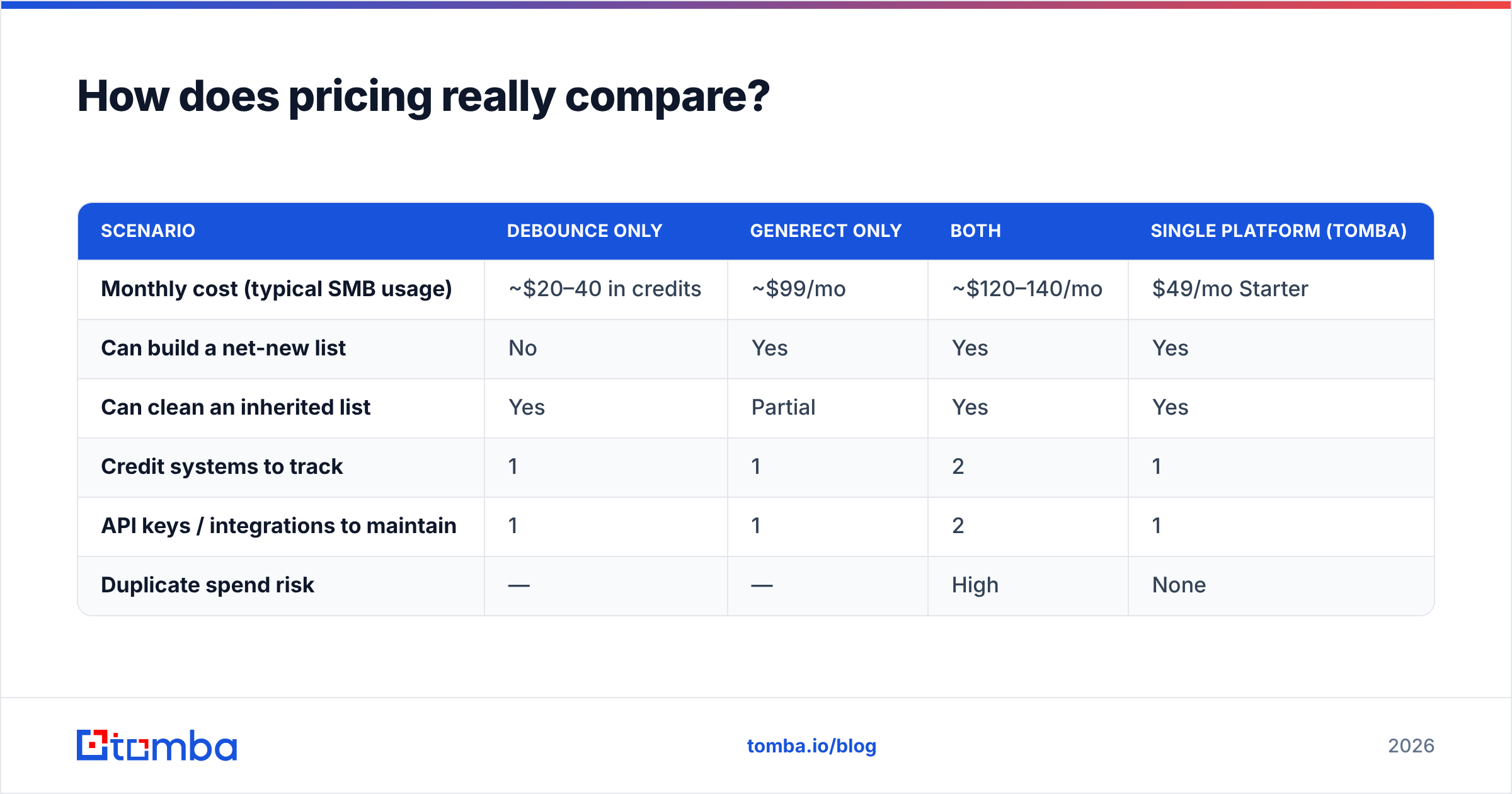
The problem appears when you stack them.
| Scenario | Debounce only | Generect only | Both | Single platform (Tomba) |
|---|---|---|---|---|
| Monthly cost (typical SMB usage) | ~$20–40 in credits | ~$99/mo | ~$120–140/mo | $49/mo Starter |
| Can build a net-new list | No | Yes | Yes | Yes |
| Can clean an inherited list | Yes | Partial | Yes | Yes |
| Credit systems to track | 1 | 1 | 2 | 1 |
| API keys / integrations to maintain | 1 | 1 | 2 | 1 |
| Duplicate spend risk | — | — | High | None |
Always check live pricing pages before budgeting — both vendors adjust tiers, and credit-to-dollar ratios move. For reference, Tomba pricing runs Free (25 searches/mo), Starter $49/mo, Growth $99/mo, Pro $249/mo, and Enterprise custom, with finding and verification drawing from the same pool.
The "duplicate spend risk" row is the one nobody models in advance. When your finder returns an address and your verifier re-checks it, you pay twice for one contact. At 10,000 contacts a month that's not a rounding error.
When is Debounce the right call?#
Choose Debounce when all of these are true:
- You already have the list. A trade-show export, a legacy CRM dump, a newsletter database that hasn't been mailed in eighteen months.
- Volume is spiky. You clean 50,000 records in March and nothing until August. Non-expiring credits fit that pattern better than a monthly seat.
- Deliverability is the acute pain. Your bounce rate crossed 4% and your ESP sent a warning. You need the list scrubbed before the next send, full stop.
- You don't need sourcing. Marketing or a partner supplies your contacts and you're the person who makes them safe to mail.
If your problem is strictly "these addresses might bounce," a dedicated verifier is a clean, cheap answer. Just don't expect it to grow the pipeline. For an equivalent scrub inside a broader stack, an email verifier that shares credits with your finder removes the second invoice without changing the workflow.
When is Generect the right call?#
Choose Generect when:
- Your list is the constraint. You've mailed everyone you have. The next 500 accounts don't exist in any system you own yet.
- You prospect from LinkedIn-style filters. Headcount, funding stage, technology, seniority — attribute-driven search rather than domain-by-domain lookup.
- You want find-time validation. Getting a validated address at the moment of discovery is genuinely better than a separate cleaning pass, when it works.
- You're building programmatically. If a RevOps engineer is wiring lead flow into your CRM, an API-first sourcing tool earns its cost.
Generect is a credible answer to the sourcing half. What it won't do is rescue a list it didn't create — and job-change decay means every list, including one Generect built, needs re-verification a few months later.

Can one tool cover both jobs?#
Yes, and that's the honest reason this comparison keeps coming up: most buyers searching "debounce vs generect" are trying to figure out whether they need two subscriptions.
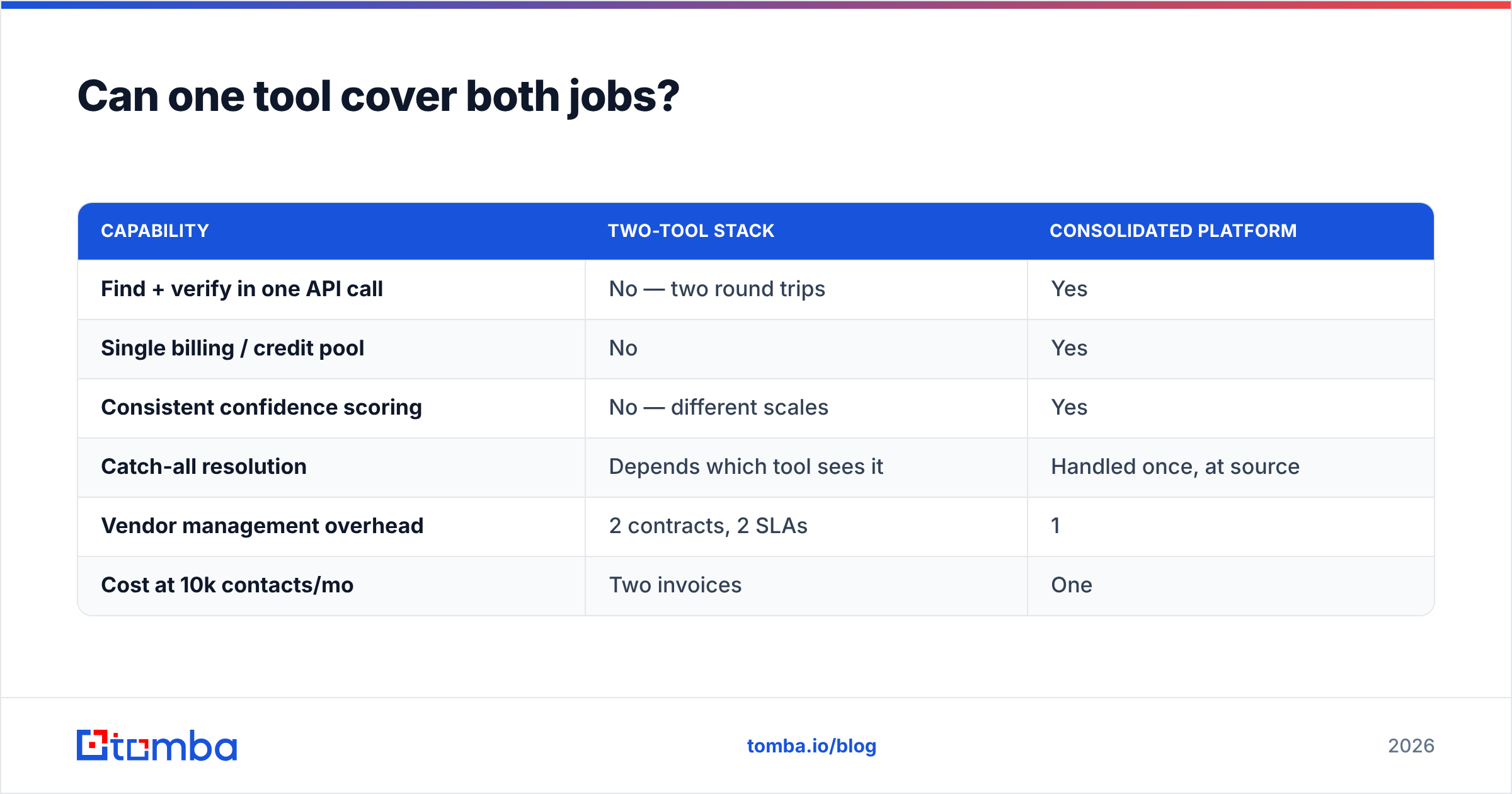
Consolidated platforms handle find-then-verify as a single operation. You pass a name and domain; the platform resolves the address, checks it, resolves catch-all status where possible, and returns a confidence score — one call, one credit, one vendor.
| Capability | Two-tool stack | Consolidated platform |
|---|---|---|
| Find + verify in one API call | No — two round trips | Yes |
| Single billing / credit pool | No | Yes |
| Consistent confidence scoring | No — different scales | Yes |
| Catch-all resolution | Depends which tool sees it | Handled once, at source |
| Vendor management overhead | 2 contracts, 2 SLAs | 1 |
| Cost at 10k contacts/mo | Two invoices | One |
Tomba is built this way. The email finder resolves addresses from a name and domain, verification runs on the same credit pool, and the catch-all verifier handles the accept-all domains that generic verifiers give up on. Domain search pulls every discoverable address at a company in one query — the closest analogue to Generect's list-building motion, with cleaning already baked in.

That doesn't make the specialists useless. If you run seven-figure send volume and your entire competitive edge is bounce-rate control, a dedicated verifier with tuned SMTP logic may still beat a bundled one on the margins. Most teams aren't in that position.
How should you run the evaluation?#
Don't read comparison pages — including this one — as the final input. Run a 90-minute test:
- Build a 200-row truth set. Contacts you have confirmed replies from, so you know the ground truth. Strip the emails.
- Run each tool on the same file. Same day, same list, no cherry-picking.
- Score find rate and precision separately. A tool that returns fewer results isn't safer, it's smaller. Track both numbers.
- Send a real test batch. 50 addresses through your actual ESP. Measure hard bounces. Vendor validity scores mean nothing until a real MTA agrees.
- Compute cost per usable contact. Not cost per credit. Divide total spend by the number of contacts that survived step 4. This single number usually settles the decision.
- Add the integration tax. Two APIs, two credit dashboards, and two renewal dates cost real hours. Price them.
Teams that run this test often find the winner is neither of the tools they started comparing — it's whichever option gets them a verified, deliverable contact at the lowest total cost with the fewest moving parts. Keep an eye on email deliverability metrics for two weeks after switching; that's the only verdict that counts.
The verdict#
Debounce wins on list hygiene at irregular volume. Non-expiring credits and a focused verification product make it a sensible line item if cleaning is a periodic chore rather than a daily workflow.
Generect wins on net-new sourcing from attribute-based search. If your pipeline is starved for accounts and you prospect the way LinkedIn users do, it addresses the harder half of the problem.
Neither wins outright, because they answer different questions. Buying both solves the workflow but doubles the vendor overhead and duplicates spend on the same contacts.
If you'd rather not run two subscriptions to accomplish one job, start with Tomba Email Finder. Find the address, verify it, resolve catch-alls, and enrich the record from one credit pool and one API — free tier gives you 25 searches to test against your own truth set before you spend anything, and Starter is $49/mo when you're ready to scale. Run it beside whatever you're using now on the same 200 contacts, and let the cost-per-usable-contact number make the call.
Related guides#
Ready to find emails that actually work?
Join 150,000+ professionals who stopped guessing and started sending. Free credits on signup — no credit card required.
Get the Tomba newsletter
Practical outbound tactics and product updates — once every two weeks.
About the author