Debounce vs RocketReach (2026): Which Tool Should You Buy?
Debounce verifies emails you already have. RocketReach finds contacts you don't. Here's the honest breakdown of pricing, accuracy, and which one your outbound stack actually needs in 2026.
TL;DR
- Debounce is an email verifier. RocketReach is a contact finder. Comparing them head-to-head is like comparing a spell-checker to a dictionary — you probably need both functions, not one product.
- Debounce is cheap and pay-as-you-go: roughly $0.0025-$0.004 per verification with credits that don't expire. RocketReach starts around $70-$99/month per seat for lookups that include phone numbers.
- If you already own a list, Debounce cleans it. If you have zero contacts, Debounce can't help you at all — and that trips up a lot of buyers.
- RocketReach's coverage is broad (personal emails, mobile numbers, 700M+ profiles claimed) but per-contact accuracy varies sharply by region and seniority.
- If you want finding and verification in one billing line, a combined platform like Tomba ($49/mo Starter, 25 free searches to test) removes the two-vendor tax entirely.
What are Debounce and RocketReach, actually?#
They are not competitors. They sit at opposite ends of the same pipeline.
Debounce (debounce.io) is a bulk email verifier. You upload a CSV of addresses you already have, and it returns a per-address verdict: deliverable, undeliverable, risky, catch-all, role-based, disposable. It performs syntax checks, MX record lookups, SMTP handshakes, and disposable-domain matching. It does not find anything. Feed it an empty file and you get an empty file back.
RocketReach (rocketreach.co) is a contact-discovery database. You search by name, company, or job title and it returns work emails, personal emails, and mobile phone numbers scraped and inferred from public web sources, plus a Chrome extension for LinkedIn. It includes a validation signal on each email, but validation is a byproduct — not the product.
So the real question is not "which is better." It's which stage of your pipeline is currently broken.
Which one do you actually need?#
Answer three questions honestly:
- Do you already have a list of email addresses? If yes and your bounce rate is above 3%, you need verification — Debounce is the relevant tool.
- Are you starting from company names, LinkedIn profiles, or job titles with no emails attached? Then you need discovery — Debounce is useless here and RocketReach is the relevant tool.
- Do you need phone numbers for cold calling? RocketReach is one of the few tools in this price band that ships mobile numbers, though hit rates outside North America drop noticeably.
Most outbound teams discover they need both, buy both, and then spend a quarter reconciling two credit systems and two CSV export formats. That's the hidden cost nobody quotes you.
How do Debounce and RocketReach compare on pricing and features?#
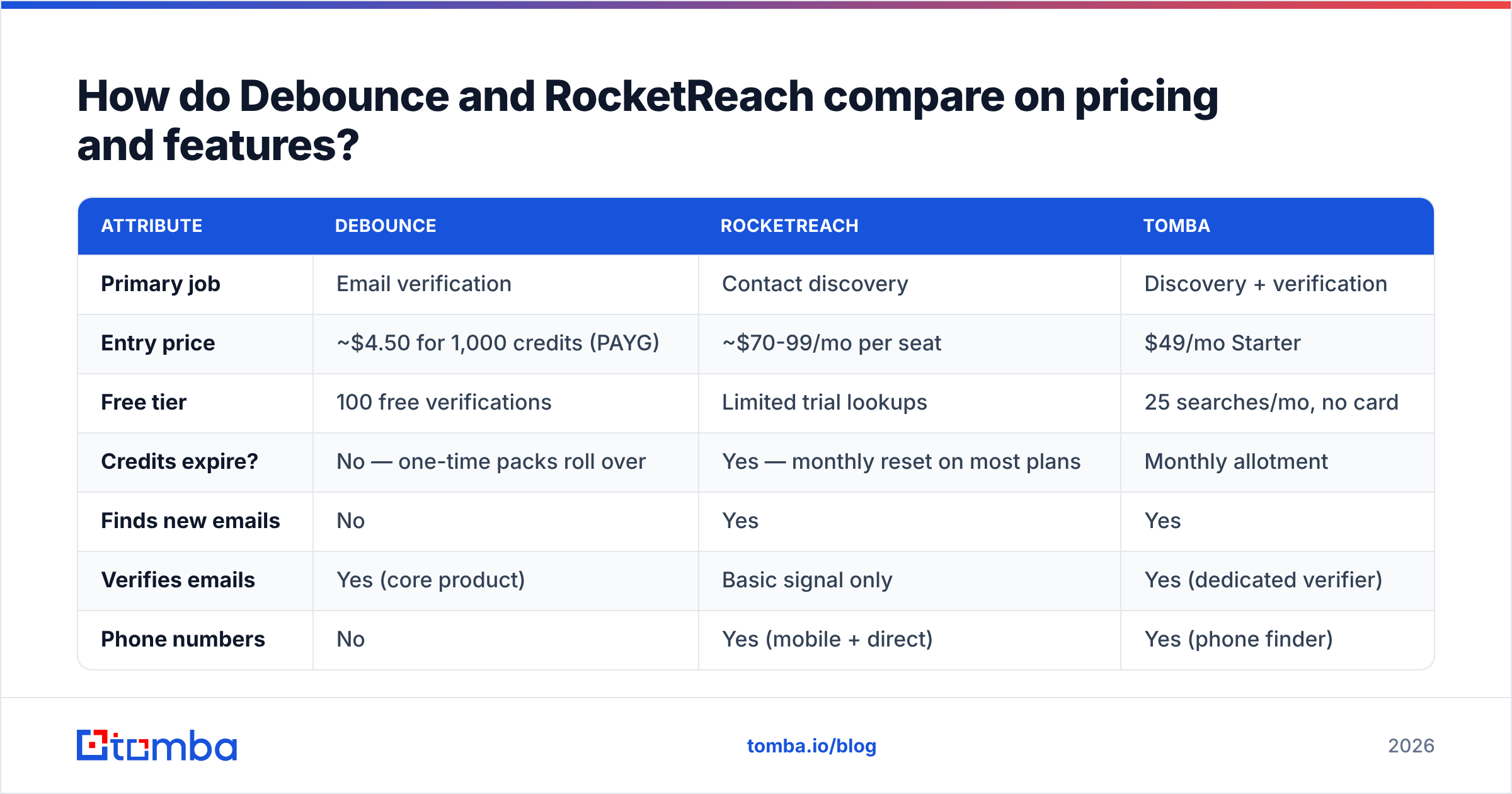
Here's the side-by-side. Prices reflect publicly listed rates as of early 2026 — always confirm on the vendor's own pricing page, since credit-pack tiers shift often.
| Attribute | Debounce | RocketReach | Tomba |
|---|---|---|---|
| Primary job | Email verification | Contact discovery | Discovery + verification |
| Entry price | ~$4.50 for 1,000 credits (PAYG) | ~$70-99/mo per seat | $49/mo Starter |
| Free tier | 100 free verifications | Limited trial lookups | 25 searches/mo, no card |
| Credits expire? | No — one-time packs roll over | Yes — monthly reset on most plans | Monthly allotment |
| Finds new emails | No | Yes | Yes |
| Verifies emails | Yes (core product) | Basic signal only | Yes (dedicated verifier) |
| Phone numbers | No | Yes (mobile + direct) | Yes (phone finder) |
| Catch-all handling | Flags as "risky" | Flags inconsistently | Dedicated catch-all verifier |
| Bulk CSV upload | Yes | Yes (higher tiers) | Yes |
| API access | Yes | Yes | Yes (Tomba API) |
| Chrome extension | No | Yes | Yes |
| Best for | Cleaning owned lists | Sourcing net-new contacts + dials | End-to-end prospecting |
The pricing models are structurally different, which is why "cheaper" is a trap. Debounce is a utility — you buy credits when you need them and they sit there. RocketReach is a subscription seat — you pay monthly whether you look anything up or not, and unused lookups typically vanish at renewal.
For a team verifying 5,000 addresses twice a year, Debounce costs about $40 annually. For a team prospecting daily, RocketReach's $99/mo is fine — but only if reps actually burn the lookups.
How accurate is each tool?#
This is where the comparison gets uncomfortable, because the two tools report accuracy in incompatible units.
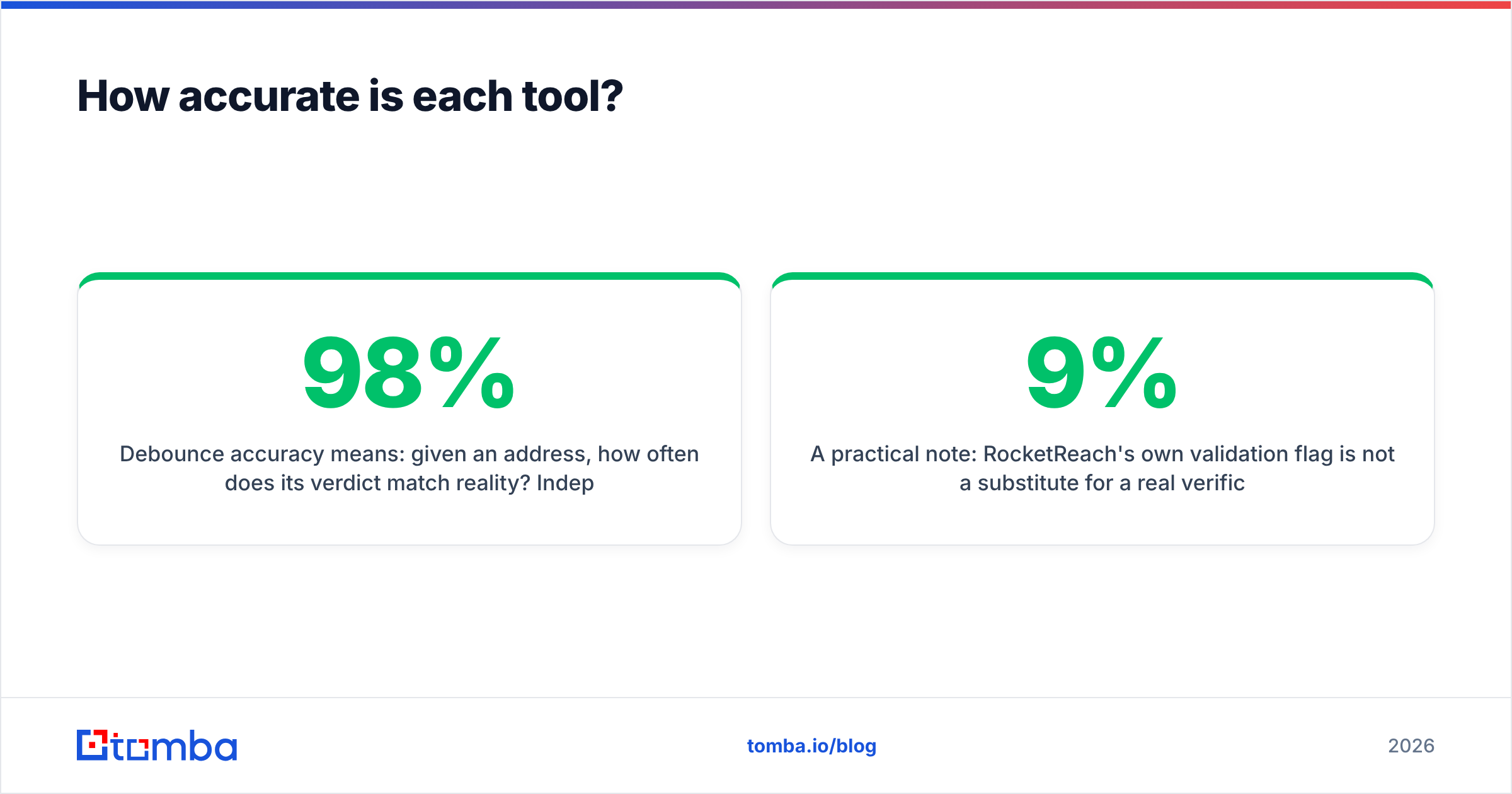
Debounce accuracy means: given an address, how often does its verdict match reality? Independent verifier benchmarks generally cluster the serious players — Debounce, ZeroBounce, Bouncer, Tomba's verifier — in the 95-98% agreement band on clean, non-catch-all domains. The differentiator is not the headline number, it's catch-all handling. Roughly 20-25% of B2B domains are configured as catch-all, meaning the mail server accepts everything at the SMTP layer. Most verifiers throw up their hands and label these "risky" or "unknown," and Debounce is in that camp. That's honest, but it leaves a quarter of your list unusable.

RocketReach accuracy means: when it hands you an email for a person, is that person's real address? Vendor-claimed rates hover in the high-80s to low-90s. Real-world user reports on G2 and Capterra are more mixed — strong on US tech and mid-market SaaS, weaker on European SMBs, non-English markets, and anyone who changed jobs in the last 90 days. Personal Gmail addresses are frequently returned alongside work addresses, which is a compliance problem in GDPR territories, not a feature.
A practical note: RocketReach's own validation flag is not a substitute for a real verification pass. Teams that pipe RocketReach exports straight into a sequencer without a second verification step routinely report bounce rates of 5-9%. Under current Google and Yahoo bulk-sender enforcement, a sustained bounce rate above 2% will damage your sender reputation fast.
What does a realistic stack look like?#
Three viable configurations, depending on where you are:
- List owner, no discovery need. You have a conference attendee list, an old CRM export, or an inherited database. Buy Debounce credits, clean the file, done. Total cost: under $50. Don't buy a finder you won't use.
- Prospector, no list. You need net-new contacts weekly. RocketReach or a comparable finder is the entry point, and you bolt a verifier on top before any send. Two subscriptions, two invoices, two credit balances.
- Combined platform. One vendor handles domain search, email finding, and verification against a shared credit pool. Fewer integrations, one CSV schema, no reconciliation.
Configuration 2 is where most teams end up by accident and stay by inertia. Worth pricing the alternative once a year.

What are the real drawbacks of each?#
Debounce weak spots:
- No discovery whatsoever. Repeating this because a surprising share of trial signups are people who expected it to find emails.
- Catch-all ambiguity. ~20%+ of B2B domains return an inconclusive verdict. You either send blind or discard the contact.
- Thin enrichment. No job titles, no company data, no LinkedIn URLs. Verification only.
- Interface is dated. Functional, fast, unglamorous. Fine for a utility; frustrating if you expected a workspace.
RocketReach weak spots:
- Per-seat pricing scales badly. A five-rep team is looking at $350-500/mo before annual discounts.
- Lookup credits reset monthly. Slow months are money burned.
- Personal email inclusion. Convenient for recruiters, a liability for GDPR-scope B2B outbound. Know which one you're pulling.
- Data staleness on job changes. Someone who moved in Q1 may still show their old employer's address in Q3.
- Verification is not its job. Treat its confidence flag as a hint, not a green light.
Are there better alternatives to running both?#
Yes, if your volume justifies it. The category has consolidated hard since 2024 — most serious platforms now ship finding, verification, enrichment, and phone data behind one API. Running a separate finder and a separate verifier increasingly looks like a legacy choice rather than a deliberate one.
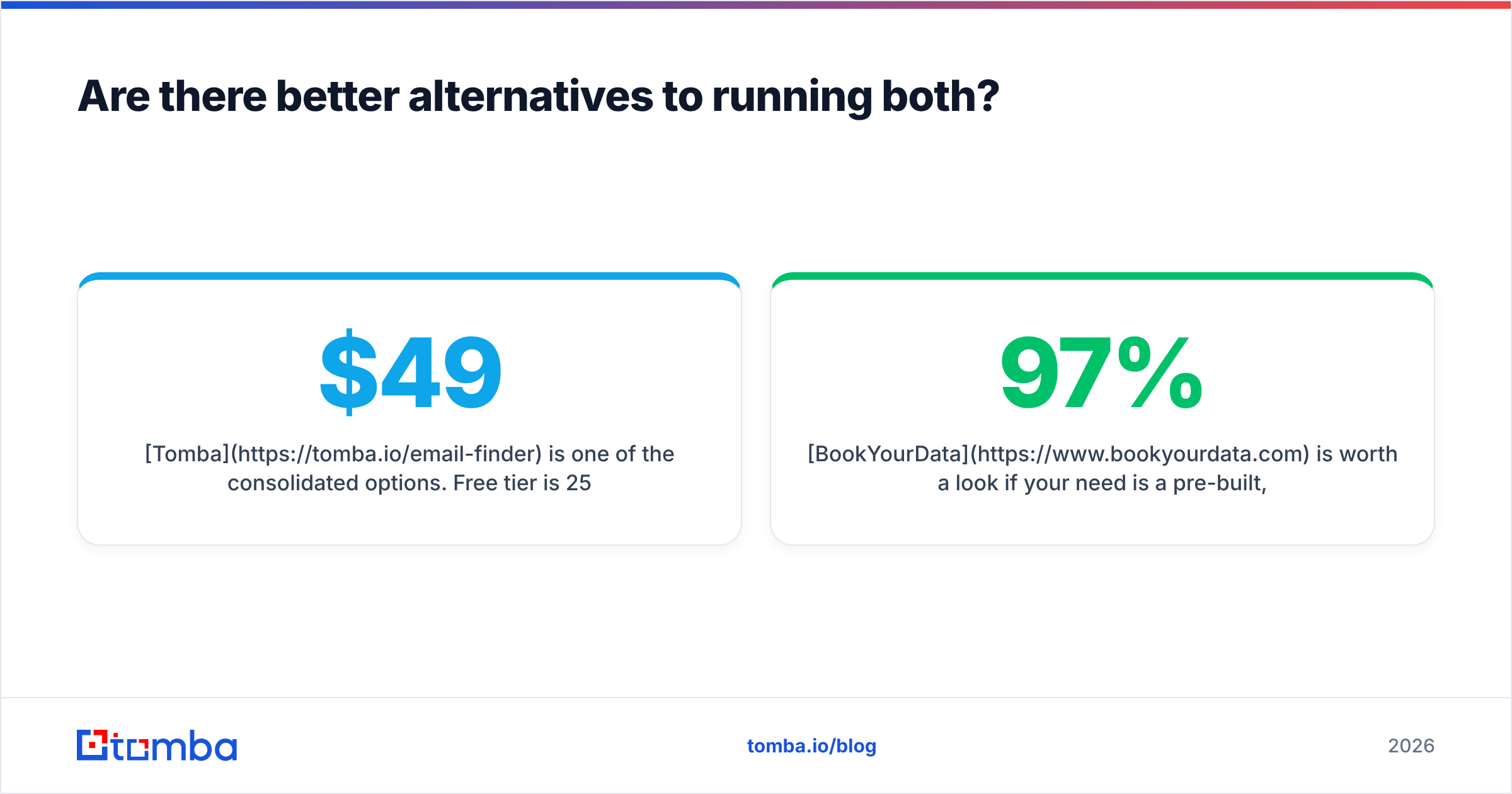
Tomba is one of the consolidated options. Free tier is 25 searches/month with no card required, Starter is $49/mo, Growth $99/mo, Pro $249/mo, Enterprise custom — see Tomba pricing for the current credit allocations. The relevant difference for this comparison: finding and verification draw from one balance, and the catch-all finder attempts a real verdict on catch-all domains rather than shrugging. There's also bulk processing, a Chrome extension, and native HubSpot and Salesforce sync.
BookYourData is worth a look if your need is a pre-built, pay-as-you-go B2B list rather than per-contact lookups — it sells verified contact lists outright with a 97% accuracy guarantee, which is a genuinely different purchasing model from both Debounce and RocketReach and a good fit for teams who want a clean list today without learning another tool.

Also in the mix: ZeroBounce and Bouncer on the verification side (see the ZeroBounce alternative breakdown), Apollo and Lusha on the discovery side. None of them changes the underlying logic — pick based on which pipeline stage is leaking.
How should you run a proper test before buying?#
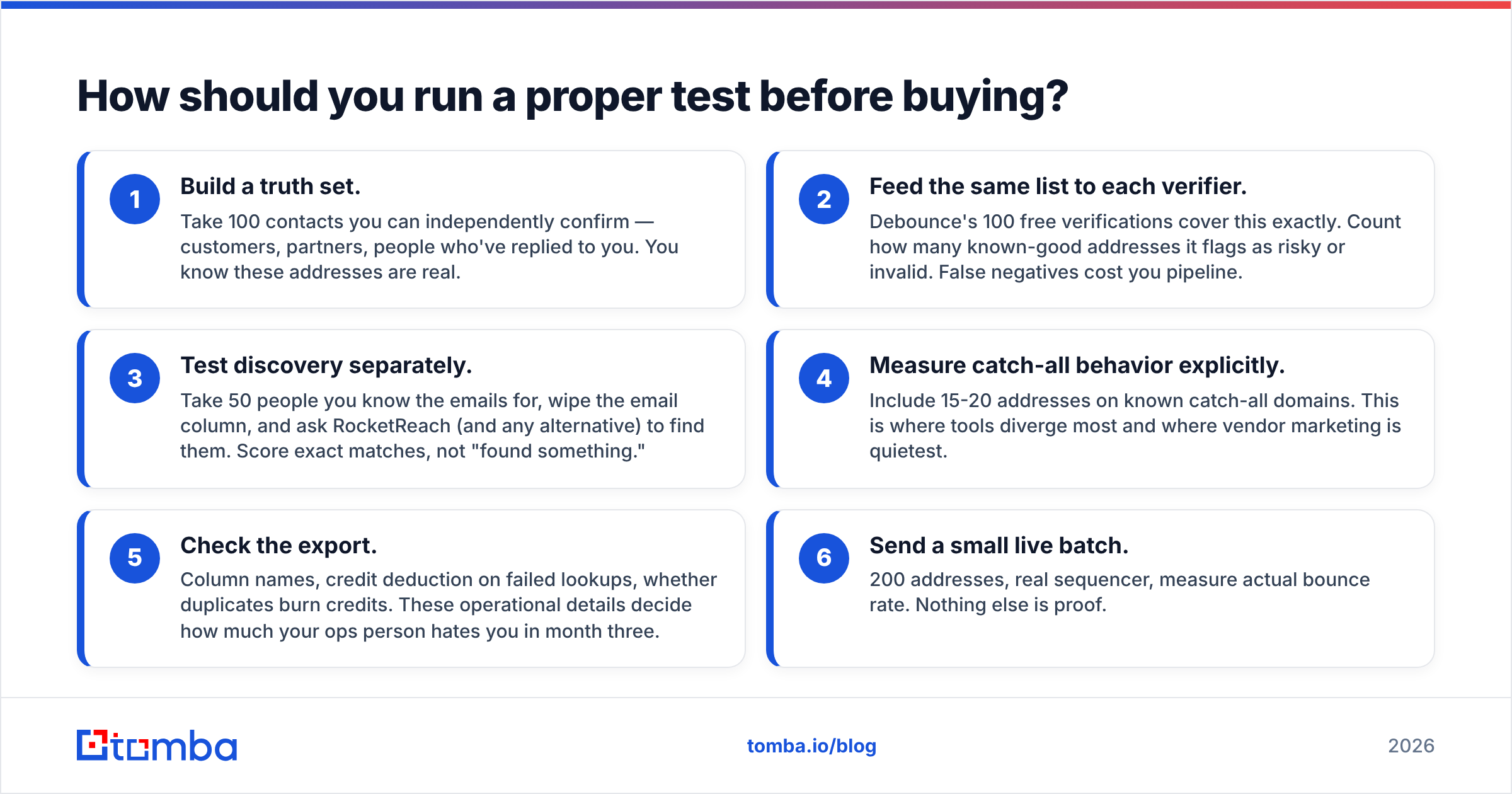
Don't trust anyone's published accuracy number, including the ones in this post. Run a 100-row bake-off:
- Build a truth set. Take 100 contacts you can independently confirm — customers, partners, people who've replied to you. You know these addresses are real.
- Feed the same list to each verifier. Debounce's 100 free verifications cover this exactly. Count how many known-good addresses it flags as risky or invalid. False negatives cost you pipeline.
- Test discovery separately. Take 50 people you know the emails for, wipe the email column, and ask RocketReach (and any alternative) to find them. Score exact matches, not "found something."
- Measure catch-all behavior explicitly. Include 15-20 addresses on known catch-all domains. This is where tools diverge most and where vendor marketing is quietest.
- Check the export. Column names, credit deduction on failed lookups, whether duplicates burn credits. These operational details decide how much your ops person hates you in month three.
- Send a small live batch. 200 addresses, real sequencer, measure actual bounce rate. Nothing else is proof.
That whole process takes an afternoon and costs almost nothing on free tiers. It will save you from a twelve-month contract signed off a marketing page.
The verdict#
Buy Debounce if you have lists and a bounce problem. It's cheap, credits don't expire, and it does one thing competently. Don't expect it to find anything.
Buy RocketReach if you need net-new contacts plus mobile numbers and you're primarily selling into North America. Budget for a separate verification step regardless of what its confidence flag says.
Buy neither separately if you're running consistent outbound volume and the two-vendor overhead is real — a combined platform will cost less than the sum and eliminate the reconciliation work.
Ready to test the consolidated path? Tomba Email Finder gives you 25 free searches per month with no credit card, and every result runs through the same verification engine before it reaches your CSV — so you're not paying two vendors to answer one question. Run it against the same 50-contact truth set you're using for the others and let the match rate decide.
Related guides#
Ready to find emails that actually work?
Join 150,000+ professionals who stopped guessing and started sending. Free credits on signup — no credit card required.
Get the Tomba newsletter
Practical outbound tactics and product updates — once every two weeks.
About the author