Debounce vs SalesIntel: Which Data Tool Wins in 2026?
Debounce cleans lists. SalesIntel sells contacts. They solve different halves of the same problem — and picking the wrong one costs you either bounces or five figures a year. Here's the honest breakdown.
TL;DR
- Debounce and SalesIntel are not competitors in any real sense. Debounce is a bulk email verification engine; SalesIntel is a human-verified B2B contact database with intent and technographic layers.
- If your problem is "my list bounces," you want verification. If your problem is "I don't have a list," you want a data provider. Buying the wrong one solves nothing.
- Debounce is pay-as-you-go and cheap — credits in the fractions-of-a-cent range, no seat minimums, credits that don't expire. SalesIntel is quote-only, annual, and lands in the five figures for most teams.
- SalesIntel's coverage skews heavily US and mid-market/enterprise. Outside North America, coverage thins fast and you'll still need a finder.
- Most outbound teams end up needing three things — find, verify, enrich — and paying three vendors for it. A single platform like Tomba at $49/mo covers all three for a fraction of a SalesIntel contract.
What are Debounce and SalesIntel actually built for?#
They sit at opposite ends of the pipeline, and that single fact decides most of this comparison.
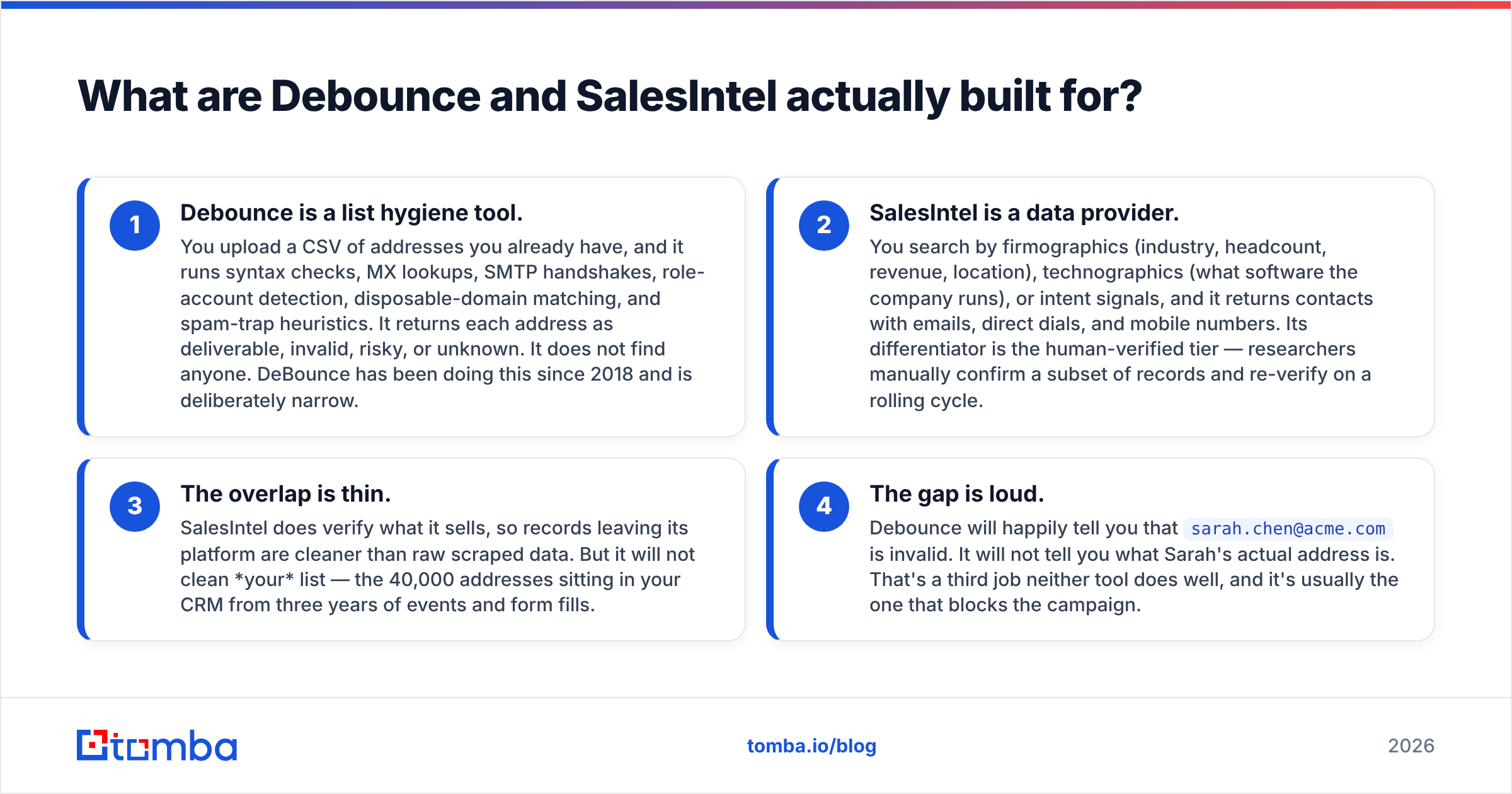
- Debounce is a list hygiene tool. You upload a CSV of addresses you already have, and it runs syntax checks, MX lookups, SMTP handshakes, role-account detection, disposable-domain matching, and spam-trap heuristics. It returns each address as deliverable, invalid, risky, or unknown. It does not find anyone. DeBounce has been doing this since 2018 and is deliberately narrow.
- SalesIntel is a data provider. You search by firmographics (industry, headcount, revenue, location), technographics (what software the company runs), or intent signals, and it returns contacts with emails, direct dials, and mobile numbers. Its differentiator is the human-verified tier — researchers manually confirm a subset of records and re-verify on a rolling cycle.
- The overlap is thin. SalesIntel does verify what it sells, so records leaving its platform are cleaner than raw scraped data. But it will not clean your list — the 40,000 addresses sitting in your CRM from three years of events and form fills.
- The gap is loud. Debounce will happily tell you that
sarah.chen@acme.comis invalid. It will not tell you what Sarah's actual address is. That's a third job neither tool does well, and it's usually the one that blocks the campaign.
Once you frame it this way, "Debounce vs SalesIntel" stops being a versus question and becomes a sequencing question: what stage of your pipeline is actually broken?

How do Debounce and SalesIntel compare feature by feature?#
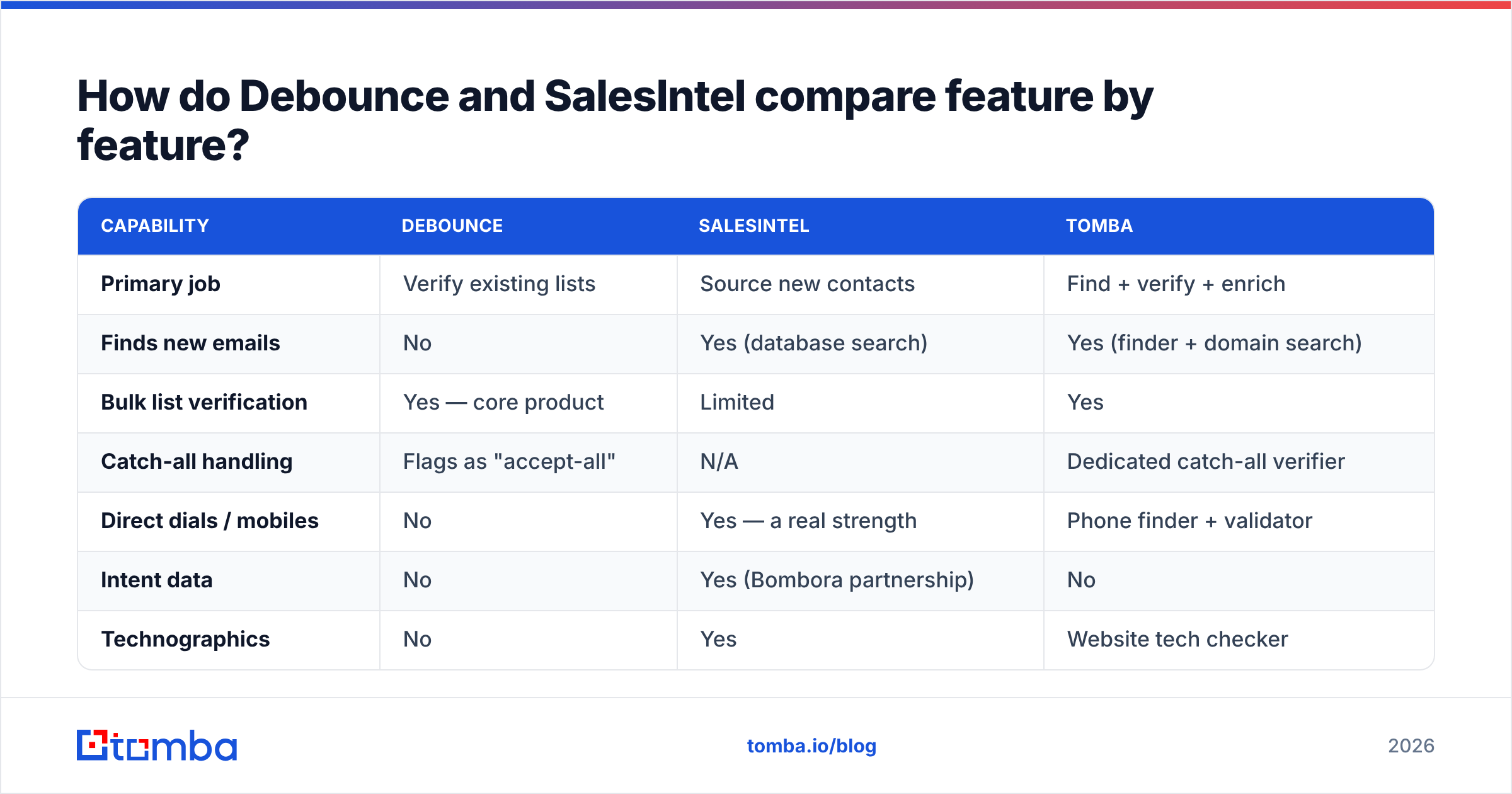
Here's the side-by-side, with Tomba included since it straddles both categories and is the reason a lot of teams don't need either.
| Capability | Debounce | SalesIntel | Tomba |
|---|---|---|---|
| Primary job | Verify existing lists | Source new contacts | Find + verify + enrich |
| Finds new emails | No | Yes (database search) | Yes (finder + domain search) |
| Bulk list verification | Yes — core product | Limited | Yes |
| Catch-all handling | Flags as "accept-all" | N/A | Dedicated catch-all verifier |
| Direct dials / mobiles | No | Yes — a real strength | Phone finder + validator |
| Intent data | No | Yes (Bombora partnership) | No |
| Technographics | No | Yes | Website tech checker |
| Geographic strength | Global (verification is domain-agnostic) | US-heavy | Global |
| Pricing model | Pay-as-you-go credits | Annual contract, quote-only | Published tiers from $49/mo |
| Free tier | 100 credits | Demo / limited trial | 25 searches/mo |
| API access | Yes | Yes (higher tiers) | Yes, on all paid plans |
| CRM sync | Via integrations | Native Salesforce/HubSpot | Native + Zapier/Make |
Two things jump out. First, Debounce's column is mostly empty — by design. It's a scalpel, not a suite, and it's priced accordingly. Second, SalesIntel's phone data is genuinely differentiated; if your motion is cold calling into US mid-market accounts, that's a real reason to look at it that no verification tool replicates.

Which one is more accurate — and accurate at what?#
Accuracy means two different things here, and vendors exploit the ambiguity.
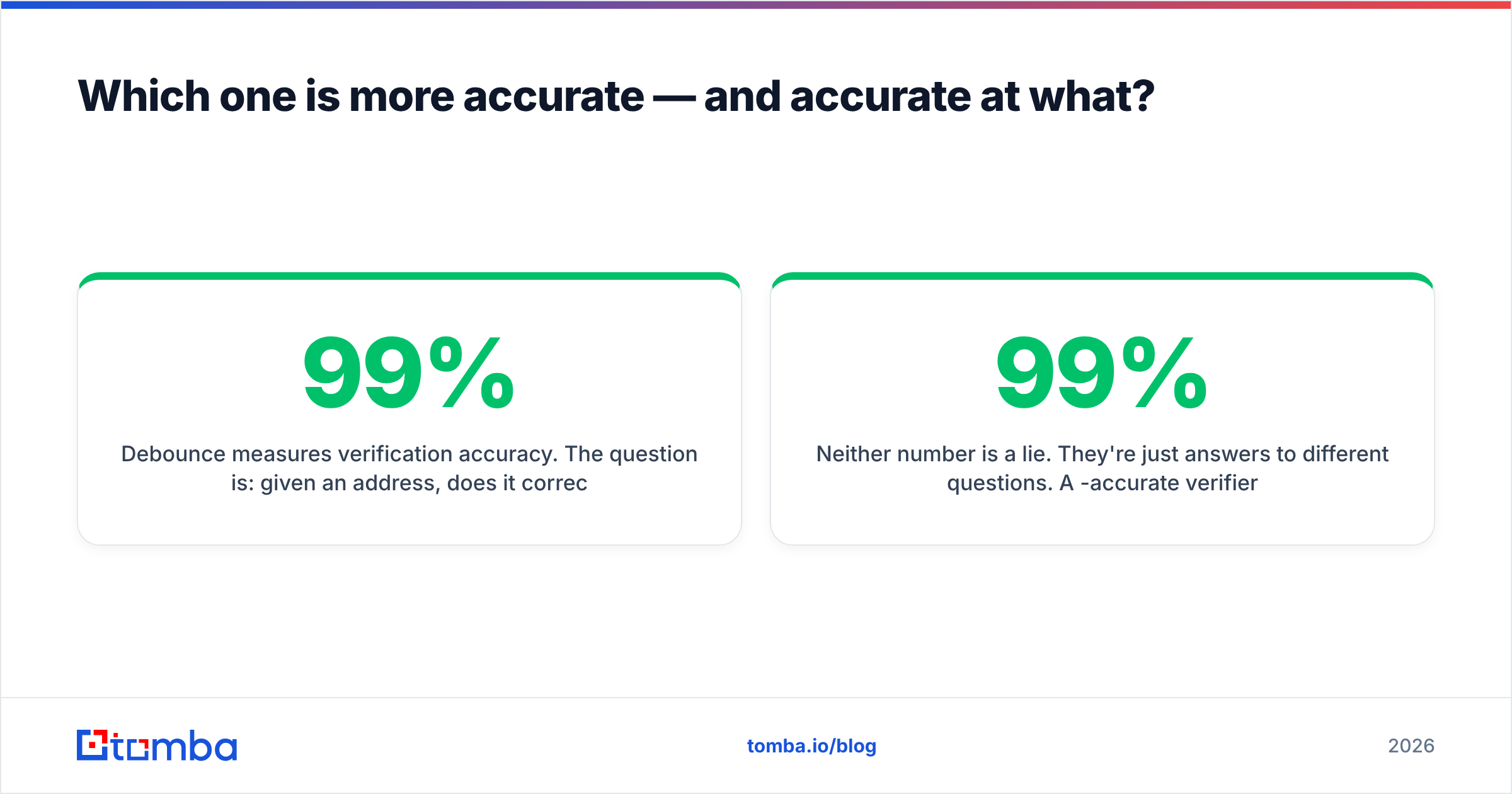
Debounce measures verification accuracy. The question is: given an address, does it correctly predict whether a message will bounce? Good verifiers land in the 97–99% range on clean tests, and Debounce sits comfortably in that band. The honest caveat every verifier shares: catch-all domains. When a mail server accepts everything at the SMTP layer, no verifier can prove a specific mailbox exists — it can only score probability. Debounce labels these "accept-all" and hands the decision back to you. That's more transparent than tools that quietly mark them valid, but it also means a chunk of your list comes back as a shrug. If catch-alls are a large share of your target accounts, a dedicated catch-all verifier that scores them rather than flagging them is worth the extra step.
SalesIntel measures data accuracy. The question is: is this the right person, at the right company, with the right title, reachable at this address and number? SalesIntel's claim rests on human verification and a re-verification cadence measured in weeks, not years. In practice, reviews on G2 consistently praise the phone data and are more mixed on coverage — buyers report strong hit rates on US mid-market and noticeably thinner results for European, APAC, and sub-50-employee companies.
Neither number is a lie. They're just answers to different questions. A 99%-accurate verifier applied to a list with 60% wrong contacts still leaves you emailing the wrong people — very deliverably. And a human-verified record pulled six months ago and left sitting in your CRM is now a guess, because B2B contact data decays at roughly 25–30% per year as people change roles.
That decay rate is the argument for verifying at send time regardless of where the data came from. Whatever provider you use, running a fresh email verification pass before a campaign is the cheapest insurance in the stack.
What do Debounce and SalesIntel actually cost?#
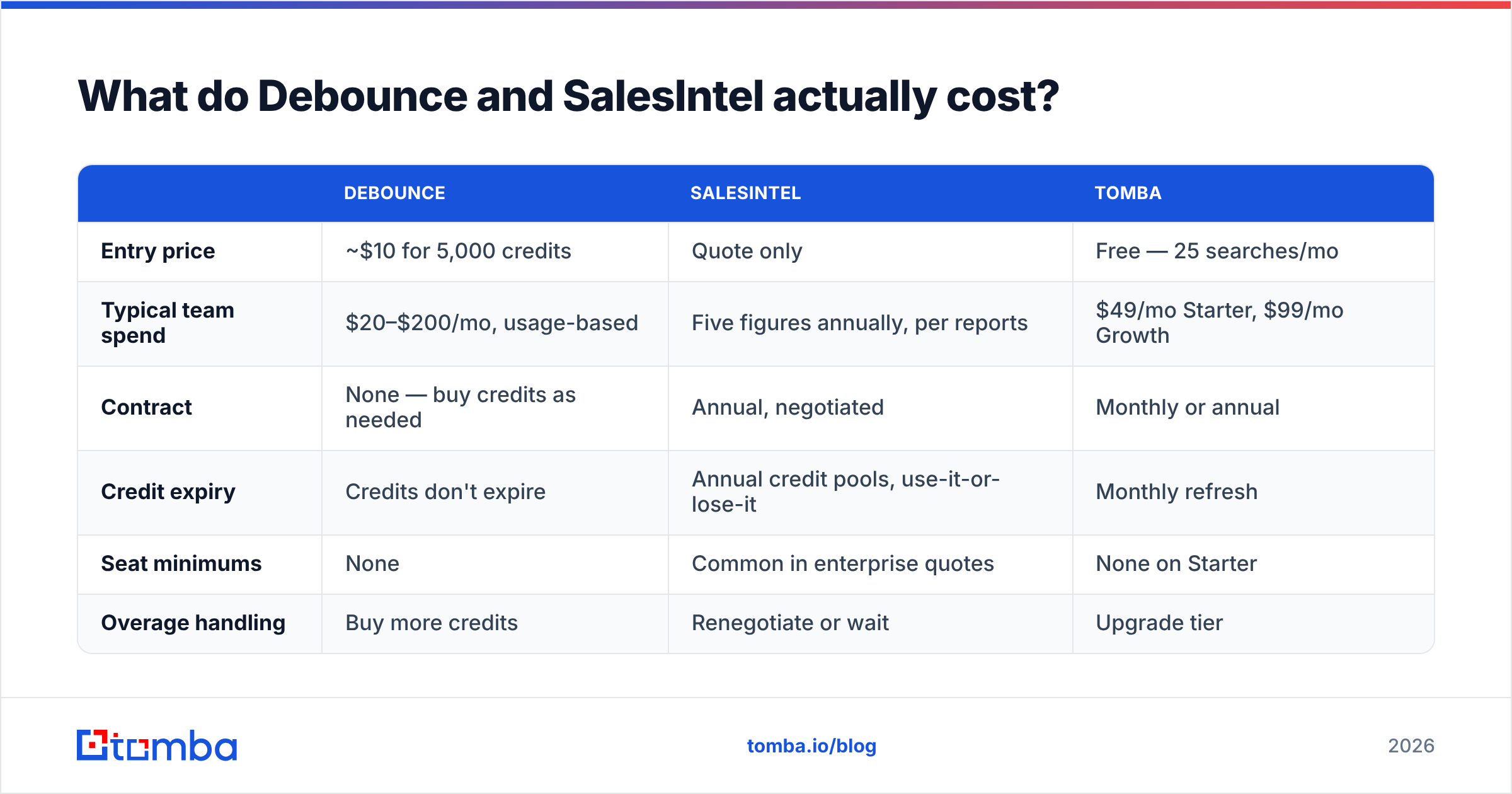
This is where the comparison gets uncomfortable, because only one of these companies publishes a price.
| Debounce | SalesIntel | Tomba | |
|---|---|---|---|
| Entry price | ~$10 for 5,000 credits | Quote only | Free — 25 searches/mo |
| Typical team spend | $20–$200/mo, usage-based | Five figures annually, per reports | $49/mo Starter, $99/mo Growth |
| Contract | None — buy credits as needed | Annual, negotiated | Monthly or annual |
| Credit expiry | Credits don't expire | Annual credit pools, use-it-or-lose-it | Monthly refresh |
| Seat minimums | None | Common in enterprise quotes | None on Starter |
| Overage handling | Buy more credits | Renegotiate or wait | Upgrade tier |
Debounce's model is close to ideal for a tool you use in bursts. You clean a list before a quarterly campaign, spend twenty dollars, and forget about it. Credits that don't expire mean a seasonal sender isn't penalized for going quiet.
SalesIntel is a procurement event. You'll go through a demo, a scoping call, and a quote, and you'll be asked to commit for twelve months against a credit pool sized by a sales rep. That's normal for the category — ZoomInfo, Cognism, and most enterprise data vendors work the same way — but it does mean you cannot test the actual data at scale before you sign. If your ICP is a poor fit for their coverage, you find out in month two.

If you want prebuilt, contract-free lists rather than a platform subscription, providers like BookYourData sell verified contacts on a pay-per-record basis, which sidesteps the annual-commitment problem entirely. It's a genuinely different purchasing model and worth knowing exists before you sign anything twelve months long.

Do you need one, the other, or both?#
Work backwards from the failure you're actually experiencing.
- Your bounce rate is above 3% and your domain reputation is sliding. You have a hygiene problem. Buy verification. Debounce solves this for the price of a lunch. Adding a data provider here would be spending five figures to fix a twenty-dollar problem.
- Your reps have no accounts to work. You have a sourcing problem. Verification is irrelevant — you can't clean a list you don't have. You need a database or a finder.
- You have accounts but no contacts at them. This is the most common case, and it's the one neither tool nails cheaply. You know you want VPs of Engineering at 300 named companies. A database may or may not have them; a domain search will pull who's actually publishing an address at those domains right now.
- Your reps need phone numbers for a call-first motion. SalesIntel is the strongest of the three here, and that's a legitimate reason to pay enterprise pricing.
- You're a two-person team testing whether outbound works at all. Neither. Start with a finder that includes verification, prove the channel, then buy specialized tooling once you know what's breaking.
The trap is buying a $30,000 data platform to solve a deliverability problem, or buying a verifier and wondering why your pipeline didn't grow. Diagnose first.
Where does Tomba fit between them?#
Tomba occupies the middle that both tools leave open: finding addresses and verifying them in the same workflow, at published prices.
The email finder takes a name and a domain and returns the address with a confidence score and the sources it was found in — so you can audit a result rather than trust it. Domain search pulls every discoverable address at a company. Verification runs on the same credits, so you're not exporting a CSV to a second vendor and re-importing it. Bulk operations, a Chrome extension, Google Sheets and Excel add-ins, and a documented email finder API cover the workflow ends.
Where Tomba doesn't compete: intent data and technographic filtering. If your GTM strategy depends on knowing which accounts are actively researching your category, SalesIntel's Bombora integration does something Tomba doesn't attempt, and you should pay for it. Same for large-scale direct-dial coverage in the US — Tomba has a phone finder, but SalesIntel's dial database is deeper.
Honest positioning: Tomba replaces Debounce outright for most teams, because verification bundled with finding beats verification alone at similar cost. It replaces SalesIntel only for teams whose real need was contact discovery, not intent intelligence — which, in our experience talking to buyers, is most of them.
For a direct feature-level breakdown against the verifier specifically, see the Debounce alternative comparison.
What's the fastest way to decide?#
Run this in an afternoon, before anyone signs anything.
- Take 200 real target contacts. Not a sample list — actual accounts your reps want.
- Run them through a free verification pass. Note the invalid and catch-all percentages. If invalid is above 15%, your data source is the problem, not your sending.
- Take 50 accounts where you have no contact at all. Try to find them with a finder's free tier. Count hits.
- Book the SalesIntel demo — but bring your own list. Ask them to run your 50 accounts live, not their curated demo accounts. Coverage on your ICP is the only number that matters.
- Price the whole year. Verification volume × rate, plus finder subscription, plus data contract. Compare that total to a single platform covering find + verify + enrichment.
- Check the exit. Monthly beats annual when you're still learning what works. Review Tomba pricing against your quote and note which one you can cancel.
Most teams who run this exercise discover their gap is discovery plus hygiene, not intent intelligence — and that they were about to pay enterprise-data prices for a mid-market problem.
The bottom line#
Debounce is an excellent, narrowly-scoped verifier at an honest price, and if list hygiene is your only issue you should just buy it. SalesIntel is a serious data platform with real phone-number strength and real US coverage, and if you're running a call-heavy motion into American mid-market accounts with budget to match, it earns its contract. Neither one is the other's replacement, and any post that ranks them 1 and 2 on a single scale is comparing a wrench to a hammer.
If your actual problem is the one in the middle — you need to find the right people, confirm their addresses land, and enrich the record without stitching three vendors together — start with the Tomba Email Finder. The free tier gives you 25 searches a month with no card, Starter is $49/mo, and every plan includes verification on the same credits. Test it against your own account list this week; you'll know within an hour whether you need to take that enterprise demo at all.
Related guides#
Ready to find emails that actually work?
Join 150,000+ professionals who stopped guessing and started sending. Free credits on signup — no credit card required.
Get the Tomba newsletter
Practical outbound tactics and product updates — once every two weeks.
About the author