12 Best BookYourData Alternatives for B2B Email Data in 2026
Pay-per-record lists, credit subscriptions, and real-time verification APIs all solve different problems. Here's an honest breakdown of 12 BookYourData alternatives, what each actually costs, and which one fits your motion.
TL;DR
- BookYourData is a solid pay-per-record B2B list vendor with a 95%+ accuracy guarantee and no subscription lock-in — if you want a one-time list, it's a legitimate choice and stays on this list as a peer, not a punching bag.
- The reason people look for alternatives is almost never quality. It's motion fit: prepaid static lists don't suit teams that need fresh, on-demand lookups wired into a CRM or a sequence.
- Split the market into three buckets: list marketplaces (BookYourData, Lead411 data packs), credit-based finders/verifiers (Tomba, Hunter, Findymail), and all-in-one prospecting suites (Apollo, ZoomInfo, Cognism).
- Cost per usable contact — not sticker price per credit — is the only number that matters. A $0.10 record that bounces costs more than a $0.20 record that lands.
- If you need an API, a Chrome extension, and verification in the same workflow, a credit-based platform like Tomba at $49/mo Starter usually beats buying static CSVs.
What is BookYourData and who is it actually for?#
BookYourData is a self-service B2B contact database where you filter by industry, job title, geography, company size, and technology, preview the count, and buy the records outright. There's no seat fee and no annual contract. You pay per record, download a CSV, and the data is yours.
That model has real advantages. You know your total cost before you commit. There's no "unused credits expire" clause eating your budget. And the platform publishes a 95%+ deliverability guarantee with a replacement policy on bounced records, which is more than most list vendors will put in writing.
The catch is structural, not qualitative. A CSV is a snapshot. B2B contact data decays at roughly 25–30% per year — people change jobs, companies get acquired, domains migrate. A list you bought in January is measurably worse in July. If your outbound motion is "buy a list, blast it, repeat next quarter," that's tolerable. If your motion is "a rep finds a prospect on LinkedIn at 2pm and needs a verified email by 2:01pm," a static file doesn't help.
So the honest framing for this post: BookYourData alternatives aren't about finding something better. They're about finding something shaped differently.
Why do teams look for BookYourData alternatives?#
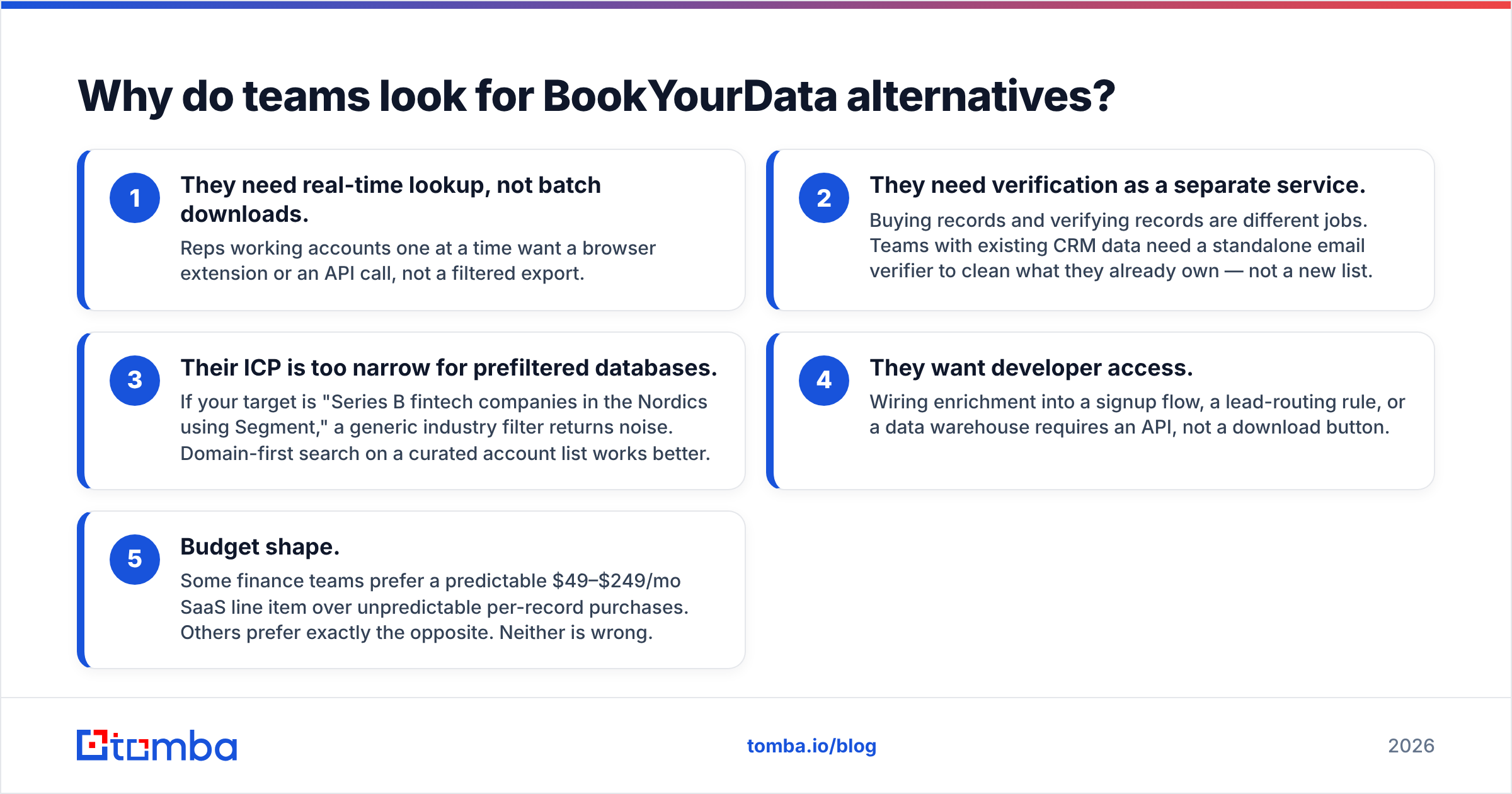
Five reasons come up repeatedly when teams evaluate a switch:
- They need real-time lookup, not batch downloads. Reps working accounts one at a time want a browser extension or an API call, not a filtered export.
- They need verification as a separate service. Buying records and verifying records are different jobs. Teams with existing CRM data need a standalone email verifier to clean what they already own — not a new list.
- Their ICP is too narrow for prefiltered databases. If your target is "Series B fintech companies in the Nordics using Segment," a generic industry filter returns noise. Domain-first search on a curated account list works better.
- They want developer access. Wiring enrichment into a signup flow, a lead-routing rule, or a data warehouse requires an API, not a download button.
- Budget shape. Some finance teams prefer a predictable $49–$249/mo SaaS line item over unpredictable per-record purchases. Others prefer exactly the opposite. Neither is wrong.
Recognize which of these applies to you before you read another comparison table, because the "best" tool changes entirely depending on the answer.
How do the main BookYourData alternatives compare?#
Here's the practical comparison across the tools most teams shortlist. Prices are entry-level published rates as of mid-2026; enterprise tiers are negotiated and not listed.
| Tool | Model | Entry price | Free tier | Verification included | API |
|---|---|---|---|---|---|
| BookYourData | Pay-per-record list | ~$0.09–$0.20/record | Sample records | Yes (95%+ guarantee) | Limited |
| Tomba | Credit subscription | $49/mo Starter | 25 searches/mo | Yes, separate verifier | Full REST API |
| Hunter | Credit subscription | ~$34/mo entry | 25–50 searches/mo | Yes | Yes |
| Apollo.io | Seat + credits | ~$49/user/mo | |||
| Limited credits | Basic | Yes (paid tiers) | |||
| ZoomInfo | Annual contract | Custom (4–5 figures) | No | Yes | Enterprise only |
| --- | --- | --- | --- | --- | --- |
| Cognism | Annual contract | Custom | No | Yes (Diamond Data) | Yes |
| Lusha | Seat + credits | ~$36/user/mo | 50 credits | Yes | Paid tiers |
| RocketReach | Credit subscription | ~$39/mo | Trial lookups | Partial | Higher tiers |
| Findymail | Credit subscription | ~$49/mo | Trial | Yes | Yes |
| Clearbit (Breeze) | Enrichment API | Bundled with HubSpot | No | N/A | Yes |
| Seamless.AI | Seat + credits | Custom | Limited | Basic | Paid tiers |
| Lead411 | Subscription + data packs | ~$99/mo | Trial | Yes | Yes |
Two things jump out. First, the price spread between the cheapest credit plan and an enterprise contract is roughly two orders of magnitude — and the underlying data overlap between them is far smaller than that gap implies. Second, almost nobody outside the pay-per-record vendors gives you a hard accuracy guarantee in writing. BookYourData does. Give it credit for that.

Which alternative fits which use case?#
Sorting by use case is more useful than ranking by "best."
1. You want a one-time list and no subscription. Stay with BookYourData, or look at Lead411's data packs. Pay-per-record genuinely wins when your need is bounded and occasional. Don't buy a SaaS seat to run one campaign a year.
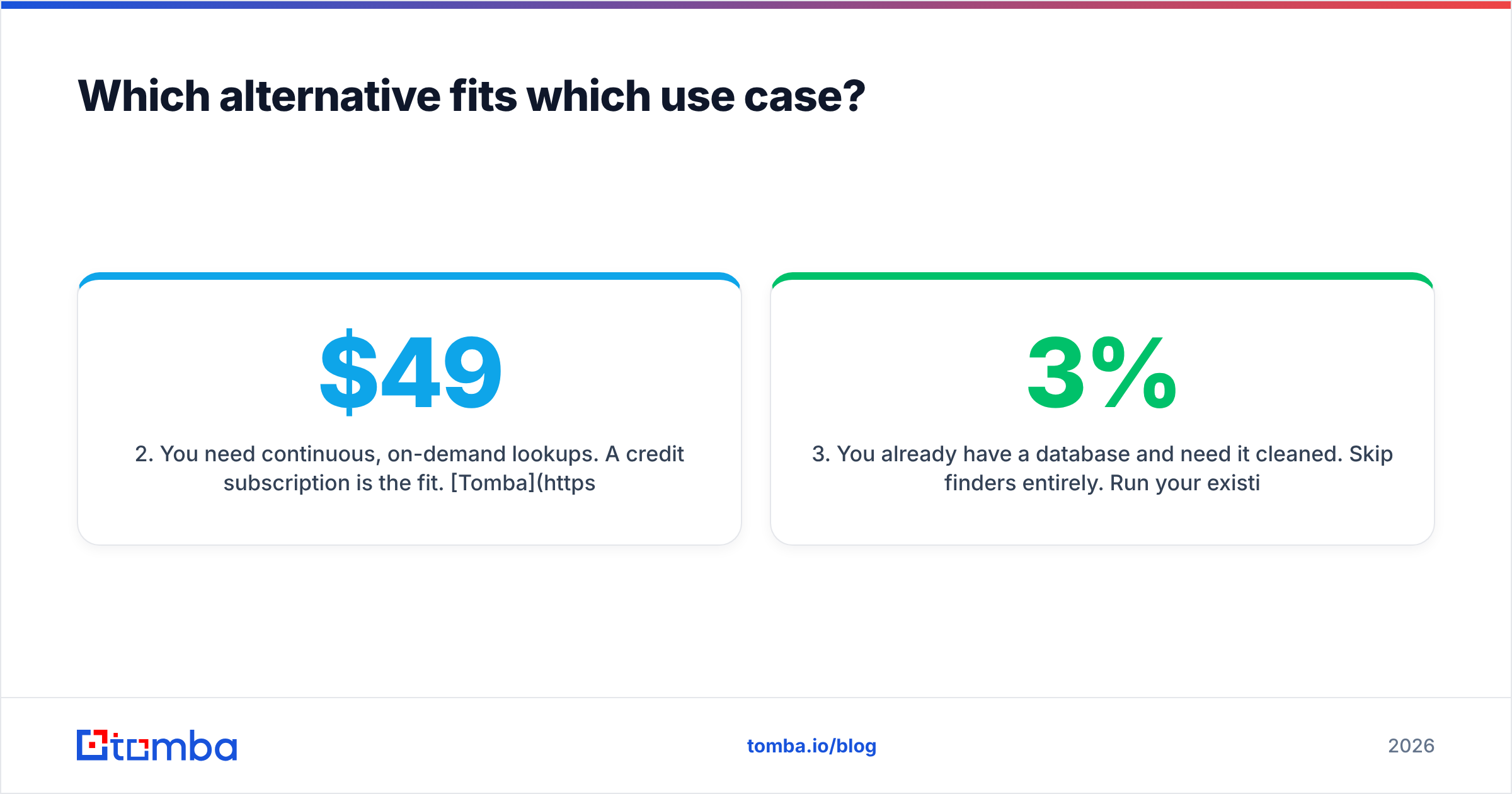
2. You need continuous, on-demand lookups. A credit subscription is the fit. Tomba runs Free (25 searches/mo), Starter $49/mo, Growth $99/mo, Pro $249/mo, with Enterprise custom — see full Tomba pricing for credit allocations. Hunter and Findymail occupy similar ground. What you're buying here is recency: the lookup happens now, against live sources, not against a file assembled months ago.
3. You already have a database and need it cleaned. Skip finders entirely. Run your existing records through a dedicated verification pass. Bounce rates above 3% put your sender reputation at risk, and Google and Yahoo's bulk-sender requirements made that threshold a hard operational limit rather than a best practice. A bulk email finder and verifier handles the batch side without you buying more contacts you don't need.
4. You need everything in one seat — data, sequencer, dialer. Apollo.io or Cognism. You'll pay for the bundle and you'll accept that no single component is best-in-class, but consolidation has real value for small teams that can't manage five vendors.
5. You're a developer wiring enrichment into product. API-first is the requirement. The Tomba API and Clearbit's enrichment endpoints are the two obvious shapes: one focused on finding and verifying contact points, the other on firmographic enrichment of records you already have.
6. Your ICP lives on LinkedIn. Extension-based tools matter more than database size. Look at ContactOut, Wiza, or a LinkedIn finder that resolves a profile to a verified work email in the browser.
Is buying a list cheaper than finding emails on demand?#
Run the arithmetic on cost per usable contact, not cost per record.
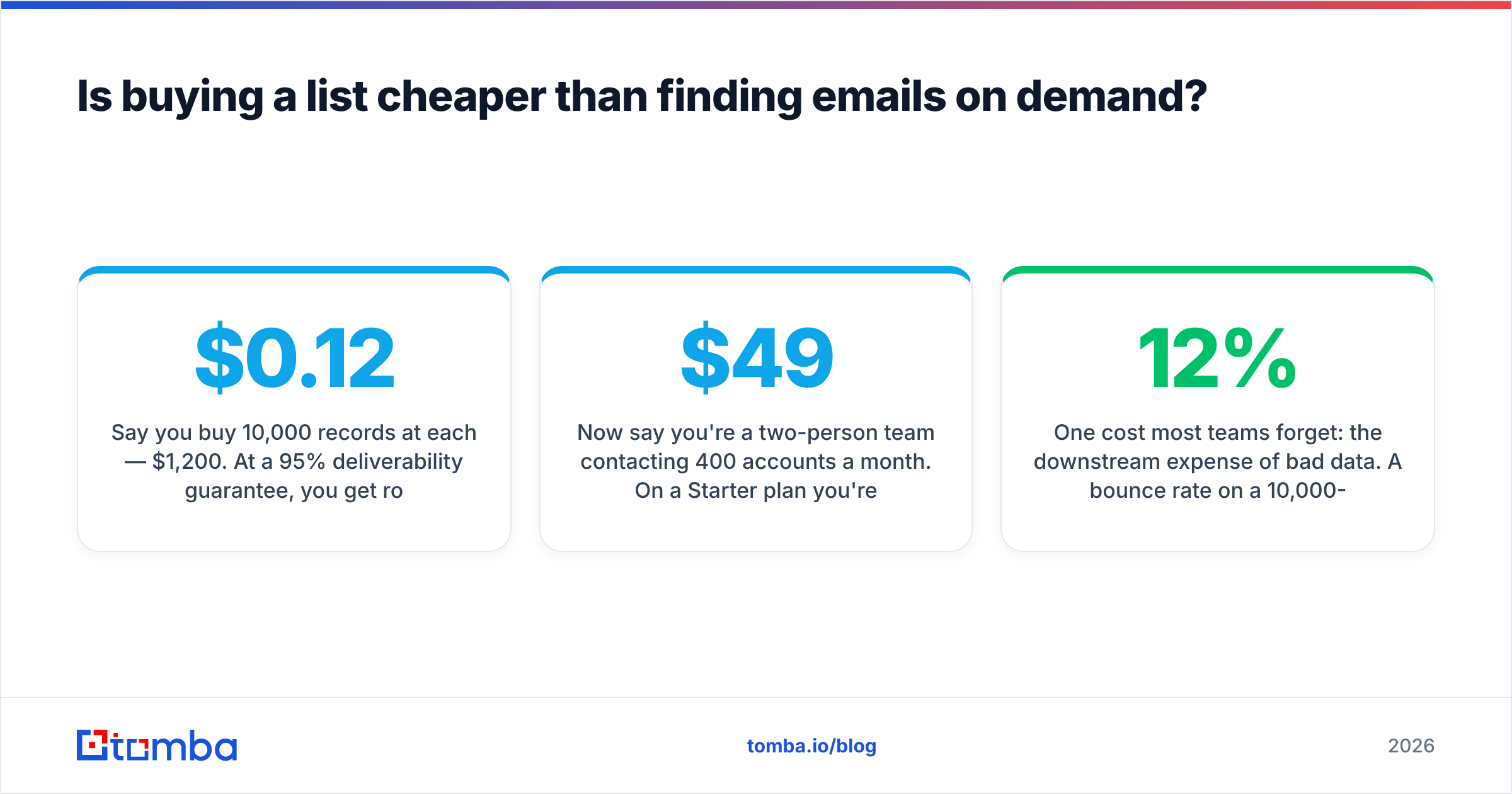
Say you buy 10,000 records at $0.12 each — $1,200. At a 95% deliverability guarantee, you get roughly 9,500 usable addresses, so about $0.126 per usable contact. That's competitive, and if you genuinely need 10,000 contacts at once, it's hard to beat.
Now say you're a two-person team contacting 400 accounts a month. On a $49/mo Starter plan you're paying $0.12 per lookup at 400 lookups — the same unit economics, but you're only buying what you actually use, and each record is fetched fresh on the day you need it. The subscription doesn't win on price. It wins on waste avoidance and freshness.
The model flips again at scale. If you're pulling 50,000 records a quarter, per-record purchasing or an enterprise contract beats stacking credit plans. There's no universal answer — there's a break-even point, and it sits somewhere around the volume where your credit spend exceeds bulk list pricing.
One cost most teams forget: the downstream expense of bad data. A 12% bounce rate on a 10,000-record send doesn't just waste 1,200 emails. It can get your sending domain throttled, which taxes every campaign after it. That's why email deliverability belongs in the tool-selection conversation, not in a separate one after you've already bought.
What should you actually test before you commit?#
Vendor accuracy claims are marketing until you validate them against your own ICP. Every provider's data is stronger in some segments and weaker in others — US mid-market SaaS is well-covered by nearly everyone; European manufacturing SMBs are not.
Run this benchmark before you sign anything:
- Build a 100-contact ground-truth list. Pull real people from your target segment whose emails you can independently confirm — existing customers, inbound leads, conference attendee lists.
- Feed the same 100 names and domains to each shortlisted tool. Same input, same day.
- Score three metrics separately. Coverage (how many returned anything at all), accuracy (how many matched the known-good address), and confidence calibration (when the tool says "high confidence," is it right?).
- Test catch-all domains specifically. Catch-all servers accept everything at SMTP, so naive verifiers mark them valid. A catch-all verifier that actually distinguishes real mailboxes from accept-all behavior is a meaningful differentiator — and a common failure point.
- Check the refund and replacement terms in writing. BookYourData's replacement policy is genuinely good here. Ask any alternative to match it.
- Test the export path. If the data can't reach your CRM without manual CSV surgery, the tool costs more than its price tag. Check for native integrations with your stack.
Cross-reference vendor claims with third-party review aggregation on G2 before you trust a homepage stat. And if you're evaluating enterprise contracts, Gartner peer reviews are worth the time, since seat-based pricing makes switching costs real.
What about compliance and data sourcing?#
This is where the choice gets less about features and more about risk.
Ask every vendor three questions:
- Where does the data come from? Public web crawling, opt-in partner networks, contributory models (users share their address books), and third-party purchases carry very different risk profiles. Tomba documents its data sources publicly; ask others to do the same.
- What's the GDPR basis for EU contacts? Legitimate interest is defensible for B2B outreach in most EU jurisdictions, but only if the vendor can produce a documented assessment and honor deletion requests. "We're compliant" without documentation isn't an answer.
- How do they handle suppression? Ask whether unsubscribes and DNC requests you register propagate back to the vendor's database or only your local copy.
Cognism markets phone-verified, DNC-screened mobile numbers as its differentiator largely because this compliance layer is expensive to build and easy to skip. If you're doing outbound calling alongside email, a phone validator step matters for the same reason — regulatory exposure on calls is significantly higher than on email in most jurisdictions. See the HubSpot resources on B2B outreach compliance for a reasonable starting framework.
What's the honest verdict on BookYourData alternatives?#
BookYourData does what it says: filtered, guaranteed, pay-once B2B lists with no contract. If that's your need, the alternatives listed here aren't upgrades — they're different products. Don't switch for the sake of switching.
Switch when your motion changes. The moment your team starts needing lookups inside a workflow — a rep in a browser extension, an API call in a signup flow, a nightly enrichment job against your CRM — a static file stops being the right container for the data. That's the real dividing line, and it has nothing to do with which vendor has better records.
The pattern that works for most teams under 50 reps: one credit-based finder for on-demand lookups, one verification pass before every send, and occasional bulk list purchases when you need volume fast. Three tools, clear boundaries, no overlap. Trying to make one vendor do all three is how you end up overpaying for capabilities you use twice a year.
If you're in that first bucket — you need fresh, verified emails on demand rather than a quarterly CSV — start with the Tomba Email Finder. The free tier gives you 25 searches a month to run the 100-contact benchmark above against your own ICP before you spend anything, and Starter at $49/mo covers most two-to-five-person outbound teams without an annual commitment. Run the test, compare the numbers against whatever else is on your shortlist, and let the accuracy data pick the winner instead of the marketing page.
Related guides#
Ready to find emails that actually work?
Join 150,000+ professionals who stopped guessing and started sending. Free credits on signup — no credit card required.
Get the Tomba newsletter
Practical outbound tactics and product updates — once every two weeks.
About the author