Definitive Healthcare vs GetProspect: 2026 Data Comparison
One tool sells healthcare market intelligence at enterprise prices. The other sells LinkedIn-sourced B2B emails for pocket change. Here's which one actually fits your pipeline — and when neither does.
TL;DR
- Definitive Healthcare and GetProspect are not competitors. One is a healthcare market intelligence platform priced in the tens of thousands per year; the other is a LinkedIn-based email finder that starts near free.
- Pick Definitive Healthcare if you sell into hospitals, IDNs, physician groups, or payers and need claims data, affiliations, technology install bases, and NPI-level provider records.
- Pick GetProspect if you need contact emails at volume across any industry and your budget is measured in dollars, not annual contract value.
- Most teams selling to healthcare need both layers — market intelligence for account selection, and a contact-data tool for the actual emails.
- If you only need accurate, verifiable work emails, a dedicated finder like Tomba Email Finder covers the same job as GetProspect with SMTP-level verification and a documented API.
Comparing Definitive Healthcare to GetProspect feels strange the first time you see the matchup — like comparing a Bloomberg terminal to a phone book. But the query comes up constantly, and for a real reason: both tools end up on the same shortlist when a sales team is told "go sell to hospitals" and starts pricing data vendors. One of them answers which accounts matter. The other answers what is this person's email. Confusing the two costs you either a five-figure contract you didn't need or six months of outbound aimed at the wrong facilities.
This breakdown covers what each platform actually does, what they cost, where the data comes from, and the decision rule for picking one — or neither.
What is Definitive Healthcare?#
Definitive Healthcare is a healthcare commercial intelligence platform. It maintains profiles on U.S. healthcare organizations — hospitals, health systems, ambulatory surgery centers, physician groups, long-term care facilities, imaging centers, payers — and the people who work in them.
The value is not the contact record. It's everything wrapped around the contact record:
- Claims data. Procedure volumes, diagnosis mixes, and referral patterns sourced from medical and pharmacy claims. This is how you find the 200 hospitals that actually perform enough of a given procedure to care about your device.
- Affiliations and network mapping. Which physicians admit to which hospitals, which facilities belong to which IDN, which groups were just acquired. Healthcare buying is network-driven; a standalone contact list misses the buying committee entirely.
- Technology install base. Which EHR a facility runs, which RCM vendor, which imaging system. Essential for anyone selling health IT or replacement software.
- Financial and quality metrics. Cost reports, CMS star ratings, bed counts, payer mix, executive turnover.
- Provider-level records. NPI numbers, specialties, taxonomy codes, and the demographic detail that a general-purpose B2B database simply does not carry.
If your ICP is "cardiology practices with more than 12 physicians running Epic in the Southeast," Definitive Healthcare answers that in a query. No generic prospecting tool comes close.
The tradeoff is scope and price. It's U.S. healthcare only, it's sold as an annual seat-based contract, and it's built for market analysis first, outbound execution second.

What is GetProspect?#
GetProspect is a B2B email finder and lead database. You search or filter for people, it returns work email addresses, and it exports to CSV or your CRM. The core mechanics:
- LinkedIn-first sourcing. A Chrome extension pulls contact data while you browse LinkedIn or Sales Navigator, which is how most users actually work with it.
- Filterable contact database. Roughly tens of millions of B2B profiles filterable by job title, company size, industry, location, and technology.
- Bulk enrichment. Upload a list of names and domains, get emails back.
- Built-in verification. Basic validity checks before export.
- Credit-based pricing with a genuinely usable free tier.
GetProspect is horizontal. It doesn't know that a facility is a 400-bed teaching hospital or that a physician performs 900 knee replacements a year. It knows that someone with the title "VP of Revenue Cycle" works at a company with a given domain, and it will guess and verify their email.
That's a different product category. It competes with Hunter, Apollo, Findymail, and Tomba's email finder — not with Definitive Healthcare.
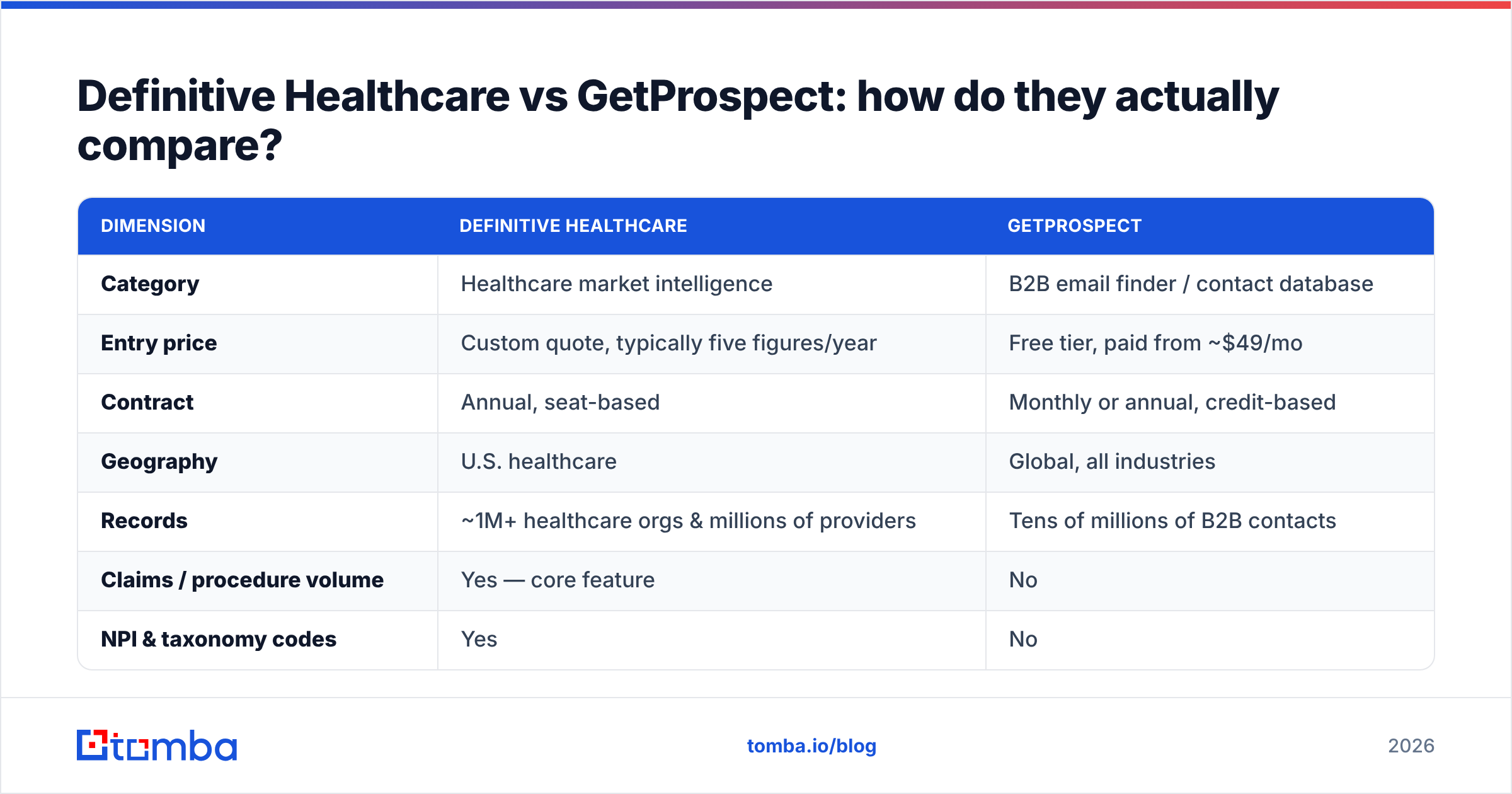
Definitive Healthcare vs GetProspect: how do they actually compare?#
| Dimension | Definitive Healthcare | GetProspect |
|---|---|---|
| Category | Healthcare market intelligence | B2B email finder / contact database |
| Entry price | Custom quote, typically five figures/year | Free tier, paid from ~$49/mo |
| Contract | Annual, seat-based | Monthly or annual, credit-based |
| Geography | U.S. healthcare | Global, all industries |
| Records | ~1M+ healthcare orgs & millions of providers | Tens of millions of B2B contacts |
| Claims / procedure volume | Yes — core feature | No |
| NPI & taxonomy codes | Yes | No |
| Technology install base | Yes (EHR, RCM, imaging) | Limited technographics |
| LinkedIn extension | No | Yes — primary workflow |
| Email verification | Basic contact validation | Built-in, basic |
| Phone numbers | Org and exec-level | Limited |
| API access | Enterprise tier | Yes, on paid plans |
| Best for | Account selection & TAM analysis | Contact acquisition at volume |
| Worst for | Cheap email lookups | Any healthcare-specific targeting |
The pattern is clear once you lay it out. These tools sit at opposite ends of the same funnel. Definitive Healthcare tells you which 300 accounts out of 6,000 hospitals are worth pursuing. GetProspect tells you the email address of the person you need to reach at one of them.
Which one is better for healthcare outbound?#
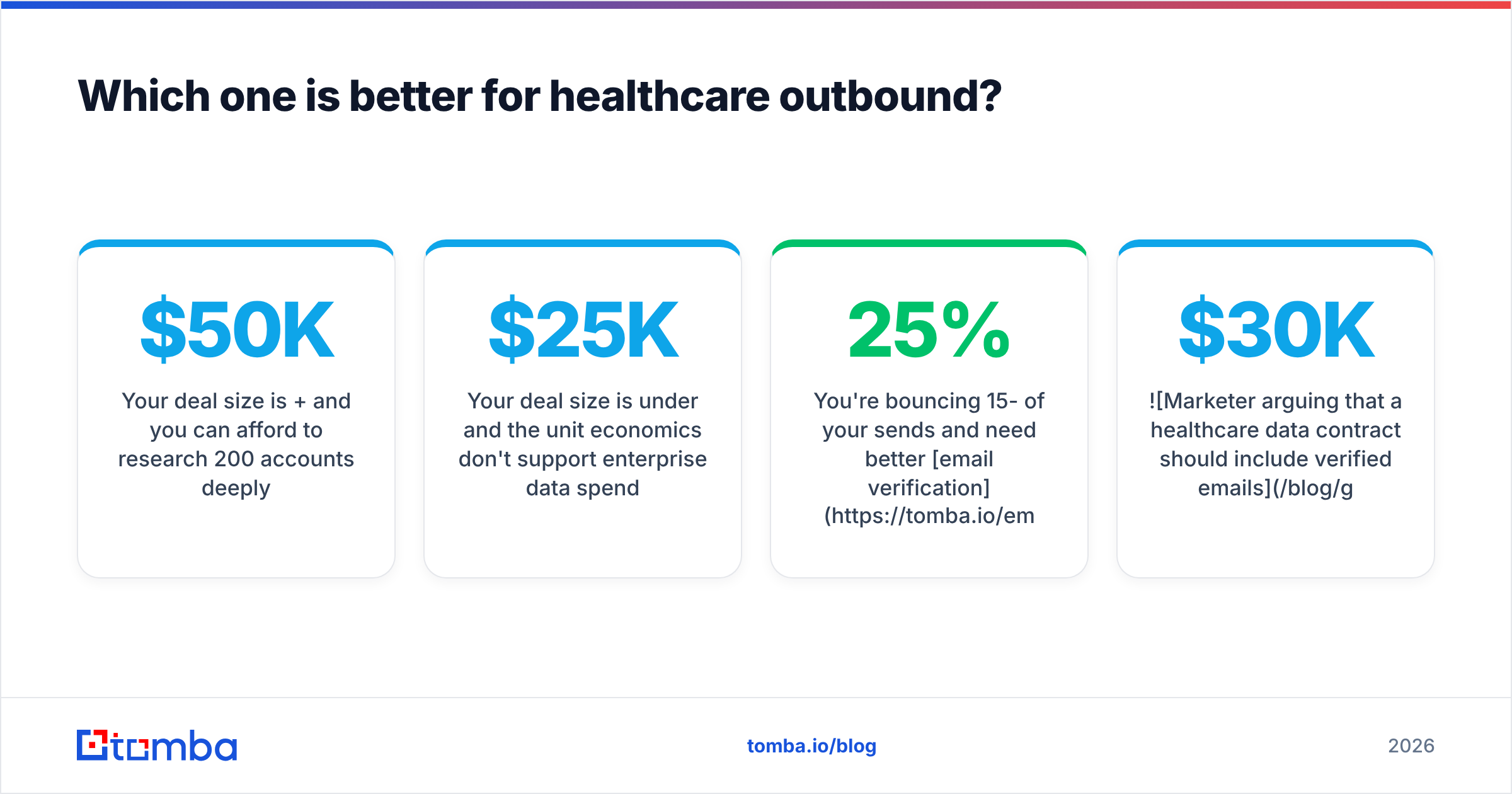
Depends entirely on whether your targeting problem or your contact problem is bigger.
Your targeting problem is bigger if:
- You sell a clinical product where procedure volume determines fit
- Your deal size is $50K+ and you can afford to research 200 accounts deeply
- You need to map IDN ownership before you can even identify the decision maker
- Your reps are burning weeks on manual research in CMS data and hospital websites
Your contact problem is bigger if:
- You already know your target list (a conference attendee list, a trade association directory, an inbound wave)
- You sell horizontally — HR software, cybersecurity, staffing — and healthcare is just one vertical
- Your deal size is under $25K and the unit economics don't support enterprise data spend
- You're bouncing 15-25% of your sends and need better email verification, not better account selection
Most mid-market teams selling into healthcare discover their contact problem first because it's the one that shows up in the metrics. Bounce rates are visible. A poorly chosen account list just looks like "outbound isn't working."

What does each one cost in 2026?#
Definitive Healthcare does not publish pricing. Based on public procurement records, G2 reviewer reports, and vendor comparison threads, contracts typically start in the $15,000–$30,000/year range for a small seat count and climb well past $100K for multi-module enterprise deployments. Modules are priced separately — the claims module, the technology install base module, and the physician-level data each carry their own line item. Budget for an annual commitment and a procurement cycle measured in months.
GetProspect publishes its pricing openly. There's a free tier with a small monthly credit allowance, and paid plans scale by verified-email credits, generally landing in the $49–$400/month band depending on volume and seats.
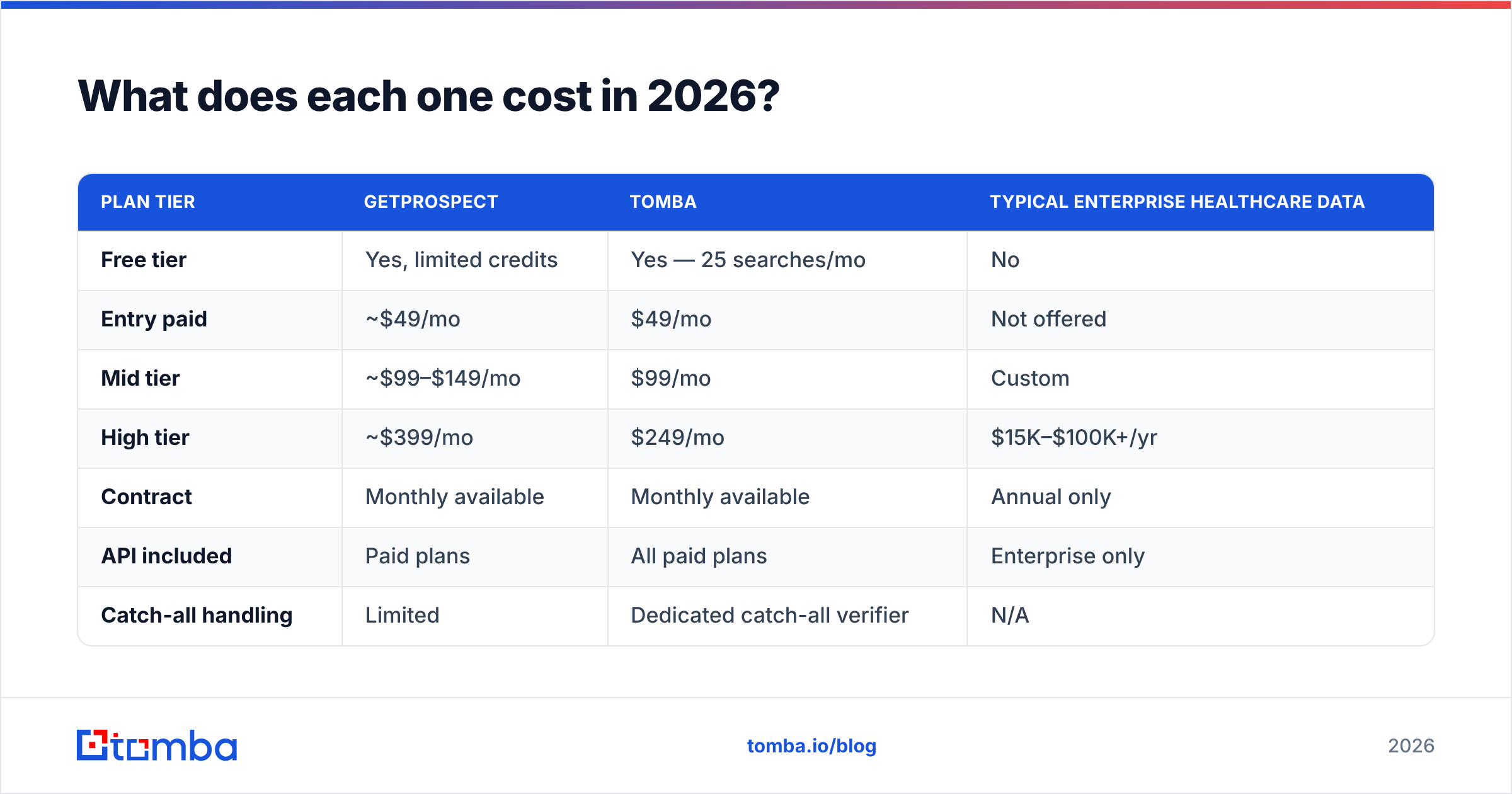
Here's how the contact-data layer compares across the tools teams usually shortlist alongside GetProspect:
| Plan tier | GetProspect | Tomba | Typical enterprise healthcare data |
|---|---|---|---|
| Free tier | Yes, limited credits | Yes — 25 searches/mo | No |
| Entry paid | ~$49/mo | $49/mo | Not offered |
| Mid tier | ~$99–$149/mo | $99/mo | Custom |
| High tier | ~$399/mo | $249/mo | $15K–$100K+/yr |
| Contract | Monthly available | Monthly available | Annual only |
| API included | Paid plans | All paid plans | Enterprise only |
| Catch-all handling | Limited | Dedicated catch-all verifier | N/A |
Full Tomba pricing is public, and the free tier is enough to test accuracy against your own known-good contacts before you commit to anything.
How accurate is the contact data on each platform?#
This is where the comparison gets uncomfortable for both vendors.
Definitive Healthcare's organizational data is excellent — it's built from CMS filings, cost reports, claims clearinghouses, and licensed datasets that are structurally reliable. Its contact data is weaker. Executive email addresses go stale fast in healthcare, where turnover in VP-level operational roles runs high, and many buyers report supplementing Definitive with a separate email tool. That's not a knock on the product; it's simply not what the platform optimizes for.
GetProspect's accuracy is respectable for a LinkedIn-sourced tool but inherits the category's structural weakness: pattern-guessing. When a tool infers first.last@domain.com and can't get a clean SMTP response — which happens constantly with hospital systems running catch-all mail servers — it either returns a low-confidence guess or nothing at all. Healthcare domains are unusually catch-all heavy, which is exactly the scenario generic finders handle worst.
If you're sending into @hospitalsystem.org domains, run everything through a catch-all verifier before it hits your sequencer. A catch-all domain accepts every address at the SMTP layer, so "verified" from a basic checker means nothing — the mail server said yes to a mailbox that doesn't exist. That's how a clean-looking list still produces a 20% bounce rate and a wrecked sender reputation.
Practical accuracy checklist before you buy either tool:
- Test on known contacts. Take 50 people whose emails you already have. Run them through the trial. Count exact matches.
- Check the catch-all rate. Ask what percentage of your target domains come back as catch-all or "accept-all." In healthcare it's often 30%+.
- Verify the freshness date. Ask when each record was last confirmed, not when it was first collected.
- Test coverage on your actual ICP, not on tech companies. Every vendor looks great on
@salesforce.comand mediocre on@stlukeshealth.org. - Measure the bounce, not the promise. Send 200 emails and count hard bounces. That number is the only accuracy figure that matters.
Are there better alternatives to either tool?#
Yes, depending on which job you're hiring for.
If you need healthcare market intelligence: Definitive Healthcare's direct competitors are IQVIA, H1, Doximity's data products, and LexisNexis Health Care. Each has a different strength — IQVIA on prescription and pharma data, H1 on physician and KOL research. Definitive tends to win on breadth of facility-level commercial data and usability of the interface. There is no cheap substitute for this layer; if you need claims data, you pay for claims data.
If you need contact data: the field is crowded and price-competitive. GetProspect, Hunter, Findymail, Apollo, and Tomba all solve variations of the same problem. BookYourData is a solid option if you'd rather buy a pre-built, filtered list outright than run searches yourself — it's a different purchasing model that suits teams without a data ops function.
Where a dedicated finder pulls ahead of a bundled platform is verification depth and API access. Tomba's stack separates the jobs deliberately: domain search to map every addressable contact at a facility's domain, the email finder for individual lookups, a standalone verifier with catch-all handling, and a documented email finder API so you can wire enrichment into your CRM instead of exporting CSVs forever.
For healthcare specifically, that domain-first workflow matters. You're rarely looking for one person — you're looking for the whole revenue cycle team, or every director-level title inside a 12-facility system. Searching by domain returns the org chart. Searching by name returns one row.
How should you combine them?#
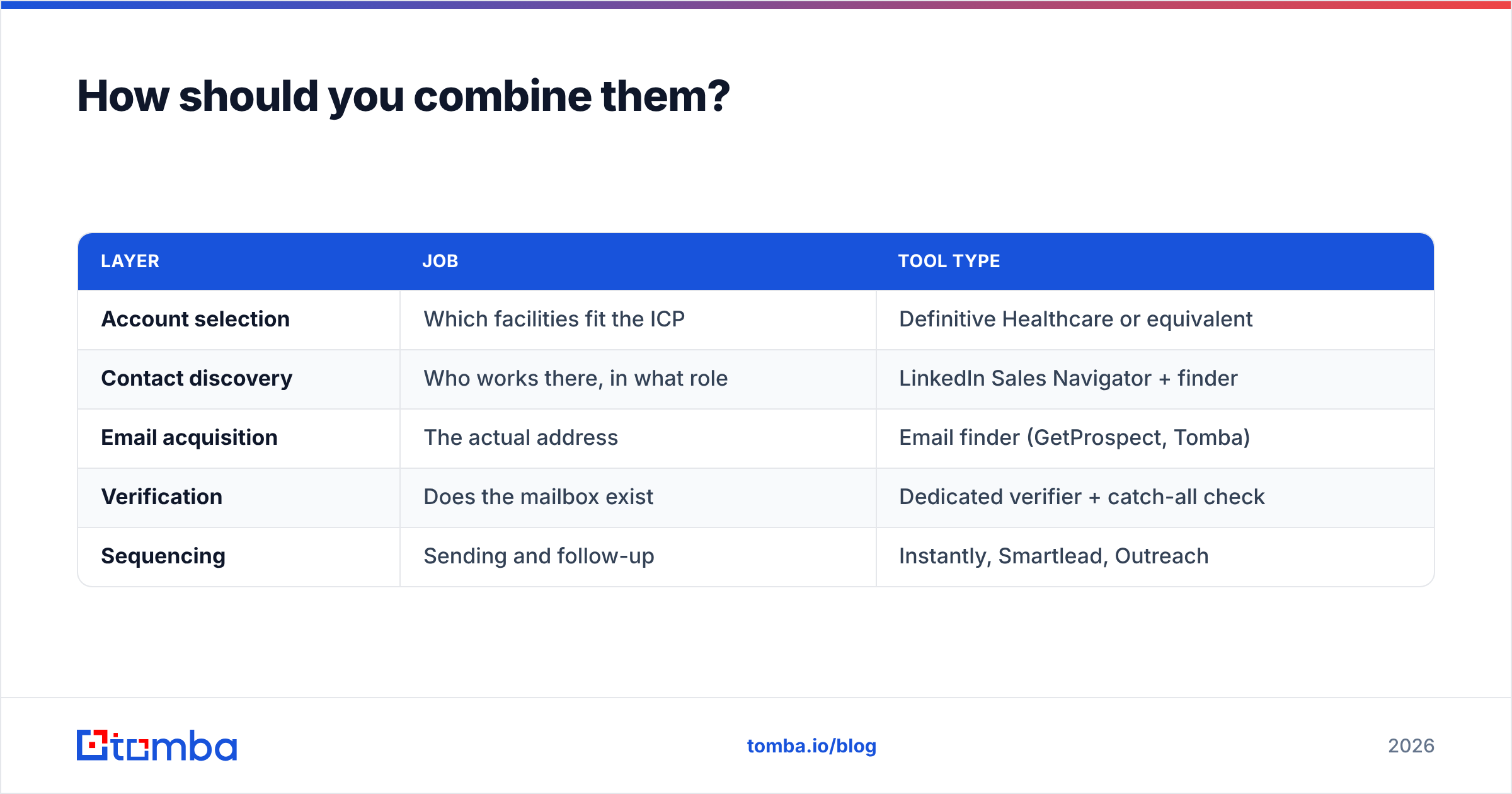
The realistic stack for a team selling into healthcare with a real budget:
| Layer | Job | Tool type |
|---|---|---|
| Account selection | Which facilities fit the ICP | Definitive Healthcare or equivalent |
| Contact discovery | Who works there, in what role | LinkedIn Sales Navigator + finder |
| Email acquisition | The actual address | Email finder (GetProspect, Tomba) |
| Verification | Does the mailbox exist | Dedicated verifier + catch-all check |
| Sequencing | Sending and follow-up | Instantly, Smartlead, Outreach |
Notice that Definitive Healthcare occupies exactly one row. Teams that buy it expecting rows three and four to come free are the ones who churn at renewal. Teams that buy it for row one, pair it with a $49/month finder for row three, and verify before sending get the results the enterprise contract was supposed to deliver.
If your budget can't stretch to the intelligence layer at all, there's a workable middle path: build the account list manually from public CMS data and state facility registries (tedious but free), then use a finder plus bulk verification to build the contact layer. You lose claims-based prioritization, but you keep your outbound running.
What's the verdict?#
Definitive Healthcare wins if healthcare is your entire business and account selection is your bottleneck. Nothing else gives you procedure volumes, IDN affiliations, and EHR install base in one query. The price is real, the contract is annual, and the ROI shows up in win rate, not in email volume.
GetProspect wins if you need emails cheaply across any industry and healthcare is one of several verticals. It's a fine tool at its price point with a workflow that suits reps who live in LinkedIn.
Neither wins if your core problem is deliverability. If your bounce rate is the metric keeping you up at night, the fix is a verification-first contact stack, not a bigger database. Enterprise intelligence platforms don't guarantee inbox placement, and generic finders don't handle catch-all domains well.
Start by naming the bottleneck. Wrong accounts, or wrong addresses? The answer picks the tool.
Test the contact layer before you commit to the intelligence layer. Tomba's Email Finder gives you 25 free searches per month — enough to run your existing known-good list through it and see the match rate on your real target domains, including the catch-all-heavy hospital systems that break most finders. Paid plans start at $49/month with full API access, bulk processing, and a dedicated catch-all verifier included. If the emails come back clean, you'll know exactly how much of your data budget belongs at the top of the funnel instead of the bottom.
Related guides#
Ready to find emails that actually work?
Join 150,000+ professionals who stopped guessing and started sending. Free credits on signup — no credit card required.
Get the Tomba newsletter
Practical outbound tactics and product updates — once every two weeks.
About the author