Definitive Healthcare vs Lusha: Which B2B Data Tool Wins in 2026?
One is a healthcare commercial intelligence platform, the other is a contact database bolted to a Chrome extension. They are not the same product — and picking the wrong one costs you a year of budget.
Definitive Healthcare vs Lusha is a shortlist a lot of GTM teams end up with. It is also a strange one. One tool maps healthcare markets. The other hands your reps a phone number. Here is how to tell which job you are actually buying for.
TL;DR
- The definitive healthcare vs lusha matchup is not a true head-to-head. Definitive Healthcare sells healthcare commercial intelligence: provider affiliations, claims-derived volumes, facility hierarchies. Lusha sells general B2B contact data with a browser extension on top.
- Buy Definitive Healthcare if your ICP is hospitals, IDNs, physician groups, or payers and you need firmographics you cannot get anywhere else. Expect a quote-based annual contract in the five figures.
- Buy Lusha if you need direct dials and work emails across generic B2B. It is sold per seat with credit caps, and a rep can self-serve in ten minutes.
- Both charge you for records you may never contact. A cheaper pattern: source the account list from the intelligence layer, then find and verify the emails on a usage-based tool.
- If your bottleneck is "I have the company, I need the person's email," a dedicated email finder at $49/mo does that one job better than either platform's contact module.
Definitive Healthcare vs Lusha: what does each tool solve?#
Start here, because the naming confuses people. "B2B data platform" is one label stretched over two very different products.
Definitive Healthcare is a healthcare commercial intelligence vendor. Its value is the graph. Which physicians are affiliated with which health systems. What procedure volumes a facility reports. Which EHR a hospital runs. How an IDN's ownership tree is built. The data comes from claims sets, public filings, CMS releases, surveys, and in-house research. You are buying market maps and account context, not a contact list.
Lusha is a contact data provider. Its value is reach: work emails, personal emails, and direct-dial mobile numbers. You get them through a Chrome extension over LinkedIn, a web app, a CRM sidebar, and an API. Coverage is broad and industry-agnostic. Depth in any one vertical is shallow by design.
So the honest framing of definitive healthcare vs lusha is not "which is better." It is this: are you buying a market model or a phone number?
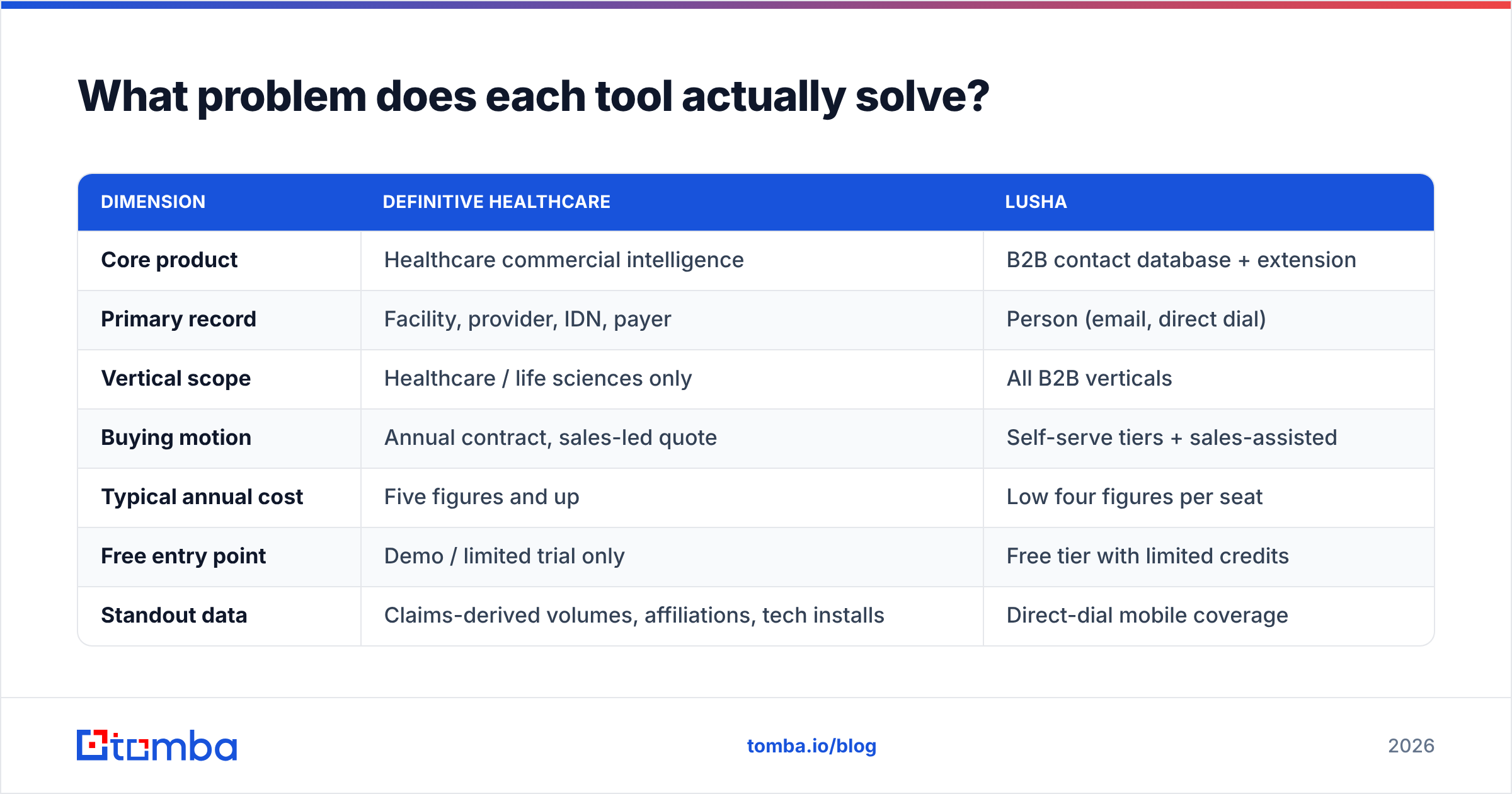
| Dimension | Definitive Healthcare | Lusha |
|---|---|---|
| Core product | Healthcare commercial intelligence | B2B contact database + extension |
| Primary record | Facility, provider, IDN, payer | Person (email, direct dial) |
| Vertical scope | Healthcare / life sciences only | All B2B verticals |
| Buying motion | Annual contract, sales-led quote | Self-serve tiers + sales-assisted |
| Typical annual cost | Five figures and up | Low four figures per seat |
| Free entry point | Demo / limited trial only | Free tier with limited credits |
| Standout data | Claims-derived volumes, affiliations, tech installs | Direct-dial mobile coverage |
| Who it's for | Med-device, pharma, health IT GTM teams | SDR teams in generic B2B |
Is Definitive Healthcare worth the contract?#
If you sell into hospitals, it usually is. But only if you use the intelligence layer, not just the contacts.
The teams that get real ROI are the ones building territory models. Picture a medical device rep. She can see that a surgical center reported rising volume for her procedure. She can see which EHR it runs. She can see that its parent system just bought two ambulatory sites. No general-purpose database gives her that. It is a qualified conversation before the first call.
The teams that waste the contract bought it as a contact list. Person-level email and phone coverage exists, but it is not the center of the product. You will find gaps on non-clinical buyers: the CFO, the IT director, the supply chain lead, the marketing VP. Those people often sign the deal. That gap is the first thing to test in any definitive healthcare vs lusha trial.
Practical checks before you sign:
- Ask for a coverage sample on your exact ICP. Not "hospitals." Try "300-to-500-bed non-profit acute care sites in the Southeast, with named directors of clinical informatics." Then count the rows that come back with a usable email.
- Ask how old the claims data is. A 12-to-18-month lag is normal. It is fine for territory planning and misleading for "they just started doing X."
- Confirm seat math. Pricing is per seat with module add-ons. Adding two analysts mid-year is rarely cheap.
- Test the export path. If your team lives in Salesforce or HubSpot, manual CSV shuttling kills half the value.
- Price the alternative. Public NPI registries plus a domain search tool can rebuild a usable list for some accounts. Less rich, far cheaper.

Is Lusha good enough for outbound in 2026?#
Lusha is genuinely good at one thing. It gets a rep from a LinkedIn profile to a mobile number in two clicks. Adoption is high because the friction is near zero. G2 reviews say the same thing: praise for ease of use, complaints about credit burn and shaky accuracy at smaller companies.
Where Lusha holds up:
- Direct dials. Mobile coverage is strong in the mid-market. If your motion is call-first, that beats email volume.
- Speed to value. A free tier with monthly credits lets a rep prove it works before procurement gets involved.
- CRM push. Native enrichment into Salesforce and HubSpot cuts the copy-paste tax.
Where Lusha frustrates teams:
- Per-seat plus credits. You pay for the seat and the lookups. Ten reps add up fast, and spare credits on one seat do not help the rep who ran out.
- Accuracy varies by segment. US enterprise and mid-market data is solid. Small companies, non-English regions, and clinical roles get patchy.
- No vertical depth. Lusha will tell you Jane Doe is Director of Nursing at a hospital. It will not tell you that hospital's procedure mix, network, or EHR.
That last gap is why the definitive healthcare vs lusha debate so often ends in "we bought both." That is the most expensive answer on the table.
Definitive Healthcare vs Lusha: how does pricing compare?#
Pricing is where definitive healthcare vs lusha stops being an apples-to-apples comparison. Neither vendor publishes one clean number. Treat the table below as structural, not exact, and confirm current rates on the vendor page.
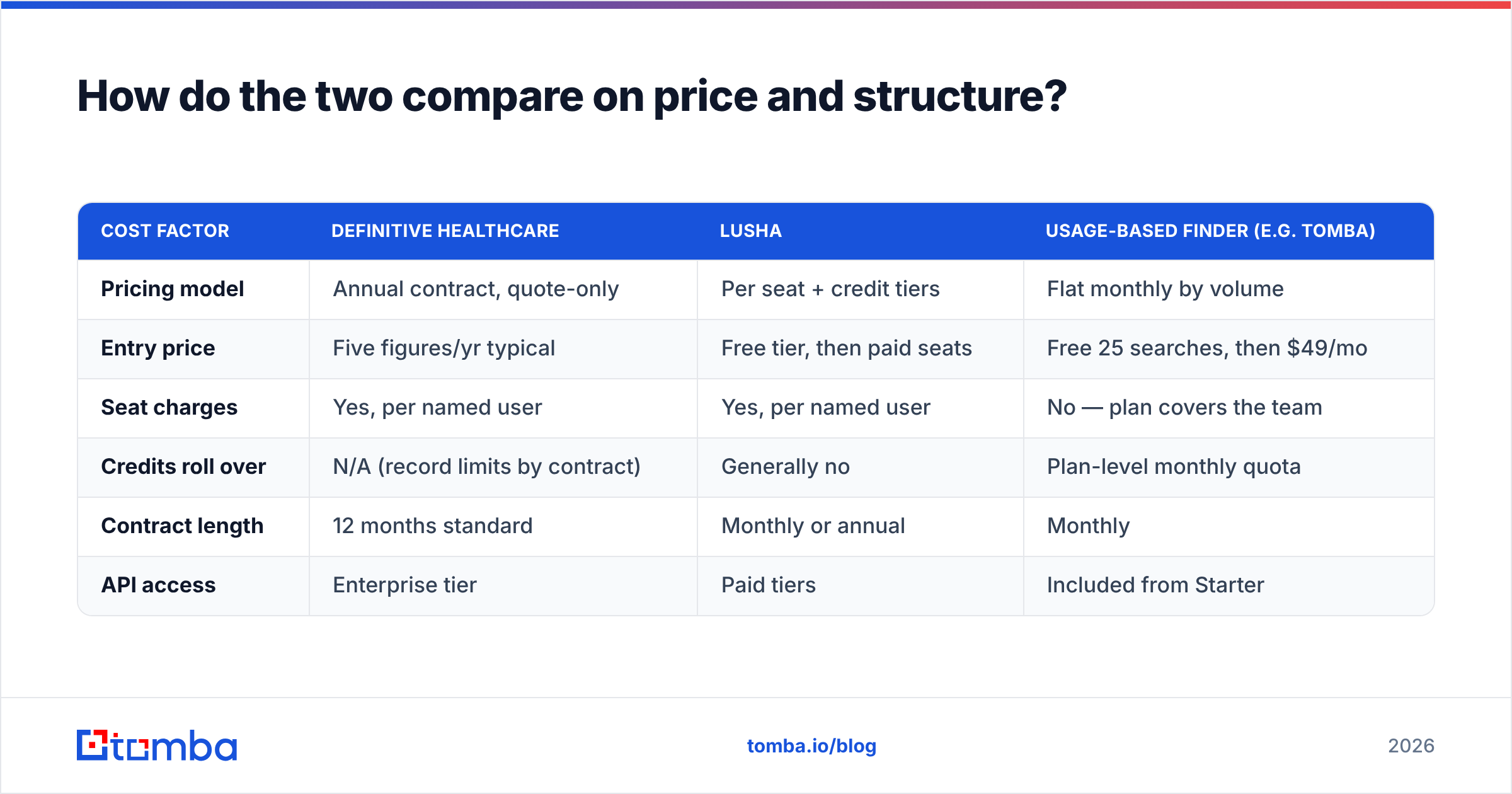
| Cost factor | Definitive Healthcare | Lusha | Usage-based finder (e.g. Tomba) |
|---|---|---|---|
| Pricing model | Annual contract, quote-only | Per seat + credit tiers | Flat monthly by volume |
| Entry price | Five figures/yr typical | Free tier, then paid seats | Free 25 searches, then $49/mo |
| Seat charges | Yes, per named user | Yes, per named user | No — plan covers the team |
| Credits roll over | N/A (record limits by contract) | Generally no | Plan-level monthly quota |
| Contract length | 12 months standard | Monthly or annual | Monthly |
| API access | Enterprise tier | Paid tiers | Included from Starter |
Notice the pattern. Both incumbents charge for identity — who is allowed to log in — rather than for work done. That is fine when every seat prospects full time. It is poor math when three people need the odd lookup. It is worse when an ops engineer enriches a list once a quarter.
For those teams, a flat plan is simply cheaper. Tomba pricing starts at $49/mo for Starter, $99/mo for Growth, and $249/mo for Pro. API access is included from the first paid tier. There is no per-seat multiplier.
Which one is more accurate?#
Accuracy is the wrong question. Accurate at what? is the right one.
Definitive Healthcare is more accurate about institutions. Affiliation data, ownership trees, and facility metadata are researched and maintained. The vendor's whole reputation rests on them. If it says a physician group is owned by a given system, that is usually correct.
Lusha is more accurate about individuals at generic B2B companies. That edge fades as you move down-market or outside the US.
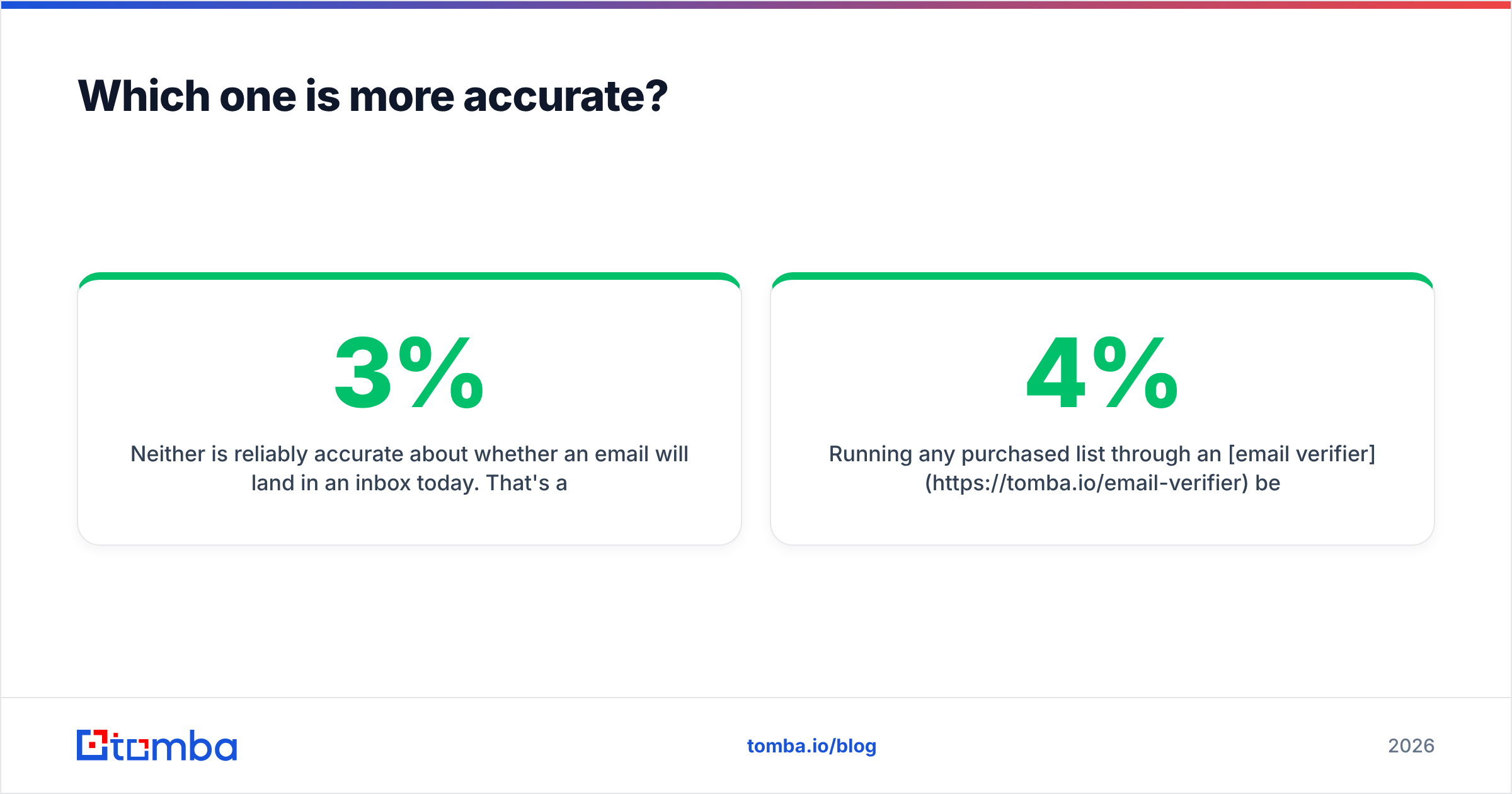
Neither is reliably accurate about one thing: whether an email will land in an inbox today. Contact records decay by roughly 2–3% per month as people change jobs. A record that was right last quarter may be dead when your sequence runs. So the definitive healthcare vs lusha choice never removes the need to verify. Serious outbound teams verify every list, whatever the source:
- Syntax and domain checks catch typos and dead domains.
- MX and SMTP probing confirms the mailbox exists on a real server.
- Catch-all detection flags domains that accept everything, so a "valid" result stays inconclusive.
- Role-account filtering strips info@ and sales@ addresses that tank reply rates.
Run any purchased list through an email verifier before it hits your sequencer. That protects sender reputation far better than switching data vendors ever will. A 4% bounce rate on a premium list hurts exactly as much as one on a scraped list.
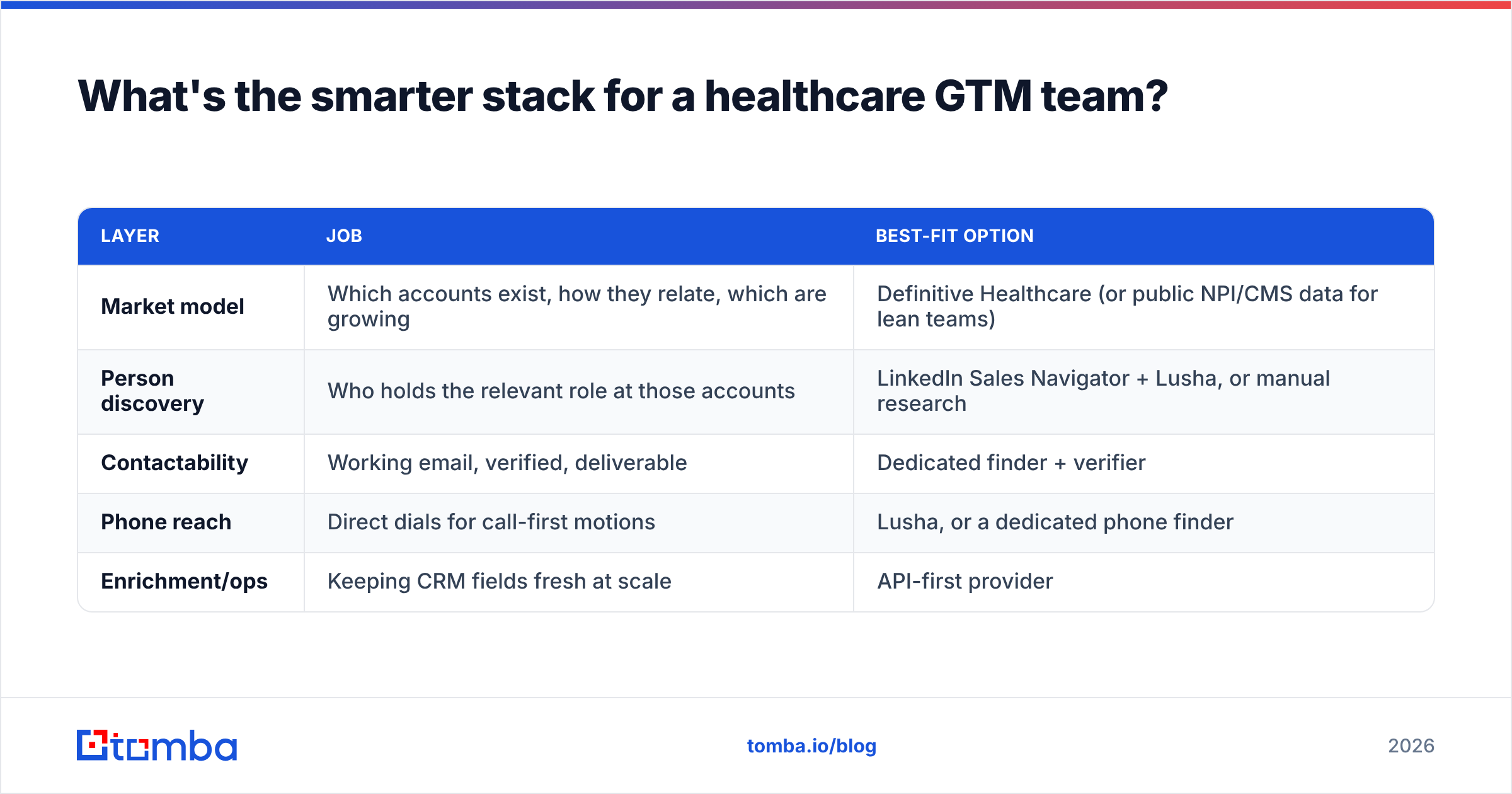
What's the smarter stack for a healthcare GTM team?#
Split the job into layers. Buy each layer on its own merits.
| Layer | Job | Best-fit option |
|---|---|---|
| Market model | Which accounts exist, how they relate, which are growing | Definitive Healthcare (or public NPI/CMS data for lean teams) |
| Person discovery | Who holds the relevant role at those accounts | LinkedIn Sales Navigator + Lusha, or manual research |
| Contactability | Working email, verified, deliverable | Dedicated finder + verifier |
| Phone reach | Direct dials for call-first motions | Lusha, or a dedicated phone finder |
| Enrichment/ops | Keeping CRM fields fresh at scale | API-first provider |
Teams overspend when they ask one vendor to cover all five rows. Definitive Healthcare is excellent at row one and average at row three. Lusha is strong at rows two and four and absent from row one. Read the definitive healthcare vs lusha question as a stack question, not a duel.

A common working setup runs like this. Pull the target account list from your intelligence platform. Export the domains. Run a bulk email finder pass to resolve named contacts at those domains. Verify the output. Only then push it into the sequencer. You keep the expensive intelligence for what it does best, and you stop paying premium rates for commodity lookups.
Looking wider? BookYourData is a credible option for pre-built, verified B2B lists, healthcare segments included. It prices by list purchase rather than by seat. Worth a look if you buy in occasional bulk rather than prospecting non-stop.
What should you ask before you sign either contract?#
Both vendors will pitch hard, so the definitive healthcare vs lusha decision comes down to answers, not demos. Put the same five questions to each one and compare side by side:
- What share of my exact ICP has a verified, contactable email? Ask for the sample. Count it yourself.
- How is the data refreshed, and how often? "Continuously" is a marketing word. Ask for the cadence per field.
- What happens at renewal? Multi-year auto-renew with an uplift clause is common in this category.
- Can I get the data out? Export caps, API rate limits, and CRM sync limits are where contracts quietly bite.
- What is the true cost per usable contact? Divide annual spend by contacts you actually emailed. That number is often 5–10x the sticker math.
Then run a two-week bake-off on the same 200 target accounts. Measure connect rate, bounce rate, and reply rate per source. Vendor accuracy claims are marketing artifacts. Your own bounce log is evidence.
The bottom line#
Definitive Healthcare wins if your edge comes from knowing healthcare institutions better than the rep at the next booth, and you have the budget to match. Lusha wins if you need broad, fast, self-serve reach across generic B2B and your motion is call-heavy. Most teams weighing definitive healthcare vs lusha are really comparing a strategy tool with a tactical one. The right move is to stop paying either one for the layer it handles worst.
Is contactability the gap in your stack? You already know the company and the person. You just need a working, verified email. That is the cheapest layer to fix. Start with the Tomba Email Finder. You get 25 free searches to test it against your own list, $49/mo for Starter with API access included, and no per-seat charges as the team grows. Run it against 100 accounts from your current provider's export and compare the bounce rates. The results will make the buying decision for you.
Related guides#
Ready to find emails that actually work?
Join 150,000+ professionals who stopped guessing and started sending. Free credits on signup — no credit card required.
Get the Tomba newsletter
Practical outbound tactics and product updates — once every two weeks.
About the author