9 Best Delivrai Alternatives in 2026 for B2B Email Data
Delivrai covers the basics, but teams outgrow it on accuracy, credit math, or API depth. Here are 9 Delivrai alternatives compared on verification quality, pricing, and the workflows they actually fit.

TL;DR
- Most teams leave Delivrai for one of three reasons: bounce rates that creep past 5%, credits that burn on failed lookups, or an API that can't keep up with an enrichment job at scale.
- The strongest all-round replacements in 2026 are Tomba, Hunter, and Findymail for finding, plus ZeroBounce and Bouncer when verification is the bottleneck.
- If you buy contacts rather than discover them, BookYourData is a solid, well-regarded option with a pay-as-you-go model and a bounce guarantee.
- Ignore headline "database size" claims. Judge on verified-hit rate per 1,000 targeted lookups, catch-all handling, and whether unfound searches cost you credits.
- Budget reality check: a two-rep outbound team doing ~4,000 lookups a month lands between $49 and $149/mo on almost every tool here. The price gap is smaller than the accuracy gap.
What is Delivrai and who actually uses it?#
Delivrai sits in the email-finding and verification category: you give it a name and a company domain, it returns a business email address and a confidence signal, and it offers list-level verification on top. That's the same core job as Hunter, Apollo, RocketReach, and Tomba.
The typical Delivrai user is a small outbound team or a solo founder who needs a few hundred to a few thousand contacts a month and doesn't want a full sales-engagement suite bolted on. It works. The friction shows up later — usually when volume grows, when a campaign bounces harder than expected, or when someone tries to wire the tool into a CRM enrichment job and finds the API thinner than the UI suggested.
That is the honest starting point for this comparison. Delivrai isn't broken. It's just narrow, and outbound teams outgrow narrow tools fast.
Why do teams look for Delivrai alternatives?#
Four patterns come up repeatedly when people churn out of a mid-tier email finder:
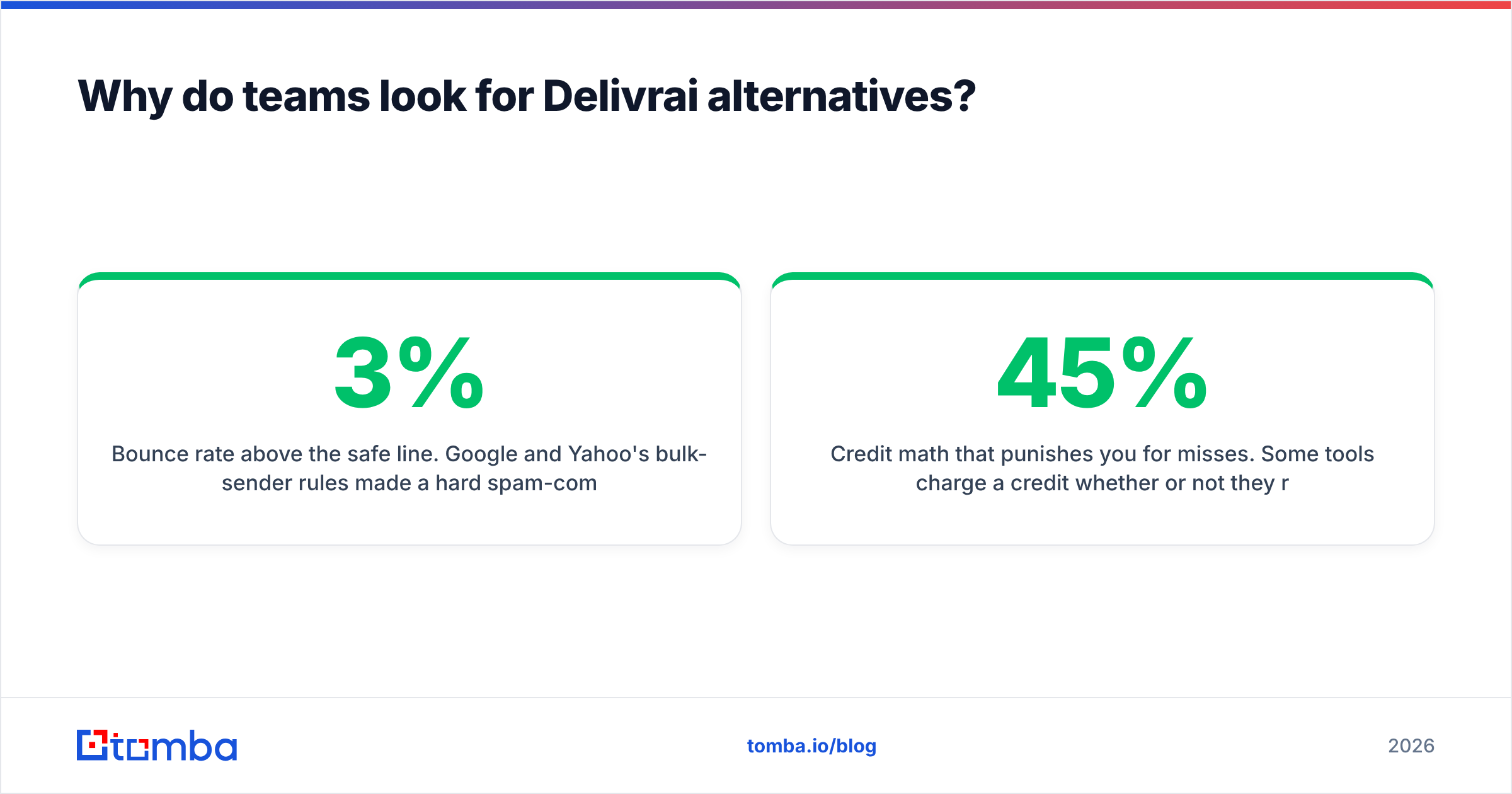
Bounce rate above the safe line. Google and Yahoo's bulk-sender rules made a hard spam-complaint threshold real, and mailbox providers now punish sloppy lists faster than they did three years ago. If your finder returns "probable" addresses without a real SMTP-level check, you eat the deliverability damage. Anything above a 3% bounce rate is a warning; above 5% you are actively burning the domain.
Credit math that punishes you for misses. Some tools charge a credit whether or not they return an address. On a list of hard-to-find prospects — regional manufacturers, agencies, anything outside the SaaS core — a 45% hit rate at full credit cost effectively doubles your real price per contact.
No catch-all strategy. Roughly a fifth of business domains are catch-all, meaning the mail server accepts everything and verification returns "unknown." Tools that dump those into a single bucket force you to either discard good leads or send blind. A proper catch-all verifier applies pattern confidence and historical signal instead of shrugging.
API and automation ceilings. The moment you want nightly enrichment of new CRM rows, a Google Sheets formula for the SDR team, or a bulk job over 50,000 rows, the API becomes the product. Rate limits, webhook support, and bulk endpoints matter more than the browser extension.

How should you evaluate a Delivrai alternative?#
Run every candidate through the same five-point test before you look at pricing. This takes an afternoon and saves a quarter of wasted spend.
- Build a 100-row control list. Use real prospects from your ICP, not famous companies. Include at least 20 rows from non-US domains and 20 from companies under 50 employees — that's where hit rates collapse.
- Measure verified-hit rate, not raw-hit rate. Count only addresses returned as valid or high-confidence. A tool that returns 80 addresses of which 55 are verified beats one that returns 95 with no status.
- Send a real test batch. Fifty addresses through your actual sending infrastructure. Track hard bounces at 48 hours. Anything over 3% disqualifies the tool for cold outbound.
- Check the credit policy in writing. Ask specifically: are failed searches charged? Do credits roll over? Is verification billed separately from finding? These three answers change effective cost by 2–3x.
- Test the API before you buy. Pull 500 rows through the documented bulk endpoint. Note the rate limit, the error format, and whether the response includes a confidence score and sources — not just a string.
Vendors optimize their marketing for step 2 and hope you skip steps 3 through 5. Don't.
What are the best Delivrai alternatives in 2026?#
Here's the field, grouped by what each tool is genuinely best at. Pricing reflects publicly listed entry plans at the time of writing — always confirm on the vendor's own page before you commit, since credit bundles change often.
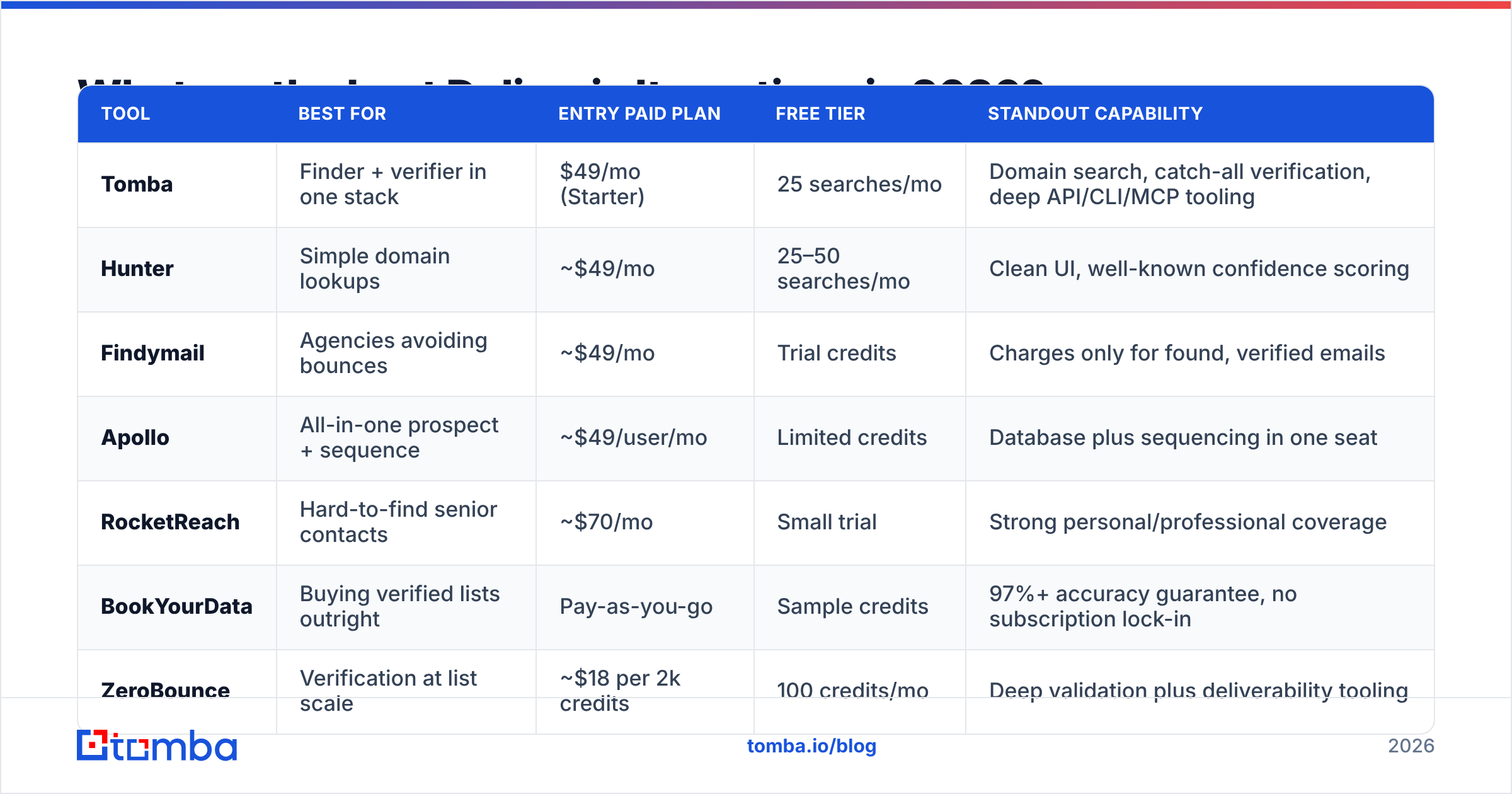
| Tool | Best for | Entry paid plan | Free tier | Standout capability |
|---|---|---|---|---|
| Tomba | Finder + verifier in one stack | $49/mo (Starter) | 25 searches/mo | Domain search, catch-all verification, deep API/CLI/MCP tooling |
| Hunter | Simple domain lookups | ~$49/mo | 25–50 searches/mo | Clean UI, well-known confidence scoring |
| Findymail | Agencies avoiding bounces | ~$49/mo | Trial credits | Charges only for found, verified emails |
| Apollo | All-in-one prospect + sequence | ~$49/user/mo | Limited credits | Database plus sequencing in one seat |
| RocketReach | Hard-to-find senior contacts | ~$70/mo | Small trial | Strong personal/professional coverage |
| BookYourData | Buying verified lists outright | Pay-as-you-go | Sample credits | 97%+ accuracy guarantee, no subscription lock-in |
| ZeroBounce | Verification at list scale | ~$18 per 2k credits | 100 credits/mo | Deep validation plus deliverability tooling |
| Bouncer | EU-focused verification | ~$8 per 1k credits | 100 credits | GDPR-first posture, toxic-domain detection |
| Clearbit / Breeze | Enrichment inside HubSpot | Bundled/enterprise | No | Firmographic enrichment on existing records |

Tomba — the closest like-for-like upgrade#
If you want Delivrai's job done with more depth, this is the direct swap. The email finder handles name-plus-domain lookups, domain search pulls every discoverable address at a company with role labels, and the email verifier runs SMTP-level checks so you're not guessing. Catch-all domains get their own handling rather than a blanket "unknown."
The reason it lands ahead for technical teams is the surface area around the core: a documented email finder API, a CLI, an MCP server, Chrome extension, Excel and Google Sheets add-ins, and native HubSpot, Salesforce, Pipedrive, and Zapier connectors. Pricing runs Free (25 searches/mo), Starter $49/mo, Growth $99/mo, Pro $249/mo, and Enterprise custom — see full Tomba pricing for credit allocations.
Where it's not the answer: if you want a sequencer, a dialer, and an inbox in one tab, this is a data layer, not a sales-engagement platform.
Hunter — the safe, familiar default#
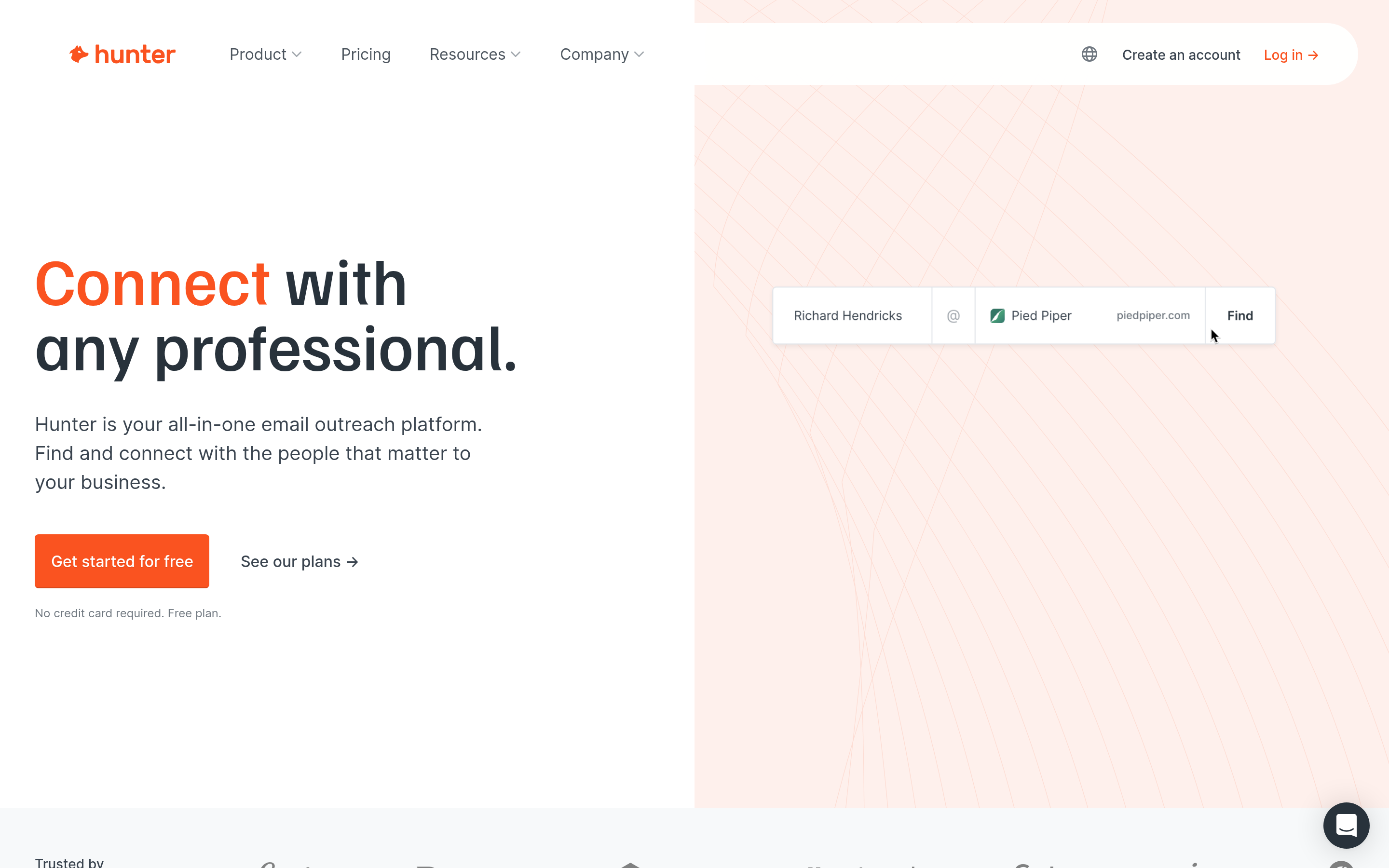
Hunter is the category's reference point. Domain search, email finder, verifier, a competent Chrome extension, and a UI that a new SDR understands in ten minutes. Coverage is strongest on well-indexed Western tech companies and thinner on smaller regional firms. If your ICP is US/EU SaaS and you value simplicity over depth, it's a defensible pick. See their published plans at hunter.io.
Findymail — built around not wasting credits#
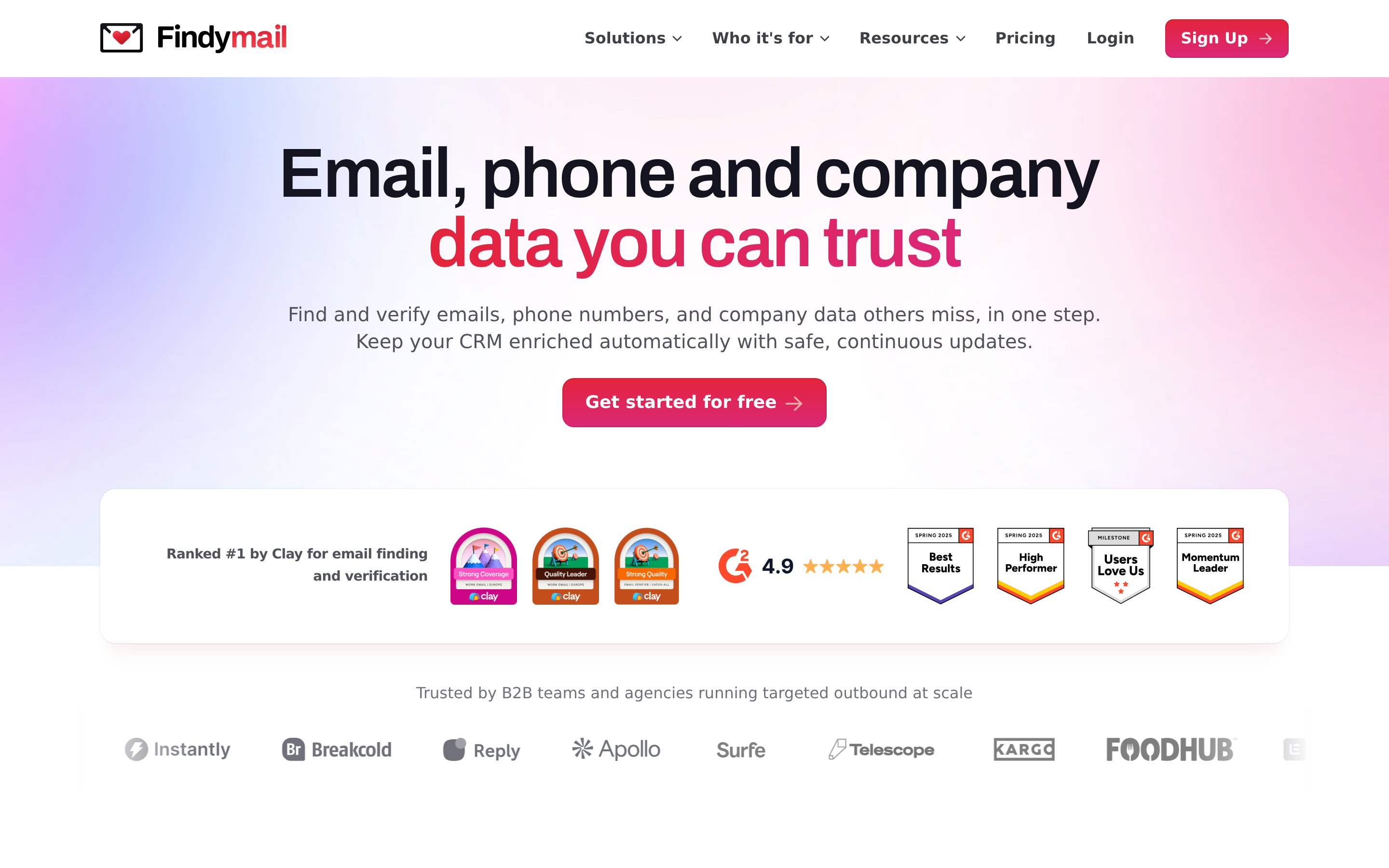
Findymail's pitch is straightforward: you're only charged for emails it finds and verifies. For agencies running client lists where hit rates vary wildly by vertical, that pricing model alone can beat a cheaper per-credit competitor. Coverage is narrower than the big databases, and there's less enrichment beyond the email itself.
Apollo — when you want the database and the sequencer#

Apollo bundles a large contact database with sequencing, dialing, and basic CRM features. That's genuinely useful for a team that has no stack yet. The trade-off is data quality variance — Apollo's records skew stale on smaller companies, and the seat-based pricing gets expensive once you add reps. Teams that like Apollo's database but want cleaner verification often run both, or look at an Apollo alternative for the data layer specifically.
RocketReach — for the contacts nobody else has#
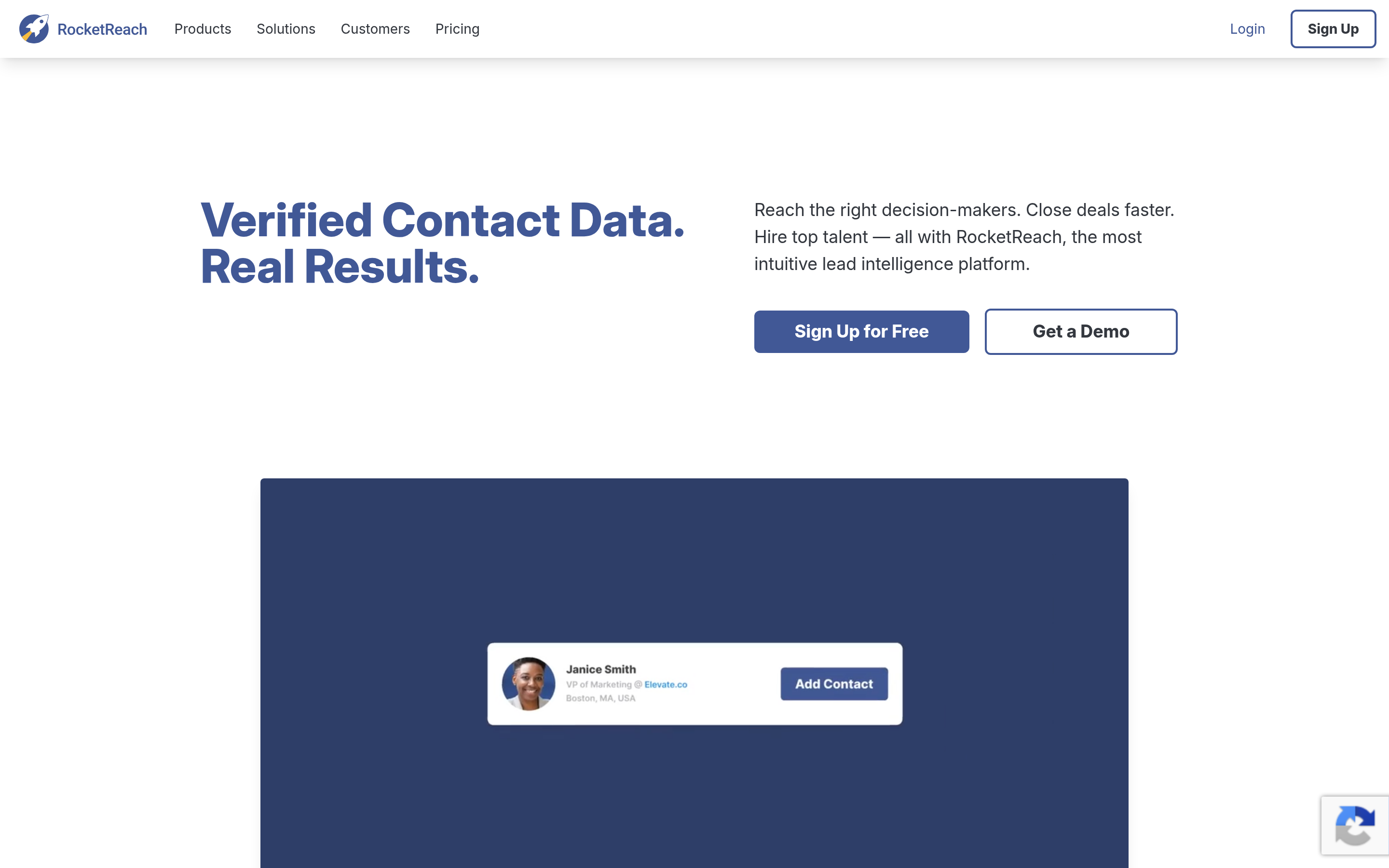
RocketReach earns its place on senior and hard-to-reach contacts, and it surfaces personal emails and phone numbers more often than pure B2B finders. It's priced above the mid-tier and the interface feels dated, but for executive-level prospecting it frequently returns a result when others don't.
BookYourData — buy the list instead of building it#
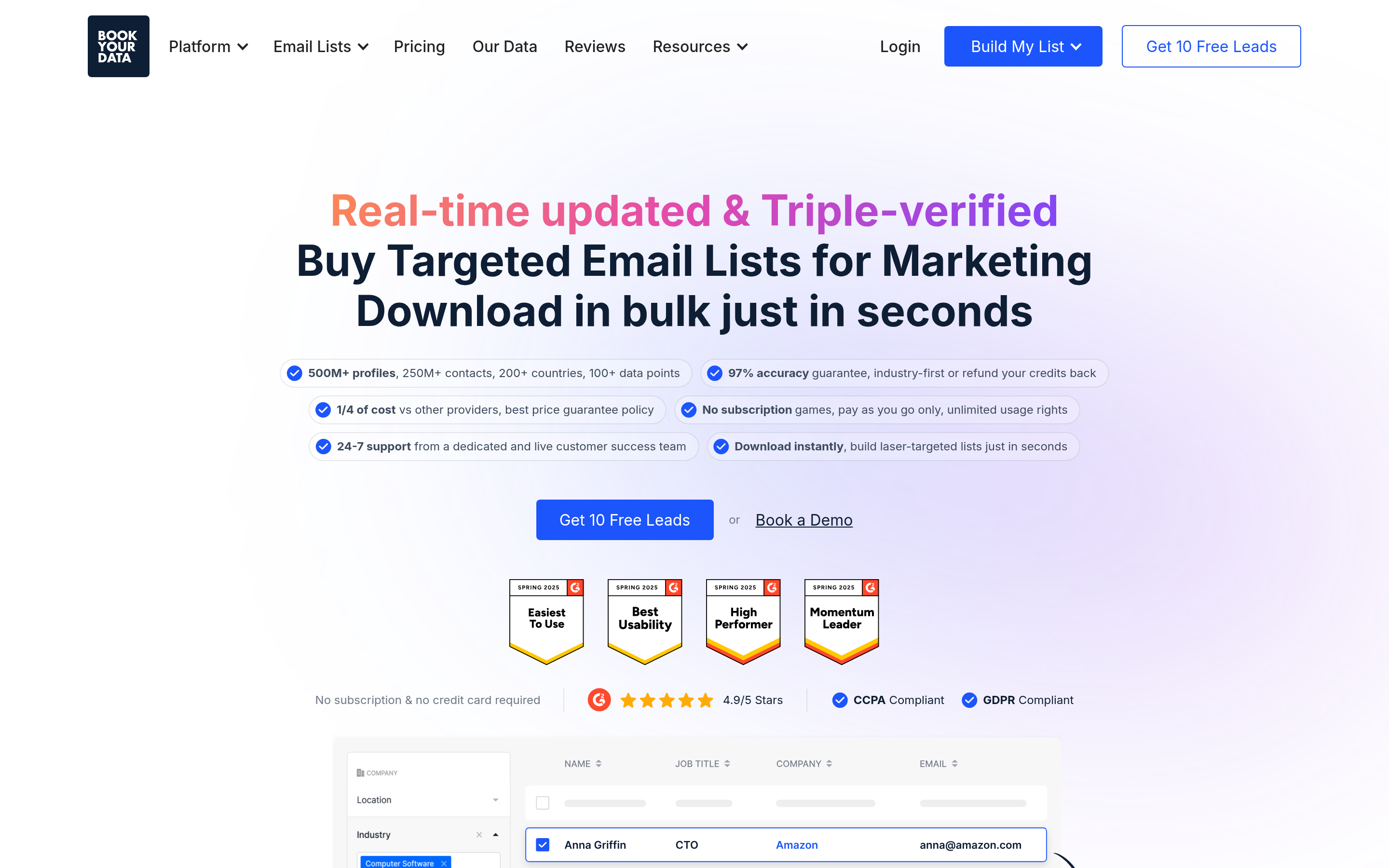
Worth calling out separately because it solves a different problem. Rather than looking up contacts one at a time, BookYourData lets you filter a verified B2B database by industry, title, geography, and company size, then buy exactly that slice on a pay-as-you-go basis with an accuracy guarantee attached. For a one-off market entry or an event campaign, that's often faster and cheaper than a subscription you'll cancel in two months. Details at bookyourdata.com.
ZeroBounce and Bouncer — verification specialists#
Neither finds emails. Both clean lists exceptionally well. ZeroBounce adds deliverability tooling (blacklist monitoring, inbox placement testing) that matters if you're running high volume. Bouncer is lighter, cheaper per credit, and positions strongly on GDPR compliance for EU senders. If your Delivrai complaint is purely "too many bounces" and your sourcing is fine, a dedicated verifier plus your existing finder may be the cheapest fix — though a ZeroBounce alternative that bundles finding and verifying removes a vendor from the stack.
How accurate are these tools really?#
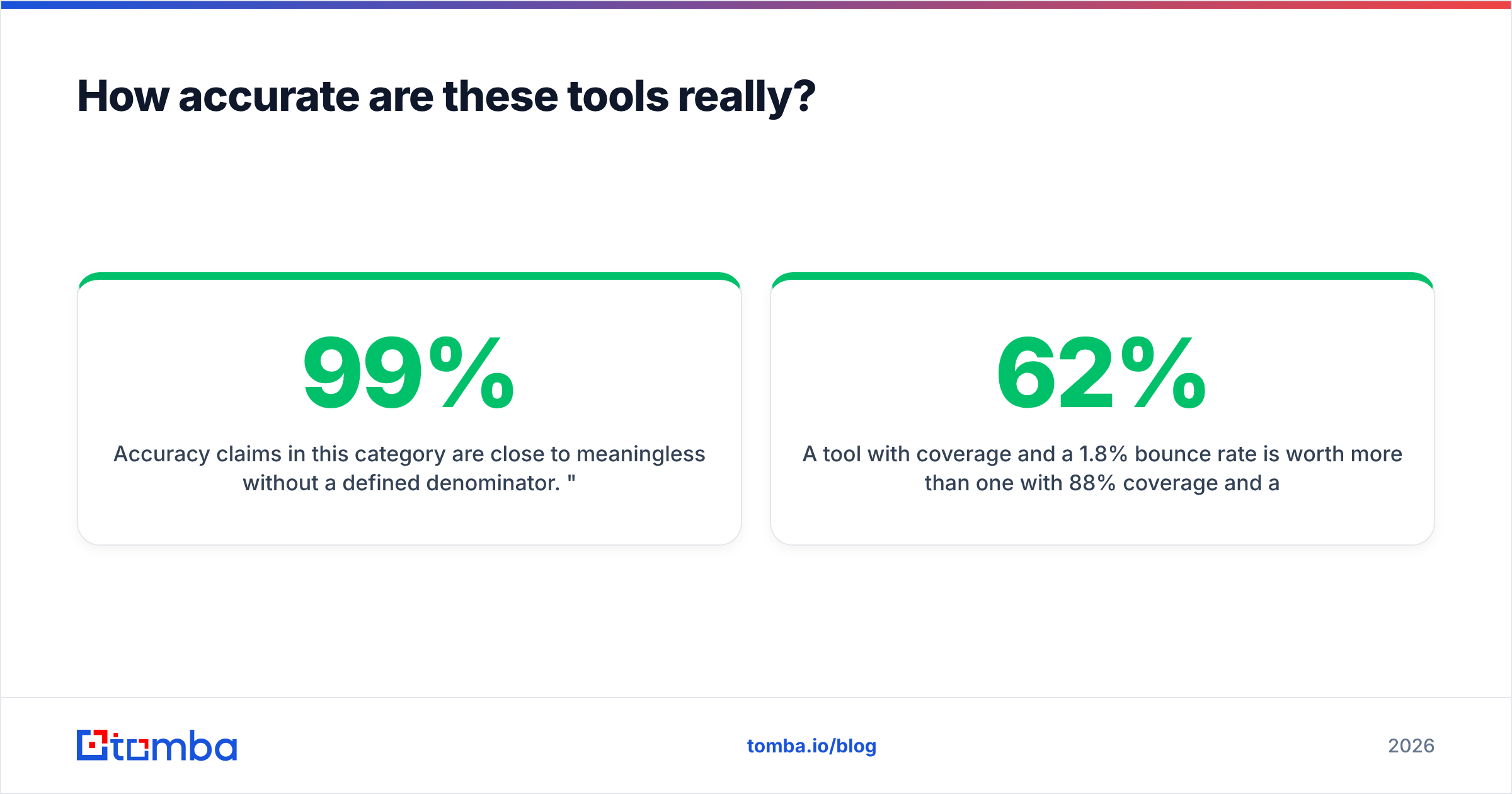
Accuracy claims in this category are close to meaningless without a defined denominator. "99% accurate" usually means: of the emails we chose to return, 99% passed our own check. It says nothing about the 40% of your list where nothing was returned at all.

Three numbers actually matter, and you should compute all three on your own control list:
- Coverage rate — what share of your target rows returned any address.
- Verified rate — what share returned an address marked valid, not "accept-all" or "unknown."
- Real bounce rate — measured after sending, at 48 hours, on your own infrastructure.
A tool with 62% coverage and a 1.8% bounce rate is worth more than one with 88% coverage and an 8% bounce rate, because the second one costs you domain reputation that takes weeks to rebuild. Independent user reviews on G2's lead intelligence category are useful for spotting patterns in complaints, but they're no substitute for your own 100-row test.
One more variable most comparisons skip: catch-all domains. When a mail server accepts every address, standard verification can't confirm anything. Tools handle this three ways — return "unknown" and charge you anyway, discard the row silently, or apply pattern-and-history confidence to give you a usable probability. The third approach is the only one that preserves leads at enterprise accounts, where catch-all configurations are most common.

What does switching actually cost at real volume?#
Model your true monthly spend, not the sticker price. Assume a two-rep team targeting 4,000 lookups per month with a 55% expected hit rate.
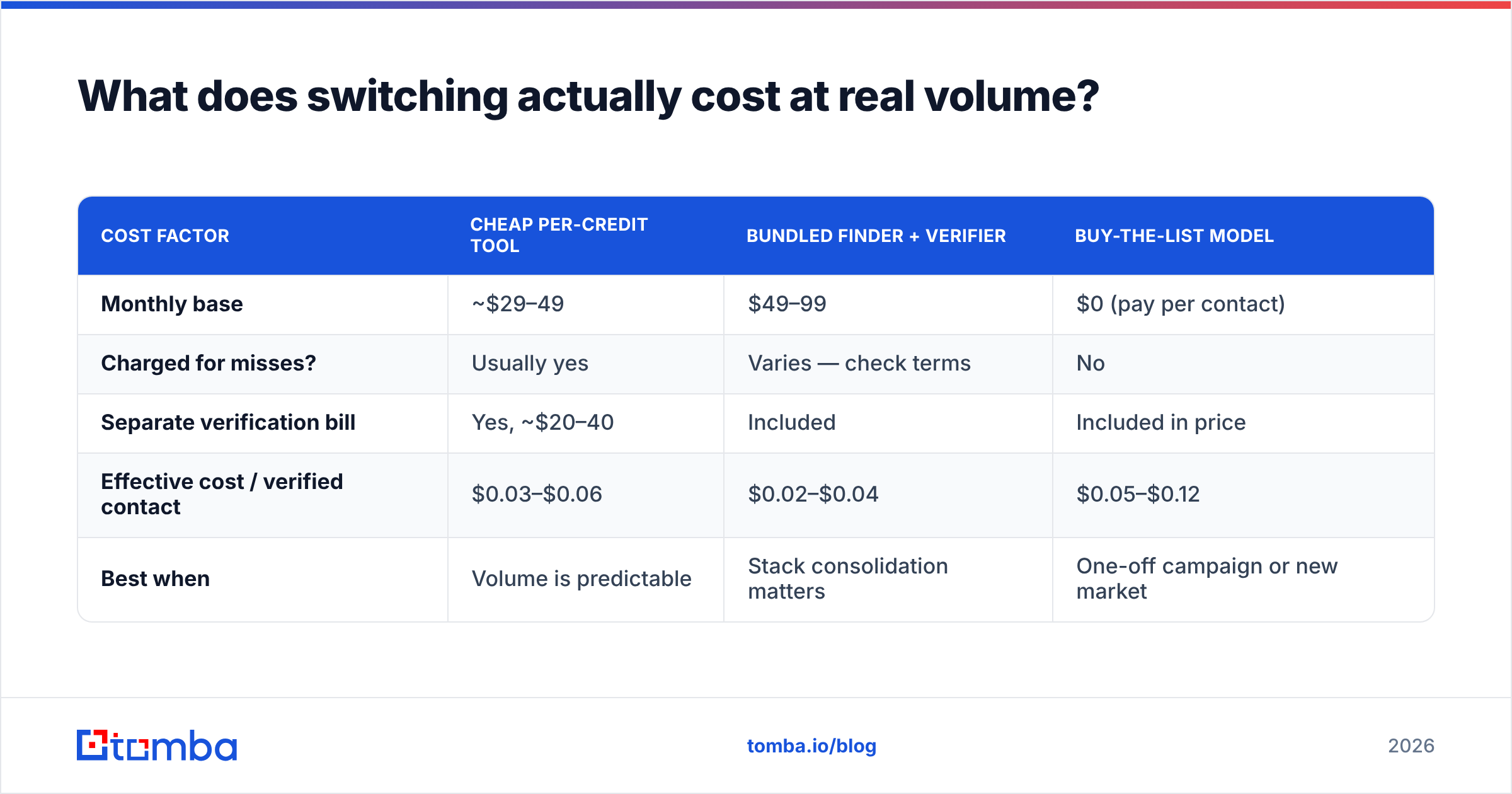
| Cost factor | Cheap per-credit tool | Bundled finder + verifier | Buy-the-list model |
|---|---|---|---|
| Monthly base | ~$29–49 | $49–99 | $0 (pay per contact) |
| Charged for misses? | Usually yes | Varies — check terms | No |
| Separate verification bill | Yes, ~$20–40 | Included | Included in price |
| Effective cost / verified contact | $0.03–$0.06 | $0.02–$0.04 | $0.05–$0.12 |
| Best when | Volume is predictable | Stack consolidation matters | One-off campaign or new market |
The pattern: bundled finder-plus-verifier plans usually win on effective cost per verified contact once you account for misses and separate verification bills, while pay-as-you-go list purchases win when you need a defined slice once and don't want a recurring plan at all. Per-credit tools look cheapest on the pricing page and rarely are.
If you're running lists in the tens of thousands, look at bulk email finder throughput and rate limits before anything else — a per-lookup price advantage evaporates if a 50,000-row job takes three days.
Which Delivrai alternative should you pick?#
Match the tool to the constraint that's actually hurting you:
- Bounces are wrecking your deliverability → add a dedicated verifier (ZeroBounce, Bouncer) or move to a stack where verification is built in.
- You're paying for lookups that return nothing → Findymail's found-only billing, or a plan with credit rollover.
- You need one vendor for finding, verifying, enriching, and API access → Tomba is the most complete swap at the $49–99 tier.
- You want a database plus sequencing in one seat → Apollo, accepting the data-quality variance.
- You need a specific verified list once, not a subscription → BookYourData.
- You're chasing VP-and-above contacts → RocketReach, priced accordingly.
Whatever you choose, migrate deliberately. Export your existing contact history, run both tools in parallel on the same 200-row list for two weeks, and compare verified-hit rate and bounce rate side by side. Switching data vendors on vibes is how teams end up back where they started six months later — just with a different logo on the invoice.
Ready to test a replacement?#
If Delivrai's ceiling is accuracy or API depth, start with the piece that touches every campaign: the lookup itself. The Tomba Email Finder gives you 25 free searches a month — enough to run the 100-row control test described above without a card — and Starter is $49/mo when you're ready to scale, with domain search, catch-all handling, verification, and full API access on the same plan. Run your own list against it, measure the bounce rate on real sends, and let the numbers decide.
Related guides#
Ready to find emails that actually work?
Join 150,000+ professionals who stopped guessing and started sending. Free credits on signup — no credit card required.
Get the Tomba newsletter
Practical outbound tactics and product updates — once every two weeks.
About the author