8 Best Delta Sales App Alternatives for Field Teams in 2026
Delta Sales App is solid for distributor field tracking, but it is not the right fit for every team. Here are 8 alternatives compared on GPS tracking, order capture, CRM depth, pricing, and the data quality that actually decides whether reps hit quota.
TL;DR
- Delta Sales App is built for distribution and FMCG field teams: GPS check-ins, beat plans, order capture, attendance. It is strong at supervision, thinner on pipeline and outbound.
- The best Delta Sales App alternatives split into three buckets: route-and-territory tools (Badger Maps, SPOTIO), retail-execution platforms (Repsly, Skynamo, Bizom, FieldAssist), and full CRMs with field modules (Zoho CRM, SalesRabbit).
- Pricing ranges from roughly $14/user/month for a general CRM to $95/user/month for enterprise route optimisation. Most retail-execution vendors quote instead of publishing.
- Switching apps rarely fixes a coverage problem. Bad contact data — wrong buyer, dead email, disconnected number — kills more field pipeline than a missing feature does.
- If you are adding net-new accounts rather than just servicing existing ones, pair whichever app you pick with a verified contact source.
What does Delta Sales App actually do?#
Delta Sales App is a field sales force automation product aimed at distributors, wholesalers, and FMCG brands — mostly in South Asia, the Middle East, and Africa. The core loop is supervision: a rep opens the app, checks in with GPS, follows a beat plan of assigned outlets, records an order or a visit note, and the manager sees a dashboard of who went where.
That specific loop is what it does well. You get attendance and location history, distributor and outlet mapping, order and collection entry, expense claims, and basic reporting. Pricing sits at the affordable end of the category, which is why it shows up in a lot of shortlists for teams of 10 to 200 field reps. You can see the current feature set on the official Delta Sales App site.
Where it starts to strain is anything that is not a repeat visit to a known outlet. There is no meaningful prospecting layer, no email or call sequencing, and no contact enrichment. If your reps spend half their week opening new accounts rather than servicing an existing route, the app is only covering half your motion.
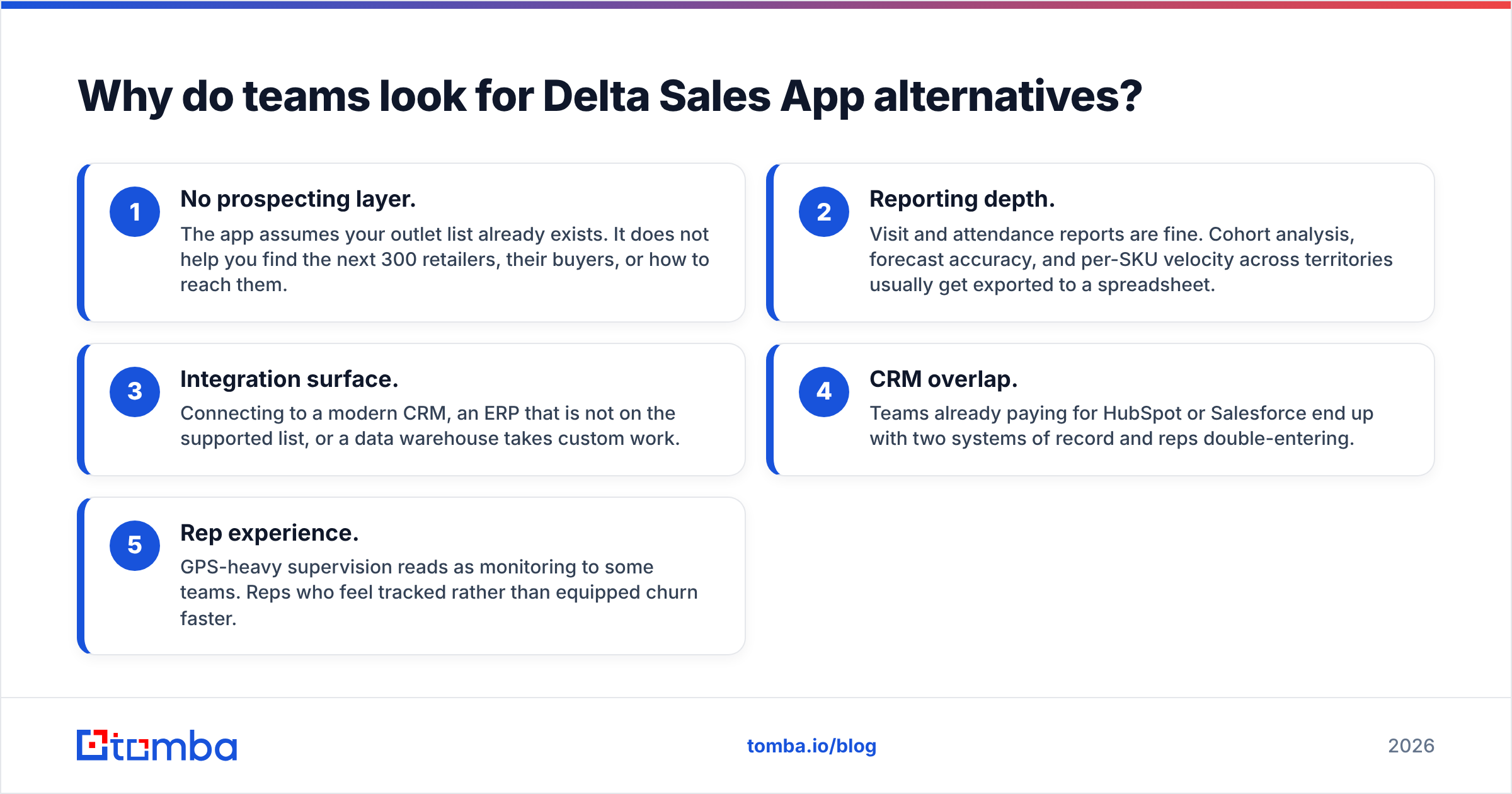
Why do teams look for Delta Sales App alternatives?#
The five complaints that show up most consistently in review threads on G2 and Capterra, and in the conversations we have with distribution sales leaders:
- No prospecting layer. The app assumes your outlet list already exists. It does not help you find the next 300 retailers, their buyers, or how to reach them.
- Reporting depth. Visit and attendance reports are fine. Cohort analysis, forecast accuracy, and per-SKU velocity across territories usually get exported to a spreadsheet.
- Integration surface. Connecting to a modern CRM, an ERP that is not on the supported list, or a data warehouse takes custom work.
- CRM overlap. Teams already paying for HubSpot or Salesforce end up with two systems of record and reps double-entering.
- Rep experience. GPS-heavy supervision reads as monitoring to some teams. Reps who feel tracked rather than equipped churn faster.
None of those are dealbreakers on their own. Together, they are why a distribution team at 40 reps often outgrows the tool at 120.
How should you compare field sales apps?#
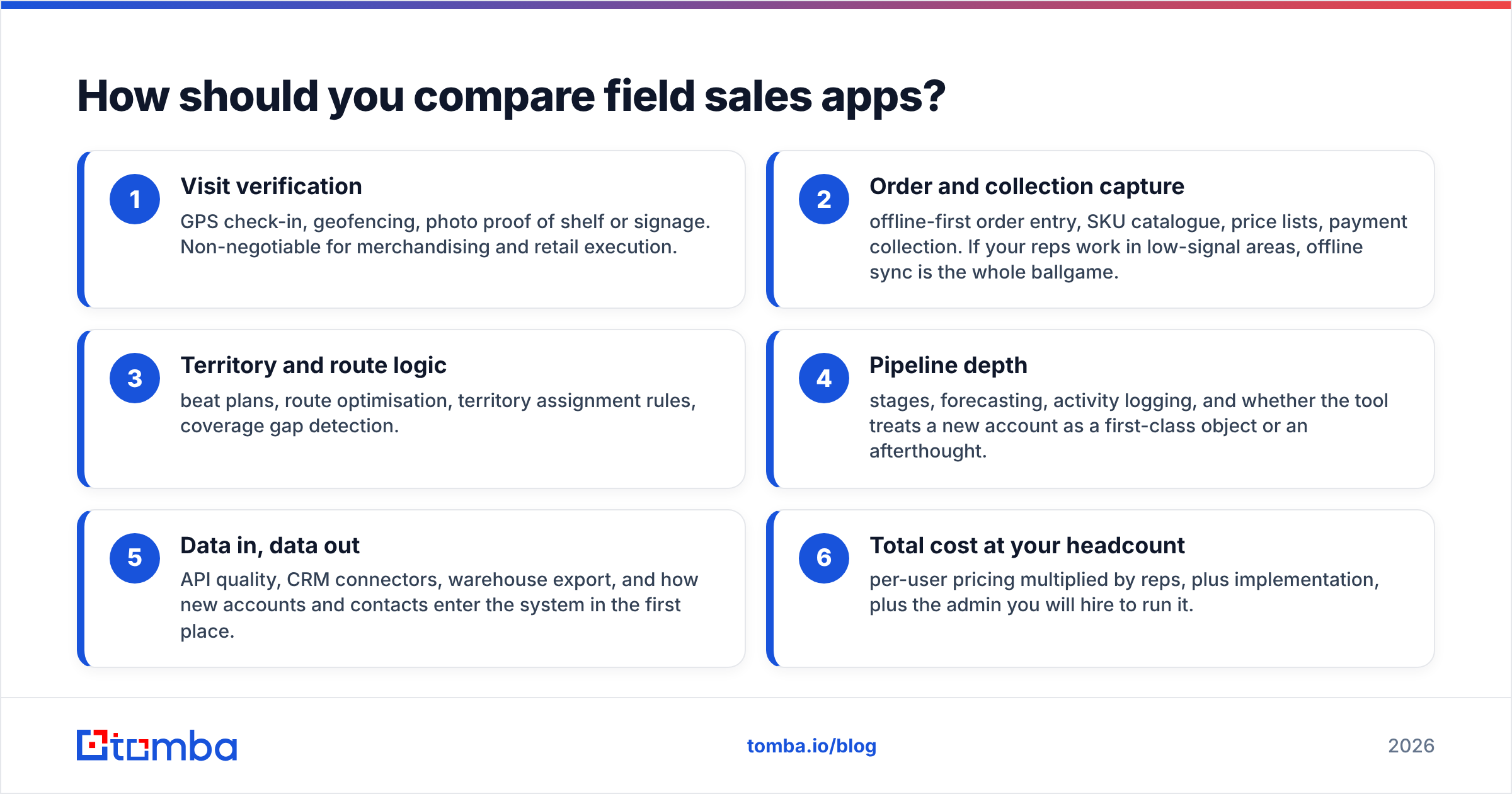
Score any shortlist on these six dimensions before you look at price. Most buyers reverse the order and regret it.
- Visit verification — GPS check-in, geofencing, photo proof of shelf or signage. Non-negotiable for merchandising and retail execution.
- Order and collection capture — offline-first order entry, SKU catalogue, price lists, payment collection. If your reps work in low-signal areas, offline sync is the whole ballgame.
- Territory and route logic — beat plans, route optimisation, territory assignment rules, coverage gap detection.
- Pipeline depth — stages, forecasting, activity logging, and whether the tool treats a new account as a first-class object or an afterthought.
- Data in, data out — API quality, CRM connectors, warehouse export, and how new accounts and contacts enter the system in the first place.
- Total cost at your headcount — per-user pricing multiplied by reps, plus implementation, plus the admin you will hire to run it.
The last one is where quote-based vendors get expensive quietly. A $45/user/month platform at 80 reps is $43,200 a year before onboarding fees.
Which Delta Sales App alternatives are worth testing in 2026?#
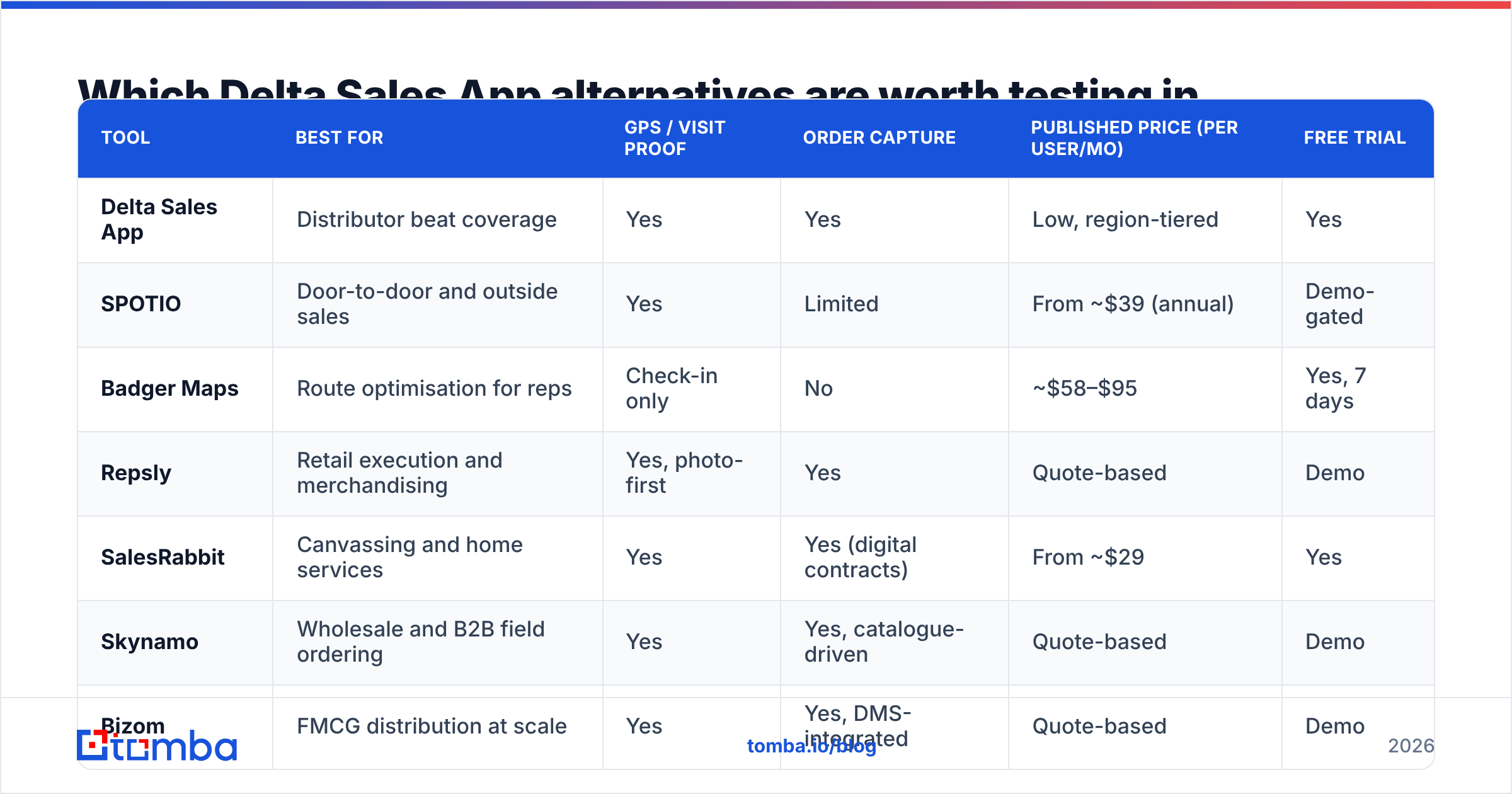
| Tool | Best for | GPS / visit proof | Order capture | Published price (per user/mo) | Free trial |
|---|---|---|---|---|---|
| Delta Sales App | Distributor beat coverage | Yes | Yes | Low, region-tiered | Yes |
| SPOTIO | Door-to-door and outside sales | Yes | Limited | From ~$39 (annual) | Demo-gated |
| Badger Maps | Route optimisation for reps | Check-in only | No | ~$58–$95 | Yes, 7 days |
| Repsly | Retail execution and merchandising | Yes, photo-first | Yes | Quote-based | Demo |
| SalesRabbit | Canvassing and home services | Yes | Yes (digital contracts) | From ~$29 | Yes |
| Skynamo | Wholesale and B2B field ordering | Yes | Yes, catalogue-driven | Quote-based | Demo |
| Bizom | FMCG distribution at scale | Yes | Yes, DMS-integrated | Quote-based | Demo |
| FieldAssist | CPG retail execution, India-heavy | Yes | Yes | Quote-based | Demo |
| Zoho CRM | Teams wanting one system of record | Check-in via mobile | Via Inventory add-on | ~$14–$52 | Yes, 15 days |
Prices are list prices at the time of writing and change often. Treat quote-based vendors as "expect $35–$60/user/month at mid-market volume" until they tell you otherwise.
SPOTIO — best for outside sales teams that also prospect#
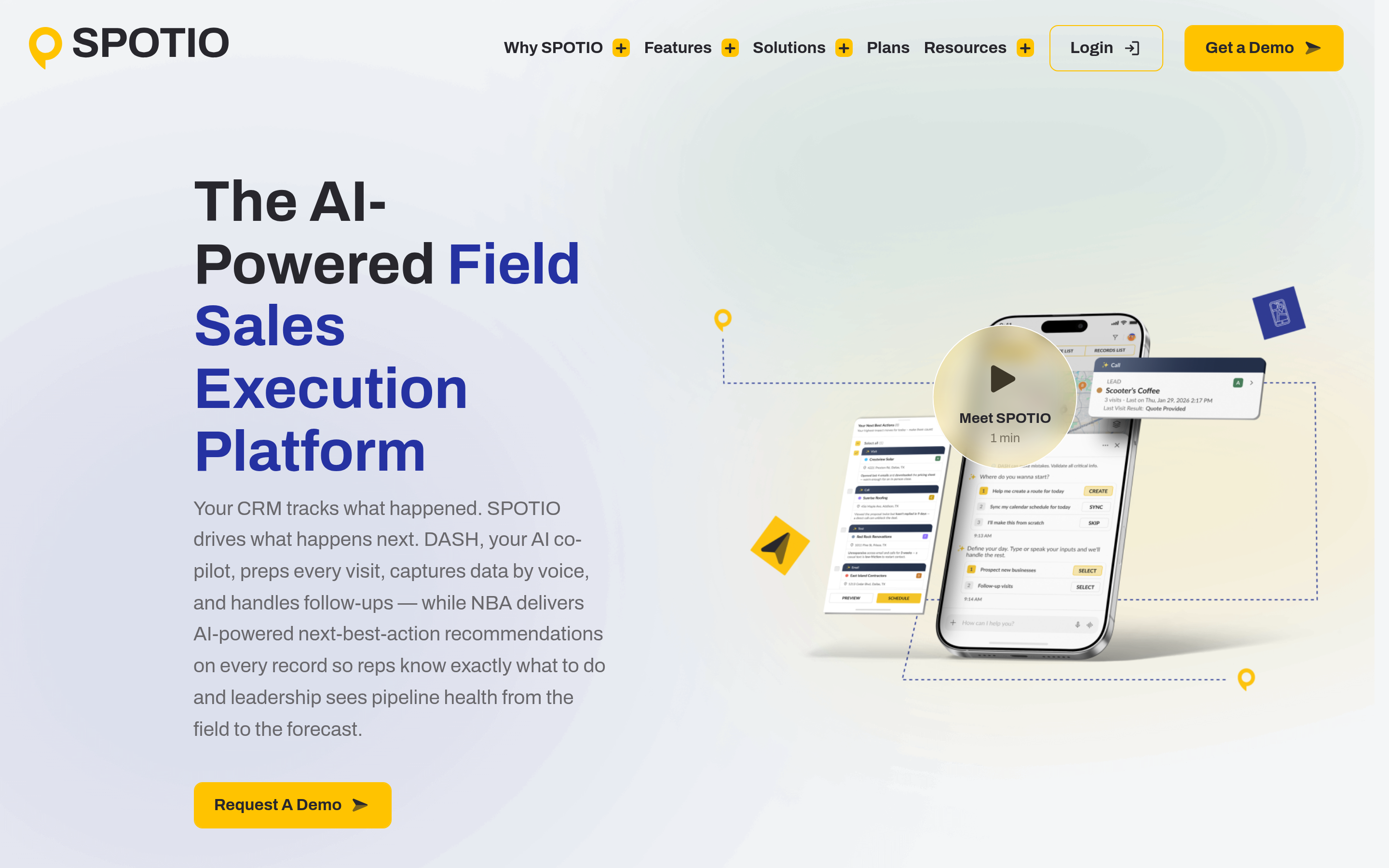
SPOTIO is the closest thing on this list to a true outside-sales CRM. You get territory mapping, lead capture in the field, multi-channel sequences, and activity tracking that managers actually use for coaching rather than surveillance. Where Delta Sales App optimises for "did the rep visit the outlet," SPOTIO optimises for "did the rep move the deal."
The trade-off is order capture. If your reps take stock orders with SKUs and price lists at every stop, SPOTIO will feel underpowered. If they are selling contracts, services, or new accounts, it is a clear upgrade.
Badger Maps — best for pure route efficiency#
Badger Maps does one thing extremely well: it turns a messy list of accounts into an optimised daily route and keeps the CRM updated from the road. Reps commonly report an extra one to two appointments a day from the same driving hours.
It is not a retail execution platform. No photo audits, no order entry, limited visit verification. Pair it with your existing CRM rather than treating it as a Delta Sales App replacement — unless routing was your only real pain.
Repsly — best for merchandising and photo audits#
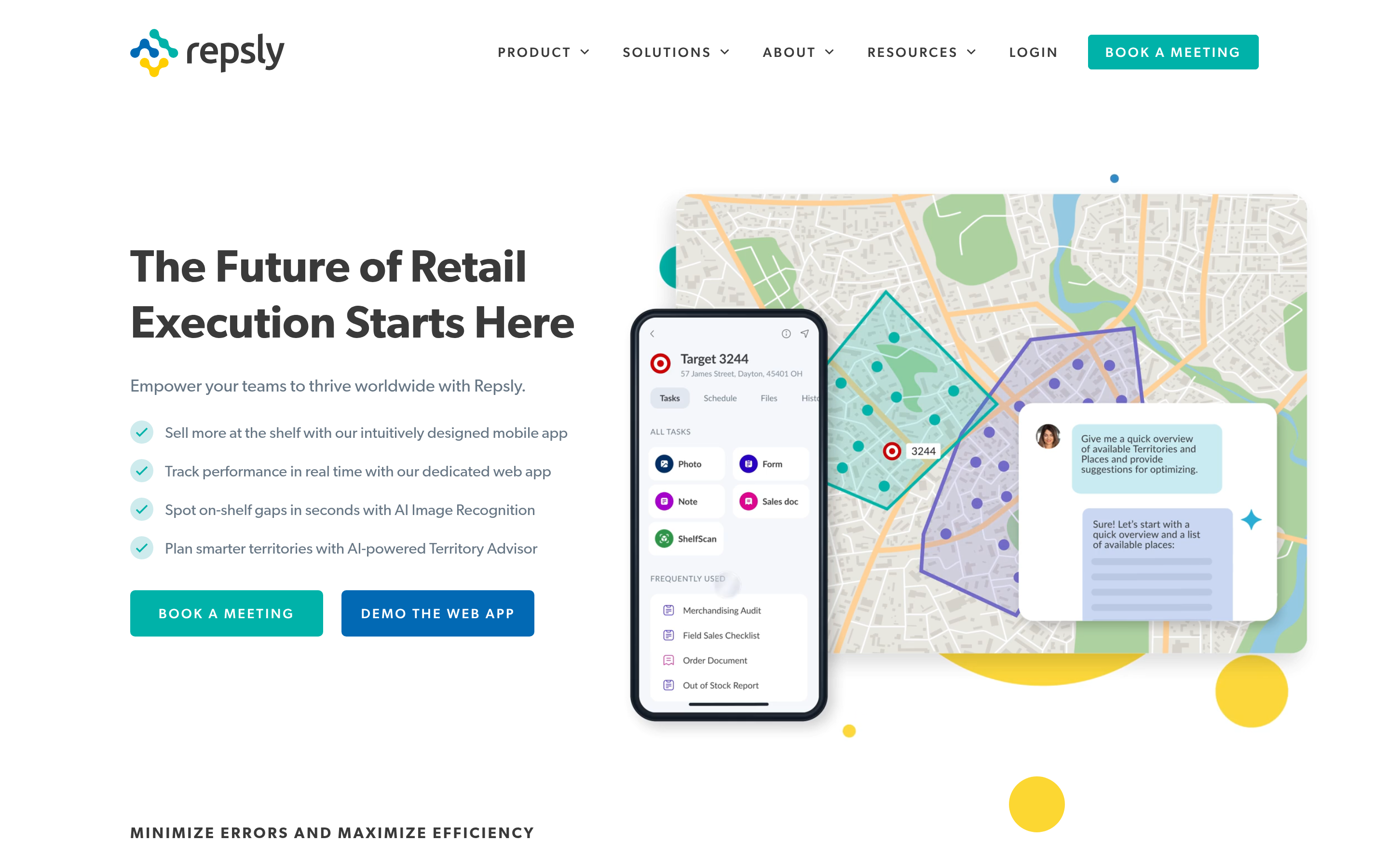
Repsly is built around retail execution: shelf photos, planogram compliance, promotion audits, and field team scheduling. If your field motion is "check the display, fix the facing, photograph it, report back," Repsly is stronger than Delta Sales App on every axis that matters.
Pricing is quote-based and lands above the budget end of the market. Budget for a real implementation, not a weekend rollout.
SalesRabbit — best for canvassing and home services#
SalesRabbit dominates door-to-door: solar, roofing, pest control, telecom. Territory drawing, lead disposition on a map, digital contracts, and a rep leaderboard that gamifies canvassing. If your "field sales" means residential doors rather than retail outlets, this is the category-correct pick and Delta Sales App is not really a competitor at all.
Skynamo — best for wholesale B2B ordering#
Skynamo is a field sales and order-taking platform for wholesalers and manufacturers with real catalogues. Offline ordering, customer-specific pricing, ERP sync, and visit history live in one place. It maps closely onto what Delta Sales App does, with deeper ERP integration and a more polished rep experience — at a higher price point.
Bizom and FieldAssist — best for FMCG distribution at scale#
These two are the enterprise end of the same market Delta Sales App plays in. Bizom leans hard into distributor management system integration and secondary sales analytics; FieldAssist is strong on retail execution analytics for CPG brands. Both assume a distributor network, hundreds of reps, and an analytics team that will use the output.
If you are a 30-rep operation, they are overkill. If you are a national brand tracking secondary sales across 50,000 outlets, Delta Sales App will not scale with you and these will.
Zoho CRM — best for consolidating onto one system#
If the real problem is that your field app and your CRM disagree about reality, collapsing them is worth considering. Zoho CRM's mobile app supports check-ins, route planning, and offline access, and Zoho Inventory covers order capture. You lose some field-specific polish and gain a single pipeline, single forecast, and a much larger integration ecosystem. Similar logic applies if you already run HubSpot and can extend it with a field module.
What actually breaks field sales pipeline?#
Here is the uncomfortable part: for most teams evaluating Delta Sales App alternatives, the app is not the bottleneck. Coverage is.
A field rep with a perfect route to the wrong 40 outlets underperforms a rep with a mediocre route to the right 40. And "right" means: the account exists, it fits your ICP, and you can reach a decision-maker without waiting for a gatekeeper to pass along a business card.
That is a data problem, not a tracking problem. Three failure modes we see repeatedly:
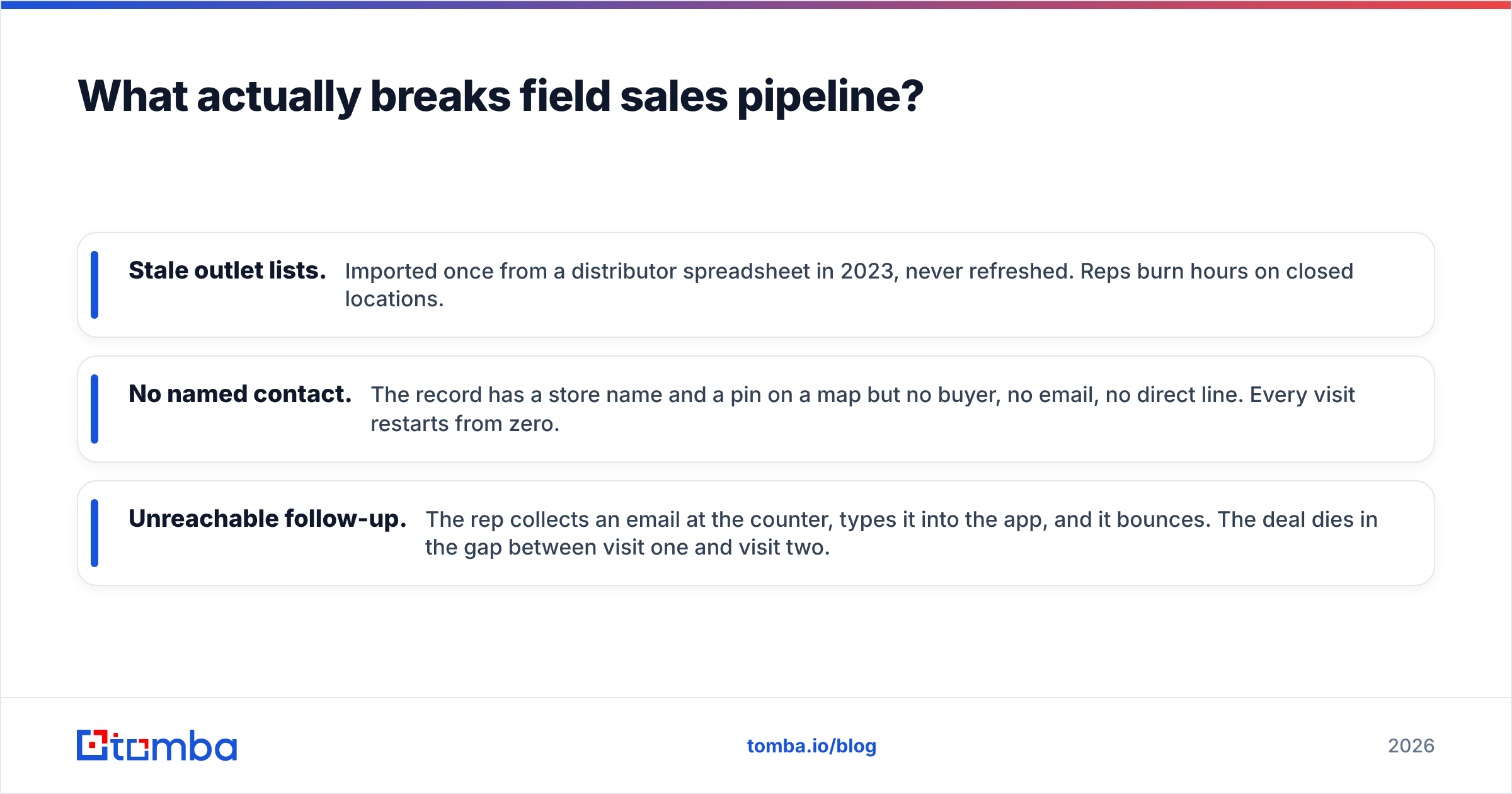
- Stale outlet lists. Imported once from a distributor spreadsheet in 2023, never refreshed. Reps burn hours on closed locations.
- No named contact. The record has a store name and a pin on a map but no buyer, no email, no direct line. Every visit restarts from zero.
- Unreachable follow-up. The rep collects an email at the counter, types it into the app, and it bounces. The deal dies in the gap between visit one and visit two.
Fixing that is straightforward and cheap relative to a platform migration. Build the account list from a real source, attach a verified contact to every record before a rep drives anywhere, and re-verify quarterly.
There are a few honest ways to do it. Purchased B2B lists from a reputable provider — BookYourData is a solid option if you want pay-as-you-go verified records with a bounce guarantee — work well for building a territory from scratch. For enriching accounts you already have, an API-driven approach usually costs less and stays fresher: run your outlet or company list through a domain search to pull the contacts and email patterns for each company, then push them into your field app with the Tomba API or a scheduled bulk email finder job.
Then verify before you send. Running collected addresses through an email verifier before the follow-up sequence protects your sender reputation and stops the "rep swears they emailed them" arguments. For distributor and wholesale accounts that publish a generic inbox and nothing else, a catch-all verifier tells you whether that address is worth a send at all.
Which alternative should you pick?#
Match the tool to your motion, not to the feature list:
- You service a fixed retail route and need order capture — Skynamo or Bizom if budget allows; stay on Delta Sales App if it is working and cost matters more than depth.
- You audit shelves and run promotions — Repsly.
- You knock doors — SalesRabbit.
- You open new B2B accounts in the field — SPOTIO, plus a verified contact source feeding it.
- Your reps waste hours driving — Badger Maps alongside your existing CRM.
- You are running two systems of record — consolidate into Zoho CRM or HubSpot and add a field layer.
Run a two-week pilot with five reps before you sign anything annual. Measure visits per day, orders per visit, and — the metric everyone skips — percentage of accounts with a reachable named contact. That last number predicts next quarter's revenue better than any dashboard the app ships with.
Ready to fix the data behind your field app?#
Whichever platform you land on, it will only be as good as the accounts and contacts you load into it. Start with Tomba Email Finder — find verified professional email addresses for the buyers at every outlet, distributor, and prospect on your territory list, then push them straight into your field app. The free tier gives you 25 searches a month to test the accuracy on your own accounts, and paid plans start at $49/month; full Tomba pricing is public, no demo call required.
Give your reps a list worth driving to.
Related guides#
Ready to find emails that actually work?
Join 150,000+ professionals who stopped guessing and started sending. Free credits on signup — no credit card required.
Get the Tomba newsletter
Practical outbound tactics and product updates — once every two weeks.
About the author