Demandbase vs ZoomInfo (2026): Which ABM Platform Wins?
Demandbase sells intent-driven ABM orchestration. ZoomInfo sells the deepest B2B contact database. Here is how they actually differ on data, pricing, contracts, and who each one is genuinely built for.
Demandbase vs ZoomInfo comes down to one question. Do you need help picking the right accounts, or help reaching the right people? Demandbase answers the first. ZoomInfo answers the second. Here is the honest breakdown on data, price, and fit.
TL;DR
- Demandbase is an ABM orchestration platform. Its value is account intelligence, intent scoring, advertising, and website personalization. The data is a means to an end, not the product.
- ZoomInfo is a contact and company database first. Its value is coverage: hundreds of millions of contacts, direct dials, org charts, and tech stack data you can push into a CRM tomorrow.
- Neither is cheap. Real annual contracts land between $30,000 and $100,000+ depending on seats, credits, and modules. Both lock you into a year. Both auto-renew, and that clause catches teams off guard.
- They overlap less than the sales decks suggest. Many enterprises buy both. ZoomInfo supplies the contact records. Demandbase handles account targeting.
- If you only need accurate emails, you're overbuying. A dedicated email finder does the same job for a fraction of the price.
What Are Demandbase and ZoomInfo, Really?#
Think of it like buying a kitchen. ZoomInfo sells you the pantry — a huge, well-organized stock of ingredients. Demandbase sells you the recipe system and the sous-chef. It picks which meals to cook, when, and for whom, then runs the stations.
Demandbase started as an account identification and B2B advertising company. It grew into a full account-based go-to-market platform. The pitch: find which accounts are in-market right now, then aim ads, sales plays, and web pages at them. It reads intent data, engagement signals, and anonymous site traffic to do that.
ZoomInfo started as a data company and stayed one. The pitch: the most complete B2B contact and company database you can buy. On top sits a growing layer of sales engagement, call analysis, and workflow tools (Copilot, SalesOS, MarketingOS).
That difference in DNA explains almost every practical gap between them.
Demandbase vs ZoomInfo: How Do They Compare Head to Head?#
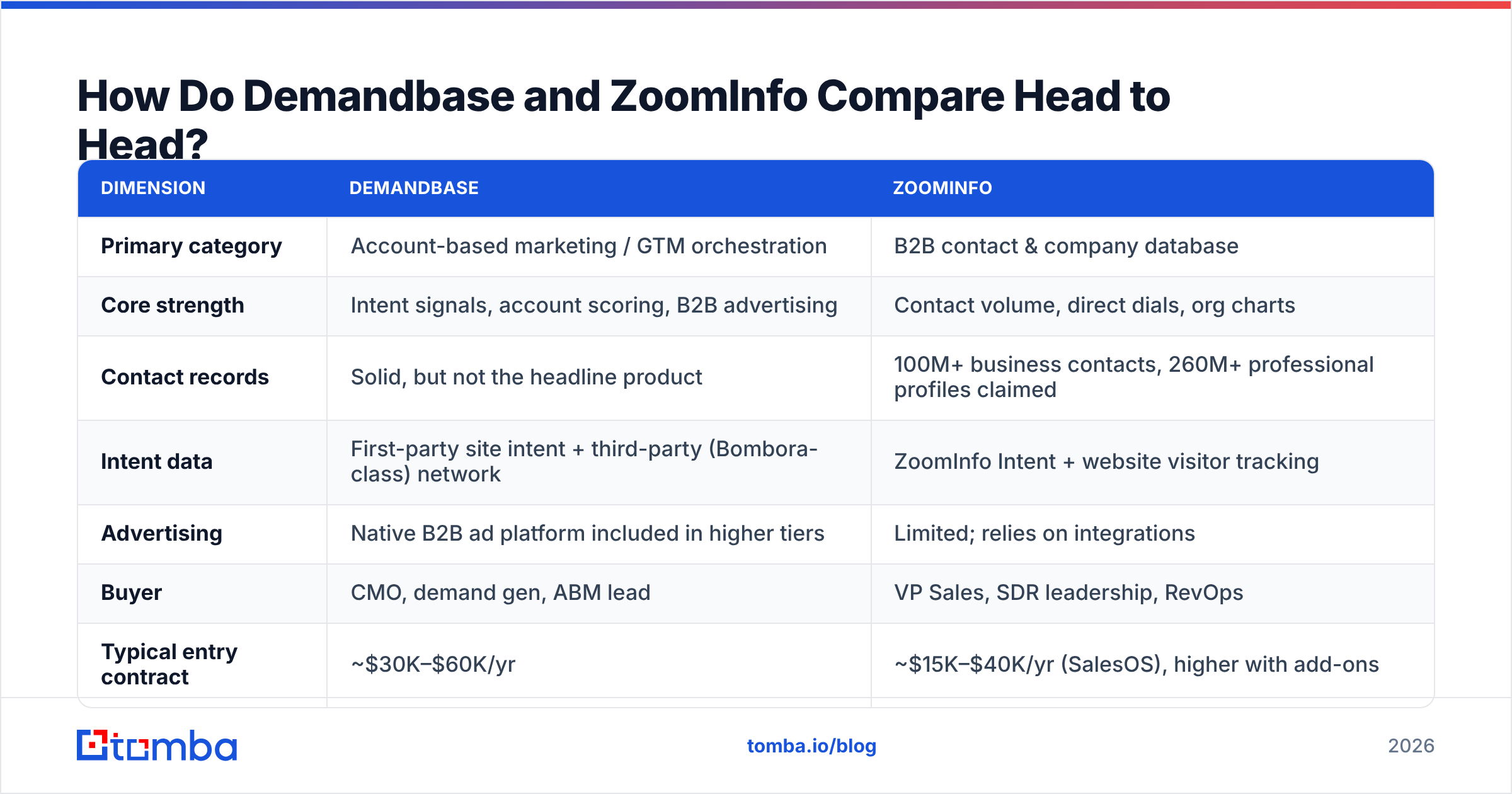
| Dimension | Demandbase | ZoomInfo |
|---|---|---|
| Primary category | Account-based marketing / GTM orchestration | B2B contact & company database |
| Core strength | Intent signals, account scoring, B2B advertising | Contact volume, direct dials, org charts |
| Contact records | Solid, but not the headline product | 100M+ business contacts, 260M+ professional profiles claimed |
| Intent data | First-party site intent + third-party (Bombora-class) network | ZoomInfo Intent + website visitor tracking |
| Advertising | Native B2B ad platform included in higher tiers | Limited; relies on integrations |
| Buyer | CMO, demand gen, ABM lead | VP Sales, SDR leadership, RevOps |
| Typical entry contract | ~$30K–$60K/yr | ~$15K–$40K/yr (SalesOS), higher with add-ons |
| Pricing transparency | Quote only, no public tiers | Quote only, no public tiers |
| Contract length | Annual, multi-year common | Annual, auto-renew standard |
| Free tier | No | Limited free trial / Community Edition (restricted) |
The table makes the fork obvious. If your problem starts with "we don't know which accounts to prioritize," Demandbase is the better shape. If it starts with "our reps can't reach the right people," ZoomInfo is.
Which Platform Has Better Data Quality?#
Honest answers get uncomfortable here. Both vendors publish accuracy numbers nobody can audit.
ZoomInfo wins on breadth. Users who install its Community Edition extension share contact data back. Add large-scale web scraping and phone checks, and you get depth few rivals match. US direct dials and mid-market companies are the strongest spots. User reviews on G2 rank it top of category for coverage.
Demandbase wins on account-level signal. The question it answers is not "is this email live." It is "is this account showing buying behavior across 20 topics this week." Its account matching — tying anonymous web traffic to a company — is genuinely strong. It also handles parent and child company links inside large enterprises better than most rivals.
Both thin out in the same places. Non-US contacts. Small businesses under 50 staff. High-churn industries. Personal email domains. If your ICP is European SMBs, expect gaps from either one, and budget for extra sources.
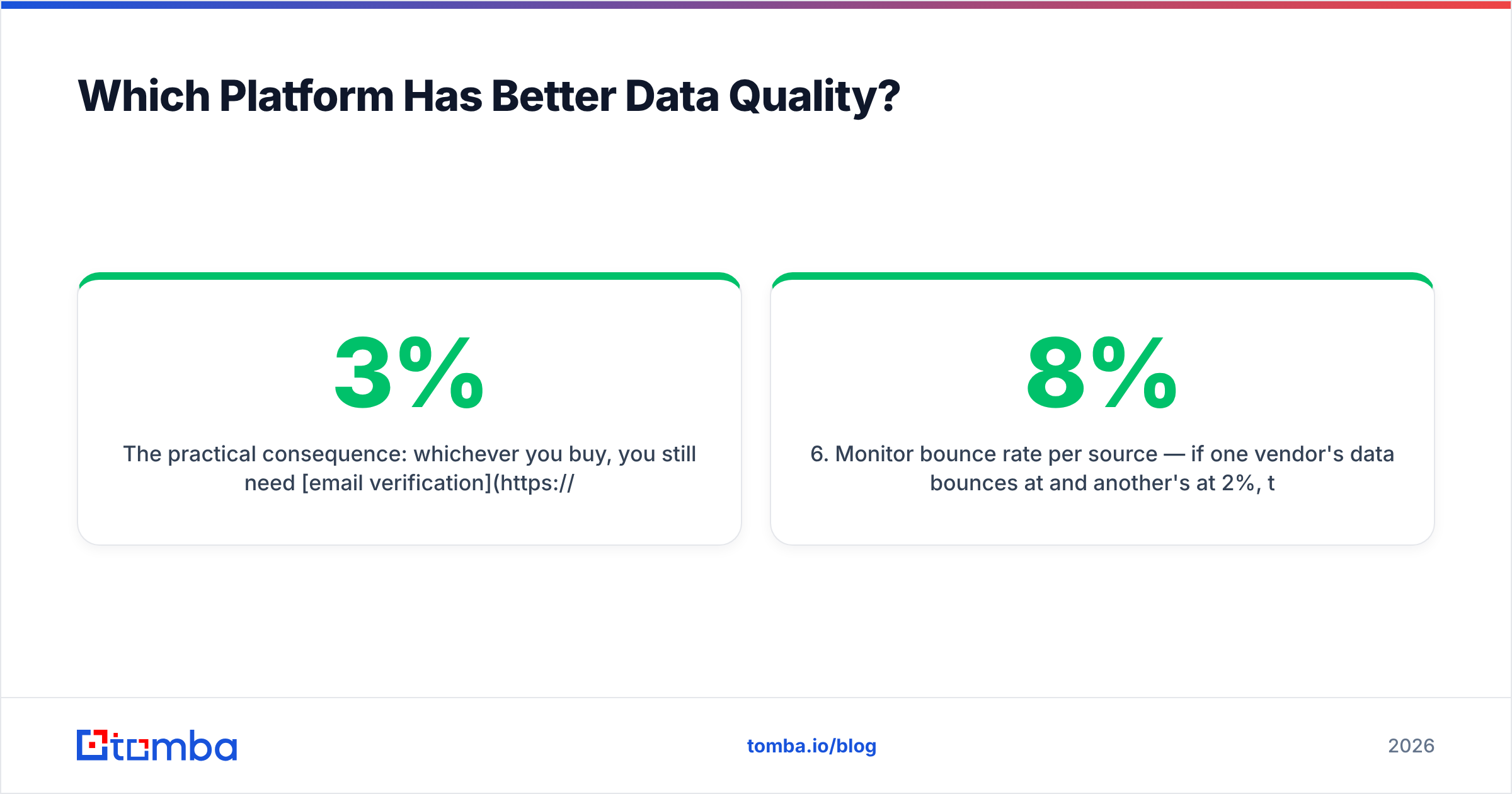
So whichever you buy, you still need email verification before you send. Records age at roughly 2–3% a month as people change jobs. A record that was accurate at export can be dead six weeks later. Neither platform re-checks your exported list for you.
Here's the workflow most disciplined teams end up running:
- Source accounts from your ABM or intent platform (Demandbase's strength).
- Pull contacts from your database of record (ZoomInfo's strength).
- Verify before send. Kill catch-alls, role accounts, and hard bounces at the door.
- Fill gaps with a targeted domain search when the database returns nothing for an account you care about.
- Enrich the CRM on a schedule, not once at import, so records don't quietly rot.
- Monitor bounce rate per source. If one vendor bounces at 8% and another at 2%, that's your renewal argument.
What Do Demandbase and ZoomInfo Actually Cost?#
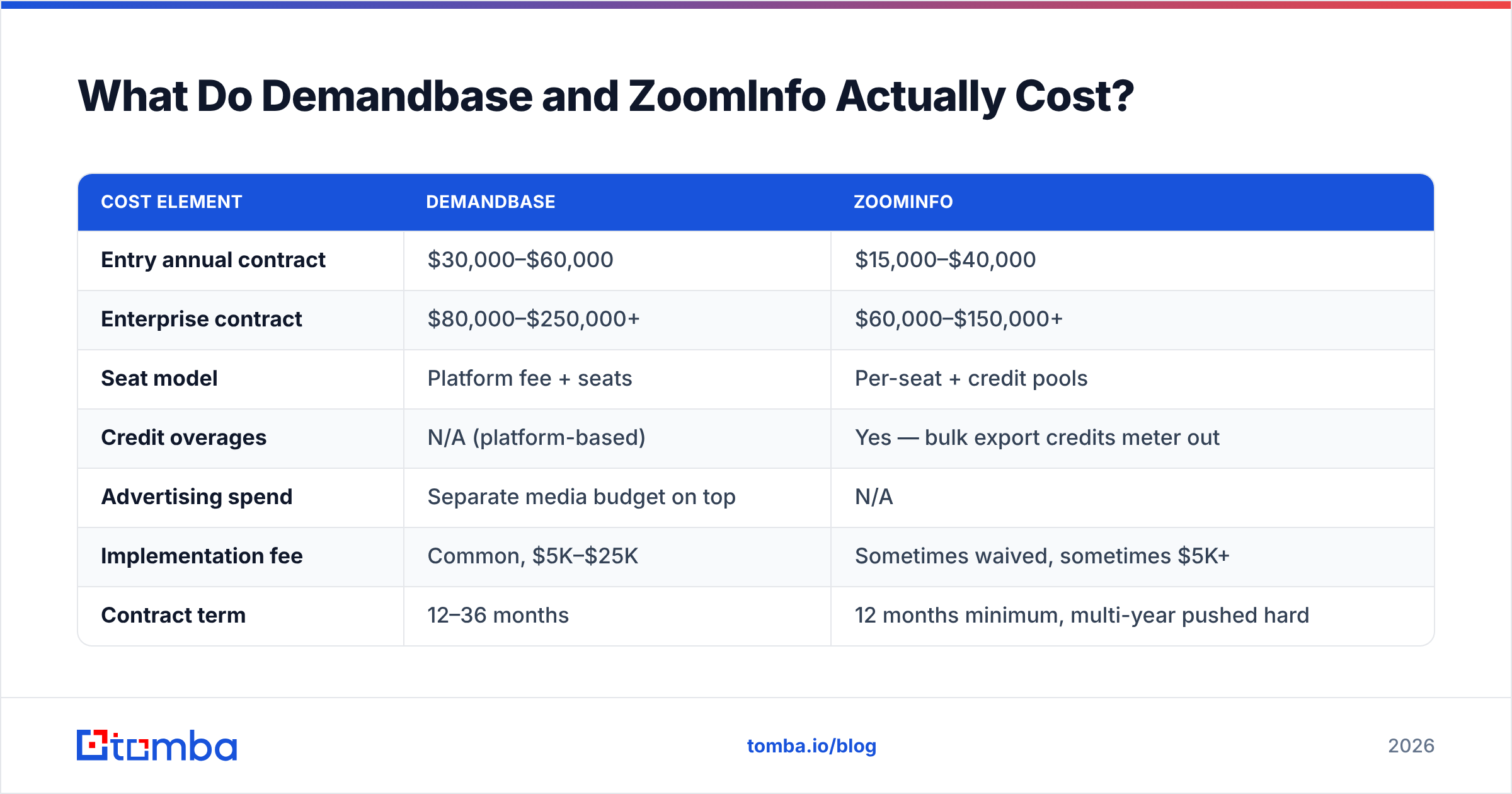
Neither publishes pricing. Both want a demo before a quote. Based on reported contract data and buyer reports on Capterra and peer communities, here is the realistic range:
| Cost element | Demandbase | ZoomInfo |
|---|---|---|
| Entry annual contract | $30,000–$60,000 | $15,000–$40,000 |
| Enterprise contract | $80,000–$250,000+ | $60,000–$150,000+ |
| Seat model | Platform fee + seats | Per-seat + credit pools |
| Credit overages | N/A (platform-based) | Yes — bulk export credits meter out |
| Advertising spend | Separate media budget on top | N/A |
| Implementation fee | Common, $5K–$25K | Sometimes waived, sometimes $5K+ |
| Contract term | 12–36 months | 12 months minimum, multi-year pushed hard |
| Auto-renewal | Yes — notice window applies | Yes — 30–60 day notice window is standard |
Two line items cause most of the buyer regret. The first is credit exhaustion. ZoomInfo seats come with export credit allowances. Teams doing big list builds burn through them by month seven. Then they negotiate mid-cycle from a weak position. The second is the auto-renewal notice window. Both contracts renew on their own unless you give written notice, usually 30–60 days before the term ends. Calendar it the day you sign.

Is Demandbase Better Than ZoomInfo for ABM?#
Yes — if you mean ABM in the full sense. That means coordinated ads, website personalization, account scoring, and one shared account list for sales and marketing.
Demandbase's orchestration layer does a lot here. You define an account list. You watch intent rise across it. Ads then run to buying-committee members at those accounts. The website changes when they visit. When engagement crosses a threshold, the account owner gets a task. ZoomInfo can feed parts of that, but it does not run the ad platform or the site personalization.
Where Demandbase struggles: time to value. Expect 60–90 days before the intent model gives you signal you trust. Expect to need a dedicated ABM owner too. Teams that bought it without someone to run it report shelfware, every time. It also assumes clean CRM data. Garbage accounts in, meaningless intent scores out.
Where ZoomInfo struggles for ABM: it is excellent at the who and weaker at the when. ZoomInfo Intent exists and has improved. It is still not the orchestration spine Demandbase is.
Is ZoomInfo Better Than Demandbase for Outbound Prospecting?#
Yes, clearly. If your motion is SDRs running high-volume sequences, ZoomInfo is the stronger buy.
Direct dials are the differentiator most teams underrate. Say your team does cold calling alongside email. ZoomInfo's mobile number coverage in North America beats most rivals, Demandbase included. Its Chrome extension works right inside the CRM, so reps actually use it. Adoption runs much higher than with tools that force reps to switch tabs.
The counterweight is cost per usable contact. Divide a $40,000 contract by the contacts your team really emails in a year. The per-record cost is often shocking. That is doubly true for teams that need only 2,000–5,000 verified contacts a quarter. That math is why the ZoomInfo alternative category exists, and why small point tools keep winning mid-market deals.
Who Should Buy Which — and Who Should Buy Neither?#
Buy Demandbase if:
- You run a genuine account-based motion with 100–2,000 target accounts
- Marketing owns pipeline targets and needs advertising plus orchestration in one system
- You have an ABM program owner with budget authority and 3+ months of runway
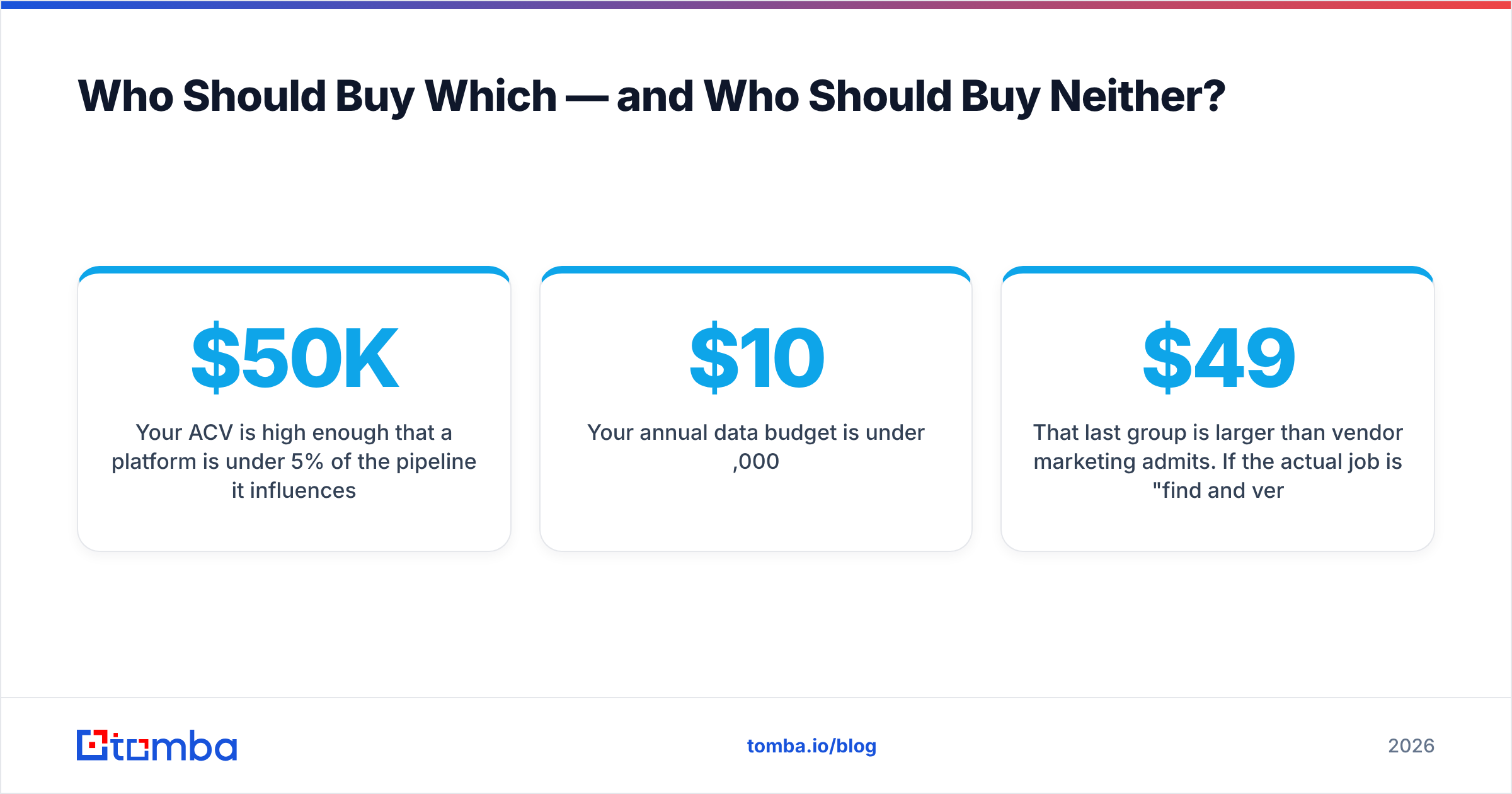
- Your ACV is high enough that a $50K platform is under 5% of the pipeline it influences
Buy ZoomInfo if:
- You have 5+ SDRs doing outbound at volume
- Direct dials materially change your connect rate
- Your ICP is North American mid-market or enterprise
- RevOps needs a single enrichment source of truth wired into Salesforce or HubSpot
Buy neither if:
- Your team is under 10 people
- You need emails, not orchestration
- Your annual data budget is under $10,000
- Your ICP is heavily international or SMB, where both platforms thin out
That last group is bigger than vendor marketing admits. If the real job is "find and verify work emails at a set list of companies," a focused tool does it at a tenth of the price. Tomba's pricing starts free at 25 searches a month. Paid plans run $49, $99, and $249 a month. A full year of the top plan costs roughly 5% of a floor-level ZoomInfo contract.
Other tools worth a look in the same bracket: Cognism (strong EU coverage and GDPR posture), Apollo (bundled sequencing), and Clay (waterfall enrichment across providers). BookYourData deserves a separate mention. It sells pay-as-you-go verified B2B lists with no annual lock-in, which is a very different commercial model from both platforms here.
How Do You Run a Fair Evaluation?#
Most Demandbase vs ZoomInfo decisions get made on a demo. Don't make yours that way. Demos are tuned to accounts the vendor already knows cold. Run this instead:
- Build a 100-account blind test list from your real ICP. Include hard cases: firms under 100 staff, non-US HQs, recently renamed businesses.
- Ask each vendor to run it during the trial and return contacts for 3 named roles per account.
- Verify the output yourself with an independent checker. Measure fill rate and bounce rate separately. A vendor can win one and lose the other badly.
- Price per usable contact. Divide the annual quote by verified, non-bouncing contacts returned. This one number ends most vendor debates.
- Test the integration path. Pull 50 records through the API into your CRM. If the mapping hurts in a trial, it will hurt more at scale.
- Read the renewal terms before the pricing. Notice window, uplift cap, credit rollover, and seat reduction rights matter more at month 14 than the discount you won at month 0.
Teams that run this process tend to find the same thing. The platform choice matters less than the verification layer behind it. Bounce rate comes from how fresh your data is at send time, not from whose logo is on the invoice.
What Does a Sensible Stack Look Like in 2026?#
The mature pattern is unbundled. Enterprises with real budget run Demandbase for account selection and orchestration. They use ZoomInfo or Cognism as the contact record source. Underneath both sits a dedicated verification and gap-fill layer.
Mid-market teams skip the ABM platform for the first two years. They set target accounts in a spreadsheet or CRM. They build contact lists with a database or a bulk email finder. They verify everything before send. Then they put the six-figure difference into headcount. That is not a compromise. For most companies under $20M ARR, it is the right order.
You have outgrown the lean stack when three things start to happen. Your ABM list passes a few hundred accounts. Marketing needs to run coordinated ads at whole buying committees. Intent-based priority would clearly change what reps do each morning. Until then, an enterprise ABM contract buys power you cannot yet use.
The Bottom Line#
Demandbase vs ZoomInfo is not really a head-to-head fight. They are neighbors that overlap at the edges. Demandbase wins account intelligence and orchestration. ZoomInfo wins contact coverage and rep adoption. Both cost real money on annual terms, with renewal clauses that reward attention.
Before you sign either, be honest about the job. If the job is "find and verify accurate business emails at companies we already know," you don't need a six-figure platform. You need a precise tool that does exactly that.
Start with the Tomba Email Finder. Find work email addresses by domain, name, or company. Verify them before they hit your sequence. Then see what your real cost per usable contact looks like. The free tier gives you 25 searches a month, with no card and no annual commitment. That is enough to benchmark against whatever quote is sitting in your inbox.
Related guides#
Ready to find emails that actually work?
Join 150,000+ professionals who stopped guessing and started sending. Free credits on signup — no credit card required.
Get the Tomba newsletter
Practical outbound tactics and product updates — once every two weeks.
About the author