Deskera Alternatives in 2026: 7 Better Business Platforms
Deskera bundles ERP, accounting, CRM, and HR into one suite, but it isn't the right fit for everyone. Here are 7 Deskera alternatives ranked by price, depth, and who they actually suit best in 2026.
Deskera sells one promise: run accounting, inventory, CRM, HR, and payroll from a single login. That bundle is genuinely useful for a small business that wants to retire five separate tools. But "all-in-one" is also where the trouble starts — you inherit modules you don't need, a CRM that trails dedicated sales tools, and pricing that scales in ways that surprise people at renewal.
If you're shopping for Deskera alternatives, you're probably feeling one of three pains: the accounting isn't deep enough for your accountant, the CRM isn't strong enough for your sales team, or the all-in-one lock-in makes switching any single piece painful. This guide breaks down seven alternatives by what they actually do best, so you can either replace Deskera wholesale or swap out just the weak module.
TL;DR#
- Best all-in-one replacement: Zoho One — same "everything suite" model, deeper apps, more mature CRM.
- Best for accounting-first teams: Xero or QuickBooks Online — leave ERP behind, win on bookkeeping.
- Best for scaling mid-market: NetSuite — real ERP when Deskera's ceiling gets low.
- Best open-source / self-host: Odoo — modular, own your data, pay per app.
- The overlooked gap: none of these tools find and enrich the contacts your CRM stores. Pair whichever platform you pick with a dedicated data layer like Tomba data enrichment.
What is Deskera and who is it really for?#
Deskera is a cloud business suite aimed at small and mid-sized companies that want accounting, inventory/MRP, CRM, and HR/payroll under one roof. Its pitch is consolidation: one vendor, one bill, one data model, instead of stitching QuickBooks + a CRM + a payroll app together.
That model works best when three things are true:
- You're small enough that "good enough everywhere" beats "great in one place." A 10-person product company doesn't need enterprise ERP.
- Your processes are standard. Deskera shines on out-of-the-box workflows and struggles with heavy customization.
- You value a single vendor relationship over picking the strongest tool per job.
The moment any of those stops being true, you start looking at Deskera alternatives. The two most common triggers: the accounting can't satisfy a serious finance function, and the bundled CRM can't keep up with a real outbound sales team.
How should you compare Deskera alternatives?#
Don't compare on feature-count — every suite claims 40 modules. Compare on the four axes that actually predict regret:
- Primary strength. Is the tool accounting-first, CRM-first, or a true balanced suite? Buy the tool whose core is the thing you use most.
- Real total cost. Look past the sticker. Count per-user fees, module add-ons, implementation, and the "next tier up" you'll hit within 12 months. Deskera itself is affordable at entry and steeper as you add seats and modules.
- Customization ceiling. How far can you bend workflows before you need a consultant? This is where open-source (Odoo) and enterprise ERP (NetSuite) pull ahead — and where lightweight suites intentionally stop.
- Data portability. All-in-one suites make it easy to get in and hard to leave. Check export formats and API depth before you commit, not after.
Run every candidate below through those four questions and the "best" tool becomes obvious for your situation rather than in the abstract.
Which are the best Deskera alternatives in 2026?#
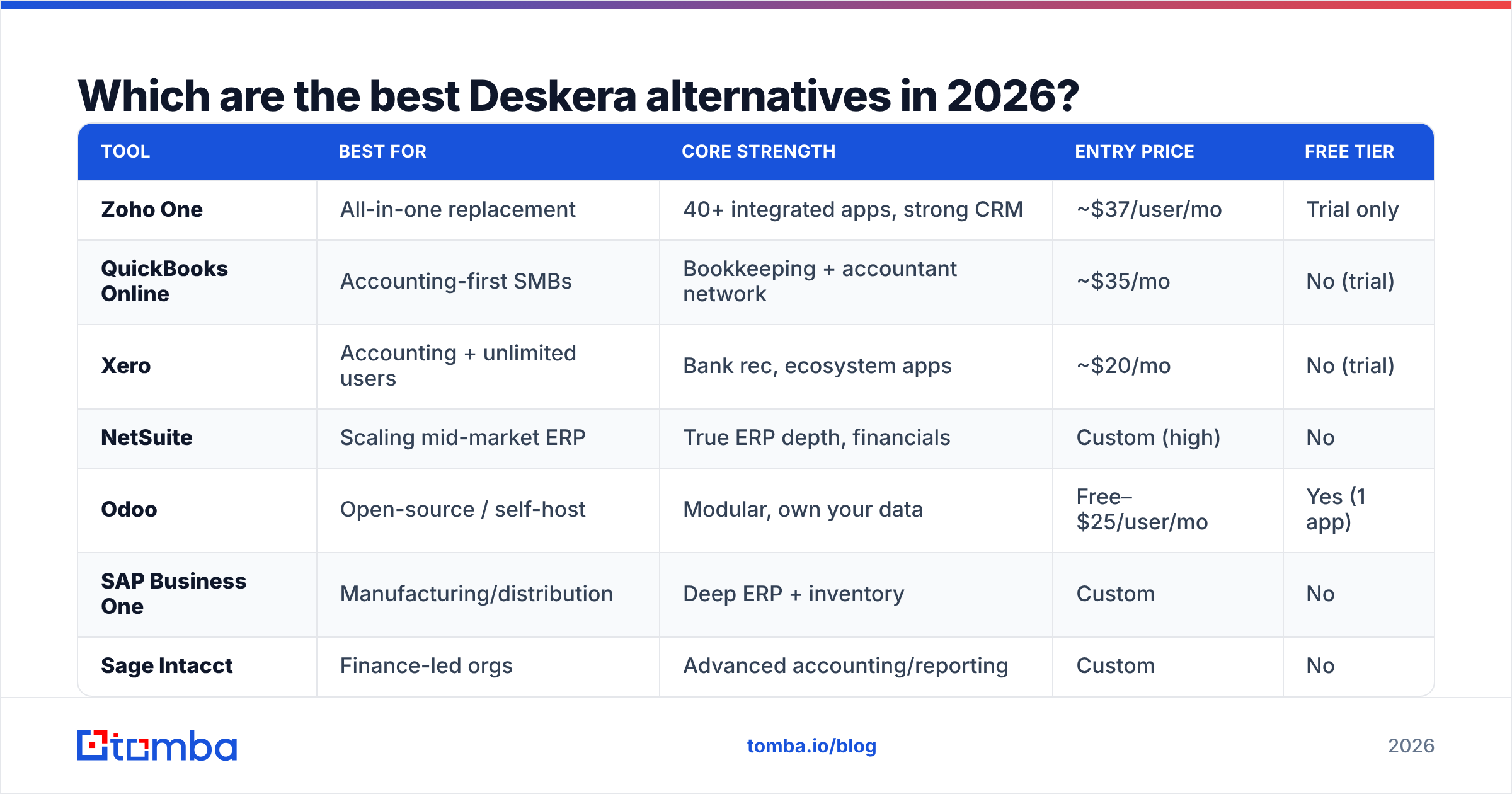
Here's the head-to-head. Prices are entry-level published rates and shift with seats, region, and add-ons — treat them as directional.
| Tool | Best for | Core strength | Entry price | Free tier |
|---|---|---|---|---|
| Zoho One | All-in-one replacement | 40+ integrated apps, strong CRM | ~$37/user/mo | Trial only |
| QuickBooks Online | Accounting-first SMBs | Bookkeeping + accountant network | ~$35/mo | No (trial) |
| Xero | Accounting + unlimited users | Bank rec, ecosystem apps | ~$20/mo | No (trial) |
| NetSuite | Scaling mid-market ERP | True ERP depth, financials | Custom (high) | No |
| Odoo | Open-source / self-host | Modular, own your data | Free–$25/user/mo | Yes (1 app) |
| SAP Business One | Manufacturing/distribution | Deep ERP + inventory | Custom | No |
| Sage Intacct | Finance-led orgs | Advanced accounting/reporting | Custom | No |
1. Zoho One — the closest all-in-one swap#
If you like Deskera's concept but want more depth, Zoho One is the natural upgrade. You get CRM, Books (accounting), Inventory, People (HR), and dozens more apps for one per-employee price. Zoho CRM in particular is far more mature than a bundled suite CRM, with sales automation, pipelines, and a real developer platform. The trade-off: 40+ apps is a lot of surface area, and the "employee count" licensing (you pay for all employees, not just users) surprises smaller teams.
2. QuickBooks Online — when accounting is the real job#
Many businesses buy Deskera for the whole suite but only truly rely on the accounting. If that's you, drop the suite and go accounting-first. QuickBooks Online has the largest accountant and bookkeeper network in North America, which matters enormously at tax time. It won't run your MRP or HR — pair it with dedicated tools — but for pure books, it's deeper and better-supported than most all-in-one modules.
3. Xero — accounting with unlimited users#
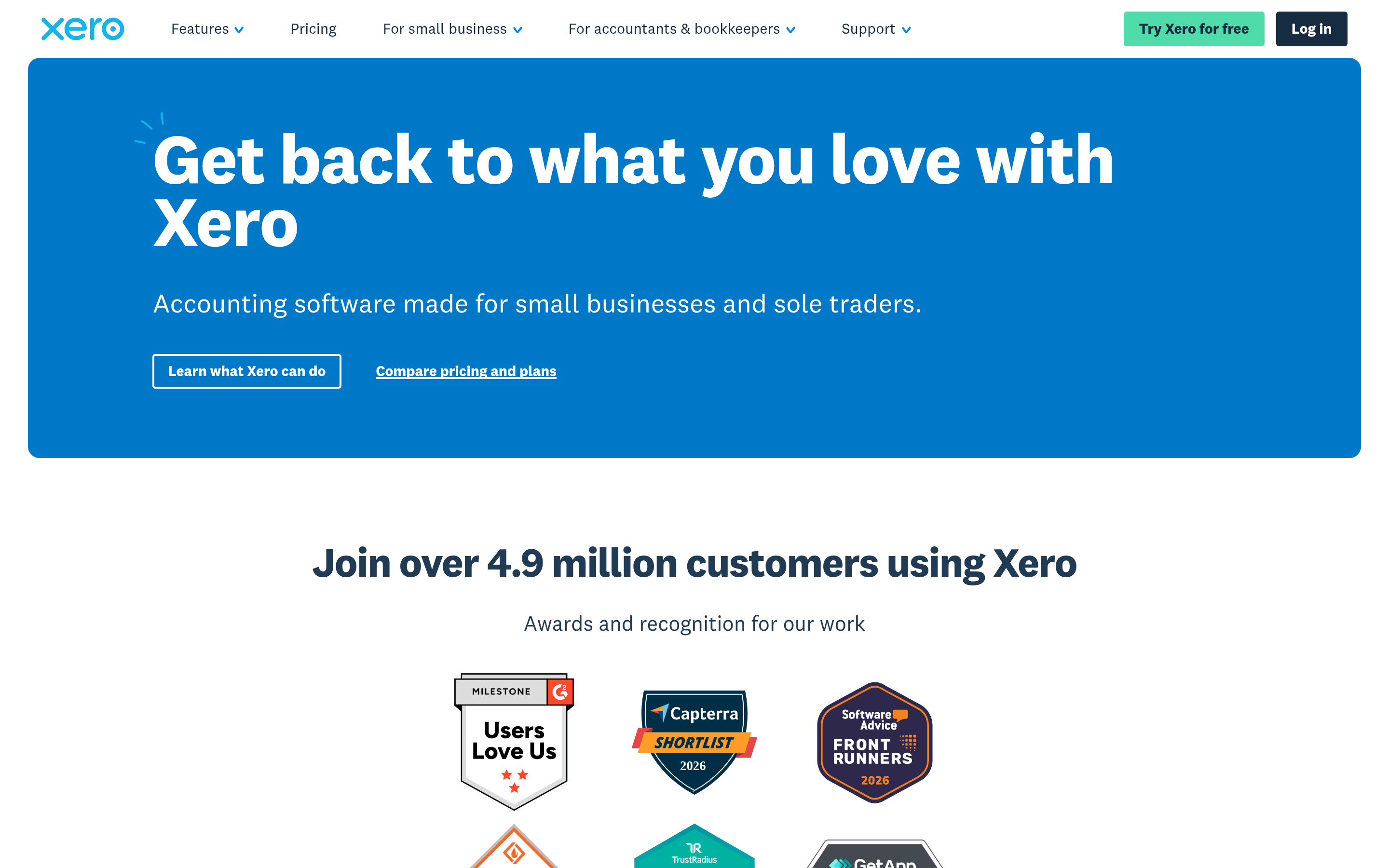
Xero is QuickBooks' biggest global rival and the better pick outside North America. Its standout is unlimited users on every plan (you're billed by features, not seats) and a clean bank-reconciliation flow. The app marketplace lets you bolt on inventory, payroll, and CRM as needed, giving you a "compose your own suite" alternative to Deskera's fixed bundle.
4. NetSuite — when you outgrow SMB tooling#
When Deskera's ceiling gets low — multi-entity, multi-currency, revenue recognition, real ERP reporting — NetSuite is the destination. It's a genuine cloud ERP built for scaling mid-market and beyond. Expect a real implementation project and enterprise pricing; this is a step up in both capability and commitment, not a lateral move.
5. Odoo — modular and open-source#
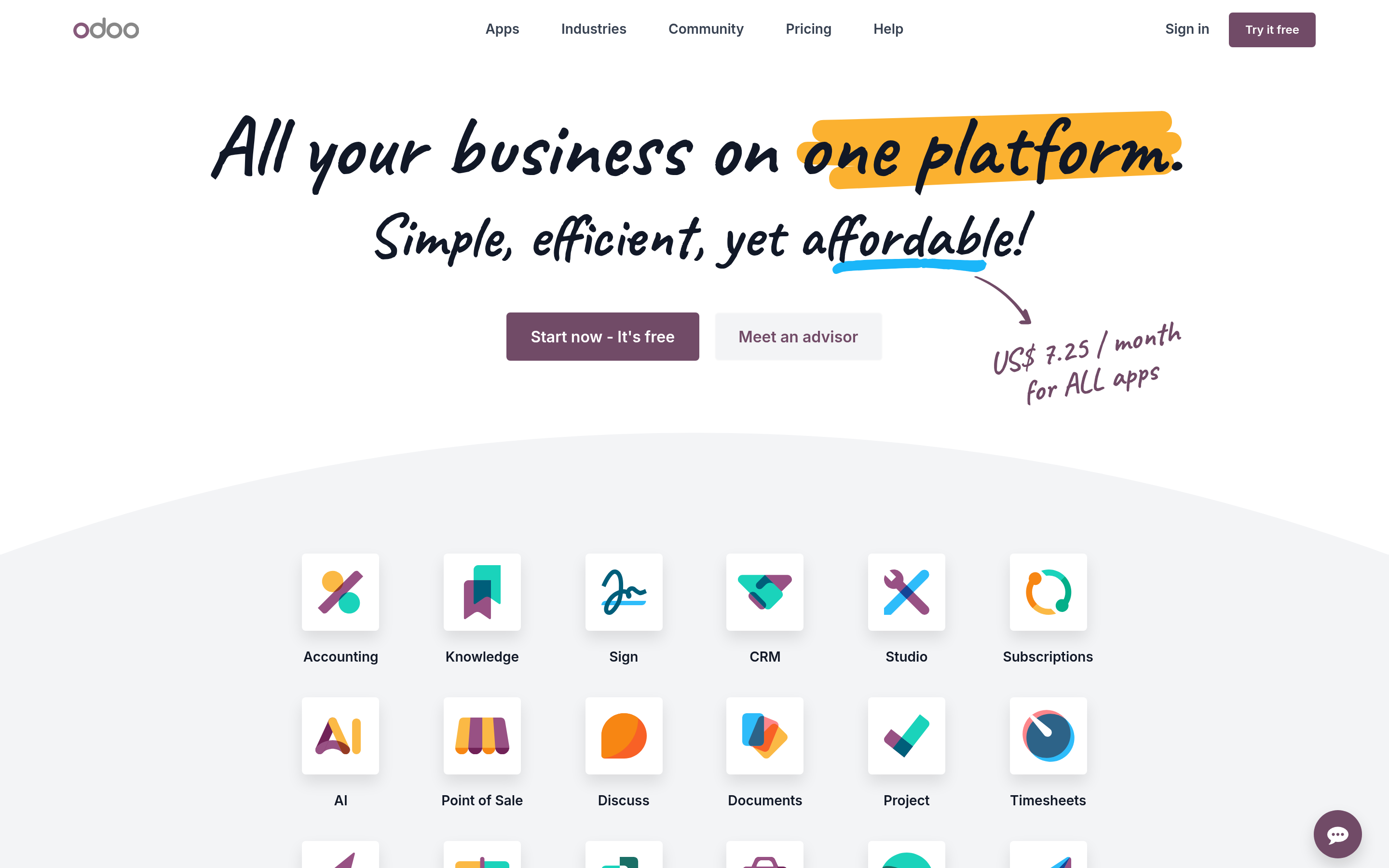
Odoo is the alternative for teams that want to own their stack. It's modular (turn on only the apps you use), open-source (self-host and customize freely), and priced per app rather than as a fixed bundle. The community edition is free; the enterprise edition adds support and hosted apps. If Deskera's lock-in bothers you, Odoo is the antidote — at the cost of doing more setup yourself.
6. SAP Business One — for manufacturing and distribution#
Businesses with serious inventory, production, and supply-chain needs often outgrow lightweight suites fast. SAP Business One is built for exactly that: deep manufacturing, warehouse, and distribution workflows with the SAP financial backbone. It's heavier and pricier than Deskera, and it's overkill for a service business — but for a growing distributor, it's a real ceiling-raiser.
7. Sage Intacct — finance-led reporting#
If your controller is the person pushing to leave Deskera, look at Sage Intacct. It's built around advanced accounting: dimensional reporting, multi-entity consolidation, and automation that a finance team actually asks for. You'll add other tools for CRM and HR, but as a finance core, it outclasses any all-in-one module.
Is an all-in-one suite even the right model?#
Here's the uncomfortable question: the reason you're comparing Deskera alternatives might be that the all-in-one model itself is the wrong fit — not that Deskera is a bad product.
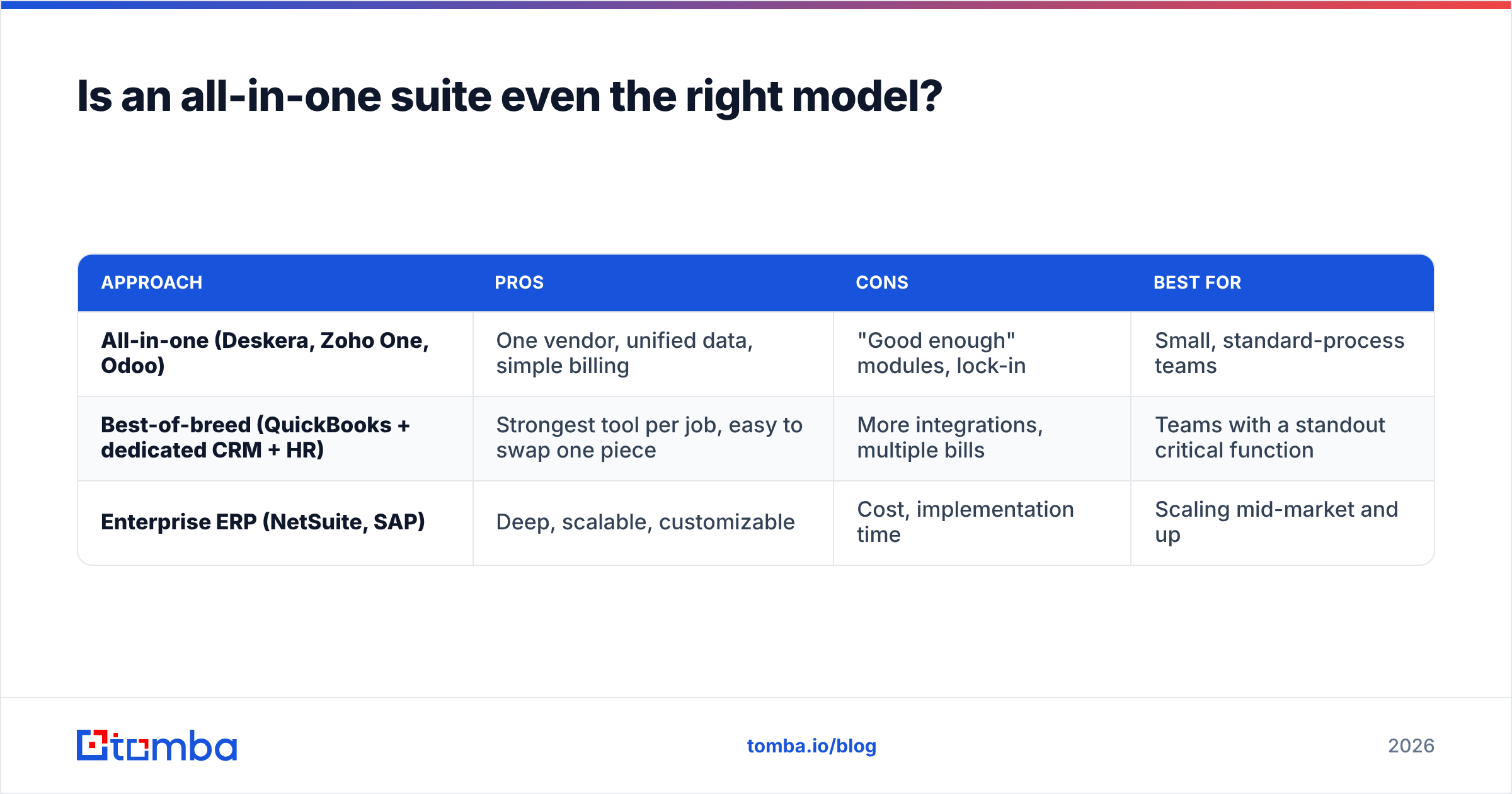
The all-in-one pitch trades peak capability for convenience. You get one vendor and one data model, but every module is "good enough" rather than best-in-class. The "best-of-breed" alternative is to pick the strongest accounting tool, the strongest CRM, and the strongest HR tool, then connect them with integrations. Modern integration layers (Zapier, native connectors, and APIs) make this far less painful than it was five years ago.
| Approach | Pros | Cons | Best for |
|---|---|---|---|
| All-in-one (Deskera, Zoho One, Odoo) | One vendor, unified data, simple billing | "Good enough" modules, lock-in | Small, standard-process teams |
| Best-of-breed (QuickBooks + dedicated CRM + HR) | Strongest tool per job, easy to swap one piece | More integrations, multiple bills | Teams with a standout critical function |
| Enterprise ERP (NetSuite, SAP) | Deep, scalable, customizable | Cost, implementation time | Scaling mid-market and up |
There's no universally right answer — but naming the trade-off up front stops you from replacing one all-in-one suite with another and hitting the identical wall next year.
What every Deskera alternative still leaves out#
Here's the gap none of these platforms close: they store contacts, they don't find or fix them. A CRM — whether it's Deskera's, Zoho's, or NetSuite's — is only as good as the data inside it. Every one of these suites assumes you already have accurate names, emails, phone numbers, and company details. In reality, B2B contact data decays roughly 22–30% per year as people change jobs.
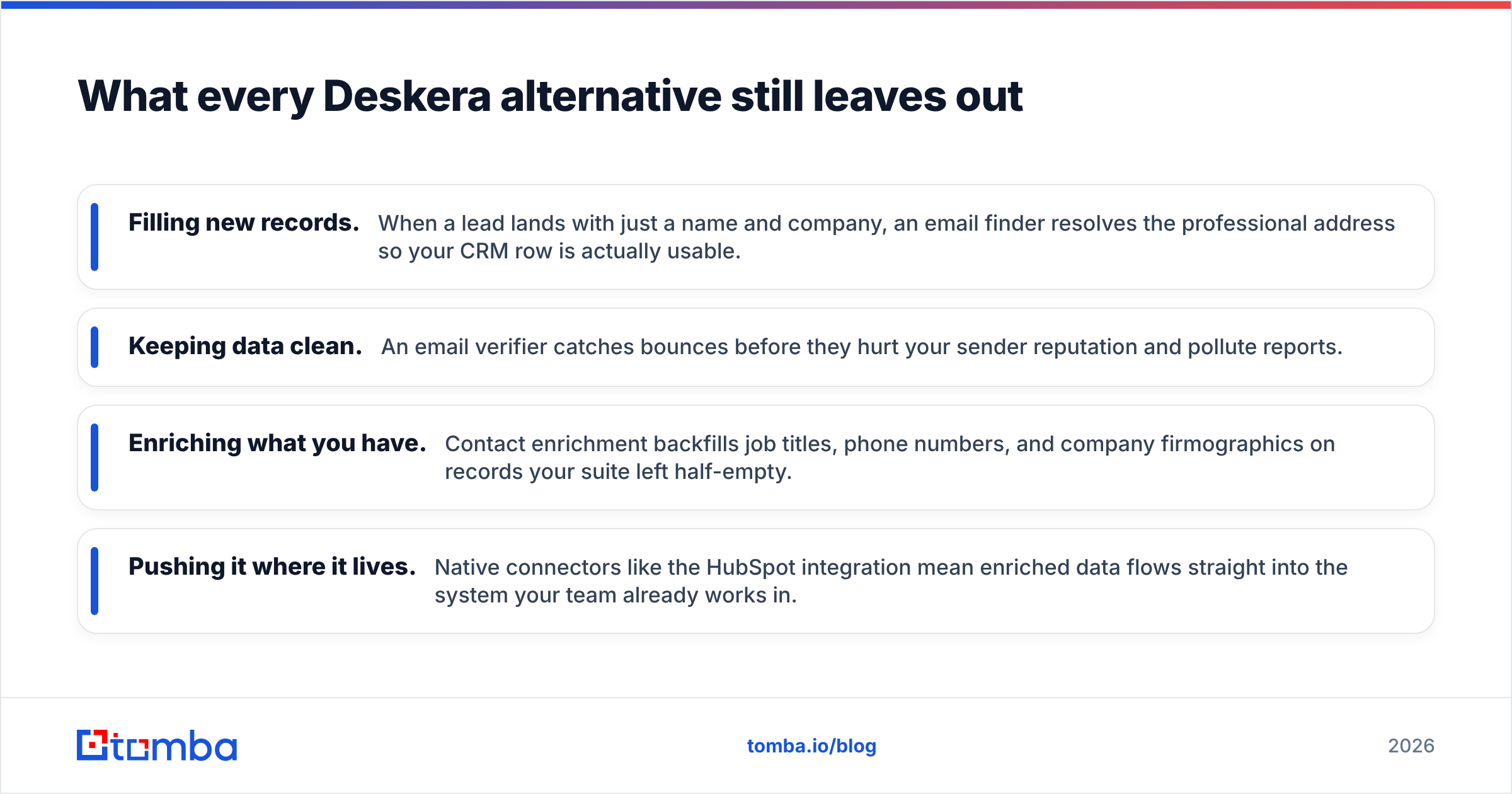
That's the layer a business platform can't fill on its own, and it's where a dedicated data tool earns its place next to whatever suite you choose:
- Filling new records. When a lead lands with just a name and company, an email finder resolves the professional address so your CRM row is actually usable.
- Keeping data clean. An email verifier catches bounces before they hurt your sender reputation and pollute reports.
- Enriching what you have. Contact enrichment backfills job titles, phone numbers, and company firmographics on records your suite left half-empty.
- Pushing it where it lives. Native connectors like the HubSpot integration mean enriched data flows straight into the system your team already works in.
Whether you stay on Deskera or move to any tool on this list, this data layer is additive, not a replacement — and it's usually the difference between a CRM people trust and one they quietly abandon.
How do you actually choose?#
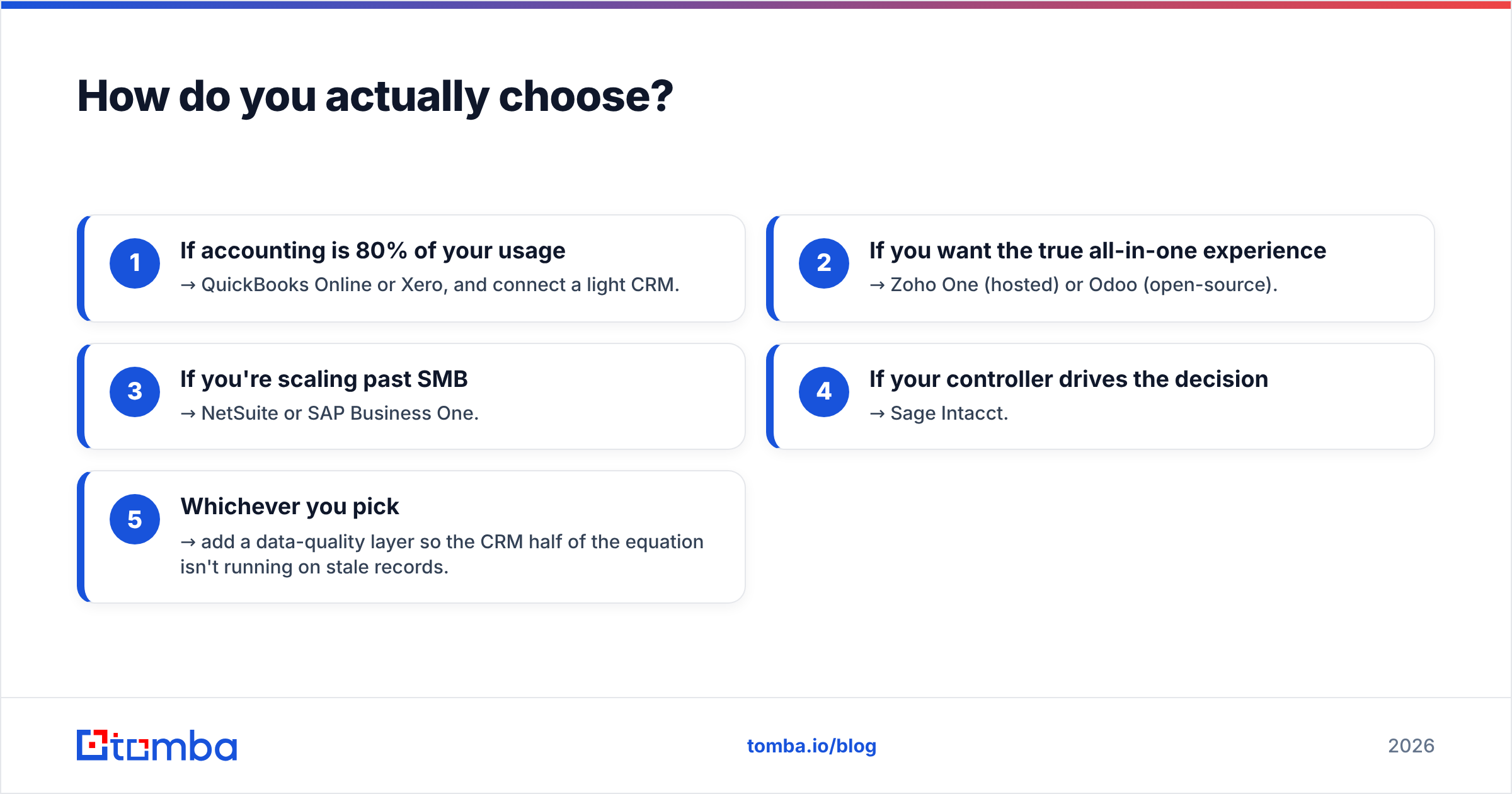
Work backward from your single most-used function:
- If accounting is 80% of your usage → QuickBooks Online or Xero, and connect a light CRM.
- If you want the true all-in-one experience → Zoho One (hosted) or Odoo (open-source).
- If you're scaling past SMB → NetSuite or SAP Business One.
- If your controller drives the decision → Sage Intacct.
- Whichever you pick → add a data-quality layer so the CRM half of the equation isn't running on stale records.
Then validate with a real trial using your data, not the demo dataset. Import a month of real transactions and 50 real contacts. The tool that handles your messy reality best — not the one with the prettiest feature grid — is your answer. Check current Tomba pricing and each vendor's published rates, and read recent reviews on G2 to catch the pain points that only show up after month three.
Final take#
There's no single best Deskera alternative — there's the best one for how you work. Teams that live in the ledger should go accounting-first with Xero or QuickBooks. Teams that love the suite concept should upgrade to Zoho One or self-host Odoo. Teams outgrowing SMB tooling should look hard at NetSuite. But every one of these paths shares the same blind spot: the contact data feeding your sales and CRM modules.
That's the piece Tomba's Email Finder is built to solve. Start on the free tier (25 searches/month), find and verify the professional emails your business platform can't source on its own, and push clean records straight into whichever suite you land on. Pick your platform for the accounting and operations — and let Tomba make sure the people inside it are real, reachable, and up to date.
Related guides#
Ready to find emails that actually work?
Join 150,000+ professionals who stopped guessing and started sending. Free credits on signup — no credit card required.
Get the Tomba newsletter
Practical outbound tactics and product updates — once every two weeks.
About the author